SAS Lawsuit against WPS- Application Dismissed

I saw Phil Rack http://twitter.com/#!/PhilRack (whom I have interviewed before at https://decisionstats.com/2009/02/03/interview-phil-rack/ ) and whom I dont talk to since Obama won the election-


well Phil -creator of Bridge to R- first SAS language to R language interface- mentioned this judgment and link.


Probably Phil should revise the documentation of Bridge to R- lest he is sued himself!!!

Conclusion
It was for these reasons that I decided to dismiss SAS’s application.

From-

http://www.bailii.org/cgi-bin/markup.cgi?doc=/ew/cases/EWHC/Ch/2010/3012.html


Neutral Citation Number: [2010] EWHC 3012 (Ch)
Case No: HC09C03293

IN THE HIGH COURT OF JUSTICE
CHANCERY DIVISION
Royal Courts of Justice
Strand, London, WC2A 2LL
22 November 2010

B e f o r e :

THE HON MR JUSTICE ARNOLD
____________________
Between:
SAS INSTITUTE INC. Claimant
– and –

WORLD PROGRAMMING LIMITED Defendant

____________________

Michael Hicks (instructed by Bristows) for the Claimant
Martin Howe QC and Isabel Jamal (instructed by Speechly Bircham LLP) for the Defendant
Hearing date: 18 November 2010
____________________

HTML VERSION OF JUDGMENT
____________________

Crown Copyright ©

MR. JUSTICE ARNOLD :

Introduction
By order dated 28 July 2010 I referred certain questions concerning the interpretation of Council Directive 91/250/EEC of 14 May 1991 on the legal protection of computer programs, which was recently codified as European Parliament and Council Directive 2009/24/EC of 23 April 2009, and European Parliament and Council Directive 2001/29/EC of 22 May 2001 on the harmonisation of certain aspects of copyright and related rights in the information society to the Court of Justice of the European Union under Article 267 of the Treaty on the Functioning of the European Union. The background to the reference is set out in full in my judgment dated 23 July 2010 [2010] EWHC 1829 (Ch). The reference is presently pending before the Court of Justice as Case C-406/10. By an application notice issued on 11 October 2010 SAS applied for the wording of the questions to be amended in a number of respects. I heard that application on 18 November 2010 and refused it for reasons to be given later. This judgment contains those reasons.

The questions and the proposed amendments
I set out below the questions referred with the amendments proposed by SAS shown by strikethrough and underlining:

“A. On the interpretation of Council Directive 91/250/EEC of 14 May 1991 on the legal protection of computer programs and of Directive 2009/24/EC of the European Parliament and of the Council of 23 April 2009 (codified version):
1. Where a computer program (‘the First Program’) is protected by copyright as a literary work, is Article 1(2) to be interpreted as meaning that it is not an infringement of the copyright in the First Program for a competitor of the rightholder without access to the source code of the First Program, either directly or via a process such as decompilation of the object code, to create another program (‘the Second Program’) which replicates by copying the functions of the First Program?
2. Is the answer to question 1 affected by any of the following factors:
(a) the nature and/or extent of the functionality of the First Program;
(b) the nature and/or extent of the skill, judgment and labour which has been expended by the author of the First Program in devising and/or selecting the functionality of the First Program;
(c) the level of detail to which the functionality of the First Program has been reproduced in the Second Program;
(d) if, the Second Program includes the following matters as a result of copying directly or indirectly from the First Program:
(i) the selection of statistical operations which have been implemented in the First Program;
(ii) the selection of mathematical formulae defining the statistical operations which the First Program carries out;
(iii) the particular commands or combinations of commands by which those statistical operations may be invoked;
(iv) the options which the author of the First Program has provided in respect of various commands;
(v) the keywords and syntax recognised by the First Program;
(vi) the defaults which the author of the First Program has chosen to implement in the event that a particular command or option is not specified by the user;
(vii) the number of iterations which the First Program will perform in certain circumstances;
(e)(d) if the source code for the Second Program reproduces by copying aspects of the source code of the First Program to an extent which goes beyond that which was strictly necessary in order to produce the same functionality as the First Program?
3. Where the First Program interprets and executes application programs written by users of the First Program in a programming language devised by the author of the First Program which comprises keywords devised or selected by the author of the First Program and a syntax devised by the author of the First Program, is Article 1(2) to be interpreted as meaning that it is not an infringement of the copyright in the First Program for the Second Program to be written so as to interpret and execute such application programs using the same keywords and the same syntax?
4. Where the First Program reads from and writes to data files in a particular format devised by the author of the First Program, is Article 1(2) to be interpreted as meaning that it is not an infringement of the copyright in the First Program for the Second Program to be written so as to read from and write to data files in the same format?
5. Does it make any difference to the answer to questions 1, 2, 3 and 4 if the author of the Second Program created the Second Program without access to the source code of the First Program, either directly or via decompilation of the object code by:
(a) observing, studying and testing the functioning of the First Program; or
(b) reading a manual created and published by the author of the First Program which describes the functions of the First Program (“the Manual”) and by implementing in the Second Program the functions described in the Manual; or
(c) both (a) and (b)?
6. Where a person has the right to use a copy of the First Program under a licence, is Article 5(3) to be interpreteding as meaning that the licensee is entitled, without the authorisation of the rightholder, to perform acts of loading, running and storing the program in order to observe, test or study the functioning of the First Program so as to determine the ideas and principles which underlie any element of the program, if the licence permits the licensee to perform acts of loading, running and storing the First Program when using it for the particular purpose permitted by the licence, but the acts done in order to observe, study or test the First Program extend outside the scope of the purpose permitted by the licence and are therefore acts for which the licensee has no right to use the copy of the First Program under the licence?
7. Is Article 5(3) to be interpreted as meaning that acts of observing, testing or studying of the functioning of the First Program are to be regarded as being done in order to determine the ideas or principles which underlie any element of the First Program where they are done:
(a) to ascertain the way in which the First Program functions, in particular details which are not described in the Manual, for the purpose of writing the Second Program in the manner referred to in question 1 above;
(b) to ascertain how the First Program interprets and executes statements written in the programming language which it interprets and executes (see question 3 above);
(c) to ascertain the formats of data files which are written to or read by the First Program (see question 4 above);
(d) to compare the performance of the Second Program with the First Program for the purpose of investigating reasons why their performances differ and to improve the performance of the Second Program;
(e) to conduct parallel tests of the First Program and the Second Program in order to compare their outputs in the course of developing the Second Program, in particular by running the same test scripts through both the First Program and the Second Program;
(f) to ascertain the output of the log file generated by the First Program in order to produce a log file which is identical or similar in appearance;
(g) to cause the First Program to output data (in fact, data correlating zip codes to States of the USA) for the purpose of ascertaining whether or not it corresponds with official databases of such data, and if it does not so correspond, to program the Second Program so that it will respond in the same way as the First Program to the same input data.
B. On the interpretation of Directive 2001/29/EC of the European Parliament and of the Council of 22 May 2001 on the harmonisation of certain aspects of copyright and related rights in the information society:
8. Where the Manual is protected by copyright as a literary work, is Article 2(a) to be interpreted as meaning that it is an infringement of the copyright in the Manual for the author of the Second Program to reproduce or substantially reproduce in the Second Program any or all of the following matters described in the Manual:
(a) the selection of statistical operations which have been described in the Manual as being implemented in the First Program;
(b) the mathematical formulae used in the Manual to describe those statistical operations;
(c) the particular commands or combinations of commands by which those statistical operations may be invoked;
(d) the options which the author of the First Program has provided in respect of various commands;
(e) the keywords and syntax recognised by the First Program;
(f) the defaults which the author of the First Program has chosen to implement in the event that a particular command or option is not specified by the user;
(g) the number of iterations which the First Program will perform in certain circumstances?
9. Is Article 2(a) to be interpreted as meaning that it is an infringement of the copyright in the Manual for the author of the Second Program to reproduce or substantially reproduce in a manual describing the Second Program the keywords and syntax recognised by the First Program?”

Jurisdiction
It was common ground between counsel that, although there is no direct authority on the point, it appears that the Court of Justice would accept an amendment to questions which had previously been referred by the referring court. The Court of Justice has stated that “national courts have the widest discretion in referring matters”: see Case 166/73 Rheinmühlen Düsseldorf v Einfuhr-und Vorratstelle für Getreide under Futtermittel [1974] ECR 33 at [4]. If an appeal court substitutes questions for those referred by a lower court, the substituted questions will be answered: Case 65/77 Razanatsimba [1977] ECR 2229. Sometimes the Court of Justice itself invites the referring court to clarify its questions, as occurred in Interflora Inc v Marks & Spencer plc (No 2) [2010] EWHC 925 (Ch). In these circumstances, there does not appear to be any reason to think that, if the referring court itself had good reason to amend its questions, the Court of Justice would disregard the amendment.

Counsel for WPL submitted, however, that, as a matter of domestic procedural law, this Court had no jurisdiction to vary an order for reference once sealed unless either there had been a material change of circumstances since the order (as in Interflora) or it had subsequently emerged that the Court had made the order on a false basis. He submitted that neither of those conditions was satisfied here. In those circumstances, the only remedy of a litigant in the position of SAS was to seek to appeal to the Court of Appeal.

As counsel for WPL pointed out, CPR rule 3.1(7) confers on courts what appears to be a general power to vary or revoke their own orders. The proper exercise of that power was considered by the Court of Appeal in Collier v Williams [2006] EWCA Civ 20, [2006] 1 WLR 1945 and Roult v North West Strategic Health Authority [2009] EWCA Civ 444, [2010] 1 WLR 487.

In Collier Dyson LJ (as he then was) giving the judgment of the Court of Appeal said:

“39. We now turn to the third argument. CPR 3.1(7) gives a very general power to vary or revoke an order. Consideration was given to the circumstances in which that power might be used by Patten J in Lloyds Investment (Scandinavia) Limited v Christen Ager-Hanssen [2003] EWHC 1740 (Ch). He said at paragraph 7:
‘The Deputy Judge exercised a discretion under CPR Part 13.3. It is not open to me as a judge exercising a parallel jurisdiction in the same division of the High Court to entertain what would in effect be an appeal from that order. If the Defendant wished to challenge whether the order made by Mr Berry was disproportionate and wrong in principle, then he should have applied for permission to appeal to the Court of Appeal. I have been given no real reasons why this was not done. That course remains open to him even today, although he will have to persuade the Court of Appeal of the reasons why he should have what, on any view, is a very considerable extension of time. It seems to me that the only power available to me on this application is that contained in CPR Part 3.1(7), which enables the Court to vary or revoke an order. This is not confined to purely procedural orders and there is no real guidance in the White Book as to the possible limits of the jurisdiction. Although this is not intended to be an exhaustive definition of the circumstances in which the power under CPR Part 3.1(7) is exercisable, it seems to me that, for the High Court to revisit one of its earlier orders, the Applicant must either show some material change of circumstances or that the judge who made the earlier order was misled in some way, whether innocently or otherwise, as to the correct factual position before him. The latter type of case would include, for example, a case of material non-disclosure on an application for an injunction. If all that is sought is a reconsideration of the order on the basis of the same material, then that can only be done, in my judgment, in the context of an appeal. Similarly it is not, I think, open to a party to the earlier application to seek in effect to re-argue that application by relying on submissions and evidence which were available to him at the time of the earlier hearing, but which, for whatever reason, he or his legal representatives chose not to employ. It is therefore clear that I am not entitled to entertain this application on the basis of the Defendant’s first main submission, that Mr Berry’s order was in any event disproportionate and wrong in principle, although I am bound to say that I have some reservations as to whether he was right to impose a condition of this kind without in terms enquiring whether the Defendant had any realistic prospects of being able to comply with the condition.’
We endorse that approach. We agree that the power given by CPR 3.1(7) cannot be used simply as an equivalent to an appeal against an order with which the applicant is dissatisfied. The circumstances outlined by Patten J are the only ones in which the power to revoke or vary an order already made should be exercised under 3.1(7).”
In Roult Hughes LJ, with whom Smith and Carnwath LJJ agreed, said at [15]:

“There is scant authority upon Rule 3.1(7) but such as exists is unanimous in holding that it cannot constitute a power in a judge to hear an appeal from himself in respect of a final order. Neuberger J said as much in Customs & Excise v Anchor Foods (No 3) [1999] EWHC 834 (Ch). So did Patten J in Lloyds Investment (Scandinavia) Ltd v Ager-Hanssen [2003] EWHC 1740 (Ch). His general approach was approved by this court, in the context of case management decisions, in Collier v Williams [2006] EWCA Civ 20. I agree that in its terms the rule is not expressly confined to procedural orders. Like Patten J in Ager-Hanssen I would not attempt any exhaustive classification of the circumstances in which it may be proper to invoke it. I am however in no doubt that CPR 3.1(7) cannot bear the weight which Mr Grime’s argument seeks to place upon it. If it could, it would come close to permitting any party to ask any judge to review his own decision and, in effect, to hear an appeal from himself, on the basis of some subsequent event. It would certainly permit any party to ask the judge to review his own decision when it is not suggested that he made any error. It may well be that, in the context of essentially case management decisions, the grounds for invoking the rule will generally fall into one or other of the two categories of (i) erroneous information at the time of the original order or (ii) subsequent event destroying the basis on which it was made. The exigencies of case management may well call for a variation in planning from time to time in the light of developments. There may possibly be examples of non-procedural but continuing orders which may call for revocation or variation as they continue – an interlocutory injunction may be one. But it does not follow that wherever one or other of the two assertions mentioned (erroneous information and subsequent event) can be made, then any party can return to the trial judge and ask him to re-open any decision…..”
In the present case there has been no material change of circumstances since I made the Order dated 28 July 2010. Nor did counsel for SAS suggest that I had made the Order upon a false basis. Counsel for SAS did submit, however, that the Court of Appeal had left open the possibility that it might be proper to exercise the power conferred by rule 3.1(7) even if there had no been material change of circumstances and it was not suggested that the order in question had been made on a false basis. Furthermore, he relied upon paragraph 1.1 of the Practice Direction to CPR Part 68, which provides that “responsibility for settling the terms of the reference lies with the English court and not with the parties”. He suggested that this meant that orders for references were not subject to the usual constraints on orders made purely inter partes.

In my judgment PD68 paragraph 1.1 does not justify exercising the power conferred by rule 3.1(7) in circumstances falling outside those identified in Collier and Roult. I am therefore very doubtful that it would be a proper exercise of the power conferred on me by CPR r. 3.1(7) to vary the Order dated 28 July 2010 in the present circumstances. I prefer, however, not to rest my decision on that ground.

Discretion
Counsel for WPL also submitted that, even if this Court had jurisdiction to amend the questions, I should exercise my discretion by refusing to do so for two reasons. First, because the application was made too late. Secondly, because there was no sufficient justification for the amendments anyway. I shall consider these points separately.

Delay
The relevant dates are as follows. The judgment was handed down on 23 July 2010, a draft having been made available to the parties a few days before that. There was a hearing to consider the form of the order, and in particular the wording of the questions to be referred, on 28 July 2010. Prior to that hearing both parties submitted drafts of the questions, and the respective drafts were discussed at the hearing. Following the hearing I settled the Order, and in particular the questions. The Order was sealed on 2 August 2010. The sealed Order was received by the parties between 3 and 5 August 2010. At around the same time the Senior Master of the Queen’s Bench Division transmitted the Order to the Court of Justice. On 15 September 2010 the Registry of the Court of Justice notified the parties, Member States and EU institutions of the reference. On 1 October 2010 the United Kingdom Intellectual Property Office advertised the reference on its website and invited comments by interested parties by 7 October 2010. The latest date on which written observations on the questions referred may be filed at the Court of Justice is 8 December 2010 (two months from the date of the notification plus 10 days extension on account of distance where applicable). This period is not extendable in any circumstances.

As noted above, the application was not issued until 11 October 2010. No justification has been provided by SAS for the delay in making the application. The only explanation offered by counsel for SAS was that the idea of proposing the amendments had only occurred to those representing SAS when starting work on SAS’s written observations.

Furthermore, the application notice requested that the matter be dealt with without a hearing. In my view that was not appropriate: the application was plainly one which was likely to require at least a short hearing. Furthermore, the practical consequence of proceeding in that way was to delay the hearing of the application. The paper application was put before me on 22 October 2010. On the same day I directed that the matter be listed for hearing. In the result it was not listed for hearing until 18 November 2010. If SAS had applied for the matter to be heard urgently, I am sure that it could have been dealt with sooner.

As counsel for WPL submitted, it is likely that the parties, Member States and institutions who intend to file written observations are now at an advanced stage of preparing those observations. Indeed, it is likely that preparations would have been well advanced even on 11 October 2010. To amend the questions at this stage in the manner proposed by SAS would effectively require the Court of Justice to re-start the written procedure all over again. The amended questions would have to be translated into all the EU official languages; the parties, Member States and EU institutions would have to be notified of the amended questions; and the time for submitting written observations would have to be re-set. This would have two consequences. First, a certain amount of time, effort and money on the part of those preparing written observations would be wasted. Secondly, the progress of the case would be delayed. Those are consequences that could have been avoided if SAS had moved promptly after receiving the sealed Order.

In these circumstances, it would not in my judgment be proper to exercise any discretion I may have in favour of amending the questions.

No sufficient justification
Counsel for WPL submitted that in any event SAS’s proposed amendments were not necessary in order to enable the Court of Justice to provide guidance on the issues in this case, and therefore there was no sufficient justification for making the amendments.

Before addressing that submission directly, I think it is worth commenting more generally on the formulation of questions. As is common ground, and reflected in paragraph 1.1 of PD68, it is well established that the questions posed on a reference under Article 267 are the referring court’s questions, not the parties’. The purpose of the procedure is for the Court of Justice to provide the referring court with the guidance it needs in order to deal with the issues before it. It follows that it is for the referring court to decide how to formulate the questions.

In my view it is usually helpful for the court to have the benefit of the parties’ comments on the wording of the proposed questions, as envisaged in paragraph 1.1 of PD68. There are two main reasons for this. The first is to try to ensure that the questions are sufficiently comprehensive to enable all the issues arising to be addressed by the Court of Justice, and thus avoid the need for a further reference at a later stage of the proceedings, as occurred in the Boehringer Ingelheim v Swingward litigation. In that case Laddie J referred questions to the Court of Justice, which were answered in Case C-143/00 [2002] ECR I-3759. The Court of Appeal subsequently concluded, with regret, that the answers to those questions did not suffice to enable it to deal with the case, and referred further questions to the Court of Justice: [2004] EWCA Civ 575, [2004] ETMR 65. Those questions were answered in Case C-348/04 [2007] ECR I-3391. The second main reason is to try to ensure that the questions are clear and free from avoidable ambiguity or obscurity.

In my experience it is not uncommon for parties addressing the court on the formulation of the questions to attempt to ensure that the questions are worded in a leading manner, that is to say, in a way which suggests the desired answer. In my view that is neither proper nor profitable. It is not proper because the questions should so far as possible be impartially worded. It is not profitable because experience shows that the Court of Justice is usually not concerned with the precise wording of the questions referred, but with their legal substance. Thus the Court of Justice frequently reformulates the question in giving its answer.

As counsel for WPL pointed out, and as I have already mentioned, in the present case the parties provided me with draft questions which were discussed at a hearing. In settling the questions I took into account the parties’ drafts and their comments on each other’s drafts, but the final wording is, for better or worse, my own.

As counsel for WPL submitted, at least to some extent SAS’s proposed amendments to the questions appear designed to bring the wording closer to that originally proposed by SAS. This is particularly true of the proposed amendment to question 1. In my judgment it would not be a proper exercise of any discretion that I may have to permit such an amendment, both because it appears to be an attempt by SAS to have the question worded in a manner which it believes favours its case and because its proper remedy if it objected to my not adopting the wording it proposed was to seek to appeal to the Court of Appeal. In saying this, I do not overlook the fact that SAS proposes to move some of the words excised from question 1 to question 5.

In any event, I am not satisfied that any of the amendments are necessary either to enable the parties to present their respective arguments to the Court of Justice or to enable the Court to give guidance on any of the issues arising in this case. On the contrary, I consider that the existing questions are sufficient for these purposes. By way of illustration, I will take the biggest single amendment, which is the proposed insertion of new paragraph (d) in question 2. In my view, the matters referred to in paragraph (d) are matters that are encompassed within paragraphs (b) and/or (c); or at least can be addressed by the parties, and hence the Court of Justice, in the context provided by paragraphs (b) and/or (c). When I put this to counsel for SAS during the course of argument, he accepted it.

Other amendments counsel for SAS himself presented as merely being minor matters of clarification. In my view none of them amount to the elimination of what would otherwise be ambiguities or obscurities in the questions.

It is fair to say that SAS have identified a small typographical error in question 2 (“interpreting” should read “interpreted”), but in my view this is an obvious error which will not cause any difficulty in the proceedings before the Court of Justice.

Conclusion
It was for these reasons that I decided to dismiss SAS’s application

Quantifying Analytics ROI

Japanese House Crest “Go-Shichi no Kiri”
Image via Wikipedia

I had a brief twitter exchange with Jim Davis, Chief Marketing Officer, SAS Institute on Return of Investment on Business Analytics Projects for customers. I have interviewed Jim Davis before last year https://decisionstats.com/2009/06/05/interview-jim-davis-sas-institute/

Now Jim Davis is a big guy, and he is rushing from the launch of SAS Institute’s Social Media Analytics in Japan- to some arguably difficult flying conditions in time to be home in America for Thanksgiving. That and and I have not been much of a good Blog Boy recently, more swayed by love of open source, than love of software per se. I love equally, given I am bad at both equally.

Anyways, Jim’s contention  ( http://twitter.com/Davis_Jim ) was customers should go in business analytics only if there is Positive Return on Investment.  I am quoting him here-

What is important is that there be a positive ROI on each and every BA project. Otherwise don’t do it.

That’s not the marketing I was taught in my business school- basically it was sell, sell, sell.

However I see most BI sales vendors also go through -let me meet my sales quota for this quarter- and quantifying customer ROI is simple maths than predictive analytics but there seems to be some information assymetry in it.

Here is a paper from North Western University on ROI in IT projects-.

but overall it would be in the interest of customers and Business Analytics Vendors to publish aggregated ROI.

The opponents to this transparency in ROI would be market leaders in market share, who have trapped their customers by high migration costs (due to complexity) or contractually.

A recent study listed Oracle having a large percentage of unhappy customers who would still renew!, SAP had problems when it raised prices for licensing arbitrarily (that CEO is now CEO of HP and dodging legal notices from Oracle).

Indeed Jim Davis’s famous unsettling call for focusing on Business Analytics,as Business Intelligence is dead- that call has been implemented more aggressively by IBM in analytical acquisitions than even SAS itself which has been conservative about inorganic growth. Quantifying ROI, should theoretically aid open source software the most (since they are cheapest in up front licensing) or newer technologies like MapReduce /Hadoop (since they are quite so fast)- but I think that market has a way of factoring in these things- and customers are not as foolish neither as unaware of costs versus benefits of migration.

The contrary to this is Business Analytics and Business Intelligence are imperfect markets with duo-poly  or big players thriving in absence of customer regulation.

You get more protection as a customer of $20 bag of potato chips, than as a customer of a $200,000 software. Regulators are wary to step in to ensure ROI fairness (since most bright techies are qither working for private sector, have their own startup or invested in startups)- who in Govt understands Analytics and Intelligence strong enough to ensure vendor lock-ins are not done, and market flexibility is done. It is also a lower choice for embattled regulators to ensure ROI on enterprise software unlike the aggressiveness they have showed in retail or online software.

Who will Analyze the Analysts and who can quantify the value of quants (or penalize them for shoddy quantitative analytics)- is an interesting phenomenon we expect to see more of.


Cloud Computing with R

Illusion of Depth and Space (4/22) - Rotating ...
Image by Dominic's pics via Flickr

Here is a short list of resources and material I put together as starting points for R and Cloud Computing It’s a bit messy but overall should serve quite comprehensively.

Cloud computing is a commonly used expression to imply a generational change in computing from desktop-servers to remote and massive computing connections,shared computers, enabled by high bandwidth across the internet.

As per the National Institute of Standards and Technology Definition,
Cloud computing is a model for enabling convenient, on-demand network access to a shared pool of configurable computing resources (e.g., networks, servers, storage, applications, and services) that can be rapidly provisioned and released with minimal management effort or service provider interaction.

(Citation: The NIST Definition of Cloud Computing

Authors: Peter Mell and Tim Grance
Version 15, 10-7-09
National Institute of Standards and Technology, Information Technology Laboratory
http://csrc.nist.gov/groups/SNS/cloud-computing/cloud-def-v15.doc)

R is an integrated suite of software facilities for data manipulation, calculation and graphical display.

From http://cran.r-project.org/doc/FAQ/R-FAQ.html#R-Web-Interfaces

R Web Interfaces

Rweb is developed and maintained by Jeff Banfield. The Rweb Home Page provides access to all three versions of Rweb—a simple text entry form that returns output and graphs, a more sophisticated JavaScript version that provides a multiple window environment, and a set of point and click modules that are useful for introductory statistics courses and require no knowledge of the R language. All of the Rweb versions can analyze Web accessible datasets if a URL is provided.
The paper “Rweb: Web-based Statistical Analysis”, providing a detailed explanation of the different versions of Rweb and an overview of how Rweb works, was published in the Journal of Statistical Software (http://www.jstatsoft.org/v04/i01/).

Ulf Bartel has developed R-Online, a simple on-line programming environment for R which intends to make the first steps in statistical programming with R (especially with time series) as easy as possible. There is no need for a local installation since the only requirement for the user is a JavaScript capable browser. See http://osvisions.com/r-online/ for more information.

Rcgi is a CGI WWW interface to R by MJ Ray. It had the ability to use “embedded code”: you could mix user input and code, allowing the HTMLauthor to do anything from load in data sets to enter most of the commands for users without writing CGI scripts. Graphical output was possible in PostScript or GIF formats and the executed code was presented to the user for revision. However, it is not clear if the project is still active.

Currently, a modified version of Rcgi by Mai Zhou (actually, two versions: one with (bitmap) graphics and one without) as well as the original code are available from http://www.ms.uky.edu/~statweb/.

CGI-based web access to R is also provided at http://hermes.sdu.dk/cgi-bin/go/. There are many additional examples of web interfaces to R which basically allow to submit R code to a remote server, see for example the collection of links available from http://biostat.mc.vanderbilt.edu/twiki/bin/view/Main/StatCompCourse.

David Firth has written CGIwithR, an R add-on package available from CRAN. It provides some simple extensions to R to facilitate running R scripts through the CGI interface to a web server, and allows submission of data using both GET and POST methods. It is easily installed using Apache under Linux and in principle should run on any platform that supports R and a web server provided that the installer has the necessary security permissions. David’s paper “CGIwithR: Facilities for Processing Web Forms Using R” was published in the Journal of Statistical Software (http://www.jstatsoft.org/v08/i10/). The package is now maintained by Duncan Temple Lang and has a web page athttp://www.omegahat.org/CGIwithR/.

Rpad, developed and actively maintained by Tom Short, provides a sophisticated environment which combines some of the features of the previous approaches with quite a bit of JavaScript, allowing for a GUI-like behavior (with sortable tables, clickable graphics, editable output), etc.
Jeff Horner is working on the R/Apache Integration Project which embeds the R interpreter inside Apache 2 (and beyond). A tutorial and presentation are available from the project web page at http://biostat.mc.vanderbilt.edu/twiki/bin/view/Main/RApacheProject.

Rserve is a project actively developed by Simon Urbanek. It implements a TCP/IP server which allows other programs to use facilities of R. Clients are available from the web site for Java and C++ (and could be written for other languages that support TCP/IP sockets).

OpenStatServer is being developed by a team lead by Greg Warnes; it aims “to provide clean access to computational modules defined in a variety of computational environments (R, SAS, Matlab, etc) via a single well-defined client interface” and to turn computational services into web services.

Two projects use PHP to provide a web interface to R. R_PHP_Online by Steve Chen (though it is unclear if this project is still active) is somewhat similar to the above Rcgi and Rweb. R-php is actively developed by Alfredo Pontillo and Angelo Mineo and provides both a web interface to R and a set of pre-specified analyses that need no R code input.

webbioc is “an integrated web interface for doing microarray analysis using several of the Bioconductor packages” and is designed to be installed at local sites as a shared computing resource.

Rwui is a web application to create user-friendly web interfaces for R scripts. All code for the web interface is created automatically. There is no need for the user to do any extra scripting or learn any new scripting techniques. Rwui can also be found at http://rwui.cryst.bbk.ac.uk.

Finally, the R.rsp package by Henrik Bengtsson introduces “R Server Pages”. Analogous to Java Server Pages, an R server page is typically HTMLwith embedded R code that gets evaluated when the page is requested. The package includes an internal cross-platform HTTP server implemented in Tcl, so provides a good framework for including web-based user interfaces in packages. The approach is similar to the use of the brew package withRapache with the advantage of cross-platform support and easy installation.

Also additional R Cloud Computing Use Cases
http://wwwdev.ebi.ac.uk/Tools/rcloud/

ArrayExpress R/Bioconductor Workbench

Remote access to R/Bioconductor on EBI’s 64-bit Linux Cluster

Start the workbench by downloading the package for your operating system (Macintosh or Windows), or via Java Web Start, and you will get access to an instance of R running on one of EBI’s powerful machines. You can install additional packages, upload your own data, work with graphics and collaborate with colleagues, all as if you are running R locally, but unlimited by your machine’s memory, processor or data storage capacity.

  • Most up-to-date R version built for multicore CPUs
  • Access to all Bioconductor packages
  • Access to our computing infrastructure
  • Fast access to data stored in EBI’s repositories (e.g., public microarray data in ArrayExpress)

Using R Google Docs
http://www.omegahat.org/RGoogleDocs/run.pdf
It uses the XML and RCurl packages and illustrates that it is relatively quick and easy
to use their primitives to interact with Web services.

Using R with Amazon
Citation
http://rgrossman.com/2009/05/17/running-r-on-amazons-ec2/

Amazon’s EC2 is a type of cloud that provides on demand computing infrastructures called an Amazon Machine Images or AMIs. In general, these types of cloud provide several benefits:

  • Simple and convenient to use. An AMI contains your applications, libraries, data and all associated configuration settings. You simply access it. You don’t need to configure it. This applies not only to applications like R, but also can include any third-party data that you require.
  • On-demand availability. AMIs are available over the Internet whenever you need them. You can configure the AMIs yourself without involving the service provider. You don’t need to order any hardware and set it up.
  • Elastic access. With elastic access, you can rapidly provision and access the additional resources you need. Again, no human intervention from the service provider is required. This type of elastic capacity can be used to handle surge requirements when you might need many machines for a short time in order to complete a computation.
  • Pay per use. The cost of 1 AMI for 100 hours and 100 AMI for 1 hour is the same. With pay per use pricing, which is sometimes called utility pricing, you simply pay for the resources that you use.

Connecting to R on Amazon EC2- Detailed tutorials
Ubuntu Linux version
https://decisionstats.com/2010/09/25/running-r-on-amazon-ec2/
and Windows R version
https://decisionstats.com/2010/10/02/running-r-on-amazon-ec2-windows/

Connecting R to Data on Google Storage and Computing on Google Prediction API
https://github.com/onertipaday/predictionapirwrapper
R wrapper for working with Google Prediction API

This package consists in a bunch of functions allowing the user to test Google Prediction API from R.
It requires the user to have access to both Google Storage for Developers and Google Prediction API:
see
http://code.google.com/apis/storage/ and http://code.google.com/apis/predict/ for details.

Example usage:

#This example requires you had previously created a bucket named data_language on your Google Storage and you had uploaded a CSV file named language_id.txt (your data) into this bucket – see for details
library(predictionapirwrapper)

and Elastic R for Cloud Computing
http://user2010.org/tutorials/Chine.html

Abstract

Elastic-R is a new portal built using the Biocep-R platform. It enables statisticians, computational scientists, financial analysts, educators and students to use cloud resources seamlessly; to work with R engines and use their full capabilities from within simple browsers; to collaborate, share and reuse functions, algorithms, user interfaces, R sessions, servers; and to perform elastic distributed computing with any number of virtual machines to solve computationally intensive problems.
Also see Karim Chine’s http://biocep-distrib.r-forge.r-project.org/

R for Salesforce.com

At the point of writing this, there seem to be zero R based apps on Salesforce.com This could be a big opportunity for developers as both Apex and R have similar structures Developers could write free code in R and charge for their translated version in Apex on Salesforce.com

Force.com and Salesforce have many (1009) apps at
http://sites.force.com/appexchange/home for cloud computing for
businesses, but very few forecasting and statistical simulation apps.

Example of Monte Carlo based app is here
http://sites.force.com/appexchange/listingDetail?listingId=a0N300000016cT9EAI#

These are like iPhone apps except meant for business purposes (I am
unaware if any university is offering salesforce.com integration
though google apps and amazon related research seems to be on)

Force.com uses a language called Apex  and you can see
http://wiki.developerforce.com/index.php/App_Logic and
http://wiki.developerforce.com/index.php/An_Introduction_to_Formulas
Apex is similar to R in that is OOPs

SAS Institute has an existing product for taking in Salesforce.com data.

A new SAS data surveyor is
available to access data from the Customer Relationship Management
(CRM) software vendor Salesforce.com. at
http://support.sas.com/documentation/cdl/en/whatsnew/62580/HTML/default/viewer.htm#datasurveyorwhatsnew902.htm)

Personal Note-Mentioning SAS in an email to a R list is a big no-no in terms of getting a response and love. Same for being careless about which R help list to email (like R devel or R packages or R help)

For python based cloud see http://pi-cloud.com

Using R for Time Series in SAS


Time series: random data plus trend, with best...
Image via Wikipedia


Here is a great paper on using Time Series in R, and it specifically allows you to use just R output in Base SAS.

SAS Code

/* three methods: */

/* 1. Call R directly – Some errors are not reported to log */

x “’C:\Program Files\R\R-2.12.0\bin\r.exe’–no-save –no-restore <“”&rsourcepath\tsdiag.r””>””&rsourcepath\tsdiag.out”””;

/* include the R log in the SAS log */7data _null_;

infile “&rsourcepath\tsdiag.out”;

file log;

input;

put ’R LOG: ’ _infile_;

run;

/* include the image in the sas output.Specify a file if you are not using autogenerated html output */

ods html;

data _null_;

file print;

put “<IMG SRC=’” “&rsourcepath\plot.png” “’ border=’0’>”;

put “<IMG SRC=’” “&rsourcepath\acf.png” “’ border=’0’>”;

put “<IMG SRC=’” “&rsourcepath\pacf.png” “’ border=’0’>”;

put “<IMG SRC=’” “&rsourcepath\spect.png” “’ border=’0’>”;

put “<IMG SRC=’” “&rsourcepath\fcst.png” “’ border=’0’>”;

run;

ods html close;

The R code to create a time series plot is quite elegant though-


library(tseries)

air <- AirPassengers #Datasetname

ts.plot(air)

acf(air)

pacf(air)

plot(decompose(air))

air.fit <- arima(air,order=c(0,1,1), seasonal=list(order=c(0,1,1), period=12) #The ARIMA Model Based on PACF and ACF Graphs

tsdiag(air.fit)

library(forecast)

air.forecast <- forecast(air.fit)

plot.forecast(air.forecast)

You can download the fascinating paper from the Analytics NCSU Website http://analytics.ncsu.edu/sesug/2008/ST-146.pdf

About the Author-

Sam Croker has a MS in Statistics from the University of South Carolina and has over ten years of experience in analytics.   His research interests are in time series analysis and forecasting with focus on stream-flow analysis.  He is currently using SAS, R and other analytical tools for fraud and abuse detection in Medicare and Medicaid data. He also has experience in analyzing, modeling and forecasting in the finance, marketing, hospitality, retail and pharmaceutical industries.

Enterprise Linux rises rapidly:New Report

Tux, as originally drawn by Larry Ewing
Image via Wikipedia

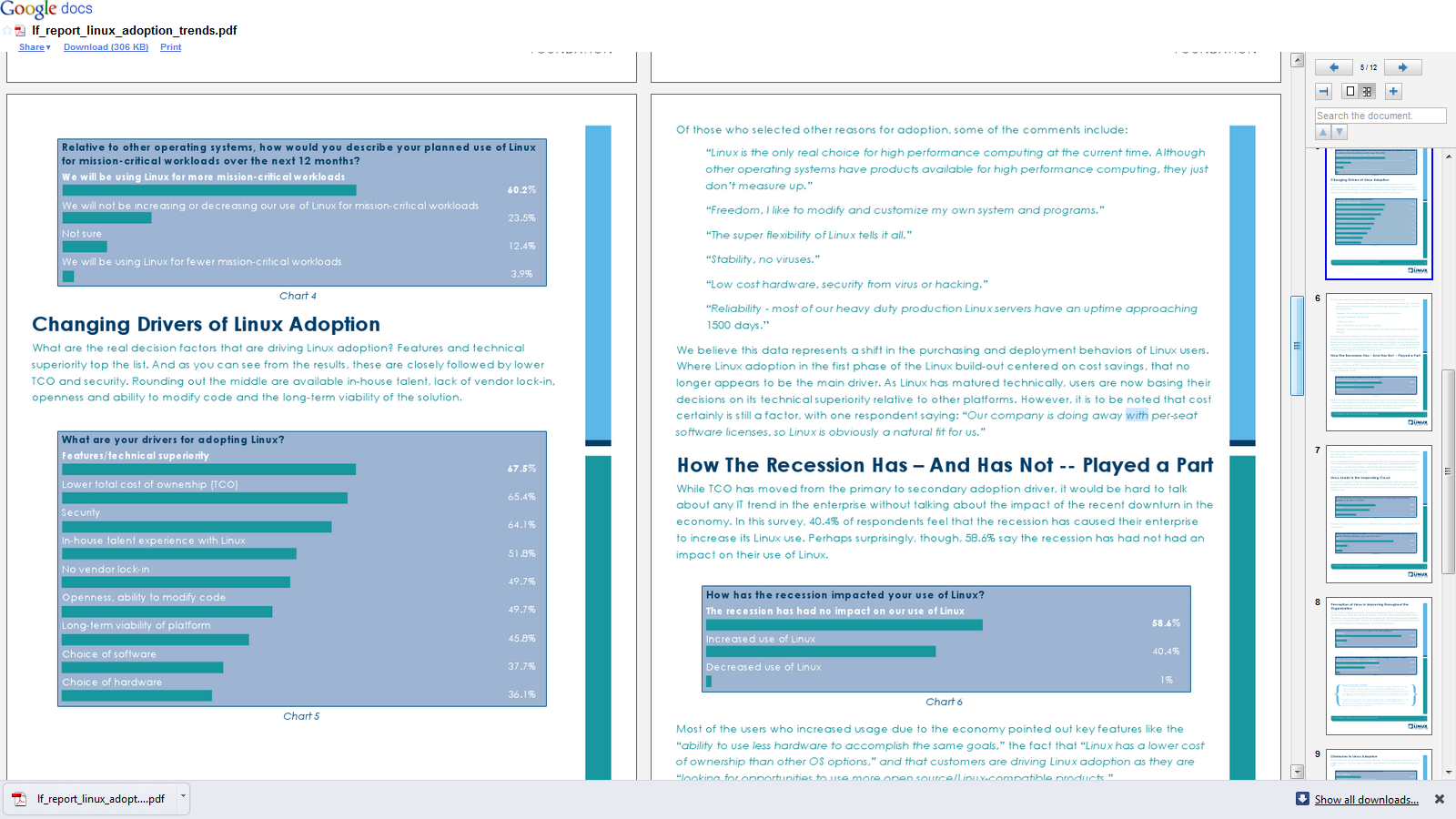
A new report from Linux Foundation found significant growth trends for enterprise usage of Linux- which should be welcome to software companies that have enabled Linux versions of software, service providers that provide Linux based consulting (note -lesser competition, lower overheads) and to application creators.

From –

http://www.linuxfoundation.org/news-media/announcements/2010/10/new-linux-foundation-user-survey-shows-enterprise-linux-achieve-sig

Key Findings from the Report
• 79.4 percent of companies are adding more Linux relative to other operating systems in the next five years.

• More people are reporting that their Linux deployments are migrations from Windows than any other platform, including Unix migrations. 66 percent of users surveyed say that their Linux deployments are brand new (“Greenfield”) deployments.

• Among the early adopters who are operating in cloud environments, 70.3 percent use Linux as their primary platform, while only 18.3 percent use Windows.

• 60.2 percent of respondents say they will use Linux for more mission-critical workloads over the next 12 months.

• 86.5 percent of respondents report that Linux is improving and 58.4 percent say their CIOs see Linux as more strategic to the organization as compared to three years ago.

• Drivers for Linux adoption extend beyond cost: technical superiority is the primary driver, followed by cost and then security.

• The growth in Linux, as demonstrated by this report, is leading companies to increasingly seek Linux IT professionals, with 38.3 percent of respondents citing a lack of Linux talent as one of their main concerns related to the platform.

• Users participate in Linux development in three primary ways: testing and submitting bugs (37.5 percent), working with vendors (30.7 percent) and participating in The Linux Foundation activities (26.0 percent).

and from the report itself-

download here-

http://www.linuxfoundation.org/lp/page/download-the-free-linux-adoption-trends-report

Interview Michael J. A. Berry Data Miners, Inc

Here is an interview with noted Data Mining practitioner Michael Berry, author of seminal books in data mining, noted trainer and consultantmjab picture

Ajay- Your famous book “Data Mining Techniques: For Marketing, Sales, and Customer Relationship Management” came out in 2004, and an update is being planned for 2011. What are the various new data mining techniques and their application that you intend to talk about in that book.

Michael- Each time we do a revision, it feels like writing a whole new book. The first edition came out in 1997 and it is hard to believe how much the world has changed since then. I’m currently spending most of my time in the on-line retailing world. The things I worry about today–improving recommendations for cross-sell and up-sell,and search engine optimization–wouldn’t have even made sense to me back then. And the data sizes that are routine today were beyond the capacity of the most powerful super computers of the nineties. But, if possible, Gordon and I have changed even more than the data mining landscape. What has changed us is experience. We learned an awful lot between the first and second editions, and I think we’ve learned even more between the second and third.

One consequence is that we now have to discipline ourselves to avoid making the book too heavy to lift. For the first edition, we could write everything we knew (and arguably, a bit more!); now we have to remind ourselves that our intended audience is still the same–intelligent laymen with a practical interest in getting more information out of data. Not statisticians. Not computer scientists. Not academic researchers. Although we welcome all readers, we are primarily writing for someone who works in a marketing department and has a title with the word “analyst” or “analytics” in it. We have relaxed our “no equations” rule slightly for cases when the equations really do make things easier to explain, but the core explanations are still in words and pictures.

The third edition completes a transition that was already happening in the second edition. We have fully embraced standard statistical modeling techniques as full-fledged components of the data miner’s toolkit. In the first edition, it seemed important to make a distinction between old, dull, statistics, and new, cool, data mining. By the second edition, we realized that didn’t really make sense, but remnants of that attitude persisted. The third edition rectifies this. There is a chapter on statistical modeling techniques that explains linear and logistic regression, naive Bayes models, and more. There is also a brand new chapter on text mining, a curious omission from previous editions.

There is also a lot more material on data preparation. Three whole chapters are devoted to various aspects of data preparation. The first focuses on creating customer signatures. The second is focused on using derived variables to bring information to the surface, and the third deals with data reduction techniques such as principal components. Since this is where we spend the greatest part of our time in our work, it seemed important to spend more time on these subjects in the book as well.

Some of the chapters have been beefed up a bit. The neural network chapter now includes radial basis functions in addition to multi-layer perceptrons. The clustering chapter has been split into two chapters to accommodate new material on soft clustering, self-organizing maps, and more. The survival analysis chapter is much improved and includes material on some of our recent application of survival analysis methods to forecasting. The genetic algorithms chapter now includes a discussion of swarm intelligence.

Ajay- Describe your early career and how you came into Data Mining as a profession. What do you think of various universities now offering MS in Analytics. How do you balance your own teaching experience with your consulting projects at The Data Miners.

Michael- I fell into data mining quite by accident. I guess I always had a latent interest in the topic. As a high school and college student, I was a fan of Martin Gardner‘s mathematical games in in Scientific American. One of my favorite things he wrote about was a game called New Eleusis in which one players, God, makes up a rule to govern how cards can be played (“an even card must be followed by a red card”, say) and the other players have to figure out the rule by watching what plays are allowed by God and which ones are rejected. Just for my own amusement, I wrote a computer program to play the game and presented it at the IJCAI conference in, I think, 1981.

That paper became a chapter in a book on computer game playing–so my first book was about finding patterns in data. Aside from that, my interest in finding patterns in data lay dormant for years. At Thinking Machines, I was in the compiler group. In particular, I was responsible for the run-time system of the first Fortran Compiler for the CM-2 and I represented Thinking Machines at the Fortran 8X (later Fortran-90) standards meetings.

What changed my direction was that Thinking Machines got an export license to sell our first machine overseas. The machine went to a research lab just outside of Paris. The connection machine was so hard to program, that if you bought one, you got an applications engineer to go along with it. None of the applications engineers wanted to go live in Paris for a few months, but I did.

Paris was a lot of fun, and so, I discovered, was actually working on applications. When I came back to the states, I stuck with that applied focus and my next assignment was to spend a couple of years at Epsilon, (then a subsidiary of American Express) working on a database marketing system that stored all the “records of charge” for American Express card members. The purpose of the system was to pick ads to go in the billing envelope. I also worked on some more general purpose data mining software for the CM-5.

When Thinking Machines folded, I had the opportunity to open a Cambridge office for a Virginia-based consulting company called MRJ that had been a major channel for placing Connection Machines in various government agencies. The new group at MRJ was focused on data mining applications in the commercial market. At least, that was the idea. It turned out that they were more interested in data warehousing projects, so after a while we parted company.

That led to the formation of Data Miners. My two partners in Data Miners, Gordon Linoff and Brij Masand, share the Thinking Machines background.

To tell the truth, I really don’t know much about the university programs in data mining that have started to crop up. I’ve visited the one at NC State, but not any of the others.

I myself teach a class in “Marketing Analytics” at the Carroll School of Management at Boston College. It is an elective part of the MBA program there. I also teach short classes for corporations on their sites and at various conferences.

Ajay- At the previous Predictive Analytics World, you took a session on Forecasting and Predicting Subsciber levels (http://www.predictiveanalyticsworld.com/dc/2009/agenda.php#day2-6) .

It seems inability to forecast is a problem many many companies face today. What do you think are the top 5 principles of business forecasting which companies need to follow.

Michael- I don’t think I can come up with five. Our approach to forecasting is essentially simulation. We try to model the underlying processes and then turn the crank to see what happens. If there is a principal behind that, I guess it is to approach a forecast from the bottom up rather than treating aggregate numbers as a time series.

Ajay- You often partner your talks with SAS Institute, and your blog at http://blog.data-miners.com/ sometimes contain SAS code as well. What particular features of the SAS software do you like. Do you use just the Enterprise Miner or other modules as well for Survival Analysis or Forecasting.

Michael- Our first data mining class used SGI’s Mineset for the hands-on examples. Later we developed versions using Clementine, Quadstone, and SAS Enterprise Miner. Then, market forces took hold. We don’t market our classes ourselves, we depend on others to market them and then share in the revenue.

SAS turned out to be much better at marketing our classes than the other companies, so over time we stopped updating the other versions. An odd thing about our relationship with SAS is that it is only with the education group. They let us use Enterprise Miner to develop course materials, but we are explicitly forbidden to use it in our consulting work. As a consequence, we don’t use it much outside of the classroom.

Ajay- Also any other software you use (apart from SQL and J)

Michael- We try to fit in with whatever environment our client has set up. That almost always is SQL-based (Teradata, Oracle, SQL Server, . . .). Often SAS Stat is also available and sometimes Enterprise Miner.

We run into SPSS, Statistica, Angoss, and other tools as well. We tend to work in big data environments so we’ve also had occasion to use Ab Initio and, more recently, Hadoop. I expect to be seeing more of that.

Biography-

Together with his colleague, Gordon Linoff, Michael Berry is author of some of the most widely read and respected books on data mining. These best sellers in the field have been translated into many languages. Michael is an active practitioner of data mining. His books reflect many years of practical, hands-on experience down in the data mines.

Data Mining Techniques cover

Data Mining Techniques for Marketing, Sales and Customer Relationship Management

by Michael J. A. Berry and Gordon S. Linoff
copyright 2004 by John Wiley & Sons
ISB

Mining the Web cover

Mining the Web

by Michael J.A. Berry and Gordon S. Linoff
copyright 2002 by John Wiley & Sons
ISBN 0-471-41609-6

Non-English editions available in Traditional Chinese and Simplified Chinese

This book looks at the new opportunities and challenges for data mining that have been created by the web. The book demonstrates how to apply data mining to specific types of online businesses, such as auction sites, B2B trading exchanges, click-and-mortar retailers, subscription sites, and online retailers of digital content.

Mastering Data Mining

by Michael J.A. Berry and Gordon S. Linoff
copyright 2000 by John Wiley & Sons
ISBN 0-471-33123-6

Non-English editions available in JapaneseItalianTraditional Chinese , and Simplified Chinese

A case study-based guide to applying data mining techniques for solving practical business problems. These “warts and all” case studies are drawn directly from consulting engagements performed by the authors.

A data mining educator as well as a consultant, Michael is in demand as a keynote speaker and seminar leader in the area of data mining generally and the application of data mining to customer relationship management in particular.

Prior to founding Data Miners in December, 1997, Michael spent 8 years at Thinking Machines Corporation. There he specialized in the application of massively parallel supercomputing techniques to business and marketing applications, including one of the largest database marketing systems of the time.

Clustering Business Analysts and Industry Analysts

In my interactions with the world at large (mostly online) in the ways of data, statistics and analytics- I come across people who like to call themselves analysts.

As per me, there are 4 kinds of analysts principally,

1) Corporate Analysts- They work for a particular software company. As per them their product is great and infallible, their code has no bugs, and last zillion customer case studies all got a big benefit by buying their software.

They are very good at writing software code themselves, unfortunately this expertise is restricted to Microsoft Outlook (emails) and MS Powerpoint ( presentations). No they are more like salesmen than analysts, but as Arthur Miller said ” All salesmen (person) are dreamers. When the dream dies, the salesman (person) dies (read transfers to bigger job at a rival company)

2) Third -Party Independent Analsyst- The main reason they are third party is they can not be tolerated in a normal corporate culture, their spouse can barely stand them for more than 2 hours a day, and their Intelligence is not matched by their emotional maturity. Alas, after turning independent analysts, they realize they are actually more dependent to people than before, and they quickly polish their behaviour to praise who ever is sponsoring their webinar,  white paper , newsletter, or flying them to junkets. They are more of boutique consultants, but they used to be quite nifty at writing code, when younger, so they call themselves independent and “Noted Industry Analyst”

3) Researcher Analysts- They mostly scrape info from press releases which are mostly written by a hapless overworked communications team thrown at a task at last moment. They get into one hour call with who ever is the press or industry/analyst  relations honcho is- turn the press release into bullet points, and publish on the blog. They call this as research Analysts and give it away for free (but actually couldnt get anyone to pay for it for last 4 years). Couldnt write code if their life depended on it, but usually will find transformation and expert somehwere in their resume/about me web page. May have co -authored a book, which would have gotten them a F for plagiarism had they submitted it as a thesis.

4) Analytical Analysts- They are mostly buried deep within organizational bureaucracies if corporate, or within partnerships if they are independent. Understand coding, innovation (or creativity). Not very aggressive at networking unless provoked by an absolute idiot belonging to first three classes of industry analyst. Prefer to read Atlas Shrugged than argue on business semantics.

Next time you see an industry expert- you know which cluster to classify them 😉

Image Citation-

http://gapingvoidgallery.com/