The Youtube Promoted Videos (basically a video form of Adsense) can really help companies like Oracle, SAP, IBM, Netezza, SAS Insititute, AsterData, Rapid Miner, Pentaho, JasperSoft, Teradata, Revolution who create
either corporate videos/training videos or upload their seminar, webinar,conference videos to Youtube.
Making a video is hard work in itself- doing an A/ B test with Youtube Promoted videos might just get a better ROI for your video marketing budget and IMHO embeddable videos from Youtube are much better and easier to share than Videos that can be seen only after registration on a company web site. You want to get the word out for your software, or you want to get website views?
Occam’s razor (or Ockham’s razor[1]) is often expressed in Latin as the lex parsimoniae(translating to the law of parsimony, law of economy or law of succinctness). The principle is popularly summarized as “the simplest explanation is more likely the correct one.
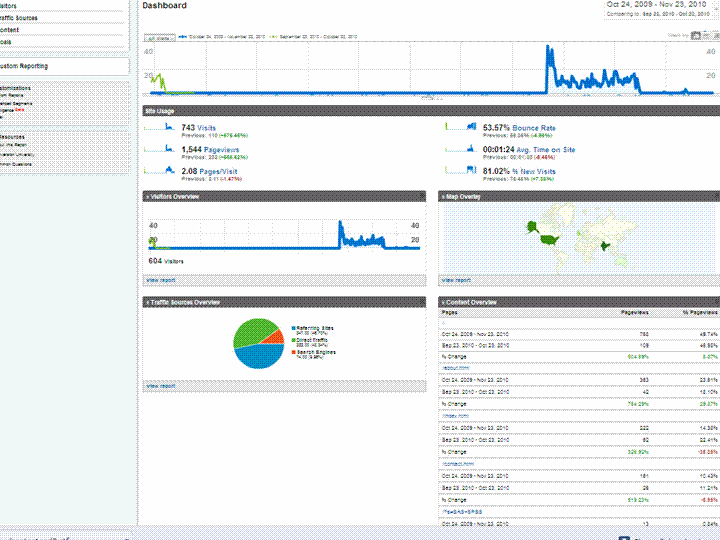
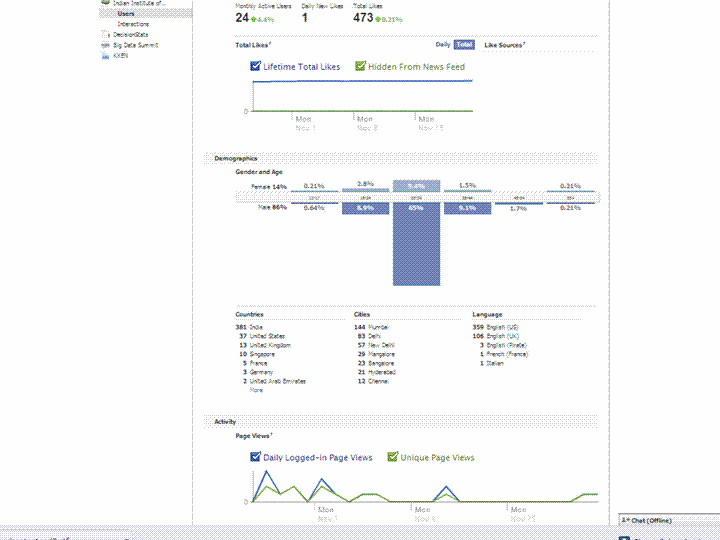
Using a simple screenshot- you can see Facebook Analytics for a Facebook page is simpler at explaining who is coming to visit rather than Google Analytics Dashboard (which has not seen the attention of a Visual UI or Graphic Redesign)
And if Facebook is going to take over the internet, well it is definitely giving better analytics in the process. What do you think?
Which Interface is simpler- and gives you better targeting. Ignore the numbers and just see the metrics measured and the way they are presented. Coincidently R is used at Facebook a lot (which has given the jjplot package)- and Google has NOT INVESTED MAJOR MONEY in creating Premium R Packages or Big Data Packages. I am talking investment at the scale Google is known for- not measly meetups.
(the summer of code dont count- it is for students mostly)
(but thanks for the Pizza G Men- and maybe revise that GA interface by putting a razor to some metrics)
Using WP- Stats I set about answering this question-
What search keywords lead here-
Clearly Michael Jackson is down this year
And R GUI, Data Mining is up.
How does that affect my writing- given I get almost 250 visitors by search engines alone daily- assume I write nothing on this blog from now on.
It doesnt- I still write what ever code or poem that comes to my mind. So it is hurtful people misunderstimate the effort in writing and jump to conclusions (esp if I write about a company- I am not on payroll of that company- just like if I write about a poem- I am not a full time poet)
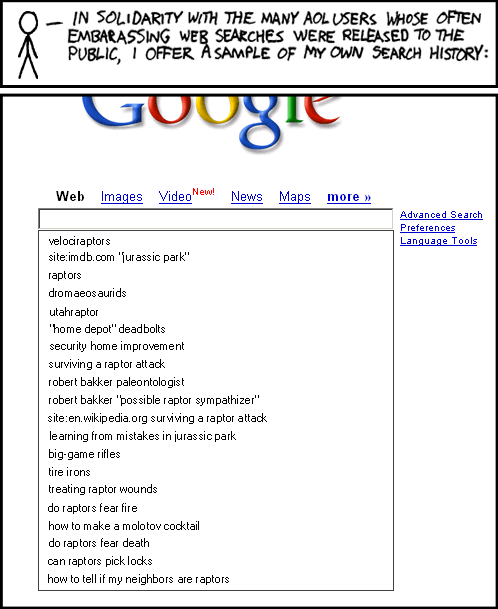
Over to xkcd
All Time (for Decisionstats.Wordpress.com)
Search
Views
libre office
818
facebook analytics
806
michael jackson history
240
wps sas lawsuit
180
r gui
168
wps sas
154
wordle.net
118
sas wps
116
decision stats
110
sas wps lawsuit
100
google maps jet ski
94
data mining
88
doug savage
72
hive tutorial
63
spss certification
63
hadley wickham
63
google maps jetski
62
sas sues wps
60
decisionstats
58
donald farmer microsoft
45
libreoffice
44
wps statistics
44
best statistics software
42
r gui ubuntu
41
rstat
37
tamilnadu advanced technical training institute tatti
Now Jim Davis is a big guy, and he is rushing from the launch of SAS Institute’s Social Media Analytics in Japan- to some arguably difficult flying conditions in time to be home in America for Thanksgiving. That and and I have not been much of a good Blog Boy recently, more swayed by love of open source, than love of software per se. I love equally, given I am bad at both equally.
Anyways, Jim’s contention ( http://twitter.com/Davis_Jim ) was customers should go in business analytics only if there is Positive Return on Investment. I am quoting him here-
What is important is that there be a positive ROI on each and every BA project. Otherwise don’t do it.
That’s not the marketing I was taught in my business school- basically it was sell, sell, sell.
However I see most BI sales vendors also go through -let me meet my sales quota for this quarter- and quantifying customer ROI is simple maths than predictive analytics but there seems to be some information assymetry in it.
Here is a paper from North Western University on ROI in IT projects-.
but overall it would be in the interest of customers and Business Analytics Vendors to publish aggregated ROI.
The opponents to this transparency in ROI would be market leaders in market share, who have trapped their customers by high migration costs (due to complexity) or contractually.
A recent study listed Oracle having a large percentage of unhappy customers who would still renew!, SAP had problems when it raised prices for licensing arbitrarily (that CEO is now CEO of HP and dodging legal notices from Oracle).
Indeed Jim Davis’s famous unsettling call for focusing on Business Analytics,as Business Intelligence is dead- that call has been implemented more aggressively by IBM in analytical acquisitions than even SAS itself which has been conservative about inorganic growth. Quantifying ROI, should theoretically aid open source software the most (since they are cheapest in up front licensing) or newer technologies like MapReduce /Hadoop (since they are quite so fast)- but I think that market has a way of factoring in these things- and customers are not as foolish neither as unaware of costs versus benefits of migration.
The contrary to this is Business Analytics and Business Intelligence are imperfect markets with duo-poly or big players thriving in absence of customer regulation.
You get more protection as a customer of $20 bag of potato chips, than as a customer of a $200,000 software. Regulators are wary to step in to ensure ROI fairness (since most bright techies are qither working for private sector, have their own startup or invested in startups)- who in Govt understands Analytics and Intelligence strong enough to ensure vendor lock-ins are not done, and market flexibility is done. It is also a lower choice for embattled regulators to ensure ROI on enterprise software unlike the aggressiveness they have showed in retail or online software.
Who will Analyze the Analysts and who can quantify the value of quants (or penalize them for shoddy quantitative analytics)- is an interesting phenomenon we expect to see more of.
some analytical positions from Analytical Searches.com
Image via Wikipedia
Relocation is provided for all except NY. H1 transfers are sponsored for the Analytical Manager/Senior Manager and Business Reporting Analyst only. ————————————————————————–
Analytical Manager and Senior Manager/To $160K
Analytics Manager/CA or IL/To $120K
Bank Analytics Manager/IL/To $120K
Business Reporting Analyst/NY/To $90K
Credit Card Risk Analyst/ Illinois/To $95K
Director Analytics/San Diego/To $170K
Director, Operations Strategy and Analytics/San Diego/To $150K
Lead Risk Analyst/CA & TX/To $150K
Manager Modeling & Analytics/CT/To $120K
Marketing Analytics/NY/To$85K
Principal Product Manager, Vertical Markets/$150K/WA
Research Statistician/OH/To $110K
Senior Consultant Marketing Analytics/NY/To $120K
Senior Director Strategic Consulting/To $130K
Senior Manager Decision Science/CA/To $160K
Senior Marketing / Web Analyst /NY/To $100K
Senior Statistician/Modeling Position/VA/$80K
Statistical Director/ Boston or Dallas/To $145K
Statistical Manager/Boston/To $95K
Contact Details- Email Use The Referral Code- Santa Clause
Yes Opera is a browser but you may as well call it an OS. With an uncluttered design, some mind bending Opera UnitePeer to Peer features (in a browser!) withhttp://unite.opera.com/applications/, and nifty widgets- try singing some Opera. I really dont know how browsers make money, especially since they are suing each other all the time, but well- heres to more choice – if you don’t want a corporation owned browser lusting to sell your leaked privacy data to Don Draper- Opera is a good choice- much better than Sea Monkey and the Fox .
I really liked the option to make my own web server in 2 clicks,and share stuff. The bit trorrent support is really nice but I wonder if there was any Scandinavian brotherly ports in bit torrent sharing 😉 , me hearties
Here is an interview with James Dixon the founder of Pentaho, self confessed Chief Geek and CTO. Pentaho has been growing very rapidly and it makes open source Business Intelligence solutions- basically the biggest chunk of enterprise software market currently.
Ajay- How would you describe Pentaho as a BI product for someone who is completely used to traditional BI vendors (read non open source). Do the Oracle lawsuits over Java bother you from a business perspective?
The Oracle/Java issue does not bother me much. There are a lot of software companies dependent on Java. If Oracle abandons Java a lot resources will suddenly focus on OpenJDK. It would be good for OpenJDK and might be the best thing for Java in the long term.
Ajay- What parts of Pentaho’s technology do you personally like the best as having an advantage over other similar proprietary packages.
Describe the latest Pentaho for Hadoop offering and Hadoop/HIVE ‘s advantage over say Map Reduce and SQL.
James- The coolest thing is that everything is pluggable:
* ETL: New data transformation steps can be added. New orchestration controls (job entries) can be added. New perspectives can be added to the design UI. New data sources and destinations can be added.
* Reporting: New content types and report objects can be added. New data sources can be added.
* BI Server: Every factory, engine, and layer can be extended or swapped out via configuration. BI components can be added. New visualizations can be added.
This means it is very easy for Pentaho, partners, customers, and community member to extend our software to do new things.
In addition every engine and component can be fully embedded into a desktop or web-based application. I made a youtube video about our philosophy: http://www.youtube.com/watch?v=uMyR-In5nKE
Our Hadoop offerings allow ETL developers to work in a familiar graphical design environment, instead of having to code MapReduce jobs in Java or Python.
90% of the Hadoop use cases we hear about are transformation/reporting/analysis of structured/semi-structured data, so an ETL tool is perfect for these situations.
Using Pentaho Data Integration reduces implementation and maintenance costs significantly. The fact that our ETL engine is Java and is embeddable means that we can deploy the engine to the Hadoop data nodes and transform the data within the nodes.
Ajay- Do you think the combination of recession, outsourcing,cost cutting, and unemployment are a suitable environment for companies to cut technology costs by going out of their usual vendor lists and try open source for a change /test projects.
Jamie- Absolutely. Pentaho grew (downloads, installations, revenue) throughout the recession. We are on target to do 250% of what we did last year, while the established vendors are flat in terms of new license revenue.
Ajay- How would you compare the user interface of reports using Pentaho versus other reporting software. Please feel free to be as specific.
James- We have all of the everyday, standard reporting features covered.
Over the years the old tools, like Crystal Reports, have become bloated and complicated.
We don’t aim to have 100% of their features, because we’d end us just as complicated.
The 80:20 rule applies here. 80% of the time people only use 20% of their features.
We aim for 80% feature parity, which should cover 95-99% of typical use cases.
Ajay- Could you describe the Pentaho integration with R as well as your relationship with Weka. Jaspersoft already has a partnership with Revolution Analytics for RevoDeployR (R on a web server)-
Any R plans for Pentaho as well?
James- The feature set of R and Weka overlap to a small extent – both of them include basic statistical functions. Weka is focused on predictive models and machine learning, whereas R is focused on a full suite of statistical models. The creator and main Weka developer is a Pentaho employee. We have integrated R into our ETL tool. (makes me happy 🙂 )
(probably not a good time to ask if SAS integration is done as well for a big chunk of legacy base SAS/ WPS users)
About-
As “Chief Geek” (CTO) at Pentaho, James Dixon is responsible for Pentaho’s architecture and technology roadmap. James has over 15 years of professional experience in software architecture, development and systems consulting. Prior to Pentaho, James held key technical roles at AppSource Corporation (acquired by Arbor Software which later merged into Hyperion Solutions) and Keyola (acquired by Lawson Software). Earlier in his career, James was a technology consultant working with large and small firms to deliver the benefits of innovative technology in real-world environments.