
LibreOffice Stable Release launched

Non Oracle Open Office completes important milestone- from the press release

The Document Foundation launches LibreOffice 3.3

The first stable release of the free office suite is available for download

The Internet, January 25, 2011 – The Document Foundation launches LibreOffice 3.3, the first stable release of the free office suite developed by the community. In less than four months, the number of developers hacking LibreOffice has grown from less than twenty in late September 2010, to well over one hundred today. This has allowed us to release ahead of the aggressive schedule set by the project.

Not only does it ship a number of new and original features, LibreOffice 3.3 is also a significant achievement for a number of reasons:

– the developer community has been able to build their own and independent process, and get up and running in a very short time (with respect to the size of the code base and the project’s strong ambitions);

– thanks to the high number of new contributors having been attracted into the project, the source code is quickly undergoing a major clean-up to provide a better foundation for future development of LibreOffice;

– the Windows installer, which is going to impact the largest and most diverse user base, has been integrated into a single build containing all language versions, thus reducing the size for download sites from 75 to 11GB, making it easier for us to deploy new versions more rapidly and lowering the carbon footprint of the entire infrastructure.

Caolán McNamara from RedHat, one of the developer community leaders, comments, “We are excited: this is our very first stable release, and therefore we are eager to get user feedback, which will be integrated as soon as possible into the code, with the first enhancements being released in February. Starting from March, we will be moving to a real time-based, predictable, transparent and public release schedule, in accordance with Engineering Steering Committee’s goals and users’ requests”. The LibreOffice development roadmap is available at http://wiki.documentfoundation.org/ReleasePlan

LibreOffice 3.3 brings several unique new features. The 10 most-popular among community members are, in no particular order:

  1. the ability to import and work with SVG files;
  2. an easy way to format title pages and their numbering in Writer;
  3. a more-helpful Navigator Tool for Writer;
  4. improved ergonomics in Calc for sheet and cell management;
  5. and Microsoft Works and Lotus Word Pro document import filters.

In addition, many great extensions are now bundled, providing

PDF import,

a slide-show presenter console,

a much improved report builder, and more besides.

A more-complete and detailed list of all the new features offered by LibreOffice 3.3 is viewable on the following web page: http://www.libreoffice.org/download/new-features-and-fixes/

LibreOffice 3.3 also provides all the new features of OpenOffice.org 3.3, such as new custom properties handling; embedding of standard PDF fonts in PDF documents; new Liberation Narrow font; increased document protection in Writer and Calc; auto decimal digits for “General” format in Calc; 1 million rows in a spreadsheet; new options for CSV import in Calc; insert drawing objects in Charts; hierarchical axis labels for Charts; improved slide layout handling in Impress; a new easier-to-use print interface; more options for changing case; and colored sheet tabs in Calc. Several of these new features were contributed by members of the LibreOffice team prior to the formation of The Document Foundation.

LibreOffice hackers will be meeting at FOSDEM in Brussels on February 5 and 6, and will be presenting their work during a one-day workshop on February 6, with speeches and hacking sessions coordinated by several members of the project.

The home of The Document Foundation is at http://www.documentfoundation.org

The home of LibreOffice is at http://www.libreoffice.org where the download page has been redesigned by the community to be more user-friendly.

*** About The Document Foundation

The Document Foundation has the mission of facilitating the evolution of the OOo Community into a new, open, independent, and meritocratic organization within the next few months. An independent Foundation is a better reflection of the values of our contributors, users and supporters, and will enable a more effective, efficient and transparent community. TDF will protect past investments by building on the achievements of the first decade, will encourage wide participation within the community, and will co-ordinate activity across the community.

*** Media Contacts for TDF

Florian Effenberger (Germany)

Mobile: +49 151 14424108 – E-mail: floeff@documentfoundation.org

Olivier Hallot (Brazil)

Mobile: +55 21 88228812 – E-mail: olivier.hallot@documentfoundation.org

Charles H. Schulz (France)

Mobile: +33 6 98655424 – E-mail: charles.schulz@documentfoundation.org

Italo Vignoli (Italy)

Mobile: +39 348 5653829 – E-mail: italo.vignoli@documentfoundation.org

Computer Education grants from Google

Image representing Google as depicted in Crunc...
Image via CrunchBase

message from the official google blog-

http://googleblog.blogspot.com/2011/01/supporting-computer-science-education.html

With programs like Computer Science for High School (CS4HS), we hope to increase the number of CS majors —and therefore the number of people entering into careers in CS—by promoting computer science curriculum at the high school level.

For the fourth consecutive year, we’re funding CS4HS to invest in the next generation of computer scientists and engineers. CS4HS is a workshop for high school and middle school computer science teachers that introduces new and emerging concepts in computing and provides tips, tools and guidance on how to teach them. The ultimate goals are to “train the trainer,” develop a thriving community of high school CS teachers and spread the word about the awe and beauty of computing.

If you’re a university, community college, or technical School in the U.S., Canada, Europe, Middle East or Africa and are interested in hosting a workshop at your institution, please visit www.cs4hs.com to submit an application for grant funding.Applications will be accepted between January 18, 2011 and February 18, 2011.

In addition to submitting your application, on the CS4HS website you’ll find info on how to organize a workshop, as well as websites and agendas from last year’s participants to give you an idea of how the workshops were structured in the past. There’s also a collection ofCS4HS curriculum modules that previous participating schools have shared for future organizers to use in their own program.

Comparing Bit Torrent Downloaders

Tux, as originally drawn by Larry Ewing
Image via Wikipedia

I personally like UTorrent on Windows and KTorrent on Linux.

While no experts on this, anything that gets the data down faster while maximizing my pipes efficiency.

I also like Torrenting than  any of the sudo-apt get method of downloading software or the zip unzip,tar untar, install/make file

Torrenting is a simpler way of sharing applications but sadly not used much by the stats computing community to share downloads.

Also I think any dashboard or visualization should be sorted (but not alphabetically but numerically/categorically)

SORT THE DASHBOARD —-KEEP IT SORTED

So I am partially recreating after sorting the data viz from http://en.wikipedia.org/wiki/Comparison_of_BitTorrent_clients

BitTorrent client Magnet URI Super-seeding Embedded tracker UPnP[81] NAT Port Mapping Protocol NAT traversal[82] DHT[83] Peer exchange Encryption UDP tracker LPD
µTorrent Yes Yes[95] Yes[96] Yes[97] Yes Yes[98] Yes[99] Yes[85] Yes[100] Yes Yes[101]
BitSpirit [11] Yes Yes Yes Yes Yes Yes Yes Yes Yes Yes No
BitTorrent 6 Yes Yes Yes Yes Yes Yes Yes Yes[85] Yes Yes Yes
OneSwarm Yes Yes Yes Yes Yes Yes Yes Yes Yes Yes No
qBittorrent Yes Yes Yes Yes Yes Yes Yes Yes Yes Yes Yes
SoMud Yes Yes Yes Yes Yes Yes Yes Yes Yes Yes Yes
Vuze (formerly Azureus) Yes Yes Yes Yes Yes Yes[102] Yes[87] Yes Yes Yes No
BitComet Yes Yes Separate download Yes Yes Yes Yes Yes Yes Yes No
Tixati [43] Yes Yes No Yes No No Yes Yes Yes Yes Partial
Aria2 Yes No Yes No No No Yes Yes Yes Yes Yes
Tribler Yes No Yes Yes Yes No Yes Yes Yes No No
Bitflu Yes No No No No No Yes Yes No Yes No
Deluge Yes No No Yes Yes Yes Yes Yes Yes Yes Yes
Flush Yes No No Yes Yes No Yes Yes No No Yes
KTorrent Yes No No Yes Yes Yes Yes Yes Yes Yes Partial
Shareaza Yes No No Yes Yes No Yes[93] Yes No No No
Transmission Yes No No Yes Yes Yes Yes Yes[94] Yes No Yes
LimeWire Partial Yes Yes Yes Yes No Yes Yes Yes Yes No
BitTyrant No Yes[citation needed] Yes Yes Yes Yes[86] Yes[87] Yes Yes No No
BitTornado No Yes Yes[84] Yes No No No No Yes No No
Torrent Swapper No Yes Yes[84] Yes No No No Yes No No No
Localhost No Yes Yes Yes No Yes Yes [89] No No No No
Meerkat Bittorrent Client No Yes No Yes Yes Yes Yes No Yes No No
rTorrent No Yes No No No No Yes Yes Yes Yes No[92]
TorrentFlux No Yes No Yes No No No No Yes No No
TorrentVolve No Partial [76] No Partial[76] Partial [76] Partial [76] Partial[76] Partial [76] Partial [76] Partial [76] No
Opera No No Yes[90] No No No No Yes[91] No No No
BitTorrent 5 / Mainline No No Yes[84] Yes Yes No Yes Yes Yes No No
ABC No No Yes Yes No No No No No No No
Blog Torrent No No Yes No No No No No No No No
MLDonkey No No Yes Yes Yes No No No No Yes No
Tomato Torrent No No Yes No No No Yes No No No No
Acquisition No No No No Yes No No No No No No
Arctic Torrent No No No No No No No Yes No No No
BitLet No No No Yes No No No No No No No
BitLord No No No Yes No Yes No Yes No Yes No
BitThief No No No No No No No No No No No
Bits on Wheels No No No No No No No No No No No
BTG No No No Yes Yes No Yes Yes Yes Yes No
BTPD No No No No No No No No No No No
FlashGet No No No No No No Yes No Yes No No
Folx No No No Yes Yes No Yes Yes No Yes No
Free Download Manager No No No No No No Yes Yes No No No
G3 Torrent No No No No No No No No No No No
Gnome BitTorrent No No No No No No No No No No No
Halite No No No Yes Yes No Yes No Yes No[88] No
QTorrent No No No No No No No No No No No
Rufus No No No No No No No No No No No
SymTorrent No No No N/A N/A N/A No No No No No
Tonido Torrent No No No Yes Yes Yes Yes No No No No
Torium No No No Yes No No Yes No No No No
ZipTorrent No No No Yes Yes No No Yes No No No


Interview Luis Torgo Author Data Mining with R

Example of k-nearest neighbour classification
Image via Wikipedia

Here is an interview with Prof Luis Torgo, author of the recent best seller “Data Mining with R-learning with case studies”.

Ajay- Describe your career in science. How do you think can more young people be made interested in science.

Luis- My interest in science only started after I’ve finished my degree. I’ve entered a research lab at the University of Porto and started working on Machine Learning, around 1990. Since then I’ve been involved generally in data analysis topics both from a research perspective as well as from a more applied point of view through interactions with industry partners on several projects. I’ve spent most of my career at the Faculty of Economics of the University of Porto, but since 2008 I’m at the department of Computer Science of the Faculty of Sciences of the same university. At the same time I’ve been a researcher at LIAAD / Inesc Porto LA (www.liaad.up.pt).

I like a lot what I do and like science and the “scientific way of thinking”, but I cannot say that I’ve always thought of this area as my “place”. Most of all I like solving challenging problems through data analysis. If that translates into some scientific outcome than I’m more satisfied but that is not my main goal, though I’m kind of “forced” to think about that because of the constraints of an academic career.

That does not mean I’m not passionate about science, I just think there are many more ways of “doing science” than what is reflected in the usual “scientific indicators” that most institutions seem to be more and more obsessed about.

Regards interesting young people in science that is a hard question that I’m not sure I’m qualified to answer. I do tend to think that young people are more sensible to concrete examples of problems they think are interesting and that science helps in solving, as a way of finding a motivation for facing the hard work they will encounter in a scientific career. I do believe in case studies as a nice way to learn and motivate, and thus my book 😉

Ajay- Describe your new book “Data Mining with R, learning with case studies” Why did you choose a case study based approach? who is the target audience? What is your favorite case study from the book

Luis- This book is about learning how to use R for data mining. The book follows a “learn by doing it” approach to data mining instead of the more common theoretical description of the available techniques in this discipline. This is accomplished by presenting a series of illustrative case studies for which all necessary steps, code and data are provided to the reader. Moreover, the book has an associated web page (www.liaad.up.pt/~ltorgo/DataMiningWithR) where all code inside the book is given so that easy copy-paste is possible for the more lazy readers.

The language used in the book is very informal without many theoretical details on the used data mining techniques. For obtaining these theoretical insights there are already many good data mining books some of which are referred in “further readings” sections given throughout the book. The decision of following this writing style had to do with the intended target audience of the book.

In effect, the objective was to write a monograph that could be used as a supplemental book for practical classes on data mining that exist in several courses, but at the same time that could be attractive to professionals working on data mining in non-academic environments, and thus the choice of this more practically oriented approach.

Regards my favorite case study that is a hard question for an author… still I would probably choose the “Predicting Stock Market Returns” case study (Chapter 3). Not only because I like this challenging problem, but mainly because the case study addresses all aspects of knowledge discovery in a real world scenario and not only the construction of predictive models. It tackles data collection, data pre-processing, model construction, transforming predictions into actions using different trading policies, using business-related performance metrics, implementing a trading simulator for “real-world” evaluation, and laying out grounds for constructing an online trading system.

Obviously, for all these steps there are far too many options to be possible to describe/evaluate all of them in a chapter, still I do believe that for the reader it is important to see the overall picture, and read about the relevant questions on this problem and some possible paths that can be followed at these different steps.

In other words: do not expect to become rich with the solution I describe in the chapter !

Ajay- Apart from R, what other data mining software do you use or have used in the past. How would you compare their advantages and disadvantages with R

Luis- I’ve played around with Clementine, Weka, RapidMiner and Knime, but really only playing with teaching goals, and no serious use/evaluation in the context of data mining projects. For the latter I mainly use R or software developed by myself (either in R or other languages). In this context, I do not think it is fair to compare R with these or other tools as I lack serious experience with them. I can however, tell you about what I see as the main pros and cons of R. The main reason for using R is really not only the power of the tool that does not stop surprising me in terms of what already exists and keeps appearing as contributions of an ever growing community, but mainly the ability of rapidly transforming ideas into prototypes. Regards some of its drawbacks I would probably mention the lack of efficiency when compared to other alternatives and the problem of data set sizes being limited by main memory.

I know that there are several efforts around for solving this latter issue not only from the community (e.g. http://cran.at.r-project.org/web/views/HighPerformanceComputing.html), but also from the industry (e.g. Revolution Analytics), but I would prefer that at this stage this would be a standard feature of the language so the the “normal” user need not worry about it. But then this is a community effort and if I’m not happy with the current status instead of complaining I should do something about it!

Ajay- Describe your writing habit- How do you set about writing the book- did you write a fixed amount daily or do you write in bursts etc

Luis- Unfortunately, I write in bursts whenever I find some time for it. This is much more tiring and time consuming as I need to read back material far too often, but I cannot afford dedicating too much consecutive time to a single task. Actually, I frequently tease my PhD students when they “complain” about the lack of time for doing what they have to, that they should learn to appreciate the luxury of having a single task to complete because it will probably be the last time in their professional life!

Ajay- What do you do to relax or unwind when not working?

Luis- For me, the best way to relax from work is by playing sports. When I’m involved in some game I reset my mind and forget about all other things and this is very relaxing for me. A part from sports I enjoy a lot spending time with my family and friends. A good and long dinner with friends over a good bottle of wine can do miracles when I’m too stressed with work! Finally,I do love traveling around with my family.

Luis Torgo

Short Bio: Luis Torgo has a degree in Systems and Informatics Engineering and a PhD in Computer Science. He is an Associate Professor of the Department of Computer Science of the Faculty of Sciences of the University of Porto. He is also a researcher of the Laboratory of Artificial Intelligence and Data Analysis (LIAAD) belonging to INESC Porto LA. Luis Torgo has been an active researcher in Machine Learning and Data Mining for more than 20 years. He has lead several academic and industrial Data Mining research projects. Luis Torgo accompanies the R project almost since its beginning, using it on his research activities. He teaches R at different levels and has given several courses in different countries.

For reading “Data Mining with R” – you can visit this site, also to avail of a 20% discount the publishers have generously given (message below)-

For more information and to place an order, visit us at http://www.crcpress.com.  Order online and apply 20% Off discount code 907HM at checkout.  CRC is pleased to offer free standard shipping on all online orders!

link to the book page  http://www.crcpress.com/product/isbn/9781439810187

Price: $79.95
Cat. #: K10510
ISBN: 9781439810187
ISBN 10: 1439810184
Publication Date: November 09, 2010
Number of Pages: 305
Availability: In Stock
Binding(s): Hardback 

Interview Ajay Ohri Decisionstats.com with DMR

From-

http://www.dataminingblog.com/data-mining-research-interview-ajay-ohri/

Here is the winner of the Data Mining Research People Award 2010: Ajay Ohri! Thanks to Ajay for giving some time to answer Data Mining Research questions. And all the best to his blog, Decision Stat!

Data Mining Research (DMR): Could you please introduce yourself to the readers of Data Mining Research?

Ajay Ohri (AO): I am a business consultant and writer based out of Delhi- India. I have been working in and around the field of business analytics since 2004, and have worked with some very good and big companies primarily in financial analytics and outsourced analytics. Since 2007, I have been writing my blog at http://decisionstats.com which now has almost 10,000 views monthly.

All in all, I wrote about data, and my hobby is also writing (poetry). Both my hobby and my profession stem from my education ( a masters in business, and a bachelors in mechanical engineering).

My research interests in data mining are interfaces (simpler interfaces to enable better data mining), education (making data mining less complex and accessible to more people and students), and time series and regression (specifically ARIMAX)
In business my research interests software marketing strategies (open source, Software as a service, advertising supported versus traditional licensing) and creation of technology and entrepreneurial hubs (like Palo Alto and Research Triangle, or Bangalore India).

DMR: I know you have worked with both SAS and R. Could you give your opinion about these two data mining tools?

AO: As per my understanding, SAS stands for SAS language, SAS Institute and SAS software platform. The terms are interchangeably used by people in industry and academia- but there have been some branding issues on this.
I have not worked much with SAS Enterprise Miner , probably because I could not afford it as business consultant, and organizations I worked with did not have a budget for Enterprise Miner.
I have worked alone and in teams with Base SAS, SAS Stat, SAS Access, and SAS ETS- and JMP. Also I worked with SAS BI but as a user to extract information.
You could say my use of SAS platform was mostly in predictive analytics and reporting, but I have a couple of projects under my belt for knowledge discovery and data mining, and pattern analysis. Again some of my SAS experience is a bit dated for almost 1 year ago.

I really like specific parts of SAS platform – as in the interface design of JMP (which is better than Enterprise Guide or Base SAS ) -and Proc Sort in Base SAS- I guess sequential processing of data makes SAS way faster- though with computing evolving from Desktops/Servers to even cheaper time shared cloud computers- I am not sure how long Base SAS and SAS Stat can hold this unique selling proposition.

I dislike the clutter in SAS Stat output, it confuses me with too much information, and I dislike shoddy graphics in the rendering output of graphical engine of SAS. Its shoddy coding work in SAS/Graph and if JMP can give better graphics why is legacy source code preventing SAS platform from doing a better job of it.

I sometimes think the best part of SAS is actually code written by Goodnight and Sall in 1970’s , the latest procs don’t impress me much.

SAS as a company is something I admire especially for its way of treating employees globally- but it is strange to see the rest of tech industry not following it. Also I don’t like over aggression and the SAS versus Rest of the Analytics /Data Mining World mentality that I sometimes pick up when I deal with industry thought leaders.

I think making SAS Enterprise Miner, JMP, and Base SAS in a completely new web interface priced at per hour rates is my wishlist but I guess I am a bit sentimental here- most data miners I know from early 2000’s did start with SAS as their first bread earning software. Also I think SAS needs to be better priced in Business Intelligence- it seems quite cheap in BI compared to Cognos/IBM but expensive in analytical licensing.

If you are a new stats or business student, chances are – you may know much more R than SAS today. The shift in education at least has been very rapid, and I guess R is also more of a platform than a analytics or data mining software.

I like a lot of things in R- from graphics, to better data mining packages, modular design of software, but above all I like the can do kick ass spirit of R community. Lots of young people collaborating with lots of young to old professors, and the energy is infectious. Everybody is a CEO in R ’s world. Latest data mining algols will probably start in R, published in journals.

Which is better for data mining SAS or R? It depends on your data and your deadline. The golden rule of management and business is -it depends.

Also I have worked with a lot of KXEN, SQL, SPSS.

DMR: Can you tell us more about Decision Stats? You have a traffic of 120′000 for 2010. How did you reach such a success?

AO: I don’t think 120,000 is a success. Its not a failure. It just happened- the more I wrote, the more people read.In 2007-2008 I used to obsess over traffic. I tried SEO, comments, back linking, and I did some black hat experimental stuff. Some of it worked- some didn’t.

In the end, I started asking questions and interviewing people. To my surprise, senior management is almost always more candid , frank and honest about their views while middle managers, public relations, marketing folks can be defensive.

Social Media helped a bit- Twitter, Linkedin, Facebook really helped my network of friends who I suppose acted as informal ambassadors to spread the word.
Again I was constrained by necessity than choices- my middle class finances ( I also had a baby son in 2007-my current laptop still has some broken keys :) – by my inability to afford traveling to conferences, and my location Delhi isn’t really a tech hub.
The more questions I asked around the internet, the more people responded, and I wrote it all down.

I guess I just was lucky to meet a lot of nice people on the internet who took time to mentor and educate me.

I tried building other websites but didn’t succeed so i guess I really don’t know. I am not a smart coder, not very clever at writing but I do try to be honest.

Basic economics says pricing is proportional to demand and inversely proportional to supply. Honest and candid opinions have infinite demand and an uncertain supply.

DMR: There is a rumor about a R book you plan to publish in 2011 :-) Can you confirm the rumor and tell us more?

AO: I just signed a contract with Springer for ” R for Business Analytics”. R is a great software, and lots of books for statistically trained people, but I felt like writing a book for the MBAs and existing analytics users- on how to easily transition to R for Analytics.

Like any language there are tricks and tweaks in R, and with a focus on code editors, IDE, GUI, web interfaces, R’s famous learning curve can be bent a bit.

Making analytics beautiful, and simpler to use is always a passion for me. With 3000 packages, R can be used for a lot more things and a lot more simply than is commonly understood.
The target audience however is business analysts- or people working in corporate environments.

Brief Bio-
Ajay Ohri has been working in the field of analytics since 2004 , when it was a still nascent emerging Industries in India. He has worked with the top two Indian outsourcers listed on NYSE,and with Citigroup on cross sell analytics where he helped sell an extra 50000 credit cards by cross sell analytics .He was one of the very first independent data mining consultants in India working on analytics products and domestic Indian market analytics .He regularly writes on analytics topics on his web site www.decisionstats.com and is currently working on open source analytical tools like R besides analytical software like SPSS and SAS.

How to balance your online advertising and your offline conscience

Google in 1998, showing the original logo
Image via Wikipedia

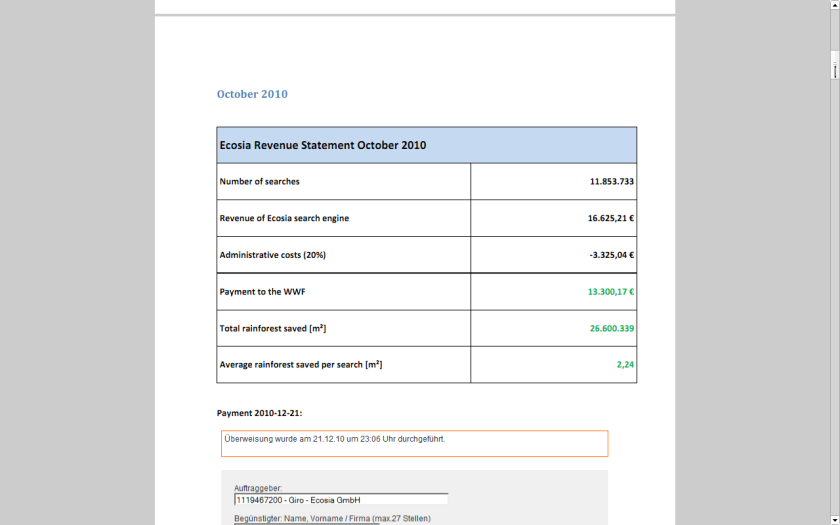
I recently found an interesting example of  a website that both makes a lot of money and yet is much more efficient than any free or non profit. It is called ECOSIA

If you see a website that wants to balance administrative costs  plus have a transparent way to make the world better- this is a great example.

  • http://ecosia.org/how.php
  • HOW IT WORKS
    You search with Ecosia.
  • Perhaps you click on an interesting sponsored link.
  • The sponsoring company pays Bing or Yahoo for the click.
  • Bing or Yahoo gives the bigger chunk of that money to Ecosia.
  • Ecosia donates at least 80% of this income to support WWF’s work in the Amazon.
  • If you like what we’re doing, help us spread the word!
  • Key facts about the park:

    • World’s largest tropical forest reserve (38,867 square kilometers, or about the size of Switzerland)
    • Home to about 14% of all amphibian species and roughly 54% of all bird species in the Amazon – not to mention large populations of at least eight threatened species, including the jaguar
    • Includes part of the Guiana Shield containing 25% of world’s remaining tropical rainforests – 80 to 90% of which are still pristine
    • Holds the last major unpolluted water reserves in the Neotropics, containing approximately 20% of all of the Earth’s water
    • One of the last tropical regions on Earth vastly unaltered by humans
    • Significant contributor to climatic regulation via heat absorption and carbon storage


    http://ecosia.org/statistics.php

    They claim to have donated 141,529.42 EUR !!!

    http://static.ecosia.org/files/donations.pdf


    Well suppose you are the Web Admin of a very popular website like Wikipedia or etc

    One way to meet server costs is to say openly hey i need to balance my costs so i need some money.

    The other way is to use online advertising.

    I started mine with Google Adsense.

    Click per milli (or CPM)  gives you a very low low conversion compared to contacting ad sponsor directly.

    But its a great data experiment-

    as you can monitor which companies are likely to be advertised on your site (assume google knows more about their algols than you will)

    which formats -banner or text or flash have what kind of conversion rates

    what are the expected pay off rates from various keywords or companies (like business intelligence software, predictive analytics software and statistical computing software are similar but have different expected returns (if you remember your eco class)


    NOW- Based on above data, you know whats your minimum baseline to expect from a private advertiser than a public, crowd sourced search engine one (like Google or Bing)

    Lets say if you have 100000 views monthly. and assume one out of 1000 page views will lead to a click. Say the advertiser will pay you 1 $ for every 1 click (=1000 impressions)

    Then your expected revenue is $100.But if your clicks are priced at 2.5$ for every click , and your click through rate is now 3 out of 1000 impressions- (both very moderate increases that can done by basic placement optimization of ad type, graphics etc)-your new revenue is  750$.

    Be a good Samaritan- you decide to share some of this with your audience -like 4 Amazon books per month ( or I free Amazon book per week)- That gives you a cost of 200$, and leaves you with some 550$.

    Wait! it doesnt end there- Adam Smith‘s invisible hand moves on .

    You say hmm let me put 100 $ for an annual paper writing contest of $1000, donate $200 to one laptop per child ( or to Amazon rain forests or to Haiti etc etc etc), pay $100 to your upgraded server hosting, and put 350$ in online advertising. say $200 for search engines and $150 for Facebook.

    Woah!

    Month 1 would should see more people  visiting you for the first time. If you have a good return rate (returning visitors as a %, and low bounce rate (visits less than 5 secs)- your traffic should see atleast a 20% jump in new arrivals and 5-10 % in long term arrivals. Ignoring bounces- within  three months you will have one of the following

    1) An interesting case study on statistics on online and social media advertising, tangible motivations for increasing community response , and some good data for study

    2) hopefully better cost management of your server expenses

    3)very hopefully a positive cash flow


    you could even set a percentage and share the monthly (or annually is better actions) to your readers and advertisers.

    go ahead- change the world!

    the key paradigms here are sharing your traffic and revenue openly to everyone

    donating to a suitable cause

    helping increase awareness of the suitable cause

    basing fixed percentages rather than absolute numbers to ensure your site and cause are sustained for years.

    The Year 2010

    Nokia N800 internet tablet, with open source s...
    Image via Wikipedia

    My annual traffic to this blog was almost 99,000 . Add in additional views on networking sites plus the 400 plus RSS readers- so I can say traffic was 1,20,000 for 2010. Nice. Thanks for reading and hope it was worth your time. (this is a long post and will take almost 440 secs to read but the summary is just given)

    My intent is either to inform you, give something useful or atleast something interesting.

    see below-

    Jan Feb Mar Apr May Jun
    2010 6,311 4,701 4,922 5,463 6,493 4,271
    Jul Aug Sep Oct Nov Dec Total
    5,041 5,403 17,913 16,430 11,723 10,096 98,767


    Sandro Saita from http://www.dataminingblog.com/ just named me for an award on his blog (but my surname is ohRi , Sandro left me without an R- What would I be without R :)) ).

    Aw! I am touched. Google for “Data Mining Blog” and Sandro is the best that it is in data mining writing.

    DMR People Award 2010
    There are a lot of active people in the field of data mining. You can discuss with them on forums. You can read their blogs. You can also meet them in events such as PAW or KDD. Among the people I follow on a regular basis, I have elected:

    Ajay Ori

    He has been very active in 2010, especially on his blog . Good work Ajay and continue sharing your experience with us!”

    What did I write in 2010- stuff.

    What did you read on this blog- well thats the top posts list.

    2009-12-31 to Today

    Title Views
    Home page More stats 21,150
    Top 10 Graphical User Interfaces in Statistical Software More stats 6,237
    Wealth = function (numeracy, memory recall) More stats 2,014
    Matlab-Mathematica-R and GPU Computing More stats 1,946
    The Top Statistical Softwares (GUI) More stats 1,405
    About DecisionStats More stats 1,352
    Using Facebook Analytics (Updated) More stats 1,313
    Test drive a Chrome notebook. More stats 1,170
    Top ten RRReasons R is bad for you ? More stats 1,157
    Libre Office More stats 1,151
    Interview Hadley Wickham R Project Data Visualization Guru More stats 1,007
    Using Red R- R with a Visual Interface More stats 854
    SAS Institute files first lawsuit against WPS- Episode 1 More stats 790
    Interview Professor John Fox Creator R Commander More stats 764
    R Package Creating More stats 754
    Windows Azure vs Amazon EC2 (and Google Storage) More stats 726
    Norman Nie: R GUI and More More stats 716
    Startups for Geeks More stats 682
    Google Maps – Jet Ski across Pacific Ocean More stats 670
    Not so AWkward after all: R GUI RKWard More stats 579
    Red R 1.8- Pretty GUI More stats 570
    Parallel Programming using R in Windows More stats 569
    R is an epic fail or is it just overhyped More stats 559
    Enterprise Linux rises rapidly:New Report More stats 537
    Rapid Miner- R Extension More stats 518
    Creating a Blog Aggregator for free More stats 504
    So which software is the best analytical software? Sigh- It depends More stats 473
    Revolution R for Linux More stats 465
    John Sall sets JMP 9 free to tango with R More stats 460

    So how do people come here –

    well I guess I owe Tal G for almost 9000 views ( incidentally I withdrew posting my blog from R- Bloggers and Analyticbridge blogs – due to SEO keyword reasons and some spam I was getting see (below))

    http://r-bloggers.com is still the CAT’s whiskers and I read it  a lot.

    I still dont know who linked my blog to a free sex movie site with 400 views but I have a few suspects.

    2009-12-31 to Today

    Referrer Views
    r-bloggers.com 9,131
    Reddit 3,829
    rattle.togaware.com 1,500
    Twitter 1,254
    Google Reader 1,215
    linkedin.com 717
    freesexmovie.irwanaf.com 422
    analyticbridge.com 341
    Google 327
    coolavenues.com 322
    Facebook 317
    kdnuggets.com 298
    dataminingblog.com 278
    en.wordpress.com 185
    google.co.in 151
    xianblog.wordpress.com 130
    inside-r.org 124
    decisionstats.com 119
    ifreestores.com 117
    bits.blogs.nytimes.com 108

    Still reading this post- gosh let me sell you some advertising. It is only $100 a month (yes its a recession)

    Advertisers are treated on First in -Last out (FILO)

    I have been told I am obsessed with SEO , but I dont care much for search engines apart from Google, and yes SEO is an interesting science (they should really re name it GEO or Google Engine Optimization)

    Apparently Hadley Wickham and Donald Farmer are big keywords for me so I should be more respectful I guess.

    Search Terms for 365 days ending 2010-12-31 (Summarized)

    2009-12-31 to Today

    Search Views
    libre office 925
    facebook analytics 798
    test drive a chrome notebook 467
    test drive a chrome notebook. 215
    r gui 203
    data mining 163
    wps sas lawsuit 158
    wordle.net 133
    wps sas 123
    google maps jet ski 123
    test drive chrome notebook 96
    sas wps 89
    sas wps lawsuit 85
    chrome notebook test drive 83
    decision stats 83
    best statistics software 74
    hadley wickham 72
    google maps jetski 72
    libreoffice 70
    doug savage 65
    hive tutorial 58
    funny india 56
    spss certification 52
    donald farmer microsoft 51
    best statistical software 49

    What about outgoing links? Apparently I need to find a way to ask Google to pay me for the free advertising I gave their chrome notebook launch. But since their search engine and browser is free to me, guess we are even steven.

    Clicks for 365 days ending 2010-12-31 (Summarized)

    2009-12-31 to Today

    URL Clicks
    rattle.togaware.com 378
    facebook.com/Decisionstats 355
    rapid-i.com/content/view/182/196 319
    services.google.com/fb/forms/cr48basic 313
    red-r.org 228
    decisionstats.wordpress.com/2010/05/07/the-top-statistical-softwares-gui 199
    teamwpc.co.uk/products/wps 162
    r4stats.com/popularity 148
    r-statistics.com/2010/04/r-and-the-google-summer-of-code-2010-accepted-students-and-projects 138
    socserv.mcmaster.ca/jfox/Misc/Rcmdr 138
    spss.com/certification 116
    learnr.wordpress.com 114
    dudeofdata.com/decisionstats 108
    r-project.org 107
    documentfoundation.org/faq 104
    goo.gl/maps/UISY 100
    inside-r.org/download 96
    en.wikibooks.org/wiki/R_Programming 92
    nytimes.com/external/readwriteweb/2010/12/07/07readwriteweb-report-google-offering-chrome-notebook-test-11919.html 92
    sourceforge.net/apps/mediawiki/rkward/index.php?title=Main_Page 92
    analyticdroid.togaware.com 88
    yeroon.net/ggplot2 87

    so in 2010,

    SAS remained top daddy in business analytics,

    R made revolutionary strides in terms of new packages,

    JMP  launched a new version,

    SPSS got integrated with Cognos,

    Oracle sued Google and did build a great Data Mining GUI,

    Libre Office gave you a non Oracle Open office ( or open even more office)

    2011 looks like  a fun year. Have safe partying .