Towards better quantitative marketing

Cycle of Research and Development, from "...
Image via Wikipedia

The term quantitative refers to a type of information based in quantities or else quantifiable data (objective properties) —as opposed to qualitative information which deals with apparent qualities (subjective properties)

http://en.wikipedia.org/wiki/Quantitative

Fear, uncertainty, and doubt (FUD) is a tactic of rhetoric and fallacy used in sales, marketing, public relations,[1][2] politics and propaganda. FUD is generally a strategic attempt to influence public perception by disseminating negative and dubious/false information designed to undermine the credibility of their beliefs.

Source-

http://en.wikipedia.org/wiki/Fear,_uncertainty_and_doubt

Top 5 FUD Tactics in Software and what you can say to end user to retain credibility

1) That software lacks reliable support- our support team has won top prizes in Customer Appreciation for past several years.

  • Our software release history-
  • graph of bugs filed-
  • turn around time box plot for customer service issues
  • quantitatively define reliability

2) We give the best value to customers. Customer Big A got huge huge % savings thanks to our software.

  • Pricing- Transparent – and fixed. For volume discounts mention slabs.
  • Cost to Customer- Include time and cost estimates for training and installation
  • Graphs of average ROIC (return on capital invested) on TCO (total cost of ownership)  not half a dozen outlier case studies. Mention Expected % return

3) We have invested a lot of money in our Research and Development. We continue to spend a lotto of money on R &D

  • Average Salary of R and D employee versus Average Tenure (Linkedin gives the second metric quite easily)
  • Mention Tax benefits and Accounting treatment of R&D expenses
  • Give a breakdown- how much went to research and how much went to legacy application support
  • Mention open source projects openly
  • Mention community source projects separately

4) Software B got sued. Intellectual property rights (sniff)

  • Mention pending cases with your legal team
  • Mention anti trust concerns for potential acquisitions
  • Mention links to your patent portfolio (or even to US PTO with query ?=your corporate name )

5) We have a 99.8% renewal rate.

  • Mention vendor lock in concerns and flexibility
  • Mention What-If scenarios if there are delays in software implementation
  • Mention methodology in calculating return on investment.


Also

http://blogs.computerworlduk.com/infrastructure-and-operations/2010/10/three-fud-statements-used-not-to-implement-standards-based-networking/index.htm

Interview Jamie Nunnelly NISS

An interview with Jamie Nunnelly, Communications Director of National Institute of Statistical Sciences
Ajay– What does NISS do? And What does SAMSI do?

Jamie– The National Institute of Statistical Sciences (NISS) was established in 1990 by the national statistics societies and the Research Triangle universities and organizations, with the mission to identify, catalyze and foster high-impact, cross-disciplinary and cross-sector research involving the statistical sciences.

NISS is dedicated to strengthening and serving the national statistics community, most notably by catalyzing community members’ participation in applied research driven by challenges facing government and industry. NISS also provides career development opportunities for statisticians and scientists, especially those in the formative stages of their careers.

The Institute identifies emerging issues to which members of the statistics community can make key contributions, and then catalyzes the right combinations of researchers from multiple disciplines and sectors to tackle each problem. More than 300 researchers from over 100 institutions have worked on our projects.

The Statistical and Applied Mathematical Sciences Institute (SAMSI) is a partnership of Duke University,  North Carolina State University, The University of North Carolina at Chapel Hill, and NISS in collaboration with the William Kenan Jr. Institute for Engineering, Technology and Science and is part of the Mathematical Sciences Institutes of the NSF.

SAMSI focuses on 1-2 programs of research interest in the statistical and/or applied mathematical area and visitors from around the world are involved with the programs and come from a variety of disciplines in addition to mathematics and statistics.

Many come to SAMSI to attend workshops, and also participate in working groups throughout the academic year. Many of the working groups communicate via WebEx so people can be involved with the research remotely. SAMSI also has a robust education and outreach program to help undergraduate and graduate students learn about cutting edge research in applied mathematics and statistics.

Ajay– What successes have you had in 2010- and what do you need to succeed in 2011. Whats planned for 2011 anyway

Jamie– NISS has had a very successful collaboration with the National Agricultural Statistical Service (NASS) over the past two years that was just renewed for the next two years. NISS & NASS had three teams consisting of a faculty researcher in statistics, a NASS researcher, a NISS mentor, a postdoctoral fellow and a graduate student working on statistical modeling and other areas of research for NASS.

NISS is also working on a syndromic surveillance project with Clemson University, Duke University, The University of Georgia, The University of South Carolina. The group is currently working with some hospitals to test out a model they have been developing to help predict disease outbreak.

SAMSI had a very successful year with two programs ending this past summer, which were the Stochastic Dynamics program and the Space-time Analysis for Environmental Mapping, Epidemiology and Climate Change. Several papers were written and published and many presentations have been made at various conferences around the world regarding the work that was conducted as SAMSI last year.

Next year’s program is so big that the institute has decided to devote all it’s time and energy around it, which is uncertainty quantification. The opening workshop, in addition to the main methodological theme, will be broken down into three areas of interest under this broad umbrella of research: climate change, engineering and renewable energy, and geosciences.

Ajay– Describe your career in science and communication.

Jamie– I have been in communications since 1985, working for large Fortune 500 companies such as General Motors and Tropicana Products. I moved to the Research Triangle region of North Carolina after graduate school and got into economic development and science communications first working for the Research Triangle Regional Partnership in 1994.

From 1996-2005 I was the communications director for the Research Triangle Park, working for the Research Triangle Foundation of NC. I published a quarterly magazine called The Park Guide for awhile, then came to work for NISS and SAMSI in 2008.

I really enjoy working with the mathematicians and statisticians. I always joke that I am the least educated person working here and that is not far from the truth! I am honored to help get the message out about all of the important research that is conducted here each day that is helping to improve the lives of so many people out there.

Ajay– Research Triangle or Silicon Valley– Which is better for tech people and why? Your opinion

Jamie– Both the Silicon Valley and Research Triangle are great regions for tech people to locate, but of course, I have to be biased and choose Research Triangle!

Really any place in the world that you find many universities working together with businesses and government, you have an area that will grow and thrive, because the collaborations help all of us generate new ideas, many of which blossom into new businesses, or new endeavors of research.

The quality of life in places such as the Research Triangle is great because you have people from around the world moving to a place, each bringing his/her culture, food, and uniqueness to this place, and enriching everyone else as a result.

Two advantages the Research Triangle has over Silicon Valley are that the Research Triangle has a bigger diversity of industries, so when the telecommunications industry busted back in 2001-02, the region took a hit, but the biotechnology industry was still growing, so unemployment rose, but not to the extent that other areas might have experienced.

The latest recession has hit us all very hard, so even this strategy has not made us immune to having high unemployment, but the Research Triangle region has been pegged by experts to be one of the first regions to emerge out of the Great Recession.

The other advantage I think we have is that our cost of living is still much more reasonable than Silicon Valley. It’s still possible to get a nice sized home, some land and not break the bank!

Ajay– How do you manage an active online social media presence, your job and your family. How important is balance in professional life and when young professional should realize this?

Jamie– Balance is everything, isn’t it? When I leave the office, I turn off my iPhone and disconnect from Twitter/Facebook etc.

I know that is not recommended by some folks, but I am a one person communications department and I love my family and friends and feel its important to devote time to them as well as to my career.

I think it is very important for young people to establish this early in their careers because if they don’t they will fall victim to working way too many hours and really, who loves you at the end of the day?

Your company may appreciate all you do for them, but if you leave, or you get sick and cannot work for them, you will be replaced

. Lee Iacocca, former CEO of Chrystler, said, “No matter what you’ve done for yourself or for humanity, if you can’t look back on having given love and attention to your own family, what have you really accomplished?” I think that is what is really most important in life.

About-

Jamie Nunnelly has been in communications for 25 years. She is currently on the board of directors for Chatham County Economic Development Corporation and Leadership Triangle & is a member of the International Association of Business Communicators and the Public Relations Society of America. She earned a bachelor’s degree in interpersonal and public communications at Bowling Green State University and a master’s degree in mass communications at the University of South Florida.

You can contact Jamie at http://niss.org/content/jamie-nunnelly or on twitter at

Cartoons on R

The 50 million R Community needs to have atleast 1 R Cartoonist. Ergo, this week in R-

https://decisionstats.com/2010/11/16/dirk-and-jd-swoon-about-ajay-in-room-106-while-writing-r-code/

Why do bloggers blog ?

Xbox (revision 1.0) internal layout. Including...
Image via Wikipedia

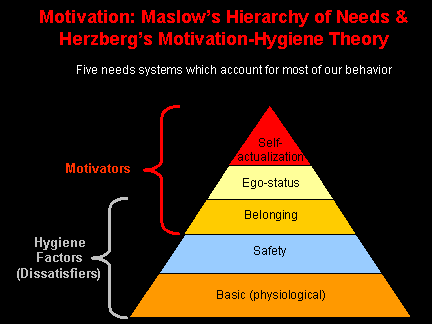
Step 1 is to create internal motivation to create a blog in the first place

Step 2 is to find what to write

Reasons Bloggers Blog-

Basic -Ranting


Examples- I hate Facebook Platform team treats me badly with waits, and breaks my code.

SAS Marketing wont give me  a big discount to make me look good in front of my boss.

Companies  wont give me their software for free- even though I will use it to make money (and not play X Box)

I want my vendors to be FOSS but my customers to switch to SaaS.

Google wont do this- Apple wont do that- Microsoft wont do those.

Revolution would give me 4 great packages but not the open source for RevoScaler (which only 300 people would understand in the first place)

Safety-

I better kiss the Professor and give a Turkey for dinner, as he sits on my thesis committee.

I will recommend Prof X’s lousy book in the hope he recommends my lousy book as a textbook too.

It is safe to laugh when the boss is making a joke-I should comment on her corporate blog, and retweet her.

Belonging-

I belong to this great online community of smart people. Let me agree to what they say.

I really believe in EVERYTHING that ALL the 2 MILLION members of the community have to say ALL the TIME.

I belong to this online community because all my friends are on my computer.

4 Egositic

My blog page rank is now X plus delta tau because of sugary key words (2004)

My technorati numbers rise (2005)

I was once on Digg (2007)

I have Z * exp N followers on Twitter and even more on Facebook (2008)

My Klout is increasing on twitter, My stack overflow reputation ‘s cup floweth over. (2009)

My Karma on Reddit is more important than my Karma in real life (2010)

Self Actualization-

I got time to kill- and I think I may learn more, meet intersting people and discover something wandering on the internet.

All those who wonder are not lost- Wikiquote

I got a story to tell, poems to write, code to give away. A free  Blog is something a Chinese , an Iranian  and a North korean really really know what the value is.

But after all that, WHY Do Bloggers Blog?

  • Because we are still waiting for Facebook to create the Blog Killer.
  • Its better than saying I am unemployed and a social loner
  • Reddit Karma feels good. Any Karma of any kind.

Reputation on Social Networks

Law of Diminishing Marginal Utility
Image via Wikipedia

Classical Economics talks of the value of utlity, diminishing marginal utility if the same things is repeated again and again (like spam in an online community)

StackOverflow has a great way of measuring reputation – and thus allows intangible benefits /awards -similar to wikipedia badges , reddit karma. Utility is also auto generated like @klout  on twitter or lists memberships and other sucessful open source communities online including Ubuntu forums have ways to create ah hierarchies even in class less utopian classes.

Basically it then acts as the motivating game as the mostly boy population try to race on numbers.


in Stack Overflow- you can get buddies to upvote you and basically act as a role playing game too.

—–From http://stackoverflow.com/faq#reputation

To gain reputation, post good questions and useful answers. Your peers will vote on your posts, and those votes will cause you to gain (or, in rare cases, lose) reputation:

answer is voted up +10
question is voted up +5
answer is accepted +15 (+2 to acceptor)
post is voted down -2 (-1 to voter)

A maximum of 30 votes can be cast per user per day, and you can earn a maximum of 200 reputation per day (although accepted answers and bounty awards are immune to this limit). Also, please note that votes for any posts marked “community wiki” do not generate reputation.

Amass enough reputation points and Stack Overflow will allow you to go beyond simply asking and answering questions:

15 Vote up
15 Flag offensive
50 Leave comments
100 Edit community wiki posts
125 Vote down (costs 1 rep)
200 Reduced advertising

Libre Office Marketing Event FOSDEM

Things begin building up for LibreOffice- and here is the inaugural event.

Source- LibreOffice Wiki


LibreOffice at FOSDEM – Call for Papers

Contents

[hide]

Call for Papers

2011: Brussels, FOSDEM.(2011-02-05 – 2011-02-06).. Your first chance ever to give a talk for LibreOffice at this great open source event… obviously you don’t want to miss this!

Do you want to share your experience in starting to hack the code, or tell about the tweaks in your build environment, talk about the code changes you have done or those that you prepare, or do you want to share insight on your QA work? Simply submit your proposal at this page.

We really like you to share in the way that fits you best, be it 5, 10 or up to 30 minutes 🙂

It might well be that we’ll have to choose between the various proposals, after all FOSDEM is only two days 😉 So please give a clear description of your talk, goals and target audience. For details, see the outline that is provided at the wiki.

FOSDEM is a free conference to attend, and we will try to seek sponsorship. But funding is limited, so please only request it if you cannot attend otherwise, and we will try our best to support you.

Thanks a lot,
TDF Steering Committee

More info

http://wiki.documentfoundation.org/Marketing/Events/Fosdem2011
For questions mail info@documentfoundation.org
Discussions with developers and code hackers take place on libreoffice@lists.freedesktop.org


Interview James Dixon Pentaho

Here is an interview with James Dixon the founder of Pentaho, self confessed Chief Geek and CTO. Pentaho has been growing very rapidly and it makes open source Business Intelligence solutions- basically the biggest chunk of enterprise software market currently.

Ajay-  How would you describe Pentaho as a BI product for someone who is completely used to traditional BI vendors (read non open source). Do the Oracle lawsuits over Java bother you from a business perspective?

James-

Pentaho has a full suite of BI software:

* ETL: Pentaho Data Integration

* Reporting: Pentaho Reporting for desktop and web-based reporting

* OLAP: Mondrian ROLAP engine, and Analyzer or Jpivot for web-based OLAP client

* Dashboards: CDF and Dashboard Designer

* Predictive Analytics: Weka

* Server: Pentaho BI Server, handles web-access, security, scheduling, sharing, report bursting etc

We have all of the standard BI functionality.

The Oracle/Java issue does not bother me much. There are a lot of software companies dependent on Java. If Oracle abandons Java a lot resources will suddenly focus on OpenJDK. It would be good for OpenJDK and might be the best thing for Java in the long term.

Ajay-  What parts of Pentaho’s technology do you personally like the best as having an advantage over other similar proprietary packages.

Describe the latest Pentaho for Hadoop offering and Hadoop/HIVE ‘s advantage over say Map Reduce and SQL.

James- The coolest thing is that everything is pluggable:

* ETL: New data transformation steps can be added. New orchestration controls (job entries) can be added. New perspectives can be added to the design UI. New data sources and destinations can be added.

* Reporting: New content types and report objects can be added. New data sources can be added.

* BI Server: Every factory, engine, and layer can be extended or swapped out via configuration. BI components can be added. New visualizations can be added.

This means it is very easy for Pentaho, partners, customers, and community member to extend our software to do new things.

In addition every engine and component can be fully embedded into a desktop or web-based application. I made a youtube video about our philosophy: http://www.youtube.com/watch?v=uMyR-In5nKE

Our Hadoop offerings allow ETL developers to work in a familiar graphical design environment, instead of having to code MapReduce jobs in Java or Python.

90% of the Hadoop use cases we hear about are transformation/reporting/analysis of structured/semi-structured data, so an ETL tool is perfect for these situations.

Using Pentaho Data Integration reduces implementation and maintenance costs significantly. The fact that our ETL engine is Java and is embeddable means that we can deploy the engine to the Hadoop data nodes and transform the data within the nodes.

Ajay-  Do you think the combination of recession, outsourcing,cost cutting, and unemployment are a suitable environment for companies to cut technology costs by going out of their usual vendor lists and try open source for a change /test projects.

Jamie- Absolutely. Pentaho grew (downloads, installations, revenue) throughout the recession. We are on target to do 250% of what we did last year, while the established vendors are flat in terms of new license revenue.

Ajay-  How would you compare the user interface of reports using Pentaho versus other reporting software. Please feel free to be as specific.

James- We have all of the everyday, standard reporting features covered.

Over the years the old tools, like Crystal Reports, have become bloated and complicated.

We don’t aim to have 100% of their features, because we’d end us just as complicated.

The 80:20 rule applies here. 80% of the time people only use 20% of their features.

We aim for 80% feature parity, which should cover 95-99% of typical use cases.

Ajay-  Could you describe the Pentaho integration with R as well as your relationship with Weka. Jaspersoft already has a partnership with Revolution Analytics for RevoDeployR (R on a web server)-

Any  R plans for Pentaho as well?

James- The feature set of R and Weka overlap to a small extent – both of them include basic statistical functions. Weka is focused on predictive models and machine learning, whereas R is focused on a full suite of statistical models. The creator and main Weka developer is a Pentaho employee. We have integrated R into our ETL tool. (makes me happy 🙂 )

(probably not a good time to ask if SAS integration is done as well for a big chunk of legacy base SAS/ WPS users)

About-

As “Chief Geek” (CTO) at Pentaho, James Dixon is responsible for Pentaho’s architecture and technology roadmap. James has over 15 years of professional experience in software architecture, development and systems consulting. Prior to Pentaho, James held key technical roles at AppSource Corporation (acquired by Arbor Software which later merged into Hyperion Solutions) and Keyola (acquired by Lawson Software). Earlier in his career, James was a technology consultant working with large and small firms to deliver the benefits of innovative technology in real-world environments.