DDE reconnect – the old DDE implementation was very quirky in that, opening and closing a DDE server document a few times would totally disconnect the link with the client document. Plus it also causes several other side-effects because of the way it accessed the server documents. The new implementation removes those quirkiness plus enables re-connection of DDE server client pair when the server document is loaded into LO when the client document is already open.
External reference rework – External reference handling has been re-worked to make it work within OFFSET function. In addition, this change allows Calc to read data directly from documents already loaded when possible. The old implementation would always load from disk even when the document was already loaded.
Autocorrect accidental caps locks – automatically corrects what appears to be a mis-cap such as tHIS or tHAT, as a result of the user not realizing the CAPS lock key was on. When correcting the mis-cap, it also automatically turns off CAPS lock (note: not working on Mac OS X yet). (translation)(look for accidental-caps-lock in the commit log)
Swapped default key bindings of Delete and Backspace keys in Calc – this was a major annoyance for former Excel users when migrating to Calc.
(look for delete-backspace-key in the commit log)
In Calc, hitting TAB during auto-complete commits current selection and moves to the next cell. Shift-TAB cycles through auto-complete selections.
and lots of bugs squashed….
_Announcement_
The Document Foundation is happy to announce the third beta of LibreOffice 3.3. This beta comes with lots of improvements and bugfixes. As usual, be warned that this is beta quality software – nevertheless, we ask you to play with it – we very much welcome your feedback and testing!
On Demand entertainment I need to hear
On Demand information of webcasts, white papers dear
On demand downloads of information I am told I really need
Sometimes it is tough to keep which is shallow what is deep
Is it really on demand or were you overwhelmed and manipulated by the supply
On Demand Supply and estimates of forecasts of influencer of the demand
Friendship is also on demand
How many Fans, Followers, Likes can you get
Before your critical mass makes you Viral
Like a Video Bieber whose clothes are torn by crowds
Searching for your 900 seconds of On Demand fame
You want to be paid on demand but work only on a creative fancy
Your on demand laziness is too demanding now
Ceteras Paribus, On demand is too much to demand
and much too on always on 24 7
Give me a book a friend and some peace and quiet
Bet you things arent there on supply but always on demand
Or are they?
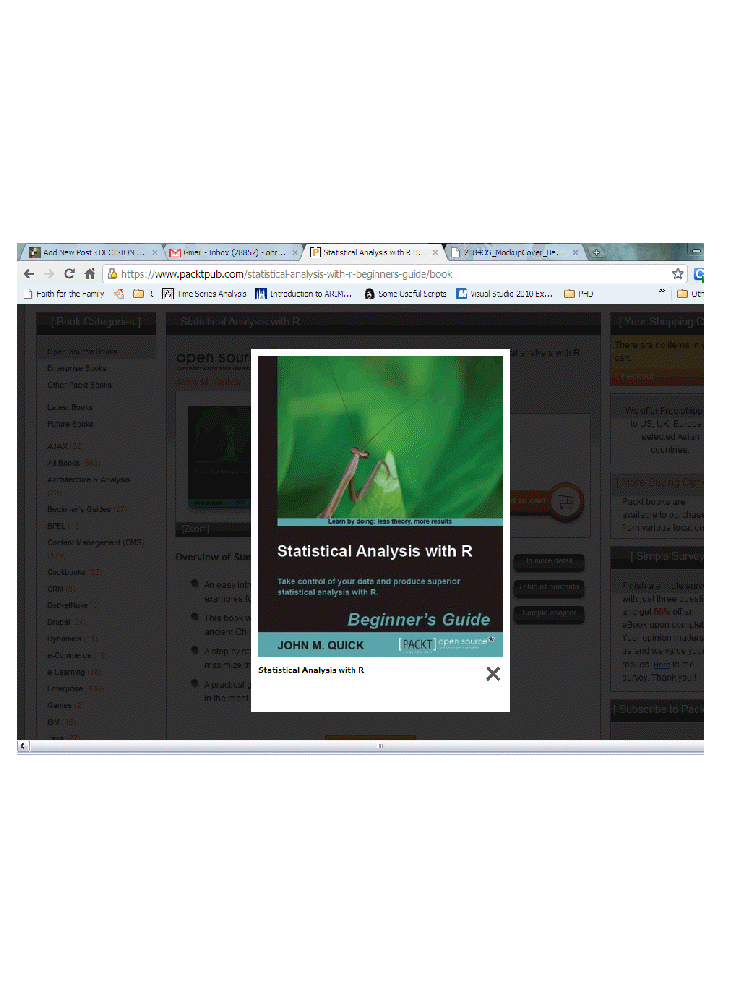
I was asked to be a techie reviewe for John M Quick’s new R book “Statistical Analysis with R” from Packt Publishing some months ago-(very much to my surprise I confess)-
I agreed- and technical reviewer work does take time- its like being a mid wife and there is whole team trying to get the book to birth.
Statistical Analysis with R- is a Beginner’s Guide so has nice screenshots, simple case studies, and quizzes to check recall of student/ reader. I remember struggling with the official “beginner’s guide to R” so this one is different in that it presents a story of a Chinese Army and how to use R to plan resources to fight the battle. It’s recommended especially for undergraduate courses- R need not be an elitist language- and given my experience with Asian programming acumen – I am sure it is a matter of time before high schools in India teach basic R in final years ( I learnt quite a shit load of quantum physics as compulsory topics in Indian high schools- but I guess we didnt have Jersey Shore things to do)
Congrats to author Mr John M Quick- he is doing his educational Phd from ASU- and I am sure both he and his approach to making education simple informative and fun will go places.
Only bad thing- The Name Statistical Analysis with R has atleast three other books , but I guess Google will catch up to it.
Here is an interview with James Dixon the founder of Pentaho, self confessed Chief Geek and CTO. Pentaho has been growing very rapidly and it makes open source Business Intelligence solutions- basically the biggest chunk of enterprise software market currently.
Ajay- How would you describe Pentaho as a BI product for someone who is completely used to traditional BI vendors (read non open source). Do the Oracle lawsuits over Java bother you from a business perspective?
The Oracle/Java issue does not bother me much. There are a lot of software companies dependent on Java. If Oracle abandons Java a lot resources will suddenly focus on OpenJDK. It would be good for OpenJDK and might be the best thing for Java in the long term.
Ajay- What parts of Pentaho’s technology do you personally like the best as having an advantage over other similar proprietary packages.
Describe the latest Pentaho for Hadoop offering and Hadoop/HIVE ‘s advantage over say Map Reduce and SQL.
James- The coolest thing is that everything is pluggable:
* ETL: New data transformation steps can be added. New orchestration controls (job entries) can be added. New perspectives can be added to the design UI. New data sources and destinations can be added.
* Reporting: New content types and report objects can be added. New data sources can be added.
* BI Server: Every factory, engine, and layer can be extended or swapped out via configuration. BI components can be added. New visualizations can be added.
This means it is very easy for Pentaho, partners, customers, and community member to extend our software to do new things.
In addition every engine and component can be fully embedded into a desktop or web-based application. I made a youtube video about our philosophy: http://www.youtube.com/watch?v=uMyR-In5nKE
Our Hadoop offerings allow ETL developers to work in a familiar graphical design environment, instead of having to code MapReduce jobs in Java or Python.
90% of the Hadoop use cases we hear about are transformation/reporting/analysis of structured/semi-structured data, so an ETL tool is perfect for these situations.
Using Pentaho Data Integration reduces implementation and maintenance costs significantly. The fact that our ETL engine is Java and is embeddable means that we can deploy the engine to the Hadoop data nodes and transform the data within the nodes.
Ajay- Do you think the combination of recession, outsourcing,cost cutting, and unemployment are a suitable environment for companies to cut technology costs by going out of their usual vendor lists and try open source for a change /test projects.
Jamie- Absolutely. Pentaho grew (downloads, installations, revenue) throughout the recession. We are on target to do 250% of what we did last year, while the established vendors are flat in terms of new license revenue.
Ajay- How would you compare the user interface of reports using Pentaho versus other reporting software. Please feel free to be as specific.
James- We have all of the everyday, standard reporting features covered.
Over the years the old tools, like Crystal Reports, have become bloated and complicated.
We don’t aim to have 100% of their features, because we’d end us just as complicated.
The 80:20 rule applies here. 80% of the time people only use 20% of their features.
We aim for 80% feature parity, which should cover 95-99% of typical use cases.
Ajay- Could you describe the Pentaho integration with R as well as your relationship with Weka. Jaspersoft already has a partnership with Revolution Analytics for RevoDeployR (R on a web server)-
Any R plans for Pentaho as well?
James- The feature set of R and Weka overlap to a small extent – both of them include basic statistical functions. Weka is focused on predictive models and machine learning, whereas R is focused on a full suite of statistical models. The creator and main Weka developer is a Pentaho employee. We have integrated R into our ETL tool. (makes me happy 🙂 )
(probably not a good time to ask if SAS integration is done as well for a big chunk of legacy base SAS/ WPS users)
About-
As “Chief Geek” (CTO) at Pentaho, James Dixon is responsible for Pentaho’s architecture and technology roadmap. James has over 15 years of professional experience in software architecture, development and systems consulting. Prior to Pentaho, James held key technical roles at AppSource Corporation (acquired by Arbor Software which later merged into Hyperion Solutions) and Keyola (acquired by Lawson Software). Earlier in his career, James was a technology consultant working with large and small firms to deliver the benefits of innovative technology in real-world environments.
Here is a short list of resources and material I put together as starting points for R and Cloud Computing It’s a bit messy but overall should serve quite comprehensively.
Cloud computing is a commonly used expression to imply a generational change in computing from desktop-servers to remote and massive computing connections,shared computers, enabled by high bandwidth across the internet.
As per the National Institute of Standards and Technology Definition,
Cloud computing is a model for enabling convenient, on-demand network access to a shared pool of configurable computing resources (e.g., networks, servers, storage, applications, and services) that can be rapidly provisioned and released with minimal management effort or service provider interaction.
Rweb is developed and maintained by Jeff Banfield. The Rweb Home Page provides access to all three versions of Rweb—a simple text entry form that returns output and graphs, a more sophisticated JavaScript version that provides a multiple window environment, and a set of point and click modules that are useful for introductory statistics courses and require no knowledge of the R language. All of the Rweb versions can analyze Web accessible datasets if a URL is provided.
The paper “Rweb: Web-based Statistical Analysis”, providing a detailed explanation of the different versions of Rweb and an overview of how Rweb works, was published in the Journal of Statistical Software (http://www.jstatsoft.org/v04/i01/).
Ulf Bartel has developed R-Online, a simple on-line programming environment for R which intends to make the first steps in statistical programming with R (especially with time series) as easy as possible. There is no need for a local installation since the only requirement for the user is a JavaScript capable browser. See http://osvisions.com/r-online/ for more information.
Rcgi is a CGI WWW interface to R by MJ Ray. It had the ability to use “embedded code”: you could mix user input and code, allowing the HTMLauthor to do anything from load in data sets to enter most of the commands for users without writing CGI scripts. Graphical output was possible in PostScript or GIF formats and the executed code was presented to the user for revision. However, it is not clear if the project is still active.
Currently, a modified version of Rcgi by Mai Zhou (actually, two versions: one with (bitmap) graphics and one without) as well as the original code are available from http://www.ms.uky.edu/~statweb/.
David Firth has written CGIwithR, an R add-on package available from CRAN. It provides some simple extensions to R to facilitate running R scripts through the CGI interface to a web server, and allows submission of data using both GET and POST methods. It is easily installed using Apache under Linux and in principle should run on any platform that supports R and a web server provided that the installer has the necessary security permissions. David’s paper “CGIwithR: Facilities for Processing Web Forms Using R” was published in the Journal of Statistical Software (http://www.jstatsoft.org/v08/i10/). The package is now maintained by Duncan Temple Lang and has a web page athttp://www.omegahat.org/CGIwithR/.
Rpad, developed and actively maintained by Tom Short, provides a sophisticated environment which combines some of the features of the previous approaches with quite a bit of JavaScript, allowing for a GUI-like behavior (with sortable tables, clickable graphics, editable output), etc.
Jeff Horner is working on the R/Apache Integration Project which embeds the R interpreter inside Apache 2 (and beyond). A tutorial and presentation are available from the project web page at http://biostat.mc.vanderbilt.edu/twiki/bin/view/Main/RApacheProject.
Rserve is a project actively developed by Simon Urbanek. It implements a TCP/IP server which allows other programs to use facilities of R. Clients are available from the web site for Java and C++ (and could be written for other languages that support TCP/IP sockets).
OpenStatServer is being developed by a team lead by Greg Warnes; it aims “to provide clean access to computational modules defined in a variety of computational environments (R, SAS, Matlab, etc) via a single well-defined client interface” and to turn computational services into web services.
Two projects use PHP to provide a web interface to R. R_PHP_Online by Steve Chen (though it is unclear if this project is still active) is somewhat similar to the above Rcgi and Rweb. R-php is actively developed by Alfredo Pontillo and Angelo Mineo and provides both a web interface to R and a set of pre-specified analyses that need no R code input.
webbioc is “an integrated web interface for doing microarray analysis using several of the Bioconductor packages” and is designed to be installed at local sites as a shared computing resource.
Rwui is a web application to create user-friendly web interfaces for R scripts. All code for the web interface is created automatically. There is no need for the user to do any extra scripting or learn any new scripting techniques. Rwui can also be found at http://rwui.cryst.bbk.ac.uk.
Finally, the R.rsp package by Henrik Bengtsson introduces “R Server Pages”. Analogous to Java Server Pages, an R server page is typically HTMLwith embedded R code that gets evaluated when the page is requested. The package includes an internal cross-platform HTTP server implemented in Tcl, so provides a good framework for including web-based user interfaces in packages. The approach is similar to the use of the brew package withRapache with the advantage of cross-platform support and easy installation.
Remote access to R/Bioconductor on EBI’s 64-bit Linux Cluster
Start the workbench by downloading the package for your operating system (Macintosh or Windows), or via Java Web Start, and you will get access to an instance of R running on one of EBI’s powerful machines. You can install additional packages, upload your own data, work with graphics and collaborate with colleagues, all as if you are running R locally, but unlimited by your machine’s memory, processor or data storage capacity.
Most up-to-date R version built for multicore CPUs
Access to all Bioconductor packages
Access to our computing infrastructure
Fast access to data stored in EBI’s repositories (e.g., public microarray data in ArrayExpress)
Using R Google Docs http://www.omegahat.org/RGoogleDocs/run.pdf
It uses the XML and RCurl packages and illustrates that it is relatively quick and easy
to use their primitives to interact with Web services.
Amazon’s EC2 is a type of cloud that provides on demand computing infrastructures called an Amazon Machine Images or AMIs. In general, these types of cloud provide several benefits:
Simple and convenient to use. An AMI contains your applications, libraries, data and all associated configuration settings. You simply access it. You don’t need to configure it. This applies not only to applications like R, but also can include any third-party data that you require.
On-demand availability. AMIs are available over the Internet whenever you need them. You can configure the AMIs yourself without involving the service provider. You don’t need to order any hardware and set it up.
Elastic access. With elastic access, you can rapidly provision and access the additional resources you need. Again, no human intervention from the service provider is required. This type of elastic capacity can be used to handle surge requirements when you might need many machines for a short time in order to complete a computation.
Pay per use. The cost of 1 AMI for 100 hours and 100 AMI for 1 hour is the same. With pay per use pricing, which is sometimes called utility pricing, you simply pay for the resources that you use.
#This example requires you had previously created a bucket named data_language on your Google Storage and you had uploaded a CSV file named language_id.txt (your data) into this bucket – see for details
library(predictionapirwrapper)
Elastic-R is a new portal built using the Biocep-R platform. It enables statisticians, computational scientists, financial analysts, educators and students to use cloud resources seamlessly; to work with R engines and use their full capabilities from within simple browsers; to collaborate, share and reuse functions, algorithms, user interfaces, R sessions, servers; and to perform elastic distributed computing with any number of virtual machines to solve computationally intensive problems.
Also see Karim Chine’s http://biocep-distrib.r-forge.r-project.org/
R for Salesforce.com
At the point of writing this, there seem to be zero R based apps on Salesforce.com This could be a big opportunity for developers as both Apex and R have similar structures Developers could write free code in R and charge for their translated version in Apex on Salesforce.com
Force.com and Salesforce have many (1009) apps at http://sites.force.com/appexchange/home for cloud computing for
businesses, but very few forecasting and statistical simulation apps.
These are like iPhone apps except meant for business purposes (I am
unaware if any university is offering salesforce.com integration
though google apps and amazon related research seems to be on)
Personal Note-Mentioning SAS in an email to a R list is a big no-no in terms of getting a response and love. Same for being careless about which R help list to email (like R devel or R packages or R help)
Prologue– In April 2009 I was as happy as I could be. or should have been. I was working from my house on my own sleep -wake schedule, had a bouncy 1 yr old son, an adoring girlfriend turned wife, a nice in-the-money 3 Bedroom Suburban apartment, and my startup /website was doing great, pulling in almost 4000 USD per month which was really huge given that I was parked in Delhi, India. and I had just been selected for a fully paid up grad school in the United States. Yes sir, life could not have been much better.
But the reality was I was extremely unhappy- or as unhappy as a person could be without being crazy about it. I was addicted to the always-on rush of the internet, working without a break on my writing and my job/contracts. I was ignoring my wife ‘s demands for more time as childish, and the rest of my family as interfering. Even my son seemed an time-crawl at times, so he spent more time with his nanny than me. I was hooked- and the drug was electronic, unblinking and always on. When I was not working, I was playing games on Facebook, tweeting like a teenager, or playing paid strategy games.I had been having mild arguments for the past several weeks with my wife, but I dismissed those concerns as feminine posturing. I mean, I knew her for eight years now- four before marriage and four after that. Any demands from her for more time or even to help out with the work at home meant time away from my computer or my business or even my sleep. After the high of fourteen go-go hours at work I needed some pills at the end of each day to sleep.
The wife could wait. The job, the money and the networking could not.
And then she walked out on me. With the kid. And the nanny. And With my credit card.
I was furious. How could this happen to me? In vain I raged against her, created scenes at her house to get my son back. She gave my credit card back. But it would take much more time than I realized to get my life back.
At work- I slowly began burning out. My pill fueled sleep was not refreshing and gave rise to hesitant and erratic behavior. Once again I blamed my client and co workers. They were the stupid ones- me- I was the creative genius. I lost their respect and then their friendship- eventually losing my monthly income. I now had a big mortgage on my house and no income to support it. And no family to fill the big house too.
Too proud to admit whose fault it was, I packed my bags to start life afresh in school in America.
My parents were supportive, especially my father. I had often been distant with him as he too had a demanding job as a police officer. I rationalized my work alcoholism on the ground that I was doing it for my family and making good money, unlike my father who had just spent thirty years on a middle level pay and much more work. My father had endured those complaints silently and just as silently he helped me through basic therapy to help me reach a medical condition fit enough to travel.
In America-
I resolved to start life anew in the United States. At first it went well. I swam in the housing pool and walked along the beautiful green campus.My immigrant energy was good enough for me to start impressing my classmates and my teachers. I used the opportunities available in the US to travel to conferences in New York and Las Vegas. And I partied like a bachelor in both these places. I had nothing else left to lose and so I thought. Beer bars were my salvation and I was redeemed there-at least for the evening. But then a familiar pattern from the past emerged- I could not focus long enough on my studies. My medication (this time prescribed by a doctor) increased but I steadily drank as well. I tried distracting myself with sports- especially with the university football team which played every Saturday. Caught up in the weekly ritual, I hoped it would give a good outlet to the hurt I felt inside. It was one such Saturday that I came across my Baptist friends.
I was hitch-hiking my way to the football stadium and steadily grew flustered as there was a steady stream of cars hurrying to their tailgates without sparing a thought for me. After walking in vain for almost half an hour under the burning sun, I threw my hands up, looked up at the sky, and silently implored heaven to give me a break.
Enter Jesus
And then a minor miracle happened. I got a ride from 4 guys in a car. For a colored guy to get a ride is a minor miracle in East Tennessee. It turned out Brendan,Brian , Brett and James were members of the local Crown College– a private Baptist college and they did not mind crowding in the back seat so I could have a comfortable ride. When Brendan mentioned that he and James were thinking of being Pastors after graduation, I asked them if we could study the Bible together-we promised to meet next Saturday and that was it.
The Bible studies were quite different from my childhood readings of the Bible while studying at a Catholic school in India. My relationship with God was that of a teenager with his Dad- I prayed only when I needed help or money or both.
These Bible studies were more like group discussions based on what we were doing, or where we wanted to be, all revolving around the particular quote or passage which was being studied. Contrary to my exceptions, studying the Bible was as natural for me as studying the Gita- and the study was much more rational and logical than I thought it would be.
After a couple of months of these I felt confident enough to go to their local Baptist Church. In the meantime I had expanded my weekly Bible studies to two- every Saturday with the awesome foursome Crownies and every Wednesday at Moe’s – a burrito eating place with Austin , a University student I had met while rock climbing in the campus gymnasium.
The Change
After a couple of months doing Bible Study I felt confident to go to Church, with Austin and my friends. While I alternated between the Baptist and the Prebysterian church I eventually settled for the Redeemer church as that was closest to me. In the meantime, Austin got engaged ,graduated and became busy holding two jobs. It was at a Christmas party that I first met Michael who had just started working with Bridges, a campus ministry.
Doing Michael ‘s Bible study was an evolution for me spiritually as I could now not only just read the Bible but start learning to apply it’s teachings in my daily life. While the Bible is clearly a religious book for Jews and Christians, the application of the works in your daily life is very common sense. People reading the Bible are happier than people not reading it, and happiness is what we strive for in our mortal life.
My relationships with people in my personal life improved, as I started learning the value of tolerance and forgiveness. I started drinking much much less, my health and disposition became much better. For the first time in 32 years of my life I could even say I was blessed to be with friends rather than be a habitual loner.
And God worked his miracles in my professional and personal life as well. While still at a struggle for money, I was having a steady income as my website business- and I started preparing to reconcile back to my son , my wife and my parents in India.Happy Beginning.
I am now in India, have a delightful 3 year old son, a caring wife, a small startup. This morning I got up and started designing the logo of my new firm. I talk better with my parents than I have in many decades.
I still follow Jesus but I dont go to church. Jesus was all about love, but churches can sometimes talk about hating gays, terrorists, foreigners etc.
I realized that believing in God has nothing to do with following or unfollowing a particular religion.
Are life’s struggles over? Am I never going to be in trouble or trying times again. I dont think so- if at all being more spiritually aware means a greater understanding of right and wrong and a bigger task to walk the straight and narrow path. I call this my Happy Beginning- and I wish you the same. Whatever religion you may have faith in, forgiveness and belief in a higher more forgiving , more merciful God can only help you achieve calm and happiness.
You can go to a pub /not believe in anything or choose to go to a church (or a temple /synagogue/ mosque).
Chances are people who believe in the latter are going to be happier. And if you add this with a merciful and forgiving attitude towards others (like God has for you) – there is no limit to where you Happy Beginning can take you.
I did get divorced and lost custody of my son. I also wrote books, became more successful in my life. Above all , learning to accept Gid without caring too much for the baggage that preachers impose in the name of organized religion, helps calm me down.
Cisco SocialMiner is a social media customer care solution that can help you proactively respond to customers and prospects communicating through public social media networks like Twitter, Facebook, or other public forums or blogging sites. By providing social media monitoring, queuing, and workflow to organize customer posts on social media networks and deliver them to your social media customer care team, your company can respond to customers in real time using the same social network they are using.
Cisco SocialMiner provides:
The ability to configure multiple campaigns to search for customer postings on the public social web about your company’s products, services, or area of expertise
Filtering of social contacts based on preconfigured campaign filters to focus campaign searches
Routing of social contacts to skilled customer care representatives in the contact center or to experts in the enterprise–multiple people can work together to handle responses to customer postings through shared work queues
Detailed metrics for social media customer care activities, campaign reports, and team reports
With Cisco SocialMiner, your company can listen and respond to customer conversations originating in the social web. Being proactive can help your company enhance its service, improve customer loyalty, garner new customers, and protect your brand.
Table 1. Features and Benefits of Cisco SocialMiner 8.5
Feature
Benefits
Product Baseline Features
Social media feeds
• Feeds are configurable sources to capture public social contacts that contain specific words, terms, or phrases.
• Feeds enable you to search for information on the public social web about your company’s products, services, or area of expertise.
• Cisco SocialMiner supports the following types of feeds:
• Groups feeds into campaigns to organize all posting activity related to a product category or business objective
• Produces metrics on campaign activity
• Provides the ability to configure multiple campaigns to search for customer postings on specific products or services
• Groups social contacts for handling by the social media customer care team
• Enables filtering of social contacts based on preconfigured campaign filters to focus campaign searches
Route and queue social contacts
• Enables routing of social contacts to skilled customer care representatives in the contact center
• Draws on expertise in the enterprise by allowing multiple people in the enterprise to work together to handle responses to customer postings through shared work queues
• Enables automated distribution of work to improve efficiency and effectiveness of social media engagement
Tagging
• Allows work to be routed to the appropriate team by grouping each post or social contact into different categories; for example, a post can be marked with the “customer_support” tag; this post will then appear on a customer support agent’s queue for processing
Social media customer care metrics
• Provides detailed metrics on social media customer care activities, campaign reports, and team reports
• Measures work and results
• Manages to service-level goals
• Supports brand management
• Optimizes staffing
• Includes dashboarding of social media posting activity when Cisco Unified Intelligence Center is used
Reporting for social contacts
• Provides a reporting database that can be accessed using any reporting tool, including Cisco Unified Intelligence Center
• Enables customer care management to accurately report on and track social media interactions by the contact center
OpenSocial-compliant gadgets
Representational State Transfer (REST) application programming interfaces (APIs)
• Provides flexible user interface options
• Enables extensive opportunities for customization
Optional integration with full suite of Cisco Collaboration tools
• Allows you to take advantage of the full suite of Cisco Collaboration tools, including Cisco Quad, Cisco Show and Share, and Cisco Pulse technology, to help your social media customer care team quickly find answers to help customers efficiently and effectively
• Requires a Cisco UCS C-Series or B-Series Server.
• Server consolidation means lower cost per server with Cisco UCS Servers.
Architecture
Scalability
• One server supports up to 30 simultaneous social media customer care users and 10,000 social contacts per hour.
Management
Cisco Unified Real-Time Monitoring Tool (RTMT)
• Operational management is enhanced through integration with the Cisco Unified RTMT, providing consistent application monitoring across Cisco Unified Communications Solutions.
Simple Network Management Protocol (SNMP)
• SNMP with an associated MIB is supported through the Cisco Voice Operating System (VOS).
Reporting
Cisco Unified Intelligence Center
• Create customizable reports of social media customer care events using Cisco Unified Intelligence Center (purchased separately).








 DECISION STATS