Short Interview Jill Dyche

Here is brief one question interview with Jill Dyche , founder Baseline Consulting.


In 2010.


  • It was more about consciousness-raising in the executive suite—
  • getting C-level managers to understand the ongoing value proposition of BI,
  • why MDM isn’t their father’s database, and
  • how data governance can pay for itself over time.
  • Some companies succeeded with these consciousness-raising efforts. Some didn’t.


But three big ones in 2011 would be:

  1. Predictive analytics in the cloud. The technology is now ready, and so is the market—and that includes SMB companies.
  2. Enterprise search being baked into (commoditized) BI software tools. (The proliferation of static reports is SO 2006!)
  3. Data governance will begin paying dividends. Until now it was all about common policies for data. In 2011, it will be about ROI.

I do a “Predictions for the coming year” article every January for TDWI,

Note- Jill ‘s January TDWI article seems worth waiting for in this case.

About-

Source-http://www.baseline-consulting.com/pages/page.asp?page_id=49125

Partner and Co-Founder

Jill Dyché is a partner and co-founder of Baseline Consulting.  She is responsible for key client strategies and market analysis in the areas of data governance, business intelligence, master data management, and customer relationship management. 

Jill counsels boards of directors on the strategic importance of their information investments.

Author

Jill is the author of three books on the business value of IT. Jill’s first book, e-Data (Addison Wesley, 2000) has been published in eight languages. She is a contributor to Impossible Data Warehouse Situations: Solutions from the Experts (Addison Wesley, 2002), and her book, The CRM Handbook (Addison Wesley, 2002), is the bestseller on the topic. 

Jill’s work has been featured in major publications such as Computerworld, Information Week, CIO Magazine, the Wall Street Journal, the Chicago Tribune and Newsweek.com. Jill’s latest book, Customer Data Integration (John Wiley and Sons, 2006) was co-authored with Baseline partner Evan Levy, and shows the business breakthroughs achieved with integrated customer data.

Industry Expert

Jill is a featured speaker at industry conferences, university programs, and vendor events. She serves as a judge for several IT best practice awards. She is a member of the Society of Information Managementand Women in Technology, a faculty member of TDWI, and serves as a co-chair for the MDM Insight conference. Jill is a columnist for DM Review, and a blogger for BeyeNETWORK and Baseline Consulting.


Complex Event Processing- SASE Language

Logo of the anti-RFID campaign by German priva...
Image via Wikipedia

Complex Event Processing (CEP- not to be confused by Circular Probability Error) is defined processing many events happening across all the layers of an organization, identifying the most meaningful events within the event cloud, analyzing their impact, and taking subsequent action in real time.

Software supporting CEP are-

Oracle http://www.oracle.com/us/technologies/soa/service-oriented-architecture-066455.html

Oracle CEP is a Java application server for the development and deployment of high-performance event driven applications. It can detect patterns in the flow of events and message payloads, often based on filtering, correlation, and aggregation across event sources, and includes industry leading temporal and ordering capabilities. It supports ultra-high throughput (1 million/sec++) and microsecond latency.

Tibco is also trying to get into this market (it claims to have a 40 % market share in the public CEP market 😉 though probably they have not measured the DoE and DoD as worthy of market share yet

– see webcast by TIBCO ‘s head here http://www.tibco.com/products/business-optimization/complex-event-processing/default.jsp

and product info here-http://www.tibco.com/products/business-optimization/complex-event-processing/businessevents/default.jsp

TIBCO is the undisputed leader in complex event processing (CEP) software with over 40 percent market share, according to a recent IDC Study.

A good explanation of how social media itself can be used as an analogy for CEP is given in this SAS Global Paper

http://support.sas.com/resources/papers/proceedings10/040-2010.pdf

You can see a report on Predictive Analytics and Data Mining  in q1 2010 also from SAS’s website  at –http://www.sas.com/news/analysts/forresterwave-predictive-analytics-dm-104388-0210.pdf

A very good explanation on architecture involved is given by SAS CTO Keith Collins here on SAS’s Knowledge Exchange site,

http://www.sas.com/knowledge-exchange/risk/four-ways-divide-conquer.html

What it is: Methods 1 through 3 look at historical data and traditional architectures with information stored in the warehouse. In this environment, it often takes months of data cleansing and preparation to get the data ready to analyze. Now, what if you want to make a decision or determine the effect of an action in real time, as a sale is made, for instance, or at a specific step in the manufacturing process. With streaming data architectures, you can look at data in the present and make immediate decisions. The larger flood of data coming from smart phones, online transactions and smart-grid houses will continue to increase the amount of data that you might want to analyze but not keep. Real-time streaming, complex event processing (CEP) and analytics will all come together here to let you decide on the fly which data is worth keeping and which data to analyze in real time and then discard.

When you use it: Radio-frequency identification (RFID) offers a good user case for this type of architecture. RFID tags provide a lot of information, but unless the state of the item changes, you don’t need to keep warehousing the data about that object every day. You only keep data when it moves through the door and out of the warehouse.

The same concept applies to a customer who does the same thing over and over. You don’t need to keep storing data for analysis on a regular pattern, but if they change that pattern, you might want to start paying attention.

Figure  4: Traditional architecture vs. streaming architecture

Figure 4: Traditional architecture vs. streaming architecture


In academia  here is something called SASE Language

  • A rich declarative event language
  • Formal semantics of the event language
  • Theorectical underpinnings of CEP
  • An efficient automata-based implementation

http://sase.cs.umass.edu/

and

http://avid.cs.umass.edu/sase/index.php?page=navleft_1col

Financial Services

The query below retrieves the total trading volume of Google stocks in the 4 hour period after some bad news occurred.

PATTERN SEQ(News a, Stock+ b[ ])WHERE   [symbol]    AND	a.type = 'bad'    AND	b[i].symbol = 'GOOG' WITHIN  4 hoursHAVING  b[b.LEN].volume < 80%*b[1].volumeRETURN  sum(b[ ].volume)

The next query reports a one-hour period in which the price of a stock increased from 10 to 20 and its trading volume stayed relatively stable.

PATTERN	SEQ(Stock+ a[])WHERE 	 [symbol]   AND	  a[1].price = 10   AND	  a[i].price > a[i-1].price   AND	  a[a.LEN].price = 20            WITHIN  1 hourHAVING	avg(a[].volume) ≥ a[1].volumeRETURN	a[1].symbol, a[].price

The third query detects a more complex trend: in an hour, the volume of a stock started high, but after a period of price increasing or staying relatively stable, the volume plummeted.

PATTERN SEQ(Stock+ a[], Stock b)WHERE 	 [symbol]   AND	  a[1].volume > 1000   AND	  a[i].price > avg(a[…i-1].price))   AND	  b.volume < 80% * a[a.LEN].volume           WITHIN  1 hourRETURN	a[1].symbol, a[].(price,volume), b.(price,volume)

(note from Ajay-


I was not really happy about the depth of resources on CEP available online- there seem to be missing bits and pieces in both open source, academic and corporate information- one reason for this is the obvious military dual use of this technology- like feeds from Satellite, Audio Scans, etc)

Who searches for this Blog?

Statue of Michael Jackson in Eindhoven, the Ne...
Image via Wikipedia

Using WP- Stats I set about answering this question-

What search keywords lead here-

Clearly Michael Jackson is down this year

And R GUI, Data Mining is up.

How does that affect my writing- given I get almost 250 visitors by search engines alone daily- assume I write nothing on this blog from now on.

It doesnt- I still write what ever code or poem that comes to my mind. So it is hurtful people misunderstimate the effort in writing and jump to conclusions (esp if I write about a company- I am not on payroll of that company- just like if  I write about a poem- I am not a full time poet)

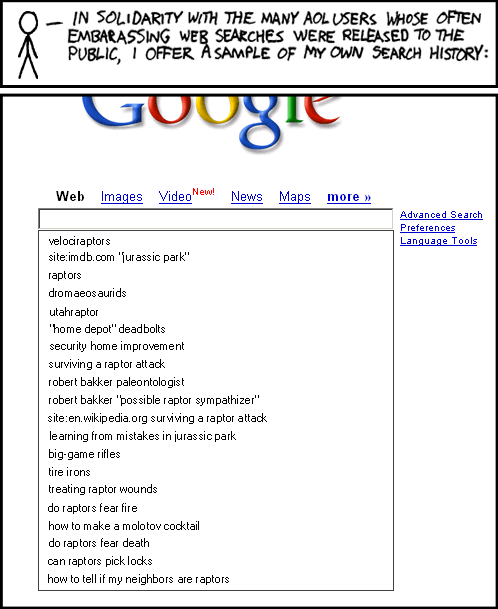
Over to xkcd

All Time (for Decisionstats.Wordpress.com)

Search Views
libre office 818
facebook analytics 806
michael jackson history 240
wps sas lawsuit 180
r gui 168
wps sas 154
wordle.net 118
sas wps 116
decision stats 110
sas wps lawsuit 100
google maps jet ski 94
data mining 88
doug savage 72
hive tutorial 63
spss certification 63
hadley wickham 63
google maps jetski 62
sas sues wps 60
decisionstats 58
donald farmer microsoft 45
libreoffice 44
wps statistics 44
best statistics software 42
r gui ubuntu 41
rstat 37
tamilnadu advanced technical training institute tatti 37

YTD

2009-11-24 to Today

Search Views
libre office 818
facebook analytics 781
wps sas lawsuit 170
r gui 164
wps sas 125
wordle.net 118
sas wps 101
sas wps lawsuit 95
google maps jet ski 94
data mining 86
decision stats 82
doug savage 63
hadley wickham 63
google maps jetski 62
hive tutorial 56
donald farmer microsoft 45

Quantifying Analytics ROI

Japanese House Crest “Go-Shichi no Kiri”
Image via Wikipedia

I had a brief twitter exchange with Jim Davis, Chief Marketing Officer, SAS Institute on Return of Investment on Business Analytics Projects for customers. I have interviewed Jim Davis before last year https://decisionstats.com/2009/06/05/interview-jim-davis-sas-institute/

Now Jim Davis is a big guy, and he is rushing from the launch of SAS Institute’s Social Media Analytics in Japan- to some arguably difficult flying conditions in time to be home in America for Thanksgiving. That and and I have not been much of a good Blog Boy recently, more swayed by love of open source, than love of software per se. I love equally, given I am bad at both equally.

Anyways, Jim’s contention  ( http://twitter.com/Davis_Jim ) was customers should go in business analytics only if there is Positive Return on Investment.  I am quoting him here-

What is important is that there be a positive ROI on each and every BA project. Otherwise don’t do it.

That’s not the marketing I was taught in my business school- basically it was sell, sell, sell.

However I see most BI sales vendors also go through -let me meet my sales quota for this quarter- and quantifying customer ROI is simple maths than predictive analytics but there seems to be some information assymetry in it.

Here is a paper from North Western University on ROI in IT projects-.

but overall it would be in the interest of customers and Business Analytics Vendors to publish aggregated ROI.

The opponents to this transparency in ROI would be market leaders in market share, who have trapped their customers by high migration costs (due to complexity) or contractually.

A recent study listed Oracle having a large percentage of unhappy customers who would still renew!, SAP had problems when it raised prices for licensing arbitrarily (that CEO is now CEO of HP and dodging legal notices from Oracle).

Indeed Jim Davis’s famous unsettling call for focusing on Business Analytics,as Business Intelligence is dead- that call has been implemented more aggressively by IBM in analytical acquisitions than even SAS itself which has been conservative about inorganic growth. Quantifying ROI, should theoretically aid open source software the most (since they are cheapest in up front licensing) or newer technologies like MapReduce /Hadoop (since they are quite so fast)- but I think that market has a way of factoring in these things- and customers are not as foolish neither as unaware of costs versus benefits of migration.

The contrary to this is Business Analytics and Business Intelligence are imperfect markets with duo-poly  or big players thriving in absence of customer regulation.

You get more protection as a customer of $20 bag of potato chips, than as a customer of a $200,000 software. Regulators are wary to step in to ensure ROI fairness (since most bright techies are qither working for private sector, have their own startup or invested in startups)- who in Govt understands Analytics and Intelligence strong enough to ensure vendor lock-ins are not done, and market flexibility is done. It is also a lower choice for embattled regulators to ensure ROI on enterprise software unlike the aggressiveness they have showed in retail or online software.

Who will Analyze the Analysts and who can quantify the value of quants (or penalize them for shoddy quantitative analytics)- is an interesting phenomenon we expect to see more of.


Libre Office (Beta) 3 Launched

Larry Ellison crop
Image via Wikipedia

The guys who forked off Larry Ellison‘s Open Office launched Beta 3 .

Whats new-

  • DDE reconnect – the old DDE implementation was very quirky in that, opening and closing a DDE server document a few times would totally disconnect the link with the client document. Plus it also causes several other side-effects because of the way it accessed the server documents. The new implementation removes those quirkiness plus enables re-connection of DDE server client pair when the server document is loaded into LO when the client document is already open.
  • External reference rework – External reference handling has been re-worked to make it work within OFFSET function. In addition, this change allows Calc to read data directly from documents already loaded when possible. The old implementation would always load from disk even when the document was already loaded.
  • Autocorrect accidental caps locks – automatically corrects what appears to be a mis-cap such as tHIS or tHAT, as a result of the user not realizing the CAPS lock key was on. When correcting the mis-cap, it also automatically turns off CAPS lock (note: not working on Mac OS X yet). (translation)(look for accidental-caps-lock in the commit log)
  • Swapped default key bindings of Delete and Backspace keys in Calc – this was a major annoyance for former Excel users when migrating to Calc.

(look for delete-backspace-key in the commit log)

  • In Calc, hitting TAB during auto-complete commits current selection and moves to the next cell. Shift-TAB cycles through auto-complete selections.
  • and lots of bugs squashed….

_Announcement_


The Document Foundation is happy to announce the third beta of
LibreOffice 3.3. This beta comes with lots of improvements and
bugfixes. As usual, be warned that this is beta quality software –
nevertheless, we ask you to play with it – we very much welcome your
feedback and testing!

Please, download suitable package(s) from

http://www.documentfoundation.org/download/

install them, and start testing. Should you find bugs, please report
them to the FreeDesktop Bugzilla:

https://bugs.freedesktop.org

A detailed list of changes from the past four weeks of development is
to be found here:

http://wiki.documentfoundation.org/Development/Weekly_Summary

If you want to get involved with this exciting project, you can
contribute code:

http://www.documentfoundation.org/develop/

translate LibreOffice to your language:

http://www.freedesktop.org/wiki/Software/LibreOffice/i18n/translating_3.3

or just donate:

http://www.documentfoundation.org/contribution/

A list of known issues with Beta 3 is available from our wiki:

http://wiki.documentfoundation.org/Beta3

Nice BI Tutorials

Tutorials screenshot.
Image via Wikipedia

Here is a set of very nice, screenshot enabled tutorials from SAP BI. They are a bit outdated (3 years old) but most of it is quite relevant- especially from a Tutorial Design Perspective –

Most people would rather see screenshot based step by step powerpoints, than cluttered or clever presentations , or even videos that force you to sit like a TV zombie. Unfortunately most tutorial presentations I see especially for BI are either slides with one or two points, that abruptly shift to “concepts” or videos that are atleast more than 10 minutes long. That works fine for scripting tutorials or hands on workshops, but cannot be reproduced for later instances of study.

The mode of tutorials especially for GUI software can vary, it may be Slideshare, Scribd, Google Presentation,Microsoft Powerpoint but a step by step screenshot by screenshot tutorial is much better for understanding than commando line jargon/ Youtub   Videos presentations, or Powerpoint with Points.

Have a look at these SAP BI 7 slideshares

and

Speaking of BI, the R Package called Brew is going to brew up something special especially combined with R Apache. However I wish R Apache, or R Web, or RServe had step by step install screenshot tutorials to increase their usage in Business Intelligence.

I tried searching for JMP GUI Tutorials too, but I believe putting all your content behind a registration wall is not so great. Do a Pareto Analysis of your training material, surely you can share a couple more tutorials without registration. It also will help new wanna-migrate users to get a test and feel for the installation complexities as well as final report GUI.


Why do bloggers blog ?

Xbox (revision 1.0) internal layout. Including...
Image via Wikipedia

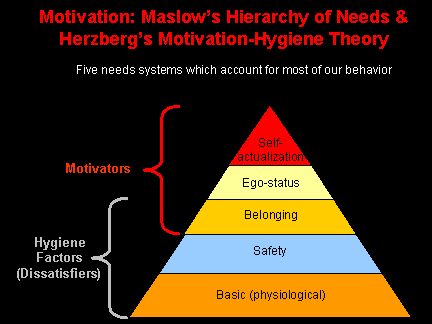
Step 1 is to create internal motivation to create a blog in the first place

Step 2 is to find what to write

Reasons Bloggers Blog-

Basic -Ranting


Examples- I hate Facebook Platform team treats me badly with waits, and breaks my code.

SAS Marketing wont give me  a big discount to make me look good in front of my boss.

Companies  wont give me their software for free- even though I will use it to make money (and not play X Box)

I want my vendors to be FOSS but my customers to switch to SaaS.

Google wont do this- Apple wont do that- Microsoft wont do those.

Revolution would give me 4 great packages but not the open source for RevoScaler (which only 300 people would understand in the first place)

Safety-

I better kiss the Professor and give a Turkey for dinner, as he sits on my thesis committee.

I will recommend Prof X’s lousy book in the hope he recommends my lousy book as a textbook too.

It is safe to laugh when the boss is making a joke-I should comment on her corporate blog, and retweet her.

Belonging-

I belong to this great online community of smart people. Let me agree to what they say.

I really believe in EVERYTHING that ALL the 2 MILLION members of the community have to say ALL the TIME.

I belong to this online community because all my friends are on my computer.

4 Egositic

My blog page rank is now X plus delta tau because of sugary key words (2004)

My technorati numbers rise (2005)

I was once on Digg (2007)

I have Z * exp N followers on Twitter and even more on Facebook (2008)

My Klout is increasing on twitter, My stack overflow reputation ‘s cup floweth over. (2009)

My Karma on Reddit is more important than my Karma in real life (2010)

Self Actualization-

I got time to kill- and I think I may learn more, meet intersting people and discover something wandering on the internet.

All those who wonder are not lost- Wikiquote

I got a story to tell, poems to write, code to give away. A free  Blog is something a Chinese , an Iranian  and a North korean really really know what the value is.

But after all that, WHY Do Bloggers Blog?

  • Because we are still waiting for Facebook to create the Blog Killer.
  • Its better than saying I am unemployed and a social loner
  • Reddit Karma feels good. Any Karma of any kind.