Facebook Deals

Facebook plans a deadly new entrant to social buying-and Groupon gets a new competitor. The sequel to “The Social Network” would be good, if they could get Robert De Niro to play Eric Schmidt

Click on screenshot for more details.

http://www.facebook.com/deals

Tips to Play Farmville Really Well

Here are some tips to play Farmville really well-

1) Keep your Farmville friends in a seperate friend list  by creating a list at http://www.facebook.com/friends/edit/

This ensures friendship , work and Farmville dont mess around with each other. You also dont need a lot of friends in Farmville (max 40 actives) unlike Mafia Wars

2) Register at http://rewards.zynga.com/ to get free or double rewards by doing the same work. These rewards can be redeemed in-game

3) Set a time as well as money budget. Like $10 per month and 1 hour on weekends with 15 minutes on weekdays with max 3-4 logins. Continue reading “Tips to Play Farmville Really Well”

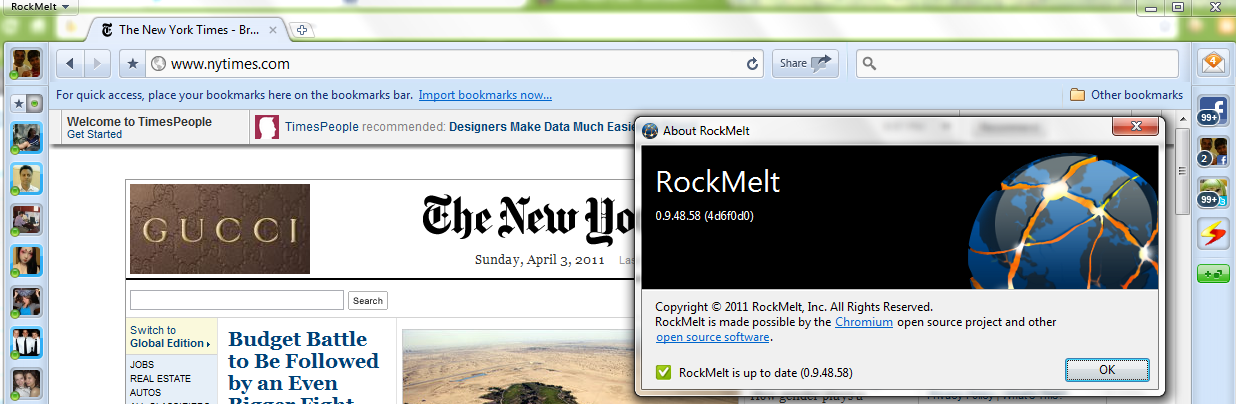
Rockmelt: A chromium based browser with a social layer

I kind of liked the latest browser on the block: Rockmelt.

It is based on Chromium open source project, that is primarily lead by Google. In case Facebook wants to buy a browser it can use Rockmelt–provided the mutual powers and angels agree.

I really liked the idea of a social layer- though I am not sure how the analytics embedded within a browser/report should be used.

Basically it re-designs the interface to put your social networks to the margin, thus quite a boon in you have active social media presence on multiple sites or a power reader/surfer. Timely alerts ping you to status/new messages without cluttering your screen and internet experience. Worth atleast a try or first look for the innovator kind of internet customer.

I still prefer the speed of Chrome– because Rockwell interface is still not easy to transition to – it almost adds in 3 dimensions in terms of where your eyeball should be while surfing (to left/right/margin).


and thats despite the funny fine print in Chrome’s user agreement of “continuing innovation”

type about:terms in your chrome bar to see-

4.3 As part of this continuing innovation, you acknowledge and agree that Google may stop (permanently or temporarily) providing the Services (or any features within the Services) to you or to users generally at Google’s sole discretion, without prior notice to you. You may stop using the Services at any time. You do not need to specifically inform Google when you stop using the Services.

Carole-Ann’s 2011 Predictions for Decision Management

Carole-Ann’s 2011 Predictions for Decision Management

For Ajay Ohri on DecisionStats.com

What were the top 5 events in 2010 in your field?
  1. Maturity: the Decision Management space was made up of technology vendors, big and small, that typically focused on one or two aspects of this discipline.  Over the past few years, we have seen a lot of consolidation in the industry – first with Business Intelligence (BI) then Business Process Management (BPM) and lately in Business Rules Management (BRM) and Advanced Analytics.  As a result the giant Platform vendors have helped create visibility for this discipline.  Lots of tiny clues finally bubbled up in 2010 to attest of the increasing activity around Decision Management.  For example, more products than ever were named Decision Manager; companies advertised for Decision Managers as a job title in their job section; most people understand what I do when I am introduced in a social setting!
  2. Boredom: unfortunately, as the industry matures, inevitably innovation slows down…  At the main BRMS shows we heard here and there complaints that the technology was stalling.  We heard it from vendors like Red Hat (Drools) and we heard it from bored end-users hoping for some excitement at Business Rules Forum’s vendor panel.  They sadly did not get it
  3. Scrum: I am not thinking about the methodology there!  If you have ever seen a rugby game, you can probably understand why this is the term that comes to mind when I look at the messy & confusing technology landscape.  Feet blindly try to kick the ball out while superhuman forces are moving randomly the whole pack – or so it felt when I played!  Business Users in search of Business Solutions are facing more and more technology choices that feel like comparing apples to oranges.  There is value in all of them and each one addresses a specific aspect of Decision Management but I regret that the industry did not simplify the picture in 2010.  On the contrary!  Many buzzwords were created or at least made popular last year, creating even more confusion on a muddy field.  A few examples: Social CRM, Collaborative Decision Making, Adaptive Case Management, etc.  Don’t take me wrong, I *do* like the technologies.  I sympathize with the decision maker that is trying to pick the right solution though.
  4. Information: Analytics have been used for years of course but the volume of data surrounding us has been growing to unparalleled levels.  We can blame or thank (depending on our perspective) Social Media for that.  Sites like Facebook and LinkedIn have made it possible and easy to publish relevant (as well as fluffy) information in real-time.  As we all started to get the hang of it and potentially over-publish, technology evolved to enable the storage, correlation and analysis of humongous volumes of data that we could not dream of before.  25 billion tweets were posted in 2010.  Every month, over 30 billion pieces of data are shared on Facebook alone.  This is not just about vanity and marketing though.  This data can be leveraged for the greater good.  Carlos pointed to some fascinating facts about catastrophic event response team getting organized thanks to crowd-sourced information.  We are also seeing, in the Decision management world, more and more applicability for those very technology that have been developed for the needs of Big Data – I’ll name for example Hadoop that Carlos (yet again) discussed in his talks at Rules Fest end of 2009 and 2010.
  5. Self-Organization: it may be a side effect of the Social Media movement but I must admit that I was impressed by the success of self-organizing initiatives.  Granted, this last trend has nothing to do with Decision Management per se but I think it is a great evolution worth noting.  Let me point to a couple of examples.  I usually attend traditional conferences and tradeshows in which the content can be good but is sometimes terrible.  I was pleasantly surprised by the professionalism and attendance at *un-conferences* such as P-Camp (P stands for Product – an event for Product Managers).  When you think about it, it is already difficult to get a show together when people are dedicated to the tasks.  How crazy is it to have volunteers set one up with no budget and no agenda?  Well, people simply show up to do their part and everyone has fun voting on-site for what seems the most appealing content at the time.  Crowdsourcing applied to shows: it works!  Similar experience with meetups or tweetups.  I also enjoyed attending some impromptu Twitter jam sessions on a given topic.  Social Media is certainly helping people reach out and get together in person or virtually and that is wonderful!

A segment of a social network
Image via Wikipedia

What are the top three trends you see in 2011?

  1. Performance:  I might be cheating here.   I was very bullish about predicting much progress for 2010 in the area of Performance Management in your Decision Management initiatives.  I believe that progress was made but Carlos did not give me full credit for the right prediction…  Okay, I am a little optimistic on timeline…  I admit it…  If it did not fully happen in 2010, can I predict it again in 2011?  I think that companies want to better track their business performance in order to correct the trajectory of course but also to improve their projections.  I see that it is turning into reality already here and there.  I expect it to become a trend in 2011!
  2. Insight: Big Data being available all around us with new technologies and algorithms will continue to propagate in 2011 leading to more widely spread Analytics capabilities.  The buzz at Analytics shows on Social Network Analysis (SNA) is a sign that there is interest in those kinds of things.  There is tremendous information that can be leveraged for smart decision-making.  I think there will be more of that in 2011 as initiatives launches in 2010 will mature into material results.
    5 Ways to Cultivate an Active Social Network
    Image by Intersection Consulting via Flickr
  3. Collaboration:  Social Media for the Enterprise is a discipline in the making.  Social Media was initially seen for the most part as a Marketing channel.  Over the years, companies have started experimenting with external communities and ideation capabilities with moderate success.  The few strategic initiatives started in 2010 by “old fashion” companies seem to be an indication that we are past the early adopters.  This discipline may very well materialize in 2011 as a core capability, well, or at least a new trend.  I believe that capabilities such Chatter, offered by Salesforce, will transform (slowly) how people interact in the workplace and leverage the volumes of social data captured in LinkedIn and other Social Media sites.  Collaboration is of course a topic of interest for me personally.  I even signed up for Kare Anderson’s collaboration collaboration site – yes, twice the word “collaboration”: it is really about collaborating on collaboration techniques.  Even though collaboration does not require Social Media, this medium offers perspectives not available until now.

Brief Bio-

Carole-Ann is a renowned guru in the Decision Management space. She created the vision for Decision Management that is widely adopted now in the industry. Her claim to fame is the strategy and direction of Blaze Advisor, the then-leading BRMS product, while she also managed all the Decision Management tools at FICO (business rules, predictive analytics and optimization). She has a vision for Decision Management both as a technology and a discipline that can revolutionize the way corporations do business, and will never get tired of painting that vision for her audience. She speaks often at Industry conferences and has conducted university classes in France and Washington DC.

Leveraging her Masters degree in Applied Mathematics / Computer Science from a “Grande Ecole” in France, she started her career building advanced systems using all kinds of technologies — expert systems, rules, optimization, dashboarding and cubes, web search, and beta version of database replication – as well as conducting strategic consulting gigs around change management.

She now tweets as @CMatignon, blogs at blog.sparklinglogic.com and interacts at community.sparklinglogic.com.

She started her career building advanced systems using all kinds of technologies — expert systems, rules, optimization, dashboarding and cubes, web search, and beta version of database replication.  At Cleversys (acquired by Kurt Salmon & Associates), she also conducted strategic consulting gigs mostly around change management.

While playing with advanced software components, she found a passion for technology and joined ILOG (acquired by IBM).  She developed a growing interest in Optimization as well as Business Rules.  At ILOG, she coined the term BRMS while brainstorming with her Sales counterpart.  She led the Presales organization for Telecom in the Americas up until 2000 when she joined Blaze Software (acquired by Brokat Technologies, HNC Software and finally FICO).

Her 360-degree experience allowed her to gain appreciation for all aspects of a software company, giving her a unique perspective on the business.  Her technical background kept her very much in touch with technology as she advanced.

She also became addicted to Twitter in the process.  She is active on all kinds of social media, always looking for new digital experience!

Outside of work, Carole-Ann loves spending time with her two boys.  They grow fruits in their Northern California home and cook all together in the French tradition.

profile on LinkedIn

TwitterFollow me on Twitter

Filtering to Gain Social Network Value
Image by Intersection Consulting via Flickr
Social Networks Hype Cycle
Image by fredcavazza via Flickr

PAW Videos

A message from Predictive Analytics World on  newly available videos. It has many free videos as well so you can check them out.
Predictive Analytics World March 2011 in San Francisco

Access PAW DC Session Videos Now

Predictive Analytics World is pleased to announce on-demand access to the videos of PAW Washington DC, October 2010, including over 30 sessions and keynotes that you may view at your convenience. Access this leading predictive analytics content online now:

View the PAW DC session videos online

Register by January 18th and receive $150 off the full 2-day conference program videos (enter code PAW150 at checkout)

Trial videos – view the following for no charge:

Select individual conference sessions, or recognize savings by registering for access to one or two full days of sessions. These on-demand videos deliver PAW DC right to your desk, covering hot topics and advanced methods such as:

Social data 

Text mining

Search marketing

Risk management

Survey analysis

Consumer privacy

Sales force optimization

Response & cross-sell

Recommender systems

Featuring experts such as:
Usama Fayyad, Ph.D.
CEO, Open Insights Former Chief Data Officer, Yahoo!

Andrew Pole
Sr Mgr, Media/DB Mktng
Target
View Keynote for Free

John F. Elder, Ph.D.
CEO and Founder
Elder Research

Bruno Aziza
Director, Worldwide Strategy Lead, BI
Microsoft

Eric Siegel, Ph.D.
Conference Chair
Predictive Analytics World

PAW DC videos feature over 25 speakers with case studies from leading enterprises such as: CIBC, CEB, Forrester, Macy’s, MetLife, Microsoft, Miles Kimball, Monster.com, Oracle, Paychex, SunTrust, Target, UPMC, Xerox, Yahoo!, YMCA, and more.

How video access works:

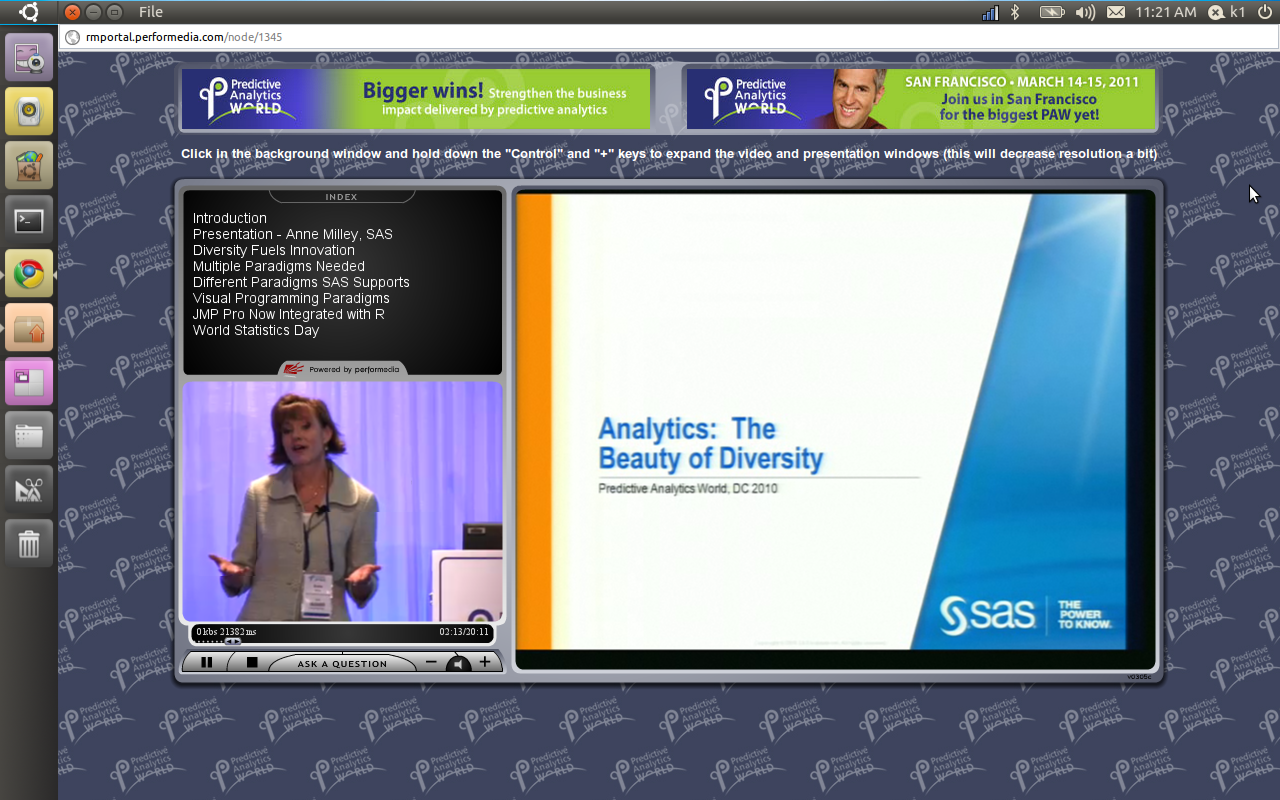
View Slides on the Left See & Hear Speaker in the Right Window

Sign up by January 18 for immediate video access and $150 discount


San Francisco
March 14-15, 2011
Washington DC
October, 2011
London
November, 2011
Contact Us

Produced by:


Session Gallery: Day 1 of 2

Viewing (17) Sessions of (31)


keynote.jpg
Add to Cart
Keynote: Five Ways Predictive Analytics Cuts Enterprise Risk  

Eric Siegel, Ph.D., Program Chair, Predictive Analytics World

All business is an exercise in risk management. All organizations would benefit from measuring, tracking and computing risk as a core process, much like insurance companies do.

Predictive analytics does the trick, one customer at a time. This technology is a data-driven means to compute the risk each customer will defect, not respond to an expensive mailer, consume a retention discount even if she were not going to leave in the first place, not be targeted for a telephone solicitation that would have landed a sale, commit fraud, or become a “loss customer” such as a bad debtor or an insurance policy-holder with high claims.

In this keynote session, Dr. Eric Siegel reveals:

– Five ways predictive analytics evolves your enterprise to reduce risk

– Hidden sources of risk across operational functions

– What every business should learn from insurance companies

– How advancements have reversed the very meaning of fraud

– Why “man + machine” teams are greater than the sum of their parts for enterprise decision support

Length – 00:45:57 | Email to a Colleague

Price: $195


sponsor.jpg
Play video of session: Platinum Sponsor Presentation, Analytics: The Beauty of Diversity
Platinum Sponsor Presentation: Analytics – The Beauty of Diversity 

Anne H. Milley, Senior Director of Analytic Strategy, Worldwide Product Marketing, SAS

Analytics contributes to, and draws from, multiple disciplines. The unifying theme of “making the world a better place” is bred from diversity. For instance, the same methods used in econometrics might be used in market research, psychometrics and other disciplines. In a similar way, diverse paradigms are needed to best solve problems, reveal opportunities and make better decisions. This is why we evolve capabilities to formulate and solve a wide range of problems through multiple integrated languages and interfaces. Extending that, we have provided integration with other languages so that users can draw on the disciplines and paradigms needed to best practice their craft.

Length – 20:11 | Email to a Colleague

Free viewing enabled – no charge


gold sponsor.jpg
Play video of session: Gold Sponsor Presentation Predictive Analytics Accelerate Insight for Financial Services
Gold Sponsor Presentation: Predictive Analytics Accelerate Insight for Financial Services 

Finbarr Deely, Director of Business Development,ParAccel

Financial services organizations face immense hurdles in maintaining profitability and building competitive advantage. Financial services organizations must perform “what-if” scenario analysis, identify risks, and detect fraud patterns. The advanced analytic complexity required often makes such analysis slow and painful, if not impossible. This presentation outlines the analytic challenges facing these organizations and provides a clear path to providing the accelerated insight needed to perform in today’s complex business environment to reduce risk, stop fraud and increase profits. * The value of predictive analytics in Accelerating Insight * Financial Services Analytic Case Studies * Brief Overview of ParAccel Analytic Database

Length – 09:06 | Email to a Colleague

Free viewing enabled – no charge


isson1.jpg
Add to Cart
TOPIC: BUSINESS VALUE
Case Study: Monster.com
Creating Global Competitive Power with Predictive Analytics 

Jean Paul Isson, Vice President, Globab BI & Predictive Analytics, Monster Worldwide

Using Predictive analytics to gain a deeper understanding of customer behaviours, increase marketing ROI and drive growth

– Creating global competitive power with business intelligence: Making the right decisions – at the right time

– Avoiding common change management challenges in sales, marketing, customer service, and products

– Developing a BI vision – and implementing it: successful business intelligence implementation models

– Using predictive analytics as a business driver to stay on top of the competition

– Following the Monster Worldwide global BI evolution: How Monster used BI to go from good to great

Length – 51:17 | Email to a Colleague

Price: $195


abbot.jpg
Add to Cart
TOPIC: SURVEY ANALYSIS
Case Study: YMCA
Turning Member Satisfaction Surveys into an Actionable Narrative 

Dean Abbott, President, Abbott Analytics

Employees are a key constituency at the Y and previous analysis has shown that their attitudes have a direct bearing on Member Satisfaction. This session will describe a successful approach for the analysis of YMCA employee surveys. Decision trees are built and examined in depth to identify key questions in describing key employee satisfaction metrics, including several interesting groupings of employee attitudes. Our approach will be contrasted with other factor analysis and regression-based approaches to survey analysis that we used initially. The predictive models described are currently in use and resulted in both greater understanding of employee attitudes, and a revised “short-form” survey with fewer key questions identified by the decision trees as the most important predictors.

Length – 50:19 | Email to a Colleague

Price: $195


rexer.jpg
Add to Cart
TOPIC: INDUSTRY TRENDS
2010 Data Minter Survey Results: Highlights
 

Karl Rexer, Ph.D., Rexer Analytics

Do you want to know the views, actions, and opinions of the data mining community? Each year, Rexer Analytics conducts a global survey of data miners to find out. This year at PAW we unveil the results of our 4th Annual Data Miner Survey. This session will present the research highlights, such as:

– Analytic goals & key challenges

– Impact of the economy

– Regional differences

– Text mining trends

Length – 15:20 | Email to a Colleague

Price: $195


elder.jpg
Add to Cart
Multiple Case Studies: U.S. DoD, U.S. DHS, SSA
Text Mining: Lessons Learned 

John F. Elder, Chief Scientist, Elder Research, Inc.

Text Mining is the “Wild West” of data mining and predictive analytics – the potential for gain is huge, the capability claims are often tall tales, and the “land rush” for leadership is very much a race.

In solving unstructured (text) analysis challenges, we found that principles from inductive modeling – learning relationships from labeled cases – has great power to enhance text mining. Dr. Elder highlights key technical breakthroughs discovered while working on projects for leading government agencies, including: Text Mining is the “Wild West” of data mining and predictive analytics – the potential for gain is huge, the capability claims are often tall tales, and the “land rush” for leadership is very much a race.

– Prioritizing searches for the Dept. of Homeland Security

– Quick decisions for Social Security Admin. disability

– Document discovery for the Dept. of Defense

– Disease discovery for the Dept. of Homeland Security

– Risk profiling for the Dept. of Defense

Length – 48:58 | Email to a Colleague

Price: $195


target.jpg
Play video of session: Keynote: How Target Gets the Most out of Its Guest Data to Improve Marketing ROI
Keynote: How Target Gets the Most out of Its Guest Data to Improve Marketing ROI 

Andrew Pole, Senior Manager, Media and Database Marketing, Target

In this session, you’ll learn how Target leverages its own internal guest data to optimize its direct marketing – with the ultimate goal of enhancing our guests’ shopping experience and driving in-store and online performance. You will hear about what guest data is available at Target, how and where we collect it, and how it is used to improve the performance and relevance of direct marketing vehicles. Furthermore, we will discuss Target’s development and usage of guest segmentation, response modeling, and optimization as means to suppress poor performers from mailings, determine relevant product categories and services for online targeted content, and optimally assign receipt marketing offers to our guests when offer quantities are limited.

Length – 47:49 | Email to a Colleague

Free viewing enabled – no charge


analytics.jpg
Play video of session: Platinum Sponsor Presentation: Driving Analytics Into Decision Making
Platinum Sponsor Presentation: Driving Analytics Into Decision Making  

Jason Verlen, Director, SPSS Product Strategy & Management, IBM Software Group

Organizations looking to dramatically improve their business outcomes are turning to decision management, a convergence of technology and business processes that is used to streamline and predict the outcome of daily decision-making. IBM SPSS Decision Management technology provides the critical link between analytical insight and recommended actions. In this session you’ll learn how Decision Management software integrates analytics with business rules and business applications for front-line systems such as call center applications, insurance claim processing, and websites. See how you can improve every customer interaction, minimize operational risk, reduce fraud and optimize results.

Length – 17:29 | Email to a Colleague

Free viewing enabled – no charge


macy.jpg
Add to Cart
TOPIC: DATA INFRASTRUCTURE AND INTEGRATION
Case Study: Macy’s
The world is not flat (even though modeling software has to think it is) 

Paul Coleman, Director of Marketing Statistics, Macy’s Inc.

Software for statistical modeling generally use flat files, where each record represents a unique case with all its variables. In contrast most large databases are relational, where data are distributed among various normalized tables for efficient storage. Variable creation and model scoring engines are necessary to bridge data mining and storage needs. Development datasets taken from a sampled history require snapshot management. Scoring datasets are taken from the present timeframe and the entire available universe. Organizations, with significant data, must decide when to store or calculate necessary data and understand the consequences for their modeling program.

Length – 34:54 | Email to a Colleague

Price: $195


gwaltney.jpg
Add to Cart
TOPIC: CUSTOMER VALUE
Case Study: SunTrust
When One Model Will Not Solve the Problem – Using Multiple Models to Create One Solution 

Dudley Gwaltney, Group Vice President, Analytical Modeling, SunTrust Bank

In 2007, SunTrust Bank developed a series of models to identify clients likely to have large changes in deposit balances. The models include three basic binary and two linear regression models.

Based on the models, 15% of SunTrust clients were targeted as those most likely to have large balance changes. These clients accounted for 65% of the absolute balance change and 60% of the large balance change clients. The targeted clients are grouped into a portfolio and assigned to individual SunTrust Retail Branch. Since 2008, the portfolio generated a 2.6% increase in balances over control.

Using the SunTrust example, this presentation will focus on:

– Identifying situations requiring multiple models

– Determining what types of models are needed

– Combining the individual component models into one output

Length – 48:22 | Email to a Colleague

Price: $195


paychex1.jpg
Add to Cart
TOPIC: RESPONSE & CROSS-SELL
Case Study: Paychex
Staying One Step Ahead of the Competition – Development of a Predictive 401(k) Marketing and Sales Campaign 

Jason Fox, Information Systems and Portfolio Manager,Paychex

In-depth case study of Paychex, Inc. utilizing predictive modeling to turn the tides on competitive pressures within their own client base. Paychex, a leading provider of payroll and human resource solutions, will guide you through the development of a Predictive 401(k) Marketing and Sales model. Through the use of sophisticated data mining techniques and regression analysis the model derives the probability a client will add retirement services products with Paychex or with a competitor. Session will include roadblocks that could have ended development and ROI analysis. Speaker: Frank Fiorille, Director of Enterprise Risk Management, Paychex Speaker: Jason Fox, Risk Management Analyst, Paychex

Length – 26:29 | Email to a Colleague

Price: $195


ling.jpg
Add to Cart
TOPIC: SEGMENTATION
Practitioner: Canadian Imperial Bank of Commerce
Segmentation Do’s and Don’ts 

Daymond Ling, Senior Director, Modelling & Analytics,Canadian Imperial Bank of Commerce

The concept of Segmentation is well accepted in business and has withstood the test of time. Even with the advent of new artificial intelligence and machine learning methods, this old war horse still has its place and is alive and well. Like all analytical methods, when used correctly it can lead to enhanced market positioning and competitive advantage, while improper application can have severe negative consequences.

This session will explore what are the elements of success, and what are the worse practices that lead to failure. The relationship between segmentation and predictive modeling will also be discussed to clarify when it is appropriate to use one versus the other, and how to use them together synergistically.

Length – 45:57 | Email to a Colleague

Price: $195


kobelius1.jpg
Add to Cart
TOPIC: SOCIAL DATA
Thought Leadership
Social Network Analysis: Killer Application for Cloud Analytics
 

James Kobielus, Senior Analyst, Forrester Research

Social networks such as Twitter and Facebook are a potential goldmine of insights on what is truly going through customers´minds. Every company wants to know whether, how, how often, and by whom they´re being mentioned across the billowing new cloud of social media. Just as important, every company wants to influence those discussions in their favor, target new business, and harvest maximum revenue potential. In this session, Forrester analyst James Kobielus identifies fruitful applications of social network analysis in customer service, sales, marketing, and brand management. He presents a roadmap for enterprises to leverage their inline analytics initiatives and leverage high-performance data warehousing (DW) clouds and appliances in order to analyze shifting patterns of customer sentiment, influence, and propensity. Leveraging Forrester’s ongoing research in advanced analytics and customer relationship management, Kobielus will discuss industry trends, commercial modeling tools, and emerging best practices in social network analysis, which represents a game-changing new discipline in predictive analytics.

Length – 48:16 | Email to a Colleague

Price: $195


dogan.jpg
Add to Cart
TOPIC: HEALTHCARE – INTERNATIONAL TARGETING
Case Study: Life Line Screening
Taking CRM Global Through Predictive Analytics 

Ozgur Dogan,
VP, Quantitative Solutions Group, Merkle Inc

Trish Mathe,
Director of Database Marketing, Life Line Screening

While Life Line is successfully executing a US CRM roadmap, they are also beginning this same evolution abroad. They are beginning in the UK where Merkle procured data and built a response model that is pulling responses over 30% higher than competitors. This presentation will give an overview of the US CRM roadmap, and then focus on the beginning of their strategy abroad, focusing on the data procurement they could not get anywhere else but through Merkle and the successful modeling and analytics for the UK. Speaker: Ozgur Dogan, VP, Quantitative Solutions Group, Merkle Inc Speaker: Trish Mathe, Director of Database Marketing, Life Line Screening

Length – 40:12 | Email to a Colleague

Price: $195


sambamoorthi1.jpg
Add to Cart
TOPIC: SURVEY ANALYSIS
Case Study: Forrester
Making Survey Insights Addressable and Scalable – The Case Study of Forrester’s Technographics Benchmark Survey 

Nethra Sambamoorthi, Team Leader, Consumer Dynamics & Analytics, Global Consulting, Acxiom Corporation

Marketers use surveys to create enterprise wide applicable strategic insights to: (1) develop segmentation schemes, (2) summarize consumer behaviors and attitudes for the whole US population, and (3) use multiple surveys to draw unified views about their target audience. However, these insights are not directly addressable and scalable to the whole consumer universe which is very important when applying the power of survey intelligence to the one to one consumer marketing problems marketers routinely face. Acxiom partnered with Forrester Research, creating addressable and scalable applications of Forrester’s Technographics Survey and applied it successfully to a number of industries and applications.

Length – 39:23 | Email to a Colleague

Price: $195


zasadil.jpg
Add to Cart
TOPIC: HEALTHCARE
Case Study: UPMC Health Plan
A Predictive Model for Hospital Readmissions 

Scott Zasadil, Senior Scientist, UPMC Health Plan

Hospital readmissions are a significant component of our nation’s healthcare costs. Predicting who is likely to be readmitted is a challenging problem. Using a set of 123,951 hospital discharges spanning nearly three years, we developed a model that predicts an individual’s 30-day readmission should they incur a hospital admission. The model uses an ensemble of boosted decision trees and prior medical claims and captures 64% of all 30-day readmits with a true positive rate of over 27%. Moreover, many of the ‘false’ positives are simply delayed true positives. 53% of the predicted 30-day readmissions are readmitted within 180 days.

Length – 54:18 | Email to a Colleague

Price: $195

RWui :Creating R Web Interfaces on the go

Here is a great R application created by http://sysbio.mrc-bsu.cam.ac.uk

R Wui for creating R Web Interfaces

its been there for some time now- but presumably R Apache is more well known.

From-

http://sysbio.mrc-bsu.cam.ac.uk/Rwui/tutorial/Rwui_Rnews_final.pdf

The web application Rwui is used to create web interfaces  for running R scripts. All the code is generated automatically so that a fully functional web interface for an R script can be downloaded and up and running in a matter of minutes.

Rwui is aimed at R script writers who have scripts that they want people unversed in R to use. The script writer uses Rwui to create a web application that will run their R script. Rwui allows the script writer to do this without them having to do any web application programming, because Rwui generates all the code for them.

The script writer designs the web application to run their R script by entering information on a sequence of web pages. The script writer then downloads the application they have created and installs it on their own server.

http://sysbio.mrc-bsu.cam.ac.uk/Rwui/tutorial/Technical_Report.pdf

Features of web applications created by Rwui

  1. Whole range of input items available if required – text boxes, checkboxes, file upload etc.
  2. Facility for uploading of an arbitrary number of files (for example, microarray replicates).
  3. Facility for grouping uploaded files (for example, into ‘Diseased’ and ‘Control’ microarray data files).
  4. Results files displayed on results page and available for download.
  5. Results files can be e-mailed to the user.
  6. Interactive results files using image maps.
  7. Repeat analyses with different parameters and data files – new results added to results list, as a link to the corresponding results page.
  8. Real time progress information (text or graphical) displayed when running the application.

Requirements

In order to use the completed web applications created by Rwui you will need:

  1. A Java webserver such as Tomcat version 5.5 or later.
  2. Java version 1.5
  3. R – a version compatible with your R script(s).

Using Rwui

Using Rwui to create a web application for an R script simply involves:

  1. Entering details about your Rscript on a sequence of web pages.
  2. Rwui is quite flexible so you can backtrack, edit and insert, as you design your application.
  3. Rwui then generates the web application, which is Java based and platform independent.
  4. The application can be downloaded either as a .zip or .tgz file.
  5. Unpacked, the download contains all the source code and a .war file.
  6. Once the .war file is copied to the Tomcat webapps directory, the application is ready to use.
  7. Application details are saved in an ‘application definition file’ for reuse and modification.
Interested-
go click and check out a new web app from http://sysbio.mrc-bsu.cam.ac.uk/Rwui/ in a matter of minutes
Also see

Brief Interview Timo Elliott

Here is a brief interview with Timo Elliott.Timo Elliott is a 19-year veteran of SAP Business Objects.

Ajay- What are the top 5 events in Business Integration and Data Visualization services you saw in 2010 and what are the top three trends you see in these in 2011.


Timo-

Top five events in 2010:

(1) Back to strong market growth. IT spending plummeted last year (BI continued to grow, but more slowly than previous years). This year, organizations reopened their wallets and funded new analytics initiatives — all the signs indicate that BI market growth will be double that of 2009.

(2) The launch of the iPad. Mobile BI has been around for years, but the iPad opened the floodgates of organizations taking a serious look at mobile analytics — and the easy-to-use, executive-friendly iPad dashboards have considerably raised the profile of analytics projects inside organizations.

(3) Data warehousing got exciting again. Decades of incremental improvements (column databases, massively parallel processing, appliances, in-memory processing…) all came together with robust commercial offers that challenged existing data storage and calculation methods. And new “NoSQL” approaches, designed for the new problems of massive amounts of less-structured web data, started moving into the mainstream.

(4) The end of Google Wave, the start of social BI.Google Wave was launched as a rethink of how we could bring together email, instant messaging, and social networks. While Google decided to close down the technology this year, it has left its mark, notably by influencing the future of “social BI”, with several major vendors bringing out commercial products this year.

(5) The start of the big BI merge. While several small independent BI vendors reported strong growth, the major trend of the year was consolidation and integration: the BI megavendors (SAP, Oracle, IBM, Microsoft) increased their market share (sometimes by acquiring smaller vendors, e.g. IBM/SPSS and SAP/Sybase) and integrated analytics with their existing products, blurring the line between BI and other technology areas.

Top three trends next year:

(1) Analytics, reinvented. New DW techniques make it possible to do sub-second, interactive analytics directly against row-level operational data. Now BI processes and interfaces need to be rethought and redesigned to make best use of this — notably by blurring the distinctions between the “design” and “consumption” phases of BI.

(2) Corporate and personal BI come together. The ability to mix corporate and personal data for quick, pragmatic analysis is a common business need. The typical solution to the problem — extracting and combining the data into a local data store (either Excel or a departmental data mart) — pleases users, but introduces duplication and extra costs and makes a mockery of information governance. 2011 will see the rise of systems that let individuals and departments load their data into personal spaces in the corporate environment, allowing pragmatic analytic flexibility without compromising security and governance.

(3) The next generation of business applications. Where are the business applications designed to support what people really do all day, such as implementing this year’s strategy, launching new products, or acquiring another company? 2011 will see the first prototypes of people-focused, flexible, information-centric, and collaborative applications, bringing together the best of business intelligence, “enterprise 2.0”, and existing operational applications.

And one that should happen, but probably won’t:

(4) Intelligence = Information + PEOPLE. Successful analytics isn’t about technology — it’s about people, process, and culture. The biggest trend in 2011 should be organizations spending the majority of their efforts on user adoption rather than technical implementation.                 About- http://timoelliott.com/blog/about

Timo Elliott is a 19-year veteran of SAP BusinessObjects, and has spent the last twenty years working with customers around the world on information strategy.

He works closely with SAP research and innovation centers around the world to evangelize new technology prototypes.

His popular Business Analytics and SAPWeb20 blogs track innovation in analytics and social media, including topics such as augmented corporate reality, collaborative decision-making, and social network analysis.

His PowerPoint Twitter Tools lets presenters see and react to tweets in real time, embedded directly within their slides.

A popular and engaging speaker, Elliott presents regularly to IT and business audiences at international conferences, on subjects such as why BI projects fail and what to do about it, and the intersection of BI and enterprise 2.0.

Prior to Business Objects, Elliott was a computer consultant in Hong Kong and led analytics projects for Shell in New Zealand. He holds a first-class honors degree in Economics with Statistics from Bristol University, England. He blogs on http://timoelliott.com/blog/ (one of the best designed blogs in BI) . You can see more about him personal web site here and photo/sketch blog here. You should follow Timo at http://twitter.com/timoelliott

Art Credit- Timo Elliott

Related Articles