Stuxnet DeMystified

Detail of a New York Times Advertisement - 1895
Image via Wikipedia

A fascinating article in New York Times details the fascinating details of the Stuxnet virus, apparently the most successful cyber weapon in recent times.

Given that Industrial Controllers are a part of a everything from factories to missile launch configurations, I believe this is a fascinating area of study for the world’s research scientists including creating variants and defenses for this.

https://www.nytimes.com/2011/01/16/world/middleeast/16stuxnet.html

Also a 2008 presentation by Siemens that the NYT was kind enough to link to- (whither Wikileaks ??)

Brief Interview Timo Elliott

Here is a brief interview with Timo Elliott.Timo Elliott is a 19-year veteran of SAP Business Objects.

Ajay- What are the top 5 events in Business Integration and Data Visualization services you saw in 2010 and what are the top three trends you see in these in 2011.


Timo-

Top five events in 2010:

(1) Back to strong market growth. IT spending plummeted last year (BI continued to grow, but more slowly than previous years). This year, organizations reopened their wallets and funded new analytics initiatives — all the signs indicate that BI market growth will be double that of 2009.

(2) The launch of the iPad. Mobile BI has been around for years, but the iPad opened the floodgates of organizations taking a serious look at mobile analytics — and the easy-to-use, executive-friendly iPad dashboards have considerably raised the profile of analytics projects inside organizations.

(3) Data warehousing got exciting again. Decades of incremental improvements (column databases, massively parallel processing, appliances, in-memory processing…) all came together with robust commercial offers that challenged existing data storage and calculation methods. And new “NoSQL” approaches, designed for the new problems of massive amounts of less-structured web data, started moving into the mainstream.

(4) The end of Google Wave, the start of social BI.Google Wave was launched as a rethink of how we could bring together email, instant messaging, and social networks. While Google decided to close down the technology this year, it has left its mark, notably by influencing the future of “social BI”, with several major vendors bringing out commercial products this year.

(5) The start of the big BI merge. While several small independent BI vendors reported strong growth, the major trend of the year was consolidation and integration: the BI megavendors (SAP, Oracle, IBM, Microsoft) increased their market share (sometimes by acquiring smaller vendors, e.g. IBM/SPSS and SAP/Sybase) and integrated analytics with their existing products, blurring the line between BI and other technology areas.

Top three trends next year:

(1) Analytics, reinvented. New DW techniques make it possible to do sub-second, interactive analytics directly against row-level operational data. Now BI processes and interfaces need to be rethought and redesigned to make best use of this — notably by blurring the distinctions between the “design” and “consumption” phases of BI.

(2) Corporate and personal BI come together. The ability to mix corporate and personal data for quick, pragmatic analysis is a common business need. The typical solution to the problem — extracting and combining the data into a local data store (either Excel or a departmental data mart) — pleases users, but introduces duplication and extra costs and makes a mockery of information governance. 2011 will see the rise of systems that let individuals and departments load their data into personal spaces in the corporate environment, allowing pragmatic analytic flexibility without compromising security and governance.

(3) The next generation of business applications. Where are the business applications designed to support what people really do all day, such as implementing this year’s strategy, launching new products, or acquiring another company? 2011 will see the first prototypes of people-focused, flexible, information-centric, and collaborative applications, bringing together the best of business intelligence, “enterprise 2.0”, and existing operational applications.

And one that should happen, but probably won’t:

(4) Intelligence = Information + PEOPLE. Successful analytics isn’t about technology — it’s about people, process, and culture. The biggest trend in 2011 should be organizations spending the majority of their efforts on user adoption rather than technical implementation.                 About- http://timoelliott.com/blog/about

Timo Elliott is a 19-year veteran of SAP BusinessObjects, and has spent the last twenty years working with customers around the world on information strategy.

He works closely with SAP research and innovation centers around the world to evangelize new technology prototypes.

His popular Business Analytics and SAPWeb20 blogs track innovation in analytics and social media, including topics such as augmented corporate reality, collaborative decision-making, and social network analysis.

His PowerPoint Twitter Tools lets presenters see and react to tweets in real time, embedded directly within their slides.

A popular and engaging speaker, Elliott presents regularly to IT and business audiences at international conferences, on subjects such as why BI projects fail and what to do about it, and the intersection of BI and enterprise 2.0.

Prior to Business Objects, Elliott was a computer consultant in Hong Kong and led analytics projects for Shell in New Zealand. He holds a first-class honors degree in Economics with Statistics from Bristol University, England. He blogs on http://timoelliott.com/blog/ (one of the best designed blogs in BI) . You can see more about him personal web site here and photo/sketch blog here. You should follow Timo at http://twitter.com/timoelliott

Art Credit- Timo Elliott

Related Articles

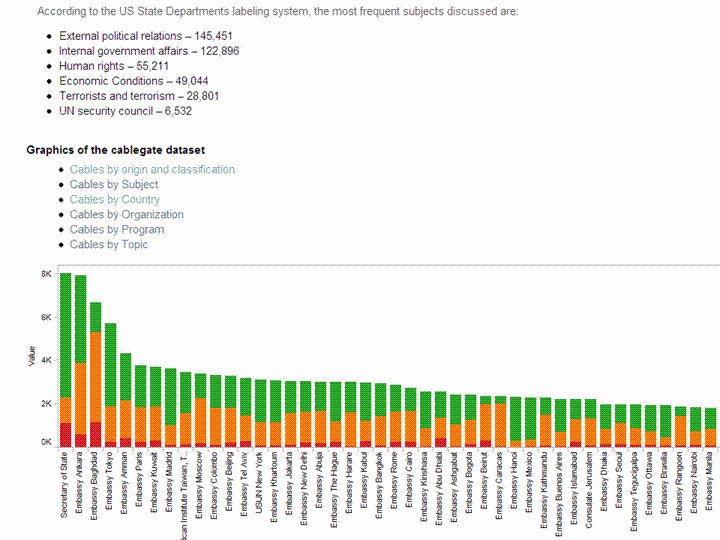
The Gospel as per WikiLeaks

Logo used by Wikileaks
Image via Wikipedia

– First Assume Nothing-

I would be very surprised if 260,000 documents and not even one was a counter-intelligence dis information move. Why was ALL the information stored in one place- maybe Wikileaks would leak the launch codes of the missiles next.

One more data visualization for Tableau– R watchers can not how jjplot by Facebook Analytics and Tableau are replacing GGPLOT 2 as visualization standards- (GGPLOT 2 needs a better GUI maybe using pyqt than the Deducer currently- maybe they can create GGPLOT extensions for Red R yet)

and yes stranger stupid things have happened in diplomacy and intelligence (like India exploding the nuclear bomb on exactly the same date and same place —-surprising CIA, but we are supposed to be on the same side atleast for the next decade) but it would be wrong not to cross reference the cables with the some verification.

Tableau gives great data viz though, but I dont think all 260,000 cables are valid data points (and boy they must really be regretting creating the internet at DARPA and DoD- but you can always blame Al Gore for that)

Quantifying Analytics ROI

Japanese House Crest “Go-Shichi no Kiri”
Image via Wikipedia

I had a brief twitter exchange with Jim Davis, Chief Marketing Officer, SAS Institute on Return of Investment on Business Analytics Projects for customers. I have interviewed Jim Davis before last year https://decisionstats.com/2009/06/05/interview-jim-davis-sas-institute/

Now Jim Davis is a big guy, and he is rushing from the launch of SAS Institute’s Social Media Analytics in Japan- to some arguably difficult flying conditions in time to be home in America for Thanksgiving. That and and I have not been much of a good Blog Boy recently, more swayed by love of open source, than love of software per se. I love equally, given I am bad at both equally.

Anyways, Jim’s contention  ( http://twitter.com/Davis_Jim ) was customers should go in business analytics only if there is Positive Return on Investment.  I am quoting him here-

What is important is that there be a positive ROI on each and every BA project. Otherwise don’t do it.

That’s not the marketing I was taught in my business school- basically it was sell, sell, sell.

However I see most BI sales vendors also go through -let me meet my sales quota for this quarter- and quantifying customer ROI is simple maths than predictive analytics but there seems to be some information assymetry in it.

Here is a paper from North Western University on ROI in IT projects-.

but overall it would be in the interest of customers and Business Analytics Vendors to publish aggregated ROI.

The opponents to this transparency in ROI would be market leaders in market share, who have trapped their customers by high migration costs (due to complexity) or contractually.

A recent study listed Oracle having a large percentage of unhappy customers who would still renew!, SAP had problems when it raised prices for licensing arbitrarily (that CEO is now CEO of HP and dodging legal notices from Oracle).

Indeed Jim Davis’s famous unsettling call for focusing on Business Analytics,as Business Intelligence is dead- that call has been implemented more aggressively by IBM in analytical acquisitions than even SAS itself which has been conservative about inorganic growth. Quantifying ROI, should theoretically aid open source software the most (since they are cheapest in up front licensing) or newer technologies like MapReduce /Hadoop (since they are quite so fast)- but I think that market has a way of factoring in these things- and customers are not as foolish neither as unaware of costs versus benefits of migration.

The contrary to this is Business Analytics and Business Intelligence are imperfect markets with duo-poly  or big players thriving in absence of customer regulation.

You get more protection as a customer of $20 bag of potato chips, than as a customer of a $200,000 software. Regulators are wary to step in to ensure ROI fairness (since most bright techies are qither working for private sector, have their own startup or invested in startups)- who in Govt understands Analytics and Intelligence strong enough to ensure vendor lock-ins are not done, and market flexibility is done. It is also a lower choice for embattled regulators to ensure ROI on enterprise software unlike the aggressiveness they have showed in retail or online software.

Who will Analyze the Analysts and who can quantify the value of quants (or penalize them for shoddy quantitative analytics)- is an interesting phenomenon we expect to see more of.


A Poem on Demand

On Demand entertainment I need to hear
On Demand information of webcasts, white papers dear
On demand downloads of information I am told I really need
Sometimes it is tough to keep which is shallow what is deep

Is it really on demand or were you overwhelmed and manipulated by the supply
On Demand Supply and estimates of forecasts of influencer of the demand
Friendship is also on demand

But Loneliness is Free and Open Source
And so is Freedom

How many Fans, Followers, Likes can you get
Before your critical mass makes you Viral
Like a Video Bieber whose clothes are torn by crowds

Searching for your 900 seconds of On Demand fame
You want to be paid on demand but work only on a creative fancy
Your on demand laziness is too demanding now
Ceteras Paribus, On demand is too much to demand
and much too on always on 24 7

Give me a book a friend and some peace and quiet
Bet you things arent there on supply but always on demand
Or are they?

Facebook Gmail Killer Threatens to commit Hara Kari live on AOL Techcrunch if unsucessful

The Facebook headquarters in Palo Alto, CA (fr...
Image via Wikipedia

As per Techcrunchhttp://techcrunch.com/2010/11/11/facebook-gmail-titan/

Project Titan — a web-based email client that we hear is unofficially referred to internally as its “Gmail killer”. Now we’ve heard from sources that this is indeed what’s coming on Monday during Facebook’s special event, alongside personal @facebook.com email addresses for users.

Now Techcrunch always tells the Truth and the Gospel as per Mike is always right, especially when he is talking of gates of heaven and Angels.

Again as per the newly rich Mike Arringotn (who qualifies to be an Angel Investor himself except AOL has locked in his err wings)

Our understanding is that this is more than just a UI refresh for Facebook’s existing messaging service with POP access tacked on. Rather, Facebook is building a full-fledged webmail client, and while it may only be in early stages come its launch Monday, there’s a huge amount of potential here.

Facebook has the world’s most popular photos product, the most popular events product, and soon will have a very popular local deals product as well.  It can tweak the design of its webmail client to display content from each of these in a seamless fashion (and don’t forget messages from games, or payments via Facebook Credits). And there’s also the social element: Facebook knows who your friends are and how closely you’re connected to them; it can probably do a pretty good job figuring out which personal emails you want to read most and prioritize them accordingly.

Oh, and assuming our sources prove accurate, this explains the timing of the Google/Facebook slap fight over contact information.

In an exclusive chat with Decisionstats, Senior VP Eduard Patel Bumberg said- This is it. I am going to kill Gmail. This movie I just had  a small part in the mens room while they had the groupies. If we finally kill Gmail, I hope to get a much bigger part in Social Network 3.

New The new Facebook email gives you lesses spam (primarily) as it leans on its contacts in the Cosa Nostra of Spam- and tell them no spam to .fb books.

Yes Anyone is someone in spam has had a connection in the spam pie in Facebook, like creating duplicate 50 million accounts just before the movie got launched, inflating the number of daily Farmville players, invites, links .

Arringutan even covered some of it in an earlier FB game called scamville.

Saint Mark and Mike would have approved Senior VP Eduard Patel Bumberg decision to either kill Gmail or commit hara kari live on U Stream. It is good for the sequel.