Contest for SAS Users and Students

Heres a new contest for SAS users. The prizes are books, so students should be interested as well.

From http://www.sascommunity.org/mwiki/images/b/bc/PointsforprizesRules.pdf

HOW TO ENTER: To qualify for entry, go to the sasCommunity.org web site located at http://www.sascommunity.org/wiki/Main_Page
between April 11, 2011 and May 9, 2011 and either add or edit valid content as described herein to earn award points.
Creation of a first time profile on www.sascommunity.org will earn 1,000 points. For each valid article creation or edit, 100
points will be earned. Articles and subsequent edits should adhere to the sasCommunity.org terms of use as outlined on
http://www.sascommunity.org/wiki/sasCommunity:Terms_of_Use. All points’ accumulation will end at 5:00 PM GMT on
May 9, 2011 and only those points earned between 8:00 AM GMT on April 11, 2011 and 5:00 PM GMT on May 9, 2011
will be counted in this contest. Contest entries made through the Internet will be declared made by the registered user of
the sasCommunity.org profile account. Sponsor is not responsible for phone, technical, network, electronic, computer
hardware or software failures of any kind, misdirected, incomplete, garbled or delayed transmissions. Sponsor will not be
responsible for incorrect or inaccurate entry information, whether caused by entrants or by any of the equipment or
programming associated with or utilized in the contest.
ELIGIBILITY: The contest is open to all sasCommunity.org members 18 year of age or older on the start date of the
contest. Void where prohibited by law. Employees (including immediate family members and/or those living in the same 
household of each), the Sponsor, members of the sasCommunity.org Advisory Board, SAS Global Users Group Executive 
Board, their advertising, promotion and production agencies, the affiliated companies of each, and the immediate family 
members of each are not eligible. 

PRIZE: Three (3) prizes will be awarded based on total points accumulated during the contest as follows:
 1stPlace: 3 SAS®Press books - not to exceed $250 in combined retail value;
 2ndPlace: 2 SAS®Press books - not to exceed $150 in combined retail value; and
 3rdPlace: 1 SAS®Press book - not to exceed $100 in retail value.

What’s New

http://www.sascommunity.org/wiki/Main_Page

New Points for Prizes Contest
Points for Prizes Contest
Win SAS books!
Contribute content or SAS code to sasCommunity.org for your chance to WIN! To qualify, simply add or edit articles between April 11, 2011 and May 9, 2011 (GMT). Creation of a first-time profile on sasCommunity.org gives you 1,000 points. For each valid article creation or edit, 100 points will be earned. The user with the most points collected during this time wins SAS Press Books!

Become a sasCommunity Guru
Thanks for Contributing to sasCommunity.org!
New sasCommunity.org Point System
The sasCommunity support team has been hard at work adding new features and is pleased to announce a points system that recognizes each user’s contributions to the site. Every time you contribute by creating a page, updating it, or just doing a little wiki gardening, you earn points.Earning points is automatic and simple – all you have to do is contribute! Creating your account starts you with 1000 points and all the current users have been credited with points dating back to the site coming online in April 2007.

Heritage Health Prize- Data Mining Contest for 3mill USD

An animation of the quicksort algorithm sortin...
Image via Wikipedia

If Netflix was about 1 mill USD to better online video choices, here is a chance to earn serious money, write great code, and save lives!

From http://www.heritagehealthprize.com/

Heritage Health Prize
Launching April 4

Laptop

More than 71 Million individuals in the United States are admitted to
hospitals each year, according to the latest survey from the American
Hospital Association. Studies have concluded that in 2006 well over
$30 billion was spent on unnecessary hospital admissions. Each of
these unnecessary admissions took away one hospital bed from someone
else who needed it more.

Prize Goal & Participation

The goal of the prize is to develop a predictive algorithm that can identify patients who will be admitted to the hospital within the next year, using historical claims data.

Official registration will open in 2011, after the launch of the prize. At that time, pre-registered teams will be notified to officially register for the competition. Teams must consent to be bound by final competition rules.

Registered teams will develop and test their algorithms. The winning algorithm will be able to predict patients at risk for an unplanned hospital admission with a high rate of accuracy. The first team to reach the accuracy threshold will have their algorithms confirmed by a judging panel. If confirmed, a winner will be declared.

The competition is expected to run for approximately two years. Registration will be open throughout the competition.

Data Sets

Registered teams will be granted access to two separate datasets of de-identified patient claims data for developing and testing algorithms: a training dataset and a quiz/test dataset. The datasets will be comprised of de-identified patient data. The datasets will include:

  • Outpatient encounter data
  • Hospitalization encounter data
  • Medication dispensing claims data, including medications
  • Outpatient laboratory data, including test outcome values

The data for each de-identified patient will be organized into two sections: “Historical Data” and “Admission Data.” Historical Data will represent three years of past claims data. This section of the dataset will be used to predict if that patient is going to be admitted during the Admission Data period. Admission Data represents previous claims data and will contain whether or not a hospital admission occurred for that patient; it will be a binary flag.

DataThe training dataset includes several thousand anonymized patients and will be made available, securely and in full, to any registered team for the purpose of developing effective screening algorithms.

The quiz/test dataset is a smaller set of anonymized patients. Teams will only receive the Historical Data section of these datasets and the two datasets will be mixed together so that teams will not be aware of which de-identified patients are in which set. Teams will make predictions based on these data sets and submit their predictions to HPN through the official Heritage Health Prize web site. HPN will use the Quiz Dataset for the initial assessment of the Team’s algorithms. HPN will evaluate and report back scores to the teams through the prize website’s leader board.

Scores from the final Test Dataset will not be made available to teams until the accuracy thresholds are passed. The test dataset will be used in the final judging and results will be kept hidden. These scores are used to preserve the integrity of scoring and to help validate the predictive algorithms.

Teams can begin developing and testing their algorithms as soon as they are registered and ready. Teams will log onto the official Heritage Health Prize website and submit their predictions online. Comparisons will be run automatically and team accuracy scores will be posted on the leader board. This score will be only on a portion of the predictions submitted (the Quiz Dataset), the additional results will be kept back (the Test Dataset).

Form

Once a team successfully scores above the accuracy thresholds on the online testing (quiz dataset), final judging will occur. There will be three parts to this judging. First, the judges will confirm that the potential winning team’s algorithm accurately predicts patient admissions in the Test Dataset (again, above the thresholds for accuracy).

Next, the judging panel will confirm that the algorithm does not identify patients and use external data sources to derive its predictions. Lastly, the panel will confirm that the team’s algorithm is authentic and derives its predictive power from the datasets, not from hand-coding results to improve scores. If the algorithm meets these three criteria, it will be declared the winner.

Failure to meet any one of these three parts will disqualify the team and the contest will continue. The judges reserve the right to award second and third place prizes if deemed applicable.


Interview Ajay Ohri Decisionstats.com with DMR

From-

http://www.dataminingblog.com/data-mining-research-interview-ajay-ohri/

Here is the winner of the Data Mining Research People Award 2010: Ajay Ohri! Thanks to Ajay for giving some time to answer Data Mining Research questions. And all the best to his blog, Decision Stat!

Data Mining Research (DMR): Could you please introduce yourself to the readers of Data Mining Research?

Ajay Ohri (AO): I am a business consultant and writer based out of Delhi- India. I have been working in and around the field of business analytics since 2004, and have worked with some very good and big companies primarily in financial analytics and outsourced analytics. Since 2007, I have been writing my blog at http://decisionstats.com which now has almost 10,000 views monthly.

All in all, I wrote about data, and my hobby is also writing (poetry). Both my hobby and my profession stem from my education ( a masters in business, and a bachelors in mechanical engineering).

My research interests in data mining are interfaces (simpler interfaces to enable better data mining), education (making data mining less complex and accessible to more people and students), and time series and regression (specifically ARIMAX)
In business my research interests software marketing strategies (open source, Software as a service, advertising supported versus traditional licensing) and creation of technology and entrepreneurial hubs (like Palo Alto and Research Triangle, or Bangalore India).

DMR: I know you have worked with both SAS and R. Could you give your opinion about these two data mining tools?

AO: As per my understanding, SAS stands for SAS language, SAS Institute and SAS software platform. The terms are interchangeably used by people in industry and academia- but there have been some branding issues on this.
I have not worked much with SAS Enterprise Miner , probably because I could not afford it as business consultant, and organizations I worked with did not have a budget for Enterprise Miner.
I have worked alone and in teams with Base SAS, SAS Stat, SAS Access, and SAS ETS- and JMP. Also I worked with SAS BI but as a user to extract information.
You could say my use of SAS platform was mostly in predictive analytics and reporting, but I have a couple of projects under my belt for knowledge discovery and data mining, and pattern analysis. Again some of my SAS experience is a bit dated for almost 1 year ago.

I really like specific parts of SAS platform – as in the interface design of JMP (which is better than Enterprise Guide or Base SAS ) -and Proc Sort in Base SAS- I guess sequential processing of data makes SAS way faster- though with computing evolving from Desktops/Servers to even cheaper time shared cloud computers- I am not sure how long Base SAS and SAS Stat can hold this unique selling proposition.

I dislike the clutter in SAS Stat output, it confuses me with too much information, and I dislike shoddy graphics in the rendering output of graphical engine of SAS. Its shoddy coding work in SAS/Graph and if JMP can give better graphics why is legacy source code preventing SAS platform from doing a better job of it.

I sometimes think the best part of SAS is actually code written by Goodnight and Sall in 1970’s , the latest procs don’t impress me much.

SAS as a company is something I admire especially for its way of treating employees globally- but it is strange to see the rest of tech industry not following it. Also I don’t like over aggression and the SAS versus Rest of the Analytics /Data Mining World mentality that I sometimes pick up when I deal with industry thought leaders.

I think making SAS Enterprise Miner, JMP, and Base SAS in a completely new web interface priced at per hour rates is my wishlist but I guess I am a bit sentimental here- most data miners I know from early 2000’s did start with SAS as their first bread earning software. Also I think SAS needs to be better priced in Business Intelligence- it seems quite cheap in BI compared to Cognos/IBM but expensive in analytical licensing.

If you are a new stats or business student, chances are – you may know much more R than SAS today. The shift in education at least has been very rapid, and I guess R is also more of a platform than a analytics or data mining software.

I like a lot of things in R- from graphics, to better data mining packages, modular design of software, but above all I like the can do kick ass spirit of R community. Lots of young people collaborating with lots of young to old professors, and the energy is infectious. Everybody is a CEO in R ’s world. Latest data mining algols will probably start in R, published in journals.

Which is better for data mining SAS or R? It depends on your data and your deadline. The golden rule of management and business is -it depends.

Also I have worked with a lot of KXEN, SQL, SPSS.

DMR: Can you tell us more about Decision Stats? You have a traffic of 120′000 for 2010. How did you reach such a success?

AO: I don’t think 120,000 is a success. Its not a failure. It just happened- the more I wrote, the more people read.In 2007-2008 I used to obsess over traffic. I tried SEO, comments, back linking, and I did some black hat experimental stuff. Some of it worked- some didn’t.

In the end, I started asking questions and interviewing people. To my surprise, senior management is almost always more candid , frank and honest about their views while middle managers, public relations, marketing folks can be defensive.

Social Media helped a bit- Twitter, Linkedin, Facebook really helped my network of friends who I suppose acted as informal ambassadors to spread the word.
Again I was constrained by necessity than choices- my middle class finances ( I also had a baby son in 2007-my current laptop still has some broken keys :) – by my inability to afford traveling to conferences, and my location Delhi isn’t really a tech hub.

The more questions I asked around the internet, the more people responded, and I wrote it all down.

I guess I just was lucky to meet a lot of nice people on the internet who took time to mentor and educate me.

I tried building other websites but didn’t succeed so i guess I really don’t know. I am not a smart coder, not very clever at writing but I do try to be honest.

Basic economics says pricing is proportional to demand and inversely proportional to supply. Honest and candid opinions have infinite demand and an uncertain supply.

DMR: There is a rumor about a R book you plan to publish in 2011 :-) Can you confirm the rumor and tell us more?

AO: I just signed a contract with Springer for ” R for Business Analytics”. R is a great software, and lots of books for statistically trained people, but I felt like writing a book for the MBAs and existing analytics users- on how to easily transition to R for Analytics.

Like any language there are tricks and tweaks in R, and with a focus on code editors, IDE, GUI, web interfaces, R’s famous learning curve can be bent a bit.

Making analytics beautiful, and simpler to use is always a passion for me. With 3000 packages, R can be used for a lot more things and a lot more simply than is commonly understood.
The target audience however is business analysts- or people working in corporate environments.

Brief Bio-
Ajay Ohri has been working in the field of analytics since 2004 , when it was a still nascent emerging Industries in India. He has worked with the top two Indian outsourcers listed on NYSE,and with Citigroup on cross sell analytics where he helped sell an extra 50000 credit cards by cross sell analytics .He was one of the very first independent data mining consultants in India working on analytics products and domestic Indian market analytics .He regularly writes on analytics topics on his web site www.decisionstats.com and is currently working on open source analytical tools like R besides analytical software like SPSS and SAS.

The Year 2010

Nokia N800 internet tablet, with open source s...
Image via Wikipedia

My annual traffic to this blog was almost 99,000 . Add in additional views on networking sites plus the 400 plus RSS readers- so I can say traffic was 1,20,000 for 2010. Nice. Thanks for reading and hope it was worth your time. (this is a long post and will take almost 440 secs to read but the summary is just given)

My intent is either to inform you, give something useful or atleast something interesting.

see below-

Jan Feb Mar Apr May Jun
2010 6,311 4,701 4,922 5,463 6,493 4,271
Jul Aug Sep Oct Nov Dec Total
5,041 5,403 17,913 16,430 11,723 10,096 98,767


Sandro Saita from http://www.dataminingblog.com/ just named me for an award on his blog (but my surname is ohRi , Sandro left me without an R- What would I be without R :)) ).

Aw! I am touched. Google for “Data Mining Blog” and Sandro is the best that it is in data mining writing.

DMR People Award 2010
There are a lot of active people in the field of data mining. You can discuss with them on forums. You can read their blogs. You can also meet them in events such as PAW or KDD. Among the people I follow on a regular basis, I have elected:

Ajay Ori

He has been very active in 2010, especially on his blog . Good work Ajay and continue sharing your experience with us!”

What did I write in 2010- stuff.

What did you read on this blog- well thats the top posts list.

2009-12-31 to Today

Title Views
Home page More stats 21,150
Top 10 Graphical User Interfaces in Statistical Software More stats 6,237
Wealth = function (numeracy, memory recall) More stats 2,014
Matlab-Mathematica-R and GPU Computing More stats 1,946
The Top Statistical Softwares (GUI) More stats 1,405
About DecisionStats More stats 1,352
Using Facebook Analytics (Updated) More stats 1,313
Test drive a Chrome notebook. More stats 1,170
Top ten RRReasons R is bad for you ? More stats 1,157
Libre Office More stats 1,151
Interview Hadley Wickham R Project Data Visualization Guru More stats 1,007
Using Red R- R with a Visual Interface More stats 854
SAS Institute files first lawsuit against WPS- Episode 1 More stats 790
Interview Professor John Fox Creator R Commander More stats 764
R Package Creating More stats 754
Windows Azure vs Amazon EC2 (and Google Storage) More stats 726
Norman Nie: R GUI and More More stats 716
Startups for Geeks More stats 682
Google Maps – Jet Ski across Pacific Ocean More stats 670
Not so AWkward after all: R GUI RKWard More stats 579
Red R 1.8- Pretty GUI More stats 570
Parallel Programming using R in Windows More stats 569
R is an epic fail or is it just overhyped More stats 559
Enterprise Linux rises rapidly:New Report More stats 537
Rapid Miner- R Extension More stats 518
Creating a Blog Aggregator for free More stats 504
So which software is the best analytical software? Sigh- It depends More stats 473
Revolution R for Linux More stats 465
John Sall sets JMP 9 free to tango with R More stats 460

So how do people come here –

well I guess I owe Tal G for almost 9000 views ( incidentally I withdrew posting my blog from R- Bloggers and Analyticbridge blogs – due to SEO keyword reasons and some spam I was getting see (below))

http://r-bloggers.com is still the CAT’s whiskers and I read it  a lot.

I still dont know who linked my blog to a free sex movie site with 400 views but I have a few suspects.

2009-12-31 to Today

Referrer Views
r-bloggers.com 9,131
Reddit 3,829
rattle.togaware.com 1,500
Twitter 1,254
Google Reader 1,215
linkedin.com 717
freesexmovie.irwanaf.com 422
analyticbridge.com 341
Google 327
coolavenues.com 322
Facebook 317
kdnuggets.com 298
dataminingblog.com 278
en.wordpress.com 185
google.co.in 151
xianblog.wordpress.com 130
inside-r.org 124
decisionstats.com 119
ifreestores.com 117
bits.blogs.nytimes.com 108

Still reading this post- gosh let me sell you some advertising. It is only $100 a month (yes its a recession)

Advertisers are treated on First in -Last out (FILO)

I have been told I am obsessed with SEO , but I dont care much for search engines apart from Google, and yes SEO is an interesting science (they should really re name it GEO or Google Engine Optimization)

Apparently Hadley Wickham and Donald Farmer are big keywords for me so I should be more respectful I guess.

Search Terms for 365 days ending 2010-12-31 (Summarized)

2009-12-31 to Today

Search Views
libre office 925
facebook analytics 798
test drive a chrome notebook 467
test drive a chrome notebook. 215
r gui 203
data mining 163
wps sas lawsuit 158
wordle.net 133
wps sas 123
google maps jet ski 123
test drive chrome notebook 96
sas wps 89
sas wps lawsuit 85
chrome notebook test drive 83
decision stats 83
best statistics software 74
hadley wickham 72
google maps jetski 72
libreoffice 70
doug savage 65
hive tutorial 58
funny india 56
spss certification 52
donald farmer microsoft 51
best statistical software 49

What about outgoing links? Apparently I need to find a way to ask Google to pay me for the free advertising I gave their chrome notebook launch. But since their search engine and browser is free to me, guess we are even steven.

Clicks for 365 days ending 2010-12-31 (Summarized)

2009-12-31 to Today

URL Clicks
rattle.togaware.com 378
facebook.com/Decisionstats 355
rapid-i.com/content/view/182/196 319
services.google.com/fb/forms/cr48basic 313
red-r.org 228
decisionstats.wordpress.com/2010/05/07/the-top-statistical-softwares-gui 199
teamwpc.co.uk/products/wps 162
r4stats.com/popularity 148
r-statistics.com/2010/04/r-and-the-google-summer-of-code-2010-accepted-students-and-projects 138
socserv.mcmaster.ca/jfox/Misc/Rcmdr 138
spss.com/certification 116
learnr.wordpress.com 114
dudeofdata.com/decisionstats 108
r-project.org 107
documentfoundation.org/faq 104
goo.gl/maps/UISY 100
inside-r.org/download 96
en.wikibooks.org/wiki/R_Programming 92
nytimes.com/external/readwriteweb/2010/12/07/07readwriteweb-report-google-offering-chrome-notebook-test-11919.html 92
sourceforge.net/apps/mediawiki/rkward/index.php?title=Main_Page 92
analyticdroid.togaware.com 88
yeroon.net/ggplot2 87

so in 2010,

SAS remained top daddy in business analytics,

R made revolutionary strides in terms of new packages,

JMP  launched a new version,

SPSS got integrated with Cognos,

Oracle sued Google and did build a great Data Mining GUI,

Libre Office gave you a non Oracle Open office ( or open even more office)

2011 looks like  a fun year. Have safe partying .

SAS X

0o0 0O

Tal G, creator of the rbloggers.com website, has created a new blog aggregator for SAS language users at http://sas-x.com/

With almost 26 blogs joining there (I suspect many more should join , it seems like a good website to use for analytics users and students.  My favorite SAS Blog is http://statcompute.spaces.live.com/ – its pure code- little anything else.

Related-

SAS MACRO TO CALCULATE PDO (Points to Double Odds) OF A SCORECARD

A SAS MACRO FOR DECISION STUMP

A DEMO OF VECTOR AUTOREGRESSIVE FORECASTING MODEL


Interview Jamie Nunnelly NISS

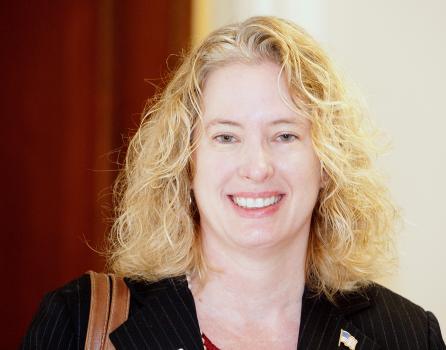
An interview with Jamie Nunnelly, Communications Director of National Institute of Statistical Sciences
Ajay– What does NISS do? And What does SAMSI do?

Jamie– The National Institute of Statistical Sciences (NISS) was established in 1990 by the national statistics societies and the Research Triangle universities and organizations, with the mission to identify, catalyze and foster high-impact, cross-disciplinary and cross-sector research involving the statistical sciences.

NISS is dedicated to strengthening and serving the national statistics community, most notably by catalyzing community members’ participation in applied research driven by challenges facing government and industry. NISS also provides career development opportunities for statisticians and scientists, especially those in the formative stages of their careers.

The Institute identifies emerging issues to which members of the statistics community can make key contributions, and then catalyzes the right combinations of researchers from multiple disciplines and sectors to tackle each problem. More than 300 researchers from over 100 institutions have worked on our projects.

The Statistical and Applied Mathematical Sciences Institute (SAMSI) is a partnership of Duke University,  North Carolina State University, The University of North Carolina at Chapel Hill, and NISS in collaboration with the William Kenan Jr. Institute for Engineering, Technology and Science and is part of the Mathematical Sciences Institutes of the NSF.

SAMSI focuses on 1-2 programs of research interest in the statistical and/or applied mathematical area and visitors from around the world are involved with the programs and come from a variety of disciplines in addition to mathematics and statistics.

Many come to SAMSI to attend workshops, and also participate in working groups throughout the academic year. Many of the working groups communicate via WebEx so people can be involved with the research remotely. SAMSI also has a robust education and outreach program to help undergraduate and graduate students learn about cutting edge research in applied mathematics and statistics.

Ajay– What successes have you had in 2010- and what do you need to succeed in 2011. Whats planned for 2011 anyway

Jamie– NISS has had a very successful collaboration with the National Agricultural Statistical Service (NASS) over the past two years that was just renewed for the next two years. NISS & NASS had three teams consisting of a faculty researcher in statistics, a NASS researcher, a NISS mentor, a postdoctoral fellow and a graduate student working on statistical modeling and other areas of research for NASS.

NISS is also working on a syndromic surveillance project with Clemson University, Duke University, The University of Georgia, The University of South Carolina. The group is currently working with some hospitals to test out a model they have been developing to help predict disease outbreak.

SAMSI had a very successful year with two programs ending this past summer, which were the Stochastic Dynamics program and the Space-time Analysis for Environmental Mapping, Epidemiology and Climate Change. Several papers were written and published and many presentations have been made at various conferences around the world regarding the work that was conducted as SAMSI last year.

Next year’s program is so big that the institute has decided to devote all it’s time and energy around it, which is uncertainty quantification. The opening workshop, in addition to the main methodological theme, will be broken down into three areas of interest under this broad umbrella of research: climate change, engineering and renewable energy, and geosciences.

Ajay– Describe your career in science and communication.

Jamie– I have been in communications since 1985, working for large Fortune 500 companies such as General Motors and Tropicana Products. I moved to the Research Triangle region of North Carolina after graduate school and got into economic development and science communications first working for the Research Triangle Regional Partnership in 1994.

From 1996-2005 I was the communications director for the Research Triangle Park, working for the Research Triangle Foundation of NC. I published a quarterly magazine called The Park Guide for awhile, then came to work for NISS and SAMSI in 2008.

I really enjoy working with the mathematicians and statisticians. I always joke that I am the least educated person working here and that is not far from the truth! I am honored to help get the message out about all of the important research that is conducted here each day that is helping to improve the lives of so many people out there.

Ajay– Research Triangle or Silicon Valley– Which is better for tech people and why? Your opinion

Jamie– Both the Silicon Valley and Research Triangle are great regions for tech people to locate, but of course, I have to be biased and choose Research Triangle!

Really any place in the world that you find many universities working together with businesses and government, you have an area that will grow and thrive, because the collaborations help all of us generate new ideas, many of which blossom into new businesses, or new endeavors of research.

The quality of life in places such as the Research Triangle is great because you have people from around the world moving to a place, each bringing his/her culture, food, and uniqueness to this place, and enriching everyone else as a result.

Two advantages the Research Triangle has over Silicon Valley are that the Research Triangle has a bigger diversity of industries, so when the telecommunications industry busted back in 2001-02, the region took a hit, but the biotechnology industry was still growing, so unemployment rose, but not to the extent that other areas might have experienced.

The latest recession has hit us all very hard, so even this strategy has not made us immune to having high unemployment, but the Research Triangle region has been pegged by experts to be one of the first regions to emerge out of the Great Recession.

The other advantage I think we have is that our cost of living is still much more reasonable than Silicon Valley. It’s still possible to get a nice sized home, some land and not break the bank!

Ajay– How do you manage an active online social media presence, your job and your family. How important is balance in professional life and when young professional should realize this?

Jamie– Balance is everything, isn’t it? When I leave the office, I turn off my iPhone and disconnect from Twitter/Facebook etc.

I know that is not recommended by some folks, but I am a one person communications department and I love my family and friends and feel its important to devote time to them as well as to my career.

I think it is very important for young people to establish this early in their careers because if they don’t they will fall victim to working way too many hours and really, who loves you at the end of the day?

Your company may appreciate all you do for them, but if you leave, or you get sick and cannot work for them, you will be replaced

. Lee Iacocca, former CEO of Chrystler, said, “No matter what you’ve done for yourself or for humanity, if you can’t look back on having given love and attention to your own family, what have you really accomplished?” I think that is what is really most important in life.

About-

Jamie Nunnelly has been in communications for 25 years. She is currently on the board of directors for Chatham County Economic Development Corporation and Leadership Triangle & is a member of the International Association of Business Communicators and the Public Relations Society of America. She earned a bachelor’s degree in interpersonal and public communications at Bowling Green State University and a master’s degree in mass communications at the University of South Florida.

You can contact Jamie at http://niss.org/content/jamie-nunnelly or on twitter at

Data Visualization using Tableau

Image representing Tableau Software as depicte...
Image via CrunchBase

Here is a great piece of software for data visualization– the public version is free.

And you can use it for Desktop Analytics as well as BI /server versions at very low cost.

About Tableau Software

http://www.tableausoftware.com/press_release/tableau-massive-growth-hiring-q3-2010

Tableau was named by Software Magazine as the fastest growing software company in the $10 million to $30 million range in the world, and the second fastest growing software company worldwide overall. The ranking stems from the publication’s 28th annual Software 500 ranking of the world’s largest software service providers.

“We’re growing fast because the market is starving for easy-to-use products that deliver rapid-fire business intelligence to everyone. Our customers want ways to unlock their databases and produce engaging reports and dashboards,” said Christian Chabot CEO and co-founder of Tableau.

http://www.tableausoftware.com/about/who-we-are

History in the Making

Put together an Academy-Award winning professor from the nation’s most prestigious university, a savvy business leader with a passion for data, and a brilliant computer scientist. Add in one of the most challenging problems in software – making databases and spreadsheets understandable to ordinary people. You have just recreated the fundamental ingredients for Tableau.

The catalyst? A Department of Defense (DOD) project aimed at increasing people’s ability to analyze information and brought to famed Stanford professor, Pat Hanrahan. A founding member of Pixar and later its chief architect for RenderMan, Pat invented the technology that changed the world of animated film. If you know Buzz and Woody of “Toy Story”, you have Pat to thank.

Under Pat’s leadership, a team of Stanford Ph.D.s got together just down the hall from the Google folks. Pat and Chris Stolte, the brilliant computer scientist, realized that data visualization could produce large gains in people’s ability to understand information. Rather than analyzing data in text form and then creating visualizations of those findings, Pat and Chris invented a technology called VizQL™ by which visualization is part of the journey and not just the destination. Fast analytics and visualization for everyone was born.

While satisfying the DOD project, Pat and Chris met Christian Chabot, a former data analyst who turned into Jello when he saw what had been invented. The three formed a company and spun out of Stanford like so many before them (Yahoo, Google, VMWare, SUN). With Christian on board as CEO, Tableau rapidly hit one success after another: its first customer (now Tableau’s VP, Operations, Tom Walker), an OEM deal with Hyperion (now Oracle), funding from New Enterprise Associates, a PC Magazine award for “Product of the Year” just one year after launch, and now over 50,000 people in 50+ countries benefiting from the breakthrough.

also see http://www.tableausoftware.com/about/leadership

http://www.tableausoftware.com/about/board

—————————————————————————-

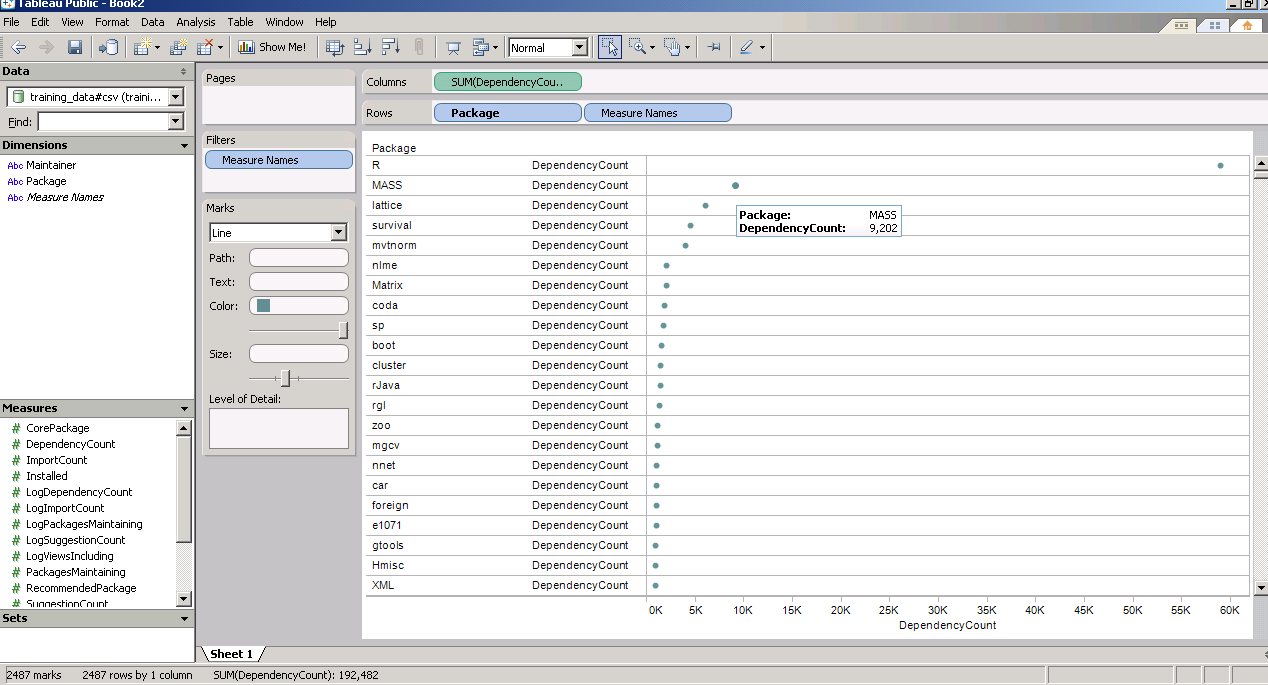
and now  a demo I ran on the Kaggle contest data (it is a csv dataset with 95000 rows)

I found Tableau works extremely good at pivoting data and visualizing it -almost like Excel on  Steroids. Download the free version here ( I dont know about an academic program (see links below) but software is not expensive at all)

http://buy.tableausoftware.com/

Desktop Personal Edition

The Personal Edition is a visual analysis and reporting solution for data stored in Excel, MS Access or Text Files. Available via download.

Product Information

$999*

Desktop Professional Edition

The Professional Edition is a visual analysis and reporting solution for data stored in MS SQL Server, MS Analysis Services, Oracle, IBM DB2, Netezza, Hyperion Essbase, Teradata, Vertica, MySQL, PostgreSQL, Firebird, Excel, MS Access or Text Files. Available via download.

Product Information

$1800*

Tableau Server

Tableau Server enables users of Tableau Desktop Professional to publish workbooks and visualizations to a server where users with web browsers can access and interact with the results. Available via download.

Product Information

Contact Us

* Price is per Named User and includes one year of maintenance (upgrades and support). Products are made available as a download immediately after purchase. You may revisit the download site at any time during your current maintenance period to access the latest releases.