Choosing R for business – What to consider?

A composite of the GNU logo and the OSI logo, ...
Image via Wikipedia

Additional features in R over other analytical packages-

1) Source Code is given to ensure complete custom solution and embedding for a particular application. Open source code has an advantage that is extensively peer- reviewed in Journals and Scientific Literature.  This means bugs will found, shared and corrected transparently.

2) Wide literature of training material in the form of books is available for the R analytical platform.

3) Extensively the best data visualization tools in analytical software (apart from Tableau Software ‘s latest version). The extensive data visualization available in R is of the form a variety of customizable graphs, as well as animation. The principal reason third-party software initially started creating interfaces to R is because the graphical library of packages in R is more advanced as well as rapidly getting more features by the day.

4) Free in upfront license cost for academics and thus budget friendly for small and large analytical teams.

5) Flexible programming for your data environment. This includes having packages that ensure compatibility with Java, Python and C++.


6) Easy migration from other analytical platforms to R Platform. It is relatively easy for a non R platform user to migrate to R platform and there is no danger of vendor lock-in due to the GPL nature of source code and open community.

Statistics are numbers that tell (descriptive), advise ( prescriptive) or forecast (predictive). Analytics is a decision-making help tool. Analytics on which no decision is to be made or is being considered can be classified as purely statistical and non analytical. Thus ease of making a correct decision separates a good analytical platform from a not so good analytical platform. The distinction is likely to be disputed by people of either background- and business analysis requires more emphasis on how practical or actionable the results are and less emphasis on the statistical metrics in a particular data analysis task. I believe one clear reason between business analytics is different from statistical analysis is the cost of perfect information (data costs in real world) and the opportunity cost of delayed and distorted decision-making.

Specific to the following domains R has the following costs and benefits

  • Business Analytics
    • R is free per license and for download
    • It is one of the few analytical platforms that work on Mac OS
    • It’s results are credibly established in both journals like Journal of Statistical Software and in the work at LinkedIn, Google and Facebook’s analytical teams.
    • It has open source code for customization as per GPL
    • It also has a flexible option for commercial vendors like Revolution Analytics (who support 64 bit windows) as well as bigger datasets
    • It has interfaces from almost all other analytical software including SAS,SPSS, JMP, Oracle Data Mining, Rapid Miner. Existing license holders can thus invoke and use R from within these software
    • Huge library of packages for regression, time series, finance and modeling
    • High quality data visualization packages
    • Data Mining
      • R as a computing platform is better suited to the needs of data mining as it has a vast array of packages covering standard regression, decision trees, association rules, cluster analysis, machine learning, neural networks as well as exotic specialized algorithms like those based on chaos models.
      • Flexibility in tweaking a standard algorithm by seeing the source code
      • The RATTLE GUI remains the standard GUI for Data Miners using R. It was created and developed in Australia.
      • Business Dashboards and Reporting
      • Business Dashboards and Reporting are an essential piece of Business Intelligence and Decision making systems in organizations. R offers data visualization through GGPLOT, and GUI like Deducer and Red-R can help even non R users create a metrics dashboard
        • For online Dashboards- R has packages like RWeb, RServe and R Apache- which in combination with data visualization packages offer powerful dashboard capabilities.
        • R can be combined with MS Excel using the R Excel package – to enable R capabilities to be imported within Excel. Thus a MS Excel user with no knowledge of R can use the GUI within the R Excel plug-in to use powerful graphical and statistical capabilities.

Additional factors to consider in your R installation-

There are some more choices awaiting you now-
1) Licensing Choices-Academic Version or Free Version or Enterprise Version of R

2) Operating System Choices-Which Operating System to choose from? Unix, Windows or Mac OS.

3) Operating system sub choice- 32- bit or 64 bit.

4) Hardware choices-Cost -benefit trade-offs for additional hardware for R. Choices between local ,cluster and cloud computing.

5) Interface choices-Command Line versus GUI? Which GUI to choose as the default start-up option?

6) Software component choice- Which packages to install? There are almost 3000 packages, some of them are complimentary, some are dependent on each other, and almost all are free.

7) Additional Software choices- Which additional software do you need to achieve maximum accuracy, robustness and speed of computing- and how to use existing legacy software and hardware for best complementary results with R.

1) Licensing Choices-
You can choose between two kinds of R installations – one is free and open source from http://r-project.org The other R installation is commercial and is offered by many vendors including Revolution Analytics. However there are other commercial vendors too.

Commercial Vendors of R Language Products-
1) Revolution Analytics http://www.revolutionanalytics.com/
2) XL Solutions- http://www.experience-rplus.com/
3) Information Builder – Webfocus RStat -Rattle GUI http://www.informationbuilders.com/products/webfocus/PredictiveModeling.html
4) Blue Reference- Inference for R http://inferenceforr.com/default.aspx

  1. Choosing Operating System
      1. Windows


Windows remains the most widely used operating system on this planet. If you are experienced in Windows based computing and are active on analytical projects- it would not make sense for you to move to other operating systems. This is also based on the fact that compatibility problems are minimum for Microsoft Windows and the help is extensively documented. However there may be some R packages that would not function well under Windows- if that happens a multiple operating system is your next option.

        1. Enterprise R from Revolution Analytics- Enterprise R from Revolution Analytics has a complete R Development environment for Windows including the use of code snippets to make programming faster. Revolution is also expected to make a GUI available by 2011. Revolution Analytics claims several enhancements for it’s version of R including the use of optimized libraries for faster performance.
      1. MacOS


Reasons for choosing MacOS remains its considerable appeal in aesthetically designed software- but MacOS is not a standard Operating system for enterprise systems as well as statistical computing. However open source R claims to be quite optimized and it can be used for existing Mac users. However there seem to be no commercially available versions of R available as of now for this operating system.

      1. Linux


        1. Ubuntu
        2. Red Hat Enterprise Linux
        3. Other versions of Linux


Linux is considered a preferred operating system by R users due to it having the same open source credentials-much better fit for all R packages and it’s customizability for big data analytics.

Ubuntu Linux is recommended for people making the transition to Linux for the first time. Ubuntu Linux had an marketing agreement with revolution Analytics for an earlier version of Ubuntu- and many R packages can  installed in a straightforward way as Ubuntu/Debian packages are available. Red Hat Enterprise Linux is officially supported by Revolution Analytics for it’s enterprise module. Other versions of Linux popular are Open SUSE.

      1. Multiple operating systems-
        1. Virtualization vs Dual Boot-


You can also choose between having a VMware VM Player for a virtual partition on your computers that is dedicated to R based computing or having operating system choice at the startup or booting of your computer. A software program called wubi helps with the dual installation of Linux and Windows.

  1. 64 bit vs 32 bit – Given a choice between 32 bit versus 64 bit versions of the same operating system like Linux Ubuntu, the 64 bit version would speed up processing by an approximate factor of 2. However you need to check whether your current hardware can support 64 bit operating systems and if so- you may want to ask your Information Technology manager to upgrade atleast some operating systems in your analytics work environment to 64 bit operating systems.


  1. Hardware choices- At the time of writing this book, the dominant computing paradigm is workstation computing followed by server-client computing. However with the introduction of cloud computing, netbooks, tablet PCs, hardware choices are much more flexible in 2011 than just a couple of years back.

Hardware costs are a significant cost to an analytics environment and are also  remarkably depreciated over a short period of time. You may thus examine your legacy hardware, and your future analytical computing needs- and accordingly decide between the various hardware options available for R.
Unlike other analytical software which can charge by number of processors, or server pricing being higher than workstation pricing and grid computing pricing extremely high if available- R is well suited for all kinds of hardware environment with flexible costs. Given the fact that R is memory intensive (it limits the size of data analyzed to the RAM size of the machine unless special formats and /or chunking is used)- it depends on size of datasets used and number of concurrent users analyzing the dataset. Thus the defining issue is not R but size of the data being analyzed.

    1. Local Computing- This is meant to denote when the software is installed locally. For big data the data to be analyzed would be stored in the form of databases.
      1. Server version- Revolution Analytics has differential pricing for server -client versions but for the open source version it is free and the same for Server or Workstation versions.
      2. Workstation
    2. Cloud Computing- Cloud computing is defined as the delivery of data, processing, systems via remote computers. It is similar to server-client computing but the remote server (also called cloud) has flexible computing in terms of number of processors, memory, and data storage. Cloud computing in the form of public cloud enables people to do analytical tasks on massive datasets without investing in permanent hardware or software as most public clouds are priced on pay per usage. The biggest cloud computing provider is Amazon and many other vendors provide services on top of it. Google is also coming for data storage in the form of clouds (Google Storage), as well as using machine learning in the form of API (Google Prediction API)
      1. Amazon
      2. Google
      3. Cluster-Grid Computing/Parallel processing- In order to build a cluster, you would need the RMpi and the SNOW packages, among other packages that help with parallel processing.
    3. How much resources
      1. RAM-Hard Disk-Processors- for workstation computing
      2. Instances or API calls for cloud computing
  1. Interface Choices
    1. Command Line
    2. GUI
    3. Web Interfaces
  2. Software Component Choices
    1. R dependencies
    2. Packages to install
    3. Recommended Packages
  3. Additional software choices
    1. Additional legacy software
    2. Optimizing your R based computing
    3. Code Editors
      1. Code Analyzers
      2. Libraries to speed up R

citation-  R Development Core Team (2010). R: A language and environment for statistical computing. R Foundation for Statistical Computing,Vienna, Austria. ISBN 3-900051-07-0, URL http://www.R-project.org.

(Note- this is a draft in progress)

How to Analyze Wikileaks Data – R SPARQL

Logo for R
Image via Wikipedia

Drew Conway- one of the very very few Project R voices I used to respect until recently. declared on his blog http://www.drewconway.com/zia/

Why I Will Not Analyze The New WikiLeaks Data

and followed it up with how HE analyzed the post announcing the non-analysis.

“If you have not visited the site in a week or so you will have missed my previous post on analyzing WikiLeaks data, which from the traffic and 35 Comments and 255 Reactions was at least somewhat controversial. Given this rare spotlight I thought it would be fun to use the infochimps API to map out the geo-location of everyone that visited the blog post over the last few days. Unfortunately, after nearly two years with the same web hosting service, only today did I realize that I was not capturing daily log files for my domain”

Anyways – non American users of R Project can analyze the Wikileaks data using the R SPARQL package I would advise American friends not to use this approach or attempt to analyze any data because technically the data is still classified and it’s possession is illegal (which is the reason Federal employees and organizations receiving federal funds have advised not to use this or any WikiLeaks dataset)

https://code.google.com/p/r-sparql/

Overview

R is a programming language designed for statistics.

R Sparql allows you to run SPARQL Queries inside R and store it as a R data frame.

The main objective is to allow the integration of Ontologies with Statistics.

It requires Java and rJava installed.

Example (in R console):

> library(sparql)> data <- query("SPARQL query>","RDF file or remote SPARQL Endpoint")

and the data in a remote SPARQL  http://www.ckan.net/package/cablegate

SPARQL is an easy language to pick  up, but dammit I am not supposed to blog on my vacations.

http://code.google.com/p/r-sparql/wiki/GettingStarted

Getting Started

1. Installation

1.1 Make sure Java is installed and is the default JVM:

$ sudo apt-get install sun-java6-bin sun-java6-jre sun-java6-jdk$ sudo update-java-alternatives -s java-6-sun

1.2 Configure R to use the correct version of Java

$ sudo R CMD javareconf

1.3 Install the rJava library

$ R> install.packages("rJava")> q()

1.4 Download and install the sparql library

Download: http://code.google.com/p/r-sparql/downloads/list

$ R CMD INSTALL sparql-0.1-X.tar.gz

2. Executing a SPARQL query

2.1 Start R

#Load the librarylibrary(sparql)#Run the queryresult <- query("SELECT ... ", "http://...")#Print the resultprint(result)

3. Examples

3.1 The Query can be a string or a local file:

query("SELECT ?date ?number ?season WHERE {  ... }", "local-file.rdf")
query("my-query.rq", "local-file.rdf")

The package will detect if my-query.rq exists and will load it from the file.

3.3 The uri can be a file or an url (for remote queries):

query("SELECT ... ","local-file.db")
query("SELECT ... ","http://dbpedia.org/sparql")

3.4 Get some examples here: http://code.google.com/p/r-sparql/downloads/list

SPARQL Tutorial-

http://openjena.org/ARQ/Tutorial/index.html

Also read-

http://webr3.org/blog/linked-data/virtuoso-6-sparqlgeo-and-linked-data/

and from the favorite blog of Project R- Also known as NY Times

http://bits.blogs.nytimes.com/2010/11/15/sorting-through-the-government-data-explosion/?twt=nytimesbits

In May 2009, the Obama administration started putting raw 
government data on the Web. 
It started with 47 data sets. Today, there are more than
 270,000 government data sets, spanning every imaginable 
category from public health to foreign aid.

RWui :Creating R Web Interfaces on the go

Here is a great R application created by http://sysbio.mrc-bsu.cam.ac.uk

R Wui for creating R Web Interfaces

its been there for some time now- but presumably R Apache is more well known.

From-

http://sysbio.mrc-bsu.cam.ac.uk/Rwui/tutorial/Rwui_Rnews_final.pdf

The web application Rwui is used to create web interfaces  for running R scripts. All the code is generated automatically so that a fully functional web interface for an R script can be downloaded and up and running in a matter of minutes.

Rwui is aimed at R script writers who have scripts that they want people unversed in R to use. The script writer uses Rwui to create a web application that will run their R script. Rwui allows the script writer to do this without them having to do any web application programming, because Rwui generates all the code for them.

The script writer designs the web application to run their R script by entering information on a sequence of web pages. The script writer then downloads the application they have created and installs it on their own server.

http://sysbio.mrc-bsu.cam.ac.uk/Rwui/tutorial/Technical_Report.pdf

Features of web applications created by Rwui

  1. Whole range of input items available if required – text boxes, checkboxes, file upload etc.
  2. Facility for uploading of an arbitrary number of files (for example, microarray replicates).
  3. Facility for grouping uploaded files (for example, into ‘Diseased’ and ‘Control’ microarray data files).
  4. Results files displayed on results page and available for download.
  5. Results files can be e-mailed to the user.
  6. Interactive results files using image maps.
  7. Repeat analyses with different parameters and data files – new results added to results list, as a link to the corresponding results page.
  8. Real time progress information (text or graphical) displayed when running the application.

Requirements

In order to use the completed web applications created by Rwui you will need:

  1. A Java webserver such as Tomcat version 5.5 or later.
  2. Java version 1.5
  3. R – a version compatible with your R script(s).

Using Rwui

Using Rwui to create a web application for an R script simply involves:

  1. Entering details about your Rscript on a sequence of web pages.
  2. Rwui is quite flexible so you can backtrack, edit and insert, as you design your application.
  3. Rwui then generates the web application, which is Java based and platform independent.
  4. The application can be downloaded either as a .zip or .tgz file.
  5. Unpacked, the download contains all the source code and a .war file.
  6. Once the .war file is copied to the Tomcat webapps directory, the application is ready to use.
  7. Application details are saved in an ‘application definition file’ for reuse and modification.
Interested-
go click and check out a new web app from http://sysbio.mrc-bsu.cam.ac.uk/Rwui/ in a matter of minutes
Also see

SAS Lawsuit against WPS- Application Dismissed

I saw Phil Rack http://twitter.com/#!/PhilRack (whom I have interviewed before at https://decisionstats.com/2009/02/03/interview-phil-rack/ ) and whom I dont talk to since Obama won the election-


well Phil -creator of Bridge to R- first SAS language to R language interface- mentioned this judgment and link.


Probably Phil should revise the documentation of Bridge to R- lest he is sued himself!!!

Conclusion
It was for these reasons that I decided to dismiss SAS’s application.

From-

http://www.bailii.org/cgi-bin/markup.cgi?doc=/ew/cases/EWHC/Ch/2010/3012.html


Neutral Citation Number: [2010] EWHC 3012 (Ch)
Case No: HC09C03293

IN THE HIGH COURT OF JUSTICE
CHANCERY DIVISION
Royal Courts of Justice
Strand, London, WC2A 2LL
22 November 2010

B e f o r e :

THE HON MR JUSTICE ARNOLD
____________________
Between:
SAS INSTITUTE INC. Claimant
– and –

WORLD PROGRAMMING LIMITED Defendant

____________________

Michael Hicks (instructed by Bristows) for the Claimant
Martin Howe QC and Isabel Jamal (instructed by Speechly Bircham LLP) for the Defendant
Hearing date: 18 November 2010
____________________

HTML VERSION OF JUDGMENT
____________________

Crown Copyright ©

MR. JUSTICE ARNOLD :

Introduction
By order dated 28 July 2010 I referred certain questions concerning the interpretation of Council Directive 91/250/EEC of 14 May 1991 on the legal protection of computer programs, which was recently codified as European Parliament and Council Directive 2009/24/EC of 23 April 2009, and European Parliament and Council Directive 2001/29/EC of 22 May 2001 on the harmonisation of certain aspects of copyright and related rights in the information society to the Court of Justice of the European Union under Article 267 of the Treaty on the Functioning of the European Union. The background to the reference is set out in full in my judgment dated 23 July 2010 [2010] EWHC 1829 (Ch). The reference is presently pending before the Court of Justice as Case C-406/10. By an application notice issued on 11 October 2010 SAS applied for the wording of the questions to be amended in a number of respects. I heard that application on 18 November 2010 and refused it for reasons to be given later. This judgment contains those reasons.

The questions and the proposed amendments
I set out below the questions referred with the amendments proposed by SAS shown by strikethrough and underlining:

“A. On the interpretation of Council Directive 91/250/EEC of 14 May 1991 on the legal protection of computer programs and of Directive 2009/24/EC of the European Parliament and of the Council of 23 April 2009 (codified version):
1. Where a computer program (‘the First Program’) is protected by copyright as a literary work, is Article 1(2) to be interpreted as meaning that it is not an infringement of the copyright in the First Program for a competitor of the rightholder without access to the source code of the First Program, either directly or via a process such as decompilation of the object code, to create another program (‘the Second Program’) which replicates by copying the functions of the First Program?
2. Is the answer to question 1 affected by any of the following factors:
(a) the nature and/or extent of the functionality of the First Program;
(b) the nature and/or extent of the skill, judgment and labour which has been expended by the author of the First Program in devising and/or selecting the functionality of the First Program;
(c) the level of detail to which the functionality of the First Program has been reproduced in the Second Program;
(d) if, the Second Program includes the following matters as a result of copying directly or indirectly from the First Program:
(i) the selection of statistical operations which have been implemented in the First Program;
(ii) the selection of mathematical formulae defining the statistical operations which the First Program carries out;
(iii) the particular commands or combinations of commands by which those statistical operations may be invoked;
(iv) the options which the author of the First Program has provided in respect of various commands;
(v) the keywords and syntax recognised by the First Program;
(vi) the defaults which the author of the First Program has chosen to implement in the event that a particular command or option is not specified by the user;
(vii) the number of iterations which the First Program will perform in certain circumstances;
(e)(d) if the source code for the Second Program reproduces by copying aspects of the source code of the First Program to an extent which goes beyond that which was strictly necessary in order to produce the same functionality as the First Program?
3. Where the First Program interprets and executes application programs written by users of the First Program in a programming language devised by the author of the First Program which comprises keywords devised or selected by the author of the First Program and a syntax devised by the author of the First Program, is Article 1(2) to be interpreted as meaning that it is not an infringement of the copyright in the First Program for the Second Program to be written so as to interpret and execute such application programs using the same keywords and the same syntax?
4. Where the First Program reads from and writes to data files in a particular format devised by the author of the First Program, is Article 1(2) to be interpreted as meaning that it is not an infringement of the copyright in the First Program for the Second Program to be written so as to read from and write to data files in the same format?
5. Does it make any difference to the answer to questions 1, 2, 3 and 4 if the author of the Second Program created the Second Program without access to the source code of the First Program, either directly or via decompilation of the object code by:
(a) observing, studying and testing the functioning of the First Program; or
(b) reading a manual created and published by the author of the First Program which describes the functions of the First Program (“the Manual”) and by implementing in the Second Program the functions described in the Manual; or
(c) both (a) and (b)?
6. Where a person has the right to use a copy of the First Program under a licence, is Article 5(3) to be interpreteding as meaning that the licensee is entitled, without the authorisation of the rightholder, to perform acts of loading, running and storing the program in order to observe, test or study the functioning of the First Program so as to determine the ideas and principles which underlie any element of the program, if the licence permits the licensee to perform acts of loading, running and storing the First Program when using it for the particular purpose permitted by the licence, but the acts done in order to observe, study or test the First Program extend outside the scope of the purpose permitted by the licence and are therefore acts for which the licensee has no right to use the copy of the First Program under the licence?
7. Is Article 5(3) to be interpreted as meaning that acts of observing, testing or studying of the functioning of the First Program are to be regarded as being done in order to determine the ideas or principles which underlie any element of the First Program where they are done:
(a) to ascertain the way in which the First Program functions, in particular details which are not described in the Manual, for the purpose of writing the Second Program in the manner referred to in question 1 above;
(b) to ascertain how the First Program interprets and executes statements written in the programming language which it interprets and executes (see question 3 above);
(c) to ascertain the formats of data files which are written to or read by the First Program (see question 4 above);
(d) to compare the performance of the Second Program with the First Program for the purpose of investigating reasons why their performances differ and to improve the performance of the Second Program;
(e) to conduct parallel tests of the First Program and the Second Program in order to compare their outputs in the course of developing the Second Program, in particular by running the same test scripts through both the First Program and the Second Program;
(f) to ascertain the output of the log file generated by the First Program in order to produce a log file which is identical or similar in appearance;
(g) to cause the First Program to output data (in fact, data correlating zip codes to States of the USA) for the purpose of ascertaining whether or not it corresponds with official databases of such data, and if it does not so correspond, to program the Second Program so that it will respond in the same way as the First Program to the same input data.
B. On the interpretation of Directive 2001/29/EC of the European Parliament and of the Council of 22 May 2001 on the harmonisation of certain aspects of copyright and related rights in the information society:
8. Where the Manual is protected by copyright as a literary work, is Article 2(a) to be interpreted as meaning that it is an infringement of the copyright in the Manual for the author of the Second Program to reproduce or substantially reproduce in the Second Program any or all of the following matters described in the Manual:
(a) the selection of statistical operations which have been described in the Manual as being implemented in the First Program;
(b) the mathematical formulae used in the Manual to describe those statistical operations;
(c) the particular commands or combinations of commands by which those statistical operations may be invoked;
(d) the options which the author of the First Program has provided in respect of various commands;
(e) the keywords and syntax recognised by the First Program;
(f) the defaults which the author of the First Program has chosen to implement in the event that a particular command or option is not specified by the user;
(g) the number of iterations which the First Program will perform in certain circumstances?
9. Is Article 2(a) to be interpreted as meaning that it is an infringement of the copyright in the Manual for the author of the Second Program to reproduce or substantially reproduce in a manual describing the Second Program the keywords and syntax recognised by the First Program?”

Jurisdiction
It was common ground between counsel that, although there is no direct authority on the point, it appears that the Court of Justice would accept an amendment to questions which had previously been referred by the referring court. The Court of Justice has stated that “national courts have the widest discretion in referring matters”: see Case 166/73 Rheinmühlen Düsseldorf v Einfuhr-und Vorratstelle für Getreide under Futtermittel [1974] ECR 33 at [4]. If an appeal court substitutes questions for those referred by a lower court, the substituted questions will be answered: Case 65/77 Razanatsimba [1977] ECR 2229. Sometimes the Court of Justice itself invites the referring court to clarify its questions, as occurred in Interflora Inc v Marks & Spencer plc (No 2) [2010] EWHC 925 (Ch). In these circumstances, there does not appear to be any reason to think that, if the referring court itself had good reason to amend its questions, the Court of Justice would disregard the amendment.

Counsel for WPL submitted, however, that, as a matter of domestic procedural law, this Court had no jurisdiction to vary an order for reference once sealed unless either there had been a material change of circumstances since the order (as in Interflora) or it had subsequently emerged that the Court had made the order on a false basis. He submitted that neither of those conditions was satisfied here. In those circumstances, the only remedy of a litigant in the position of SAS was to seek to appeal to the Court of Appeal.

As counsel for WPL pointed out, CPR rule 3.1(7) confers on courts what appears to be a general power to vary or revoke their own orders. The proper exercise of that power was considered by the Court of Appeal in Collier v Williams [2006] EWCA Civ 20, [2006] 1 WLR 1945 and Roult v North West Strategic Health Authority [2009] EWCA Civ 444, [2010] 1 WLR 487.

In Collier Dyson LJ (as he then was) giving the judgment of the Court of Appeal said:

“39. We now turn to the third argument. CPR 3.1(7) gives a very general power to vary or revoke an order. Consideration was given to the circumstances in which that power might be used by Patten J in Lloyds Investment (Scandinavia) Limited v Christen Ager-Hanssen [2003] EWHC 1740 (Ch). He said at paragraph 7:
‘The Deputy Judge exercised a discretion under CPR Part 13.3. It is not open to me as a judge exercising a parallel jurisdiction in the same division of the High Court to entertain what would in effect be an appeal from that order. If the Defendant wished to challenge whether the order made by Mr Berry was disproportionate and wrong in principle, then he should have applied for permission to appeal to the Court of Appeal. I have been given no real reasons why this was not done. That course remains open to him even today, although he will have to persuade the Court of Appeal of the reasons why he should have what, on any view, is a very considerable extension of time. It seems to me that the only power available to me on this application is that contained in CPR Part 3.1(7), which enables the Court to vary or revoke an order. This is not confined to purely procedural orders and there is no real guidance in the White Book as to the possible limits of the jurisdiction. Although this is not intended to be an exhaustive definition of the circumstances in which the power under CPR Part 3.1(7) is exercisable, it seems to me that, for the High Court to revisit one of its earlier orders, the Applicant must either show some material change of circumstances or that the judge who made the earlier order was misled in some way, whether innocently or otherwise, as to the correct factual position before him. The latter type of case would include, for example, a case of material non-disclosure on an application for an injunction. If all that is sought is a reconsideration of the order on the basis of the same material, then that can only be done, in my judgment, in the context of an appeal. Similarly it is not, I think, open to a party to the earlier application to seek in effect to re-argue that application by relying on submissions and evidence which were available to him at the time of the earlier hearing, but which, for whatever reason, he or his legal representatives chose not to employ. It is therefore clear that I am not entitled to entertain this application on the basis of the Defendant’s first main submission, that Mr Berry’s order was in any event disproportionate and wrong in principle, although I am bound to say that I have some reservations as to whether he was right to impose a condition of this kind without in terms enquiring whether the Defendant had any realistic prospects of being able to comply with the condition.’
We endorse that approach. We agree that the power given by CPR 3.1(7) cannot be used simply as an equivalent to an appeal against an order with which the applicant is dissatisfied. The circumstances outlined by Patten J are the only ones in which the power to revoke or vary an order already made should be exercised under 3.1(7).”
In Roult Hughes LJ, with whom Smith and Carnwath LJJ agreed, said at [15]:

“There is scant authority upon Rule 3.1(7) but such as exists is unanimous in holding that it cannot constitute a power in a judge to hear an appeal from himself in respect of a final order. Neuberger J said as much in Customs & Excise v Anchor Foods (No 3) [1999] EWHC 834 (Ch). So did Patten J in Lloyds Investment (Scandinavia) Ltd v Ager-Hanssen [2003] EWHC 1740 (Ch). His general approach was approved by this court, in the context of case management decisions, in Collier v Williams [2006] EWCA Civ 20. I agree that in its terms the rule is not expressly confined to procedural orders. Like Patten J in Ager-Hanssen I would not attempt any exhaustive classification of the circumstances in which it may be proper to invoke it. I am however in no doubt that CPR 3.1(7) cannot bear the weight which Mr Grime’s argument seeks to place upon it. If it could, it would come close to permitting any party to ask any judge to review his own decision and, in effect, to hear an appeal from himself, on the basis of some subsequent event. It would certainly permit any party to ask the judge to review his own decision when it is not suggested that he made any error. It may well be that, in the context of essentially case management decisions, the grounds for invoking the rule will generally fall into one or other of the two categories of (i) erroneous information at the time of the original order or (ii) subsequent event destroying the basis on which it was made. The exigencies of case management may well call for a variation in planning from time to time in the light of developments. There may possibly be examples of non-procedural but continuing orders which may call for revocation or variation as they continue – an interlocutory injunction may be one. But it does not follow that wherever one or other of the two assertions mentioned (erroneous information and subsequent event) can be made, then any party can return to the trial judge and ask him to re-open any decision…..”
In the present case there has been no material change of circumstances since I made the Order dated 28 July 2010. Nor did counsel for SAS suggest that I had made the Order upon a false basis. Counsel for SAS did submit, however, that the Court of Appeal had left open the possibility that it might be proper to exercise the power conferred by rule 3.1(7) even if there had no been material change of circumstances and it was not suggested that the order in question had been made on a false basis. Furthermore, he relied upon paragraph 1.1 of the Practice Direction to CPR Part 68, which provides that “responsibility for settling the terms of the reference lies with the English court and not with the parties”. He suggested that this meant that orders for references were not subject to the usual constraints on orders made purely inter partes.

In my judgment PD68 paragraph 1.1 does not justify exercising the power conferred by rule 3.1(7) in circumstances falling outside those identified in Collier and Roult. I am therefore very doubtful that it would be a proper exercise of the power conferred on me by CPR r. 3.1(7) to vary the Order dated 28 July 2010 in the present circumstances. I prefer, however, not to rest my decision on that ground.

Discretion
Counsel for WPL also submitted that, even if this Court had jurisdiction to amend the questions, I should exercise my discretion by refusing to do so for two reasons. First, because the application was made too late. Secondly, because there was no sufficient justification for the amendments anyway. I shall consider these points separately.

Delay
The relevant dates are as follows. The judgment was handed down on 23 July 2010, a draft having been made available to the parties a few days before that. There was a hearing to consider the form of the order, and in particular the wording of the questions to be referred, on 28 July 2010. Prior to that hearing both parties submitted drafts of the questions, and the respective drafts were discussed at the hearing. Following the hearing I settled the Order, and in particular the questions. The Order was sealed on 2 August 2010. The sealed Order was received by the parties between 3 and 5 August 2010. At around the same time the Senior Master of the Queen’s Bench Division transmitted the Order to the Court of Justice. On 15 September 2010 the Registry of the Court of Justice notified the parties, Member States and EU institutions of the reference. On 1 October 2010 the United Kingdom Intellectual Property Office advertised the reference on its website and invited comments by interested parties by 7 October 2010. The latest date on which written observations on the questions referred may be filed at the Court of Justice is 8 December 2010 (two months from the date of the notification plus 10 days extension on account of distance where applicable). This period is not extendable in any circumstances.

As noted above, the application was not issued until 11 October 2010. No justification has been provided by SAS for the delay in making the application. The only explanation offered by counsel for SAS was that the idea of proposing the amendments had only occurred to those representing SAS when starting work on SAS’s written observations.

Furthermore, the application notice requested that the matter be dealt with without a hearing. In my view that was not appropriate: the application was plainly one which was likely to require at least a short hearing. Furthermore, the practical consequence of proceeding in that way was to delay the hearing of the application. The paper application was put before me on 22 October 2010. On the same day I directed that the matter be listed for hearing. In the result it was not listed for hearing until 18 November 2010. If SAS had applied for the matter to be heard urgently, I am sure that it could have been dealt with sooner.

As counsel for WPL submitted, it is likely that the parties, Member States and institutions who intend to file written observations are now at an advanced stage of preparing those observations. Indeed, it is likely that preparations would have been well advanced even on 11 October 2010. To amend the questions at this stage in the manner proposed by SAS would effectively require the Court of Justice to re-start the written procedure all over again. The amended questions would have to be translated into all the EU official languages; the parties, Member States and EU institutions would have to be notified of the amended questions; and the time for submitting written observations would have to be re-set. This would have two consequences. First, a certain amount of time, effort and money on the part of those preparing written observations would be wasted. Secondly, the progress of the case would be delayed. Those are consequences that could have been avoided if SAS had moved promptly after receiving the sealed Order.

In these circumstances, it would not in my judgment be proper to exercise any discretion I may have in favour of amending the questions.

No sufficient justification
Counsel for WPL submitted that in any event SAS’s proposed amendments were not necessary in order to enable the Court of Justice to provide guidance on the issues in this case, and therefore there was no sufficient justification for making the amendments.

Before addressing that submission directly, I think it is worth commenting more generally on the formulation of questions. As is common ground, and reflected in paragraph 1.1 of PD68, it is well established that the questions posed on a reference under Article 267 are the referring court’s questions, not the parties’. The purpose of the procedure is for the Court of Justice to provide the referring court with the guidance it needs in order to deal with the issues before it. It follows that it is for the referring court to decide how to formulate the questions.

In my view it is usually helpful for the court to have the benefit of the parties’ comments on the wording of the proposed questions, as envisaged in paragraph 1.1 of PD68. There are two main reasons for this. The first is to try to ensure that the questions are sufficiently comprehensive to enable all the issues arising to be addressed by the Court of Justice, and thus avoid the need for a further reference at a later stage of the proceedings, as occurred in the Boehringer Ingelheim v Swingward litigation. In that case Laddie J referred questions to the Court of Justice, which were answered in Case C-143/00 [2002] ECR I-3759. The Court of Appeal subsequently concluded, with regret, that the answers to those questions did not suffice to enable it to deal with the case, and referred further questions to the Court of Justice: [2004] EWCA Civ 575, [2004] ETMR 65. Those questions were answered in Case C-348/04 [2007] ECR I-3391. The second main reason is to try to ensure that the questions are clear and free from avoidable ambiguity or obscurity.

In my experience it is not uncommon for parties addressing the court on the formulation of the questions to attempt to ensure that the questions are worded in a leading manner, that is to say, in a way which suggests the desired answer. In my view that is neither proper nor profitable. It is not proper because the questions should so far as possible be impartially worded. It is not profitable because experience shows that the Court of Justice is usually not concerned with the precise wording of the questions referred, but with their legal substance. Thus the Court of Justice frequently reformulates the question in giving its answer.

As counsel for WPL pointed out, and as I have already mentioned, in the present case the parties provided me with draft questions which were discussed at a hearing. In settling the questions I took into account the parties’ drafts and their comments on each other’s drafts, but the final wording is, for better or worse, my own.

As counsel for WPL submitted, at least to some extent SAS’s proposed amendments to the questions appear designed to bring the wording closer to that originally proposed by SAS. This is particularly true of the proposed amendment to question 1. In my judgment it would not be a proper exercise of any discretion that I may have to permit such an amendment, both because it appears to be an attempt by SAS to have the question worded in a manner which it believes favours its case and because its proper remedy if it objected to my not adopting the wording it proposed was to seek to appeal to the Court of Appeal. In saying this, I do not overlook the fact that SAS proposes to move some of the words excised from question 1 to question 5.

In any event, I am not satisfied that any of the amendments are necessary either to enable the parties to present their respective arguments to the Court of Justice or to enable the Court to give guidance on any of the issues arising in this case. On the contrary, I consider that the existing questions are sufficient for these purposes. By way of illustration, I will take the biggest single amendment, which is the proposed insertion of new paragraph (d) in question 2. In my view, the matters referred to in paragraph (d) are matters that are encompassed within paragraphs (b) and/or (c); or at least can be addressed by the parties, and hence the Court of Justice, in the context provided by paragraphs (b) and/or (c). When I put this to counsel for SAS during the course of argument, he accepted it.

Other amendments counsel for SAS himself presented as merely being minor matters of clarification. In my view none of them amount to the elimination of what would otherwise be ambiguities or obscurities in the questions.

It is fair to say that SAS have identified a small typographical error in question 2 (“interpreting” should read “interpreted”), but in my view this is an obvious error which will not cause any difficulty in the proceedings before the Court of Justice.

Conclusion
It was for these reasons that I decided to dismiss SAS’s application

Message from RATTLE

Microsoft Windows Vista Wallpaper
Image by Brajeshwar via Flickr

A new release of the R GUI Rattle is making its way to CRAN (currently on the Austrian server).

Latest version 2.5.47 (revision 527) released 13 Nov 2010.

Change Log link for details –

http://cran.r-project.org/web/packages/rattle/index.html

Major changes relate to simplifying the installation of Rattle under the recently released R 2.12.0 on Microsoft Windows 32bit and 64bit.

The major advance for R 2.12.0 is the improved support for 64bit Microsoft Windows and thus support for much larger datasets in memory.

See the new installation steps at http://datamining.togaware.com/survivor/Internet_Connected.html

For Microsoft Windows installations, to upgrade your Rattle installation you may need to remove any old installs of the Gtk+ libraries using the Uninstall application from the Microsoft Windows Control Panel). Then install the new Gtk2 library:

http://downloads.sourceforge.net/gtk-win/gtk2-runtime-2.22.0-2010-10-21-ash.exe

You can the update Rattle to version 2.5.47:

> install.packages(“rattle“)

>library(rattle)

rattle.info()

The output from rattle.info() will include an “install.packages” command that will identify Rattle related packages that have updates available. You can cut-and-paste that command to the R prompt to have those packages updated in your installation.

Citation- From rattle-users@googlegroups.com

http://rattle.togaware.com/

Cloud Computing with R

Illusion of Depth and Space (4/22) - Rotating ...
Image by Dominic's pics via Flickr

Here is a short list of resources and material I put together as starting points for R and Cloud Computing It’s a bit messy but overall should serve quite comprehensively.

Cloud computing is a commonly used expression to imply a generational change in computing from desktop-servers to remote and massive computing connections,shared computers, enabled by high bandwidth across the internet.

As per the National Institute of Standards and Technology Definition,
Cloud computing is a model for enabling convenient, on-demand network access to a shared pool of configurable computing resources (e.g., networks, servers, storage, applications, and services) that can be rapidly provisioned and released with minimal management effort or service provider interaction.

(Citation: The NIST Definition of Cloud Computing

Authors: Peter Mell and Tim Grance
Version 15, 10-7-09
National Institute of Standards and Technology, Information Technology Laboratory
http://csrc.nist.gov/groups/SNS/cloud-computing/cloud-def-v15.doc)

R is an integrated suite of software facilities for data manipulation, calculation and graphical display.

From http://cran.r-project.org/doc/FAQ/R-FAQ.html#R-Web-Interfaces

R Web Interfaces

Rweb is developed and maintained by Jeff Banfield. The Rweb Home Page provides access to all three versions of Rweb—a simple text entry form that returns output and graphs, a more sophisticated JavaScript version that provides a multiple window environment, and a set of point and click modules that are useful for introductory statistics courses and require no knowledge of the R language. All of the Rweb versions can analyze Web accessible datasets if a URL is provided.
The paper “Rweb: Web-based Statistical Analysis”, providing a detailed explanation of the different versions of Rweb and an overview of how Rweb works, was published in the Journal of Statistical Software (http://www.jstatsoft.org/v04/i01/).

Ulf Bartel has developed R-Online, a simple on-line programming environment for R which intends to make the first steps in statistical programming with R (especially with time series) as easy as possible. There is no need for a local installation since the only requirement for the user is a JavaScript capable browser. See http://osvisions.com/r-online/ for more information.

Rcgi is a CGI WWW interface to R by MJ Ray. It had the ability to use “embedded code”: you could mix user input and code, allowing the HTMLauthor to do anything from load in data sets to enter most of the commands for users without writing CGI scripts. Graphical output was possible in PostScript or GIF formats and the executed code was presented to the user for revision. However, it is not clear if the project is still active.

Currently, a modified version of Rcgi by Mai Zhou (actually, two versions: one with (bitmap) graphics and one without) as well as the original code are available from http://www.ms.uky.edu/~statweb/.

CGI-based web access to R is also provided at http://hermes.sdu.dk/cgi-bin/go/. There are many additional examples of web interfaces to R which basically allow to submit R code to a remote server, see for example the collection of links available from http://biostat.mc.vanderbilt.edu/twiki/bin/view/Main/StatCompCourse.

David Firth has written CGIwithR, an R add-on package available from CRAN. It provides some simple extensions to R to facilitate running R scripts through the CGI interface to a web server, and allows submission of data using both GET and POST methods. It is easily installed using Apache under Linux and in principle should run on any platform that supports R and a web server provided that the installer has the necessary security permissions. David’s paper “CGIwithR: Facilities for Processing Web Forms Using R” was published in the Journal of Statistical Software (http://www.jstatsoft.org/v08/i10/). The package is now maintained by Duncan Temple Lang and has a web page athttp://www.omegahat.org/CGIwithR/.

Rpad, developed and actively maintained by Tom Short, provides a sophisticated environment which combines some of the features of the previous approaches with quite a bit of JavaScript, allowing for a GUI-like behavior (with sortable tables, clickable graphics, editable output), etc.
Jeff Horner is working on the R/Apache Integration Project which embeds the R interpreter inside Apache 2 (and beyond). A tutorial and presentation are available from the project web page at http://biostat.mc.vanderbilt.edu/twiki/bin/view/Main/RApacheProject.

Rserve is a project actively developed by Simon Urbanek. It implements a TCP/IP server which allows other programs to use facilities of R. Clients are available from the web site for Java and C++ (and could be written for other languages that support TCP/IP sockets).

OpenStatServer is being developed by a team lead by Greg Warnes; it aims “to provide clean access to computational modules defined in a variety of computational environments (R, SAS, Matlab, etc) via a single well-defined client interface” and to turn computational services into web services.

Two projects use PHP to provide a web interface to R. R_PHP_Online by Steve Chen (though it is unclear if this project is still active) is somewhat similar to the above Rcgi and Rweb. R-php is actively developed by Alfredo Pontillo and Angelo Mineo and provides both a web interface to R and a set of pre-specified analyses that need no R code input.

webbioc is “an integrated web interface for doing microarray analysis using several of the Bioconductor packages” and is designed to be installed at local sites as a shared computing resource.

Rwui is a web application to create user-friendly web interfaces for R scripts. All code for the web interface is created automatically. There is no need for the user to do any extra scripting or learn any new scripting techniques. Rwui can also be found at http://rwui.cryst.bbk.ac.uk.

Finally, the R.rsp package by Henrik Bengtsson introduces “R Server Pages”. Analogous to Java Server Pages, an R server page is typically HTMLwith embedded R code that gets evaluated when the page is requested. The package includes an internal cross-platform HTTP server implemented in Tcl, so provides a good framework for including web-based user interfaces in packages. The approach is similar to the use of the brew package withRapache with the advantage of cross-platform support and easy installation.

Also additional R Cloud Computing Use Cases
http://wwwdev.ebi.ac.uk/Tools/rcloud/

ArrayExpress R/Bioconductor Workbench

Remote access to R/Bioconductor on EBI’s 64-bit Linux Cluster

Start the workbench by downloading the package for your operating system (Macintosh or Windows), or via Java Web Start, and you will get access to an instance of R running on one of EBI’s powerful machines. You can install additional packages, upload your own data, work with graphics and collaborate with colleagues, all as if you are running R locally, but unlimited by your machine’s memory, processor or data storage capacity.

  • Most up-to-date R version built for multicore CPUs
  • Access to all Bioconductor packages
  • Access to our computing infrastructure
  • Fast access to data stored in EBI’s repositories (e.g., public microarray data in ArrayExpress)

Using R Google Docs
http://www.omegahat.org/RGoogleDocs/run.pdf
It uses the XML and RCurl packages and illustrates that it is relatively quick and easy
to use their primitives to interact with Web services.

Using R with Amazon
Citation
http://rgrossman.com/2009/05/17/running-r-on-amazons-ec2/

Amazon’s EC2 is a type of cloud that provides on demand computing infrastructures called an Amazon Machine Images or AMIs. In general, these types of cloud provide several benefits:

  • Simple and convenient to use. An AMI contains your applications, libraries, data and all associated configuration settings. You simply access it. You don’t need to configure it. This applies not only to applications like R, but also can include any third-party data that you require.
  • On-demand availability. AMIs are available over the Internet whenever you need them. You can configure the AMIs yourself without involving the service provider. You don’t need to order any hardware and set it up.
  • Elastic access. With elastic access, you can rapidly provision and access the additional resources you need. Again, no human intervention from the service provider is required. This type of elastic capacity can be used to handle surge requirements when you might need many machines for a short time in order to complete a computation.
  • Pay per use. The cost of 1 AMI for 100 hours and 100 AMI for 1 hour is the same. With pay per use pricing, which is sometimes called utility pricing, you simply pay for the resources that you use.

Connecting to R on Amazon EC2- Detailed tutorials
Ubuntu Linux version
https://decisionstats.com/2010/09/25/running-r-on-amazon-ec2/
and Windows R version
https://decisionstats.com/2010/10/02/running-r-on-amazon-ec2-windows/

Connecting R to Data on Google Storage and Computing on Google Prediction API
https://github.com/onertipaday/predictionapirwrapper
R wrapper for working with Google Prediction API

This package consists in a bunch of functions allowing the user to test Google Prediction API from R.
It requires the user to have access to both Google Storage for Developers and Google Prediction API:
see
http://code.google.com/apis/storage/ and http://code.google.com/apis/predict/ for details.

Example usage:

#This example requires you had previously created a bucket named data_language on your Google Storage and you had uploaded a CSV file named language_id.txt (your data) into this bucket – see for details
library(predictionapirwrapper)

and Elastic R for Cloud Computing
http://user2010.org/tutorials/Chine.html

Abstract

Elastic-R is a new portal built using the Biocep-R platform. It enables statisticians, computational scientists, financial analysts, educators and students to use cloud resources seamlessly; to work with R engines and use their full capabilities from within simple browsers; to collaborate, share and reuse functions, algorithms, user interfaces, R sessions, servers; and to perform elastic distributed computing with any number of virtual machines to solve computationally intensive problems.
Also see Karim Chine’s http://biocep-distrib.r-forge.r-project.org/

R for Salesforce.com

At the point of writing this, there seem to be zero R based apps on Salesforce.com This could be a big opportunity for developers as both Apex and R have similar structures Developers could write free code in R and charge for their translated version in Apex on Salesforce.com

Force.com and Salesforce have many (1009) apps at
http://sites.force.com/appexchange/home for cloud computing for
businesses, but very few forecasting and statistical simulation apps.

Example of Monte Carlo based app is here
http://sites.force.com/appexchange/listingDetail?listingId=a0N300000016cT9EAI#

These are like iPhone apps except meant for business purposes (I am
unaware if any university is offering salesforce.com integration
though google apps and amazon related research seems to be on)

Force.com uses a language called Apex  and you can see
http://wiki.developerforce.com/index.php/App_Logic and
http://wiki.developerforce.com/index.php/An_Introduction_to_Formulas
Apex is similar to R in that is OOPs

SAS Institute has an existing product for taking in Salesforce.com data.

A new SAS data surveyor is
available to access data from the Customer Relationship Management
(CRM) software vendor Salesforce.com. at
http://support.sas.com/documentation/cdl/en/whatsnew/62580/HTML/default/viewer.htm#datasurveyorwhatsnew902.htm)

Personal Note-Mentioning SAS in an email to a R list is a big no-no in terms of getting a response and love. Same for being careless about which R help list to email (like R devel or R packages or R help)

For python based cloud see http://pi-cloud.com

Data Visualization using Tableau

Image representing Tableau Software as depicte...
Image via CrunchBase

Here is a great piece of software for data visualization– the public version is free.

And you can use it for Desktop Analytics as well as BI /server versions at very low cost.

About Tableau Software

http://www.tableausoftware.com/press_release/tableau-massive-growth-hiring-q3-2010

Tableau was named by Software Magazine as the fastest growing software company in the $10 million to $30 million range in the world, and the second fastest growing software company worldwide overall. The ranking stems from the publication’s 28th annual Software 500 ranking of the world’s largest software service providers.

“We’re growing fast because the market is starving for easy-to-use products that deliver rapid-fire business intelligence to everyone. Our customers want ways to unlock their databases and produce engaging reports and dashboards,” said Christian Chabot CEO and co-founder of Tableau.

http://www.tableausoftware.com/about/who-we-are

History in the Making

Put together an Academy-Award winning professor from the nation’s most prestigious university, a savvy business leader with a passion for data, and a brilliant computer scientist. Add in one of the most challenging problems in software – making databases and spreadsheets understandable to ordinary people. You have just recreated the fundamental ingredients for Tableau.

The catalyst? A Department of Defense (DOD) project aimed at increasing people’s ability to analyze information and brought to famed Stanford professor, Pat Hanrahan. A founding member of Pixar and later its chief architect for RenderMan, Pat invented the technology that changed the world of animated film. If you know Buzz and Woody of “Toy Story”, you have Pat to thank.

Under Pat’s leadership, a team of Stanford Ph.D.s got together just down the hall from the Google folks. Pat and Chris Stolte, the brilliant computer scientist, realized that data visualization could produce large gains in people’s ability to understand information. Rather than analyzing data in text form and then creating visualizations of those findings, Pat and Chris invented a technology called VizQL™ by which visualization is part of the journey and not just the destination. Fast analytics and visualization for everyone was born.

While satisfying the DOD project, Pat and Chris met Christian Chabot, a former data analyst who turned into Jello when he saw what had been invented. The three formed a company and spun out of Stanford like so many before them (Yahoo, Google, VMWare, SUN). With Christian on board as CEO, Tableau rapidly hit one success after another: its first customer (now Tableau’s VP, Operations, Tom Walker), an OEM deal with Hyperion (now Oracle), funding from New Enterprise Associates, a PC Magazine award for “Product of the Year” just one year after launch, and now over 50,000 people in 50+ countries benefiting from the breakthrough.

also see http://www.tableausoftware.com/about/leadership

http://www.tableausoftware.com/about/board

—————————————————————————-

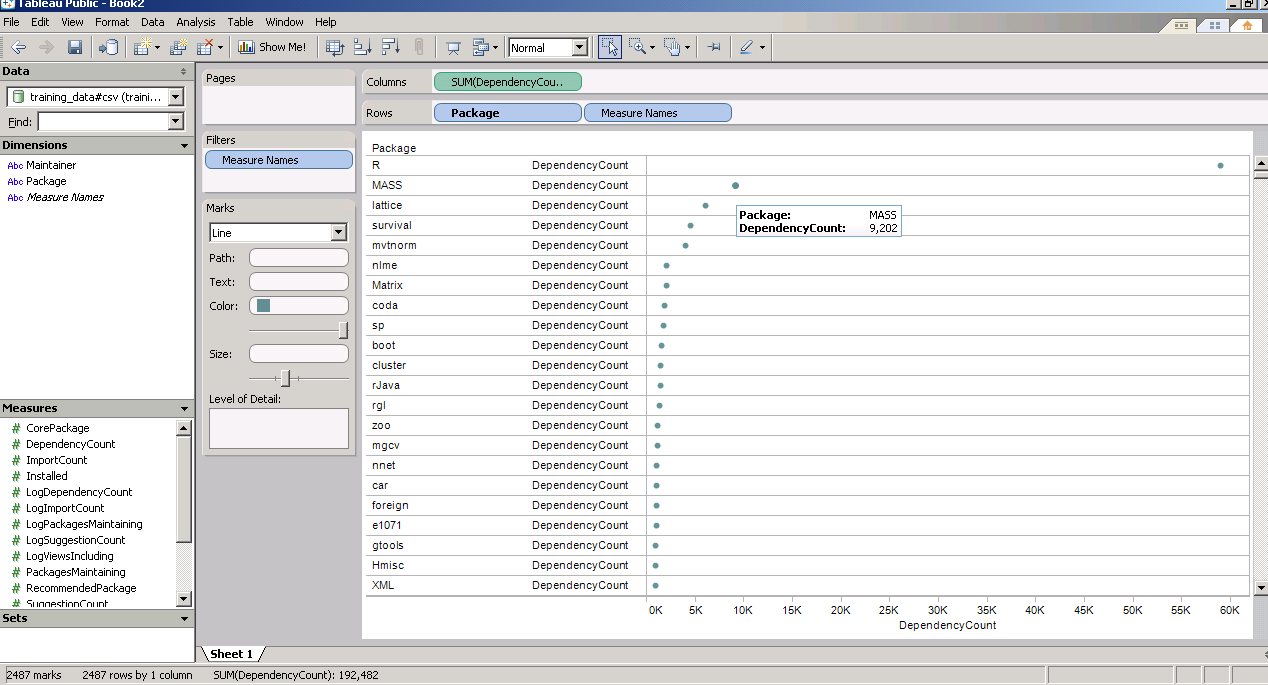
and now  a demo I ran on the Kaggle contest data (it is a csv dataset with 95000 rows)

I found Tableau works extremely good at pivoting data and visualizing it -almost like Excel on  Steroids. Download the free version here ( I dont know about an academic program (see links below) but software is not expensive at all)

http://buy.tableausoftware.com/

Desktop Personal Edition

The Personal Edition is a visual analysis and reporting solution for data stored in Excel, MS Access or Text Files. Available via download.

Product Information

$999*

Desktop Professional Edition

The Professional Edition is a visual analysis and reporting solution for data stored in MS SQL Server, MS Analysis Services, Oracle, IBM DB2, Netezza, Hyperion Essbase, Teradata, Vertica, MySQL, PostgreSQL, Firebird, Excel, MS Access or Text Files. Available via download.

Product Information

$1800*

Tableau Server

Tableau Server enables users of Tableau Desktop Professional to publish workbooks and visualizations to a server where users with web browsers can access and interact with the results. Available via download.

Product Information

Contact Us

* Price is per Named User and includes one year of maintenance (upgrades and support). Products are made available as a download immediately after purchase. You may revisit the download site at any time during your current maintenance period to access the latest releases.