Quantifying Analytics ROI

Japanese House Crest “Go-Shichi no Kiri”
Image via Wikipedia

I had a brief twitter exchange with Jim Davis, Chief Marketing Officer, SAS Institute on Return of Investment on Business Analytics Projects for customers. I have interviewed Jim Davis before last year https://decisionstats.com/2009/06/05/interview-jim-davis-sas-institute/

Now Jim Davis is a big guy, and he is rushing from the launch of SAS Institute’s Social Media Analytics in Japan- to some arguably difficult flying conditions in time to be home in America for Thanksgiving. That and and I have not been much of a good Blog Boy recently, more swayed by love of open source, than love of software per se. I love equally, given I am bad at both equally.

Anyways, Jim’s contention  ( http://twitter.com/Davis_Jim ) was customers should go in business analytics only if there is Positive Return on Investment.  I am quoting him here-

What is important is that there be a positive ROI on each and every BA project. Otherwise don’t do it.

That’s not the marketing I was taught in my business school- basically it was sell, sell, sell.

However I see most BI sales vendors also go through -let me meet my sales quota for this quarter- and quantifying customer ROI is simple maths than predictive analytics but there seems to be some information assymetry in it.

Here is a paper from North Western University on ROI in IT projects-.

but overall it would be in the interest of customers and Business Analytics Vendors to publish aggregated ROI.

The opponents to this transparency in ROI would be market leaders in market share, who have trapped their customers by high migration costs (due to complexity) or contractually.

A recent study listed Oracle having a large percentage of unhappy customers who would still renew!, SAP had problems when it raised prices for licensing arbitrarily (that CEO is now CEO of HP and dodging legal notices from Oracle).

Indeed Jim Davis’s famous unsettling call for focusing on Business Analytics,as Business Intelligence is dead- that call has been implemented more aggressively by IBM in analytical acquisitions than even SAS itself which has been conservative about inorganic growth. Quantifying ROI, should theoretically aid open source software the most (since they are cheapest in up front licensing) or newer technologies like MapReduce /Hadoop (since they are quite so fast)- but I think that market has a way of factoring in these things- and customers are not as foolish neither as unaware of costs versus benefits of migration.

The contrary to this is Business Analytics and Business Intelligence are imperfect markets with duo-poly  or big players thriving in absence of customer regulation.

You get more protection as a customer of $20 bag of potato chips, than as a customer of a $200,000 software. Regulators are wary to step in to ensure ROI fairness (since most bright techies are qither working for private sector, have their own startup or invested in startups)- who in Govt understands Analytics and Intelligence strong enough to ensure vendor lock-ins are not done, and market flexibility is done. It is also a lower choice for embattled regulators to ensure ROI on enterprise software unlike the aggressiveness they have showed in retail or online software.

Who will Analyze the Analysts and who can quantify the value of quants (or penalize them for shoddy quantitative analytics)- is an interesting phenomenon we expect to see more of.


Libre Office (Beta) 3 Launched

Larry Ellison crop
Image via Wikipedia

The guys who forked off Larry Ellison‘s Open Office launched Beta 3 .

Whats new-

  • DDE reconnect – the old DDE implementation was very quirky in that, opening and closing a DDE server document a few times would totally disconnect the link with the client document. Plus it also causes several other side-effects because of the way it accessed the server documents. The new implementation removes those quirkiness plus enables re-connection of DDE server client pair when the server document is loaded into LO when the client document is already open.
  • External reference rework – External reference handling has been re-worked to make it work within OFFSET function. In addition, this change allows Calc to read data directly from documents already loaded when possible. The old implementation would always load from disk even when the document was already loaded.
  • Autocorrect accidental caps locks – automatically corrects what appears to be a mis-cap such as tHIS or tHAT, as a result of the user not realizing the CAPS lock key was on. When correcting the mis-cap, it also automatically turns off CAPS lock (note: not working on Mac OS X yet). (translation)(look for accidental-caps-lock in the commit log)
  • Swapped default key bindings of Delete and Backspace keys in Calc – this was a major annoyance for former Excel users when migrating to Calc.

(look for delete-backspace-key in the commit log)

  • In Calc, hitting TAB during auto-complete commits current selection and moves to the next cell. Shift-TAB cycles through auto-complete selections.
  • and lots of bugs squashed….

_Announcement_


The Document Foundation is happy to announce the third beta of
LibreOffice 3.3. This beta comes with lots of improvements and
bugfixes. As usual, be warned that this is beta quality software –
nevertheless, we ask you to play with it – we very much welcome your
feedback and testing!

Please, download suitable package(s) from

http://www.documentfoundation.org/download/

install them, and start testing. Should you find bugs, please report
them to the FreeDesktop Bugzilla:

https://bugs.freedesktop.org

A detailed list of changes from the past four weeks of development is
to be found here:

http://wiki.documentfoundation.org/Development/Weekly_Summary

If you want to get involved with this exciting project, you can
contribute code:

http://www.documentfoundation.org/develop/

translate LibreOffice to your language:

http://www.freedesktop.org/wiki/Software/LibreOffice/i18n/translating_3.3

or just donate:

http://www.documentfoundation.org/contribution/

A list of known issues with Beta 3 is available from our wiki:

http://wiki.documentfoundation.org/Beta3

Summer School on Uncertainty Quantification

Scheme for sensitivity analysis
Image via Wikipedia

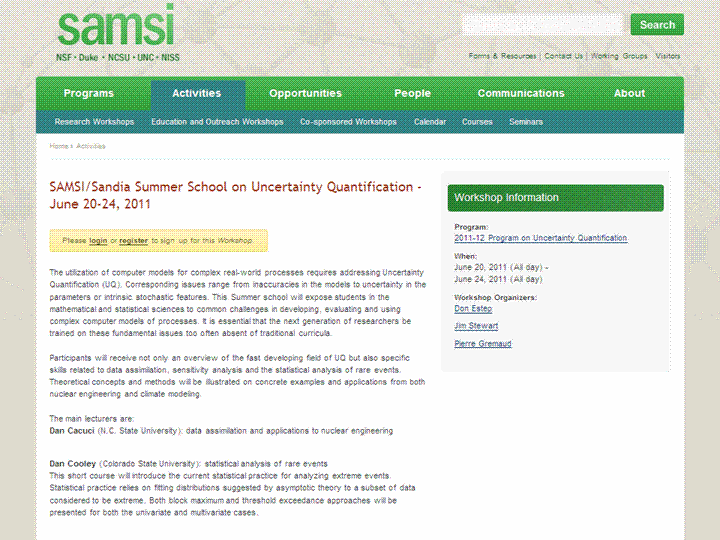
SAMSI/Sandia Summer School on Uncertainty Quantification – June 20-24, 2011

http://www.samsi.info/workshop/samsisandia-summer-school-uncertainty-quantification

The utilization of computer models for complex real-world processes requires addressing Uncertainty Quantification (UQ). Corresponding issues range from inaccuracies in the models to uncertainty in the parameters or intrinsic stochastic features.

This Summer school will expose students in the mathematical and statistical sciences to common challenges in developing, evaluating and using complex computer models of processes. It is essential that the next generation of researchers be trained on these fundamental issues too often absent of traditional curricula.

Participants will receive not only an overview of the fast developing field of UQ but also specific skills related to data assimilation, sensitivity analysis and the statistical analysis of rare events.

Theoretical concepts and methods will be illustrated on concrete examples and applications from both nuclear engineering and climate modeling.

The main lecturers are:
Dan Cacuci (N.C. State University): data assimilation and applications to nuclear engineering

Dan Cooley (Colorado State University): statistical analysis of rare events
This short course will introduce the current statistical practice for analyzing extreme events. Statistical practice relies on fitting distributions suggested by asymptotic theory to a subset of data considered to be extreme. Both block maximum and threshold exceedance approaches will be presented for both the univariate and multivariate cases.

Doug Nychka (NCAR): data assimilation and applications in climate modeling
Climate prediction and modeling do not incorporate geophysical data in the sequential manner as weather forecasting and comparison to data is typically based on accumulated statistics, such as averages. This arises because a climate model matches the state of the Earth’s atmosphere and ocean “on the average” and so one would not expect the detailed weather fluctuations to be similar between a model and the real system. An emerging area for climate model validation and improvement is the use of data assimilation to scrutinize the physical processes in a model using observations on shorter time scales. The idea is to find a match between the state of the climate model and observed data that is particular to the observed weather. In this way one can check whether short time physical processes such as cloud formation or dynamics of the atmosphere are consistent with what is observed.

Dongbin Xiu (Purdue University): sensitivity analysis and polynomial chaos for differential equations
This lecture will focus on numerical algorithms for stochastic simulations, with an emphasis on the methods based on generalized polynomial chaos methodology. Both the mathematical framework and the technical details will be examined, along with performance comparisons and implementation issues for practical complex systems.

The main lectures will be supplemented by discussion sessions and by presentations from UQ practitioners from both the Sandia and Los Alamos National Laboratories.

http://www.samsi.info/workshop/samsisandia-summer-school-uncertainty-quantification

Nice BI Tutorials

Tutorials screenshot.
Image via Wikipedia

Here is a set of very nice, screenshot enabled tutorials from SAP BI. They are a bit outdated (3 years old) but most of it is quite relevant- especially from a Tutorial Design Perspective –

Most people would rather see screenshot based step by step powerpoints, than cluttered or clever presentations , or even videos that force you to sit like a TV zombie. Unfortunately most tutorial presentations I see especially for BI are either slides with one or two points, that abruptly shift to “concepts” or videos that are atleast more than 10 minutes long. That works fine for scripting tutorials or hands on workshops, but cannot be reproduced for later instances of study.

The mode of tutorials especially for GUI software can vary, it may be Slideshare, Scribd, Google Presentation,Microsoft Powerpoint but a step by step screenshot by screenshot tutorial is much better for understanding than commando line jargon/ Youtub   Videos presentations, or Powerpoint with Points.

Have a look at these SAP BI 7 slideshares

and

Speaking of BI, the R Package called Brew is going to brew up something special especially combined with R Apache. However I wish R Apache, or R Web, or RServe had step by step install screenshot tutorials to increase their usage in Business Intelligence.

I tried searching for JMP GUI Tutorials too, but I believe putting all your content behind a registration wall is not so great. Do a Pareto Analysis of your training material, surely you can share a couple more tutorials without registration. It also will help new wanna-migrate users to get a test and feel for the installation complexities as well as final report GUI.


Analytical Jobs for Thanksgiving /Christmass

some analytical positions from Analytical Searches.com

WWW's "historical" logo, created by ...
Image via Wikipedia

Relocation is provided for all except NY. H1 transfers are sponsored for the Analytical Manager/Senior Manager and Business Reporting Analyst only. ————————————————————————–

  1. Analytical Manager and Senior Manager/To $160K
  2. Analytics Manager/CA or IL/To $120K
  3. Bank Analytics Manager/IL/To $120K
  4. Business Reporting Analyst/NY/To $90K
  5. Credit Card Risk Analyst/ Illinois/To $95K
  6. Director Analytics/San Diego/To $170K
  7. Director, Operations Strategy and Analytics/San Diego/To $150K
  8. Lead Risk Analyst/CA & TX/To $150K
  9. Manager Modeling & Analytics/CT/To $120K
  10. Marketing Analytics/NY/To$85K
  11. Principal Product Manager, Vertical Markets/$150K/WA
  12. Research Statistician/OH/To $110K
  13. Senior Consultant Marketing Analytics/NY/To $120K
  14. Senior Director Strategic Consulting/To $130K
  15. Senior Manager Decision Science/CA/To $160K
  16. Senior Marketing / Web Analyst /NY/To $100K
  17. Senior Statistician/Modeling Position/VA/$80K
  18. Statistical Director/ Boston or Dallas/To $145K
  19. Statistical Manager/Boston/To $95K


Contact Details- Email Use The Referral Code- Santa Clause

Zen and the art of applying T tests to Spam Data

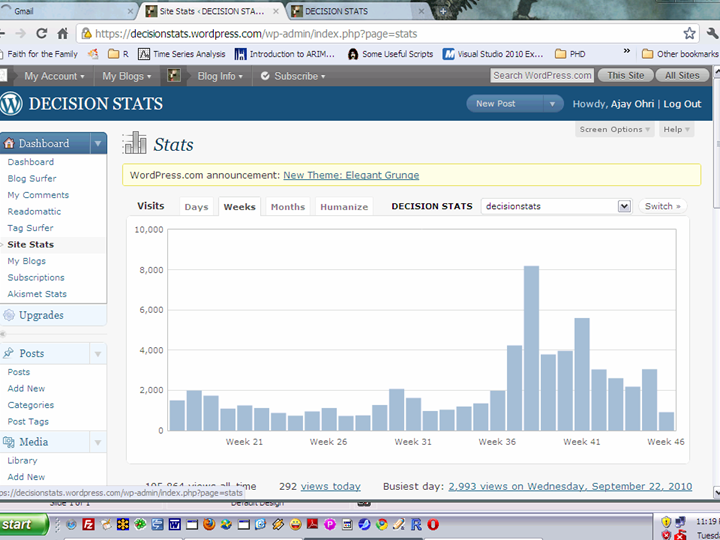
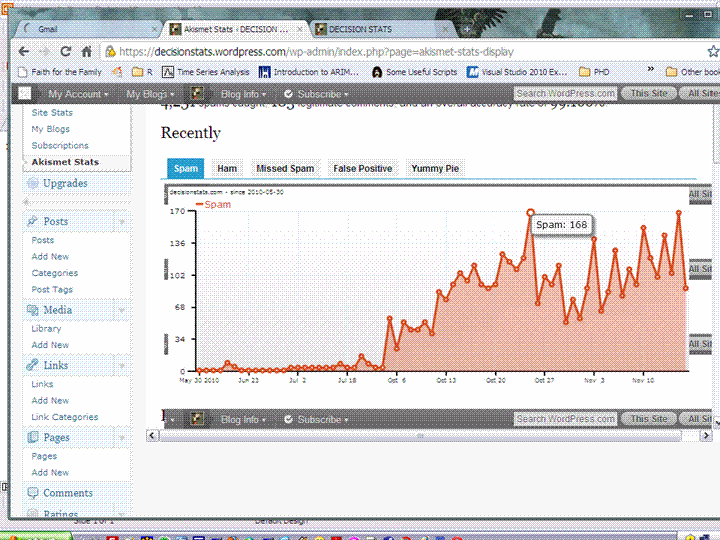
Decisionstats traffic seemed up mmm but Spam is way way up

Whos spamming my dear bloggie

hmm

is it the russians doing a link spam. unlikely they dont bot against Akismet that much (as they fail)

And Captcha can be failed by python (apparently. sigh)

Is there a co relation of certain tags of posts, and count of spam- hoping to distort say blogs’s search engine rankings for SAS WPS Lawsuit in Google or jet ski across  pacific in Google.

Sigh- an old retired outlaw black hat is never kept in peace. Try doing a blog search for R in Google- Revo  is now down to number 7 (which is hmm given Google Instant)

Of course I think too much about SEO, but I dont run CPC ads- I made much more money when traffic is low – say 5-10 small businesses needing to forecast their sales .

and enjoy your Thanksgiving. Remember the Indians bring the Turkeys.


Statistical Analysis with R- by John M Quick

I was asked to be a techie reviewe for John M Quick’s new R book “Statistical Analysis with R” from Packt Publishing some months ago-(very much to my surprise I confess)-

I agreed- and technical reviewer work does take time- its like being a mid wife and there is whole team trying to get the book to birth.

Statistical Analysis with R- is a Beginner’s Guide so has nice screenshots, simple case studies, and quizzes to check recall of student/ reader. I remember struggling with the official “beginner’s guide to R” so this one is different in that it presents a story of a Chinese Army and how to use R to plan resources to fight the battle. It’s recommended especially for undergraduate courses- R need not be an elitist language- and given my experience with Asian programming acumen – I am sure it is a matter of time before high schools in India teach basic R in final years ( I learnt quite a shit load of quantum physics as compulsory topics in Indian high schools- but I guess we didnt have Jersey Shore things to do)

Congrats to author Mr John M Quick- he is doing his educational Phd from ASU- and I am sure both he and his approach to making education simple informative and fun will go places.

Only bad thing- The Name Statistical Analysis with R has atleast three other books , but I guess Google will catch up to it.

This book is here-https://www.packtpub.com/statistical-analysis-with-r-beginners-guide/book