Workflows and MyExperiment.org

Here is a great website for sharing workflows – it is called MyExperiment.org and it can also include Work flows from many software.

myExperiment currently has 4742 members270 groups1842 workflows423 files and 173 packs

Could it also include workflow from Red-R from #rstats or Enterprise Miner

Continue reading “Workflows and MyExperiment.org”

Machine Learning Contest

New Contest at http://www.ecmlpkdd2011.org/dcOverview.php


Discovery Challenge Overview

Organization | Overview | Task and DatasetsTimeline


General description: tasks and dataset

VideoLectures.net is a free and open access multimedia repository of video lectures, mainly of research and educational character. The lectures are given by distinguished scholars and scientists at the most important and prominent events like conferences, summer schools, workshops and science promotional events from many fields of Science. The portal is aimed at promoting science, exchanging ideas and fostering knowledge sharing by providing high quality didactic contents not only to the scientific community but also to the general public. All lectures, accompanying documents, information and links are systematically selected and classified through the editorial process taking into account also users’ comments.

The ECML-PKDD 2011 Discovery Challenge is organized in order to improve the website’s current recommender system. The challenge consists of two main tasks and a “side-by” contest. The provided data is for both of the tasks, and it is up to the contestants how it will be used for learning (building up) a recommender.

Due to the nature of the problem, each of the tasks has its own merit: task 1 simulates new-user and new- item recommendation (cold-start mode), task 2 simulates clickstream based recommendation (normal mode). Continue reading “Machine Learning Contest”

Forecasting World Events Team

a large and diverse panel of forecasters, including substantial representation from government, academia, “think tanks,” and industry. Here are a few other details concerning your fellow participants:
  • At this time, over 600 people are being invited to participate. Please note that we expect that new participants will be joining the panel on a rolling basis for years to come.
  • Around 85% of these 600+ participants have at least a Bachelor’s degree, and over 60% of them have advanced degrees.
  • In terms of background training, participants represent a range of academic fields. Around 40% report a Social-Behavioral Science background, but there is also significant representation from those with backgrounds in Business (15%), the Humanities (13%), Engineering (12%), and the Natural Sciences (10%), among others.
  • The average participant age is 43 years-old, with a standard deviation of 15 years.
  • The panel’s gender composition is 75% men / 25% women, and this closely mirrors the gender ratio for all FWE registrants.
  • In addition to participation from individuals overseas, we are pleased to have eligible participants representing 44 of the 50 United States.
We are currently scheduled to begin the core forecasting study in late summer, a few months later than we initially anticipated. In the meantime, we will be readying our web-based forecasting environment and assembling our initial set of forecasting questions. As our formal launch date approaches, we will be contacting you with a link to the forecasting website and any other information you’ll need to get started. Between now and then we may reach out to you with other related announcements.
Finally, registration remains open, and we encourage you to “spread the word” by sharing our registration homepage link with your friends and colleagues.
Thanks once again for your interest in Forecasting World Events. We look forward to you joining us this summer.
Sincerely,
The Forecasting World Events Team
E-mail is not a secure form of communication.

The confidentiality of this message cannot be guaranteed.

ps- above message was from this new contest. Enter at your initiative. Buyer Beware!.

Google Storage for Developers goes into Enterprise Mode

Schematic representation of the SSL handshake ...
Image via Wikipedia

To help unify and uniform, collobrative work and data management and business models across the enterprise in secure SSL cloud environments- Google Storage has been rolling out some changes (read below)-this also gives you more options on the day Amazon goes ahem down (cough cough) because they didn’t think someone in their data environment could be sympathetic to free data.

——————————————————————————————————————————————————————–

https://groups.google.com/group/gs-announce

And now to the actual update.

We’re making some changes to Google Storage for Developers to make team-based development easier. As part of this work, we are introducing the concept of a project. In preparation for this feature, we will be creating projects for every user and migrating their buckets to it.

What does this mean for you?

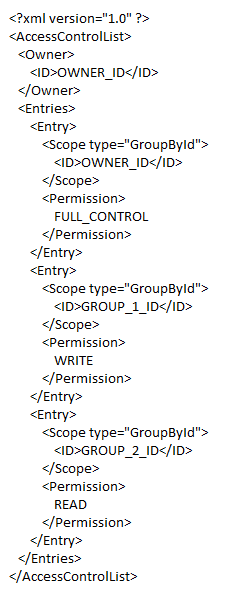
Everything will continue to work as it always has. However, you will notice that if you perform a get-acl operation on any of your buckets, you will see extra ACL entries. These entries correspond to project groups. Each group has only one member – the person who owned the buckets before the bucket migration;  no additional rights have been granted to any of your buckets or objects. You should preserve these new ACL grants if you modify bucket ACLs.

An example entry for a modified ACL would look like this:

We’ll be rolling out these changes over the next few days,

http://blog.cloudberrylab.com/2011/04/cloudberry-explorer-for-google-storage.html

Detailed Note on GS-

https://code.google.com/apis/storage/

Google Storage for Developers is a RESTful service for storing and accessing your data on Google’s infrastructure. The service combines the performance and scalability of Google’s cloud with advanced security and sharing capabilities. Highlights include:

Fast, scalable, highly available object store

  • All data replicated to multiple U.S. data centers
  • Read-your-writes data consistency
  • Objects of hundreds of gigabytes in size per request with range-get support
  • Domain-scoped bucket namespace

Easy, flexible authentication and sharing

  • Key-based authentication
  • Authenticated downloads from a web browser
  • Individual- and group-level access controls

In addition, Google Storage for Developers offers a web-based interface for managing your storage and GSUtil, an open source command line tool and library. The service is also compatible with many existing cloud storage tools and libraries. With pay-as-you-go pricing, it’s easy to get started and scale as your needs grow.

Google Storage for Developers is currently only available to a limited number of developers. Please sign up to join the waiting list.

AsterData still alive;/launches SQL-MapReduce Developer Portal

so apparantly ole client AsterData continues to thrive under gentle touch of Terrific Data

———————————————————————————————————————————————————

Aster Data today launched the SQL-MapReduce Developer Portal, a new online community for data scientists and analytic developers. For your convenience, I copied the release below and it can also be found here. Please let me know if you have any questions or if there is anything else I can help you with.

Sara Korolevich

Point Communications Group for Aster Data

sarak@pointcgroup.com

Office: 602.279.1137

Mobile: 623.326.0881

Teradata Accelerates Big Data Analytics with First Collaborative Community for SQL-MapReduce®

New online community for data scientists and analytic developers enables development and sharing of powerful MapReduce analytics


San Carlos, California – Teradata Corporation (NYSE:TDC) today announced the launch of the Aster Data SQL-MapReduce® Developer Portal. This portal is the first collaborative online developer community for SQL-MapReduce analytics, an emerging framework for processing non-relational data and ultra-fast analytics.

“Aster Data continues to deliver on its unique vision for powerful analytics with a rich set of tools to make development of those analytics quick and easy,” said Tasso Argyros, vice president of Aster Data Marketing and Product Management, Teradata Corporation. “This new developer portal builds on Aster Data’s continuing SQL-MapReduce innovation, leveraging the flexibility and power of SQL-MapReduce for analytics that were previously impossible or impractical.”

The developer portal showcases the power and flexibility of Aster Data’s SQL-MapReduce – which uniquely combines standard SQL with the popular MapReduce distributed computing technology for processing big data – by providing a collaborative community for sharing SQL-MapReduce expert insights in addition to sharing SQL-MapReduce analytic functions and sample code. Data scientists, quantitative analysts, and developers can now leverage the experience, knowledge, and best practices of a community of experts to easily harness the power of SQL-MapReduce for big data analytics.

A recent report from IDC Research, “Taking Care of Your Quants: Focusing Data Warehousing Resources on Quantitative Analysts Matters,” has shown that by enabling data scientists with the tools to harness emerging types and sources of data, companies create significant competitive advantage and become leaders in their respective industry.

“The biggest positive differences among leaders and the rest come from the introduction of new types of data,” says Dan Vesset, program vice president, Business Analytics Solutions, IDC Research. “This may include either new transactional data sources or new external data feeds of transactional or multi-structured interactional data — the latter may include click stream or other data that is a by-product of social networking.”

Vesset goes on to say, “Aster Data provides a comprehensive platform for analytics and their SQL-MapReduce Developer Portal provides a community for sharing best practices and functions which can have an even greater impact to an organization’s business.”

With this announcement Aster Data extends its industry leadership in delivering the most comprehensive analytic platform for big data analytics — not only capable of processing massive volumes of multi-structured data, but also providing an extensive set of tools and capabilities that make it simple to leverage the power of MapReduce analytics. The Aster Data

SQL-MapReduce Developer Portal brings the power of SQL-MapReduce accessible to data scientists, quantitative analysis, and analytic developers by making it easy to share and collaborate with experts in developing SQL-MapReduce analytics. This portal builds on Aster Data’s history of SQL-MapReduce innovations, including:

  • The first deep integration of SQL with MapReduce
  • The first MapReduce support for .NET
  • The first integrated development environment, Aster Data
    Developer Express
  • A comprehensive suite of analytic functions, Aster Data
    Analytic Foundation

Aster Data’s patent-pending SQL-MapReduce enables analytic applications and functions that can deliver faster, deeper insights on terabytes to petabytes of data. These applications are implemented using MapReduce but delivered through standard SQL and business intelligence (BI) tools.

SQL-MapReduce makes it possible for data scientists and developers to empower business analysts with the ability to make informed decisions, incorporating vast amounts of data, regardless of query complexity or data type. Aster Data customers are using SQL-MapReduce for rich analytics including analytic applications for social network analysis, digital marketing optimization, and on-the-fly fraud detection and prevention.

“Collaboration is at the core of our success as one of the leading providers, and pioneers of social software,” said Navdeep Alam, director of Data Architecture at Mzinga. “We are pleased to be one of the early members of The Aster Data SQL-MapReduce Developer Portal, which will allow us the ability to share and leverage insights with others in using big data analytics to attain a deeper understanding of customers’ behavior and create competitive advantage for our business.”

SQL-MapReduce is one of the core capabilities within Aster Data’s flagship product. Aster DatanCluster™ 4.6, the industry’s first massively parallel processing (MPP) analytic platform has an integrated analytics engine that stores and processes both relational and non-relational data at scale. With Aster Data’s unique analytics framework that supports both SQL and
SQL-MapReduce™, customers benefit from rich, new analytics on large data volumes with complex data types. Aster Data analytic functions are embedded within the analytic platform and processed locally with data, which allows for faster data exploration. The SQL-MapReduce framework provides scalable fault-tolerance for new analytics, providing users with superior reliability, regardless of number of users, query size, or data types.


About Aster Data
Aster Data is a market leader in big data analytics, enabling the powerful combination of cost-effective storage and ultra-fast analysis of new sources and types of data. The Aster Data nCluster analytic platform is a massively parallel software solution that embeds MapReduce analytic processing with data stores for deeper insights on new data sources and types to deliver new analytic capabilities with breakthrough performance and scalability. Aster Data’s solution utilizes Aster Data’s patent-pending SQL-MapReduce to parallelize processing of data and applications and deliver rich analytic insights at scale. Companies including Barnes & Noble, Intuit, LinkedIn, Akamai, and MySpace use Aster Data to deliver applications such as digital marketing optimization, social network and relationship analysis, and fraud detection and prevention.


About Teradata
Teradata is the world’s leader in data warehousing and integrated marketing management through itsdatabase softwaredata warehouse appliances, and enterprise analytics. For more information, visitteradata.com.

# # #

Teradata is a trademark or registered trademark of Teradata Corporation in the United States and other countries.

Getting Flatr on a wordpress.com blog

What is Flattr?

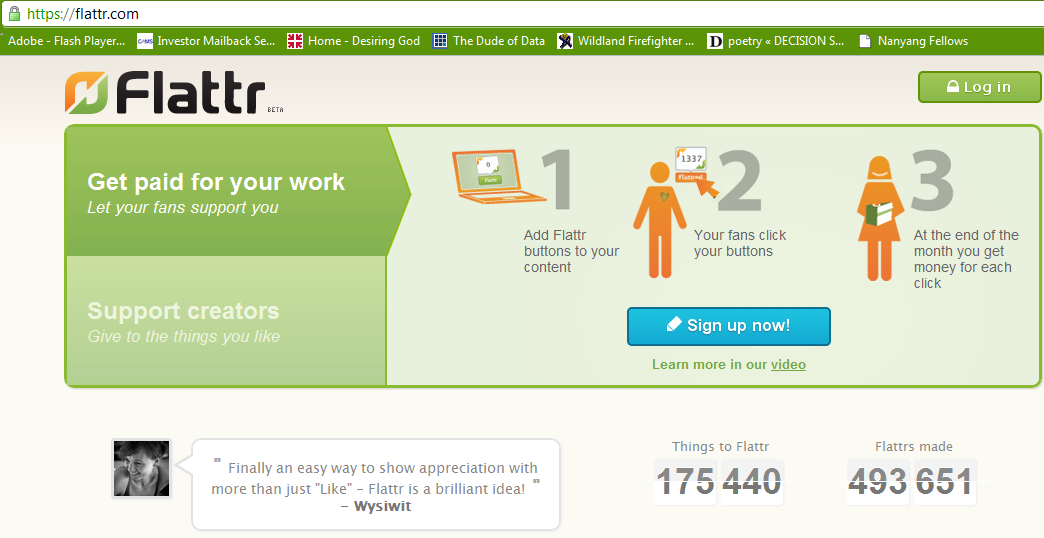
social micro payments- aka another way for bloggers, tweeters, facebookies to make money.

Thing of it as the Paypal plus a ReTweetmeme button.

FlattR is the new legal business of the creator of Pirate Bay- the large search engine for bit torrent data.

 and how to enable it on WordPress.com

Read some snarkly grrovy instructions here with a screenshot

http://thereturnofthepublic.wordpress.com/2011/04/10/putting-flattr-on-a-wordpress-com-blog-a-guide-for-drooling-imbeciles/

1.) Open a Flattr.com account here. This should be reasonably straightforward. A monkey hitting keys at random could manage it in about half an hour. It took me less than 45 minutes.

2.) In the top right of ‘Your Flattr Dashboard’ there is a button ‘Submit Thing’. Click on that and enter the details of your blog – the URL (like decisionstats.com for me) and a description (make that atleast 3 sentences). Flattr will create a page – for example,https://flattr.com/thing/162940/example-blog


Now go to your wordpress dashboard- sharing tab.

/wp-admin/options-general.php?page=sharing

Add the following lines to your New Add Service in respective tabs

URL= https://flattr.com/thing/175763/DecisionStats (change this to the one created for yourself instep2 above)

ICON = http://api.flatrr.com/button/flattr-badge-large.png

 If you have a non WordPress blog see instructions at http://markup.io/v/jz3wv155bsfg or screenshot of instructions here-

Why search optimization can make you like Rebecca Black

Felicia Day, actress and web content producer.
Image via Wikipedia

A highly optimized blog post or web content can get you a lot of attention just like Rebecca Black’s video (provided it passes through the new quality metrics \change*/ in the Search Engine)

But if the underlying content is weak, or based on a shoddy understanding of the content-it can drive lots of horrid comments as well as ensuring that bad word of mouth is spread about the content or you/despite your hard work.

An example of this is copy and paste journalism especially in technology circles, where even a bigger Page Ranked website /blog can get away with scraping or stealing content from a lower page ranked website (or many websites)  after adding a cursory “expert comment”. This is also true when someone who is basically a corporate communication specialist (or PR -public relations) person is given a techinical text and encourage to write about it without completely understanding it.

A mild technical defect in the search engine algorithm is that it does not seem to pay attention to when the content was published, so the copying website or blog actually can get by as fresher content even if it is practically has 90% of the same words). The second flaw is over punishment or manual punishment of excessive linking – this can encourage search optimization minded people to hoard links or discourage trackbacks.

A free internet is one which promotes free sharing of content and does not encourage stealing or un-authorized scraping or content copying. Unfortunately current search engine optimization can encourage scraping and content copying without paying too much attention to origin of the words.

In addition the analytical rigor by which search algorithms search your inboxes (as in search all emails for a keyword) or media rich sites (like Youtube) are quite on a different level of quality altogether. The chances of garbage results are much more while searching for media content and/or emails.