For some time now, I had been hoping for a place where new package or algorithm developers get at least a fraction of the money that iPad or iPhone application developers get. Rapid Miner has taken the lead in establishing a marketplace for extensions. Is there going to be paid extensions as well- I hope so!!
This probably makes it the first “app” marketplace in open source and the second app marketplace in analytics after salesforce.com
It is hard work to think of new algols, and some of them can really be usefull.
Can we hope for #rstats marketplace where people downloading say ggplot3.0 atleast get a prompt to donate 99 cents per download to Hadley Wickham’s Amazon wishlist. http://www.amazon.com/gp/registry/1Y65N3VFA613B
Do you think it is okay to pay 99 cents per iTunes song, but not pay a cent for open source software.
I dont know- but I am just a capitalist born in a country that was socialist for the first 13 years of my life. Congratulations once again to Rapid Miner for innovating and leading the way.
Over the years, many of you have been developing new RapidMiner Extensions dedicated to a broad set of topics. Whereas these extensions are easy to install in RapidMiner – just download and place them in the plugins folder – the hard part is to find them in the vastness that is the Internet. Extensions made by ourselves at Rapid-I, on the other hand, are distributed by the update server making them searchable and installable directly inside RapidMiner.
We thought that this was a bit unfair, so we decieded to open up the update server to the public, and not only this, we even gave it a new look and name. The Rapid-I Marketplace is available in beta mode at http://rapidupdate.de:8180/ . You can use the Web interface to browse, comment, and rate the extensions, and you can use the update functionality in RapidMiner by going to the preferences and entering http://rapidupdate.de:8180/UpdateServer/ as the update server URL. (Once the beta test is complete, we will change the port back to 80 so we won’t have any firewall problems.)
As an Extension developer, just register with the Marketplace and drop me an email (fischer at rapid-i dot com) so I can give you permissions to upload your own extension. Upload is simple provided you use the standard RapidMiner Extension build process and will boost visibility of your extension.
Looking forward to see many new extensions there soon!
Disclaimer- Decisionstats is a partner of Rapid Miner. I have been liking the software for a long long time, and recently agreed to partner with them just like I did with KXEN some years back, and with Predictive AnalyticsConference, and Aster Data until last year.
I still think Rapid Miner is a very very good software,and a globally created software after SAP.
Welcome to the Rapid-I Marketplace Public Beta Test
The Rapid-I Marketplace will soon replace the RapidMiner update server. Using this marketplace, you can share your RapidMiner extensions and make them available for download by the community of RapidMiner users. Currently, we are beta testing this server. If you want to use this server in RapidMiner, you must go to the preferences and enter http://rapidupdate.de:8180/UpdateServer for the update url. After the beta test, we will change the port back to 80, which is currently occupied by the old update server. You can test the marketplace as a user (downloading extensions) and as an Extension developer. If you want to publish your extension here, please let us know via the contact form.
This is a short list of several known as well as lesser known R ( #rstats) language codes, packages and tricks to build a business intelligence application. It will be slightly Messy (and not Messi) but I hope to refine it someday when the cows come home.
It assumes that BI is basically-
a Database, a Document Database, a Report creation/Dashboard pulling software as well unique R packages for business intelligence.
What is business intelligence?
Seamless dissemination of data in the organization. In short let it flow- from raw transactional data to aggregate dashboards, to control and test experiments, to new and legacy data mining models- a business intelligence enabled organization allows information to flow easily AND capture insights and feedback for further action.
BI software has lately meant to be just reporting software- and Business Analytics has meant to be primarily predictive analytics. the terms are interchangeable in my opinion -as BI reports can also be called descriptive aggregated statistics or descriptive analytics, and predictive analytics is useless and incomplete unless you measure the effect in dashboards and summary reports.
Data Mining- is a bit more than predictive analytics- it includes pattern recognizability as well as black box machine learning algorithms. To further aggravate these divides, students mostly learn data mining in computer science, predictive analytics (if at all) in business departments and statistics, and no one teaches metrics , dashboards, reporting in mainstream academia even though a large number of graduates will end up fiddling with spreadsheets or dashboards in real careers.
Basically dispensing with the relational setup, with primary and foreign keys, and with the additional overhead involved in keeping transactional safety, often gives you extreme increases in performance
NoSQL is a kind of database that doesn’t have a fixed schema like a traditional RDBMS does. With the NoSQL databases the schema is defined by the developer at run time. They don’t write normal SQL statements against the database, but instead use an API to get the data that they need.
instead relating data in one table to another you store things as key value pairs and there is no database schema, it is handled instead in code.)
I believe any corporation with data driven decision making would need to both have atleast one RDBMS and one NoSQL for unstructured data-Ajay. This is a sweeping generic statement 😉 , and is an opinion on future technologies.
RevoConnectR for JasperReports Server RevoConnectR for JasperReports Server is a Java library interface between JasperReports Server and Revolution R Enterprise’s RevoDeployR, a standardized collection of web services that integrates security, APIs, scripts and libraries for R into a single server. JasperReports Server dashboards can retrieve R charts and result sets from RevoDeployR.
Extending Pentaho with R analytics”R” is a popular open source statistical and analytical language that academics and commercial organizations alike have used for years to get maximum insight out of information using advanced analytic techniques. In this twelve-minute video, David Reinke from Pentaho Certified Partner OpenBI provides an overview of R, as well as a demonstration of integration between R and Pentaho.
R and BI – Integrating R with Open Source Business
Intelligence Platforms Pentaho and Jaspersoft
David Reinke, Steve Miller
Keywords: business intelligence
Increasingly, R is becoming the tool of choice for statistical analysis, optimization, machine learning and
visualization in the business world. This trend will only escalate as more R analysts transition to business
from academia. But whereas in academia R is often the central tool for analytics, in business R must coexist
with and enhance mainstream business intelligence (BI) technologies. A modern BI portfolio already includes
relational databeses, data integration (extract, transform, load – ETL), query and reporting, online analytical
processing (OLAP), dashboards, and advanced visualization. The opportunity to extend traditional BI with
R analytics revolves on the introduction of advanced statistical modeling and visualizations native to R. The
challenge is to seamlessly integrate R capabilities within the existing BI space. This presentation will explain
and demo an initial approach to integrating R with two comprehensive open source BI (OSBI) platforms –
Pentaho and Jaspersoft. Our efforts will be successful if we stimulate additional progress, transparency and
innovation by combining the R and BI worlds.
The demonstration will show how we integrated the OSBI platforms with R through use of RServe and
its Java API. The BI platforms provide an end user web application which include application security,
data provisioning and BI functionality. Our integration will demonstrate a process by which BI components
can be created that prompt the user for parameters, acquire data from a relational database and pass into
RServer, invoke R commands for processing, and display the resulting R generated statistics and/or graphs
within the BI platform. Discussion will include concepts related to creating a reusable java class library of
commonly used processes to speed additional development.
An review and update on the predictions made in our 2007 article focused on the current state of the commercial open source BI market. Also included is a brief analysis of potential options for commercial open source business models and our take on their applicability.
R has become the “lingua franca” for academic statistical analysis and modeling, and is now rapidly gaining exposure in the commercial world. Steve examines the R technology and community and its relevancy to mainstream BI.
Boxplots and variants (e.g. Violin Plot) are explored as an essential graphical technique to summarize data distributions by categories and dimensions of other attributes.
Lattices and logarithmic data transformations are used to illuminate data density and distribution and find patterns otherwise missed using classic charting techniques.
How do you deal with highly skewed data distributions? Standard charting techniques on this “deviant” data often fail to illuminate relationships. This article explains techniques to re-express skewed data so that it is more understandable.
Steve uses the R open source stats package and Monte Carlo simulations to examine alternative investment portfolio returns…a good example of applied statistics using R.
In August, Steve attended the 2007 Internation R User conference (useR!2007). This article details his experiences, including his meeting with long-time R community expert, Frank Harrell.
The newly launched Dashboard Insight web site is focused on the most useful of BI tools: dashboards. With this article discussing the use of R and trellis graphics, OpenBI brings the realm of open source to this forum.
Utilizing Tufte’s philosophy of maximizing the data to ink ratio of graphics, Steve demonstrates the value in dot plot diagramming. The R open source statistical/analytics software is showcased.
I think that the report generation package Brew would also qualify as a BI package, but large scale implementation remains to be seen in
a commercial business environment
brew: Creating Repetitive Reports
 brew: Templating Framework for Report Generation

brew implements a templating framework for mixing text and R code for report generation. brew template syntax is similar to PHP, Ruby's erb module, Java Server Pages, and Python's psp module. http://bit.ly/jINmaI
I always liked Citrix products when I was a member of the Technical Advisory Board at the University of Tennessee. I especially liked enabling SAS software , R software, Matlab software , ONLY from a browser.
Data Mining through cloud computing, yes University of Tennessee’s analytics server http://analytics.utk.edu was way ahead in 2009- all these softwares at one portal no software needed on your own PC, simply upload data and work on any analytics software.
Here is a nice citrix webinar on managing Time (so you can read more webinars! nah. I think Youtube live streaming events with interactive question and answers is the way of the future while webinars are for Baby Boomers- you can do a test and control experiment yourself if you are in the webinar business. its a web2.oinar)
Interruptions are productivity killers – between email, phone calls and back-to-back meetings, how do you find time to work on your top priorities?
Join top time-management guru Kent Curtis and learn how to stop “living in your inbox” and start prioritising tasks, messages and appointments according to what is most important.
This webinar takes the best principles from FranklinCovey’s world-class productivity training and teaches you how to apply them while using Microsoft Outlook as your scheduling tool.
Attend this interactive, one-hour webinar to:
Stay focused every day with a reliable planning system utilising Microsoft Outlook.
Control competing demands such as email, voice mail, meetings and interruptions.
Apply a planning process that gets better business results.
Reduce stress by eliminating low priority activities and distractions.
Register for the Webinar
Please forward this to colleagues who might be interested in learning more.
If you do a Google search for Data Mining Blog- for the past several years one Blog will come on top. data mining blog – Google Search http://bit.ly/kEdPlE
To honor 5 years of Sandro Saitta’s blog (yes thats 5 years!) , we cover an exclusive interview with him where he reveals his unique sauce for cool techie blogging.
Ajay- Describe your journey as a scientist and data miner, from early experiences, to schooling to your work/research/blogging.
Sandro- My first experience with data mining was my master project. I used decision tree to predict pollen concentration for the following week using input data such as wind, temperature and rain. The fact that an algorithm can make a computer learn from experience was really amazing to me. I found it so interesting that I started a PhD in data mining. This time, the field of application was civil engineering. Civil engineers put a lot of sensors on their structure in order to understand how they behave. With all these sensors they generate a lot of data. To interpret these data, I used data mining techniques such as feature selection and clustering. I started my blog, Data Mining Research, during my PhD, to share with other researchers.
I then started applying data mining in the stock market as my first job in industry. I realized the difference between image recognition, where 99% correct classification rate is state of the art, and stock market, where you’re happy with 55%. However, the company ambiance was not as good as I thought, so I moved to consulting. There, I applied data mining in behavioral targeting to increase click-through rates. When you compare the number of customers who click with the ones who don’t, then you really understand what class imbalance mean. A few months ago, I accepted a very good opportunity at SICPA. I’m looking forward to resolving new challenges there.
Ajay- Your blog is the top ranked blog for “data mining blog”. Could you share some tips on better blogging for analytics and technical people
Sandro- It’s always difficult to start a blog, since at the beginning you have no reader. Writing for nobody may seem stupid, but it is not. By writing my first posts during my PhD I was reorganizing my ideas. I was expressing concepts which were not always clear to me. I thus learned a lot and also improved my English level. Of course, it’s still not perfect, but I hope most people can understand me.
Next come the readers. A few dozen each week first. To increase this number, I then started to learn SEO (Search Engine Optimization) by reading books and blogs. I tested many techniques that increased Data Mining Research visibility in the blogosphere. I think SEO is interesting when you already have some content published (which means not at the very beginning of your blog). After a while, once your blog is nicely ranked, the main task is to work on the content of the blog. To be of interest, your content must be particular: original, informative or provocative for example. I also had the chance to have a good visibility thanks to well-known people in the field like Kevin Hillstrom, Gregory Piatetsky-Shapiro, Will Dwinnell / Dean Abbott, Vincent Granville, Matthew Hurst and many others.
Ajay- Whats your favorite statistical software and what are the various softwares that you have worked with. Could you compare and contrast these software as well.
Sandro- My favorite software at this point is SAS. I worked with it for two years. Once you know the language, you can perform ETL and data mining so easily. It’s also very fast compared to others. There are a lot of tools for data mining, but I cannot think of a tool that is as powerful as SAS and, in the same time, has a high-level programming language behind it.
I also worked with R and Matlab. R is very nice since you have all the up-to-date data mining algorithms implemented. However, working in the memory is not always a good choice, especially for ETL. Matlab is an excellent tool for prototyping. It’s not so fast and certainly not done for ETL, but the price is low regarding all the possibilities for data mining. According to me, SAS is the best choice for ETL and a good choice for data mining. Of course, there is the price.
Ajay- What are your favorite techniques and training resources for learning basics of data mining to say statisticians or business management graduates.
Sandro- I’m the kind of guy who likes to read books. I read data mining books one after the other. The fact that the same concepts are explained differently (and by different people) helps a lot in learning a topic like data mining. Of course, nothing replaces experience in the field. You can read hundreds of books, you will still not be a good practitioner until you really apply data mining in specific fields. My second choice after books is blogs. By reading data mining blogs, you will really see the issues and challenges in the field. It’s still not experience, but we are closer. Finally, web resources and networks such as KDnuggets of course, but also AnalyticBridge and LinkedIn.
Ajay- Describe your hobbies and how they help you ,if at all in your professional life.
Sandro- One of my hobbies is reading. I read a lot of books about data mining, SEO, Google as well as Sci-Fi and Fantasy. I’m a big fan of Asimov by the way. My other hobby is playing tennis. I think I simply use my hobbies as a way to find equilibrium in my life. I always try to find the best balance between work, family, friends and sport.
Ajay- What are your plans for your website for 2011-2012.
Sandro- I will continue to publish guest posts and interviews. I think it is important to let other people express themselves about data mining topics. I will not write about my current applications due to the policies of my current employer. But don’t worry, I still have a lot to write, whether it is technical or not. I will also emphasis more on my experience with data mining, advices for data miners, tips and tricks, and of course book reviews!
Standard Disclosure of Blogging- Sandro awarded me the Peoples Choice award for his blog for 2010 and carried out my interview. There is a lot of love between our respective wordpress blogs, but to reassure our puritan American readers- it is platonic and intellectual.
About Sandro S-
Sandro Saitta is a Data Mining Research Engineer at SICPA Security Solutions. He is also a blogger at Data Mining Research (www.dataminingblog.com). His interests include data mining, machine learning, search engine optimization and website marketing.
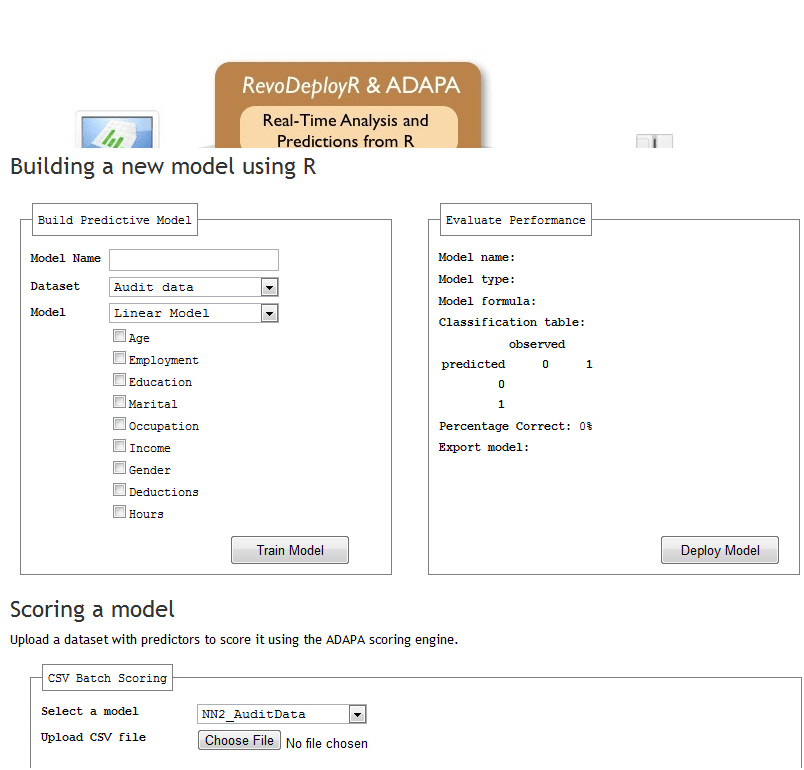
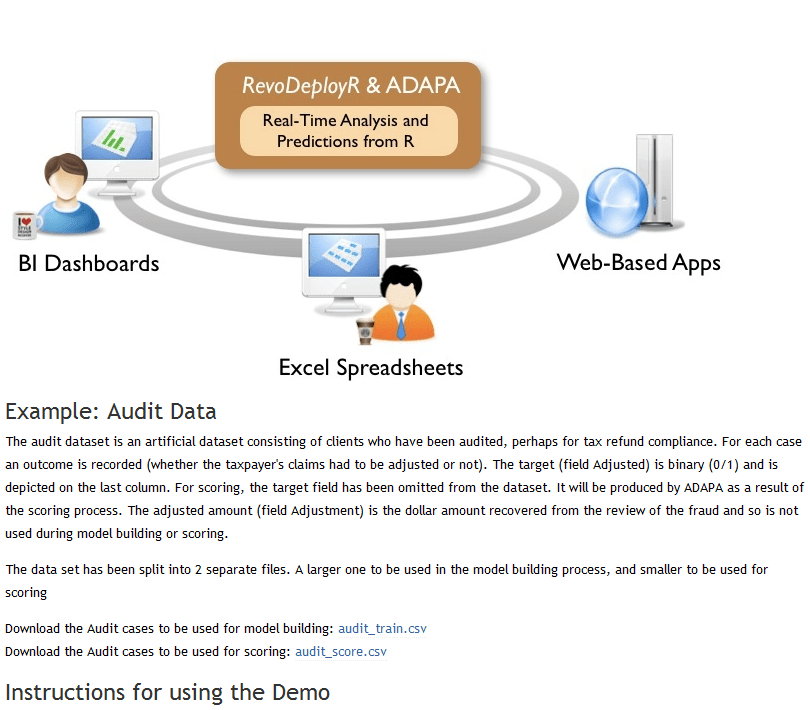
Here is an excellent example of how websites should help rather than hinder new customers take a demo of the software without being overwhelmed by sweet talking marketing guys who dont know the difference between heteroskedasticity, probability, odds and likelihood.
It is made by Zementis (Dr Michael Zeller has been a frequent guest here) and Revolution Analytics is still the best shot in Enterprise software for #Rstats
Now if only Revo could get into the lucrative Department of Energy or Department of Defense business- they could change the world AND earn some more revenue than they have been doing. But seriously.
message from Predictive Analytics World. If you are NY based you may want to drop in and listen.———————————————————————————-Tom Davenport to Keynote at
Predictive Analytics World New York Take advantage of Super Early Bird Pricing by May 20th and recognize savings of $400. Additional savings when you bring the team*
Announcing Tom Davenport Keynote:
Every Day Analytics:
Making Leading Edge CommonplaceThomas Davenport
President’s Distinguished Prof, Babson College
Author, Competing on Analytics & Analytics at Work
Join your peers October 17-21, 2011 at the Hilton New York for Predictive Analytics World, the business event for predictive analytics professionals, managers and commercial practitioners, covering today’s commercial deployment of predictive analytics, across industries and across software vendors.
PAW NYC promises to once again break records as the biggest cross-vendor predictive analytics event ever. The conference program is packed with the top predictive analytics experts, practitioners, authors and business thought leaders, including keynote addresses from Thomas Davenport, author of Competing on Analytics: The New Science of Winning, and PAW Program Chair Eric Siegel, plus special sessions from industry heavy-weights Usama Fayyad and John Elder.
RAVE REVIEWS:“I came to PAW because it provides case studies relevant to my industry. It has lived up to the expectation and I think it’s the best analytics conference I’ve ever attended!“
Shaohua Zhang, Senior Data Mining Analyst
Rogers Telecommunications
“Hands down, best applied analytics conference I have ever attended. Great exposure to cutting-edge predictive techniques and I was able to turn around and apply some of those learnings to my work immediately. I’ve never been able to say that after any conference I’ve attended before!”
Jon Francis, Senior Statistician
T-Mobile
PAW NYC’s agenda covers black box trading, churn modeling, crowdsourcing, demand forecasting, ensemble models, fraud detection, healthcare, insurance applications, law enforcement, litigation, market mix modeling, mobile analytics, online marketing, risk management, social data, supply chain management, targeting direct marketing, uplift modeling (net lift), and other innovative applications that benefit organizations in new and creative ways.
Take advantage of Super Early Bird Pricing and realize
$400 in savings before May 20, 2011.
Note: Each additional attendee from the same company registered at the same time receives an extra $200 off the Conference Pass.








 DECISION STATS