Review of Google Plus

After resisting for two weeks I have decided to write a Google Plus review. This includes both the changed designed parameters, the invite growth features and all of the main sub-items and activities you can do in the G+  Stream, Share, Hang Out, Pictures, Circles.

Since I have 2500 people in my circles and I am in 91 circles

To keep it simple – I have noted the following 6 main sub-points.

1) Content Dissemination-


  • Sharing Blog Articles
  • Micro-Blogging
  • Sharing Pictures

2) Online Professional Networking  and 3) Online Personal Socializing

4) Spam Control / Malware /Phishing/Porn Protection

5) Time Cost versus Networking Benefit

————————————————————————————————————————————————————–

1) Content Dissemination-

  • Sharing Blog Articles


Sharing is as simple as Facebook but the design makes it simpler.

Note G+ uses lower number of colors, bigger fonts, slightly bigger icons to reduce the appearance of clutter.

Contrast this

with this-


Interesting to see that G+ has four types of media to share- besides writing the status/micro-blog (unfettered by 140 characters). Note these show icons only with hover text to tell you what the icon stands for.

Photo,Video,URL,Location (which seems to be Twitter like in every share)

Facebook has 5 types of Sharing and note the slightly different order as well the fact that both icon and text make it slightly more cluttered- Status (which is redundant clearly ),Photo,Link,Video,Question

G+ thus lacks polls /questions features. It is much easier to share content on Facebook automatically as of now- but for G+ you need to share the URL privately though. There exist G+ meme-s already thanks to re-sharing in G+ plus which seems to be inspired by Tumblr (?).

In addition Google has made your Google Profile the number one SERP for searching your name, so there seem clear tied in benefits of SEO with content disseminated here.

G+ has sharing in circles whereas Facebook has only Everyone, Friends, Friends of Friends ,Customize.  This makes G+ interface slightly better in tweaking the spread of content to targeted audience esp by Bloggers.

  • For sharing Photos– G+ goes in for a whole new separate tab (one out of four) whereas Facebook treats photo sharing less prominently.
  • Google has lesser white space between photos, (The Facebook way used to be just snap photo by iPhone and send by email to auto-post), and the privacy in sharing photos is much better in G+ as the dropdowns in Facebook are not as granular and neither as nifty in icon design.
  •  
  • Also I like the hover and photo grows bigger feature and the auto import from Picassa (but I would like to auto-import into G+ from Flickr just as I can do in Facebook)
  • Google Plus also has a much more detailed version for sharing videos than photos as compared to Facebook  -upload Photo options  versus
  • G+ has much more focus on auto-sharing from mobiles


2) Online Professional Networking  and 3) Online Personal Socializing Organizing Contacts in Google Plus and seperate privacy controls make it easier to customize sharing without getting too complex. You can make as many circles and drag and drop very easily instead of manually clicking a dropdown box. Effectively speaking Facebook has just 4 kinds of circles and it does not distinguish between various types of friends which is great from philosophical point of view but not so goodn enforcing separateness between professional and personal networks. Note Facebook privacy settings are overwhelming despite the groovy data viz

4) Spam Control / Malware /Phishing/Porn Protection 

Spam Control in Facebook versus in Google Plus- note the different options in Google Plus (including the ability to NOT reshare). I am not aware of more enhanced protection than the ones available for Gmail already. Spam is what really killed off a lot many social networks and the ability to control or reduce spam will be a critical design choice

5) Time Cost versus Networking Benefit

Linkedin has the lowest cost in time spent and networking done. If G+ adds a resume section for jobs, recruiters, and adds in Zynga games, the benefit from G+ will expand. As of now G+ is a minimal social network with minimalism as design ethos.

(Zynga would do well to partner with G+)


Facebook to Google Plus Migration

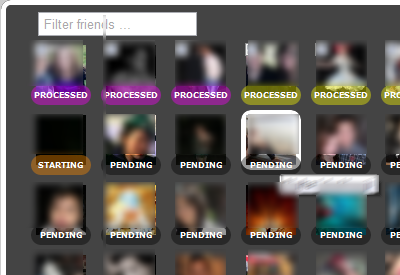
and there is a new tool on that already but you are on your own if your data gets redirected. Does Chrome take legal liability for malware extensions? Dunno-and yes it works on Chrome alone (at the point of speaking)

https://chrome.google.com/webstore/detail/ficlccidpkaiepnnboobcmafnnfoomga


Facebook Friend Exporter
Logo 

Facebook Friend Exporter
Verified author: mohamedmansour.com
Free
Get *your* data contact out of Facebook to Google Contacts or CSV, whether they want you to or not.
103 ratings
5,527 users
Install
Description
Get *your* data contact out of Facebook, whether they want you to or not. You gave them your friends and allowed them to store that data, and you have right to take it back out! Facebook doesn't own my friends. Only available in English Facebook. Any other language will not work.

SOURCE CODE: http://goo.gl/VtRCl (GitHub) fb-exporter

PRE NOTICE:
 1 - Must have English version of Facebook for this to work (you can switch)
 2 - Do not enable SSL for Facebook use HTTP not HTTPS
 3 - If you need any help running this, contact me. Commenting below will be lost.
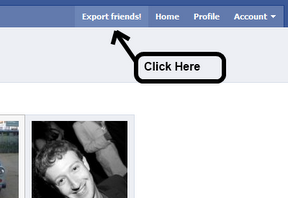
 4 - An "Export" button will appear on Facebooks toolbar after refresh once installed.
 5 - Please disable all Facebook Extensions that you have downloaded, many of them affect the page. For example "Better Facebook" breaks this extension.

This extension will allow you to get your friends information that they shared to you: Continue reading "Facebook to Google Plus Migration"

Updated Interview Elissa Fink -VP Tableau Software

Here is an interview with Elissa Fink, VP Marketing of that new wonderful software called Tableau that makes data visualization so nice and easy to learn and work with.

Elissa Fink, VP, Marketing

Ajay-  Describe your career journey from high school to over 20 plus years in marketing. What are the various trends that you have seen come and go in marketing.

Elissa- I studied literature and linguistics in college and didn’t discover analytics until my first job selling advertising for the Wall Street Journal. Oddly enough, the study of linguistics is not that far from decision analytics: they both are about taking a structured view of information and trying to see and understand common patterns. At the Journal, I was completely captivated analyzing and comparing readership data. At the same time, the idea of using computers in marketing was becoming more common. I knew that the intersection of technology and marketing was going to radically change things – how we understand consumers, how we market and sell products, and how we engage with customers. So from that point on, I’ve always been focused on technology and marketing, whether it’s working as a marketer at technology companies or applying technology to marketing problems for other types of companies.  There have been so many interesting trends. Taking a long view, a key trend I’ve noticed is how marketers work to understand, influence and motivate consumer behavior. We’ve moved marketing from where it was primarily unpredictable, qualitative and aimed at talking to mass audiences, where the advertising agency was king. Now it’s a discipline that is more data-driven, quantitative and aimed at conversations with individuals, where the best analytics wins. As with any trend, the pendulum swings far too much to either side causing backlashes but overall, I think we are in a great place now. We are using data-driven analytics to understand consumer behavior. But pure analytics is not the be-all, end-all; good marketing has to rely on understanding human emotions, intuition and gut feel – consumers are far from rational so taking only a rational or analytical view of them will never explain everything we need to know.

Ajay- Do you think technology companies are still predominantly dominated by men . How have you seen diversity evolve over the years. What initiatives has Tableau taken for both hiring and retaining great talent.

Elissa- The thing I love about the technology industry is that its key success metrics – inventing new products that rapidly gain mass adoption in pursuit of making profit – are fairly objective. There’s little subjective nature to the counting of dollars collected selling a product and dollars spent building a product. So if a female can deliver a better product and bigger profits faster and better, then that female is going to get the resources, jobs, power and authority to do exactly that. That’s not to say that the technology industry is gender-blind, race-blind, etc. It isn’t – technology is far from perfect. For example, the industry doesn’t have enough diversity in positions of power. But I think overall, in comparison to a lot of other industries, it’s pretty darn good at giving people with great ideas the opportunities to realize their visions regardless of their backgrounds or characteristics.

At Tableau, we are very serious about bringing in and developing talented people – they are the key to our growth and success. Hiring is our #1 initiative so we’ve spent a lot of time and energy both on finding great candidates and on making Tableau a place that they want to work. This includes things like special recruiting events, employee referral programs, a flexible work environment, fun social events, and the rewards of working for a start-up. Probably our biggest advantage is the company itself – working with people you respect on amazing, cutting-edge products that delight customers and are changing the world is all too rare in the industry but a reality at Tableau. One of our senior software developers put it best when he wrote “The emphasis is on working smarter rather than longer: family and friends are why we work, not the other way around. Tableau is all about happy, energized employees executing at the highest level and delivering a highly usable, high quality, useful product to our customers.” People who want to be at a place like that should check out our openings at http://www.tableausoftware.com/jobs.

Ajay- What are most notable features in tableau’s latest edition. What are the principal software that competes with Tableau Software products and how would you say Tableau compares with them.

Elissa- Tableau 6.1 will be out in July and we are really excited about it for 3 reasons.

First, we’re introducing our mobile business intelligence capabilities. Our customers can have Tableau anywhere they need it. When someone creates an interactive dashboard or analytical application with Tableau and it’s viewed on a mobile device, an iPad in particular, the viewer will have a native, touch-optimized experience. No trying to get your fingertips to act like a mouse. And the author didn’t have to create anything special for the iPad; she just creates her analytics the usual way in Tableau. Tableau knows the dashboard is being viewed on an iPad and presents an optimized experience.

Second, we’ve take our in-memory analytics engine up yet another level. Speed and performance are faster and now people can update data incrementally rapidly. Introduced in 6.0, our data engine makes any data fast in just a few clicks. We don’t run out of memory like other applications. So if I build an incredible dashboard on my 8-gig RAM PC and you try to use it on your 2-gig RAM laptop, no problem.

And, third, we’re introducing more features for the international markets – including French and German versions of Tableau Desktop along with more international mapping options.  It’s because we are constantly innovating particularly around user experience that we can compete so well in the market despite our relatively small size. Gartner’s seminal research study about the Business Intelligence market reported a massive market shift earlier this year: for the first time, the ease-of-use of a business intelligence platform was more important than depth of functionality. In other words, functionality that lots of people can actually use is more important than having sophisticated functionality that only specialists can use. Since we focus so heavily on making easy-to-use products that help people rapidly see and understand their data, this is good news for our customers and for us.

Ajay-  Cloud computing is the next big thing with everyone having a cloud version of their software. So how would you run Cloud versions of Tableau Server (say deploying it on an Amazon Ec2  or a private cloud)

Elissa- In addition to the usual benefits espoused about Cloud computing, the thing I love best is that it makes data and information more easily accessible to more people. Easy accessibility and scalability are completely aligned with Tableau’s mission. Our free product Tableau Public and our product for commercial websites Tableau Digital are two Cloud-based products that deliver data and interactive analytics anywhere. People often talk about large business intelligence deployments as having thousands of users. With Tableau Public and Tableau Digital, we literally have millions of users. We’re serving up tens of thousands of visualizations simultaneously – talk about accessibility and scalability!  We have lots of customers connecting to databases in the Cloud and running Tableau Server in the Cloud. It’s actually not complex to set up. In fact, we focus a lot of resources on making installation and deployment easy and fast, whether it’s in the cloud, on premise or what have you. We don’t want people to have spend weeks or months on massive roll-out projects. We want it to be minutes, hours, maybe a day or 2. With the Cloud, we see that people can get started and get results faster and easier than ever before. And that’s what we’re about.

Ajay- Describe some of the latest awards that Tableau has been wining. Also how is Tableau helping universities help address the shortage of Business Intelligence and Big Data professionals.

Elissa-Tableau has been very fortunate. Lately, we’ve been acknowledged by both Gartner and IDC as the fastest growing business intelligence software vendor in the world. In addition, our customers and Tableau have won multiple distinctions including InfoWorld Technology Leadership awards, Inc 500, Deloitte Fast 500, SQL Server Magazine Editors’ Choice and Community Choice awards, Data Hero awards, CODiEs, American Business Awards among others. One area we’re very passionate about is academia, participating with professors, students and universities to help build a new generation of professionals who understand how to use data. Data analysis should not be exclusively for specialists. Everyone should be able to see and understand data, whatever their background. We come from academic roots, having been spun out of a Stanford research project. Consequently, we strongly believe in supporting universities worldwide and offer 2 academic programs. The first is Tableau For Teaching, where any professor can request free term-length licenses of Tableau for academic instruction during his or her courses. And, we offer a low-cost Student Edition of Tableau so that students can choose to use Tableau in any of their courses at any time.

Elissa Fink, VP Marketing,Tableau Software


Elissa Fink is Tableau Software’s Vice President of Marketing. With 20+ years helping companies improve their marketing operations through applied data analysis, Elissa has held executive positions in marketing, business strategy, product management, and product development. Prior to Tableau, Elissa was EVP Marketing at IXI Corporation, now owned by Equifax. She has also served in executive positions at Tele Atlas (acquired by TomTom), TopTier Software (acquired by SAP), and Nielsen/Claritas. Elissa also sold national advertising for the Wall Street Journal. She’s a frequent speaker and has spoken at conferences including the DMA, the NCDM, Location Intelligence, the AIR National Forum and others. Elissa is a graduate of Santa Clara University and holds an MBA in Marketing and Decision Systems from the University of Southern California.

Elissa first discovered Tableau late one afternoon at her previous company. Three hours later, she was still “at play” with her data. “After just a few minutes using the product, I was getting answers to questions that were taking my company’s programmers weeks to create. It was instantly obvious that Tableau was on a special mission with something unique to offer the world. I just had to be a part of it.”

To know more – read at http://www.tableausoftware.com/

and existing data viz at http://www.tableausoftware.com/learn/gallery

Storm seasons: measuring and tracking key indicators
What’s happening with local real estate prices?
How are sales opportunities shaping up?
Identify your best performing products
Applying user-defined parameters to provide context
Not all tech companies are rocket ships
What’s really driving the economy?
Considering factors and industry influencers
The complete orbit along the inside, or around a fixed circle
How early do you have to be at the airport?
What happens if sales grow but so does customer churn?
What are the trends for new retail locations?
How have student choices changed?
Do patients who disclose their HIV status recover better?
Closer look at where gas prices swing in areas of the U.S.
U.S. Census data shows more women of greater age
Where do students come from and how does it affect their grades?
Tracking customer service effectiveness
Comparing national and local test scores
What factors correlate with high overall satisfaction ratings?
Fund inflows largely outweighed outflows well after the bubble
Which programs are competing for federal stimulus dollars?
Oil prices and volatility
A classic candlestick chart
How do oil, gold and CPI relate to the GDP growth rate?


Interview- Top Data Mining Blogger on Earth , Sandro Saitta

Surajustement Modèle 2
Image via Wikipedia

If you do a Google search for Data Mining Blog- for the past several years one Blog will come on top. data mining blog – Google Search http://bit.ly/kEdPlE

To honor 5 years of Sandro Saitta’s blog (yes thats 5 years!) , we cover an exclusive interview with him where he reveals his unique sauce for cool techie blogging.

Ajay- Describe your journey as a scientist and data miner, from early experiences, to schooling to your work/research/blogging.

Sandro- My first experience with data mining was my master project. I used decision tree to predict pollen concentration for the following week using input data such as wind, temperature and rain. The fact that an algorithm can make a computer learn from experience was really amazing to me. I found it so interesting that I started a PhD in data mining. This time, the field of application was civil engineering. Civil engineers put a lot of sensors on their structure in order to understand how they behave. With all these sensors they generate a lot of data. To interpret these data, I used data mining techniques such as feature selection and clustering. I started my blog, Data Mining Research, during my PhD, to share with other researchers.

I then started applying data mining in the stock market as my first job in industry. I realized the difference between image recognition, where 99% correct classification rate is state of the art, and stock market, where you’re happy with 55%. However, the company ambiance was not as good as I thought, so I moved to consulting. There, I applied data mining in behavioral targeting to increase click-through rates. When you compare the number of customers who click with the ones who don’t, then you really understand what class imbalance mean. A few months ago, I accepted a very good opportunity at SICPA. I’m looking forward to resolving new challenges there.

Ajay- Your blog is the top ranked blog for “data mining blog”. Could you share some tips on better blogging for analytics and technical people

Sandro- It’s always difficult to start a blog, since at the beginning you have no reader. Writing for nobody may seem stupid, but it is not. By writing my first posts during my PhD I was reorganizing my ideas. I was expressing concepts which were not always clear to me. I thus learned a lot and also improved my English level. Of course, it’s still not perfect, but I hope most people can understand me.

Next come the readers. A few dozen each week first. To increase this number, I then started to learn SEO (Search Engine Optimization) by reading books and blogs. I tested many techniques that increased Data Mining Research visibility in the blogosphere. I think SEO is interesting when you already have some content published (which means not at the very beginning of your blog). After a while, once your blog is nicely ranked, the main task is to work on the content of the blog. To be of interest, your content must be particular: original, informative or provocative for example. I also had the chance to have a good visibility thanks to well-known people in the field like Kevin Hillstrom, Gregory Piatetsky-Shapiro, Will Dwinnell / Dean Abbott, Vincent Granville, Matthew Hurst and many others.

Ajay- Whats your favorite statistical software and what are the various softwares that you have worked with.
Could you compare and contrast these software as well.

Sandro- My favorite software at this point is SAS. I worked with it for two years. Once you know the language, you can perform ETL and data mining so easily. It’s also very fast compared to others. There are a lot of tools for data mining, but I cannot think of a tool that is as powerful as SAS and, in the same time, has a high-level programming language behind it.

I also worked with R and Matlab. R is very nice since you have all the up-to-date data mining algorithms implemented. However, working in the memory is not always a good choice, especially for ETL. Matlab is an excellent tool for prototyping. It’s not so fast and certainly not done for ETL, but the price is low regarding all the possibilities for data mining. According to me, SAS is the best choice for ETL and a good choice for data mining. Of course, there is the price.

Ajay- What are your favorite techniques and training resources for learning basics of data mining to say statisticians or business management graduates.

Sandro- I’m the kind of guy who likes to read books. I read data mining books one after the other. The fact that the same concepts are explained differently (and by different people) helps a lot in learning a topic like data mining. Of course, nothing replaces experience in the field. You can read hundreds of books, you will still not be a good practitioner until you really apply data mining in specific fields. My second choice after books is blogs. By reading data mining blogs, you will really see the issues and challenges in the field. It’s still not experience, but we are closer. Finally, web resources and networks such as KDnuggets of course, but also AnalyticBridge and LinkedIn.

Ajay- Describe your hobbies and how they help you ,if at all in your professional life.

Sandro- One of my hobbies is reading. I read a lot of books about data mining, SEO, Google as well as Sci-Fi and Fantasy. I’m a big fan of Asimov by the way. My other hobby is playing tennis. I think I simply use my hobbies as a way to find equilibrium in my life. I always try to find the best balance between work, family, friends and sport.

Ajay- What are your plans for your website for 2011-2012.

Sandro- I will continue to publish guest posts and interviews. I think it is important to let other people express themselves about data mining topics. I will not write about my current applications due to the policies of my current employer. But don’t worry, I still have a lot to write, whether it is technical or not. I will also emphasis more on my experience with data mining, advices for data miners, tips and tricks, and of course book reviews!

Standard Disclosure of Blogging- Sandro awarded me the Peoples Choice award for his blog for 2010 and carried out my interview. There is a lot of love between our respective wordpress blogs, but to reassure our puritan American readers- it is platonic and intellectual.

About Sandro S-


Sandro Saitta is a Data Mining Research Engineer at SICPA Security Solutions. He is also a blogger at Data Mining Research (www.dataminingblog.com). His interests include data mining, machine learning, search engine optimization and website marketing.

You can contact Mr Saitta at his Twitter address- 

https://twitter.com/#!/dataminingblog

Forecasting World Events Team

a large and diverse panel of forecasters, including substantial representation from government, academia, “think tanks,” and industry. Here are a few other details concerning your fellow participants:
  • At this time, over 600 people are being invited to participate. Please note that we expect that new participants will be joining the panel on a rolling basis for years to come.
  • Around 85% of these 600+ participants have at least a Bachelor’s degree, and over 60% of them have advanced degrees.
  • In terms of background training, participants represent a range of academic fields. Around 40% report a Social-Behavioral Science background, but there is also significant representation from those with backgrounds in Business (15%), the Humanities (13%), Engineering (12%), and the Natural Sciences (10%), among others.
  • The average participant age is 43 years-old, with a standard deviation of 15 years.
  • The panel’s gender composition is 75% men / 25% women, and this closely mirrors the gender ratio for all FWE registrants.
  • In addition to participation from individuals overseas, we are pleased to have eligible participants representing 44 of the 50 United States.
We are currently scheduled to begin the core forecasting study in late summer, a few months later than we initially anticipated. In the meantime, we will be readying our web-based forecasting environment and assembling our initial set of forecasting questions. As our formal launch date approaches, we will be contacting you with a link to the forecasting website and any other information you’ll need to get started. Between now and then we may reach out to you with other related announcements.
Finally, registration remains open, and we encourage you to “spread the word” by sharing our registration homepage link with your friends and colleagues.
Thanks once again for your interest in Forecasting World Events. We look forward to you joining us this summer.
Sincerely,
The Forecasting World Events Team
E-mail is not a secure form of communication.

The confidentiality of this message cannot be guaranteed.

ps- above message was from this new contest. Enter at your initiative. Buyer Beware!.

Google Chrome- Unites All Blog Readers across the world

D'où vient le logo de Google Chrome ?
Image by Emilie Ogez via Flickr

ever wondered what Pakistani blogs are saying about UBL. What Libyan bloggers go through to send you a piece.

Dont trust Ne-ew York Times or Fox-y News and /or both.

Read directly using breakthrough machine learning algorithms.

The Boys in Stanford and friends – bring Google Chrome Languages-

Now available at 0 cost. No viruses. Just annoying ads. Superbowl style.