Interview Beth Schultz Editor AllAnalytics.com

Here is an interview with Beth Scultz Editor in Chief, AllAnalytics.com .

Allanalytics.com http://www.allanalytics.com/ is the new online community on Predictive Analytics, and its a bit different in emphasizing quality more than just quantity. Beth is veteran in tech journalism and communities.

Ajay-Describe your journey in technology journalism and communication. What are the other online communities that you have been involved with?

Beth- I’m a longtime IT journalist, having begun my career covering the telecommunications industry at the brink of AT&T’s divestiture — many eons ago. Over the years, I’ve covered the rise of internal corporate networking; the advent of the Internet and creation of the Web for business purposes; the evolution of Web technology for use in building intranets, extranets, and e-commerce sites; the move toward a highly dynamic next-generation IT infrastructure that we now call cloud computing; and development of myriad enterprise applications, including business intelligence and the analytics surrounding them. I have been involved in developing online B2B communities primarily around next-generation enterprise IT infrastructure and applications. In addition, Shawn Hessinger, our community editor, has been involved in myriad Web sites aimed at creating community for small business owners.

 Ajay- Technology geeks get all the money while journalists get a story. Comments please

Beth- Great technology geeks — those being the ones with technology smarts as well as business savvy — do stand to make a lot of money. And some pursue that to all ends (with many entrepreneurs gunning for the acquisition) while others more or less fall into it. Few journalists, at least few tech journalists, have big dollars in mind. The gratification for journalists comes in being able to meet these folks, hear and deliver their stories — as appropriate — and help explain what makes this particular technology geek developing this certain type of product or service worth paying attention to.

 Ajay- Describe what you are trying to achieve with the All Analytics community and how it seeks to differentiate itself with other players in this space.

 Beth- With AllAnaltyics.com, we’re concentrating on creating the go-to site for CXOs, IT professionals, line-of-business managers, and other professionals to share best practices, concrete experiences, and research about data analytics, business intelligence, information optimization, and risk management, among many other topics. We differentiate ourself by featuring excellent editorial content from a top-notch group of bloggers, access to industry experts through weekly chats, ongoing lively and engaging message board discussions, and biweekly debates.

We’re a new property, and clearly in rapid building mode. However, we’ve already secured some of the industry’s most respected BI/analytics experts to participate as bloggers. For example, a small sampling of our current lineup includes the always-intrigueing John Barnes, a science fiction novelist and statistics guru; Sandra Gittlen, a longtime IT journalist with an affinity for BI coverage; Olivia Parr-Rud, an internationally recognized expert in BI and organizational alignment; Tom Redman, a well-known data-quality expert; and Steve Williams, a leading BI strategy consultant. I blog daily as well, and in particular love to share firsthand experiences of how organizations are benefiting from the use of BI, analytics, data warehousing, etc. We’ve featured inside looks at analytics initiatives at companies such as 1-800-Flowers.com, Oberweis Dairy, the Cincinnati Zoo & Botanical Garden, and Thomson Reuters, for example.

In addition, we’ve hosted instant e-chats with Web and social media experts Joe Stanganelli and Pierre DeBois, and this Friday, Aug. 26, at 3 p.m. ET we’ll be hosting an e-chat with Marshall Sponder, Web metrics guru and author of the newly published book, Social Media Analytics: Effective Tools for Building, Interpreting, and Using Metrics. (Readers interested in participating in the chat do need to fill out a quick registration form, available here http://www.allanalytics.com/register.asp . The chat is available here http://www.allanalytics.com/messages.asp?piddl_msgthreadid=241039&piddl_msgid=439898#msg_439898 .

Experts participating in our biweekly debate series, called Point/Counterpoint, have broached topics such as BI in the cloud, mobile BI and whether an analytics culture is truly possible to build.

Ajay-  What are some tips you would like to share about writing tech stories to aspiring bloggers.

Beth- I suppose my best advice is this: Don’t write about technology for technology’s sake. Always strive to tell the audience why they should care about a particular technology, product, or service. How might a reader use it to his or her company’s advantage, and what are the potential benefits? Improved productivity, increased revenue, better customer service? Providing anecdotal evidence goes a long way toward delivering that message, as well.

Ajay- What are the other IT world websites that have made a mark on the internet.

Beth- I’d be remiss if I didn’t give a shout out to UBM TechWeb sites, including InformationWeek, which has long charted the use of IT within the enterprise; Dark Reading, a great source for folks interested in securing an enterprise’s information assets; and Light Reading, which takes the pulse of the telecom industry.

 Biography- 

Beth Schultz has more than two decades of experience as an IT writer and editor. Most recently, she brought her expertise to bear writing thought-provoking editorial and marketing materials on a variety of technology topics for leading IT publications and industry players. Previously, she oversaw multimedia content development, writing and editing for special feature packages at Network World. Beth has a keen ability to identify business and technology trends, developing expertise through in-depth analysis and early-adopter case studies. Over the years, she has earned more than a dozen national and regional editorial excellence awards for special issues from American Business Media, American Society of Business Press Editors, Folio.net, and others.

 

Revolution #Rstats Webinar

David Smith of Revo presents a nice webinar on the capabilities and abilities of Revolution R- if you are R curious and wonder how the commercial version has matured- you may want to take a look.

click below to view an executive Webinar

——————————————————————————————-

Revolution R Enterprise—presented by author and blogger David Smith:

Revolution R: 100% R and More
On-Demand Webinar

This Webinar covers how R users can upgrade to:

  • Multi-processor speed improvements and parallel processing
  • Productivity and debugging with an integrated development environment (IDE) for the R language
  • “Big Data” analysis, with out-of-memory storage of multi-gigabyte data sets
  • Web Services for R, to integrate R computations and graphics into 3rd-Party applications like Excel and BI Dashboards
  • Expert technical support and consulting services for R

This webinar will be of value to current R users who want to learn more about the additional capabilities of Revolution R Enterprise to enhance the productivity, ease of use, and enterprise readiness of open source R. R users in academia will also find this webinar valuable: we will explain how all members of the academic community can obtain Revolution R Enterprise free of charge.

—————————————————————————————

contact -1-855-GET-REVO or via online form.
info@revolutionanalytics.com | (650) 330-0553 | Twitter @RevolutionR

Interview Mike Boyarski Jaspersoft

Here is an interview with Mike Boyarski , Director Product Marketing at Jaspersoft

.


the largest BI community with over 14 million downloads, nearly 230,000 registered members, representing over 175,000 production deployments, 14,000 customers, across 100 countries.

Ajay- Describe your career in science from Biology to marketing great software.
Mike- I studied Biology with the assumption I’d pursue a career in medicine. It took about 2 weeks during an internship at a Los Angeles hospital to determine I should do something else.  I enjoyed learning about life science, but the whole health care environment was not for me.  I was initially introduced to enterprise-level software while at Applied Materials within their Microcontamination group.  I was able to assist with an internal application used to collect contamination data.  I later joined Oracle to work on an Oracle Forms application used to automate the production of software kits (back when documentation and CDs had to be physically shipped to recognize revenue). This gave me hands on experience with Oracle 7, web application servers, and the software development process.
I then transitioned to product management for various products including application servers, software appliances, and Oracle’s first generation SaaS based software infrastructure. In 2006, with the Siebel and PeopleSoft acquisitions underway, I moved on to Ingres to help re-invigorate their solid yet antiquated technology. This introduced me to commercial open source software and the broader Business Intelligence market.  From Ingres I joined Jaspersoft, one of the first and most popular open source Business Intelligence vendors, serving as head of product marketing since mid 2009.
Ajay- Describe some of the new features in Jaspersoft 4.1 that help differentiate it from the rest of the crowd. What are the exciting product features we can expect from Jaspersoft down the next couple of years.
Mike- Jaspersoft 4.1 was an exciting release for our customers because we were able to extend the latest UI advancements in our ad hoc report designer to the data analysis environment. Now customers can use a unified intuitive web-based interface to perform several powerful and interactive analytic functions across any data source, whether its relational, non-relational, or a Big Data source.
 The reality is that most (roughly 70%) of todays BI adoption is in the form of reports and dashboards. These tools are used to drive and measure an organizations business, however, data analysis presents the most strategic opportunity for companies because it can identify new opportunities, efficiencies, and competitive differentiation.  As more data comes online, the difference between those companies that are successful and those that are not will likely be attributed to their ability to harness data analysis techniques to drive and improve business performance. Thus, with Jaspersoft 4.1, and our improved ad hoc reporting and analysis UI we can effectively address a broader set of BI requirements for organizations of all sizes.
Ajay-  What do you think is a good metric to measure influence of an open source software product – is it revenue or is it number of downloads or number of users. How does Jaspersoft do by these counts.
Mike- History has shown that open source software is successful as a “bottoms up” disrupter within IT or the developer market.  Today, many new software projects and startup ventures are birthed on open source software, often initiated with little to no budget. As the organization achieves success with a particular project, the next initiative tends to be larger and more strategic, often displacing what was historically solved with a proprietary solution. These larger deployments strengthen the technology over time.
Thus, the more proven and battle tested an open source solution is, often measured via downloads, deployments, community size, and community activity, usually equates to its long term success. Linux, Tomcat, and MySQL have plenty of statistics to model this lifecycle. This model is no different for open source BI.
The success to date of Jaspersoft is directly tied to its solid proven technology and the vibrancy of the community.  We proudly and openly claim to have the largest BI community with over 14 million downloads, nearly 230,000 registered members, representing over 175,000 production deployments, 14,000 customers, across 100 countries.  Every day, 30,000 developers are using Jaspersoft to build BI applications.  Behind Excel, its hard to imagine a more widely used BI tool in the market.  Jaspersoft could not reach these kind of numbers with crippled or poorly architected software.
Ajay- What are your plans for leveraging cloud computing, mobile and tablet platforms and for making Jaspersoft more easy and global  to use.

#Rstats for Business Intelligence

This is a short list of several known as well as lesser known R ( #rstats) language codes, packages and tricks to build a business intelligence application. It will be slightly Messy (and not Messi) but I hope to refine it someday when the cows come home.

It assumes that BI is basically-

a Database, a Document Database, a Report creation/Dashboard pulling software as well unique R packages for business intelligence.

What is business intelligence?

Seamless dissemination of data in the organization. In short let it flow- from raw transactional data to aggregate dashboards, to control and test experiments, to new and legacy data mining models- a business intelligence enabled organization allows information to flow easily AND capture insights and feedback for further action.

BI software has lately meant to be just reporting software- and Business Analytics has meant to be primarily predictive analytics. the terms are interchangeable in my opinion -as BI reports can also be called descriptive aggregated statistics or descriptive analytics, and predictive analytics is useless and incomplete unless you measure the effect in dashboards and summary reports.

Data Mining- is a bit more than predictive analytics- it includes pattern recognizability as well as black box machine learning algorithms. To further aggravate these divides, students mostly learn data mining in computer science, predictive analytics (if at all) in business departments and statistics, and no one teaches metrics , dashboards, reporting  in mainstream academia even though a large number of graduates will end up fiddling with spreadsheets or dashboards in real careers.

Using R with

1) Databases-

I created a short list of database connectivity with R here at https://rforanalytics.wordpress.com/odbc-databases-for-r/ but R has released 3 new versions since then.

The RODBC package remains the package of choice for connecting to SQL Databases.

http://cran.r-project.org/web/packages/RODBC/RODBC.pdf

Details on creating DSN and connecting to Databases are given at  https://rforanalytics.wordpress.com/odbc-databases-for-r/

For document databases like MongoDB and CouchDB

( what is the difference between traditional RDBMS and NoSQL if you ever need to explain it in a cocktail conversation http://dba.stackexchange.com/questions/5/what-are-the-differences-between-nosql-and-a-traditional-rdbms

Basically dispensing with the relational setup, with primary and foreign keys, and with the additional overhead involved in keeping transactional safety, often gives you extreme increases in performance

NoSQL is a kind of database that doesn’t have a fixed schema like a traditional RDBMS does. With the NoSQL databases the schema is defined by the developer at run time. They don’t write normal SQL statements against the database, but instead use an API to get the data that they need.

instead relating data in one table to another you store things as key value pairs and there is no database schema, it is handled instead in code.)

I believe any corporation with data driven decision making would need to both have atleast one RDBMS and one NoSQL for unstructured data-Ajay. This is a sweeping generic statement 😉 , and is an opinion on future technologies.

  • Use RMongo

From- http://tommy.chheng.com/2010/11/03/rmongo-accessing-mongodb-in-r/

http://plindenbaum.blogspot.com/2010/09/connecting-to-mongodb-database-from-r.html

Connecting to a MongoDB database from R using Java

http://nsaunders.wordpress.com/2010/09/24/connecting-to-a-mongodb-database-from-r-using-java/

Also see a nice basic analysis using R Mongo from

http://pseudofish.com/blog/2011/05/25/analysis-of-data-with-mongodb-and-r/

For CouchDB

please see https://github.com/wactbprot/R4CouchDB and

http://digitheadslabnotebook.blogspot.com/2010/10/couchdb-and-r.html

  • First install RCurl and RJSONIO. You’ll have to download the tar.gz’s if you’re on a Mac. For the second part, we’ll need to installR4CouchDB,

2) External Report Creating Software-

Jaspersoft- It has good integration with R and is a certified Revolution Analytics partner (who seem to be the only ones with a coherent #Rstats go to market strategy- which begs the question – why is the freest and finest stats software having only ONE vendor- if it was so great lots of companies would make exclusive products for it – (and some do -see https://rforanalytics.wordpress.com/r-business-solutions/ and https://rforanalytics.wordpress.com/using-r-from-other-software/)

From

http://www.jaspersoft.com/sites/default/files/downloads/events/Analytics%20-Jaspersoft-SEP2010.pdf

we see

http://jasperforge.org/projects/rrevodeployrbyrevolutionanalytics

RevoConnectR for JasperReports Server

RevoConnectR for JasperReports Server RevoConnectR for JasperReports Server is a Java library interface between JasperReports Server and Revolution R Enterprise’s RevoDeployR, a standardized collection of web services that integrates security, APIs, scripts and libraries for R into a single server. JasperReports Server dashboards can retrieve R charts and result sets from RevoDeployR.

http://jasperforge.org/plugins/esp_frs/optional_download.php?group_id=409


Using R and Pentaho
Extending Pentaho with R analytics”R” is a popular open source statistical and analytical language that academics and commercial organizations alike have used for years to get maximum insight out of information using advanced analytic techniques. In this twelve-minute video, David Reinke from Pentaho Certified Partner OpenBI provides an overview of R, as well as a demonstration of integration between R and Pentaho.
and from
R and BI – Integrating R with Open Source Business
Intelligence Platforms Pentaho and Jaspersoft
David Reinke, Steve Miller
Keywords: business intelligence
Increasingly, R is becoming the tool of choice for statistical analysis, optimization, machine learning and
visualization in the business world. This trend will only escalate as more R analysts transition to business
from academia. But whereas in academia R is often the central tool for analytics, in business R must coexist
with and enhance mainstream business intelligence (BI) technologies. A modern BI portfolio already includes
relational databeses, data integration (extract, transform, load – ETL), query and reporting, online analytical
processing (OLAP), dashboards, and advanced visualization. The opportunity to extend traditional BI with
R analytics revolves on the introduction of advanced statistical modeling and visualizations native to R. The
challenge is to seamlessly integrate R capabilities within the existing BI space. This presentation will explain
and demo an initial approach to integrating R with two comprehensive open source BI (OSBI) platforms –
Pentaho and Jaspersoft. Our efforts will be successful if we stimulate additional progress, transparency and
innovation by combining the R and BI worlds.
The demonstration will show how we integrated the OSBI platforms with R through use of RServe and
its Java API. The BI platforms provide an end user web application which include application security,
data provisioning and BI functionality. Our integration will demonstrate a process by which BI components
can be created that prompt the user for parameters, acquire data from a relational database and pass into
RServer, invoke R commands for processing, and display the resulting R generated statistics and/or graphs
within the BI platform. Discussion will include concepts related to creating a reusable java class library of
commonly used processes to speed additional development.

If you know Java- try http://ramanareddyg.blog.com/2010/07/03/integrating-r-and-pentaho-data-integration/


and I like this list by two venerable powerhouses of the BI Open Source Movement

http://www.openbi.com/demosarticles.html

Open Source BI as disruptive technology

http://www.openbi.biz/articles/osbi_disruption_openbi.pdf

Open Source Punditry

TITLE AUTHOR COMMENTS
Commercial Open Source BI Redux Dave Reinke & Steve Miller An review and update on the predictions made in our 2007 article focused on the current state of the commercial open source BI market. Also included is a brief analysis of potential options for commercial open source business models and our take on their applicability.
Open Source BI as Disruptive Technology Dave Reinke & Steve Miller Reprint of May 2007 DM Review article explaining how and why Commercial Open Source BI (COSBI) will disrupt the traditional proprietary market.

Spotlight on R

TITLE AUTHOR COMMENTS
R You Ready for Open Source Statistics? Steve Miller R has become the “lingua franca” for academic statistical analysis and modeling, and is now rapidly gaining exposure in the commercial world. Steve examines the R technology and community and its relevancy to mainstream BI.
R and BI (Part 1): Data Analysis with R Steve Miller An introduction to R and its myriad statistical graphing techniques.
R and BI (Part 2): A Statistical Look at Detail Data Steve Miller The usage of R’s graphical building blocks – dotplots, stripplots and xyplots – to create dashboards which require little ink yet tell a big story.
R and BI (Part 3): The Grooming of Box and Whiskers Steve Miller Boxplots and variants (e.g. Violin Plot) are explored as an essential graphical technique to summarize data distributions by categories and dimensions of other attributes.
R and BI (Part 4): Embellishing Graphs Steve Miller Lattices and logarithmic data transformations are used to illuminate data density and distribution and find patterns otherwise missed using classic charting techniques.
R and BI (Part 5): Predictive Modelling Steve Miller An introduction to basic predictive modelling terminology and techniques with graphical examples created using R.
R and BI (Part 6) :
Re-expressing Data
Steve Miller How do you deal with highly skewed data distributions? Standard charting techniques on this “deviant” data often fail to illuminate relationships. This article explains techniques to re-express skewed data so that it is more understandable.
The Stock Market, 2007 Steve Miller R-based dashboards are presented to demonstrate the return performance of various asset classes during 2007.
Bootstrapping for Portfolio Returns: The Practice of Statistical Analysis Steve Miller Steve uses the R open source stats package and Monte Carlo simulations to examine alternative investment portfolio returns…a good example of applied statistics using R.
Statistical Graphs for Portfolio Returns Steve Miller Steve uses the R open source stats package to analyze market returns by asset class with some very provocative embedded trellis charts.
Frank Harrell, Iowa State and useR!2007 Steve Miller In August, Steve attended the 2007 Internation R User conference (useR!2007). This article details his experiences, including his meeting with long-time R community expert, Frank Harrell.
An Open Source Statistical “Dashboard” for Investment Performance Steve Miller The newly launched Dashboard Insight web site is focused on the most useful of BI tools: dashboards. With this article discussing the use of R and trellis graphics, OpenBI brings the realm of open source to this forum.
Unsexy Graphics for Business Intelligence Steve Miller Utilizing Tufte’s philosophy of maximizing the data to ink ratio of graphics, Steve demonstrates the value in dot plot diagramming. The R open source statistical/analytics software is showcased.
I think that the report generation package Brew would also qualify as a BI package, but large scale implementation remains to be seen in
a commercial business environment
  • brew: Creating Repetitive Reports
 brew: Templating Framework for Report Generation

brew implements a templating framework for mixing text and R code for report generation. brew template syntax is similar to PHP, Ruby's erb module, Java Server Pages, and Python's psp module. http://bit.ly/jINmaI
  • Yarr- creating reports in R
to be continued ( when I have more time and the temperature goes down from 110F in Delhi, India)

Jaspersoft 4.1 launched

http://www.jaspersoft.com/events/jaspersoft-41-webinar-north-america

one more webinar, but a newer software and a changing paradigm.

———————————————————————————————————————————————

Webinar: Introducing Jaspersoft 4.1- North America

 Date: June 8, 2011

Time: 10:00 AM PT/1:00 PM ET
Duration: 60 Minutes
Language: English

Self-service Business Intelligence helps individuals and organizations respond quickly to operational and strategic decisions.  A driving factor for the success of self-service BI is an intuitive and integrated UI that spans reporting, dashboards, and data analysis. Additionally, the rise of the cloud and big-data environments presents new opportunities for organizations that can analyze and respond to these emerging data sources.

In this webinar, see how the new Jaspersoft Business Intelligence Suite 4.1 release achieves all this and more.
Register now and learn how you can now take advantage of:

  • Modern self-service BI for reporting and analysis: powerful, unified capabilities for both ad hoc reporting and analysis tasks.
  • Flexible insight into any data source: a seamless analytics UI for both data stored within relational, OLAP, and big data stores.
  • Maximum performance—now designed to take advantage of 64-bit processors.

    Join the webinar and explore the world’s most advanced and affordable BI suite through live demos, interactive Q&A and more.

the upcoming Jaspersoft 4.1 Webinar and Demo. Here’s a preview of what you’ll see:

  • Unified drag-and-drop UI for reporting and analytics. Jaspersoft 4.1 delivers powerful, unified drag-and-drop usability to both ad hoc reporting and analysis tasks while supporting both in-memory and OLAP engines. That means easier, more powerful analysis for business users and a faster route to self-service BI.
  • Insight against any data source. The analytics UI provides easier, more powerful analysis across relational, OLAP, and Big Data stores.
  • High performance with native 64-bit installer support. With Jaspersoft 4.1, you can also scale BI applications to new performance heights, thanks to full support for today’s powerful 64-bit processors.

Join us for the webinar and see how quickly and easily BI Builders like you can deliver true, self-service BI, combining reports, dashboards, and analytics, against virtually any data source — all through a single, web-based UI.

Chromebooks for enterprise BI

From-

http://googleblog.blogspot.com/

Chromebooks will be available online June 15 in the U.S., U.K., France, Germany, Netherlands, Italy and Spain. More countries will follow in the coming months. In the U.S., Chromebooks will be available from Amazon and Best Buy and internationally from leading retailers.

Even with dedicated IT departments, businesses and schools struggle with the same complex, costly and insecure computers as the rest of us. To address this, we’re also announcing Chromebooks for Business and Education.

and

http://www.google.com/chromebook/business-education.html#

Chromebooks: work better.

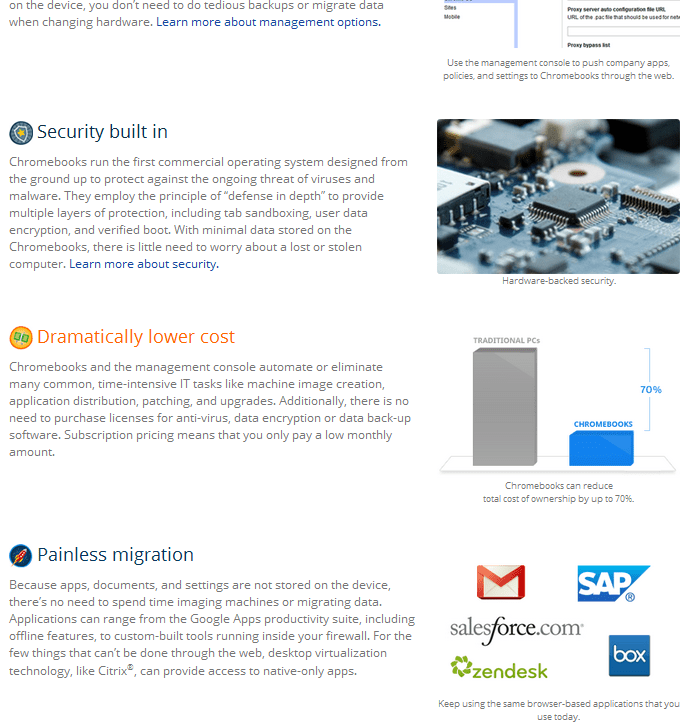
Crashes, long boot times, application conflicts, endless updates, viruses, security issues and obsolete hardware all frustrate IT managers and end users – and most users don’t need or want the complexity and annoyance of their current PCs.

Increasingly the browser is the only tool users need, making a new and better computing model possible. Chromebooks can instantly run your browser-based apps, whether in the cloud or behind your firewall, and apps virtualized through technologies like Citrix®. And an entire fleet of Chromebooks can be managed from one web-based console – making life better for users and IT admins alike.

Contact Sales

Analyzing Conversations on Twitter

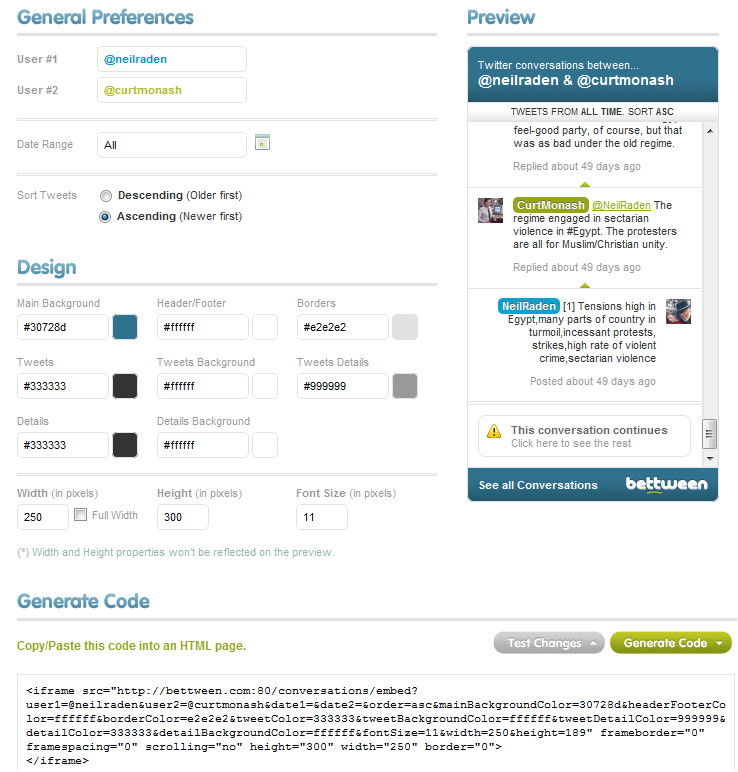
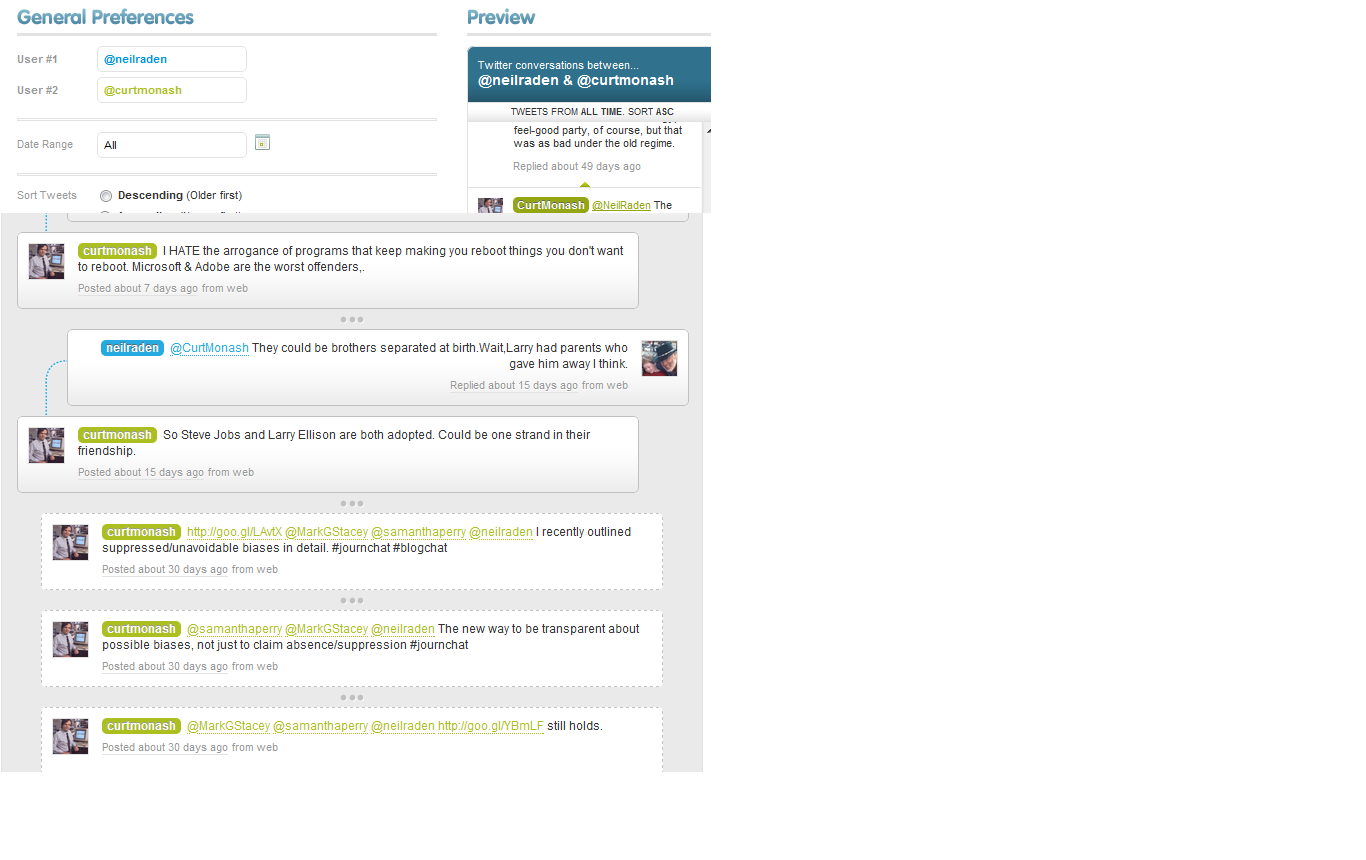
If you are a marketing , analyst relationship, public relationship or a product manager who uses or abuses social media, you sometimes need to track what influencers and analysts are saying. A tool called Bettween allows you to capture public conversations between two influential (or interesting) tweeps.

See conversations between Neil Raden http://www.beyeblogs.com/raden/ and Curt Monash http://www.dbms2.com/ two noted BI gurus

http://bettween.com/neilraden/curtmonash

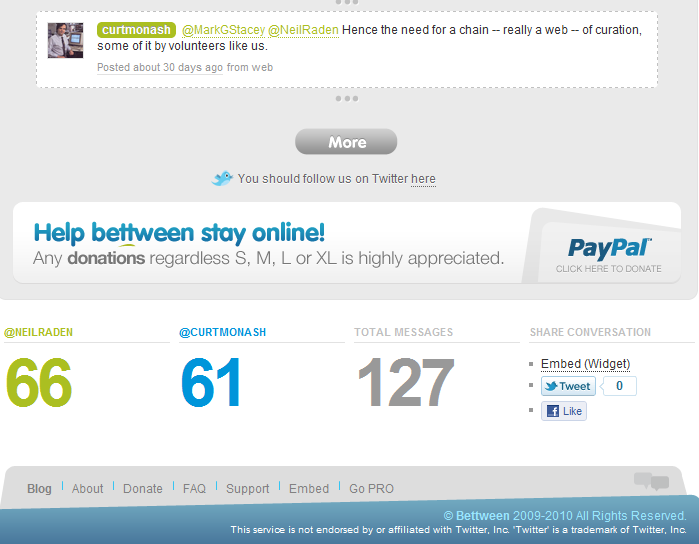
  • @NEILRADEN66
  • @CURTMONASH61
  • TOTAL MESSAGES127
  • SHARE CONVERSATION


unless Google decides to license its Wave technology to Twitter for separate encrypted , or public tweets. 🙂 They do share some history and employees (cough cough) or Twitter waits to create or better its public /protected tweet mode to be more granular

http://bettween.com/neilraden/curtmonash#statistics

tools to analyze Twitter conversations in SAS