#Rstats for Business Intelligence

This is a short list of several known as well as lesser known R ( #rstats) language codes, packages and tricks to build a business intelligence application. It will be slightly Messy (and not Messi) but I hope to refine it someday when the cows come home.

It assumes that BI is basically-

a Database, a Document Database, a Report creation/Dashboard pulling software as well unique R packages for business intelligence.

What is business intelligence?

Seamless dissemination of data in the organization. In short let it flow- from raw transactional data to aggregate dashboards, to control and test experiments, to new and legacy data mining models- a business intelligence enabled organization allows information to flow easily AND capture insights and feedback for further action.

BI software has lately meant to be just reporting software- and Business Analytics has meant to be primarily predictive analytics. the terms are interchangeable in my opinion -as BI reports can also be called descriptive aggregated statistics or descriptive analytics, and predictive analytics is useless and incomplete unless you measure the effect in dashboards and summary reports.

Data Mining- is a bit more than predictive analytics- it includes pattern recognizability as well as black box machine learning algorithms. To further aggravate these divides, students mostly learn data mining in computer science, predictive analytics (if at all) in business departments and statistics, and no one teaches metrics , dashboards, reporting  in mainstream academia even though a large number of graduates will end up fiddling with spreadsheets or dashboards in real careers.

Using R with

1) Databases-

I created a short list of database connectivity with R here at https://rforanalytics.wordpress.com/odbc-databases-for-r/ but R has released 3 new versions since then.

The RODBC package remains the package of choice for connecting to SQL Databases.

http://cran.r-project.org/web/packages/RODBC/RODBC.pdf

Details on creating DSN and connecting to Databases are given at  https://rforanalytics.wordpress.com/odbc-databases-for-r/

For document databases like MongoDB and CouchDB

( what is the difference between traditional RDBMS and NoSQL if you ever need to explain it in a cocktail conversation http://dba.stackexchange.com/questions/5/what-are-the-differences-between-nosql-and-a-traditional-rdbms

Basically dispensing with the relational setup, with primary and foreign keys, and with the additional overhead involved in keeping transactional safety, often gives you extreme increases in performance

NoSQL is a kind of database that doesn’t have a fixed schema like a traditional RDBMS does. With the NoSQL databases the schema is defined by the developer at run time. They don’t write normal SQL statements against the database, but instead use an API to get the data that they need.

instead relating data in one table to another you store things as key value pairs and there is no database schema, it is handled instead in code.)

I believe any corporation with data driven decision making would need to both have atleast one RDBMS and one NoSQL for unstructured data-Ajay. This is a sweeping generic statement 😉 , and is an opinion on future technologies.

  • Use RMongo

From- http://tommy.chheng.com/2010/11/03/rmongo-accessing-mongodb-in-r/

http://plindenbaum.blogspot.com/2010/09/connecting-to-mongodb-database-from-r.html

Connecting to a MongoDB database from R using Java

http://nsaunders.wordpress.com/2010/09/24/connecting-to-a-mongodb-database-from-r-using-java/

Also see a nice basic analysis using R Mongo from

http://pseudofish.com/blog/2011/05/25/analysis-of-data-with-mongodb-and-r/

For CouchDB

please see https://github.com/wactbprot/R4CouchDB and

http://digitheadslabnotebook.blogspot.com/2010/10/couchdb-and-r.html

  • First install RCurl and RJSONIO. You’ll have to download the tar.gz’s if you’re on a Mac. For the second part, we’ll need to installR4CouchDB,

2) External Report Creating Software-

Jaspersoft- It has good integration with R and is a certified Revolution Analytics partner (who seem to be the only ones with a coherent #Rstats go to market strategy- which begs the question – why is the freest and finest stats software having only ONE vendor- if it was so great lots of companies would make exclusive products for it – (and some do -see https://rforanalytics.wordpress.com/r-business-solutions/ and https://rforanalytics.wordpress.com/using-r-from-other-software/)

From

http://www.jaspersoft.com/sites/default/files/downloads/events/Analytics%20-Jaspersoft-SEP2010.pdf

we see

http://jasperforge.org/projects/rrevodeployrbyrevolutionanalytics

RevoConnectR for JasperReports Server

RevoConnectR for JasperReports Server RevoConnectR for JasperReports Server is a Java library interface between JasperReports Server and Revolution R Enterprise’s RevoDeployR, a standardized collection of web services that integrates security, APIs, scripts and libraries for R into a single server. JasperReports Server dashboards can retrieve R charts and result sets from RevoDeployR.

http://jasperforge.org/plugins/esp_frs/optional_download.php?group_id=409


Using R and Pentaho
Extending Pentaho with R analytics”R” is a popular open source statistical and analytical language that academics and commercial organizations alike have used for years to get maximum insight out of information using advanced analytic techniques. In this twelve-minute video, David Reinke from Pentaho Certified Partner OpenBI provides an overview of R, as well as a demonstration of integration between R and Pentaho.
and from
R and BI – Integrating R with Open Source Business
Intelligence Platforms Pentaho and Jaspersoft
David Reinke, Steve Miller
Keywords: business intelligence
Increasingly, R is becoming the tool of choice for statistical analysis, optimization, machine learning and
visualization in the business world. This trend will only escalate as more R analysts transition to business
from academia. But whereas in academia R is often the central tool for analytics, in business R must coexist
with and enhance mainstream business intelligence (BI) technologies. A modern BI portfolio already includes
relational databeses, data integration (extract, transform, load – ETL), query and reporting, online analytical
processing (OLAP), dashboards, and advanced visualization. The opportunity to extend traditional BI with
R analytics revolves on the introduction of advanced statistical modeling and visualizations native to R. The
challenge is to seamlessly integrate R capabilities within the existing BI space. This presentation will explain
and demo an initial approach to integrating R with two comprehensive open source BI (OSBI) platforms –
Pentaho and Jaspersoft. Our efforts will be successful if we stimulate additional progress, transparency and
innovation by combining the R and BI worlds.
The demonstration will show how we integrated the OSBI platforms with R through use of RServe and
its Java API. The BI platforms provide an end user web application which include application security,
data provisioning and BI functionality. Our integration will demonstrate a process by which BI components
can be created that prompt the user for parameters, acquire data from a relational database and pass into
RServer, invoke R commands for processing, and display the resulting R generated statistics and/or graphs
within the BI platform. Discussion will include concepts related to creating a reusable java class library of
commonly used processes to speed additional development.

If you know Java- try http://ramanareddyg.blog.com/2010/07/03/integrating-r-and-pentaho-data-integration/


and I like this list by two venerable powerhouses of the BI Open Source Movement

http://www.openbi.com/demosarticles.html

Open Source BI as disruptive technology

http://www.openbi.biz/articles/osbi_disruption_openbi.pdf

Open Source Punditry

TITLE AUTHOR COMMENTS
Commercial Open Source BI Redux Dave Reinke & Steve Miller An review and update on the predictions made in our 2007 article focused on the current state of the commercial open source BI market. Also included is a brief analysis of potential options for commercial open source business models and our take on their applicability.
Open Source BI as Disruptive Technology Dave Reinke & Steve Miller Reprint of May 2007 DM Review article explaining how and why Commercial Open Source BI (COSBI) will disrupt the traditional proprietary market.

Spotlight on R

TITLE AUTHOR COMMENTS
R You Ready for Open Source Statistics? Steve Miller R has become the “lingua franca” for academic statistical analysis and modeling, and is now rapidly gaining exposure in the commercial world. Steve examines the R technology and community and its relevancy to mainstream BI.
R and BI (Part 1): Data Analysis with R Steve Miller An introduction to R and its myriad statistical graphing techniques.
R and BI (Part 2): A Statistical Look at Detail Data Steve Miller The usage of R’s graphical building blocks – dotplots, stripplots and xyplots – to create dashboards which require little ink yet tell a big story.
R and BI (Part 3): The Grooming of Box and Whiskers Steve Miller Boxplots and variants (e.g. Violin Plot) are explored as an essential graphical technique to summarize data distributions by categories and dimensions of other attributes.
R and BI (Part 4): Embellishing Graphs Steve Miller Lattices and logarithmic data transformations are used to illuminate data density and distribution and find patterns otherwise missed using classic charting techniques.
R and BI (Part 5): Predictive Modelling Steve Miller An introduction to basic predictive modelling terminology and techniques with graphical examples created using R.
R and BI (Part 6) :
Re-expressing Data
Steve Miller How do you deal with highly skewed data distributions? Standard charting techniques on this “deviant” data often fail to illuminate relationships. This article explains techniques to re-express skewed data so that it is more understandable.
The Stock Market, 2007 Steve Miller R-based dashboards are presented to demonstrate the return performance of various asset classes during 2007.
Bootstrapping for Portfolio Returns: The Practice of Statistical Analysis Steve Miller Steve uses the R open source stats package and Monte Carlo simulations to examine alternative investment portfolio returns…a good example of applied statistics using R.
Statistical Graphs for Portfolio Returns Steve Miller Steve uses the R open source stats package to analyze market returns by asset class with some very provocative embedded trellis charts.
Frank Harrell, Iowa State and useR!2007 Steve Miller In August, Steve attended the 2007 Internation R User conference (useR!2007). This article details his experiences, including his meeting with long-time R community expert, Frank Harrell.
An Open Source Statistical “Dashboard” for Investment Performance Steve Miller The newly launched Dashboard Insight web site is focused on the most useful of BI tools: dashboards. With this article discussing the use of R and trellis graphics, OpenBI brings the realm of open source to this forum.
Unsexy Graphics for Business Intelligence Steve Miller Utilizing Tufte’s philosophy of maximizing the data to ink ratio of graphics, Steve demonstrates the value in dot plot diagramming. The R open source statistical/analytics software is showcased.
I think that the report generation package Brew would also qualify as a BI package, but large scale implementation remains to be seen in
a commercial business environment
  • brew: Creating Repetitive Reports
 brew: Templating Framework for Report Generation

brew implements a templating framework for mixing text and R code for report generation. brew template syntax is similar to PHP, Ruby's erb module, Java Server Pages, and Python's psp module. http://bit.ly/jINmaI
  • Yarr- creating reports in R
to be continued ( when I have more time and the temperature goes down from 110F in Delhi, India)

Who writes white papers?

A social network diagram
Image via Wikipedia

There are four main types of commercial white papers:

  • Business benefits: Makes a business case for a certain technology or methodology.
  • Technical: Describes how a certain technology works.
  • Hybrid: Combines business benefits with technical details in a single document.
  • Policy: Makes a case for a certain political solution to a societal or economic challenge.
Name the best white paper you ever read? (comment that in the field)..
What categoy of white papers is the best?
Do you think white papers are too expensive or they give adequate ROI?
To be continued- including

  1. demographic and social network analysis of analysts and white paper sponsors to measure interaction effects.
  2. white papers segmented by type of software company
  3. proc freq analysis of the words frequency data viz in white papers written by same analysts for different companies on same topics.
  4. Race and ethnic analysis of influencers and analysts in Business Analysts and Business Intelligence. – Null hypothesis – it is not a white mans world, women, Hispanics and other minorities are adequately represented.
Why I am doing this?
I am writing a white paper on WHO writes a white paper? 
Sponsorships are invited- but academics and startups in analytics may be preferred.

AsterData still alive;/launches SQL-MapReduce Developer Portal

so apparantly ole client AsterData continues to thrive under gentle touch of Terrific Data

———————————————————————————————————————————————————

Aster Data today launched the SQL-MapReduce Developer Portal, a new online community for data scientists and analytic developers. For your convenience, I copied the release below and it can also be found here. Please let me know if you have any questions or if there is anything else I can help you with.

Sara Korolevich

Point Communications Group for Aster Data

sarak@pointcgroup.com

Office: 602.279.1137

Mobile: 623.326.0881

Teradata Accelerates Big Data Analytics with First Collaborative Community for SQL-MapReduce®

New online community for data scientists and analytic developers enables development and sharing of powerful MapReduce analytics


San Carlos, California – Teradata Corporation (NYSE:TDC) today announced the launch of the Aster Data SQL-MapReduce® Developer Portal. This portal is the first collaborative online developer community for SQL-MapReduce analytics, an emerging framework for processing non-relational data and ultra-fast analytics.

“Aster Data continues to deliver on its unique vision for powerful analytics with a rich set of tools to make development of those analytics quick and easy,” said Tasso Argyros, vice president of Aster Data Marketing and Product Management, Teradata Corporation. “This new developer portal builds on Aster Data’s continuing SQL-MapReduce innovation, leveraging the flexibility and power of SQL-MapReduce for analytics that were previously impossible or impractical.”

The developer portal showcases the power and flexibility of Aster Data’s SQL-MapReduce – which uniquely combines standard SQL with the popular MapReduce distributed computing technology for processing big data – by providing a collaborative community for sharing SQL-MapReduce expert insights in addition to sharing SQL-MapReduce analytic functions and sample code. Data scientists, quantitative analysts, and developers can now leverage the experience, knowledge, and best practices of a community of experts to easily harness the power of SQL-MapReduce for big data analytics.

A recent report from IDC Research, “Taking Care of Your Quants: Focusing Data Warehousing Resources on Quantitative Analysts Matters,” has shown that by enabling data scientists with the tools to harness emerging types and sources of data, companies create significant competitive advantage and become leaders in their respective industry.

“The biggest positive differences among leaders and the rest come from the introduction of new types of data,” says Dan Vesset, program vice president, Business Analytics Solutions, IDC Research. “This may include either new transactional data sources or new external data feeds of transactional or multi-structured interactional data — the latter may include click stream or other data that is a by-product of social networking.”

Vesset goes on to say, “Aster Data provides a comprehensive platform for analytics and their SQL-MapReduce Developer Portal provides a community for sharing best practices and functions which can have an even greater impact to an organization’s business.”

With this announcement Aster Data extends its industry leadership in delivering the most comprehensive analytic platform for big data analytics — not only capable of processing massive volumes of multi-structured data, but also providing an extensive set of tools and capabilities that make it simple to leverage the power of MapReduce analytics. The Aster Data

SQL-MapReduce Developer Portal brings the power of SQL-MapReduce accessible to data scientists, quantitative analysis, and analytic developers by making it easy to share and collaborate with experts in developing SQL-MapReduce analytics. This portal builds on Aster Data’s history of SQL-MapReduce innovations, including:

  • The first deep integration of SQL with MapReduce
  • The first MapReduce support for .NET
  • The first integrated development environment, Aster Data
    Developer Express
  • A comprehensive suite of analytic functions, Aster Data
    Analytic Foundation

Aster Data’s patent-pending SQL-MapReduce enables analytic applications and functions that can deliver faster, deeper insights on terabytes to petabytes of data. These applications are implemented using MapReduce but delivered through standard SQL and business intelligence (BI) tools.

SQL-MapReduce makes it possible for data scientists and developers to empower business analysts with the ability to make informed decisions, incorporating vast amounts of data, regardless of query complexity or data type. Aster Data customers are using SQL-MapReduce for rich analytics including analytic applications for social network analysis, digital marketing optimization, and on-the-fly fraud detection and prevention.

“Collaboration is at the core of our success as one of the leading providers, and pioneers of social software,” said Navdeep Alam, director of Data Architecture at Mzinga. “We are pleased to be one of the early members of The Aster Data SQL-MapReduce Developer Portal, which will allow us the ability to share and leverage insights with others in using big data analytics to attain a deeper understanding of customers’ behavior and create competitive advantage for our business.”

SQL-MapReduce is one of the core capabilities within Aster Data’s flagship product. Aster DatanCluster™ 4.6, the industry’s first massively parallel processing (MPP) analytic platform has an integrated analytics engine that stores and processes both relational and non-relational data at scale. With Aster Data’s unique analytics framework that supports both SQL and
SQL-MapReduce™, customers benefit from rich, new analytics on large data volumes with complex data types. Aster Data analytic functions are embedded within the analytic platform and processed locally with data, which allows for faster data exploration. The SQL-MapReduce framework provides scalable fault-tolerance for new analytics, providing users with superior reliability, regardless of number of users, query size, or data types.


About Aster Data
Aster Data is a market leader in big data analytics, enabling the powerful combination of cost-effective storage and ultra-fast analysis of new sources and types of data. The Aster Data nCluster analytic platform is a massively parallel software solution that embeds MapReduce analytic processing with data stores for deeper insights on new data sources and types to deliver new analytic capabilities with breakthrough performance and scalability. Aster Data’s solution utilizes Aster Data’s patent-pending SQL-MapReduce to parallelize processing of data and applications and deliver rich analytic insights at scale. Companies including Barnes & Noble, Intuit, LinkedIn, Akamai, and MySpace use Aster Data to deliver applications such as digital marketing optimization, social network and relationship analysis, and fraud detection and prevention.


About Teradata
Teradata is the world’s leader in data warehousing and integrated marketing management through itsdatabase softwaredata warehouse appliances, and enterprise analytics. For more information, visitteradata.com.

# # #

Teradata is a trademark or registered trademark of Teradata Corporation in the United States and other countries.

Analyzing Conversations on Twitter

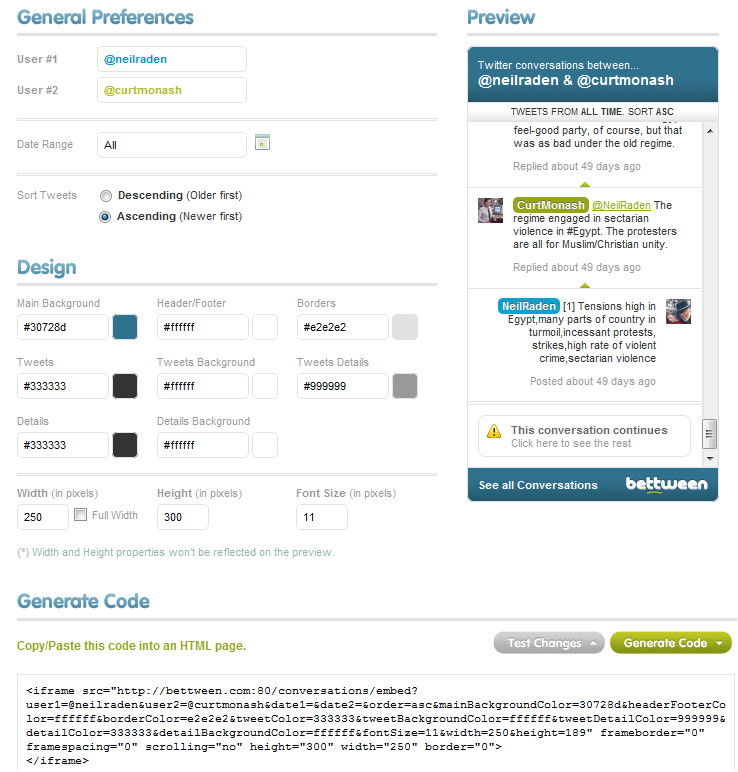
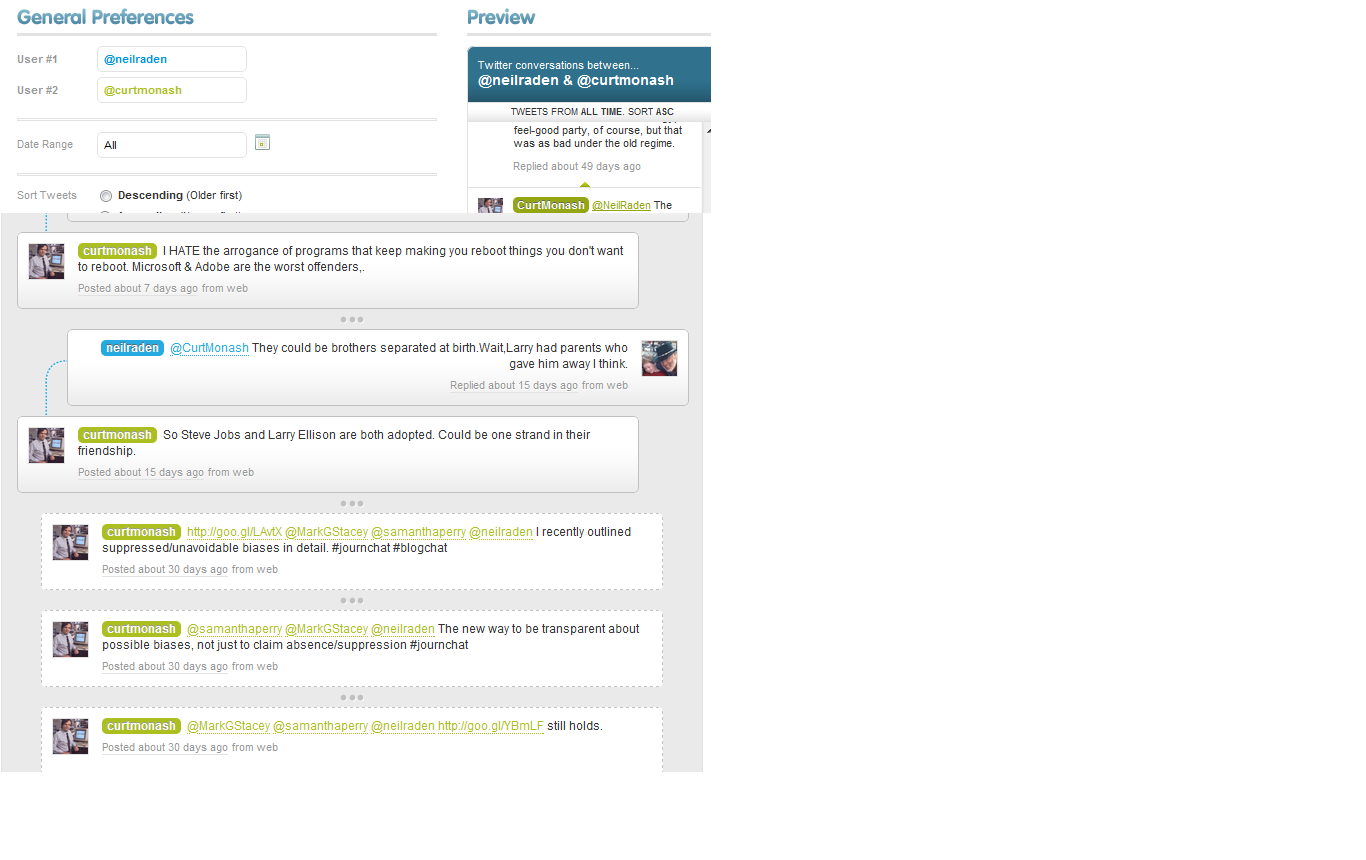
If you are a marketing , analyst relationship, public relationship or a product manager who uses or abuses social media, you sometimes need to track what influencers and analysts are saying. A tool called Bettween allows you to capture public conversations between two influential (or interesting) tweeps.

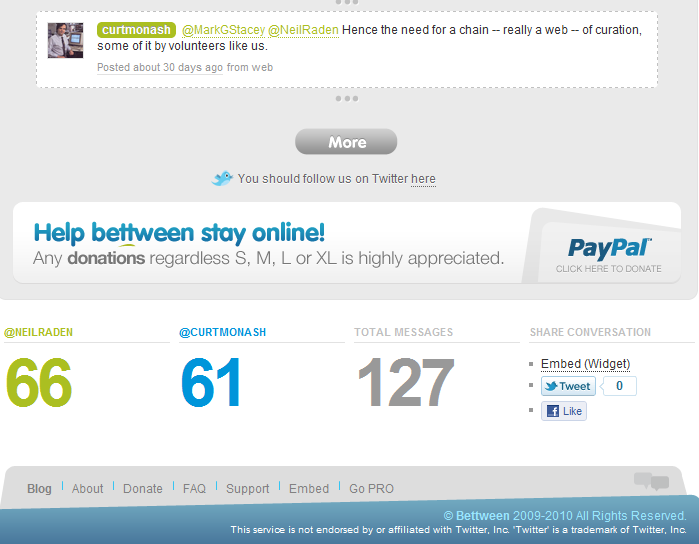
See conversations between Neil Raden http://www.beyeblogs.com/raden/ and Curt Monash http://www.dbms2.com/ two noted BI gurus

http://bettween.com/neilraden/curtmonash

  • @NEILRADEN66
  • @CURTMONASH61
  • TOTAL MESSAGES127
  • SHARE CONVERSATION


unless Google decides to license its Wave technology to Twitter for separate encrypted , or public tweets. 🙂 They do share some history and employees (cough cough) or Twitter waits to create or better its public /protected tweet mode to be more granular

http://bettween.com/neilraden/curtmonash#statistics

tools to analyze Twitter conversations in SAS

IBM and Revolution team to create new in-database R

From the Press Release at http://www.revolutionanalytics.com/news-events/news-room/2011/revolution-analytics-netezza-partnership.php

Under the terms of the agreement, the companies will work together to create a version of Revolution’s software that takes advantage of IBM Netezza’s i-class technology so that Revolution R Enterprise can run in-database in an optimal fashion.

About IBM

For information about IBM Netezza, please visit: http://www.netezza.com.
For Information on IBM Information Management, please visit: http://www.ibm.com/software/data/information-on-demand/
For information on IBM Business Analytics, please visit the online press kit: http://www.ibm.com/press/us/en/presskit/27163.wss
Follow IBM and Analytics on Twitter: http://twitter.com/ibmbizanalytics
Follow IBM analytics on Tumblr: http://smarterplanet.tumblr.com/tagged/new_intelligence
IBM YouTube Analytics Channel: http://www.youtube.com/user/ibmbusinessanalytics
For information on IBM Smarter Systems: http://www-03.ibm.com/systems/smarter/

About Revolution Analytics

Revolution Analytics is the leading commercial provider of software and services based on the open source R project for statistical computing.  Led by predictive analytics pioneer Norman Nie, the company brings high performance, productivity and enterprise readiness to R, the most powerful statistics language in the world. The company’s flagship Revolution R product is designed to meet the production needs of large organizations in industries such as finance, life sciences, retail, manufacturing and media.  Used by over 2 million analysts in academia and at cutting-edge companies such as Google, Bank of America and Acxiom, R has emerged as the standard of innovation in statistical analysis. Revolution Analytics is committed to fostering the continued growth of the R community through sponsorship of the Inside-R.org community site, funding worldwide R user groups and offers free licenses of Revolution R Enterprise to everyone in academia.


Netezza, an IBM Company, is the global leader in data warehouse, analytic and monitoring appliances that dramatically simplify high-performance analytics across an extended enterprise. IBM Netezza’s technology enables organizations to process enormous amounts of captured data at exceptional speed, providing a significant competitive and operational advantage in today’s data-intensive industries, including digital media, energy, financial services, government, health and life sciences, retail and telecommunications.

The IBM Netezza TwinFin® appliance is built specifically to analyze petabytes of detailed data significantly faster than existing data warehouse options, and at a much lower total cost of ownership. It stores, filters and processes terabytes of records within a single unit, analyzing only the relevant information for each query.

Using Revolution R Enterprise & Netezza Together

Revolution Analytics and IBM Netezza have announced a partnership to integrate Revolution R Enterprise and the IBM Netezza TwinFin  Data Warehouse Appliance. For the first time, customers seeking to run high performance and full-scale predictive analytics from within a data warehouse platform will be able to directly leverage the power of the open source R statistics language. The companies are working together to create a version of Revolution’s software that takes advantage of IBM Netezza’s i-class technology so that Revolution R Enterprise can run in-database in an optimal fashion.

This partnership integrates Revolution R Enterprise with IBM Netezza’s high performance data warehouse and advanced analytics platform to help organizations combat the challenges that arise as complexity and the scale of data grow.  By moving the analytics processing next to the data, this integration will minimize data movement – a significant bottleneck, especially when dealing with “Big Data”.  It will deliver high performance on large scale data, while leveraging the latest innovations in analytics.

With Revolution R Enterprise for IBM Netezza, advanced R computations are available for rapid analysis of hundreds of terabyte-class data volumes — and can deliver 10-100x performance improvements at a fraction of the cost compared to traditional analytics vendors.

Additional Resources


Zementis partners with R Analytics Vendor- Revo

Logo for R
Image via Wikipedia

Just got a  PR email from Michael Zeller,CEO , Zementis annoucing Zementis (ADAPA) and Revolution  Analytics just partnered up.

Is this something substantial or just time-sharing http://bi.cbronline.com/news/sas-ceo-says-cep-open-source-and-cloud-bi-have-limited-appeal or a Barney Partnership (http://www.dbms2.com/2008/05/08/database-blades-are-not-what-they-used-to-be/)

Summary- Thats cloud computing scoring of models on EC2 (Zementis) partnering with the actual modeling software in R (Revolution Analytics RevoDeployR)

See previous interviews with both Dr Zeller at https://decisionstats.com/2009/02/03/interview-michael-zeller-ceozementis/ ,https://decisionstats.com/2009/05/07/interview-ron-ramos-zementis/ and https://decisionstats.com/2009/10/05/interview-michael-zellerceo-zementis-on-pmml/)

and Revolution guys at https://decisionstats.com/2010/08/03/q-a-with-david-smith-revolution-analytics/

and https://decisionstats.com/2009/05/29/interview-david-smith-revolution-computing/

strategic partnership with Revolution Analytics, the leading commercial provider of software and support for the popular open source R statistics language. With this partnership, predictive models developed on Revolution R Enterprise are now accessible for real-time scoring through the ADAPA Decisioning Engine by Zementis. 

ADAPA is an extremely fast and scalable predictive platform. Models deployed in ADAPA are automatically available for execution in real-time and batch-mode as Web Services. ADAPA allows Revolution R Enterprise to leverage the Predictive Model Markup Language (PMML) for better decision management. With PMML, models built in R can be used in a wide variety of real-world scenarios without requiring laborious or expensive proprietary processes to convert them into applications capable of running on an execution system.

partnership

“By partnering with Zementis, Revolution Analytics is building an end-to-end solution for moving enterprise-level predictive R models into the execution environment,” said Jeff Erhardt, Revolution Analytics Chief Operation Officer. “With Zementis, we are eliminating the need to take R applications apart and recode, retest and redeploy them in order to obtain desirable results.”


Got demo? 

Yes, we do! Revolution Analytics and Zementis have put together a demo which combines the building of models in R with automatic deployment and execution in ADAPA. It uses Revolution Analytics’ RevoDeployR, a new Web Services framework that allows for data analysts working in R to publish R scripts to a server-based installation of Revolution R Enterprise.

Action Items:

  1. Try our INTERACTIVE DEMO
  2. DOWNLOAD the white paper
  3. Try the ADAPA FREE TRIAL

RevoDeployR & ADAPA allow for real-time analysis and predictions from R to be effectively used by existing Excel spreadsheets, BI dashboards and Web-based applications, all in real-time.

RevoADAPAPredictive analytics with RevoDeployR from Revolution Analytics and ADAPA from Zementis put model building and real-time scoring into a league of their own. Seriously!

Input Data in R using the top 3 R GUI

PC-DOS was an early OS for personal computers ...
Image via Wikipedia

One area where clearly GUI methods are preferable to command line methods in R, is data input. There is no need of learning read.csv or read.table when these options are only two clicks away in any R GUI. For academics/students there is a definite need to easily access

datasets from attached packages just as it is a need for business analysts to access databases with a few clicks than learn or read pages of pdf on RODBC. However some GUI (like Rattle) need data only in data frames, rather than list or arrays-this limits R’s flexibility. These are my views but you can see and compare views of data input in R Commander, Rattle and Deducer.