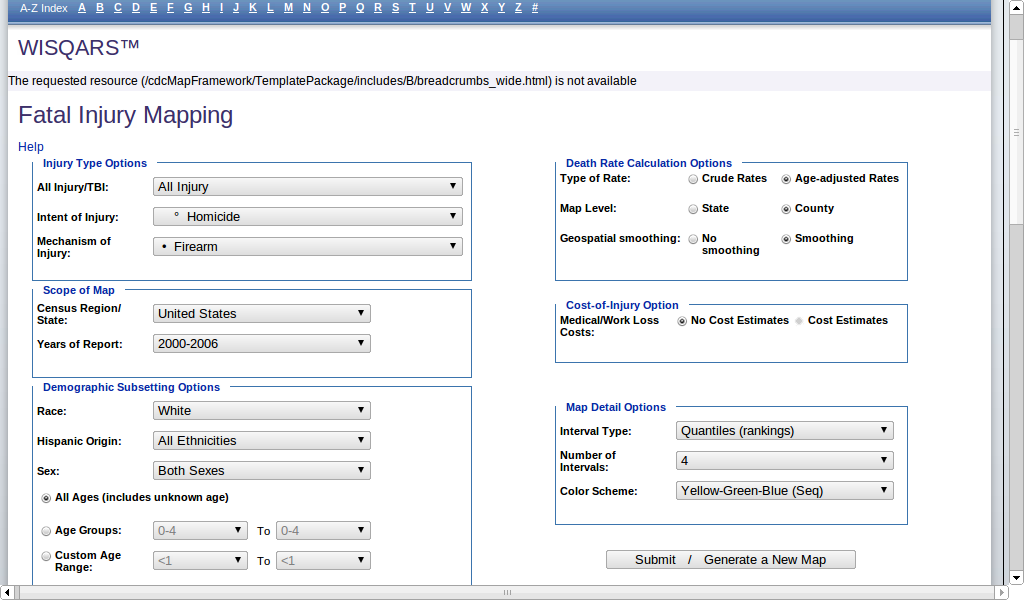
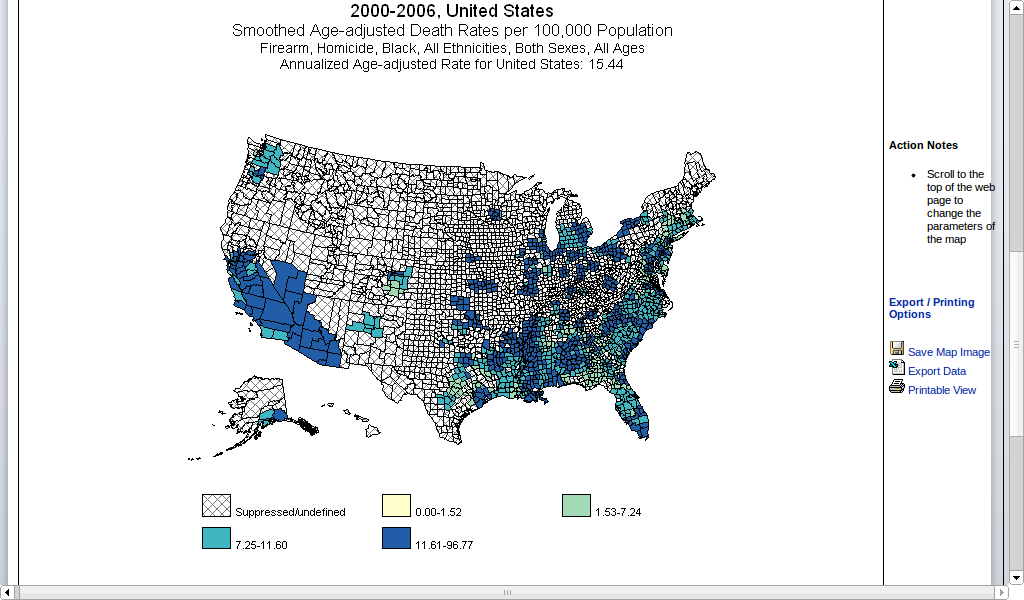
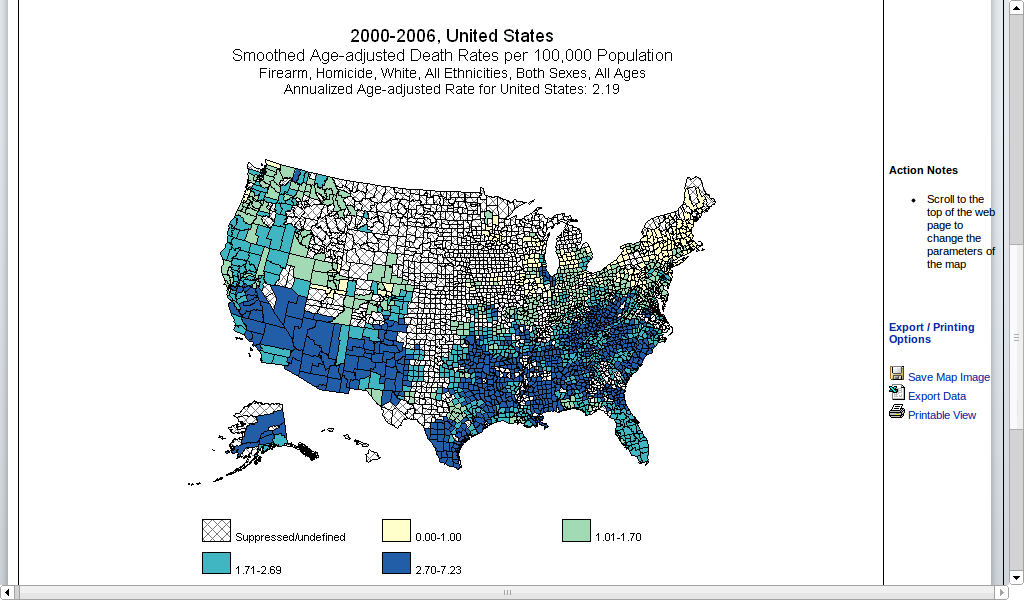
As a test I decided to map out injuries due to fire arms , and compare firearm deaths of white people versus the whole population.(see firearm deaths file)
See white people are more likely than black people to own guns (also read http://www.ncbi.nlm.nih.gov/pubmed/9572612 ), but it seems statistically they are less likely to be injured by firearms- so it could affect support for gun control laws on a racial ground- that was my null hypothesis. No politics, just plain statistics. I dont know- why dont you look at the data and decide-
Carole-Ann’s 2011 Predictions for Decision Management
For Ajay Ohri on DecisionStats.com
What were the top 5 events in 2010 in your field?
Maturity: the Decision Management space was made up of technology vendors, big and small, that typically focused on one or two aspects of this discipline. Over the past few years, we have seen a lot of consolidation in the industry – first with Business Intelligence (BI) then Business Process Management (BPM) and lately in Business Rules Management (BRM) and Advanced Analytics. As a result the giant Platform vendors have helped create visibility for this discipline. Lots of tiny clues finally bubbled up in 2010 to attest of the increasing activity around Decision Management. For example, more products than ever were named Decision Manager; companies advertised for Decision Managers as a job title in their job section; most people understand what I do when I am introduced in a social setting!
Boredom: unfortunately, as the industry matures, inevitably innovation slows down… At the main BRMS shows we heard here and there complaints that the technology was stalling. We heard it from vendors like Red Hat (Drools) and we heard it from bored end-users hoping for some excitement at Business Rules Forum’s vendor panel. They sadly did not get it
Scrum: I am not thinking about the methodology there! If you have ever seen a rugby game, you can probably understand why this is the term that comes to mind when I look at the messy & confusing technology landscape. Feet blindly try to kick the ball out while superhuman forces are moving randomly the whole pack – or so it felt when I played! Business Users in search of Business Solutions are facing more and more technology choices that feel like comparing apples to oranges. There is value in all of them and each one addresses a specific aspect of Decision Management but I regret that the industry did not simplify the picture in 2010. On the contrary! Many buzzwords were created or at least made popular last year, creating even more confusion on a muddy field. A few examples: Social CRM, Collaborative Decision Making, Adaptive Case Management, etc. Don’t take me wrong, I *do* like the technologies. I sympathize with the decision maker that is trying to pick the right solution though.
Information: Analytics have been used for years of course but the volume of data surrounding us has been growing to unparalleled levels. We can blame or thank (depending on our perspective) Social Media for that. Sites like Facebook and LinkedIn have made it possible and easy to publish relevant (as well as fluffy) information in real-time. As we all started to get the hang of it and potentially over-publish, technology evolved to enable the storage, correlation and analysis of humongous volumes of data that we could not dream of before. 25 billion tweets were posted in 2010. Every month, over 30 billion pieces of data are shared on Facebook alone. This is not just about vanity and marketing though. This data can be leveraged for the greater good. Carlos pointed to some fascinating facts about catastrophic event response team getting organized thanks to crowd-sourced information. We are also seeing, in the Decision management world, more and more applicability for those very technology that have been developed for the needs of Big Data – I’ll name for example Hadoop that Carlos (yet again) discussed in his talks at Rules Fest end of 2009 and 2010.
Self-Organization: it may be a side effect of the Social Media movement but I must admit that I was impressed by the success of self-organizing initiatives. Granted, this last trend has nothing to do with Decision Management per se but I think it is a great evolution worth noting. Let me point to a couple of examples. I usually attend traditional conferences and tradeshows in which the content can be good but is sometimes terrible. I was pleasantly surprised by the professionalism and attendance at *un-conferences* such as P-Camp (P stands for Product – an event for Product Managers). When you think about it, it is already difficult to get a show together when people are dedicated to the tasks. How crazy is it to have volunteers set one up with no budget and no agenda? Well, people simply show up to do their part and everyone has fun voting on-site for what seems the most appealing content at the time. Crowdsourcing applied to shows: it works! Similar experience with meetups or tweetups. I also enjoyed attending some impromptu Twitter jam sessions on a given topic. Social Media is certainly helping people reach out and get together in person or virtually and that is wonderful!
Image via Wikipedia
What are the top three trends you see in 2011?
Performance: I might be cheating here. I was very bullish about predicting much progress for 2010 in the area of Performance Management in your Decision Management initiatives. I believe that progress was made but Carlos did not give me full credit for the right prediction… Okay, I am a little optimistic on timeline… I admit it… If it did not fully happen in 2010, can I predict it again in 2011? I think that companies want to better track their business performance in order to correct the trajectory of course but also to improve their projections. I see that it is turning into reality already here and there. I expect it to become a trend in 2011!
Insight: Big Data being available all around us with new technologies and algorithms will continue to propagate in 2011 leading to more widely spread Analytics capabilities. The buzz at Analytics shows on Social Network Analysis (SNA) is a sign that there is interest in those kinds of things. There is tremendous information that can be leveraged for smart decision-making. I think there will be more of that in 2011 as initiatives launches in 2010 will mature into material results.
Image by Intersection Consulting via Flickr
Collaboration: Social Media for the Enterprise is a discipline in the making. Social Media was initially seen for the most part as a Marketing channel. Over the years, companies have started experimenting with external communities and ideation capabilities with moderate success. The few strategic initiatives started in 2010 by “old fashion” companies seem to be an indication that we are past the early adopters. This discipline may very well materialize in 2011 as a core capability, well, or at least a new trend. I believe that capabilities such Chatter, offered by Salesforce, will transform (slowly) how people interact in the workplace and leverage the volumes of social data captured in LinkedIn and other Social Media sites. Collaboration is of course a topic of interest for me personally. I even signed up for Kare Anderson’s collaboration collaboration site – yes, twice the word “collaboration”: it is really about collaborating on collaboration techniques. Even though collaboration does not require Social Media, this medium offers perspectives not available until now.
Brief Bio-
Carole-Ann is a renowned guru in the Decision Management space. She created the vision for Decision Management that is widely adopted now in the industry. Her claim to fame is the strategy and direction of Blaze Advisor, the then-leading BRMS product, while she also managed all the Decision Management tools at FICO (business rules, predictive analytics and optimization). She has a vision for Decision Management both as a technology and a discipline that can revolutionize the way corporations do business, and will never get tired of painting that vision for her audience. She speaks often at Industry conferences and has conducted university classes in France and Washington DC.
Leveraging her Masters degree in Applied Mathematics / Computer Science from a “Grande Ecole” in France, she started her career building advanced systems using all kinds of technologies — expert systems, rules, optimization, dashboarding and cubes, web search, and beta version of database replication – as well as conducting strategic consulting gigs around change management.
She started her career building advanced systems using all kinds of technologies — expert systems, rules, optimization, dashboarding and cubes, web search, and beta version of database replication. At Cleversys (acquired by Kurt Salmon & Associates), she also conducted strategic consulting gigs mostly around change management.
While playing with advanced software components, she found a passion for technology and joined ILOG (acquired by IBM). She developed a growing interest in Optimization as well as Business Rules. At ILOG, she coined the term BRMS while brainstorming with her Sales counterpart. She led the Presales organization for Telecom in the Americas up until 2000 when she joined Blaze Software (acquired by Brokat Technologies, HNC Software and finally FICO).
Her 360-degree experience allowed her to gain appreciation for all aspects of a software company, giving her a unique perspective on the business. Her technical background kept her very much in touch with technology as she advanced.
She also became addicted to Twitter in the process. She is active on all kinds of social media, always looking for new digital experience!
Outside of work, Carole-Ann loves spending time with her two boys. They grow fruits in their Northern California home and cook all together in the French tradition.
A fascinating article in New York Times details the fascinating details of the Stuxnet virus, apparently the most successful cyber weapon in recent times.
Given that Industrial Controllers are a part of a everything from factories to missile launch configurations, I believe this is a fascinating area of study for the world’s research scientists including creating variants and defenses for this.
Some common analytical tasks from the diary of the glamorous life of a business analyst-
1) removing duplicates from a dataset based on certain key values/variables
2) merging two datasets based on a common key/variable/s
3) creating a subset based on a conditional value of a variable
4) creating a subset based on a conditional value of a time-date variable
5) changing format from one date time variable to another
6) doing a means grouped or classified at a level of aggregation
7) creating a new variable based on if then condition
8) creating a macro to run same program with different parameters
9) creating a logistic regression model, scoring dataset,
10) transforming variables
11) checking roc curves of model
12) splitting a dataset for a random sample (repeatable with random seed)
13) creating a cross tab of all variables in a dataset with one response variable
14) creating bins or ranks from a certain variable value
15) graphically examine cross tabs
16) histograms
17) plot(density())
18)creating a pie chart
19) creating a line graph, creating a bar graph
20) creating a bubbles chart
21) running a goal seek kind of simulation/optimization
22) creating a tabular report for multiple metrics grouped for one time/variable
23) creating a basic time series forecast
and some case studies I could think of-
As the Director, Analytics you have to examine current marketing efficiency as well as help optimize sales force efficiency across various channels. In addition you have to examine multiple sales channels including inbound telephone, outgoing direct mail, internet email campaigns. The datawarehouse is an RDBMS but it has multiple data quality issues to be checked for. In addition you need to submit your budget estimates for next year’s annual marketing budget to maximize sales return on investment.
As the Director, Risk you have to examine the overdue mortgages book that your predecessor left you. You need to optimize collections and minimize fraud and write-offs, and your efforts would be measured in maximizing profits from your department.
As a social media consultant you have been asked to maximize social media analytics and social media exposure to your client. You need to create a mechanism to report particular brand keywords, as well as automated triggers between unusual web activity, and statistical analysis of the website analytics metrics. Above all it needs to be set up in an automated reporting dashboard .
As a consultant to a telecommunication company you are asked to monitor churn and review the existing churn models. Also you need to maximize advertising spend on various channels. The problem is there are a large number of promotions always going on, some of the data is either incorrectly coded or there are interaction effects between the various promotions.
As a modeller you need to do the following-
1) Check ROC and H-L curves for existing model
2) Divide dataset in random splits of 40:60
3) Create multiple aggregated variables from the basic variables
4) run regression again and again
5) evaluate statistical robustness and fit of model
6) display results graphically
All these steps can be broken down in little little pieces of code- something which i am putting down a list of.
Are there any common data analysis tasks that you think I am missing out- any common case studies ? let me know.
WRITER is the word processor inside LibreOffice. Use it for everything, from dashing off a quick letter to producing an entire book with tables of contents, embedded illustrations, bibliographies and diagrams. The while-you-type auto-completion, auto-formatting and automatic spelling checking make difficult tasks easy (but are easy to disable if you prefer). Writer is powerful enough to tackle desktop publishing tasks such as creating multi-column newsletters and brochures. The only limit is your imagination.
CALC tames your numbers and helps with difficult decisions when you’re weighing the alternatives. Analyze your data with Calc and then use it to present your final output. Charts and analysis tools help bring transparency to your conclusions. A fully-integrated help system makes easier work of entering complex formulas. Add data from external databases such as SQL or Oracle, then sort and filter them to produce statistical analyses. Use the graphing functions to display large number of 2D and 3D graphics from 13 categories, including line, area, bar, pie, X-Y, and net – with the dozens of variations available, you’re sure to find one that suits your project.
IMPRESS is the fastest and easiest way to create effective multimedia presentations. Stunning animation and sensational special effects help you convince your audience. Create presentations that look even more professional than the standard presentations you commonly see at work. Get your collegues’ and bosses’ attention by creating something a little bit different.
DRAW lets you build diagrams and sketches from scratch. A picture is worth a thousand words, so why not try something simple with box and line diagrams? Or else go further and easily build dynamic 3D illustrations and special effects. It’s as simple or as powerful as you want it to be.
BASE is the database front-end of the LibreOffice suite. With Base, you can seamlessly integrate into your existing database structures. Based on imported and linked tables and queries from MySQL, PostgreSQL or Microsoft Access and many other data sources, you can build powerful databases containing forms, reports, views and queries. Full integration is possible with the in-built HSQL database.
MATH is a simple equation editor that lets you lay-out and display your mathematical, chemical, electrical or scientific equations quickly in standard written notation. Even the most-complex calculations can be understandable when displayed correctly. E=mc2
Open Documentation just announced release candidate 3 of Libre office.
Better performance and interoperability on Excel doc import;
Better performance on DBF import;
Slightly better performance on ODS import;
Possibility to use English formula names;
Distributed alignment – allows one to specify ‘distributed’ horizontal alignment and ‘justified’ and ‘distributed’ vertical alignments within cells. This is notably useful for CJK locales;
Support for 3 different formula syntaxes: Calc A1, Excel A1 and Excel R1C1;
Configurable argument and array separators in formula expressions;
External reference works within OFFSET function;
Hitting TAB during auto-complete commits current selection and moves to the next cell;
Shift-TAB cycles through auto-complete selections;
Find and replace skips those cells that are filtered out (thus hidden);
Protecting sheet provides two additional sheet protection options, to optionally limit cursor placement in protected and unprotected areas;
Copying a range highlights the range being copied. It also allows you to paste it by hitting ENTER key. Hitting ESC removes the range highlight;
Jumping to and from references in formula cells via “Ctrl-[” and “Ctrl-]”;
Cell cursor stays at the original cell during range selection.
Writer
AutoCorrections match case of the words that AutoCorrect replaces. (Issuezilla 2838);
Analyzing data can have many challenges associated with it. In the case of business analytics data, these challenges or constraints can have a marked effect on the quality and timeliness of the analysis as well as the expected versus actual payoff from the analytical results.
Challenges of Analytical Data Processing-
1) Data Formats- Reading in complete data, without losing any part (or meta data), or adding in superfluous details (that increase the scope). Technical constraints of data formats are relatively easy to navigate thanks to ODBC and well documented and easily search-able syntax and language.
The costs of additional data augmentation (should we pay for additional credit bureau data to be appended) , time of storing and processing the data (every column needed for analysis can add in as many rows as whole dataset, which can be a time enhancing problem if you are considering an extra 100 variables with a few million rows), but above all that of business relevance and quality guidelines will ensure basic data input and massaging are considerable parts of whole analytical project timeline.
2) Data Quality-Perfect data exists in a perfect world. The price of perfect information is one business will mostly never budget or wait for. To deliver inferences and results based on summaries of data which has missing, invalid, outlier data embedded within it makes the role of an analyst just as important as which ever tool is chosen to remove outliers, replace missing values, or treat invalid data.
3) Project Scope-
How much data? How much Analytical detail versus High Level Summary? Timelines for delivery as well as refresh of data analysis? Checks (statistical as well as business)?
How easy is it to load and implement the new analysis in existing Information Technology Infrastructure? These are some of the outer parameters that can limit both your analytical project scope, your analytical tool choice, and your processing methodology.
4) Output Results vis a vis stakeholder expectation management-
Stakeholders like to see results, not constraints, hypothesis ,assumptions , p-value, or chi -square value. Output results need to be streamlined to a decision management process to justify the investment of human time and effort in an analytical project, choice,training and navigating analytical tool complexities and constraints are subset of it. Optimum use of graphical display is a part of aligning results to a more palatable form to stakeholders, provided graphics are done nicely.
Eg Marketing wants to get more sales so they need a clear campaign, to target certain customers via specific channels with specified collateral. In order to base their business judgement, business analytics needs to validate , cross validate and sometimes invalidate this business decision making with clear transparent methods and processes.
Given a dataset- the basic analytical steps that an analyst will do with R are as follows. This is meant as a note for analysts at a beginner level with R.
Package -specific syntax
update.packages() #This updates all packages
install.packages(package1) #This installs a package locally, a one time event
library(package1) #This loads a specified package in the current R session, which needs to be done every R session
CRAN________LOCAL HARD DISK_________R SESSION is the top to bottom hierarchy of package storage and invocation.
ls() #This lists all objects or datasets currently active in the R session
> names(assetsCorr) #This gives the names of variables within a dataframe
[1] “AssetClass” “LargeStocksUS” “SmallStocksUS”
[4] “CorporateBondsUS” “TreasuryBondsUS” “RealEstateUS”
[7] “StocksCanada” “StocksUK” “StocksGermany”
[10] “StocksSwitzerland” “StocksEmergingMarkets”
> dim(assetsCorr) #gives dimensions observations and variable number
[1] 12 11
str(Dataset) – This gives the structure of the dataset (note structure gives both the names of variables within dataset as well as dimensions of the dataset)
head(dataset,n1) gives the first n1 rows of dataset while
tail(dataset,n2) gives the last n2 rows of a dataset where n1,n2 are numbers and dataset is the name of the object (here a data frame that is being considered)
summary(dataset) gives you a brief summary of all variables while
library(Hmisc)
describe(dataset) gives a detailed description on the variables
simple graphics can be given by
hist(Dataset1)
and
plot(Dataset1)
As you can see in above cases, there are multiple ways to get even basic analysis about data in R- however most of the syntax commands are intutively understood (like hist for histogram, t.test for t test, plot for plot).
For detailed analysis throughout the scope of analysis, for a business analytics user it is recommended to using multiple GUI, and multiple packages. Even for highly specific and specialized analytical tasks it is recommended to check for a GUI that incorporates the required package.





 Follow me on Twitter


 DECISION STATS