Google Product Launches

So dear G launched a whole new set of Products. Some thoughts-

1) Join up the Social Invite List here – it is called Google Plus. We hope it doesnt end up like Buzz http://www.google.com/buzz or Orkut https://groups.google.com/group/opensocial-api/?pli=1 or Plus One http://www.google.com/webmasters/+1/button/ or Wave (email killer) http://googlewave.blogspot.com/

When the biggest cloud computing company in the world announces a phased rollout to a product- we wonder if they are really sure on launching the product rollout or just were in a hurry again.

Machine learning wont work with social , chaps. Well not everything in social. And the Google Social Blog forgot to write about it http://googlesocialweb.blogspot.com/

Well anyways, even Google Finance’s automated announcements feed failed to pick many of their own  product launches (or it does in an automated manner depending on which time period you choose – yes still no social buttons up http://www.google.com/finance?q=google

BACK TO GOOGLE PLUS

https://services.google.com/fb/forms/googleplus/

Google+

Thanks for stopping by.We’re still ironing out a few kinks in Google+, so it’s not quite ready for everyone to climb aboard. But, if you want, we’ll let you know the minute the doors are open for real. Cool? Cool.

  • First Name *
  • Email *

Google+ Privacy Policy

2) Google Web Fonts- Great product, how and hey http://googlewebfonts.blogspot.com/ when do you plan to monetize uhm  web fonts. Not that would be awesome. Not even a single ad on those pages- not even for philanthropy. or poor poets. or even Google Book Authors who self publish . Sound of silence….

http://www.google.com/webfonts/v2


3) Google Analytics gets some groove back. I really want to see much better integration of Google Apps and Google Analytics and Google Desktop search. Ditto for the interface. Enterprise software uses different fonts than retail software, dude. More fries, http://analytics.blogspot.com/ ?

Feature 1- Custom Reports for metrics I can slice and dice on my own

Feature 2 Awesome analytics for In-Page Analytics (beta feature) Beta is boring if overused. Try Theta maybe?

Feature 3 Daily Automated Alerts for Unusual Server /Traffic Activity

Feature 4 event Tracking is cool esp for understanding social media impact


It is still too early for mobile (in terms of traffic) as well as tablet analytics (?)

4) Angry Birds is still the best feature in Chrome  (but there are lots others at http://chrome.blogspot.com/) and esp http://googlecode.blogspot.com/2011/06/working-with-chromes-file-browser.html

Try http://chrome.angrybirds.com/

There are ways to make software that are not evil. Very very disappointed at total lack of monetization of this chrome app. Not even a T Shirt for me to buy ad . sighs

Funny thing- the product manager forgot to take off Facebook like button or even add the +1 button or even the Tweet this button.

Quo Vadis ?


5) What do you love?

http://www.wdyl.com/#

Analytics 2011 Conference

From http://www.sas.com/events/analytics/us/

The Analytics 2011 Conference Series combines the power of SAS’s M2010 Data Mining Conference and F2010 Business Forecasting Conference into one conference covering the latest trends and techniques in the field of analytics. Analytics 2011 Conference Series brings the brightest minds in the field of analytics together with hundreds of analytics practitioners. Join us as these leading conferences change names and locations. At Analytics 2011, you’ll learn through a series of case studies, technical presentations and hands-on training. If you are in the field of analytics, this is one conference you can’t afford to miss.

Conference Details

October 24-25, 2011
Grande Lakes Resort
Orlando, FL

Analytics 2011 topic areas include:

Workflows and MyExperiment.org

Here is a great website for sharing workflows – it is called MyExperiment.org and it can also include Work flows from many software.

myExperiment currently has 4742 members270 groups1842 workflows423 files and 173 packs

Could it also include workflow from Red-R from #rstats or Enterprise Miner

Continue reading “Workflows and MyExperiment.org”

Amazon Ec2 goes Red Hat

message from Amazing Amazon’s cloud team- this will also help for #rstats users given that revolution Analytics full versions on RHEL.

—————————————————-

on-demand instances of Amazon EC2 running Red Hat Enterprise Linux (RHEL) for as little as $0.145 per instance hour. The offering combines the cost-effectiveness, scalability and flexibility of running in Amazon EC2 with the proven reliability of Red Hat Enterprise Linux.

Highlights of the offering include:

  • Support is included through subscription to AWS Premium Support with back-line support by Red Hat
  • Ongoing maintenance, including security patches and bug fixes, via update repositories available in all Amazon EC2 regions
  • Amazon EC2 running RHEL currently supports RHEL 5.5, RHEL 5.6, RHEL 6.0 and RHEL 6.1 in both 32 bit and 64 bit formats, and is available in all Regions.
  • Customers who already own Red Hat licenses will continue to be able to use those licenses at no additional charge.
  • Like all services offered by AWS, Amazon EC2 running Red Hat Enterprise Linux offers a low-cost, pay-as-you-go model with no long-term commitments and no minimum fees.

For more information, please visit the Amazon EC2 Red Hat Enterprise Linux page.

which is

Amazon EC2 Running Red Hat Enterprise Linux

Amazon EC2 running Red Hat Enterprise Linux provides a dependable platform to deploy a broad range of applications. By running RHEL on EC2, you can leverage the cost effectiveness, scalability and flexibility of Amazon EC2, the proven reliability of Red Hat Enterprise Linux, and AWS premium support with back-line support from Red Hat.. Red Hat Enterprise Linux on EC2 is available in versions 5.5, 5.6, 6.0, and 6.1, both in 32-bit and 64-bit architectures.

Amazon EC2 running Red Hat Enterprise Linux provides seamless integration with existing Amazon EC2 features including Amazon Elastic Block Store (EBS), Amazon CloudWatch, Elastic-Load Balancing, and Elastic IPs. Red Hat Enterprise Linux instances are available in multiple Availability Zones in all Regions.

Sign Up

Pricing

Pay only for what you use with no long-term commitments and no minimum fee.

On-Demand Instances

On-Demand Instances let you pay for compute capacity by the hour with no long-term commitments.

Region:US – N. VirginiaUS – N. CaliforniaEU – IrelandAPAC – SingaporeAPAC – Tokyo
Standard Instances Red Hat Enterprise Linux
Small (Default) $0.145 per hour
Large $0.40 per hour
Extra Large $0.74 per hour
Micro Instances Red Hat Enterprise Linux
Micro $0.08 per hour
High-Memory Instances Red Hat Enterprise Linux
Extra Large $0.56 per hour
Double Extra Large $1.06 per hour
Quadruple Extra Large $2.10 per hour
High-CPU Instances Red Hat Enterprise Linux
Medium $0.23 per hour
Extra Large $0.78 per hour
Cluster Compute Instances Red Hat Enterprise Linux
Quadruple Extra Large $1.70 per hour
Cluster GPU Instances Red Hat Enterprise Linux
Quadruple Extra Large $2.20 per hour

Pricing is per instance-hour consumed for each instance type. Partial instance-hours consumed are billed as full hours.

↑ Top

and

Available Instance Types

Standard Instances

Instances of this family are well suited for most applications.

Small Instance – default*

1.7 GB memory
1 EC2 Compute Unit (1 virtual core with 1 EC2 Compute Unit)
160 GB instance storage
32-bit platform
I/O Performance: Moderate
API name: m1.small

Large Instance

7.5 GB memory
4 EC2 Compute Units (2 virtual cores with 2 EC2 Compute Units each)
850 GB instance storage
64-bit platform
I/O Performance: High
API name: m1.large

Extra Large Instance

15 GB memory
8 EC2 Compute Units (4 virtual cores with 2 EC2 Compute Units each)
1,690 GB instance storage
64-bit platform
I/O Performance: High
API name: m1.xlarge

Micro Instances

Instances of this family provide a small amount of consistent CPU resources and allow you to burst CPU capacity when additional cycles are available. They are well suited for lower throughput applications and web sites that consume significant compute cycles periodically.

Micro Instance

613 MB memory
Up to 2 EC2 Compute Units (for short periodic bursts)
EBS storage only
32-bit or 64-bit platform
I/O Performance: Low
API name: t1.micro

High-Memory Instances

Instances of this family offer large memory sizes for high throughput applications, including database and memory caching applications.

High-Memory Extra Large Instance

17.1 GB of memory
6.5 EC2 Compute Units (2 virtual cores with 3.25 EC2 Compute Units each)
420 GB of instance storage
64-bit platform
I/O Performance: Moderate
API name: m2.xlarge

High-Memory Double Extra Large Instance

34.2 GB of memory
13 EC2 Compute Units (4 virtual cores with 3.25 EC2 Compute Units each)
850 GB of instance storage
64-bit platform
I/O Performance: High
API name: m2.2xlarge

High-Memory Quadruple Extra Large Instance

68.4 GB of memory
26 EC2 Compute Units (8 virtual cores with 3.25 EC2 Compute Units each)
1690 GB of instance storage
64-bit platform
I/O Performance: High
API name: m2.4xlarge

High-CPU Instances

Instances of this family have proportionally more CPU resources than memory (RAM) and are well suited for compute-intensive applications.

High-CPU Medium Instance

1.7 GB of memory
5 EC2 Compute Units (2 virtual cores with 2.5 EC2 Compute Units each)
350 GB of instance storage
32-bit platform
I/O Performance: Moderate
API name: c1.medium

High-CPU Extra Large Instance

7 GB of memory
20 EC2 Compute Units (8 virtual cores with 2.5 EC2 Compute Units each)
1690 GB of instance storage
64-bit platform
I/O Performance: High
API name: c1.xlarge

Cluster Compute Instances

Instances of this family provide proportionally high CPU resources with increased network performance and are well suited for High Performance Compute (HPC) applications and other demanding network-bound applications. Learn more about use of this instance type for HPC applications.

Cluster Compute Quadruple Extra Large Instance

23 GB of memory
33.5 EC2 Compute Units (2 x Intel Xeon X5570, quad-core “Nehalem” architecture)
1690 GB of instance storage
64-bit platform
I/O Performance: Very High (10 Gigabit Ethernet)
API name: cc1.4xlarge

Cluster GPU Instances

Instances of this family provide general-purpose graphics processing units (GPUs) with proportionally high CPU and increased network performance for applications benefitting from highly parallelized processing, including HPC, rendering and media processing applications. While Cluster Compute Instances provide the ability to create clusters of instances connected by a low latency, high throughput network, Cluster GPU Instances provide an additional option for applications that can benefit from the efficiency gains of the parallel computing power of GPUs over what can be achieved with traditional processors. Learn more about use of this instance type for HPC applications.

Cluster GPU Quadruple Extra Large Instance

22 GB of memory
33.5 EC2 Compute Units (2 x Intel Xeon X5570, quad-core “Nehalem” architecture)
2 x NVIDIA Tesla “Fermi” M2050 GPUs
1690 GB of instance storage
64-bit platform
I/O Performance: Very High (10 Gigabit Ethernet)
API name: cg1.4xlarge


Getting Started

To get started using Red Hat Enterprise Linux on Amazon EC2, perform the following steps:

  • Open and log into the AWS Management Console
  • Click on Launch Instance from the EC2 Dashboard
  • Select the Red Hat Enterprise Linux AMI from the QuickStart tab
  • Specify additional details of your instance and click Launch
  • Additional details can be found on each AMI’s Catalog Entry page

The AWS Management Console is an easy tool to start and manage your instances. If you are looking for more details on launching an instance, a quick video tutorial on how to use Amazon EC2 with the AWS Management Console can be found here .
A full list of Red Hat Enterprise Linux AMIs can be found in the AWS AMI Catalog.

↑ Top


Support

All customers running Red Hat Enterprise Linux on EC2 will receive access to repository updates from Red Hat. Moreover, AWS Premium support customers can contact AWS to get access to a support structure from both Amazon and Red Hat.

↑ Top


Resources

↑ Top


About Red Hat

Red Hat, the world’s leading open source solutions provider, is headquartered in Raleigh, NC with over 50 satellite offices spanning the globe. Red Hat provides high-quality, low-cost technology with its operating system platform, Red Hat Enterprise Linux, together with applications, management and Services Oriented Architecture (SOA) solutions, including the JBoss Enterprise Middleware Suite. Red Hat also offers support, training and consulting services to its customers worldwide.


also from Revolution Analytics- in case you want to #rstats in the cloud and thus kill all that talk of RAM dependency, slow R than other softwares (just increase the RAM above in the instances to keep it simple)

,or Revolution not being open enough

http://www.revolutionanalytics.com/downloads/gpl-sources.php

GPL SOURCES

Revolution Analytics uses an Open-Core Licensing model. We provide open- source R bundled with proprietary modules from Revolution Analytics that provide additional functionality for our users. Open-source R is distributed under the GNU Public License (version 2), and we make our software available under a commercial license.

Revolution Analytics respects the importance of open source licenses and has contributed code to the open source R project and will continue to do so. We have carefully reviewed our compliance with GPLv2 and have worked with Mark Radcliffe of DLA Piper, the outside General Legal Counsel of the Open Source Initiative, to ensure that we fully comply with the obligations of the GPLv2.

For our Revolution R distribution, we may make some minor modifications to the R sources (the ChangeLog file lists all changes made). You can download these modified sources of open-source R under the terms of the GPLv2, using either the links below or those in the email sent to you when you download a specific version of Revolution R.

Download GPL Sources

Product Version Platform Modified R Sources
Revolution R Community 3.2 Windows R 2.10.1
Revolution R Community 3.2 MacOS R 2.10.1
Revolution R Enterprise 3.1.1 RHEL R 2.9.2
Revolution R Enterprise 4.0 Windows R 2.11.1
Revolution R Enterprise 4.0.1 RHEL R 2.11.1
Revolution R Enterprise 4.1.0 Windows R 2.11.1
Revolution R Enterprise 4.2 Windows R 2.11.1
Revolution R Enterprise 4.2 RHEL R 2.11.1
Revolution R Enterprise 4.3 Windows & RHEL R 2.12.2


Why open source companies dont dance?

I have been pondering on this seemingly logical paradox for some time now-

1) Why are open source solutions considered technically better but not customer friendly.

2) Why do startups and app creators in social media or mobile get much more press coverage than

profitable startups in enterprise software.

3) How does tech journalism differ in covering open source projects in enterprise versus retail software.

4) What are the hidden rules of the game of enterprise software.

Some observations-

1) Open source companies often focus much more on technical community management and crowd sourcing code. Traditional software companies focus much more on managing the marketing community of customers and influencers. Accordingly the balance of power is skewed in favor of techies and R and D in open source companies, and in favor of marketing and analyst relations in traditional software companies.

Traditional companies also spend much more on hiring top notch press release/public relationship agencies, while open source companies are both financially and sometimes ideologically opposed to older methods of marketing software. The reverse of this is you are much more likely to see Videos and Tutorials by an open source company than a traditional company. You can compare the websites of ClouderaDataStax, Hadapt ,Appistry and Mapr and contrast that with Teradata or Oracle (which has a much bigger and much more different marketing strategy.

Social media for marketing is also more efficiently utilized by smaller companies (open source) while bigger companies continue to pay influential analysts for expensive white papers that help present the brand.

Lack of budgets is a major factor that limits access to influential marketing for open source companies particularly in enterprise software.

2 and 3) Retail software is priced at 2-100$ and sells by volume. Accordingly technology coverage of these software is based on volume.

Enterprise software is much more expensively priced and has much more discreet volume or sales points. Accordingly the technology coverage of enterprise software is more discreet, in terms of a white paper coming every quarter, a webinar every month and a press release every week. Retail software is covered non stop , but these journalists typically do not charge for “briefings”.

Journalists covering retail software generally earn money by ads or hosting conferences. So they have an interest in covering new stuff or interesting disruptive stuff. Journalists or analysts covering enterprise software generally earn money by white papers, webinars, attending than hosting conferences, writing books. They thus have a much stronger economic incentive to cover existing landscape and technologies than smaller startups.

4) What are the hidden rules of the game of enterprise software.

  • It is mostly a white man’s world. this can be proved by statistical demographic analysis
  • There is incestuous intermingling between influencers, marketers, and PR people. This can be proved by simple social network analysis of who talks to who and how much. A simple time series between sponsorship and analysts coverage also will prove this (I am working on quantifying this ).
  • There are much larger switching costs to enterprise software than retail software. This leads to legacy shoddy software getting much chances than would have been allowed in an efficient marketplace.
  • Enterprise software is a less efficient marketplace than retail software in all definitions of the term “efficient markets”
  • Cloud computing, and SaaS and Open source threatens to disrupt the jobs and careers of a large number of people. In the long term, they will create many more jobs, but in the short term, people used to comfortable living of enterprise software (making,selling,or writing) will actively and passively resist these changes to the  paradigms in the current software status quo.
  • Open source companies dont dance and dont play ball. They prefer to hire 4 more college grads than commission 2 more white papers.

and the following with slight changes from a comment I made on a fellow blog-

  • While the paradigm on how to create new software has evolved from primarily silo-driven R and D departments to a broader collaborative effort, the biggest drawback is software marketing has not evolved.
  • If you want your own version of the open source community editions to be more popular, some standardization is necessary for the corporate decision makers, and we need better marketing paradigms.
  • While code creation is crowdsourced, solution implementation cannot be crowdsourced. Customers want solutions to a problem not code.
  • Just as open source as a production and licensing paradigm threatens to disrupt enterprise software, it will lead to newer ways to marketing software given the hostility of existing status quo.


#Rstats gets into Enterprise Cloud Software

Defense Agencies of the United States Departme...
Image via Wikipedia

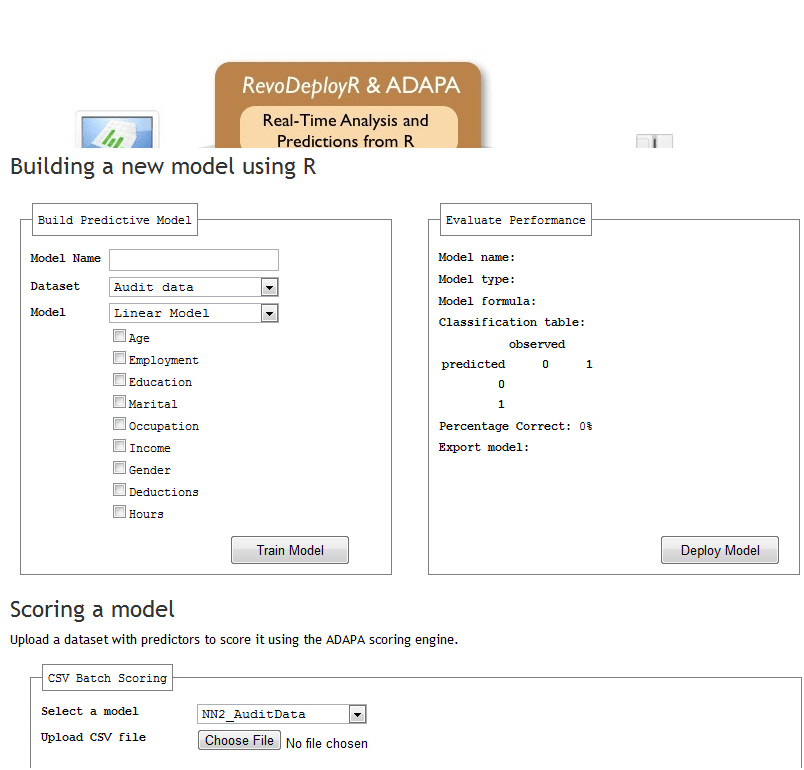
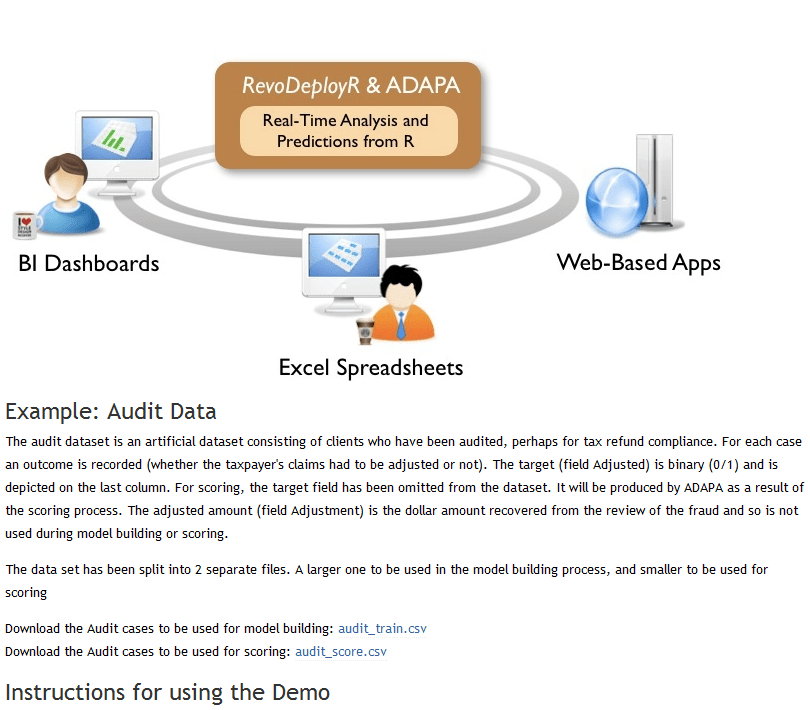
Here is an excellent example of how websites should help rather than hinder new customers take a demo of the software without being overwhelmed by sweet talking marketing guys who dont know the difference between heteroskedasticity, probability, odds and likelihood.

It is made by Zementis (Dr Michael Zeller has been a frequent guest here) and Revolution Analytics is still the best shot in Enterprise software for #Rstats

Now if only Revo could get into the lucrative Department of Energy or Department of Defense business- they could change the world AND earn some more revenue than they have been doing. But seriously.

Check out http://deployr.revolutionanalytics.com/zementis/ and play with it. or better still mash it with some data viz and ROC curves.- or extend it with some APIS 😉

Chromebooks for enterprise BI

From-

http://googleblog.blogspot.com/

Chromebooks will be available online June 15 in the U.S., U.K., France, Germany, Netherlands, Italy and Spain. More countries will follow in the coming months. In the U.S., Chromebooks will be available from Amazon and Best Buy and internationally from leading retailers.

Even with dedicated IT departments, businesses and schools struggle with the same complex, costly and insecure computers as the rest of us. To address this, we’re also announcing Chromebooks for Business and Education.

and

http://www.google.com/chromebook/business-education.html#

Chromebooks: work better.

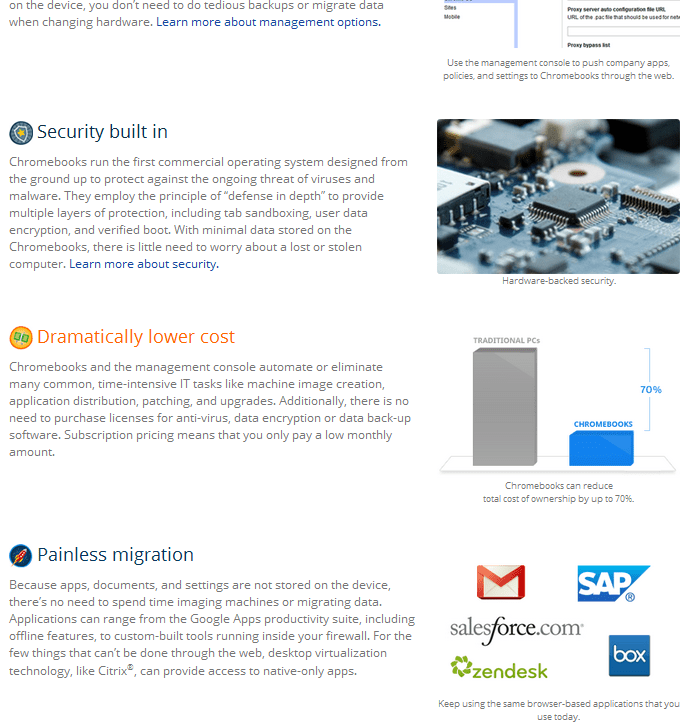
Crashes, long boot times, application conflicts, endless updates, viruses, security issues and obsolete hardware all frustrate IT managers and end users – and most users don’t need or want the complexity and annoyance of their current PCs.

Increasingly the browser is the only tool users need, making a new and better computing model possible. Chromebooks can instantly run your browser-based apps, whether in the cloud or behind your firewall, and apps virtualized through technologies like Citrix®. And an entire fleet of Chromebooks can be managed from one web-based console – making life better for users and IT admins alike.

Contact Sales