Save the Data

Breakdown of political party representation in...
Image via Wikipedia

I just read an online cause here-

http://sunlightfoundation.com/savethedata/

Some of the most important technology programs that keep Washington accountable are in danger of being eliminated. Data.gov, USASpending.gov, the IT Dashboard and other federal data transparency and government accountability programs are facing a massive budget cut, despite only being a tiny fraction of the national budget. Help save the data and make sure that Congress doesn’t leave the American people in the dark.

I wonder why the federal government/ non profit agencies can help create a SPARQL database, and in days of cloud computing, why a tech major cannot donate storage space to it, after all despite US corporate tax rate being high, US technological companies do end up paying a lower rate thanks to tax breaks/routing overseas revenue.

In the new age data is power, and the US has led in its mission to use technology to further its own values even especially in Middle East. The datasets should be made public and transitioned to the private sector/academia for research and re designing for data augmentation with out straining the massive deficit /borrowing/ fighting 3 wars. Of particular interest would be datasets of campaign finances  and donors especially given large number of retail/small donors/internet marketing in elections as it will also help serve as an example of democracy and change. Even countries like China can create a corruption/expense efficiency tracking internal dashboard with restricted rights to help with rural and urban governance.

Why search optimization can make you like Rebecca Black

Felicia Day, actress and web content producer.
Image via Wikipedia

A highly optimized blog post or web content can get you a lot of attention just like Rebecca Black’s video (provided it passes through the new quality metrics \change*/ in the Search Engine)

But if the underlying content is weak, or based on a shoddy understanding of the content-it can drive lots of horrid comments as well as ensuring that bad word of mouth is spread about the content or you/despite your hard work.

An example of this is copy and paste journalism especially in technology circles, where even a bigger Page Ranked website /blog can get away with scraping or stealing content from a lower page ranked website (or many websites)  after adding a cursory “expert comment”. This is also true when someone who is basically a corporate communication specialist (or PR -public relations) person is given a techinical text and encourage to write about it without completely understanding it.

A mild technical defect in the search engine algorithm is that it does not seem to pay attention to when the content was published, so the copying website or blog actually can get by as fresher content even if it is practically has 90% of the same words). The second flaw is over punishment or manual punishment of excessive linking – this can encourage search optimization minded people to hoard links or discourage trackbacks.

A free internet is one which promotes free sharing of content and does not encourage stealing or un-authorized scraping or content copying. Unfortunately current search engine optimization can encourage scraping and content copying without paying too much attention to origin of the words.

In addition the analytical rigor by which search algorithms search your inboxes (as in search all emails for a keyword) or media rich sites (like Youtube) are quite on a different level of quality altogether. The chances of garbage results are much more while searching for media content and/or emails.

Is Random Poetry Click Fraud

Meta-search-vi
Image via Wikipedia

Is poetry when randomized

Tweaked, meta tagged , search engine optimized

Violative of unseen terms and conditional clauses

Is random poetry or aggregated prose farmed for click fraud uses


I dont know, you tell me, says the blog boy,

Tapping away at the keyboard like a shiny new toy,

Geeks unfortunately too often are men too many,

Forgive the generalization, but the tech world is yet to be equalized.


If a New York Hot Dog  is a slice of heaven at four bucks a piece

Then why is prose and poetry at five bucks an hour considered waste

Ah I see, you have grown old and cynical,

Of the numerous stupid internet capers and cyber ways


The clicking finger clicks on

swiftly but mostly delightfully virally moves on

While people collect its trails and

ponder its aggregated merry ways


All people are equal but all links are not,

Thus overturning two centuries of psychology had you been better taught,

But you chose to drop out of school, and create that search engine so big

It is now a fraud catchers head ache that millions try to search engine optimize and rig


Once again, people are different, in so many ways so prettier

Links are the same hyper linked code number five or earlier

People think like artificial artificial (thus natural) neural nets

Biochemically enhanced Harmonically possessed.


rather than  analyze forensically and quite creepily

where people have been

Gentic Algorithms need some chaos

To see what till now hasnt been seen.


Again this was a random poem,

inspired by a random link that someone clicked

To get here, on a carbon burning cyber machine,

Having digested poem, moves on, unheard , unseen.

(Inspired by the Hyper Link at http://goo.gl/a8ijW )

Also-

Viva Libre Office

WordPerfect 5.1 for DOS.
Image via Wikipedia

The Document Foundation is happy to announce the release candidate of
LibreOffice 3.3.1. This release candidate is the first in a series of
frequent bugfix releases on top of our LibreOffice 3.3 product. Please
be aware that LibreOffice 3.3.1 RC1 is not yet ready for production
use, you should continue to use LibreOffice for that.

http://listarchives.documentfoundation.org/www/announce/msg00028.html

Following is the list of changes against LibreOffice 3.3:

Key changes at a glance:

* Numerous translation updates
* new mimetype icons for LibreOffice – explained here:
http://luxate.blogspot.com/2011/01/not-even-included-but-already-improved.html
* quite a few crasher fixes

Detailed change log:

* translation updates
* Removed old/unmaintained icon themes
* Fix for https://bugzilla.novell.com/show_bug.cgi?id=664516: Don’t
use a reference or the default formula string will be changed
* Install bash completion for oo* wrappers when enabled
(https://bugzilla.novell.com/show_bug.cgi?id=665402)
* Build fix: get the stlport compat workaround working for gcc 4.6.0
* Build fix: no ddraw.h or ddraw.lib in the June 2010 DirectX SDK,
removed usage
* Windows installer: padded nologobanner.bmp, new size is 102×58
* removed gd – Gaelic, ky – Kirghiz, pap – Papiamento, ti – Tigrinya,
ms – Malay, ps – Pashto, ur – Urdu. UI localization does not exist
in these languages. So it makes no sense to ship packages.
* Build fix: pass thru PYTHON, found by configure. Will be used by
filter/source/config/fragments/makefile.mk.
* Upgraded libwpd (WordPerfect filter) to 0.9.1
* Fixed BrOffice Windows start menu branding
* Removed language code ‘kid’. kid is not Koshin, but key id pseudo
language which is good for debugging UI but should no be included
in the product
* Added ca_XV and ast language/local name and description
* Fixed incorrect page number in page preview mode
(https://bugs.freedesktop.org/show_bug.cgi?id=33155). When the
window is large enough to show several ‘Page X’ strings,
the page number was not properly incremented.
* Fixed incorrect import of cell attributes from Excel
documents. When a cell with non-default formatting attribute starts
with non-first row in a column, the filter would incorrectly apply
the same format to all the cells above it if they didn’t have any
formats.
* Ubuntu: fix for lp#696527 – enable human icon theme in LibreOffice
* Fix for https://bugzilla.redhat.com/show_bug.cgi?id=673819 crash on
changing position of drawing object in header.
* Changed OpenOffice.org to LibreOffice in nsplugin
* Added Occitan dictionary
* Added Ukrainian dictionaries
* Fix window focus for langpack installation on Mac –
https://bugs.freedesktop.org/show_bug.cgi?id=33056
* Added/modified NLPsolver translations from Pootle
* Fix for https://bugzilla.novell.com/show_bug.cgi?id=655763
* Fix for RTF export crasher
(https://bugzilla.novell.com/show_bug.cgi?id=656503)
* Use LibreOffice as product name for EPS Creator header
* Parse svg ‘color’ property (fixes
https://bugs.freedesktop.org/show_bug.cgi?id=33551)
* Use double instead of float in writerfilter import
* Build fix: use PYTHON as passed through by set_soenv.in.
* Fix for https://bugs.freedesktop.org/show_bug.cgi?id=33237 remove
debug line
* Fix for https://bugs.freedesktop.org/show_bug.cgi?id=33237 – fixes
ole object import for writer (docx)
* Fix for https://bugs.freedesktop.org/show_bug.cgi?id=33249
rename OOo -> LibO on Getting Support Page
* Fix ooxml import: handle css::table::BorderLine in addition to
css::table::BorderLine2 That means that table cell properties are
correctly set on import again.
* Fix for https://bugs.freedesktop.org/show_bug.cgi?id=33258
wikihelp: Improve the check for existence of the localized help.
* Fix for https://bugs.freedesktop.org/show_bug.cgi?id=33994 – fixes
several crashes around config UNO API
* Fix for https://bugs.freedesktop.org/show_bug.cgi?id=30879
* Fix for https://bugs.freedesktop.org/show_bug.cgi?id=32872
Implementation names weren’t matching with xcu.
* Fix: don’t pushback and process a corrupt extension
* Fix: wikihelp – do not check for existence of the localized
help. In case we do not have the help installed, it is up to the
online service to decide the fallback in case a language version is
not available.
* Fix README: change su urpmi to sudo urpmi for Mandriva section
* Fix README formatting –
https://bugs.freedesktop.org/show_bug.cgi?id=32741 – using CRLF
instead of LF on WIN platform
* Fix README: word wrap at column 75 for better readability
* Build fix: KDE3 library search order
(https://bugs.freedesktop.org/show_bug.cgi?id=32797). Use LINKFLAGS
instead of STDLIBS.
* Start using technical.dic instead of oracle.dic
(https://bugs.freedesktop.org/show_bug.cgi?id=31798)
* Build fix: add explicit QRegion* for clipRegion to fix compile of
kde backend
* Cleanup: removed obsolete m_bSingleAltPress
* Remove the menu when Left Alt Key was pressed for GTK
* Fix for https://bugs.freedesktop.org/show_bug.cgi?id=33459: use
year of era in long format for zh_TW by default
* Fix wrong collation for Catalan language
* Fix for https://bugs.freedesktop.org/show_bug.cgi?id=31271 wrong
line break with “(”
* Fix for https://bugs.freedesktop.org/show_bug.cgi?id=32561 – crash
when iterating over the database types.
* Default currency for Estonia should be Euro – fixes
https://bugs.freedesktop.org/show_bug.cgi?id=33160
* Avoid a pointless GetHelpText() call in the toolbox. Fixes
https://bugs.freedesktop.org/show_bug.cgi?id=33315. GetHelpText()
can be quite heavy, see
https://bugs.freedesktop.org/show_bug.cgi?id=33088.
* Paint toolbar handle positioned properly
(https://bugs.freedesktop.org/show_bug.cgi?id=32558)
* Build fix: move cxxabi.h after stl headers to workaround gcc 4.6.0
and stlport
* Fix for https://bugs.freedesktop.org/show_bug.cgi?id=33355
manipulate also the C runtime’s environment
* Fix for CTL/Other Default Font #i25247#, #i25561#, #i48064#,
#i92341#
* RTF export crasher
(https://bugzilla.novell.com/show_bug.cgi?id=656503)
* Fixed an infinite loop in RTF exporter
* UI: translations need more space on word count dialog, made space
for it.
* Fix for https://bugzilla.novell.com/show_bug.cgi?id=660816 improve
formfield checkbox binary export (and import)

Again a BIG Thank You!

Again whats Libre Office

What does LibreOffice give you?

Writer is the word processor inside LibreOffice. Use it for everything, from dashing off a quick letter to producing an entire book with tables of contents, embedded illustrations, bibliographies and diagrams. The while-you-type auto-completion, auto-formatting and automatic spelling checking make difficult tasks easy (but are easy to disable if you prefer). Writer is powerful enough to tackle desktop publishing tasks such as creating multi-column newsletters and brochures. The only limit is your imagination.

Calc tames your numbers and helps with difficult decisions when you’re weighing the alternatives. Analyze your data with Calc and then use it to present your final output. Charts and analysis tools help bring transparency to your conclusions. A fully-integrated help system makes easier work of entering complex formulas. Add data from external databases such as SQL or Oracle, then sort and filter them to produce statistical analyses. Use the graphing functions to display large number of 2D and 3D graphics from 13 categories, including line, area, bar, pie, X-Y, and net – with the dozens of variations available, you’re sure to find one that suits your project.

Impress is the fastest and easiest way to create effective multimedia presentations. Stunning animation and sensational special effects help you convince your audience. Create presentations that look even more professional than the standard presentations you commonly see at work. Get your collegues’ and bosses’ attention by creating something a little bit different.

Draw lets you build diagrams and sketches from scratch. A picture is worth a thousand words, so why not try something simple with box and line diagrams? Or else go further and easily build dynamic 3D illustrations and special effects. It’s as simple or as powerful as you want it to be.

Base is the database front-end of the LibreOffice suite. With Base, you can seamlessly integrate your existing database structures into the other components of LibreOffice, or create an interface to use and administer your data as a stand-alone application. You can use imported and linked tables and queries from MySQL, PostgreSQL or Microsoft Access and many other data sources, or design your own with Base, to build powerful front-ends with sophisticated forms, reports and views. Support is built-in or easily addable for a very wide range of database products, notably the standardly-provided HSQL, MySQL, Adabas D, Microsoft Access and PostgreSQL.

Math is a simple equation editor that lets you lay-out and display your mathematical, chemical, electrical or scientific equations quickly in standard written notation. Even the most-complex calculations can be understandable when displayed correctly. E=mc2.

LibreOffice also comes configured with a PDF file creator, meaning you can distribute documents that you’re sure can be opened and read by users of almost any computing device or operating system.

Download LibreOffice now and try it out today.

http://www.libreoffice.org/features/


Computer Education grants from Google

Image representing Google as depicted in Crunc...
Image via CrunchBase

message from the official google blog-

http://googleblog.blogspot.com/2011/01/supporting-computer-science-education.html

With programs like Computer Science for High School (CS4HS), we hope to increase the number of CS majors —and therefore the number of people entering into careers in CS—by promoting computer science curriculum at the high school level.

For the fourth consecutive year, we’re funding CS4HS to invest in the next generation of computer scientists and engineers. CS4HS is a workshop for high school and middle school computer science teachers that introduces new and emerging concepts in computing and provides tips, tools and guidance on how to teach them. The ultimate goals are to “train the trainer,” develop a thriving community of high school CS teachers and spread the word about the awe and beauty of computing.

If you’re a university, community college, or technical School in the U.S., Canada, Europe, Middle East or Africa and are interested in hosting a workshop at your institution, please visit www.cs4hs.com to submit an application for grant funding.Applications will be accepted between January 18, 2011 and February 18, 2011.

In addition to submitting your application, on the CS4HS website you’ll find info on how to organize a workshop, as well as websites and agendas from last year’s participants to give you an idea of how the workshops were structured in the past. There’s also a collection ofCS4HS curriculum modules that previous participating schools have shared for future organizers to use in their own program.

Mapping Health Statistics at CDC.gov

Astronaut Buzz Aldrin during the first human l...
Image via Wikipedia

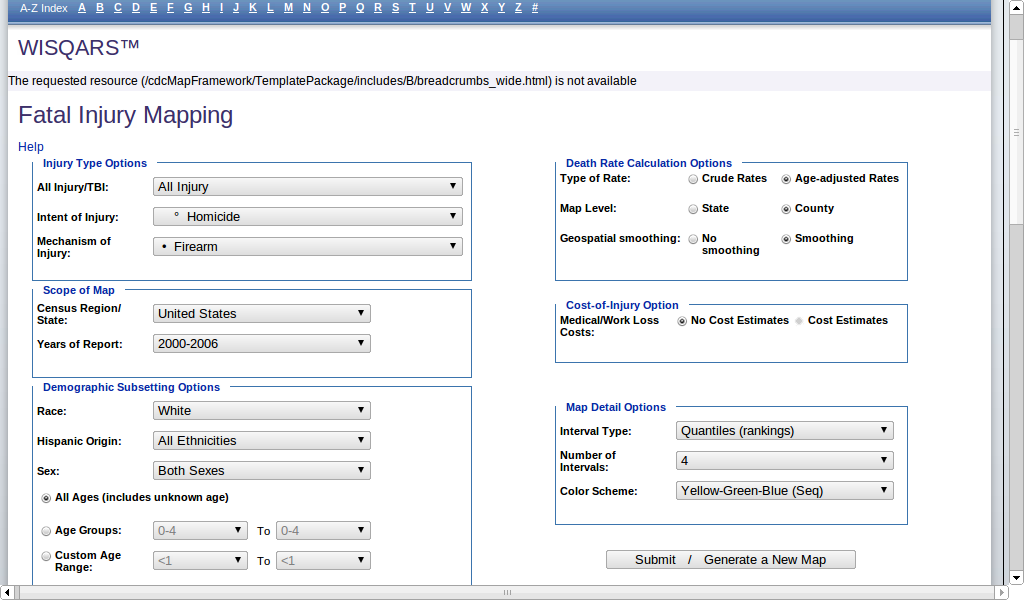
CDC.gov has a great tool for showing United States statistics on death and injury, drillable by various details.

The tool is hosted at http://wisqars.cdc.gov:8080/cdcMapFramework/

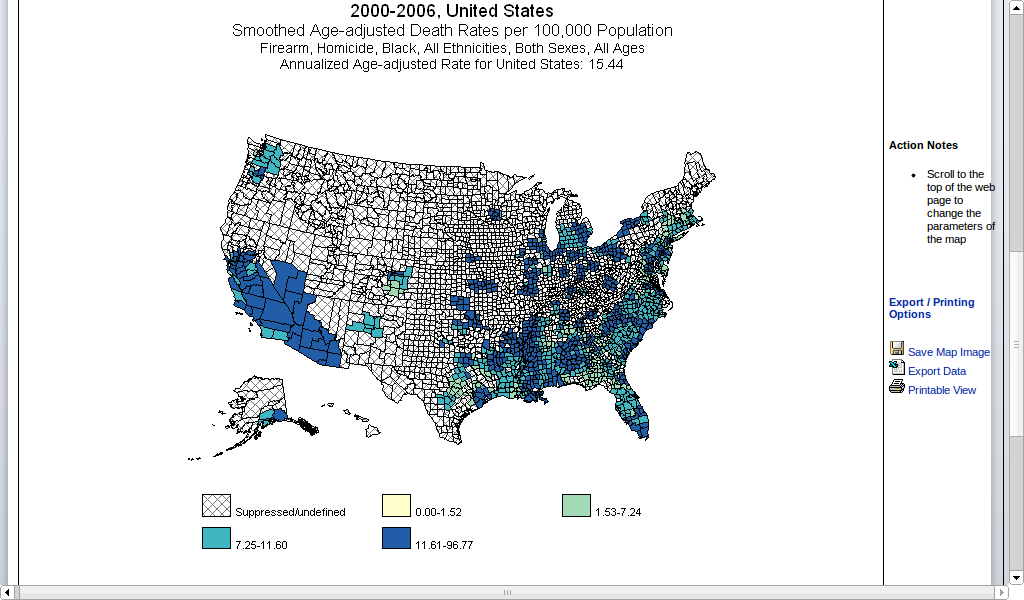
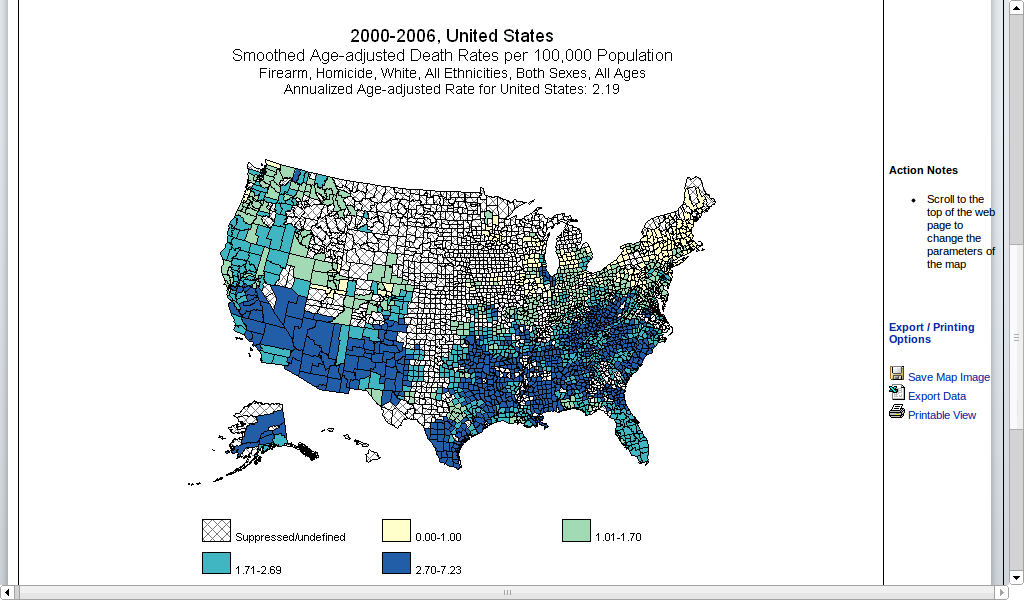
As a test I decided to map out injuries due to fire arms , and compare firearm deaths of white people versus the whole population.(see firearm deaths file)

See white people are more likely than black people to own guns (also read http://www.ncbi.nlm.nih.gov/pubmed/9572612 ), but it seems statistically they are less likely to be injured by firearms- so it could affect support for gun control laws on a racial ground- that was my null hypothesis. No politics, just plain statistics. I dont know- why dont you look at the data and decide-


Carole-Ann’s 2011 Predictions for Decision Management

Carole-Ann’s 2011 Predictions for Decision Management

For Ajay Ohri on DecisionStats.com

What were the top 5 events in 2010 in your field?
  1. Maturity: the Decision Management space was made up of technology vendors, big and small, that typically focused on one or two aspects of this discipline.  Over the past few years, we have seen a lot of consolidation in the industry – first with Business Intelligence (BI) then Business Process Management (BPM) and lately in Business Rules Management (BRM) and Advanced Analytics.  As a result the giant Platform vendors have helped create visibility for this discipline.  Lots of tiny clues finally bubbled up in 2010 to attest of the increasing activity around Decision Management.  For example, more products than ever were named Decision Manager; companies advertised for Decision Managers as a job title in their job section; most people understand what I do when I am introduced in a social setting!
  2. Boredom: unfortunately, as the industry matures, inevitably innovation slows down…  At the main BRMS shows we heard here and there complaints that the technology was stalling.  We heard it from vendors like Red Hat (Drools) and we heard it from bored end-users hoping for some excitement at Business Rules Forum’s vendor panel.  They sadly did not get it
  3. Scrum: I am not thinking about the methodology there!  If you have ever seen a rugby game, you can probably understand why this is the term that comes to mind when I look at the messy & confusing technology landscape.  Feet blindly try to kick the ball out while superhuman forces are moving randomly the whole pack – or so it felt when I played!  Business Users in search of Business Solutions are facing more and more technology choices that feel like comparing apples to oranges.  There is value in all of them and each one addresses a specific aspect of Decision Management but I regret that the industry did not simplify the picture in 2010.  On the contrary!  Many buzzwords were created or at least made popular last year, creating even more confusion on a muddy field.  A few examples: Social CRM, Collaborative Decision Making, Adaptive Case Management, etc.  Don’t take me wrong, I *do* like the technologies.  I sympathize with the decision maker that is trying to pick the right solution though.
  4. Information: Analytics have been used for years of course but the volume of data surrounding us has been growing to unparalleled levels.  We can blame or thank (depending on our perspective) Social Media for that.  Sites like Facebook and LinkedIn have made it possible and easy to publish relevant (as well as fluffy) information in real-time.  As we all started to get the hang of it and potentially over-publish, technology evolved to enable the storage, correlation and analysis of humongous volumes of data that we could not dream of before.  25 billion tweets were posted in 2010.  Every month, over 30 billion pieces of data are shared on Facebook alone.  This is not just about vanity and marketing though.  This data can be leveraged for the greater good.  Carlos pointed to some fascinating facts about catastrophic event response team getting organized thanks to crowd-sourced information.  We are also seeing, in the Decision management world, more and more applicability for those very technology that have been developed for the needs of Big Data – I’ll name for example Hadoop that Carlos (yet again) discussed in his talks at Rules Fest end of 2009 and 2010.
  5. Self-Organization: it may be a side effect of the Social Media movement but I must admit that I was impressed by the success of self-organizing initiatives.  Granted, this last trend has nothing to do with Decision Management per se but I think it is a great evolution worth noting.  Let me point to a couple of examples.  I usually attend traditional conferences and tradeshows in which the content can be good but is sometimes terrible.  I was pleasantly surprised by the professionalism and attendance at *un-conferences* such as P-Camp (P stands for Product – an event for Product Managers).  When you think about it, it is already difficult to get a show together when people are dedicated to the tasks.  How crazy is it to have volunteers set one up with no budget and no agenda?  Well, people simply show up to do their part and everyone has fun voting on-site for what seems the most appealing content at the time.  Crowdsourcing applied to shows: it works!  Similar experience with meetups or tweetups.  I also enjoyed attending some impromptu Twitter jam sessions on a given topic.  Social Media is certainly helping people reach out and get together in person or virtually and that is wonderful!

A segment of a social network
Image via Wikipedia

What are the top three trends you see in 2011?

  1. Performance:  I might be cheating here.   I was very bullish about predicting much progress for 2010 in the area of Performance Management in your Decision Management initiatives.  I believe that progress was made but Carlos did not give me full credit for the right prediction…  Okay, I am a little optimistic on timeline…  I admit it…  If it did not fully happen in 2010, can I predict it again in 2011?  I think that companies want to better track their business performance in order to correct the trajectory of course but also to improve their projections.  I see that it is turning into reality already here and there.  I expect it to become a trend in 2011!
  2. Insight: Big Data being available all around us with new technologies and algorithms will continue to propagate in 2011 leading to more widely spread Analytics capabilities.  The buzz at Analytics shows on Social Network Analysis (SNA) is a sign that there is interest in those kinds of things.  There is tremendous information that can be leveraged for smart decision-making.  I think there will be more of that in 2011 as initiatives launches in 2010 will mature into material results.
    5 Ways to Cultivate an Active Social Network
    Image by Intersection Consulting via Flickr
  3. Collaboration:  Social Media for the Enterprise is a discipline in the making.  Social Media was initially seen for the most part as a Marketing channel.  Over the years, companies have started experimenting with external communities and ideation capabilities with moderate success.  The few strategic initiatives started in 2010 by “old fashion” companies seem to be an indication that we are past the early adopters.  This discipline may very well materialize in 2011 as a core capability, well, or at least a new trend.  I believe that capabilities such Chatter, offered by Salesforce, will transform (slowly) how people interact in the workplace and leverage the volumes of social data captured in LinkedIn and other Social Media sites.  Collaboration is of course a topic of interest for me personally.  I even signed up for Kare Anderson’s collaboration collaboration site – yes, twice the word “collaboration”: it is really about collaborating on collaboration techniques.  Even though collaboration does not require Social Media, this medium offers perspectives not available until now.

Brief Bio-

Carole-Ann is a renowned guru in the Decision Management space. She created the vision for Decision Management that is widely adopted now in the industry. Her claim to fame is the strategy and direction of Blaze Advisor, the then-leading BRMS product, while she also managed all the Decision Management tools at FICO (business rules, predictive analytics and optimization). She has a vision for Decision Management both as a technology and a discipline that can revolutionize the way corporations do business, and will never get tired of painting that vision for her audience. She speaks often at Industry conferences and has conducted university classes in France and Washington DC.

Leveraging her Masters degree in Applied Mathematics / Computer Science from a “Grande Ecole” in France, she started her career building advanced systems using all kinds of technologies — expert systems, rules, optimization, dashboarding and cubes, web search, and beta version of database replication – as well as conducting strategic consulting gigs around change management.

She now tweets as @CMatignon, blogs at blog.sparklinglogic.com and interacts at community.sparklinglogic.com.

She started her career building advanced systems using all kinds of technologies — expert systems, rules, optimization, dashboarding and cubes, web search, and beta version of database replication.  At Cleversys (acquired by Kurt Salmon & Associates), she also conducted strategic consulting gigs mostly around change management.

While playing with advanced software components, she found a passion for technology and joined ILOG (acquired by IBM).  She developed a growing interest in Optimization as well as Business Rules.  At ILOG, she coined the term BRMS while brainstorming with her Sales counterpart.  She led the Presales organization for Telecom in the Americas up until 2000 when she joined Blaze Software (acquired by Brokat Technologies, HNC Software and finally FICO).

Her 360-degree experience allowed her to gain appreciation for all aspects of a software company, giving her a unique perspective on the business.  Her technical background kept her very much in touch with technology as she advanced.

She also became addicted to Twitter in the process.  She is active on all kinds of social media, always looking for new digital experience!

Outside of work, Carole-Ann loves spending time with her two boys.  They grow fruits in their Northern California home and cook all together in the French tradition.

profile on LinkedIn

TwitterFollow me on Twitter

Filtering to Gain Social Network Value
Image by Intersection Consulting via Flickr
Social Networks Hype Cycle
Image by fredcavazza via Flickr