LibreOffice Stable Release launched

Non Oracle Open Office completes important milestone- from the press release

The Document Foundation launches LibreOffice 3.3

The first stable release of the free office suite is available for download

The Internet, January 25, 2011 – The Document Foundation launches LibreOffice 3.3, the first stable release of the free office suite developed by the community. In less than four months, the number of developers hacking LibreOffice has grown from less than twenty in late September 2010, to well over one hundred today. This has allowed us to release ahead of the aggressive schedule set by the project.

Not only does it ship a number of new and original features, LibreOffice 3.3 is also a significant achievement for a number of reasons:

– the developer community has been able to build their own and independent process, and get up and running in a very short time (with respect to the size of the code base and the project’s strong ambitions);

– thanks to the high number of new contributors having been attracted into the project, the source code is quickly undergoing a major clean-up to provide a better foundation for future development of LibreOffice;

– the Windows installer, which is going to impact the largest and most diverse user base, has been integrated into a single build containing all language versions, thus reducing the size for download sites from 75 to 11GB, making it easier for us to deploy new versions more rapidly and lowering the carbon footprint of the entire infrastructure.

Caolán McNamara from RedHat, one of the developer community leaders, comments, “We are excited: this is our very first stable release, and therefore we are eager to get user feedback, which will be integrated as soon as possible into the code, with the first enhancements being released in February. Starting from March, we will be moving to a real time-based, predictable, transparent and public release schedule, in accordance with Engineering Steering Committee’s goals and users’ requests”. The LibreOffice development roadmap is available at http://wiki.documentfoundation.org/ReleasePlan

LibreOffice 3.3 brings several unique new features. The 10 most-popular among community members are, in no particular order:

  1. the ability to import and work with SVG files;
  2. an easy way to format title pages and their numbering in Writer;
  3. a more-helpful Navigator Tool for Writer;
  4. improved ergonomics in Calc for sheet and cell management;
  5. and Microsoft Works and Lotus Word Pro document import filters.

In addition, many great extensions are now bundled, providing

PDF import,

a slide-show presenter console,

a much improved report builder, and more besides.

A more-complete and detailed list of all the new features offered by LibreOffice 3.3 is viewable on the following web page: http://www.libreoffice.org/download/new-features-and-fixes/

LibreOffice 3.3 also provides all the new features of OpenOffice.org 3.3, such as new custom properties handling; embedding of standard PDF fonts in PDF documents; new Liberation Narrow font; increased document protection in Writer and Calc; auto decimal digits for “General” format in Calc; 1 million rows in a spreadsheet; new options for CSV import in Calc; insert drawing objects in Charts; hierarchical axis labels for Charts; improved slide layout handling in Impress; a new easier-to-use print interface; more options for changing case; and colored sheet tabs in Calc. Several of these new features were contributed by members of the LibreOffice team prior to the formation of The Document Foundation.

LibreOffice hackers will be meeting at FOSDEM in Brussels on February 5 and 6, and will be presenting their work during a one-day workshop on February 6, with speeches and hacking sessions coordinated by several members of the project.

The home of The Document Foundation is at http://www.documentfoundation.org

The home of LibreOffice is at http://www.libreoffice.org where the download page has been redesigned by the community to be more user-friendly.

*** About The Document Foundation

The Document Foundation has the mission of facilitating the evolution of the OOo Community into a new, open, independent, and meritocratic organization within the next few months. An independent Foundation is a better reflection of the values of our contributors, users and supporters, and will enable a more effective, efficient and transparent community. TDF will protect past investments by building on the achievements of the first decade, will encourage wide participation within the community, and will co-ordinate activity across the community.

*** Media Contacts for TDF

Florian Effenberger (Germany)

Mobile: +49 151 14424108 – E-mail: floeff@documentfoundation.org

Olivier Hallot (Brazil)

Mobile: +55 21 88228812 – E-mail: olivier.hallot@documentfoundation.org

Charles H. Schulz (France)

Mobile: +33 6 98655424 – E-mail: charles.schulz@documentfoundation.org

Italo Vignoli (Italy)

Mobile: +39 348 5653829 – E-mail: italo.vignoli@documentfoundation.org

Computer Education grants from Google

Image representing Google as depicted in Crunc...
Image via CrunchBase

message from the official google blog-

http://googleblog.blogspot.com/2011/01/supporting-computer-science-education.html

With programs like Computer Science for High School (CS4HS), we hope to increase the number of CS majors —and therefore the number of people entering into careers in CS—by promoting computer science curriculum at the high school level.

For the fourth consecutive year, we’re funding CS4HS to invest in the next generation of computer scientists and engineers. CS4HS is a workshop for high school and middle school computer science teachers that introduces new and emerging concepts in computing and provides tips, tools and guidance on how to teach them. The ultimate goals are to “train the trainer,” develop a thriving community of high school CS teachers and spread the word about the awe and beauty of computing.

If you’re a university, community college, or technical School in the U.S., Canada, Europe, Middle East or Africa and are interested in hosting a workshop at your institution, please visit www.cs4hs.com to submit an application for grant funding.Applications will be accepted between January 18, 2011 and February 18, 2011.

In addition to submitting your application, on the CS4HS website you’ll find info on how to organize a workshop, as well as websites and agendas from last year’s participants to give you an idea of how the workshops were structured in the past. There’s also a collection ofCS4HS curriculum modules that previous participating schools have shared for future organizers to use in their own program.

Data Visualization: Central Banks

Iron Ore Company of Canada
Image via Wikipedia

Trying to compare the transparency of central banks via the data visualization of two very different central banks.

One is Reserve Bank of India and the other is Federal Reserve Bank of New York

Here are some points-

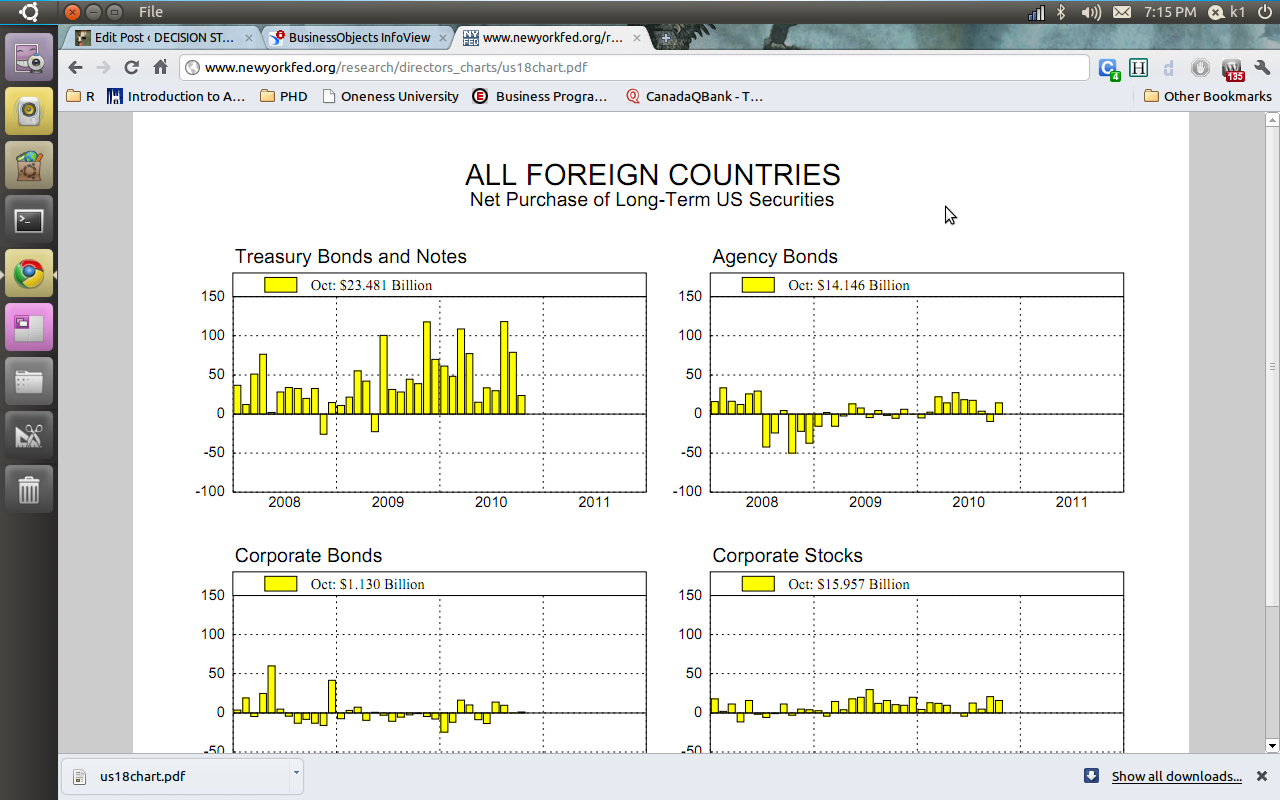
1) The federal bank gives you a huge clutter of charts to choose from and sometimes gives you very difficult to understand charts.

see http://www.newyorkfed.org/research/global_economy/usecon_charts.html

and http://www.newyorkfed.org/research/directors_charts/us18chart.pdf

us18chart

2) The Reserve bank of India choose Business Objects and gives you a proper drilldown kind  of  graph and tables. ( thats a lot of heavy metal and iron ore China needs from India 😉 😉

Foreign Trade – Export      Time-line: ALL

TIME LINE COUNTRY COMMODITY AMOUNT (US $ MILLION) EXPORT QUANTITY
2010:07 (JUL) – P China IRON ORE (Units: TON) 205.06 1878456
2010:06 (JUN) – P China IRON ORE (Units: TON) 427.68 6808528
2010:05 (MAY) – P China IRON ORE (Units: TON) 550.67 5290450
2010:04 (APR) – P China IRON ORE (Units: TON) 922.46 9931500
2010:03 (MAR) – P China IRON ORE (Units: TON) 829.75 13177672
2010:02 (FEB) – P China IRON ORE (Units: TON) 706.04 10141259
2010:01 (JAN) – P China IRON ORE (Units: TON) 577.13 8498784
2009:12 (DEC) – P China IRON ORE (Units: TON) 545.68 9264544
2009:11 (NOV) – P China IRON ORE (Units: TON) 508.17 9509213
2009:10 (OCT) – P China IRON ORE (Units: TON) 422.6 7691652
2009:09 (SEP) – P China IRON ORE (Units: TON) 278.04 4577943
2009:08 (AUG) – P China IRON ORE (Units: TON) 276.96 4371847
2009:07 (JUL) China IRON ORE (Units: TON) 266.11 4642237
2009:06 (JUN) China IRON ORE (Units: TON) 241.08 4584354

Source : DGCI & S, Ministry of Commerce & Industry, GoI


You can see the screenshots of the various visualization tools of the New York Fed Reserve Bank and Indian Reserve Bank- if the US Fed is serious about cutting the debt maybe it should start publishing better visuals

Handling time and date in R

John Harrison's famous chronometer
Image via Wikipedia

One of the most frustrating things I had to do while working as financial business analysts was working with Data Time Formats in Base SAS. The syntax was simple enough and SAS was quite good with handing queries to the Oracle data base that the client was using, but remembering the different types of formats in SAS language was a challenge (there was a date9. and date6 and mmddyy etc )

Data and Time variables are particularly important variables in financial industry as almost everything is derived variable from the time (which varies) while other inputs are mostly constants. This includes interest as well as late fees and finance fees.

In R, date and time are handled quite simply-

Use the strptime( dataset, format) function to convert the character into string

For example if the variable dob is “01/04/1977) then following will convert into a date object

z=strptime(dob,”%d/%m/%Y”)

and if the same date is 01Apr1977

z=strptime(dob,"%d%b%Y")


does the same

For troubleshooting help with date and time, remember to enclose the formats

%d,%b,%m and % Y in the same exact order as the original string- and if there are any delimiters like ” -” or “/” then these delimiters are entered in exactly the same order in the format statement of the strptime

Sys.time() gives you the current date-time while the function difftime(time1,time2) gives you the time intervals( say if you have two columns as date-time variables)


What are the various formats for inputs in date time?

%a
Abbreviated weekday name in the current locale. (Also matches full name on input.)
%A
Full weekday name in the current locale. (Also matches abbreviated name on input.)
%b
Abbreviated month name in the current locale. (Also matches full name on input.)
%B
Full month name in the current locale. (Also matches abbreviated name on input.)
%c
Date and time. Locale-specific on output, "%a %b %e %H:%M:%S %Y" on input.
%d
Day of the month as decimal number (01–31).
%H
Hours as decimal number (00–23).
%I
Hours as decimal number (01–12).
%j
Day of year as decimal number (001–366).
%m
Month as decimal number (01–12).
%M
Minute as decimal number (00–59).
%p
AM/PM indicator in the locale. Used in conjunction with %I and not with %H. An empty string in some locales.
%S
Second as decimal number (00–61), allowing for up to two leap-seconds (but POSIX-compliant implementations will ignore leap seconds).
%U
Week of the year as decimal number (00–53) using Sunday as the first day 1 of the week (and typically with the first Sunday of the year as day 1 of week 1). The US convention.
%w
Weekday as decimal number (0–6, Sunday is 0).
%W
Week of the year as decimal number (00–53) using Monday as the first day of week (and typically with the first Monday of the year as day 1 of week 1). The UK convention.
%x
Date. Locale-specific on output, "%y/%m/%d" on input.
%X
Time. Locale-specific on output, "%H:%M:%S" on input.
%y
Year without century (00–99). Values 00 to 68 are prefixed by 20 and 69 to 99 by 19 – that is the behaviour specified by the 2004 POSIX standard, but it does also say ‘it is expected that in a future version the default century inferred from a 2-digit year will change’.
%Y
Year with century.
%z
Signed offset in hours and minutes from UTC, so -0800 is 8 hours behind UTC.
%Z
(output only.) Time zone as a character string (empty if not available).

Also to read the helpful documentation (especially for time zone level, and leap year seconds and differences)
http://stat.ethz.ch/R-manual/R-patched/library/base/html/difftime.html
http://stat.ethz.ch/R-manual/R-patched/library/base/html/strptime.html
http://stat.ethz.ch/R-manual/R-patched/library/base/html/Ops.Date.html
http://stat.ethz.ch/R-manual/R-patched/library/base/html/Dates.html


Mapping Health Statistics at CDC.gov

Astronaut Buzz Aldrin during the first human l...
Image via Wikipedia

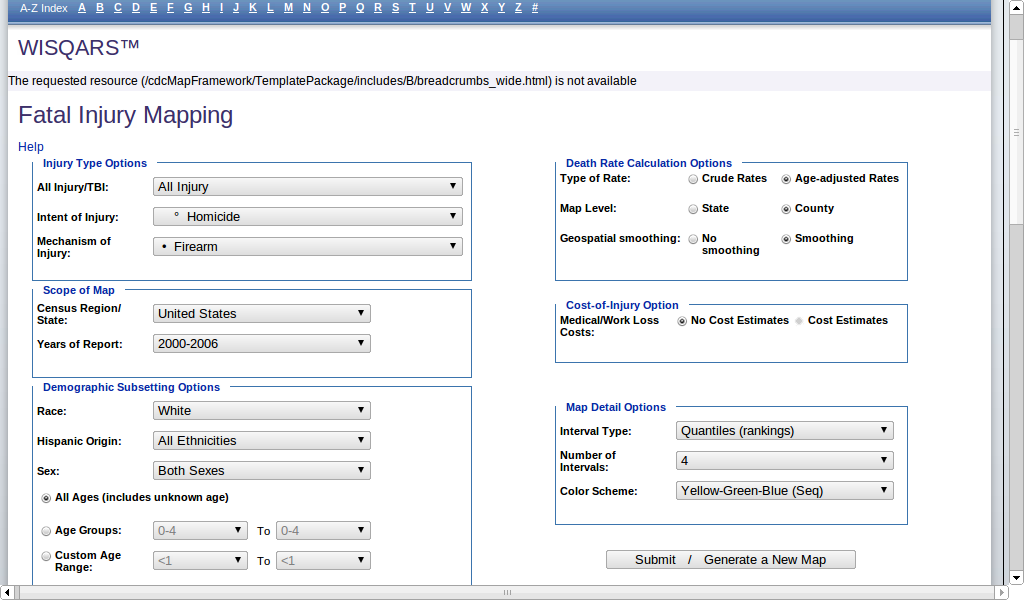
CDC.gov has a great tool for showing United States statistics on death and injury, drillable by various details.

The tool is hosted at http://wisqars.cdc.gov:8080/cdcMapFramework/

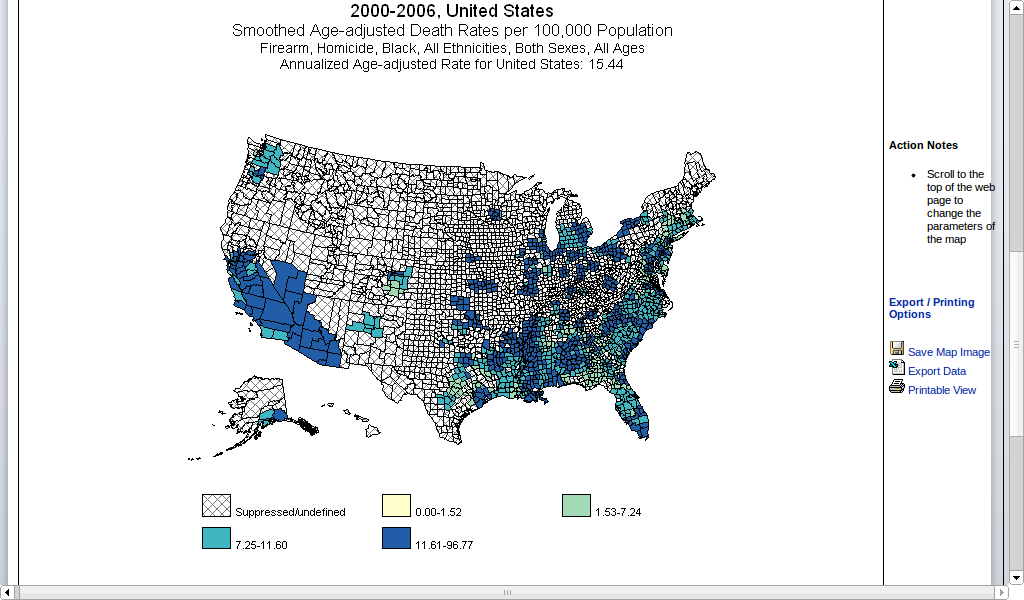
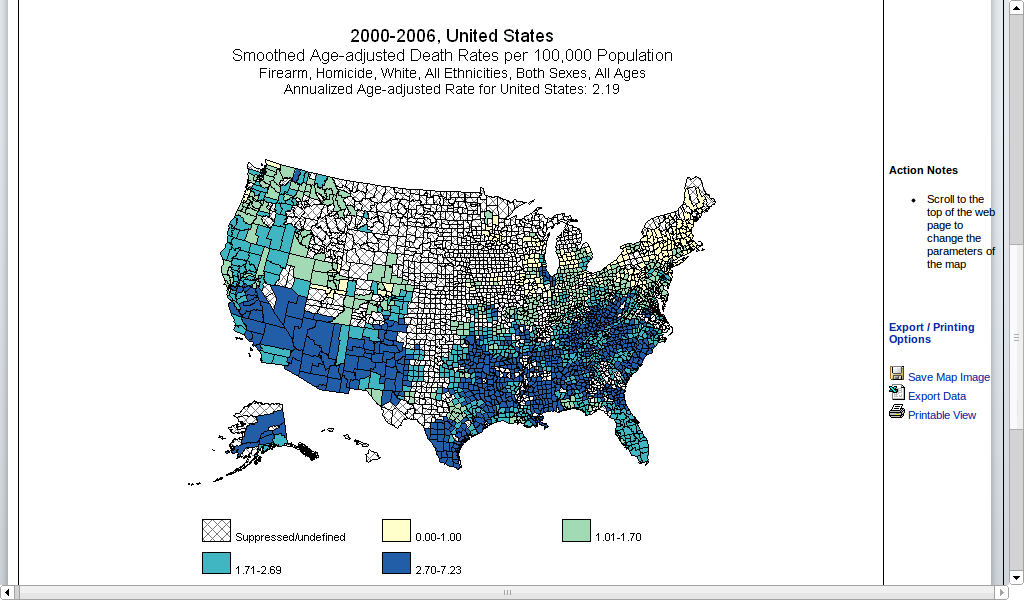
As a test I decided to map out injuries due to fire arms , and compare firearm deaths of white people versus the whole population.(see firearm deaths file)

See white people are more likely than black people to own guns (also read http://www.ncbi.nlm.nih.gov/pubmed/9572612 ), but it seems statistically they are less likely to be injured by firearms- so it could affect support for gun control laws on a racial ground- that was my null hypothesis. No politics, just plain statistics. I dont know- why dont you look at the data and decide-


Carole-Ann’s 2011 Predictions for Decision Management

Carole-Ann’s 2011 Predictions for Decision Management

For Ajay Ohri on DecisionStats.com

What were the top 5 events in 2010 in your field?
  1. Maturity: the Decision Management space was made up of technology vendors, big and small, that typically focused on one or two aspects of this discipline.  Over the past few years, we have seen a lot of consolidation in the industry – first with Business Intelligence (BI) then Business Process Management (BPM) and lately in Business Rules Management (BRM) and Advanced Analytics.  As a result the giant Platform vendors have helped create visibility for this discipline.  Lots of tiny clues finally bubbled up in 2010 to attest of the increasing activity around Decision Management.  For example, more products than ever were named Decision Manager; companies advertised for Decision Managers as a job title in their job section; most people understand what I do when I am introduced in a social setting!
  2. Boredom: unfortunately, as the industry matures, inevitably innovation slows down…  At the main BRMS shows we heard here and there complaints that the technology was stalling.  We heard it from vendors like Red Hat (Drools) and we heard it from bored end-users hoping for some excitement at Business Rules Forum’s vendor panel.  They sadly did not get it
  3. Scrum: I am not thinking about the methodology there!  If you have ever seen a rugby game, you can probably understand why this is the term that comes to mind when I look at the messy & confusing technology landscape.  Feet blindly try to kick the ball out while superhuman forces are moving randomly the whole pack – or so it felt when I played!  Business Users in search of Business Solutions are facing more and more technology choices that feel like comparing apples to oranges.  There is value in all of them and each one addresses a specific aspect of Decision Management but I regret that the industry did not simplify the picture in 2010.  On the contrary!  Many buzzwords were created or at least made popular last year, creating even more confusion on a muddy field.  A few examples: Social CRM, Collaborative Decision Making, Adaptive Case Management, etc.  Don’t take me wrong, I *do* like the technologies.  I sympathize with the decision maker that is trying to pick the right solution though.
  4. Information: Analytics have been used for years of course but the volume of data surrounding us has been growing to unparalleled levels.  We can blame or thank (depending on our perspective) Social Media for that.  Sites like Facebook and LinkedIn have made it possible and easy to publish relevant (as well as fluffy) information in real-time.  As we all started to get the hang of it and potentially over-publish, technology evolved to enable the storage, correlation and analysis of humongous volumes of data that we could not dream of before.  25 billion tweets were posted in 2010.  Every month, over 30 billion pieces of data are shared on Facebook alone.  This is not just about vanity and marketing though.  This data can be leveraged for the greater good.  Carlos pointed to some fascinating facts about catastrophic event response team getting organized thanks to crowd-sourced information.  We are also seeing, in the Decision management world, more and more applicability for those very technology that have been developed for the needs of Big Data – I’ll name for example Hadoop that Carlos (yet again) discussed in his talks at Rules Fest end of 2009 and 2010.
  5. Self-Organization: it may be a side effect of the Social Media movement but I must admit that I was impressed by the success of self-organizing initiatives.  Granted, this last trend has nothing to do with Decision Management per se but I think it is a great evolution worth noting.  Let me point to a couple of examples.  I usually attend traditional conferences and tradeshows in which the content can be good but is sometimes terrible.  I was pleasantly surprised by the professionalism and attendance at *un-conferences* such as P-Camp (P stands for Product – an event for Product Managers).  When you think about it, it is already difficult to get a show together when people are dedicated to the tasks.  How crazy is it to have volunteers set one up with no budget and no agenda?  Well, people simply show up to do their part and everyone has fun voting on-site for what seems the most appealing content at the time.  Crowdsourcing applied to shows: it works!  Similar experience with meetups or tweetups.  I also enjoyed attending some impromptu Twitter jam sessions on a given topic.  Social Media is certainly helping people reach out and get together in person or virtually and that is wonderful!

A segment of a social network
Image via Wikipedia

What are the top three trends you see in 2011?

  1. Performance:  I might be cheating here.   I was very bullish about predicting much progress for 2010 in the area of Performance Management in your Decision Management initiatives.  I believe that progress was made but Carlos did not give me full credit for the right prediction…  Okay, I am a little optimistic on timeline…  I admit it…  If it did not fully happen in 2010, can I predict it again in 2011?  I think that companies want to better track their business performance in order to correct the trajectory of course but also to improve their projections.  I see that it is turning into reality already here and there.  I expect it to become a trend in 2011!
  2. Insight: Big Data being available all around us with new technologies and algorithms will continue to propagate in 2011 leading to more widely spread Analytics capabilities.  The buzz at Analytics shows on Social Network Analysis (SNA) is a sign that there is interest in those kinds of things.  There is tremendous information that can be leveraged for smart decision-making.  I think there will be more of that in 2011 as initiatives launches in 2010 will mature into material results.
    5 Ways to Cultivate an Active Social Network
    Image by Intersection Consulting via Flickr
  3. Collaboration:  Social Media for the Enterprise is a discipline in the making.  Social Media was initially seen for the most part as a Marketing channel.  Over the years, companies have started experimenting with external communities and ideation capabilities with moderate success.  The few strategic initiatives started in 2010 by “old fashion” companies seem to be an indication that we are past the early adopters.  This discipline may very well materialize in 2011 as a core capability, well, or at least a new trend.  I believe that capabilities such Chatter, offered by Salesforce, will transform (slowly) how people interact in the workplace and leverage the volumes of social data captured in LinkedIn and other Social Media sites.  Collaboration is of course a topic of interest for me personally.  I even signed up for Kare Anderson’s collaboration collaboration site – yes, twice the word “collaboration”: it is really about collaborating on collaboration techniques.  Even though collaboration does not require Social Media, this medium offers perspectives not available until now.

Brief Bio-

Carole-Ann is a renowned guru in the Decision Management space. She created the vision for Decision Management that is widely adopted now in the industry. Her claim to fame is the strategy and direction of Blaze Advisor, the then-leading BRMS product, while she also managed all the Decision Management tools at FICO (business rules, predictive analytics and optimization). She has a vision for Decision Management both as a technology and a discipline that can revolutionize the way corporations do business, and will never get tired of painting that vision for her audience. She speaks often at Industry conferences and has conducted university classes in France and Washington DC.

Leveraging her Masters degree in Applied Mathematics / Computer Science from a “Grande Ecole” in France, she started her career building advanced systems using all kinds of technologies — expert systems, rules, optimization, dashboarding and cubes, web search, and beta version of database replication – as well as conducting strategic consulting gigs around change management.

She now tweets as @CMatignon, blogs at blog.sparklinglogic.com and interacts at community.sparklinglogic.com.

She started her career building advanced systems using all kinds of technologies — expert systems, rules, optimization, dashboarding and cubes, web search, and beta version of database replication.  At Cleversys (acquired by Kurt Salmon & Associates), she also conducted strategic consulting gigs mostly around change management.

While playing with advanced software components, she found a passion for technology and joined ILOG (acquired by IBM).  She developed a growing interest in Optimization as well as Business Rules.  At ILOG, she coined the term BRMS while brainstorming with her Sales counterpart.  She led the Presales organization for Telecom in the Americas up until 2000 when she joined Blaze Software (acquired by Brokat Technologies, HNC Software and finally FICO).

Her 360-degree experience allowed her to gain appreciation for all aspects of a software company, giving her a unique perspective on the business.  Her technical background kept her very much in touch with technology as she advanced.

She also became addicted to Twitter in the process.  She is active on all kinds of social media, always looking for new digital experience!

Outside of work, Carole-Ann loves spending time with her two boys.  They grow fruits in their Northern California home and cook all together in the French tradition.

profile on LinkedIn

TwitterFollow me on Twitter

Filtering to Gain Social Network Value
Image by Intersection Consulting via Flickr
Social Networks Hype Cycle
Image by fredcavazza via Flickr

Stuxnet DeMystified

Detail of a New York Times Advertisement - 1895
Image via Wikipedia

A fascinating article in New York Times details the fascinating details of the Stuxnet virus, apparently the most successful cyber weapon in recent times.

Given that Industrial Controllers are a part of a everything from factories to missile launch configurations, I believe this is a fascinating area of study for the world’s research scientists including creating variants and defenses for this.

https://www.nytimes.com/2011/01/16/world/middleeast/16stuxnet.html

Also a 2008 presentation by Siemens that the NYT was kind enough to link to- (whither Wikileaks ??)