Teradata Analytics

A recent announcement showing Teradata partnering with KXEN and Revolution Analytics for Teradata Analytics.

http://www.teradata.com/News-Releases/2012/Teradata-Expands-Integrated-Analytics-Portfolio/

The Latest in Open Source Emerging Software Technologies
Teradata provides customers with two additional open source technologies – “R” technology from Revolution Analytics for analytics and GeoServer technology for spatial data offered by the OpenGeo organization – both of which are able to leverage the power of Teradata in-database processing for faster, smarter answers to business questions.

In addition to the existing world-class analytic partners, Teradata supports the use of the evolving “R” technology, an open source language for statistical computing and graphics. “R” technology is gaining popularity with data scientists who are exploiting its new and innovative capabilities, which are not readily available. The enhanced “R add-on for Teradata” has a 50 percent performance improvement, it is easier to use, and its capabilities support large data analytics. Users can quickly profile, explore, and analyze larger quantities of data directly in the Teradata Database to deliver faster answers by leveraging embedded analytics.

Teradata has partnered with Revolution Analytics, the leading commercial provider of “R” technology, because of customer interest in high-performing R applications that deliver superior performance for large-scale data. “Our innovative customers understand that big data analytics takes a smart approach to the entire infrastructure and we will enable them to differentiate their business in a cost-effective way,” said David Rich, chief executive officer, Revolution Analytics. “We are excited to partner with Teradata, because we see great affinity between Teradata and Revolution Analytics – we embrace parallel computing and the high performance offered by multi-core and multi-processor hardware.”

and

The Teradata Data Lab empowers business users and leading analytic partners to start building new analytics in less than five minutes, as compared to waiting several weeks for the IT department’s assistance.

“The Data Lab within the Teradata database provides the perfect foundation to enable self-service predictive analytics with KXEN InfiniteInsight,” said John Ball, chief executive officer, KXEN. “Teradata technologies, combined with KXEN’s automated modeling capabilities and in-database scoring, put the power of predictive analytics and data mining directly into the hands of business users. This powerful combination helps our joint customers accelerate insight by delivering top-quality models in orders of magnitude faster than traditional approaches.”

Read more at

http://www.sacbee.com/2012/03/06/4315500/teradata-expands-integrated-analytics.html

Interview JJ Allaire Founder, RStudio

Here is an interview with JJ Allaire, founder of RStudio. RStudio is the IDE that has overtaken other IDE within the R Community in terms of ease of usage. On the eve of their latest product launch, JJ talks to DecisionStats on RStudio and more.

Ajay-  So what is new in the latest version of RStudio and how exactly is it useful for people?

JJ- The initial release of RStudio as well as the two follow-up releases we did last year were focused on the core elements of using R: editing and running code, getting help, and managing files, history, workspaces, plots, and packages. In the meantime users have also been asking for some bigger features that would improve the overall work-flow of doing analysis with R. In this release (v0.95) we focused on three of these features:

Projects. R developers tend to have several (and often dozens) of working contexts associated with different clients, analyses, data sets, etc. RStudio projects make it easy to keep these contexts well separated (with distinct R sessions, working directories, environments, command histories, and active source documents), switch quickly between project contexts, and even work with multiple projects at once (using multiple running versions of RStudio).

Version Control. The benefits of using version control for collaboration are well known, but we also believe that solo data analysis can achieve significant productivity gains by using version control (this discussion on Stack Overflow talks about why). In this release we introduced integrated support for the two most popular open-source version control systems: Git and Subversion. This includes changelist management, file diffing, and browsing of project history, all right from within RStudio.

Code Navigation. When you look at how programmers work a surprisingly large amount of time is spent simply navigating from one context to another. Modern programming environments for general purpose languages like C++ and Java solve this problem using various forms of code navigation, and in this release we’ve brought these capabilities to R. The two main features here are the ability to type the name of any file or function in your project and go immediately to it; and the ability to navigate to the definition of any function under your cursor (including the definition of functions within packages) using a keystroke (F2) or mouse gesture (Ctrl+Click).

Ajay- What’s the product road map for RStudio? When can we expect the IDE to turn into a full fledged GUI?

JJ- Linus Torvalds has said that “Linux is evolution, not intelligent design.” RStudio tries to operate on a similar principle—the world of statistical computing is too deep, diverse, and ever-changing for any one person or vendor to map out in advance what is most important. So, our internal process is to ship a new release every few months, listen to what people are doing with the product (and hope to do with it), and then start from scratch again making the improvements that are considered most important.

Right now some of the things which seem to be top of mind for users are improved support for authoring and reproducible research, various editor enhancements including code folding, and debugging tools.

What you’ll see is us do in a given release is to work on a combination of frequently requested features, smaller improvements to usability and work-flow, bug fixes, and finally architectural changes required to support current or future feature requirements.

While we do try to base what we work on as closely as possible on direct user-feedback, we also adhere to some core principles concerning the overall philosophy and direction of the product. So for example the answer to the question about the IDE turning into a full-fledged GUI is: never. We believe that textual representations of computations provide fundamental advantages in transparency, reproducibility, collaboration, and re-usability. We believe that writing code is simply the right way to do complex technical work, so we’ll always look for ways to make coding better, faster, and easier rather than try to eliminate coding altogether.

Ajay -Describe your journey in science from a high school student to your present work in R. I noticed you have been very successful in making software products that have been mostly proprietary products or sold to companies.

Why did you get into open source products with RStudio? What are your plans for monetizing RStudio further down the line?

JJ- In high school and college my principal areas of study were Political Science and Economics. I also had a very strong parallel interest in both computing and quantitative analysis. My first job out of college was as a financial analyst at a government agency. The tools I used in that job were SAS and Excel. I had a dim notion that there must be a better way to marry computation and data analysis than those tools, but of course no concept of what this would look like.

From there I went more in the direction of general purpose computing, starting a couple of companies where I worked principally on programming languages and authoring tools for the Web. These companies produced proprietary software, which at the time (between 1995 and 2005) was a workable model because it allowed us to build the revenue required to fund development and to promote and distribute the software to a wider audience.

By 2005 it was however becoming clear that proprietary software would ultimately be overtaken by open source software in nearly all domains. The cost of development had shrunken dramatically thanks to both the availability of high-quality open source languages and tools as well as the scale of global collaboration possible on open source projects. The cost of promoting and distributing software had also collapsed thanks to efficiency of both distribution and information diffusion on the Web.

When I heard about R and learned more about it, I become very excited and inspired by what the project had accomplished. A group of extremely talented and dedicated users had created the software they needed for their work and then shared the fruits of that work with everyone. R was a platform that everyone could rally around because it worked so well, was extensible in all the right ways, and most importantly was free (as in speech) so users could depend upon it as a long-term foundation for their work.

So I started RStudio with the aim of making useful contributions to the R community. We started with building an IDE because it seemed like a first-rate development environment for R that was both powerful and easy to use was an unmet need. Being aware that many other companies had built successful businesses around open-source software, we were also convinced that we could make RStudio available under a free and open-source license (the AGPLv3) while still creating a viable business. At this point RStudio is exclusively focused on creating the best IDE for R that we can. As the core product gets where it needs to be over the next couple of years we’ll then also begin to sell other products and services related to R and RStudio.

About-

http://rstudio.org/docs/about

Jjallaire

JJ Allaire

JJ Allaire is a software engineer and entrepreneur who has created a wide variety of products including ColdFusion,Windows Live WriterLose It!, and RStudio.

From http://en.wikipedia.org/wiki/Joseph_J._Allaire
In 1995 Joseph J. (JJ) Allaire co-founded Allaire Corporation with his brother Jeremy Allaire, creating the web development tool ColdFusion.[1] In March 2001, Allaire was sold to Macromedia where ColdFusion was integrated into the Macromedia MX product line. Macromedia was subsequently acquired by Adobe Systems, which continues to develop and market ColdFusion.
After the sale of his company, Allaire became frustrated at the difficulty of keeping track of research he was doing using Google. To address this problem, he co-founded Onfolio in 2004 with Adam Berrey, former Allaire co-founder and VP of Marketing at Macromedia.
On March 8, 2006, Onfolio was acquired by Microsoft where many of the features of the original product are being incorporated into the Windows Live Toolbar. On August 13, 2006, Microsoft released the public beta of a new desktop blogging client called Windows Live Writer that was created by Allaire’s team at Microsoft.
Starting in 2009, Allaire has been developing a web-based interface to the widely used R technical computing environment. A beta version of RStudio was publicly released on February 28, 2011.
JJ Allaire received his B.A. from Macalester College (St. Paul, MN) in 1991.
RStudio-

RStudio is an integrated development environment (IDE) for R which works with the standard version of R available from CRAN. Like R, RStudio is available under a free software license. RStudio is designed to be as straightforward and intuitive as possible to provide a friendly environment for new and experienced R users alike. RStudio is also a company, and they plan to sell services (support, training, consulting, hosting) related to the open-source software they distribute.

Credit Downgrade of USA and Triple A Whining

As a person trained , deployed and often asked to comment on macroeconomic shenanigans- I have the following observations to make on the downgrade of US Debt by S&P

1) Credit rating is both a mathematical exercise of debt versus net worth as well as intention to repay. Given the recent deadlock in United States legislature on debt ceiling, it is natural and correct to assume that holding US debt is slightly more risky in 2011 as compared to 2001. That means if the US debt was AAA in 2001 it sure is slightly more risky in 2011.

2) Politicians are criticized the world over in democracies including India, UK and US. This is natural , healthy and enforced by checks and balances by constitution of each country. At the time of writing this, there are protests in India on corruption, in UK on economic disparities, in US on debt vs tax vs spending, Israel on inflation. It is the maturity of the media as well as average educational level of citizenry that amplifies and inflames or dampens sentiment regarding policy and business.

3) Conspicuous consumption has failed both at an environmental and economic level. Cheap debt to buy things you do not need may have made good macro economic sense as long as the things were made by people locally but that is no longer the case. Outsourcing is not all evil, but it sure is not a perfect solution to economics and competitiveness. Outsourcing is good or outsourcing is bad- well it depends.

4) In 1944 , the US took debt to fight Nazism, build atomic power and generally wage a lot of war and lots of dual use inventions. In 2004-2010 the US took debt to fight wars in Iraq, Afghanistan and bail out banks and automobile companies. Some erosion in the values represented by a free democracy has taken place, much to the delight of authoritarian regimes (who have managed to survive Google and Facebook).

5) A Double A rating is still quite a good rating. Noone is moving out of the US Treasuries- I mean seriously what are your alternative financial resources to park your government or central bank assets, euro, gold, oil, rare earth futures, metals or yen??

6) Income disparity as a trigger for social unrest in UK, France and other parts is an ominous looming threat that may lead to more action than the poor maths of S &P. It has been some time since riots occured in the United States and I believe in time series and cycles especially given the rising Gini coefficients .

Gini indices for the United States at various times, according to the US Census Bureau:[8][9][10]

  • 1929: 45.0 (estimated)
  • 1947: 37.6 (estimated)
  • 1967: 39.7 (first year reported)
  • 1968: 38.6 (lowest index reported)
  • 1970: 39.4
  • 1980: 40.3
  • 1990: 42.8
    • (Recalculations made in 1992 added a significant upward shift for later values)
  • 2000: 46.2
  • 2005: 46.9
  • 2006: 47.0 (highest index reported)
  • 2007: 46.3
  • 2008: 46.69
  • 2009: 46.8

7) Again I am slightly suspicious of an American Corporation downgrading the American Governmental debt when it failed to reconcile numbers by 2 trillion and famously managed to avoid downgrading Lehman Brothers.  What are the political affiliations of the S &P board. What are their backgrounds. Check the facts, Watson.

The Chinese government should be concerned if it is holding >1000 tonnes of Gold and >1 trillion plus of US treasuries lest we have a third opium war (as either Gold or US Treasuries will burst)

. Opium in 1850 like the US Treasuries in 2010 have no inherent value except for those addicted to them.

8   ) Ron Paul and Paul Krugman are the two extremes of economic ideology in the US.

Reminds me of the old saying- Robbing Peter to pay Paul. Both the Pauls seem equally unhappy and biased.

I have to read both WSJ and NYT to make sense of what actually is happening in the US as opinionated journalism has managed to elbow out fact based journalism. Do we need analytics in journalism education/ reporting?

9) Panic buying and selling would lead to short term arbitrage positions. People like W Buffet made more money in the crash of 2008 than people did in the boom years of 2006-7

If stocks are cheap- buy. on the dips. Acquire companies before they go for IPOs. Go buy your own stock if you are sitting on  a pile of cash. Buy some technology patents in cloud , mobile, tablet and statistical computing if you have a lot of cash and need to buy some long term assets.

10) Follow all advice above at own risk and no liability to this author 😉


Interview Anne Milley JMP

Here is an interview with Anne Milley, a notable thought leader in the world of analytics. Anne is now Senior Director, Analytical Strategy in Product Marketing for JMP , the leading data visualization software from the SAS Institute.

Ajay-What do you think are the top 5 unique selling points of JMP compared to other statistical software in its category?

Anne-

JMP combines incredible analytic depth and breadth with interactive data visualization, creating a unique environment optimized for discovery and data-driven innovation.

With an extensible framework using JSL (JMP Scripting Language), and integration with SAS, R, and Excel, JMP becomes your analytic hub.

JMP is accessible to all kinds of users. A novice analyst can dig into an interactive report delivered by a custom JMP application. An engineer looking at his own data can use built-in JMP capabilities to discover patterns, and a developer can write code to extend JMP for herself or others.

State-of-the-art DOE capabilities make it easy for anyone to design and analyze efficient experiments to determine which adjustments will yield the greatest gains in quality or process improvement – before costly changes are made.

Not to mention, JMP products are exceptionally well designed and easy to use. See for yourself and check out the free trial at www.jmp.com.

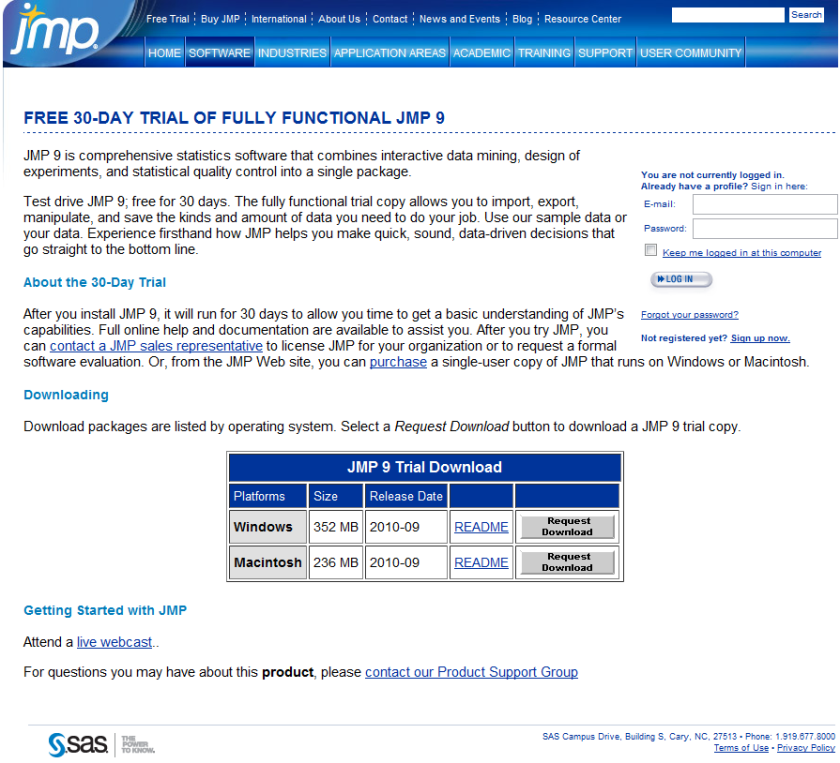
Download a free 30-day trial of JMP.

Ajay- What are the challenges and opportunities of expanding JMP’s market share? Do you see JMP expanding its conferences globally to engage global audiences?

Anne-

We realized solid global growth in 2010. The release of JMP Pro and JMP Clinical last year along with continuing enhancements to the rest of the JMP family of products (JMP and JMP Genomics) should position us well for another good year.

With the growing interest in analytics as a means to sustained value creation, we have the opportunity to help people along their analytic journey – to get started, take the next step, or adopt new paradigms speeding their time to value. The challenge is doing that as fast as we would like.

We are hiring internationally to offer even more events, training and academic programs globally.

Ajay- What are the current and proposed educational and global academic initiatives of JMP? How can we see more JMP in universities across the world (say India- China etc)?

Anne-

We view colleges and universities both as critical incubators of future JMP users and as places where attitudes about data analysis and statistics are formed. We believe that a positive experience in learning statistics makes a person more likely to eventually want and need a product like JMP.

For most students – and particularly for those in applied disciplines of business, engineering and the sciences – the ability to make a statistics course relevant to their primary area of study fosters a positive experience. Fortunately, there is a trend in statistical education toward a more applied, data-driven approach, and JMP provides a very natural environment for both students and researchers.

Its user-friendly navigation, emphasis on data visualization and easy access to the analytics behind the graphics make JMP a compelling alternative to some of our more traditional competitors.

We’ve seen strong growth in the education markets in the last few years, and JMP is now used in nearly half of the top 200 universities in the US.

Internationally, we are at an earlier stage of market development, but we are currently working with both JMP and SAS country offices and their local academic programs to promote JMP. For example, we are working with members of the JMP China office and faculty at several universities in China to support the use of JMP in the development of a master’s curriculum in Applied Statistics there, touched on in this AMSTAT News article.

Ajay- What future trends do you see for 2011 in this market (say top 5)?

Anne-

Growing complexity of data (text, image, audio…) drives the need for more and better visualization and analysis capabilities to make sense of it all.

More “chief analytics officers” are making better use of analytic talent – people are the most important ingredient for success!

JMP has been on the vanguard of 64-bit development, and users are now catching up with us as 64-bit machines become more common.

Users should demand easy-to-use, exploratory and predictive modeling tools as well as robust tools to experiment and learn to help them make the best decisions on an ongoing basis.

All these factors and more fuel the need for the integration of flexible, extensible tools with popular analytic platforms.

Ajay-You enjoy organic gardening as a hobby. How do you think hobbies and unwind time help people be better professionals?

Anne-

I am lucky to work with so many people who view their work as a hobby. They have other interests too, though, some of which are work-related (statistics is relevant everywhere!). Organic gardening helps me put things in perspective and be present in the moment. More than work defines who you are. You can be passionate about your work as well as passionate about other things. I think it’s important to spend some leisure time in ways that bring you joy and contribute to your overall wellbeing and outlook.

Btw, nice interviews over the past several months—I hadn’t kept up, but will check it out more often!

Biography–  Source- http://www.sas.com/knowledge-exchange/business-analytics/biographies.html

  • Anne Milley

    Anne Milley

    Anne Milley is Senior Director of Analytics Strategy at JMP Product Marketing at SAS. Her ties to SAS began with bank failure prediction at Federal Home Loan Bank Dallas and continued at 7-Eleven Inc. She has authored papers and served on committees for F2006, KDD, SIAM, A2010 and several years of SAS’ annual data mining conference. Milley is a contributing faculty member for the International Institute of Analytics. anne.milley@jmp.com

R Commander Plugins-20 and growing!

First graphical user interface in 1973.
Image via Wikipedia
R Commander Extensions: Enhancing a Statistical Graphical User Interface by extending menus to statistical packages

R Commander ( see paper by Prof J Fox at http://www.jstatsoft.org/v14/i09/paper ) is a well known and established graphical user interface to the R analytical environment.
While the original GUI was created for a basic statistics course, the enabling of extensions (or plug-ins  http://www.r-project.org/doc/Rnews/Rnews_2007-3.pdf ) has greatly enhanced the possible use and scope of this software. Here we give a list of all known R Commander Plugins and their uses along with brief comments.

  1. DoE – http://cran.r-project.org/web/packages/RcmdrPlugin.DoE/RcmdrPlugin.DoE.pdf
  2. doex
  3. EHESampling
  4. epack- http://cran.r-project.org/web/packages/RcmdrPlugin.epack/RcmdrPlugin.epack.pdf
  5. Export- http://cran.r-project.org/web/packages/RcmdrPlugin.Export/RcmdrPlugin.Export.pdf
  6. FactoMineR
  7. HH
  8. IPSUR
  9. MAc- http://cran.r-project.org/web/packages/RcmdrPlugin.MAc/RcmdrPlugin.MAc.pdf
  10. MAd
  11. orloca
  12. PT
  13. qcc- http://cran.r-project.org/web/packages/RcmdrPlugin.qcc/RcmdrPlugin.qcc.pdf and http://cran.r-project.org/web/packages/qcc/qcc.pdf
  14. qual
  15. SensoMineR
  16. SLC
  17. sos
  18. survival-http://cran.r-project.org/web/packages/RcmdrPlugin.survival/RcmdrPlugin.survival.pdf
  19. SurvivalT
  20. Teaching Demos

Note the naming convention for above e plugins is always with a Prefix of “RCmdrPlugin.” followed by the names above
Also on loading a Plugin, it must be already installed locally to be visible in R Commander’s list of load-plugin, and R Commander loads the e-plugin after restarting.Hence it is advisable to load all R Commander plugins in the beginning of the analysis session.

However the notable E Plugins are
1) DoE for Design of Experiments-
Full factorial designs, orthogonal main effects designs, regular and non-regular 2-level fractional
factorial designs, central composite and Box-Behnken designs, latin hypercube samples, and simple D-optimal designs can currently be generated from the GUI. Extensions to cover further latin hypercube designs as well as more advanced D-optimal designs (with blocking) are planned for the future.
2) Survival- This package provides an R Commander plug-in for the survival package, with dialogs for Cox models, parametric survival regression models, estimation of survival curves, and testing for differences in survival curves, along with data-management facilities and a variety of tests, diagnostics and graphs.
3) qcc -GUI for  Shewhart quality control charts for continuous, attribute and count data. Cusum and EWMA charts. Operating characteristic curves. Process capability analysis. Pareto chart and cause-and-effect chart. Multivariate control charts
4) epack- an Rcmdr “plug-in” based on the time series functions. Depends also on packages like , tseries, abind,MASS,xts,forecast. It covers Log-Exceptions garch
and following Models -Arima, garch, HoltWinters
5)Export- The package helps users to graphically export Rcmdr output to LaTeX or HTML code,
via xtable() or Hmisc::latex(). The plug-in was originally intended to facilitate exporting Rcmdr
output to formats other than ASCII text and to provide R novices with an easy-to-use,
easy-to-access reference on exporting R objects to formats suited for printed output. The
package documentation contains several pointers on creating reports, either by using
conventional word processors or LaTeX/LyX.
6) MAc- This is an R-Commander plug-in for the MAc package (Meta-Analysis with
Correlations). This package enables the user to conduct a meta-analysis in a menu-driven,
graphical user interface environment (e.g., SPSS), while having the full statistical capabilities of
R and the MAc package. The MAc package itself contains a variety of useful functions for
conducting a research synthesis with correlational data. One of the unique features of the MAc
package is in its integration of user-friendly functions to complete the majority of statistical steps
involved in a meta-analysis with correlations. It uses recommended procedures as described in
The Handbook of Research Synthesis and Meta-Analysis (Cooper, Hedges, & Valentine, 2009).

A query to help for ??Rcmdrplugins reveals the following information which can be quite overwhelming given that almost 20 plugins are now available-

RcmdrPlugin.DoE::DoEGlossary
Glossary for DoE terminology as used in
RcmdrPlugin.DoE
RcmdrPlugin.DoE::Menu.linearModelDesign
RcmdrPlugin.DoE Linear Model Dialog for
experimental data
RcmdrPlugin.DoE::Menu.rsm
RcmdrPlugin.DoE response surface model Dialog
for experimental data
RcmdrPlugin.DoE::RcmdrPlugin.DoE-package
R-Commander plugin package that implements
design of experiments facilities from packages
DoE.base, FrF2 and DoE.wrapper into the
R-Commander
RcmdrPlugin.DoE::RcmdrPlugin.DoEUndocumentedFunctions
Functions used in menus
RcmdrPlugin.doex::ranblockAnova
Internal RcmdrPlugin.doex objects
RcmdrPlugin.doex::RcmdrPlugin.doex-package
Install the DOEX Rcmdr Plug-In
RcmdrPlugin.EHESsampling::OpenSampling1
Internal functions for menu system of
RcmdrPlugin.EHESsampling
RcmdrPlugin.EHESsampling::RcmdrPlugin.EHESsampling-package
Help with EHES sampling
RcmdrPlugin.Export::RcmdrPlugin.Export-package
Graphically export objects to LaTeX or HTML
RcmdrPlugin.FactoMineR::defmacro
Internal RcmdrPlugin.FactoMineR objects
RcmdrPlugin.FactoMineR::RcmdrPlugin.FactoMineR
Graphical User Interface for FactoMineR
RcmdrPlugin.IPSUR::IPSUR-package
An IPSUR Plugin for the R Commander
RcmdrPlugin.MAc::RcmdrPlugin.MAc-package
Meta-Analysis with Correlations (MAc) Rcmdr
Plug-in
RcmdrPlugin.MAd::RcmdrPlugin.MAd-package
Meta-Analysis with Mean Differences (MAd) Rcmdr
Plug-in
RcmdrPlugin.orloca::activeDataSetLocaP
RcmdrPlugin.orloca: A GUI for orloca-package
(internal functions)
RcmdrPlugin.orloca::RcmdrPlugin.orloca-package
RcmdrPlugin.orloca: A GUI for orloca-package
RcmdrPlugin.orloca::RcmdrPlugin.orloca.es
RcmdrPlugin.orloca.es: Una interfaz grafica
para el paquete orloca
RcmdrPlugin.qcc::RcmdrPlugin.qcc-package
Install the Demos Rcmdr Plug-In
RcmdrPlugin.qual::xbara
Internal RcmdrPlugin.qual objects
RcmdrPlugin.qual::RcmdrPlugin.qual-package
Install the quality Rcmdr Plug-In
RcmdrPlugin.SensoMineR::defmacro
Internal RcmdrPlugin.SensoMineR objects
RcmdrPlugin.SensoMineR::RcmdrPlugin.SensoMineR
Graphical User Interface for SensoMineR
RcmdrPlugin.SLC::Rcmdr.help.RcmdrPlugin.SLC
RcmdrPlugin.SLC: A GUI for slc-package
(internal functions)
RcmdrPlugin.SLC::RcmdrPlugin.SLC-package
RcmdrPlugin.SLC: A GUI for SLC R package
RcmdrPlugin.sos::RcmdrPlugin.sos-package
Efficiently search R Help pages
RcmdrPlugin.steepness::Rcmdr.help.RcmdrPlugin.steepness
RcmdrPlugin.steepness: A GUI for
steepness-package (internal functions)
RcmdrPlugin.steepness::RcmdrPlugin.steepness
RcmdrPlugin.steepness: A GUI for steepness R
package
RcmdrPlugin.survival::allVarsClusters
Internal RcmdrPlugin.survival Objects
RcmdrPlugin.survival::RcmdrPlugin.survival-package
Rcmdr Plug-In Package for the survival Package
RcmdrPlugin.TeachingDemos::RcmdrPlugin.TeachingDemos-package
Install the Demos Rcmdr Plug-In


How to balance your online advertising and your offline conscience

Google in 1998, showing the original logo
Image via Wikipedia

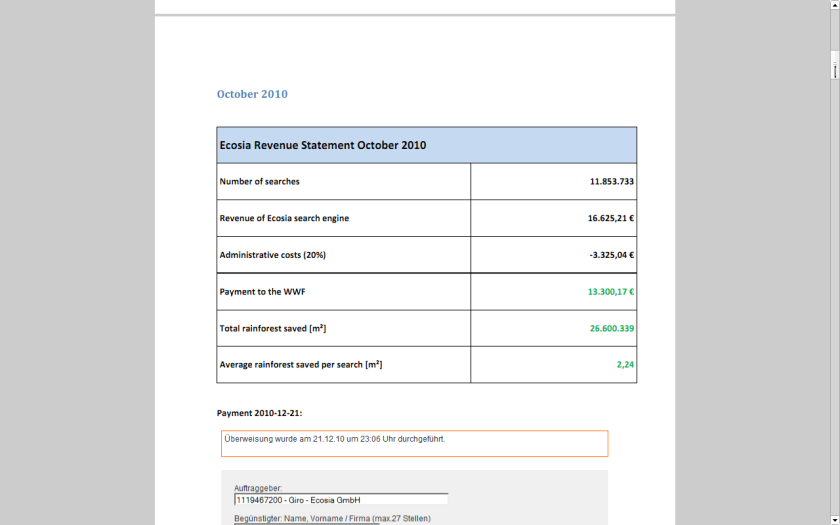
I recently found an interesting example of  a website that both makes a lot of money and yet is much more efficient than any free or non profit. It is called ECOSIA

If you see a website that wants to balance administrative costs  plus have a transparent way to make the world better- this is a great example.

  • http://ecosia.org/how.php
  • HOW IT WORKS
    You search with Ecosia.
  • Perhaps you click on an interesting sponsored link.
  • The sponsoring company pays Bing or Yahoo for the click.
  • Bing or Yahoo gives the bigger chunk of that money to Ecosia.
  • Ecosia donates at least 80% of this income to support WWF’s work in the Amazon.
  • If you like what we’re doing, help us spread the word!
  • Key facts about the park:

    • World’s largest tropical forest reserve (38,867 square kilometers, or about the size of Switzerland)
    • Home to about 14% of all amphibian species and roughly 54% of all bird species in the Amazon – not to mention large populations of at least eight threatened species, including the jaguar
    • Includes part of the Guiana Shield containing 25% of world’s remaining tropical rainforests – 80 to 90% of which are still pristine
    • Holds the last major unpolluted water reserves in the Neotropics, containing approximately 20% of all of the Earth’s water
    • One of the last tropical regions on Earth vastly unaltered by humans
    • Significant contributor to climatic regulation via heat absorption and carbon storage


    http://ecosia.org/statistics.php

    They claim to have donated 141,529.42 EUR !!!

    http://static.ecosia.org/files/donations.pdf


    Well suppose you are the Web Admin of a very popular website like Wikipedia or etc

    One way to meet server costs is to say openly hey i need to balance my costs so i need some money.

    The other way is to use online advertising.

    I started mine with Google Adsense.

    Click per milli (or CPM)  gives you a very low low conversion compared to contacting ad sponsor directly.

    But its a great data experiment-

    as you can monitor which companies are likely to be advertised on your site (assume google knows more about their algols than you will)

    which formats -banner or text or flash have what kind of conversion rates

    what are the expected pay off rates from various keywords or companies (like business intelligence software, predictive analytics software and statistical computing software are similar but have different expected returns (if you remember your eco class)


    NOW- Based on above data, you know whats your minimum baseline to expect from a private advertiser than a public, crowd sourced search engine one (like Google or Bing)

    Lets say if you have 100000 views monthly. and assume one out of 1000 page views will lead to a click. Say the advertiser will pay you 1 $ for every 1 click (=1000 impressions)

    Then your expected revenue is $100.But if your clicks are priced at 2.5$ for every click , and your click through rate is now 3 out of 1000 impressions- (both very moderate increases that can done by basic placement optimization of ad type, graphics etc)-your new revenue is  750$.

    Be a good Samaritan- you decide to share some of this with your audience -like 4 Amazon books per month ( or I free Amazon book per week)- That gives you a cost of 200$, and leaves you with some 550$.

    Wait! it doesnt end there- Adam Smith‘s invisible hand moves on .

    You say hmm let me put 100 $ for an annual paper writing contest of $1000, donate $200 to one laptop per child ( or to Amazon rain forests or to Haiti etc etc etc), pay $100 to your upgraded server hosting, and put 350$ in online advertising. say $200 for search engines and $150 for Facebook.

    Woah!

    Month 1 would should see more people  visiting you for the first time. If you have a good return rate (returning visitors as a %, and low bounce rate (visits less than 5 secs)- your traffic should see atleast a 20% jump in new arrivals and 5-10 % in long term arrivals. Ignoring bounces- within  three months you will have one of the following

    1) An interesting case study on statistics on online and social media advertising, tangible motivations for increasing community response , and some good data for study

    2) hopefully better cost management of your server expenses

    3)very hopefully a positive cash flow


    you could even set a percentage and share the monthly (or annually is better actions) to your readers and advertisers.

    go ahead- change the world!

    the key paradigms here are sharing your traffic and revenue openly to everyone

    donating to a suitable cause

    helping increase awareness of the suitable cause

    basing fixed percentages rather than absolute numbers to ensure your site and cause are sustained for years.

    John Sall sets JMP 9 free to tango with R


    Diagnostic graphs produced by plot.lm() functi...
    Image via Wikipedia


    John Sall, founder SAS AND JMP , has released the latest blockbuster edition of flagship of JMP 9 (JMP Stands for John’s Macintosh Program).

    To kill all birds with one software, it is integrated with R and SAS, and the brochure frankly lists all the qualities. Why am I excited for JMP 9 integration with R and with SAS- well it integrates bigger datasets manipulation (thanks to SAS) with R’s superb library of statistical packages and a great statistical GUI (JMP). This makes JMP the latest software apart from SAS/IML, Rapid Miner,Knime, Oracle Data Miner to showcase it’s R integration (without getting into the GPL compliance need for showing source code– it does not ship R- and advises you to just freely download R). I am sure Peter Dalgaard, and Frankie Harell are all overjoyed that R Base and Hmisc packages would be used by fellow statisticians  and students for JMP- which after all is made in the neighborhood state of North Carolina.

    Best of all a JMP 30 day trial is free- so no money lost if you download JMP 9 (and no they dont ask for your credit card number, or do they- but they do have a huuuuuuge form to register before you download. Still JMP 9 the software itself is more thoughtfully designed than the email-prospect-leads-form and the extra functionality in the free 30 day trial is worth it.

    Also see “New Features  in JMP 9  http://www.jmp.com/software/jmp9/pdf/new_features.pdf

    which has this regarding R.

    Working with R

    R is a programming language and software environment for statistical computing and graphics. JMP now  supports a set of JSL functions to access R. The JSL functions provide the following options:

    • open and close a connection between JMP and R

    • exchange data between JMP and R

    •submit R code for execution

    •display graphics produced by R

    JMP and R each have their own sets of computational methods.

    R has some methods that JMP does not have. Using JSL functions, you can connect to R and use these R computational methods from within JMP.

    Textual output and error messages from R appear in the log window.R must be installed on the same computer as JMP.

    JMP is not distributed with a copy of R. You can download R from the Comprehensive R Archive Network Web site:http://cran.r-project.org

    Because JMP is supported as both a 32-bit and a 64-bit Windows application, you must install the corresponding 32-bit or 64-bit version of R.

    For details, see the Scripting Guide book.

    and the download trial page ( search optimized URL) –

    http://www.sas.com/apps/demosdownloads/jmptrial9_PROD__sysdep.jsp?packageID=000717&jmpflag=Y

    In related news (Richest man in North Carolina also ranks nationally(charlotte.news14.com) , Jim Goodnight is now just as rich as Mark Zuckenberg, creator of Facebook-

    though probably they are not creating a movie on Jim yet (imagine a movie titled “The Statistical Software” -not just the same dude feel as “The Social Network”)

    See John’s latest interview :

    The People Behind the Software: John Sall

    http://blogs.sas.com/jmp/index.php?/archives/352-The-People-Behind-the-Software-John-Sall.html

    Interview John Sall Founder JMP/SAS Institute

    https://decisionstats.com/2009/07/28/interview-john-sall-jmp/

    SAS Early Days

    https://decisionstats.com/2010/06/02/sas-early-days/