This is a short list of several known as well as lesser known R ( #rstats) language codes, packages and tricks to build a business intelligence application. It will be slightly Messy (and not Messi) but I hope to refine it someday when the cows come home.
It assumes that BI is basically-
a Database, a Document Database, a Report creation/Dashboard pulling software as well unique R packages for business intelligence.
What is business intelligence?
Seamless dissemination of data in the organization. In short let it flow- from raw transactional data to aggregate dashboards, to control and test experiments, to new and legacy data mining models- a business intelligence enabled organization allows information to flow easily AND capture insights and feedback for further action.
BI software has lately meant to be just reporting software- and Business Analytics has meant to be primarily predictive analytics. the terms are interchangeable in my opinion -as BI reports can also be called descriptive aggregated statistics or descriptive analytics, and predictive analytics is useless and incomplete unless you measure the effect in dashboards and summary reports.
Data Mining- is a bit more than predictive analytics- it includes pattern recognizability as well as black box machine learning algorithms. To further aggravate these divides, students mostly learn data mining in computer science, predictive analytics (if at all) in business departments and statistics, and no one teaches metrics , dashboards, reporting in mainstream academia even though a large number of graduates will end up fiddling with spreadsheets or dashboards in real careers.
Using R with
1) Databases-
I created a short list of database connectivity with R here at https://rforanalytics.wordpress.com/odbc-databases-for-r/ but R has released 3 new versions since then.
The RODBC package remains the package of choice for connecting to SQL Databases.
http://cran.r-project.org/web/packages/RODBC/RODBC.pdf
Details on creating DSN and connecting to Databases are given at https://rforanalytics.wordpress.com/odbc-databases-for-r/
For document databases like MongoDB and CouchDB
( what is the difference between traditional RDBMS and NoSQL if you ever need to explain it in a cocktail conversation http://dba.stackexchange.com/questions/5/what-are-the-differences-between-nosql-and-a-traditional-rdbms
Basically dispensing with the relational setup, with primary and foreign keys, and with the additional overhead involved in keeping transactional safety, often gives you extreme increases in performance
NoSQL is a kind of database that doesn’t have a fixed schema like a traditional RDBMS does. With the NoSQL databases the schema is defined by the developer at run time. They don’t write normal SQL statements against the database, but instead use an API to get the data that they need.
instead relating data in one table to another you store things as key value pairs and there is no database schema, it is handled instead in code.)
I believe any corporation with data driven decision making would need to both have atleast one RDBMS and one NoSQL for unstructured data-Ajay. This is a sweeping generic statement 😉 , and is an opinion on future technologies.
- Use RMongo
From- http://tommy.chheng.com/2010/11/03/rmongo-accessing-mongodb-in-r/
- use the C API for MongoDB to fetch some MongoDB data from R.
http://plindenbaum.blogspot.com/2010/09/connecting-to-mongodb-database-from-r.html
Connecting to a MongoDB database from R using Java
http://nsaunders.wordpress.com/2010/09/24/connecting-to-a-mongodb-database-from-r-using-java/
Also see a nice basic analysis using R Mongo from
http://pseudofish.com/blog/2011/05/25/analysis-of-data-with-mongodb-and-r/
For CouchDB
please see https://github.com/wactbprot/R4CouchDB and
http://digitheadslabnotebook.blogspot.com/2010/10/couchdb-and-r.html
2) External Report Creating Software-
Jaspersoft- It has good integration with R and is a certified Revolution Analytics partner (who seem to be the only ones with a coherent #Rstats go to market strategy- which begs the question – why is the freest and finest stats software having only ONE vendor- if it was so great lots of companies would make exclusive products for it – (and some do -see https://rforanalytics.wordpress.com/r-business-solutions/ and https://rforanalytics.wordpress.com/using-r-from-other-software/)
From
http://www.jaspersoft.com/sites/default/files/downloads/events/Analytics%20-Jaspersoft-SEP2010.pdf
we see
http://jasperforge.org/projects/rrevodeployrbyrevolutionanalytics
RevoConnectR for JasperReports Server
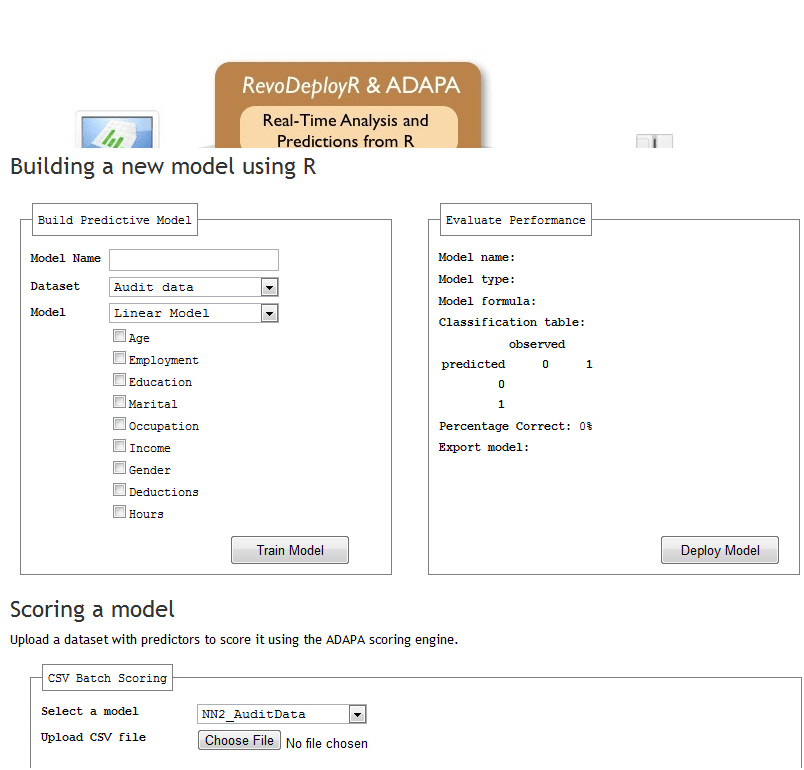
RevoConnectR for JasperReports Server RevoConnectR for JasperReports Server is a Java library interface between JasperReports Server and Revolution R Enterprise’s RevoDeployR, a standardized collection of web services that integrates security, APIs, scripts and libraries for R into a single server. JasperReports Server dashboards can retrieve R charts and result sets from RevoDeployR.
http://jasperforge.org/plugins/esp_frs/optional_download.php?group_id=409
R and BI – Integrating R with Open Source Business
Intelligence Platforms Pentaho and Jaspersoft
David Reinke, Steve Miller
Keywords: business intelligence
Increasingly, R is becoming the tool of choice for statistical analysis, optimization, machine learning and
visualization in the business world. This trend will only escalate as more R analysts transition to business
from academia. But whereas in academia R is often the central tool for analytics, in business R must coexist
with and enhance mainstream business intelligence (BI) technologies. A modern BI portfolio already includes
relational databeses, data integration (extract, transform, load – ETL), query and reporting, online analytical
processing (OLAP), dashboards, and advanced visualization. The opportunity to extend traditional BI with
R analytics revolves on the introduction of advanced statistical modeling and visualizations native to R. The
challenge is to seamlessly integrate R capabilities within the existing BI space. This presentation will explain
and demo an initial approach to integrating R with two comprehensive open source BI (OSBI) platforms –
Pentaho and Jaspersoft. Our efforts will be successful if we stimulate additional progress, transparency and
innovation by combining the R and BI worlds.
The demonstration will show how we integrated the OSBI platforms with R through use of RServe and
its Java API. The BI platforms provide an end user web application which include application security,
data provisioning and BI functionality. Our integration will demonstrate a process by which BI components
can be created that prompt the user for parameters, acquire data from a relational database and pass into
RServer, invoke R commands for processing, and display the resulting R generated statistics and/or graphs
within the BI platform. Discussion will include concepts related to creating a reusable java class library of
commonly used processes to speed additional development.
If you know Java- try http://ramanareddyg.blog.com/2010/07/03/integrating-r-and-pentaho-data-integration/
and I like this list by two venerable powerhouses of the BI Open Source Movement
http://www.openbi.com/demosarticles.html
Open Source BI as disruptive technology
http://www.openbi.biz/articles/osbi_disruption_openbi.pdf
Open Source Punditry
| TITLE | AUTHOR | COMMENTS |
|---|---|---|
| Commercial Open Source BI Redux | Dave Reinke & Steve Miller | An review and update on the predictions made in our 2007 article focused on the current state of the commercial open source BI market. Also included is a brief analysis of potential options for commercial open source business models and our take on their applicability. |
| Open Source BI as Disruptive Technology | Dave Reinke & Steve Miller | Reprint of May 2007 DM Review article explaining how and why Commercial Open Source BI (COSBI) will disrupt the traditional proprietary market. |
Spotlight on R
| TITLE | AUTHOR | COMMENTS |
|---|---|---|
| R You Ready for Open Source Statistics? | Steve Miller | R has become the “lingua franca” for academic statistical analysis and modeling, and is now rapidly gaining exposure in the commercial world. Steve examines the R technology and community and its relevancy to mainstream BI. |
| R and BI (Part 1): Data Analysis with R | Steve Miller | An introduction to R and its myriad statistical graphing techniques. |
| R and BI (Part 2): A Statistical Look at Detail Data | Steve Miller | The usage of R’s graphical building blocks – dotplots, stripplots and xyplots – to create dashboards which require little ink yet tell a big story. |
| R and BI (Part 3): The Grooming of Box and Whiskers | Steve Miller | Boxplots and variants (e.g. Violin Plot) are explored as an essential graphical technique to summarize data distributions by categories and dimensions of other attributes. |
| R and BI (Part 4): Embellishing Graphs | Steve Miller | Lattices and logarithmic data transformations are used to illuminate data density and distribution and find patterns otherwise missed using classic charting techniques. |
| R and BI (Part 5): Predictive Modelling | Steve Miller | An introduction to basic predictive modelling terminology and techniques with graphical examples created using R. |
| R and BI (Part 6) : Re-expressing Data |
Steve Miller | How do you deal with highly skewed data distributions? Standard charting techniques on this “deviant” data often fail to illuminate relationships. This article explains techniques to re-express skewed data so that it is more understandable. |
| The Stock Market, 2007 | Steve Miller | R-based dashboards are presented to demonstrate the return performance of various asset classes during 2007. |
| Bootstrapping for Portfolio Returns: The Practice of Statistical Analysis | Steve Miller | Steve uses the R open source stats package and Monte Carlo simulations to examine alternative investment portfolio returns…a good example of applied statistics using R. |
| Statistical Graphs for Portfolio Returns | Steve Miller | Steve uses the R open source stats package to analyze market returns by asset class with some very provocative embedded trellis charts. |
| Frank Harrell, Iowa State and useR!2007 | Steve Miller | In August, Steve attended the 2007 Internation R User conference (useR!2007). This article details his experiences, including his meeting with long-time R community expert, Frank Harrell. |
| An Open Source Statistical “Dashboard” for Investment Performance | Steve Miller | The newly launched Dashboard Insight web site is focused on the most useful of BI tools: dashboards. With this article discussing the use of R and trellis graphics, OpenBI brings the realm of open source to this forum. |
| Unsexy Graphics for Business Intelligence | Steve Miller | Utilizing Tufte’s philosophy of maximizing the data to ink ratio of graphics, Steve demonstrates the value in dot plot diagramming. The R open source statistical/analytics software is showcased. |
- brew: Creating Repetitive Reports
 brew: Templating Framework for Report Generation

brew implements a templating framework for mixing text and R code for report generation. brew template syntax is similar to PHP, Ruby's erb module, Java Server Pages, and Python's psp module. http://bit.ly/jINmaI
- Yarr- creating reports in R
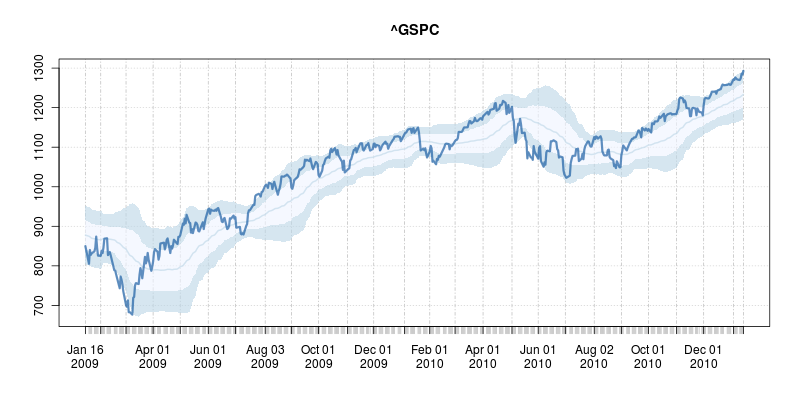
- the formidable Dirk with awesome stock reports
http://dirk.eddelbuettel.com/blog/2011/01/16/#overbought_oversold_plot
Related articles
- Jaspersoft 4.1 launched (decisionstats.com)
- rstat.us – a rival to Twitter? (i-programmer.info)




 DECISION STATS