I was searching for a Linux install of Revolution’s latest enterprise version, but it seems version 4 will be available on Red Hat Enterprise Linux only by Decemebr 2010. Also even though Revolution once opted for co branding with Canonical’s Karmic Koala, they seem to have ignored Ubuntu from the Enterprise version of Revolution R.
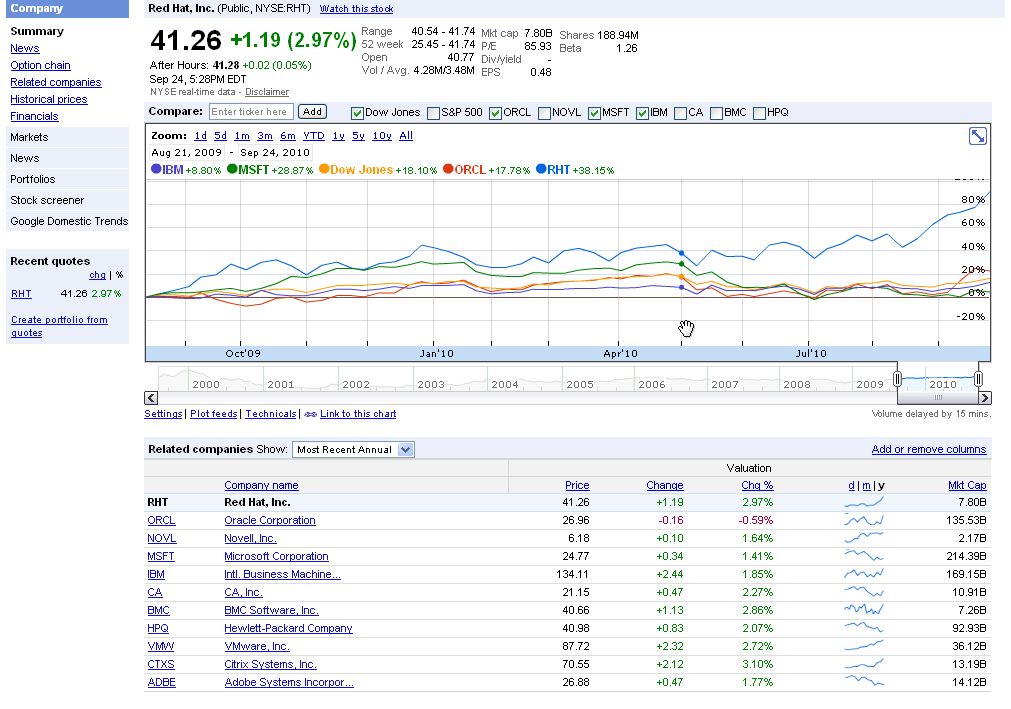
Revenue of $220 million, up 20% from the prior year
GAAP operating income up 24%, non-GAAP operating income up 25% from the prior year
Deferred revenue of $650 million, up 12% from the prior year
RALEIGH, NC – Sept 22, 2010 – Red Hat, Inc. (NYSE: RHT), the world’s leading provider of open source solutions, today announced financial results for its fiscal year 2011 second quarter ended August 31, 2010.
Total revenue for the quarter was $219.8 million, an increase of 20% from the year ago quarter. Subscription revenue for the quarter was $186.2 million, up 19% year-over-year.
His argument of love is not very original though it was first made by these four guys
I am going to argue that “some” R developers should be paid, while the main focus should be volunteers code. These R developers should be paid as per usage of their packages.
Let me expand.
Imagine the following conversation between Ross Ihaka, Norman Nie and Peter Dalgaard.
Norman- Hey Guys, Can you give me some code- I got this new startup.
Ross Ihaka and Peter Dalgaard- Sure dude. Here is 100,000 lines of code, 2000 packages and 2 decades of effort.
Norman- Thanks guys.
Ross Ihaka- Hey, What you gonna do with this code.
Norman- I will better it. Sell it. Finally beat Jim Goodnight and his **** Proc GLM and **** Proc Reg.
Ross- Okay, but what will you give us? Will you give us some code back of what you improve?
Norman – Uh, let me explain this open core …
Peter D- Well how about some royalty?
Norman- Sure, we will throw parties at all conferences, snacks you know at user groups.
Ross – Hmm. That does not sound fair. (walks away in a huff muttering)-He takes our code, sells it and wont share the code
Peter D- Doesnt sound fair. I am back to reading Hamlet, the great Dane, and writing the next edition of my book. I am glad I wrote a book- Ross didnt even write that.
Norman-Uh Oh. (picks his phone)- Hey David Smith, We need to write some blog articles pronto – these open source guys ,man…
———–I think that sums what has been going on in the dynamics of R recently. If Ross Ihaka and R Gentleman had adopted an open core strategy- meaning you can create packages to R but not share the original where would we all be?
At this point if he is reading this, David Smith , long suffering veteran of open source flameouts is rolling his eyes while Tal G is wondering if he will publish this on R Bloggers and if so when or something.
Lets bring in another R veteran- Hadley Wickham who wrote a book on R and also created ggplot. Thats the best quality, most often used graphics package.
In terms of economic utilty to end user- the ggplot package may be as useful if not more as the foreach package developed by Revolution Computing/Analytics.
However lets come to open core licensing ( read it here http://alampitt.typepad.com/lampitt_or_leave_it/2008/08/open-core-licen.html ) which is where the debate is- Revolution takes code- enhances it (in my opinion) substantially with new formats XDF for better efficieny, web services API, and soon coming next year a GUI (thanks in advance , Dr Nie and guys)
and sells this advanced R code to businesses happy to pay ( they are currently paying much more to DR Goodnight and HIS guys)
Why would any sane customer buy it from Revolution- if he could download exactly the same thing from http://r-project.org
Hence the business need for Revolution Analytics to have an enhanced R- as they are using a product based software model not software as a service model.
If Revolution gives away source code of these new enhanced codes to R core team- how will R core team protect the above mentioned intelectual property- given they have 2 decades experience of giving away free code , and back and forth on just code.
Now Revolution also has a marketing budget- and thats how they sponsor some R Core events, conferences, after conference snacks.
How would people decide if they are being too generous or too stingy in their contribution (compared to the formidable generosity of SAS Institute to its employees, stakeholders and even third party analysts).
Would it not be better- IF Revolution can shift that aspect of relationship to its Research and Development budget than it’s marketing budget- come with some sort of incentive for “SOME” developers – even researchers need grants and assistantships, scholarships, make a transparent royalty formula say 17.5 % of the NEW R sales goes to R PACKAGE Developers pool, which in turn examines usage rate of packages and need/merit before allocation- that would require Revolution to evolve from a startup to a more sophisticated corporate and R Core can use this the same way as John M Chambers software award/scholarship
Dont pay all developers- it would be an insult to many of them – say Prof Harrell creator of HMisc to accept – but can Revolution expand its dev base (and prospect for future employees) by even sponsoring some R Scholarships.
And I am sure that if Revolution opens up some more code to the community- they would the rest of the world and it’s help useful. If it cant trust people like R Gentleman with some source code – well he is a board member.
——————————————————————————————–
Now to sum up some technical discussions on NeW R
1) An accepted way of benchmarking efficiencies.
2) Code review and incorporation of efficiencies.
3) Multi threading- Multi core usage are trends to be incorporated.
4) GUIs like R Commander E Plugins for other packages, and Rattle for Data Mining to have focussed (or Deducer). This may involve hiring User Interface Designers (like from Apple 😉 who will work for love AND money ( Even the Beatles charge royalty for that song)
5) More support to cloud computing initiatives like Biocep and Elastic R – or Amazon AMI for using cloud computers- note efficiency arguements dont matter if you just use a Chrome Browser and pay 2 cents a hour for an Amazon Instance. Probably R core needs more direct involvement of Google (Cloud OS makers) and Amazon as well as even Salesforce.com (for creating Force.com Apps). Note even more corporates here need to be involved as cloud computing doesnot have any free and open source infrastructure (YET)
“If something goes wrong with Microsoft, I can phone Microsoft up and have it fixed. With Open Source, I have to rely on the community.”
And the community, as much as we may love it, is unpredictable. It might care about your problem and want to fix it, then again, it may not. Anyone who has ever witnessed something online go “viral”, good or bad, will know what I’m talking about.
present research that demonstrates the joint evolution of computational and statistical methods and techniques. Implementations can use languages such as C, C++, S, Fortran, Java, PHP, Python and Ruby or environments such as Mathematica, MATLAB, R, S-PLUS, SAS, Stata, and XLISP-STAT.
There are currently 370 articles, 23 code snippets, 86 book reviews, 4 software reviews, and 7 special volumes in archives
Pharmaceutical Programming is the official journal of the Pharmaceutical Users Software Exchange (PhUSE), a non-profit membership society with the objective of educating programmers and their managers working in the pharmaceutical industry. Available both in print and online, Pharmaceutical Programming is an international journal with focus on programming in the regulated environment of the pharmaceutical and life sciences industry.
John Ball brings 20 years of experience in enterprise software, deep expertise in business intelligence and CRM applications, and a proven track record of success driving rapid growth at highly innovative companies.
Prior to joining KXEN, Mr. Ball served in several executive roles at salesforce.com, the leading provider of SaaS applications. Most recently, John served as VP & General Manager, Analytics and Reporting Products, where he spearheaded salesforce.com’s foray into CRM analytics and business intelligence. John also served as VP & General Manager, Service and Support Applications at salesforce.com, where he successfully grew the business to become the second largest and fastest growing product line at salesforce.com. Before salesforce.com, Ball was founder and CEO of Netonomy, the leading provider of customer self-service solutions for the telecommunications industry. Ball also held a number of executive roles at Business Objects, including General Manager, Web Products, where delivered to market the first 3 versions of WebIntelligence. Ball has a master’s degree in electrical engineering from Georgia Tech and a master’s degree in electric
I hope John atleast helps build a KXEN Force.com application- there are only 2 data mining apps there on App Exchange. Also on the wish list more social media presence, a Web SaaS/Amazon API for KXEN, greater presence in American/Asian conferences, and a solution for SME’s (which cannot afford the premium pricing of the flagship solution. An alliance with bigger BI vendors like Oracle, SAP or IBM for selling the great social network analysis.
Bill Russell as Non Executive Chairman-
Bill Russell as Non-executive Chairman of the Board, effective July 16 2010. Russell has 30 years of operational experience in enterprise software, with a special focus on business intelligence, analytics, and databases.Russell held a number of senior-level positions in his more than 20 years at Hewlett-Packard, including Vice President and General Manager of the multi-billion dollar Enterprise Systems Group. He has served as Non-executive Chairman of the Board for Sylantro Systems Corporation, webMethods Inc., and Network Physics, Inc. and has served as a board director for Cognos Inc. In addition to KXEN, Russell currently serves on the boards of Saba, PROS Holdings Inc., Global 360, ParAccel Inc., and B.T. Mancini Company.
Xavier Haffreingue as senior vice president, worldwide professional services and solutions.
He has almost 20 years of international enterprise software experience gained in the CRM, BI, Web and database sectors. Haffreingue joins KXEN from software provider Axway where he was VP global support operations. Prior to Axway, he held various leadership roles in the software industry, including VP self service solutions at Comverse Technologies and VP professional services and support at Netonomy, where he successfully delivered multi-million dollar projects across Europe, Asia-Pacific and Africa. Before that he was with Business Objects and Sybase, where he ran support and services in southern Europe managing over 2,500 customers in more than 20 countries.
David Guercio as senior vice president, Americas field operations. Guercio brings to the role more than 25 years experience of building and managing high-achieving sales teams in the data mining, business intelligence and CRM markets. Guercio comes to KXEN from product lifecycle management vendor Centric Software, where he was EVP sales and client services. Prior to Centric, he was SVP worldwide sales and client services at Inxight Software, where he was also Chairman and CEO of the company’s Federal Systems Group, a subsidiary of Inxight that saw success in the US Federal Government intelligence market. The success in sales growth and penetration into the federal government led to the acquisition of Inxight by Business Objects in 2007, where Guercio then led the Inxight sales organization until Business Objects was acquired by SAP. Guercio was also a key member of the management team and a co-founder at Neovista, an early pioneer in data mining and predictive analytics. Additionally, he held the positions of director of sales and VP of professional services at Metaphor Computer Systems, one of the first data extraction solutions companies, which was acquired by IBM. During his career, Guercio also held executive positions at Resonate and SiGen.
3) Venture Capital funding to fund expansion-
It has closed $8 million in series D funding to further accelerate its growth and international expansion. The round was led by NextStage and included participation from existing investors XAnge Capital, Sofinnova Ventures, Saints Capital and Motorola Ventures.
This was done after John Ball had joined as CEO.
4) Continued kudos from analysts and customers for it’s technical excellence.
KXEN was named a leader in predictive analytics and data mining by Forrester Research (1) and was rated highest for commercial deployments of social network analytics by Frost & Sullivan (2)
Also it became an alliance partner of Accenture- which is also a prominent SAS partner as well.
In Database Optimization-
In KXEN V5.1, a new data manipulation module (ADM) is provided in conjunction with scoring to optimize database workloads and provide full in-database model deployment. Some leading data mining vendors are only now beginning to offer this kind of functionality, and then with only one or two selected databases, giving KXEN a more than five-year head start. Some other vendors are only offering generic SQL generation, not optimized for each database, and do not provide the wealth of possible outputs for their scoring equations: For example, real operational applications require not only to generate scores, but decision probabilities, error bars, individual input contributions – used to derive reasons of decision and more, which are available in KXEN in-database scoring modules.
Since 2005, KXEN has leveraged databases as the data manipulation engine for analytical dataset generation. In 2008, the ADM (Analytical Data Management) module delivered a major enhancement by providing a very easy to use data manipulation environment with unmatched productivity and efficiency. ADM works as a generator of optimized database-specific SQL code and comes with an integrated layer for the management of meta-data for analytics.
KXEN Modeling Factory (KMF) has been designed to automate the development and maintenance of predictive analytics-intensive systems, especially systems that include large numbers of models, vast amounts of data or require frequent model refreshes. Information about each project and model is monitored and disseminated to ensure complete management and oversight and to facilitate continual improvement in business performance.
Main Functions
Schedule
: creation of the Analytic Data Set (ADS), setup of how and when to score, setup of when and how to perform model retraining and refreshes …
Report: Monitormodel execution over time, Track changes in model quality over time, see how useful one variable is by considering its multiple instance in models …
Notification: Rather than having to wade through pages of event logs, KMF Department allows users to manage by exception through notifications.
Thats all for the KXEN update- all the best to the new management team and a splendid job done by Roger Haddad in creating what is France and Europe’s best known data mining company.
Caffeine expands on BigTable to create a kind of database programming model that lets the company make changes to its web index without rebuilding the entire index from scratch. “[Caffeine] is a database-driven, Big Table–variety indexing system,” Lipkovitz tells The Reg, saying that Google will soon publish a paper discussing the system. The paper, he says, will be delivered next month at the USENIX Symposium on Operating Systems Design and Implementation (OSDI).
and interestingly
MapReduce, he says, isn’t suited to calculations that need to occur in near real-time.
MapReduce is a sequence of batch operations, and generally, Lipkovits explains, you can’t start your next phase of operations until you finish the first. It suffers from “stragglers,” he says. If you want to build a system that’s based on series of map-reduces, there’s a certain probability that something will go wrong, and this gets larger as you increase the number of operations. “You can’t do anything that takes a relatively short amount of time,” Lipkovitz says, “so we got rid of it.”
With Caffeine, Google can update its index by making direct changes to the web map already stored in BigTable. This includes a kind of framework that sits atop BigTable, and Lipkovitz compares it to old-school database programming and the use of “database triggers.”
but most importantly
In 2004, Google published research papers on GFS and MapReduce that became the basis for the open source Hadoop platform now used by Yahoo!, Facebook, and — yes — Microsoft. But as Google moves beyond GFS and MapReduce, Lipokovitz stresses that he is “not claiming that the rest of the world is behind us.”
But oh no!
“We’re in business of making searches useful,” he says. “We’re not in the business of selling infrastructure
But I say why not- Search is good and advertising is okay
There is more (not evil) money in infrastructure (of big data) as there is in advertising. But the advertising guys disagree
Basically it uses a peer to peer network to connect to the internet and you can reset the connection as you want-so it hides your IP address.
Also useful for sending hatemail- limitation uses Firefox browser only.And also your webpage default keeps changing languages as the ip address changes.
Note-
The Tor Project is a 501(c)(3) non-profit based in the United States. The official address of the organization is:
The Tor Project
969 Main Street, Suite 206
Walpole, MA 02081 USA
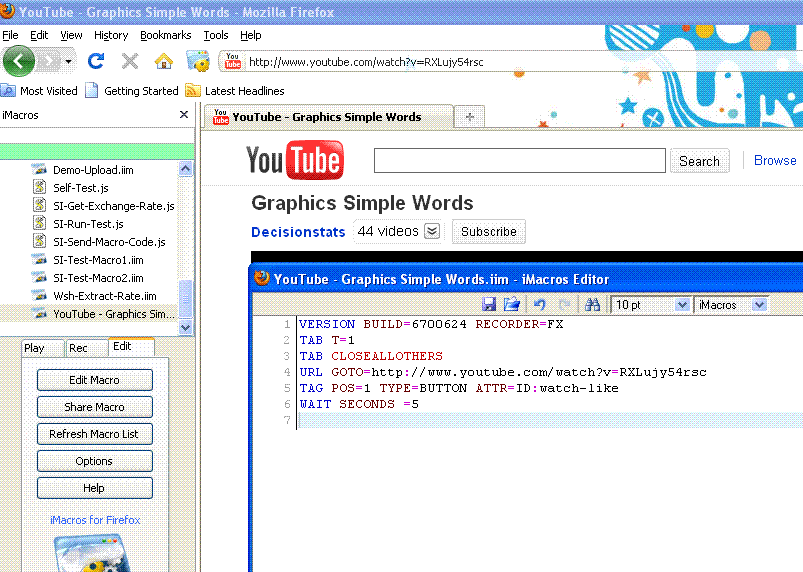
Remember when you could create an Excel Macro by just recording the Macro (in Excel 2003)
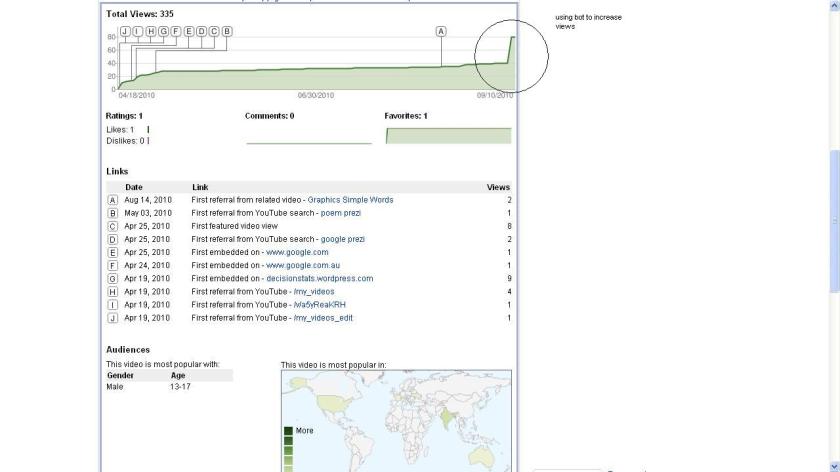
So while surfing if you need to do something again and again (like go the same Youtube video and clicking Like 5000 times) you can press record Macro
Do the action you want repeated again and again.
Click save Macro
Now run the Macro in a loop using the iMacro extension.
see screenshot below-
Note I have added two lines of code -WAIT SECONDS= 6
This means everytime the code runs in a loop it will wait for 6 seconds and then reload.
However I recommend you create a random number of wait seconds using Google Spreadsheet and the function RANDBETWEEN(5,400) (to limit between 5 and 400 seconds) and also use CONCATENATE with click and drag to create RANDOM wait times (instead of typing it say 500 times yourself)
AsterData formally marked phase 2 of it’s rapid growth story by getting as new CEO Quentin Gallivan (of Postini before it was sold to Google and also Pivotlink).
Founders (and Stanfordians) Mayan Bawa stays as Chief Customer Officer and Tasso Argyros as CTO. It has a very deja vu feel -like Eric Schmidt coming in CEO of Google in the glory days past. Indeed the investment team in Google and AsterData is quite similar and so are the backgrounds of the founders.
AsterData of course creates the leading MapReduce (also created by Google) solution for providing BI infrastructure for big data and has been rapidly been expanding into new frontiers for Big Data.
Aster Data Appoints New Chief Executive Officer
Quentin Gallivan Joins Aster Data as CEO to Lead Company to Next Level of Growth
San Carlos, CA – September 9, 2010– Aster Data, a proven leader dedicated to providing the best data management and data processing platform for big data management and analytics, today announced the appointment of Quentin Gallivan as President and CEO. Gallivan brings more than 20 years of senior executive experience to the leading analytics and database company. With Aster Data achieving tremendous growth in the past year, Gallivan will take Aster Data to the next level, further accelerating its market leadership, sales, channel partnerships and international expansion. Founding CEO Mayank Bawa, who grew the company from its inception based on the founders’ research at Stanford University, and whose passion for helping customers uniquely unlock the value of their data, will take on the role of Chief Customer Officer. Bawa, in his new role, will lead the Company’s organization devoted to ensuring the success, longevity and innovation of its fast-growing customer base. Together, Gallivan and Bawa, along with co-founder and Chief Technology Officer, Tasso Argyros, will deliver on the the Company’s mission to help customers discover more value from their data, achieve deep insights through rich analytics and do more with their massive data volumes than has ever been possible.
Gallivan joins Aster Data with over 20 years of leadership experience in the high-tech industry and has held a variety of CEO and senior executive positions with leading technology companies. Before joining Aster Data, Gallivan served as CEO at PivotLink, the leading provider of business intelligence (BI) solutions delivered via Software as a Service (SaaS), where he rapidly grew the company to over 15,000 business users, from mid-sized companies to Fortune 1000 companies, across key industries including financial services, retail, CPG manufacturing and high technology. Prior to Pivotlink, Gallivan served as CEO of Postini where he scaled the company to 35,000 customers and over 10 million users until its eventual acquisition by Google in 2007. Gallivan also served as executive vice president of worldwide sales and services at VeriSign where he was instrumental in growing the business from $20 million to $1.2 billion and was responsible for the design and execution of the global distribution strategy for the company’s security and services business. Gallivan also held a number of key executive and leadership positions at Netscape Communications and GE Information Services.
“We are delighted to have someone of Quentin’s caliber, who is a veteran of both emerging and established technology companies, lead Aster Data through our next stage of growth,” said Mayank Bawa, Chief Customer Officer and co-founder, Aster Data. “His significant experience around growing organizations and driving operational excellence will be invaluable as he takes Aster Data forward. I’m excited to shift my focus to customers and their success; to bring our innovations to our customers worldwide to help them unlock deep value from their growing data volumes.”
“I am very excited to be joining Aster Data and taking on the challenge of augmenting its already impressive level of growth and success. Aster Data is very well respected and established in the marketplace, has an enviable solution for big data management that uniquely addresses both big data storage and data processing, an impressive client list and a very talented team,” said Quentin Gallivan, President and CEO, Aster Data. “My task will be to leverage these assets, help shape a new market and provide operational guidance and strategic direction to drive even greater value for shareholders, customers and employees alike.”




 Journal
 John Ball