High Performance Analytics

Marry Big Data Analytics to High Performance Computing, and you get the buzzword of this season- High Performance Analytics.

It basically consists of Parallelized code to run in parallel on custom hardware, in -database analytics for speed, and cloud computing /high performance computing environments. On an operational level, it consists of software (as in analytics) partnering with software (as in databases, Map reduce, Hadoop) plus some hardware (HP or IBM mostly). It is considered a high margin , highly profitable, business with small number of deals compared to say desktop licenses.

As per HPC Wire- which is a great tool/newsletter to keep updated on HPC , SAS Institute has been busy on this front partnering with EMC Greenplum and TeraData (who also acquired  SAS Partner AsterData to gain a much needed foot in the MR/SQL space) Continue reading “High Performance Analytics”

Google unleashes Fusion Tables

I just discovered Fusion Tables. There is life beyond the amazing Jeff’s Amazon Ec2/s3 after all!

Check out http://www.google.com/fusiontables/public/tour/index.html

Gather, visualize and share data online

Don’t have a Google Account?
Create one now

  • Visualize and publish your data as maps, timelines and charts
  • Host your data tables online
  • Combine data from multiple people

data table turns into map

Google Fusion Tables is a modern data management and publishing web application that makes it easy
to host, manage, collaborate on, visualize, and publish data tables online.

What can I do with Google Fusion Tables?

Import your own data
Upload data tables from spreadsheets or CSV files, even KML. Developers can use the Fusion Tables API to insert, update, delete and query data programmatically. You can export your data as CSV or KML too.

Visualize it instantly
See the data on a map or as a chart immediately. Use filters for more selective visualizations.

Publish your visualization on other web properties
Now that you’ve got that nice map or chart of your data, you can embed it in a web page or blog post. Or send a link by email or IM. It will always display the latest data values from your table and helps you communicate your story more easily.

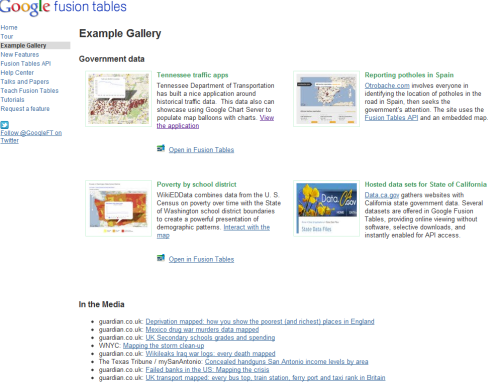
Look at the Fusion Tables Example Gallery

at https://sites.google.com/site/fusiontablestalks/stories

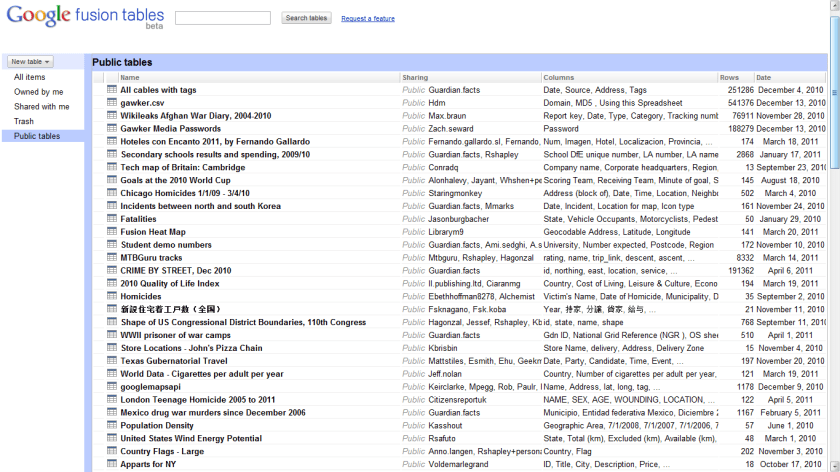
If you are worried about data.gov closing down, heres a snapshot of Fusion Table Public datasets.


Google creates a Code Jam

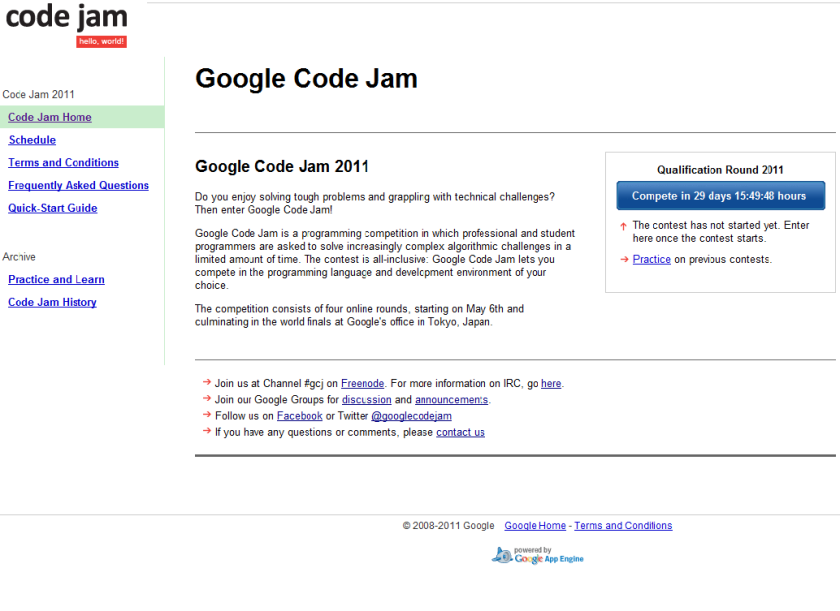
So you think you can code- here is a contest for All – programmers AND students AND professionals

Check the enthralling competition yourself at https://code.google.com/codejam

Rockmelt: A chromium based browser with a social layer

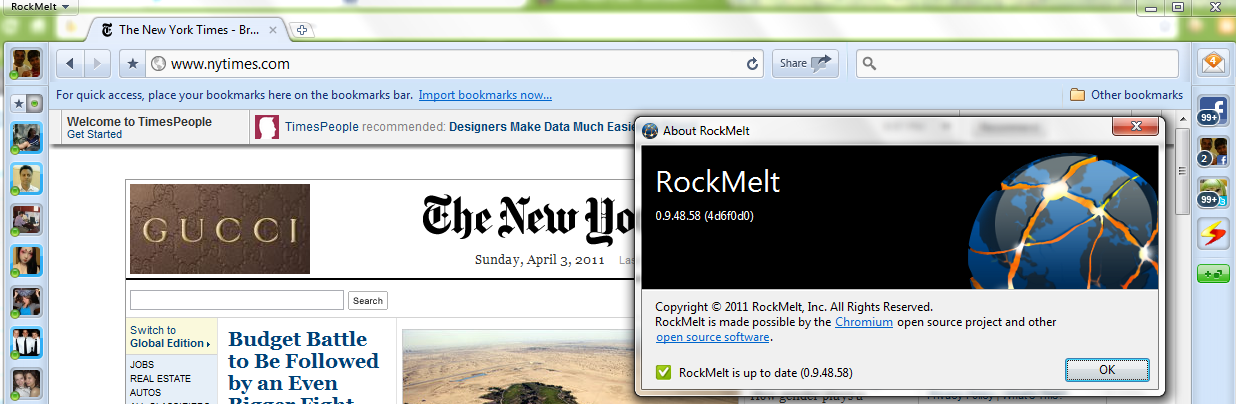
I kind of liked the latest browser on the block: Rockmelt.

It is based on Chromium open source project, that is primarily lead by Google. In case Facebook wants to buy a browser it can use Rockmelt–provided the mutual powers and angels agree.

I really liked the idea of a social layer- though I am not sure how the analytics embedded within a browser/report should be used.

Basically it re-designs the interface to put your social networks to the margin, thus quite a boon in you have active social media presence on multiple sites or a power reader/surfer. Timely alerts ping you to status/new messages without cluttering your screen and internet experience. Worth atleast a try or first look for the innovator kind of internet customer.

I still prefer the speed of Chrome– because Rockwell interface is still not easy to transition to – it almost adds in 3 dimensions in terms of where your eyeball should be while surfing (to left/right/margin).


and thats despite the funny fine print in Chrome’s user agreement of “continuing innovation”

type about:terms in your chrome bar to see-

4.3 As part of this continuing innovation, you acknowledge and agree that Google may stop (permanently or temporarily) providing the Services (or any features within the Services) to you or to users generally at Google’s sole discretion, without prior notice to you. You may stop using the Services at any time. You do not need to specifically inform Google when you stop using the Services.

Google Science Fair : Last three days left

Google is looking for the brightest, best young scientists from around the world to submit interesting, creative projects that are relevant to the world today

http://www.google.com/events/sciencefair/


Also read

Google Science Fair Blog


http://www.google.com/events/sciencefair/blog.html

Curiosity driven science
Wed, 30 Mar 2011 11:42:00 -0700
Editor’s note: We’ve invited guest blogger Rolf Heuer, Director General of CERN, the European Centre for Particle Physics – and one of the Google Science Fair finalist judges – to talk about how his passion for Science developed. To learn more about CERN’s big experiments check out our interview with physicist Tara Shears.

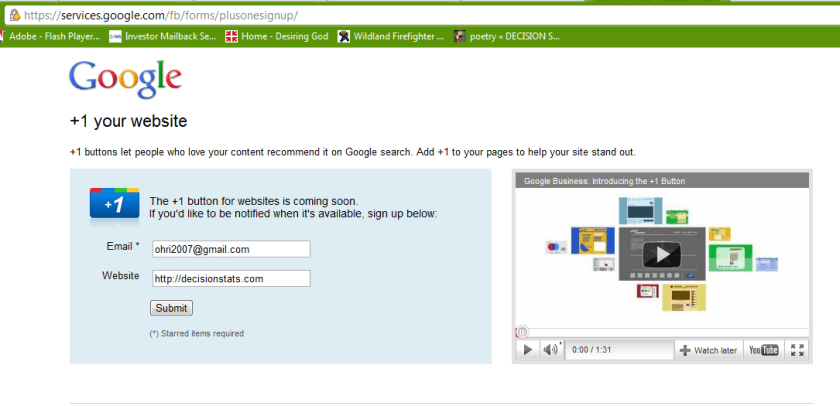
+ 1 your website -updated

how to add the all new plus one button to your own website

just go here.

submit form

wait

https://services.google.com/fb/forms/plusonesignup/

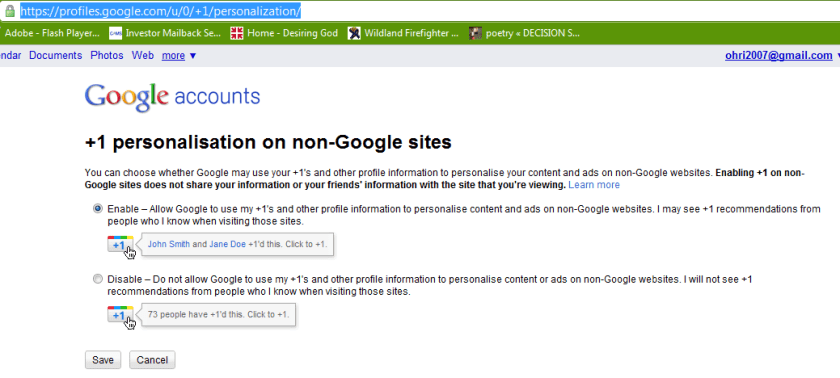
also see https://profiles.google.com/u/0/+1/personalization/

or read the hack here

http://www.yvoschaap.com/weblog/the_google_1_button_discovered

The buttons does exists because there is personalisation option available refering to non-Google sites.

Google claims the button is “coming soon” but I couldn’t wait, so I looked around the code, and looked some more, untill I found the button endpoint hiding from me, obfuscated, in a stray piece of javascript.

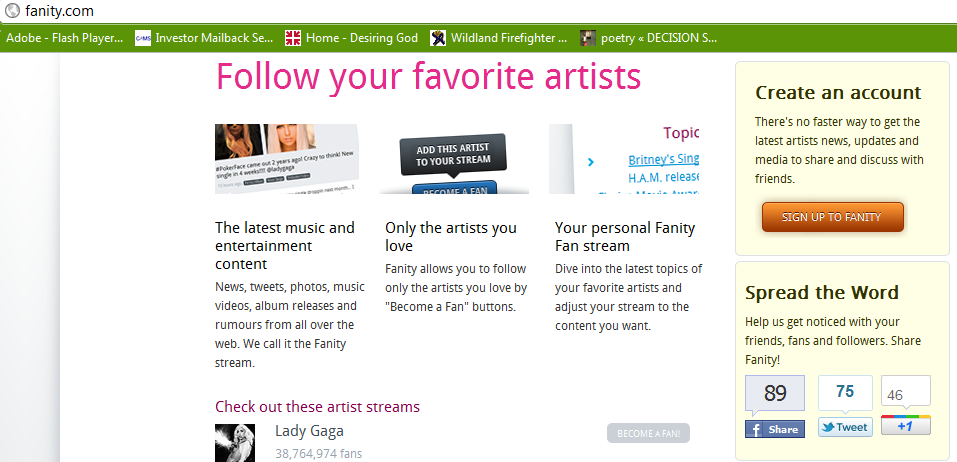
Check out these live Google +1 buttons:

at

http://fanity.com/


Libre Office turns six

On September 28th, 2010, The Document Foundation was announced. The last six months, it feels, have just passed within a short glimpse of time. Not only did we release three LibreOffice versions within three months, have created the LibreOffice-Box DVD image, and brought LibreOffice Portable on its way. We also have announced the LibreOffice Conference for October 2011 and have taken part in lots of events worldwide, with FOSDEM and CeBIT being the most prominent ones.

People follow us at Twitter, Identi.ca, XING, LinkedIn and a Facebook group and fan page, they discuss on our mailing lists with more than 6.000 subscriptions, collaborate in our wiki, get insight on our daily work in our blog, and post and blog themselves. From the very first day, openness, transparency and meritocracy have been shaping the framework we want to work in. Our discussions and decisions take place on a public mailing list, and regularly, we hold phone conferences for the Steering Committee and for the marketing teams, where everyone is invited to join. Our ideas and visions have made their way into our Next Decade Manifesto.

We have joined the Open Invention Network as well as the OpenDoc Society, and just last week have become an SPI-associated project, and we see a wide range of support from all over the world. Not only do Novell and Red Hat support our efforts with developers, but just recently, Canonical, creators of Ubuntu, joined as well. All major Linux distributions deliver LibreOffice with their operating systems, and more follow every day.

One of the most stunning contributions, that still leaves us speechless, is the support that we receive from the community. When we asked for 50,000 € capital stock for a German-based foundation, the community showed their support, appreciation and their power, and not only donated it in just eight days, but up to now has supported us with close to 100,000 €! Another one is that driven by our open, vendor neutral approach, combined with our easy hacks, we have included code contributions from over 150 entirely new developers to the project, alongside localisations from over 50 localizers. The community has developed itself better than we could ever dream of, and first meetings like the project’s weekend or the QA meeting of the Germanophone group are already being organized.

What we have seen now is just the beginning of something very big. The Document Foundation has a vision, and the creation of the foundation in Germany is about to happen soon. LibreOffice has been downloaded over 350,000 times within the first week, and we just counted more than 1,3 million downloads just from our download system — not counting packages directly delivered by Linux distributors, other download sites or DVDs included in magazines and newspapers — supported by 65 mirrors from all over the world, and millions already use and contribute to it worldwide. With our participation in the Google Summer of Code, we will engage more students and young developers to be part of our community. Our improved release schedule will ensure that new features and improvements will make their way to end-users soon, and for testers, we even provide daily builds.

We are so excited by what has been achieved over the last six months, and we are immensely grateful to all those who have supported the project in whatever ways they can. It is an honour to be working with you, to be part of one united community! The future as we are shaping it has just begun, and it will be bright and excellent.


from-

List archive: http://listarchives.documentfoundation.org/www/announce/