Google Storage for Developers goes into Enterprise Mode

Schematic representation of the SSL handshake ...
Image via Wikipedia

To help unify and uniform, collobrative work and data management and business models across the enterprise in secure SSL cloud environments- Google Storage has been rolling out some changes (read below)-this also gives you more options on the day Amazon goes ahem down (cough cough) because they didn’t think someone in their data environment could be sympathetic to free data.

——————————————————————————————————————————————————————–

https://groups.google.com/group/gs-announce

And now to the actual update.

We’re making some changes to Google Storage for Developers to make team-based development easier. As part of this work, we are introducing the concept of a project. In preparation for this feature, we will be creating projects for every user and migrating their buckets to it.

What does this mean for you?

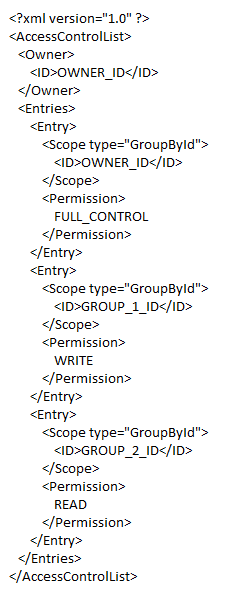
Everything will continue to work as it always has. However, you will notice that if you perform a get-acl operation on any of your buckets, you will see extra ACL entries. These entries correspond to project groups. Each group has only one member – the person who owned the buckets before the bucket migration;  no additional rights have been granted to any of your buckets or objects. You should preserve these new ACL grants if you modify bucket ACLs.

An example entry for a modified ACL would look like this:

We’ll be rolling out these changes over the next few days,

http://blog.cloudberrylab.com/2011/04/cloudberry-explorer-for-google-storage.html

Detailed Note on GS-

https://code.google.com/apis/storage/

Google Storage for Developers is a RESTful service for storing and accessing your data on Google’s infrastructure. The service combines the performance and scalability of Google’s cloud with advanced security and sharing capabilities. Highlights include:

Fast, scalable, highly available object store

  • All data replicated to multiple U.S. data centers
  • Read-your-writes data consistency
  • Objects of hundreds of gigabytes in size per request with range-get support
  • Domain-scoped bucket namespace

Easy, flexible authentication and sharing

  • Key-based authentication
  • Authenticated downloads from a web browser
  • Individual- and group-level access controls

In addition, Google Storage for Developers offers a web-based interface for managing your storage and GSUtil, an open source command line tool and library. The service is also compatible with many existing cloud storage tools and libraries. With pay-as-you-go pricing, it’s easy to get started and scale as your needs grow.

Google Storage for Developers is currently only available to a limited number of developers. Please sign up to join the waiting list.

AsterData still alive;/launches SQL-MapReduce Developer Portal

so apparantly ole client AsterData continues to thrive under gentle touch of Terrific Data

———————————————————————————————————————————————————

Aster Data today launched the SQL-MapReduce Developer Portal, a new online community for data scientists and analytic developers. For your convenience, I copied the release below and it can also be found here. Please let me know if you have any questions or if there is anything else I can help you with.

Sara Korolevich

Point Communications Group for Aster Data

sarak@pointcgroup.com

Office: 602.279.1137

Mobile: 623.326.0881

Teradata Accelerates Big Data Analytics with First Collaborative Community for SQL-MapReduce®

New online community for data scientists and analytic developers enables development and sharing of powerful MapReduce analytics


San Carlos, California – Teradata Corporation (NYSE:TDC) today announced the launch of the Aster Data SQL-MapReduce® Developer Portal. This portal is the first collaborative online developer community for SQL-MapReduce analytics, an emerging framework for processing non-relational data and ultra-fast analytics.

“Aster Data continues to deliver on its unique vision for powerful analytics with a rich set of tools to make development of those analytics quick and easy,” said Tasso Argyros, vice president of Aster Data Marketing and Product Management, Teradata Corporation. “This new developer portal builds on Aster Data’s continuing SQL-MapReduce innovation, leveraging the flexibility and power of SQL-MapReduce for analytics that were previously impossible or impractical.”

The developer portal showcases the power and flexibility of Aster Data’s SQL-MapReduce – which uniquely combines standard SQL with the popular MapReduce distributed computing technology for processing big data – by providing a collaborative community for sharing SQL-MapReduce expert insights in addition to sharing SQL-MapReduce analytic functions and sample code. Data scientists, quantitative analysts, and developers can now leverage the experience, knowledge, and best practices of a community of experts to easily harness the power of SQL-MapReduce for big data analytics.

A recent report from IDC Research, “Taking Care of Your Quants: Focusing Data Warehousing Resources on Quantitative Analysts Matters,” has shown that by enabling data scientists with the tools to harness emerging types and sources of data, companies create significant competitive advantage and become leaders in their respective industry.

“The biggest positive differences among leaders and the rest come from the introduction of new types of data,” says Dan Vesset, program vice president, Business Analytics Solutions, IDC Research. “This may include either new transactional data sources or new external data feeds of transactional or multi-structured interactional data — the latter may include click stream or other data that is a by-product of social networking.”

Vesset goes on to say, “Aster Data provides a comprehensive platform for analytics and their SQL-MapReduce Developer Portal provides a community for sharing best practices and functions which can have an even greater impact to an organization’s business.”

With this announcement Aster Data extends its industry leadership in delivering the most comprehensive analytic platform for big data analytics — not only capable of processing massive volumes of multi-structured data, but also providing an extensive set of tools and capabilities that make it simple to leverage the power of MapReduce analytics. The Aster Data

SQL-MapReduce Developer Portal brings the power of SQL-MapReduce accessible to data scientists, quantitative analysis, and analytic developers by making it easy to share and collaborate with experts in developing SQL-MapReduce analytics. This portal builds on Aster Data’s history of SQL-MapReduce innovations, including:

  • The first deep integration of SQL with MapReduce
  • The first MapReduce support for .NET
  • The first integrated development environment, Aster Data
    Developer Express
  • A comprehensive suite of analytic functions, Aster Data
    Analytic Foundation

Aster Data’s patent-pending SQL-MapReduce enables analytic applications and functions that can deliver faster, deeper insights on terabytes to petabytes of data. These applications are implemented using MapReduce but delivered through standard SQL and business intelligence (BI) tools.

SQL-MapReduce makes it possible for data scientists and developers to empower business analysts with the ability to make informed decisions, incorporating vast amounts of data, regardless of query complexity or data type. Aster Data customers are using SQL-MapReduce for rich analytics including analytic applications for social network analysis, digital marketing optimization, and on-the-fly fraud detection and prevention.

“Collaboration is at the core of our success as one of the leading providers, and pioneers of social software,” said Navdeep Alam, director of Data Architecture at Mzinga. “We are pleased to be one of the early members of The Aster Data SQL-MapReduce Developer Portal, which will allow us the ability to share and leverage insights with others in using big data analytics to attain a deeper understanding of customers’ behavior and create competitive advantage for our business.”

SQL-MapReduce is one of the core capabilities within Aster Data’s flagship product. Aster DatanCluster™ 4.6, the industry’s first massively parallel processing (MPP) analytic platform has an integrated analytics engine that stores and processes both relational and non-relational data at scale. With Aster Data’s unique analytics framework that supports both SQL and
SQL-MapReduce™, customers benefit from rich, new analytics on large data volumes with complex data types. Aster Data analytic functions are embedded within the analytic platform and processed locally with data, which allows for faster data exploration. The SQL-MapReduce framework provides scalable fault-tolerance for new analytics, providing users with superior reliability, regardless of number of users, query size, or data types.


About Aster Data
Aster Data is a market leader in big data analytics, enabling the powerful combination of cost-effective storage and ultra-fast analysis of new sources and types of data. The Aster Data nCluster analytic platform is a massively parallel software solution that embeds MapReduce analytic processing with data stores for deeper insights on new data sources and types to deliver new analytic capabilities with breakthrough performance and scalability. Aster Data’s solution utilizes Aster Data’s patent-pending SQL-MapReduce to parallelize processing of data and applications and deliver rich analytic insights at scale. Companies including Barnes & Noble, Intuit, LinkedIn, Akamai, and MySpace use Aster Data to deliver applications such as digital marketing optimization, social network and relationship analysis, and fraud detection and prevention.


About Teradata
Teradata is the world’s leader in data warehousing and integrated marketing management through itsdatabase softwaredata warehouse appliances, and enterprise analytics. For more information, visitteradata.com.

# # #

Teradata is a trademark or registered trademark of Teradata Corporation in the United States and other countries.

Lovely forecasting blog

Eight different random walks.
Image via Wikipedia

I really loved this simple, smart and yet elegant explanation of forecasting. even a high school quarterback could understand it, and maybe get a internship job building and running and re running code for Mars shot.

Despite my plea that you remain svelte in real life, I implore you to be naïve in business forecasting – and use a naïve forecasting model early and often. A naïve forecasting model is the most important model you will ever use in business forecasting.

and now the killer line

Purists may argue that the only true naïve forecast is the “no-change” forecast, meaning either a random walk (forecast = last known actual) or a seasonal random walk (e.g. forecast = actual from corresponding period last year). These are referred to as NF1 and NF2 in the Makridakis text (where NF = Naïve Forecast). In our 2006 SAS webseries Finding Flaws in Forecasting, an attendee asked “What about using a simple time series forecast with no intervention as the naïve forecast?” Is that allowed?

i did write a blog article on forecasting some time back, but back then I was a little blogger, with the website name being http://iwannacrib.com

great work in helping make forecasting easier to understand for people who have flower shops and dont have a bee, to help them with the forecasts, nor an geeky email list, not 4000$.

make it easier for the little guy to forecast his sales, so he cuts down on his supply chain inventory, lowering his carbon footprint.

Blog.sas.com take a bow, on labour day, helping workers with easy to understand models.

http://blogs.sas.com/forecasting/index.php?/archives/68-Which-Naive-Model-to-Use.html

Jump to JMP- the best statistical GUI software as per Google Search

This book just won an international award

producing graphs alongside results. In most cases, each page or two-page spread completes a JMP task, which maximizes the book’s utility as a reference.

Continue reading “Jump to JMP- the best statistical GUI software as per Google Search”

Worst Chart Ever- Confusing PIE chart as English Test

THE IELTS is used for testing non native speakers to test if they understand English properly.

Imagine many Indian and Chinese smart engineers answering this question.

From-

http://www.ielts-blog.com/recent-ielts-exams/ielts-test-in-the-uk-spain-march-2010-academic-module/

Writing test

Writing Task 1 (a report)
Three pie charts about young Australians secondary school leavers in years 1980, 1990 and 2000. Each pie showed the proportion of school leavers that continued studying, were employed or unemployed. Write a report to a university lecturer describing the pie charts below.
IELTS Academic Writing Task 1 Pie Charts

FlattR goes free for all bloggers

This is the Flattr right now
Image via Wikipedia

Email from people at FlattR. What is FlattR- social micropayments. like small Paypal button that gives a fraction of your monthly budget (say 2 euros) to people you retweet/like (called Flattered in this social media service).

Some angels are smiling over some bays , it seems. congrats FlattR and their team (which includes tech team of largest bit torrent search engine in the world). Apparently this was done in time for the royal wedding.

Important service announcement

Hello!

Flattr’s first year has been great. And not just for us but for tens of thousands of bloggers, podcasters, developers, designers and other creators out there. Just ask Tim. We’re now making an important change to the service, one which should open the floodgates of Flattr, if you will.
From May 1st we no longer require users to flattr others before they can be flattrd. Or in other words, it’s not mandatory to add money to your account to have an active Flattr button.

How does this affect you?

If you’re mainly using Flattr to make payments you will soon have much more content to flattr.If you’re using Flattr both to make and receive payments then you no longer need to check your balance at the end of each month to see whether your Flattr button is still active or not. It is and always will be.

If your Flattr button was once deactivated because balance dropped to zero, it is now active again. Forever.

This makes Flattr simpler

We have good reasons for making this change and we’ve just added a post about it on our blog. In a nutshell, we just didn’t need to force the give before you get principle onto people. During the the last year we’ve learned that people want to flattr the content they like and therefore we decided to drop any rules that made the service restrictive or outright complicated.We hope you’ll like the simpler more straightforward Flattr. If you have any comments, questions or feedback please get in touch via our blog or support page.

Linus, Peter and the rest of Flattr team

Analyzing Conversations on Twitter

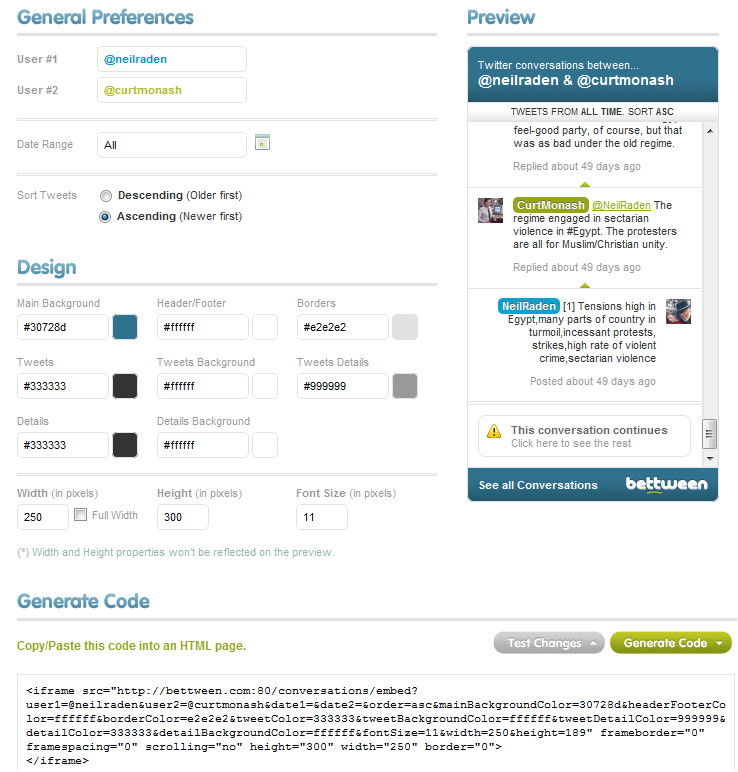
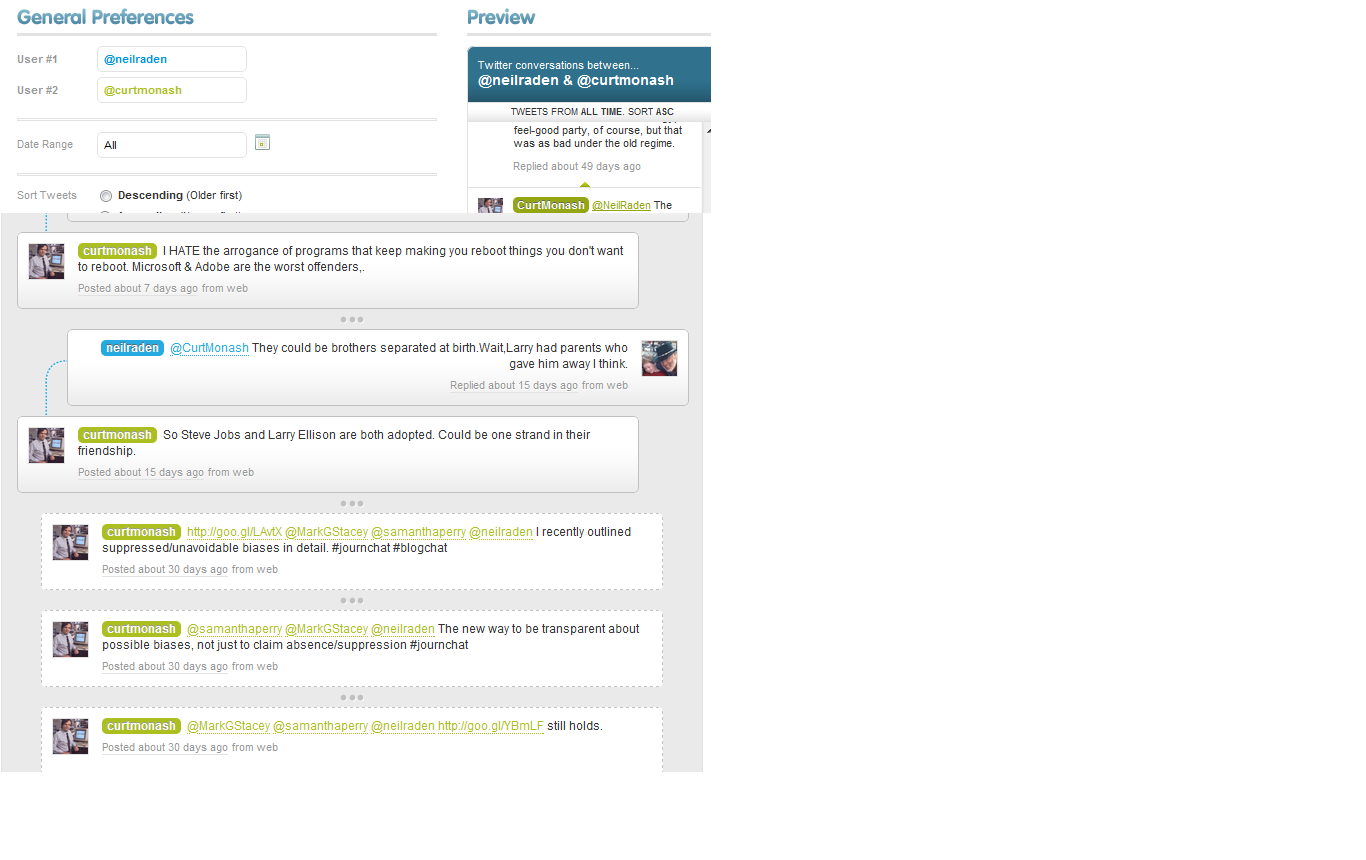
If you are a marketing , analyst relationship, public relationship or a product manager who uses or abuses social media, you sometimes need to track what influencers and analysts are saying. A tool called Bettween allows you to capture public conversations between two influential (or interesting) tweeps.

See conversations between Neil Raden http://www.beyeblogs.com/raden/ and Curt Monash http://www.dbms2.com/ two noted BI gurus

http://bettween.com/neilraden/curtmonash

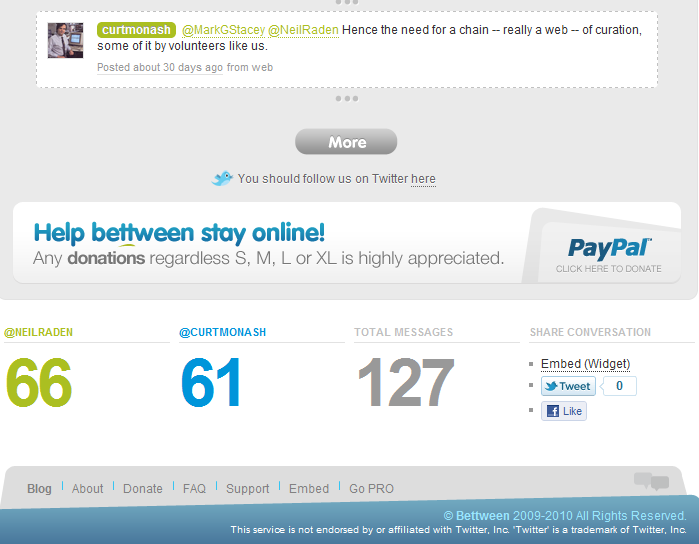
  • @NEILRADEN66
  • @CURTMONASH61
  • TOTAL MESSAGES127
  • SHARE CONVERSATION


unless Google decides to license its Wave technology to Twitter for separate encrypted , or public tweets. 🙂 They do share some history and employees (cough cough) or Twitter waits to create or better its public /protected tweet mode to be more granular

http://bettween.com/neilraden/curtmonash#statistics

tools to analyze Twitter conversations in SAS