 Probably the most colorful certificate ever!

Probably the most colorful certificate ever!
Google has a whole list of certifications for people wanting to be certified in analytics, and advertising related to internet.
Tired of everyone calling everyone else a social media expert. What seperates the social media men from the fakes.
the grain from the chaff.
Data.
Heres a webcast you may want to think of social media tickles your curiosity on how to leverage these strange new marketing tools.
https://cc.readytalk.com/cc/schedule/display.do?udc=xu40u1ex8tj8
Notice the form and fields below the screenshot-
is every field required – is each one required to measure
Have they optimized web registration forms yet.
Continue reading “How to Measure and Optimize Your Marketing:Tableau”

Just updated Decisionstats.com
Note the new D logo on top of web page.
Also redesigned the following pages-

1) removing duplicates from a dataset based on certain key values/variables
2) merging two datasets based on a common key/variable/s
3) creating a subset based on a conditional value of a variable
4) creating a subset based on a conditional value of a time-date variable
5) changing format from one date time variable to another
6) doing a means grouped or classified at a level of aggregation
7) creating a new variable based on if then condition
8) creating a macro to run same program with different parameters
9) creating a logistic regression model, scoring dataset,
10) transforming variables
11) checking roc curves of model
12) splitting a dataset for a random sample (repeatable with random seed)
13) creating a cross tab of all variables in a dataset with one response variable
14) creating bins or ranks from a certain variable value
15) graphically examine cross tabs
16) histograms
17) plot(density())
18)creating a pie chart
19) creating a line graph, creating a bar graph
20) creating a bubbles chart
21) running a goal seek kind of simulation/optimization
22) creating a tabular report for multiple metrics grouped for one time/variable
23) creating a basic time series forecast
and some case studies I could think of-
As the Director, Risk you have to examine the overdue mortgages book that your predecessor left you. You need to optimize collections and minimize fraud and write-offs, and your efforts would be measured in maximizing profits from your department.
As a social media consultant you have been asked to maximize social media analytics and social media exposure to your client. You need to create a mechanism to report particular brand keywords, as well as automated triggers between unusual web activity, and statistical analysis of the website analytics metrics. Above all it needs to be set up in an automated reporting dashboard .
As a consultant to a telecommunication company you are asked to monitor churn and review the existing churn models. Also you need to maximize advertising spend on various channels. The problem is there are a large number of promotions always going on, some of the data is either incorrectly coded or there are interaction effects between the various promotions.
As a modeller you need to do the following-
1) Check ROC and H-L curves for existing model
2) Divide dataset in random splits of 40:60
3) Create multiple aggregated variables from the basic variables
Occam’s razor (or Ockham’s razor[1]) is often expressed in Latin as the lex parsimoniae(translating to the law of parsimony, law of economy or law of succinctness). The principle is popularly summarized as “the simplest explanation is more likely the correct one.
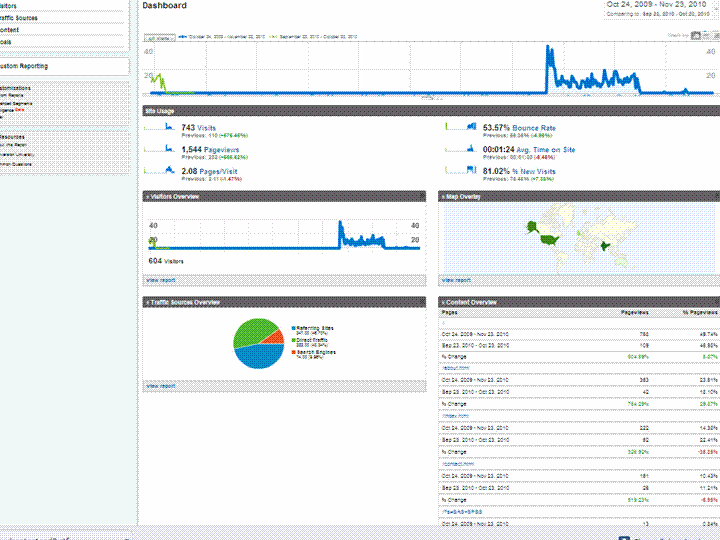
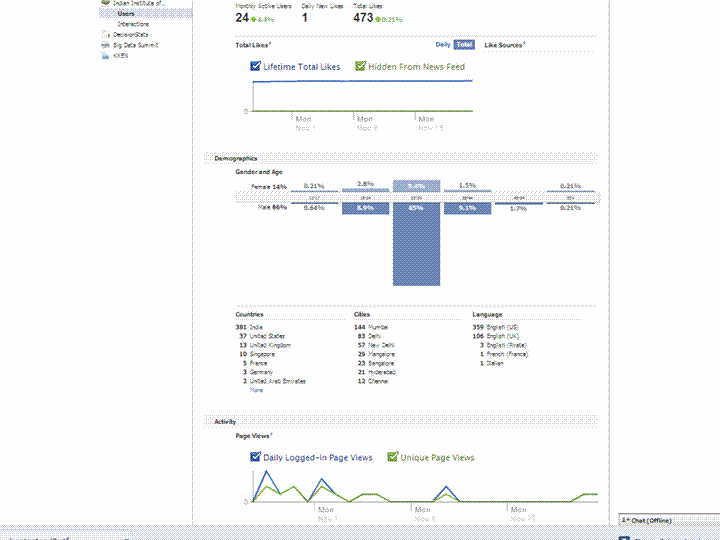
Using a simple screenshot- you can see Facebook Analytics for a Facebook page is simpler at explaining who is coming to visit rather than Google Analytics Dashboard (which has not seen the attention of a Visual UI or Graphic Redesign)
And if Facebook is going to take over the internet, well it is definitely giving better analytics in the process. What do you think?
Which Interface is simpler- and gives you better targeting. Ignore the numbers and just see the metrics measured and the way they are presented. Coincidently R is used at Facebook a lot (which has given the jjplot package)- and Google has NOT INVESTED MAJOR MONEY in creating Premium R Packages or Big Data Packages. I am talking investment at the scale Google is known for- not measly meetups.
(the summer of code dont count- it is for students mostly)
(but thanks for the Pizza G Men- and maybe revise that GA interface by putting a razor to some metrics)
GA vs Facebook Analytics

I had a brief twitter exchange with Jim Davis, Chief Marketing Officer, SAS Institute on Return of Investment on Business Analytics Projects for customers. I have interviewed Jim Davis before last year https://decisionstats.com/2009/06/05/interview-jim-davis-sas-institute/
Now Jim Davis is a big guy, and he is rushing from the launch of SAS Institute’s Social Media Analytics in Japan- to some arguably difficult flying conditions in time to be home in America for Thanksgiving. That and and I have not been much of a good Blog Boy recently, more swayed by love of open source, than love of software per se. I love equally, given I am bad at both equally.
Anyways, Jim’s contention ( http://twitter.com/Davis_Jim ) was customers should go in business analytics only if there is Positive Return on Investment. I am quoting him here-
What is important is that there be a positive ROI on each and every BA project. Otherwise don’t do it.
That’s not the marketing I was taught in my business school- basically it was sell, sell, sell.
However I see most BI sales vendors also go through -let me meet my sales quota for this quarter- and quantifying customer ROI is simple maths than predictive analytics but there seems to be some information assymetry in it.
Here is a paper from North Western University on ROI in IT projects-.
but overall it would be in the interest of customers and Business Analytics Vendors to publish aggregated ROI.
The opponents to this transparency in ROI would be market leaders in market share, who have trapped their customers by high migration costs (due to complexity) or contractually.
A recent study listed Oracle having a large percentage of unhappy customers who would still renew!, SAP had problems when it raised prices for licensing arbitrarily (that CEO is now CEO of HP and dodging legal notices from Oracle).
Indeed Jim Davis’s famous unsettling call for focusing on Business Analytics,as Business Intelligence is dead- that call has been implemented more aggressively by IBM in analytical acquisitions than even SAS itself which has been conservative about inorganic growth. Quantifying ROI, should theoretically aid open source software the most (since they are cheapest in up front licensing) or newer technologies like MapReduce /Hadoop (since they are quite so fast)- but I think that market has a way of factoring in these things- and customers are not as foolish neither as unaware of costs versus benefits of migration.
The contrary to this is Business Analytics and Business Intelligence are imperfect markets with duo-poly or big players thriving in absence of customer regulation.
You get more protection as a customer of $20 bag of potato chips, than as a customer of a $200,000 software. Regulators are wary to step in to ensure ROI fairness (since most bright techies are qither working for private sector, have their own startup or invested in startups)- who in Govt understands Analytics and Intelligence strong enough to ensure vendor lock-ins are not done, and market flexibility is done. It is also a lower choice for embattled regulators to ensure ROI on enterprise software unlike the aggressiveness they have showed in retail or online software.
Who will Analyze the Analysts and who can quantify the value of quants (or penalize them for shoddy quantitative analytics)- is an interesting phenomenon we expect to see more of.
 DECISION STATS