So which software is the best analytical software? Sigh- It depends


Graph of typical Operating System placement on...
Image via Wikipedia


Here is the software matrix that I am trying to develop for analytical software- It should help as a tentative guide for software purchases- it’s independent so unbiased (hopefully)- and it will try and bring as much range or sensitivity as possible. The list (rather than matrix) is of the format-

Type 0f analysis-

  • Data Visualization (Reporting with Pivot Ability to aggregate, disaggregate)
  • Reporting without Pivot Ability
  • Regression -Logistic Regression for Propensity or Risk Models
  • Regression- Linear for Pricing Models
  • Hypothesis Testing
  • A/B Scenario Testing
  • Decision Trees (CART, CHAID)
  • Time Series Forecasting
  • Association Analysis
  • Factor Analysis
  • Survey (Questionnaires)
  • Clustering
  • Segmentation
  • Data Manipulation

Dataset Size-

  • small dataset (upto X mb)
  • big dataset (upto Y gb)
  • enterprise class production BigData datasets (no limit)

Pricing of Software that can be used-

Ease of using Software

  • GUI vs Non GUI
  • Software that require not much extensive training
  • Software that require extensive training

Installation, Customization, Maintainability (or Support) for Software

  • Installation Dependencies- Size- Hardware (costs and  efficiencies)
  • Customization provided for specific use
  • Support Channels (including approximate Turn Around Time)

Software

  • Software I have used personally
  • SAS (Base, Stat,Enterprise,Connect,ETS) WPS KXEN SPSS (Base,Trends),Revolution R,R,Rapid Miner,Knime,JMP,SQL SERVER,Rattle, R Commander,Deducer
  • Software I know by reputation- SAS Enterprise Miner etc etc

Are there any other parameters for judging software?  let me know at http://twitter.com/decisionstats

LibreOffice Beta 2 (Office Fork off Oracle) launches!


Windows 7, the latest client version in the Mi...
Image via Wikipedia


Announcement from Code Ninjas at Document Foundation

10 years after the StarOffice code has been opened as OpenOffice.org, The Document Foundation is proud to announce the availability of LibreOffice Beta 2 for public testing. Please, download the suitable package(s) from

http://www.documentfoundation.org/download/


Ajay- Note that first beta was downloaded almost 100,000 times

install them, and start testing! Should you find bugs, please report them to the FreeDesktop Bugzilla:

https://bugs.freedesktop.org

If you want to get involved in this exciting project, you can contribute code:

http://www.documentfoundation.org/develop/

translate LibreOffice to your language:

http://www.freedesktop.org/wiki/Software/LibreOffice/i18n/translating_3.3

or just donate:

http://www.documentfoundation.org/contribution/
A list of known issues with Beta 2 is available in our wiki:

http://wiki.documentfoundation.org/Beta2

Beta Release Notes

This beta release is not intended for production use!

There are a number of known issues being worked on:

  • The Windows build is an International build – you can choose the user interface language that is suitable for you, but the help is always English. We are currently working on improving the delivery mechanism to be able to provide you with the localized help. We are also working on smaller problems like wrong description of several languages.
  • The Linux and MacOSX builds are English builds with the possibility to install language packs. Please browse the archives to get the langugage pack you need for your platform.
  • The LibreOffice branding and renaming is new and work in progress. You may still see old graphics, icons or websites. So please bear with us. This also applies to the BrOffice.org branding – applicable in Brazil.
  • Filters for the legacy StarOffice binary formats are missing.

I tested it- it seems okay enough. Once again Open Source tends to underplay expectations (when was the last time you saw that in enterprise software?)

Which software do we buy? -It depends

Software (novel)
Image via Wikipedia

Often I am asked by clients, friends and industry colleagues on the suitability or unsuitability of particular software for analytical needs.  My answer is mostly-

It depends on-

1) Cost of Type 1 error in purchase decision versus Type 2 error in Purchase Decision. (forgive me if I mix up Type 1 with Type 2 error- I do have some weird childhood learning disabilities which crop up now and then)

Here I define Type 1 error as paying more for a software when there were equivalent functionalities available at lower price, or buying components you do need , like SPSS Trends (when only SPSS Base is required) or SAS ETS, when only SAS/Stat would do.

The first kind is of course due to the presence of free tools with GUI like R, R Commander and Deducer (Rattle does have a 500$ commercial version).

The emergence of software vendors like WPS (for SAS language aficionados) which offer similar functionality as Base SAS, as well as the increasing convergence of business analytics (read predictive analytics), business intelligence (read reporting) has led to somewhat brand clutter in which all softwares promise to do everything at all different prices- though they all have specific strengths and weakness. To add to this, there are comparatively fewer business analytics independent analysts than say independent business intelligence analysts.

2) Type 2 Error- In this case the opportunity cost of delayed projects, business models , or lower accuracy – consequences of buying a lower priced software which had lesser functionality than you required.

To compound the magnitude of error 2, you are probably in some kind of vendor lock-in, your software budget is over because of buying too much or inappropriate software and hardware, and still you could do with some added help in business analytics. The fear of making a business critical error is a substantial reason why open source software have to work harder at proving them competent. This is because writing great software is not enough, we need great marketing to sell it, and great customer support to sustain it.

As Business Decisions are decisions made in the constraints of time, information and money- I will try to create a software purchase matrix based on my knowledge of known softwares (and unknown strengths and weakness), pricing (versus budgets), and ranges of data handling. I will add in basically an optimum approach based on known constraints, and add in flexibility for unknown operational constraints.

I will restrain this matrix to analytics software, though you could certainly extend it to other classes of enterprise software including big data databases, infrastructure and computing.

Noted Assumptions- 1) I am vendor neutral and do not suffer from subjective bias or affection for particular software (based on conferences, books, relationships,consulting etc)

2) All software have bugs so all need customer support.

3) All software have particular advantages , strengths and weakness in terms of functionality.

4) Cost includes total cost of ownership and opportunity cost of business analytics enabled decision.

5) All software marketing people will praise their own software- sometimes over-selling and mis-selling product bundles.

Software compared are SPSS, KXEN, R,SAS, WPS, Revolution R, SQL Server,  and various flavors and sub components within this. Optimized approach will include parallel programming, cloud computing, hardware costs, and dependent software costs.

To be continued-


Top ten RRReasons R is bad for you ?

This is the original symbol of the Perl progra...
Image via Wikipedia

R stands for programming language based out of www.r-project.org

R is bad for you because –

1) It is slower with bigger datasets than SPSS language and SAS language .If you use bigger datasets, then you should either consider more hardware , or try and wait for some of the ODBC connect packages.

2) It needs more time to learn than SAS language .Much more time to learn how to do much more.

3) R programmers are lesser paid than SAS programmers.They prefer it that way.It equates the satisfaction of creating a package in development with a world wide community with the satisfaction of using a package and earning much more money per hour.

4) It forces you to learn the exact details of what you are doing due to its object oriented structure. Thus you either get no answer or get an exact answer. Your customer pays you by the hour not by the correct answers.

5) You can not push a couple of buttons or refer to a list of top ten most commonly used commands to finish the project.

6) It is free. And open for all. It is socialism expressed in code. Some of the packages are built by university professors. It is free.Free is bad. Who pays for the mortgage of the software programmers if all softwares were free ? Who pays for the Friday picnics. Who pays for the Good Night cruises?

7) It is free. Your organization will not commend you for saving them money- they will question why you did not recommend this before. And why did you approve all those packages that expire in 2011.R is fReeeeee. Customers feel good while spending money.The more software budgets you approve the more your salary is. R thReatens all that.

8) It is impossible to install a package you do not need or want. There is no one calling you on the phone to consider one more package or solution. R can make you lonely.

9) R uses mostly Command line. Command line is from the Seventies. Or the Eighties. The GUI’s RCmdr and Rattle are there but still…..

10) R forces you to learn new stuff by the month. You prefer to only earn by the month. Till the day your job got offshored…

Written by a R user in English language

( which fortunately was not copyrighted otherwise we would be paying Britain for each word)

Ajay- The above post was reprinted by personal request. It was written on Jan 2009- and may not be truly valid now. It is meant to be taken in good humor-not so seriously.

BI Software

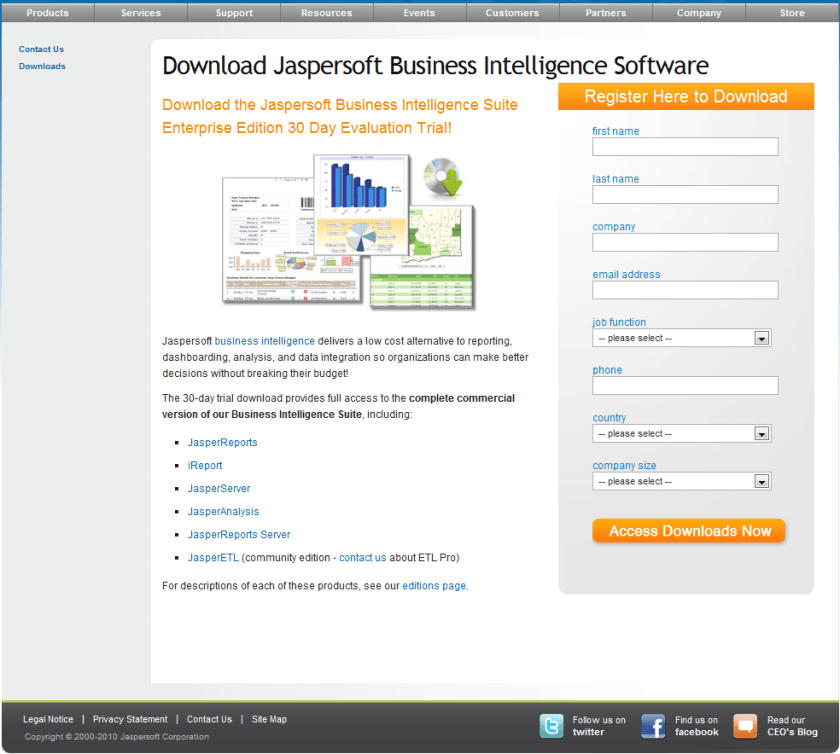
Here is the brand new release from Jaspersoft at a groovy price of 9000$. Somebody stop these guys!

It’s a great company to watch for buyouts as well- given their expertise in REPORTING and clientele- especially for anyone looking to im prove thier standing in both open source world and reporting software branding.

From AOL owned Arrogantion’s site http://www.crunchbase.com/company/jaspersoft


Total $24.5M
Series D, 8/07 1
Scale Venture Partners
SAP Ventures
Doll Capital Management
Partech International
Morgenthaler Ventures
$12M
Unattributed, 12/08 2
Adams Street Partners
Red Hat
Morgenthaler Ventures
Doll Capital Management
Partech International


The news-

Announcing JasperReports Server Professional

More Resources

Webinar: Introducing JasperReports Server Professional

Thursday October 14

In this live webinar, learn how a new solution from Jaspersoft combines the world’s favorite reporting server with powerful, mature report server functionality—for about 80% less.

  • Date: Thu, Oct 14
  • Time: 10:00 AM PDT
  • Duration: 60 minutes

The World’s Most Powerful and Affordable Reporting Server

Limited Time Introductory Offer: Starting from $9,000 (restrictions apply)

JasperReports Server is the recommended product for organizations requiring an affordable reporting solution for interactive, operational, and production-based reporting. Deployed as a standalone reporting server or integrated inside another application, JasperReports Server is a flexible, powerful, interactive reporting environment for small or large enterprises.

Powered by the world’s most popular reporting tools in JasperReports and iReport, developers and users can take advantage of more interactivity, security, and scheduling of their reports.

Key Benefits:

  • Affordable: Unlimited reports for unlimited users starting at $9,000
  • Powerful: Report scheduling and distribution to 1,000s of users on a single server
  • Flexible: Web service architecture simplifies application integration
  • Secure: Centralized repository authenticates report access
  • Interactive: Easy to interact, self-serve parameterized-based reports
  • Visual appeal: Flash-based charts and maps engage users and enhance applications
  • Open: Access to any data source including relational, XML, Hibernate, EJB, POJO, and custom


Speaking of videos -here is a great video on BI from good ol Tennessee-a great 27 min tutorial on BI for newbies


Ubuntu one goes musical

Heavenly choirs singing? Not quite, but music streaming on a cloudy platform seems like a pretty cool thing.-

readhttp://voices.canonical.com/ubuntuone/?p=617

:

Ubuntu One Basic – available now
This is the same as the current free 2 GB option but with a new name. Users can continue to sync files, contacts, bookmarks and notes for free as part of our basic service and access the integrated Ubuntu One Music Store. We are also extending our platform support to include a Windows client, which will be available in Beta very soon.

Ubuntu One Mobile – available October 7th
Ubuntu One Mobile is our first example of a service that helps you do more with the content stored in your personal cloud. With Ubuntu One Mobile’s main feature – mobile music streaming – users can listen to any MP3 songs in their personal cloud (any owned MP3s, not just those purchased from the Ubuntu One Music Store) using our custom developed apps for iPhone and Android (coming soon to their respective marketplaces). These will be open source and available from Launchpad. Ubuntu One Mobile will also include the mobile contacts sync feature that was launched in Beta for the 10.04 release.

Ubuntu One Mobile is available for $3.99 (USD) per month or $39.99 (USD) per year. Users interested in this add-on can try the service free for 30 days. Ubuntu One Mobile will be the perfect companion to your morning exercise, daily commute, and weekend at the beach – we’re really excited to bring you this service!

Ubuntu One 20-Packs – available now
A 20-Pack is 20 GB of storage for files, contacts, notes, and bookmarks. Users will be able to add multiple 20-Packs at $2.99 (USD) per month or $29.99 (USD) per year each. If you start with Ubuntu One Basic (2 GB) and add 1 20-Pack (20 GB), you will have 22 GB of storage.

All add-ons are available for purchase in multiple currencies – USD, EUR and, recently added, GBP.

Users currently paying for the old 50 GB plan (including mobile contacts sync) can either keep their existing service or switch to the new plans structure to get more value from Ubuntu One at a lower price.

The White Man's Burden-Poem

Rudyard Kipling, The White Man’s Burden

Take up the White Man’s burden–Send forth the best ye breed–

Go bind your sons to exile To serve your captives’ need;

To wait in heavy harness, On fluttered folk and wild–

Your new-caught, sullen peoples, Half-devil and half-child.

Take up the White Man’s burden–In patience to abide,

To veil the threat of terror And check the show of pride;

By open speech and simple, An hundred times made plain

To seek another’s profit, And work another’s gain.

Take up the White Man’s burden– The savage wars of peace–

Fill full the mouth of Famine And bid the sickness cease;

And when your goal is nearest The end for others sought,

Watch sloth and heathen Folly Bring all your hopes to nought.

Take up the White Man’s burden–No tawdry rule of kings,

But toil of serf and sweeper–The tale of common things.

The ports ye shall not enter,The roads ye shall not tread,

Go mark them with your living,And mark them with your dead.

Take up the White Man’s burden–And reap his old reward:

The blame of those ye better,The hate of those ye guard–

The cry of hosts ye humour (Ah, slowly!) toward the light:–

“Why brought he us from bondage, Our loved Egyptian night?”

Take up the White Man’s burden–Ye dare not stoop to less–

Nor call too loud on Freedom To cloke your weariness;

By all ye cry or whisper, By all ye leave or do,

The silent, sullen peoples Shall weigh your gods and you.

Take up the White Man’s burden– Have done with childish days–

The lightly proferred laurel, The easy, ungrudged praise.

Comes now, to search your manhood Through all the thankless years

Cold, edged with dear-bought wisdom, The judgment of your peers!

This famous poem, written by Britain‘s imperial poet, was a response to the American take over of the Phillipines after the Spanish-American War.(published in 1899)

source

http://www.fordham.edu/halsall/mod/kipling.html