How to balance your online advertising and your offline conscience

Google in 1998, showing the original logo
Image via Wikipedia

I recently found an interesting example of  a website that both makes a lot of money and yet is much more efficient than any free or non profit. It is called ECOSIA

If you see a website that wants to balance administrative costs  plus have a transparent way to make the world better- this is a great example.

  • http://ecosia.org/how.php
  • HOW IT WORKS
    You search with Ecosia.
  • Perhaps you click on an interesting sponsored link.
  • The sponsoring company pays Bing or Yahoo for the click.
  • Bing or Yahoo gives the bigger chunk of that money to Ecosia.
  • Ecosia donates at least 80% of this income to support WWF’s work in the Amazon.
  • If you like what we’re doing, help us spread the word!
  • Key facts about the park:

    • World’s largest tropical forest reserve (38,867 square kilometers, or about the size of Switzerland)
    • Home to about 14% of all amphibian species and roughly 54% of all bird species in the Amazon – not to mention large populations of at least eight threatened species, including the jaguar
    • Includes part of the Guiana Shield containing 25% of world’s remaining tropical rainforests – 80 to 90% of which are still pristine
    • Holds the last major unpolluted water reserves in the Neotropics, containing approximately 20% of all of the Earth’s water
    • One of the last tropical regions on Earth vastly unaltered by humans
    • Significant contributor to climatic regulation via heat absorption and carbon storage


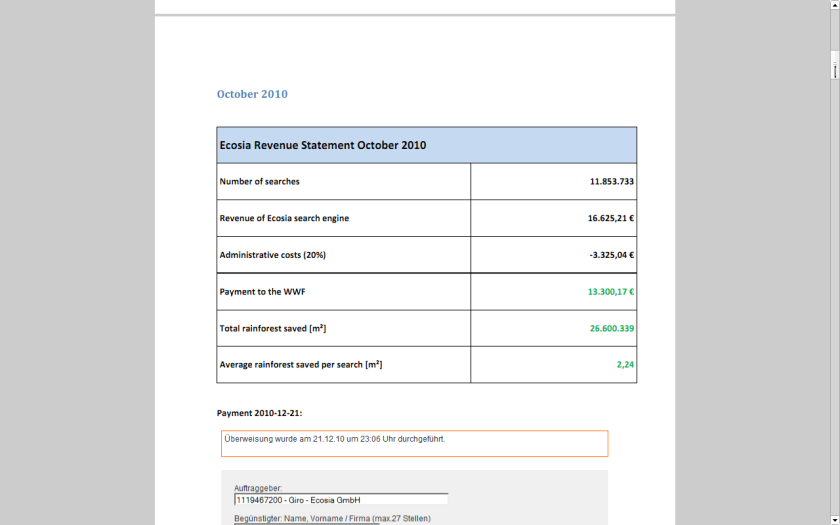
    http://ecosia.org/statistics.php

    They claim to have donated 141,529.42 EUR !!!

    http://static.ecosia.org/files/donations.pdf


    Well suppose you are the Web Admin of a very popular website like Wikipedia or etc

    One way to meet server costs is to say openly hey i need to balance my costs so i need some money.

    The other way is to use online advertising.

    I started mine with Google Adsense.

    Click per milli (or CPM)  gives you a very low low conversion compared to contacting ad sponsor directly.

    But its a great data experiment-

    as you can monitor which companies are likely to be advertised on your site (assume google knows more about their algols than you will)

    which formats -banner or text or flash have what kind of conversion rates

    what are the expected pay off rates from various keywords or companies (like business intelligence software, predictive analytics software and statistical computing software are similar but have different expected returns (if you remember your eco class)


    NOW- Based on above data, you know whats your minimum baseline to expect from a private advertiser than a public, crowd sourced search engine one (like Google or Bing)

    Lets say if you have 100000 views monthly. and assume one out of 1000 page views will lead to a click. Say the advertiser will pay you 1 $ for every 1 click (=1000 impressions)

    Then your expected revenue is $100.But if your clicks are priced at 2.5$ for every click , and your click through rate is now 3 out of 1000 impressions- (both very moderate increases that can done by basic placement optimization of ad type, graphics etc)-your new revenue is  750$.

    Be a good Samaritan- you decide to share some of this with your audience -like 4 Amazon books per month ( or I free Amazon book per week)- That gives you a cost of 200$, and leaves you with some 550$.

    Wait! it doesnt end there- Adam Smith‘s invisible hand moves on .

    You say hmm let me put 100 $ for an annual paper writing contest of $1000, donate $200 to one laptop per child ( or to Amazon rain forests or to Haiti etc etc etc), pay $100 to your upgraded server hosting, and put 350$ in online advertising. say $200 for search engines and $150 for Facebook.

    Woah!

    Month 1 would should see more people  visiting you for the first time. If you have a good return rate (returning visitors as a %, and low bounce rate (visits less than 5 secs)- your traffic should see atleast a 20% jump in new arrivals and 5-10 % in long term arrivals. Ignoring bounces- within  three months you will have one of the following

    1) An interesting case study on statistics on online and social media advertising, tangible motivations for increasing community response , and some good data for study

    2) hopefully better cost management of your server expenses

    3)very hopefully a positive cash flow


    you could even set a percentage and share the monthly (or annually is better actions) to your readers and advertisers.

    go ahead- change the world!

    the key paradigms here are sharing your traffic and revenue openly to everyone

    donating to a suitable cause

    helping increase awareness of the suitable cause

    basing fixed percentages rather than absolute numbers to ensure your site and cause are sustained for years.

    Privacy Browsing Extensions in Google Chrome

    coat of arms of the Palaiologos dynasty, the l...
    Image via Wikipedia

    Using two Chrome Extensions, Disconnect and AdBlock you can be sure of having a vary very clean browsing experience-it is recommended especially if you dont like the auto sharing of your personal preferences and cannot be bothered by the Byzantine maze of social media privacy fineprint.

    https://chrome.google.com/extensions/detail/jeoacafpbcihiomhlakheieifhpjdfeo

    Disconnect by Brian Kennish

    (184) – 44,284 users – Weekly installs: 24,086

    Stop major third parties and search engines from tracking the webpages you go to and searches you do.

    * Search depersonalization is now optional and off by default. Click the “d” button then the “Depersonalize searches” checkbox to turn this feature on (or back off in case you have trouble getting to Google or Yahoo services). For help with anything else, see the known issues below and ask questions at http://j.mp/dnewgroup.
    
    §
    
    If you’re a typical web user, you’re unintentionally sending your browsing and search history with your name and other personal information to third parties and search engines whenever you’re online.
    
    Take control of the data you share with Disconnect!
    
    From the developer of the top-10-rated Facebook Disconnect extension, Disconnect lets you:
    
    • Disable tracking by third parties like Digg, Facebook, Google, Twitter, and Yahoo, without requiring any setup or significantly degrading the usability of the web.
    
    • Truly depersonalize searches on search engines like Google and Yahoo (by blocking identifying cookies not just changing the appearance of results pages), while staying logged into other services — e.g., so you can search anonymously on Google and access iGoogle at once.
    
    • See how many resource and cookie requests are blocked, in real time
    
    
    and
    https://chrome.google.com/extensions/detail/gighmmpiobklfepjocnamgkkbiglidom
    
    ExtensionsAdBlock

    AdBlock

    (6937) - 1,615,373 users - Weekly installs: 153,032
    The most popular Chrome extension, with over 1.5 million users! Blocks ads all over the web.
    Verified author: chromeadblock.com
    =================
    
    New in version 2.1: Translated into dozens of languages!
    New in version 2.0: Ads are blocked from downloading, instead of just being removed after the fact!
    
    =======================
    
    The official AdBlock For Chrome!  Block all advertisements on all web pages.  Your browser is automatically updated with additions to the filter: just click Install, then visit your favorite website and see the ads disappear!
    
    FAQs:1. This is the official AdBlock extension: the original ad blocker written from the ground up to be optimized in Chrome.  There's an unrelated, older Firefox project called Adblock Plus, and they're working on making a Chrome version out of the old AdThwart codebase.  At the moment AdBlock blocks some ads that AdThwart only hides, but they're working to improve it.  It's available at bit.ly/id2Gqx; if you have trouble with AdBlock, they're good guys and a fine alternative!


    Top Cartoonists:Updated

    Here is a list of cartoonists I follow- I sometimes think they make more sense than all the news media combined.

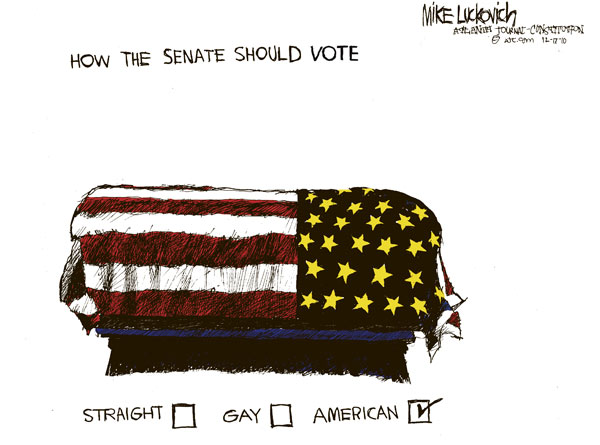
    1) Mike Luckovich He is a Pulitzer Prize winning cartoonist for AJC at http://blogs.ajc.com/mike-luckovich/

    I love his political satire-sometimes not his politics- though he is a liberal (surprisingly most people from creative arts tend to be liberal- guess because they support and need welfare more, 🙂 ) Since I am in India- I call myself a conservative (when filing taxes) or liberal (when drinking er tea)

    2) Hugh Mcleod- of Gaping Void is very different from Mike above, in the way an abstract painter would be from a classical

    artist. I like his satire on internet, technology and personal favorite – social media consultants. Hugh casts a critical eye on the world of tech and is an immensely successful artist- probably the Andy Warhol of this genre in a generation.

    3) Doug Savage of Savage Chickens http://www.savagechickens.com/ has a great series of funny cartoons based on chickens drawn on Post it notes. While his drawing is less abstract than Hugh’s above, he sometimes touches an irreverent note more like Hugh than anyone else.

    4) Professor Jorge Cham of Phd Comics http://www.phdcomics.com/comics.php is probably the most read comic in grad school  – and probably the only cartoonist with a Phd I know of.

    5) Scott Adams of Dilbert http://www.dilbert.com/ is probably the first “non kid stuff” cartoonist I started reading-in fact I once wrote to him asking for advice on my poetry to his credit- he replied with a single ” Best of Luck email”

    They named our email server in Lucknow, UP, India for him (in my business school at http://iiml.ac.in ) Probably the best of corporate toon humor. Maybe they should make the Dilbert movie yet.

    6) Randall Munroe of xkcd.com

    XKCD is geek cartooning at its best.

    For catching up with the best toons in a week, the best is Time.com ‘s weekly list at http://www.time.com/time/cartoonsoftheweek

    It is the best collection of political cartoons.

    An Introduction to Data Mining-online book

    I was reading David Smith’s blog http://blog.revolutionanalytics.com/

    where he mentioned this interview of Norman Nie, at TDWI

    http://tdwi.org/Articles/2010/11/17/R-101.aspx?Page=2

    where I saw this link (its great if you want to study Data Mining btw)

    http://www.kdnuggets.com/education/usa-canada.html

    and I c/liked the U Toronto link

    http://chem-eng.utoronto.ca/~datamining/

    Best of All- I really liked this online book created by Professor S. Sayad

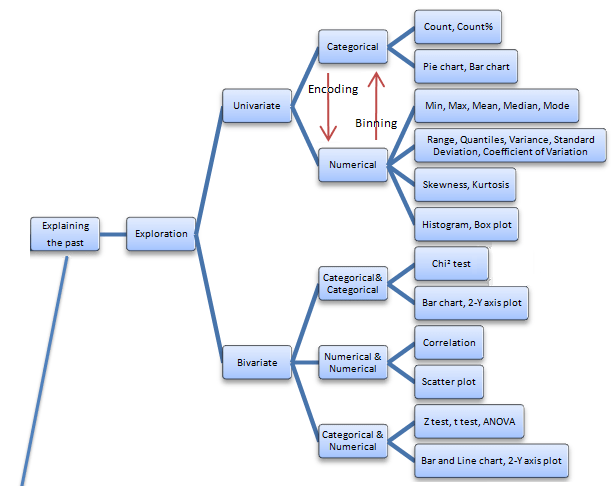
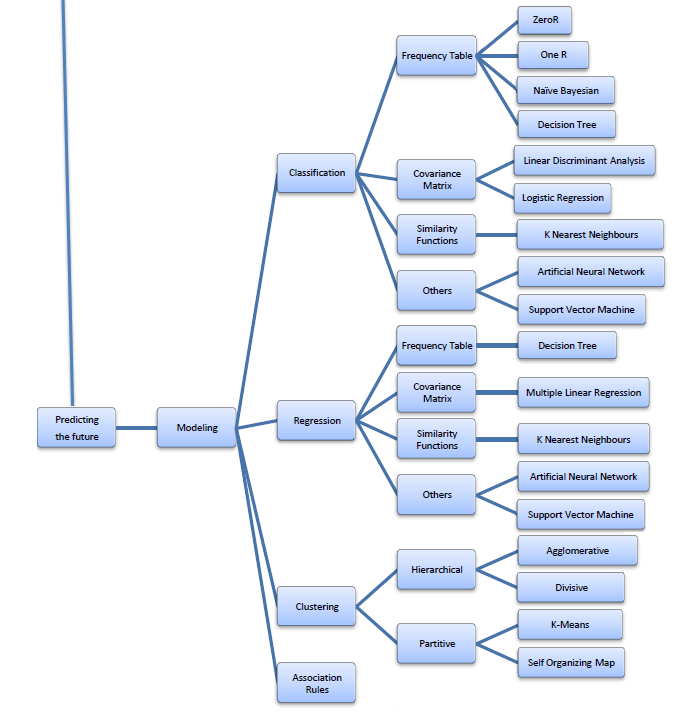
    Its succinct and beautiful and describes all of the Data Mining you want to read in one Map (actually 4 images painstakingly assembled with perfection)

    The best thing is- in the original map- even the sub items are click-able for specifics like Pie Chart and Stacked Column chart are not in one simple drop down like Charts- but rather by nature of the kind of variables that lead to these charts. For doing that- you would need to go to the site itself- ( see http://chem-eng.utoronto.ca/~datamining/dmc/categorical_variables.htm

    vs

    http://chem-eng.utoronto.ca/~datamining/dmc/categorical_numerical.htm

    Again- there is no mention of the data visualization software used to create the images but I think I can take a hint from the Software Page which says software used are-

    Software

    See it on your own-online book (c)Professor S. Sayad

    Really good DIY tutorial

    http://chem-eng.utoronto.ca/~datamining/dmc/data_mining_map.htm

    Machine Addictions

    in the middle of essential and inevitable tasks
    restless inner conscience wakens and asks
    stuck again today to the computer are we now
    please remind me this state we reached how

    oh we had bills to pay student loans to repay
    once we got hooked t’was easy to be carried away
    just a matter of time before inevitable voices query
    this is my machine that I want to marry

    I spend more time with him/her as it is
    the Machinery is devoted with focused loyalties
    meanwhile the non machine world goes round
    strives forth on things less profound

    as we stroke the keys and click the mouse
    machine addictions will only add to human grouse

    Jobs in Analytics

    Here are some jobs from Vincent Granville, founder Analyticbridge. Please contact him directly- I just thought the Season of Joy should have better jobs than currently.

    ————————————————————————————–

    Several job ads recently posted on DataShaping / AnalyticBridge, across United Sates and in Europe. Use the DataShaping search box to find more opportunities.

    Job ads are posted at:


    Selected opportunities:

    Quantitative Modeling Consultants – Agilex (Alexandria, VA)
    Sr. Software Development Engineers – Agilex (Alexandria, VA)
    Actuary – FBL Financial Group (Des Moines, IA)
    Relevance scientist – Yandex Labs (Palo Alto, CA)
    Research Engineer, Search Ranking – Chomp (San Francisco, CA)
    Mathematical Modeling and Optimization – Exxon (Clinton, NJ)
    Data Analyst – DISH Network (Englewood, CO)
    Sr Aviation Planning Research & Data Analyst – Port of Seattle (Seattle, WA)
    Statistician / Quantitative Analyst – Indeed (Austin, TX)
    Statistician – Pratt & Whitney (East Hartford, CT)
    Biostatistician – The J. David Gladstone Institutes (San Francisco, CA)
    Customer Service Representative (oklahoma, OK)
    Program Associate – Cambridge Systematics (Washington D.C., DC)
    Sr Risk Analyst – Paypal (Omaha, NE)
    Sr. Actuarial Analyst – Farmers (Simi Valley, CA)
    Senior Statistician, Data Services – Equifax (Alpharetta, GA)
    Business Intelligence Analyst – Burbery (NYC, NY)
    Fact Extraction – Amazon (Seattle, WA)
    Senior Researcher – Bing (Bellevue, WA)
    Senior Statistical Research Analyst – Walt Disney (Lake Buena Vista, FL)
    Statistician – Capital One (Nottingham, NH)
    Lead Data Analyst – Barclays (Northampton, UK)
    Analytical Data Scientist – Aviagen (Huntsville, AL or Edinburgh, UK)
    VP of Engineering for Analytics (Bay Area, CA)
    Senior Software Engineer – Numenta (Redwood City, CA)
    Numenta Internship Program – Numenta (Redwood City, CA)
    Director of Analytics – Mozilla Corporation (Mountain View, CA)
    Senior Sales Engineer – Statsoft (NY, NY)

    Complex Event Processing- SASE Language

    Logo of the anti-RFID campaign by German priva...
    Image via Wikipedia

    Complex Event Processing (CEP- not to be confused by Circular Probability Error) is defined processing many events happening across all the layers of an organization, identifying the most meaningful events within the event cloud, analyzing their impact, and taking subsequent action in real time.

    Software supporting CEP are-

    Oracle http://www.oracle.com/us/technologies/soa/service-oriented-architecture-066455.html

    Oracle CEP is a Java application server for the development and deployment of high-performance event driven applications. It can detect patterns in the flow of events and message payloads, often based on filtering, correlation, and aggregation across event sources, and includes industry leading temporal and ordering capabilities. It supports ultra-high throughput (1 million/sec++) and microsecond latency.

    Tibco is also trying to get into this market (it claims to have a 40 % market share in the public CEP market 😉 though probably they have not measured the DoE and DoD as worthy of market share yet

    – see webcast by TIBCO ‘s head here http://www.tibco.com/products/business-optimization/complex-event-processing/default.jsp

    and product info here-http://www.tibco.com/products/business-optimization/complex-event-processing/businessevents/default.jsp

    TIBCO is the undisputed leader in complex event processing (CEP) software with over 40 percent market share, according to a recent IDC Study.

    A good explanation of how social media itself can be used as an analogy for CEP is given in this SAS Global Paper

    http://support.sas.com/resources/papers/proceedings10/040-2010.pdf

    You can see a report on Predictive Analytics and Data Mining  in q1 2010 also from SAS’s website  at –http://www.sas.com/news/analysts/forresterwave-predictive-analytics-dm-104388-0210.pdf

    A very good explanation on architecture involved is given by SAS CTO Keith Collins here on SAS’s Knowledge Exchange site,

    http://www.sas.com/knowledge-exchange/risk/four-ways-divide-conquer.html

    What it is: Methods 1 through 3 look at historical data and traditional architectures with information stored in the warehouse. In this environment, it often takes months of data cleansing and preparation to get the data ready to analyze. Now, what if you want to make a decision or determine the effect of an action in real time, as a sale is made, for instance, or at a specific step in the manufacturing process. With streaming data architectures, you can look at data in the present and make immediate decisions. The larger flood of data coming from smart phones, online transactions and smart-grid houses will continue to increase the amount of data that you might want to analyze but not keep. Real-time streaming, complex event processing (CEP) and analytics will all come together here to let you decide on the fly which data is worth keeping and which data to analyze in real time and then discard.

    When you use it: Radio-frequency identification (RFID) offers a good user case for this type of architecture. RFID tags provide a lot of information, but unless the state of the item changes, you don’t need to keep warehousing the data about that object every day. You only keep data when it moves through the door and out of the warehouse.

    The same concept applies to a customer who does the same thing over and over. You don’t need to keep storing data for analysis on a regular pattern, but if they change that pattern, you might want to start paying attention.

    Figure  4: Traditional architecture vs. streaming architecture

    Figure 4: Traditional architecture vs. streaming architecture


    In academia  here is something called SASE Language

    • A rich declarative event language
    • Formal semantics of the event language
    • Theorectical underpinnings of CEP
    • An efficient automata-based implementation

    http://sase.cs.umass.edu/

    and

    http://avid.cs.umass.edu/sase/index.php?page=navleft_1col

    Financial Services

    The query below retrieves the total trading volume of Google stocks in the 4 hour period after some bad news occurred.

    PATTERN SEQ(News a, Stock+ b[ ])WHERE   [symbol]    AND	a.type = 'bad'    AND	b[i].symbol = 'GOOG' WITHIN  4 hoursHAVING  b[b.LEN].volume < 80%*b[1].volumeRETURN  sum(b[ ].volume)

    The next query reports a one-hour period in which the price of a stock increased from 10 to 20 and its trading volume stayed relatively stable.

    PATTERN	SEQ(Stock+ a[])WHERE 	 [symbol]   AND	  a[1].price = 10   AND	  a[i].price > a[i-1].price   AND	  a[a.LEN].price = 20            WITHIN  1 hourHAVING	avg(a[].volume) ≥ a[1].volumeRETURN	a[1].symbol, a[].price

    The third query detects a more complex trend: in an hour, the volume of a stock started high, but after a period of price increasing or staying relatively stable, the volume plummeted.

    PATTERN SEQ(Stock+ a[], Stock b)WHERE 	 [symbol]   AND	  a[1].volume > 1000   AND	  a[i].price > avg(a[…i-1].price))   AND	  b.volume < 80% * a[a.LEN].volume           WITHIN  1 hourRETURN	a[1].symbol, a[].(price,volume), b.(price,volume)

    (note from Ajay-


    I was not really happy about the depth of resources on CEP available online- there seem to be missing bits and pieces in both open source, academic and corporate information- one reason for this is the obvious military dual use of this technology- like feeds from Satellite, Audio Scans, etc)