Google unleashes Fusion Tables

I just discovered Fusion Tables. There is life beyond the amazing Jeff’s Amazon Ec2/s3 after all!

Check out http://www.google.com/fusiontables/public/tour/index.html

Gather, visualize and share data online

Don’t have a Google Account?
Create one now

  • Visualize and publish your data as maps, timelines and charts
  • Host your data tables online
  • Combine data from multiple people

data table turns into map

Google Fusion Tables is a modern data management and publishing web application that makes it easy
to host, manage, collaborate on, visualize, and publish data tables online.

What can I do with Google Fusion Tables?

Import your own data
Upload data tables from spreadsheets or CSV files, even KML. Developers can use the Fusion Tables API to insert, update, delete and query data programmatically. You can export your data as CSV or KML too.

Visualize it instantly
See the data on a map or as a chart immediately. Use filters for more selective visualizations.

Publish your visualization on other web properties
Now that you’ve got that nice map or chart of your data, you can embed it in a web page or blog post. Or send a link by email or IM. It will always display the latest data values from your table and helps you communicate your story more easily.

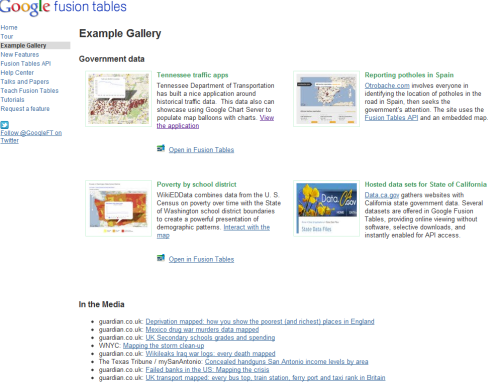
Look at the Fusion Tables Example Gallery

at https://sites.google.com/site/fusiontablestalks/stories

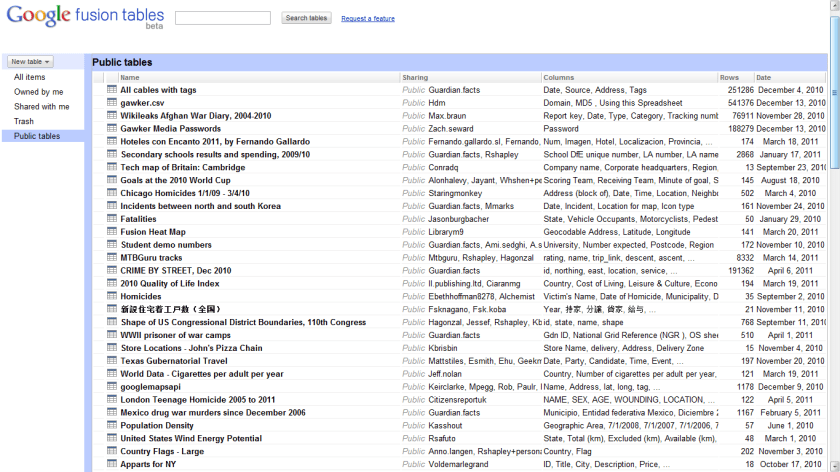
If you are worried about data.gov closing down, heres a snapshot of Fusion Table Public datasets.


Protected: Using SAS and C/C++ together

This content is password-protected. To view it, please enter the password below.

IBM and Revolution team to create new in-database R

From the Press Release at http://www.revolutionanalytics.com/news-events/news-room/2011/revolution-analytics-netezza-partnership.php

Under the terms of the agreement, the companies will work together to create a version of Revolution’s software that takes advantage of IBM Netezza’s i-class technology so that Revolution R Enterprise can run in-database in an optimal fashion.

About IBM

For information about IBM Netezza, please visit: http://www.netezza.com.
For Information on IBM Information Management, please visit: http://www.ibm.com/software/data/information-on-demand/
For information on IBM Business Analytics, please visit the online press kit: http://www.ibm.com/press/us/en/presskit/27163.wss
Follow IBM and Analytics on Twitter: http://twitter.com/ibmbizanalytics
Follow IBM analytics on Tumblr: http://smarterplanet.tumblr.com/tagged/new_intelligence
IBM YouTube Analytics Channel: http://www.youtube.com/user/ibmbusinessanalytics
For information on IBM Smarter Systems: http://www-03.ibm.com/systems/smarter/

About Revolution Analytics

Revolution Analytics is the leading commercial provider of software and services based on the open source R project for statistical computing.  Led by predictive analytics pioneer Norman Nie, the company brings high performance, productivity and enterprise readiness to R, the most powerful statistics language in the world. The company’s flagship Revolution R product is designed to meet the production needs of large organizations in industries such as finance, life sciences, retail, manufacturing and media.  Used by over 2 million analysts in academia and at cutting-edge companies such as Google, Bank of America and Acxiom, R has emerged as the standard of innovation in statistical analysis. Revolution Analytics is committed to fostering the continued growth of the R community through sponsorship of the Inside-R.org community site, funding worldwide R user groups and offers free licenses of Revolution R Enterprise to everyone in academia.


Netezza, an IBM Company, is the global leader in data warehouse, analytic and monitoring appliances that dramatically simplify high-performance analytics across an extended enterprise. IBM Netezza’s technology enables organizations to process enormous amounts of captured data at exceptional speed, providing a significant competitive and operational advantage in today’s data-intensive industries, including digital media, energy, financial services, government, health and life sciences, retail and telecommunications.

The IBM Netezza TwinFin® appliance is built specifically to analyze petabytes of detailed data significantly faster than existing data warehouse options, and at a much lower total cost of ownership. It stores, filters and processes terabytes of records within a single unit, analyzing only the relevant information for each query.

Using Revolution R Enterprise & Netezza Together

Revolution Analytics and IBM Netezza have announced a partnership to integrate Revolution R Enterprise and the IBM Netezza TwinFin  Data Warehouse Appliance. For the first time, customers seeking to run high performance and full-scale predictive analytics from within a data warehouse platform will be able to directly leverage the power of the open source R statistics language. The companies are working together to create a version of Revolution’s software that takes advantage of IBM Netezza’s i-class technology so that Revolution R Enterprise can run in-database in an optimal fashion.

This partnership integrates Revolution R Enterprise with IBM Netezza’s high performance data warehouse and advanced analytics platform to help organizations combat the challenges that arise as complexity and the scale of data grow.  By moving the analytics processing next to the data, this integration will minimize data movement – a significant bottleneck, especially when dealing with “Big Data”.  It will deliver high performance on large scale data, while leveraging the latest innovations in analytics.

With Revolution R Enterprise for IBM Netezza, advanced R computations are available for rapid analysis of hundreds of terabyte-class data volumes — and can deliver 10-100x performance improvements at a fraction of the cost compared to traditional analytics vendors.

Additional Resources


PAW Blog Partnership

Please use the following code  to get a 15% discount on the 2 Day Conference Pass: AJAY11.


Predictive Analytics World announces new full-day workshops coming to San Francisco March 13-19, amounting to seven consecutive days of content.

These workshops deliver top-notch analytical and business expertise across the hottest topics.

Register now for one or more workshops, offered just before and after the full two-day Predictive Analytics World conference program (March 14-15). Early Bird registration ends on January 31st – take advantage of reduced pricing before then.

Driving Enterprise Decisions with Business Analytics – March 13, 2011
James Taylor, CEO, Decision Management Solutions
NEW – R for Predictive Modeling: A Hands-On Introduction – March 13, 2011
Max Kuhn, Director, Nonclinical Statistics, Pfizer
The Best and Worst of Predictive Analytics: Predictive Modeling Methods and Common Data Mining Mistakes – March 16, 2011
John Elder, Ph.D., CEO and Founder, Elder Research, Inc.
Hands-On Predictive Analytics – March 17, 2011
Dean Abbott, President, Abbott Analytics
NEW – Net Lift Models: Optimizing the Impact of Your Marketing – March 18-19, 2011
Kim Larsen, VP of Analytical Insights, Market Share Partners

Download the Conference Preview or view the Predictive Analytics World Agenda online

Make savings now with the early bird rate. Receive $200 off your registration rate for Predictive Analytics World – San Francisco (March 14-15), plus $100 off each workshop for which you register.

Register now before Early Bird Price expires on January 31st!

Additional savings of $200 on the two-day conference pass when you register a colleague at the same time.


Carole-Ann’s 2011 Predictions for Decision Management

Carole-Ann’s 2011 Predictions for Decision Management

For Ajay Ohri on DecisionStats.com

What were the top 5 events in 2010 in your field?
  1. Maturity: the Decision Management space was made up of technology vendors, big and small, that typically focused on one or two aspects of this discipline.  Over the past few years, we have seen a lot of consolidation in the industry – first with Business Intelligence (BI) then Business Process Management (BPM) and lately in Business Rules Management (BRM) and Advanced Analytics.  As a result the giant Platform vendors have helped create visibility for this discipline.  Lots of tiny clues finally bubbled up in 2010 to attest of the increasing activity around Decision Management.  For example, more products than ever were named Decision Manager; companies advertised for Decision Managers as a job title in their job section; most people understand what I do when I am introduced in a social setting!
  2. Boredom: unfortunately, as the industry matures, inevitably innovation slows down…  At the main BRMS shows we heard here and there complaints that the technology was stalling.  We heard it from vendors like Red Hat (Drools) and we heard it from bored end-users hoping for some excitement at Business Rules Forum’s vendor panel.  They sadly did not get it
  3. Scrum: I am not thinking about the methodology there!  If you have ever seen a rugby game, you can probably understand why this is the term that comes to mind when I look at the messy & confusing technology landscape.  Feet blindly try to kick the ball out while superhuman forces are moving randomly the whole pack – or so it felt when I played!  Business Users in search of Business Solutions are facing more and more technology choices that feel like comparing apples to oranges.  There is value in all of them and each one addresses a specific aspect of Decision Management but I regret that the industry did not simplify the picture in 2010.  On the contrary!  Many buzzwords were created or at least made popular last year, creating even more confusion on a muddy field.  A few examples: Social CRM, Collaborative Decision Making, Adaptive Case Management, etc.  Don’t take me wrong, I *do* like the technologies.  I sympathize with the decision maker that is trying to pick the right solution though.
  4. Information: Analytics have been used for years of course but the volume of data surrounding us has been growing to unparalleled levels.  We can blame or thank (depending on our perspective) Social Media for that.  Sites like Facebook and LinkedIn have made it possible and easy to publish relevant (as well as fluffy) information in real-time.  As we all started to get the hang of it and potentially over-publish, technology evolved to enable the storage, correlation and analysis of humongous volumes of data that we could not dream of before.  25 billion tweets were posted in 2010.  Every month, over 30 billion pieces of data are shared on Facebook alone.  This is not just about vanity and marketing though.  This data can be leveraged for the greater good.  Carlos pointed to some fascinating facts about catastrophic event response team getting organized thanks to crowd-sourced information.  We are also seeing, in the Decision management world, more and more applicability for those very technology that have been developed for the needs of Big Data – I’ll name for example Hadoop that Carlos (yet again) discussed in his talks at Rules Fest end of 2009 and 2010.
  5. Self-Organization: it may be a side effect of the Social Media movement but I must admit that I was impressed by the success of self-organizing initiatives.  Granted, this last trend has nothing to do with Decision Management per se but I think it is a great evolution worth noting.  Let me point to a couple of examples.  I usually attend traditional conferences and tradeshows in which the content can be good but is sometimes terrible.  I was pleasantly surprised by the professionalism and attendance at *un-conferences* such as P-Camp (P stands for Product – an event for Product Managers).  When you think about it, it is already difficult to get a show together when people are dedicated to the tasks.  How crazy is it to have volunteers set one up with no budget and no agenda?  Well, people simply show up to do their part and everyone has fun voting on-site for what seems the most appealing content at the time.  Crowdsourcing applied to shows: it works!  Similar experience with meetups or tweetups.  I also enjoyed attending some impromptu Twitter jam sessions on a given topic.  Social Media is certainly helping people reach out and get together in person or virtually and that is wonderful!

A segment of a social network
Image via Wikipedia

What are the top three trends you see in 2011?

  1. Performance:  I might be cheating here.   I was very bullish about predicting much progress for 2010 in the area of Performance Management in your Decision Management initiatives.  I believe that progress was made but Carlos did not give me full credit for the right prediction…  Okay, I am a little optimistic on timeline…  I admit it…  If it did not fully happen in 2010, can I predict it again in 2011?  I think that companies want to better track their business performance in order to correct the trajectory of course but also to improve their projections.  I see that it is turning into reality already here and there.  I expect it to become a trend in 2011!
  2. Insight: Big Data being available all around us with new technologies and algorithms will continue to propagate in 2011 leading to more widely spread Analytics capabilities.  The buzz at Analytics shows on Social Network Analysis (SNA) is a sign that there is interest in those kinds of things.  There is tremendous information that can be leveraged for smart decision-making.  I think there will be more of that in 2011 as initiatives launches in 2010 will mature into material results.
    5 Ways to Cultivate an Active Social Network
    Image by Intersection Consulting via Flickr
  3. Collaboration:  Social Media for the Enterprise is a discipline in the making.  Social Media was initially seen for the most part as a Marketing channel.  Over the years, companies have started experimenting with external communities and ideation capabilities with moderate success.  The few strategic initiatives started in 2010 by “old fashion” companies seem to be an indication that we are past the early adopters.  This discipline may very well materialize in 2011 as a core capability, well, or at least a new trend.  I believe that capabilities such Chatter, offered by Salesforce, will transform (slowly) how people interact in the workplace and leverage the volumes of social data captured in LinkedIn and other Social Media sites.  Collaboration is of course a topic of interest for me personally.  I even signed up for Kare Anderson’s collaboration collaboration site – yes, twice the word “collaboration”: it is really about collaborating on collaboration techniques.  Even though collaboration does not require Social Media, this medium offers perspectives not available until now.

Brief Bio-

Carole-Ann is a renowned guru in the Decision Management space. She created the vision for Decision Management that is widely adopted now in the industry. Her claim to fame is the strategy and direction of Blaze Advisor, the then-leading BRMS product, while she also managed all the Decision Management tools at FICO (business rules, predictive analytics and optimization). She has a vision for Decision Management both as a technology and a discipline that can revolutionize the way corporations do business, and will never get tired of painting that vision for her audience. She speaks often at Industry conferences and has conducted university classes in France and Washington DC.

Leveraging her Masters degree in Applied Mathematics / Computer Science from a “Grande Ecole” in France, she started her career building advanced systems using all kinds of technologies — expert systems, rules, optimization, dashboarding and cubes, web search, and beta version of database replication – as well as conducting strategic consulting gigs around change management.

She now tweets as @CMatignon, blogs at blog.sparklinglogic.com and interacts at community.sparklinglogic.com.

She started her career building advanced systems using all kinds of technologies — expert systems, rules, optimization, dashboarding and cubes, web search, and beta version of database replication.  At Cleversys (acquired by Kurt Salmon & Associates), she also conducted strategic consulting gigs mostly around change management.

While playing with advanced software components, she found a passion for technology and joined ILOG (acquired by IBM).  She developed a growing interest in Optimization as well as Business Rules.  At ILOG, she coined the term BRMS while brainstorming with her Sales counterpart.  She led the Presales organization for Telecom in the Americas up until 2000 when she joined Blaze Software (acquired by Brokat Technologies, HNC Software and finally FICO).

Her 360-degree experience allowed her to gain appreciation for all aspects of a software company, giving her a unique perspective on the business.  Her technical background kept her very much in touch with technology as she advanced.

She also became addicted to Twitter in the process.  She is active on all kinds of social media, always looking for new digital experience!

Outside of work, Carole-Ann loves spending time with her two boys.  They grow fruits in their Northern California home and cook all together in the French tradition.

profile on LinkedIn

TwitterFollow me on Twitter

Filtering to Gain Social Network Value
Image by Intersection Consulting via Flickr
Social Networks Hype Cycle
Image by fredcavazza via Flickr

Challenges of Analyzing a dataset (with R)

GIF-animation showing a moving echocardiogram;...
Image via Wikipedia

Analyzing data can have many challenges associated with it. In the case of business analytics data, these challenges or constraints can have a marked effect on the quality and timeliness of the analysis as well as the expected versus actual payoff from the analytical results.

Challenges of Analytical Data Processing-

1) Data Formats- Reading in complete data, without losing any part (or meta data), or adding in superfluous details (that increase the scope). Technical constraints of data formats are relatively easy to navigate thanks to ODBC and well documented and easily search-able syntax and language.

The costs of additional data augmentation (should we pay for additional credit bureau data to be appended) , time of storing and processing the data (every column needed for analysis can add in as many rows as whole dataset, which can be a time enhancing problem if you are considering an extra 100 variables with a few million rows), but above all that of business relevance and quality guidelines will ensure basic data input and massaging are considerable parts of whole analytical project timeline.

2) Data Quality-Perfect data exists in a perfect world. The price of perfect information is one business will mostly never budget or wait for. To deliver inferences and results based on summaries of data which has missing, invalid, outlier data embedded within it makes the role of an analyst just as important as which ever tool is chosen to remove outliers, replace missing values, or treat invalid data.

3) Project Scope-

How much data? How much Analytical detail versus High Level Summary? Timelines for delivery as well as refresh of data analysis? Checks (statistical as well as business)?

How easy is it to load and implement the new analysis in existing Information Technology Infrastructure? These are some of the outer parameters that can limit both your analytical project scope, your analytical tool choice, and your processing methodology.
4) Output Results vis a vis stakeholder expectation management-

Stakeholders like to see results, not constraints, hypothesis ,assumptions , p-value, or chi -square value. Output results need to be streamlined to a decision management process to justify the investment of human time and effort in an analytical project, choice,training and navigating analytical tool complexities and constraints are subset of it. Optimum use of graphical display is a part of aligning results to a more palatable form to stakeholders, provided graphics are done nicely.

Eg Marketing wants to get more sales so they need a clear campaign, to target certain customers via specific channels with specified collateral. In order to base their business judgement, business analytics needs to validate , cross validate and sometimes invalidate this business decision making with clear transparent methods and processes.

Given a dataset- the basic analytical steps that an analyst will do with R are as follows. This is meant as a note for analysts at a beginner level with R.

Package -specific syntax

update.packages() #This updates all packages
install.packages(package1) #This installs a package locally, a one time event
library(package1) #This loads a specified package in the current R session, which needs to be done every R session

CRAN________LOCAL HARD DISK_________R SESSION is the top to bottom hierarchy of package storage and invocation.

ls() #This lists all objects or datasets currently active in the R session

> names(assetsCorr)  #This gives the names of variables within a dataframe
[1] “AssetClass”            “LargeStocksUS”         “SmallStocksUS”
[4] “CorporateBondsUS”      “TreasuryBondsUS”       “RealEstateUS”
[7] “StocksCanada”          “StocksUK”              “StocksGermany”
[10] “StocksSwitzerland”     “StocksEmergingMarkets”

> str(assetsCorr) #gives complete structure of dataset
‘data.frame’:    12 obs. of  11 variables:
$ AssetClass           : Factor w/ 12 levels “CorporateBondsUS”,..: 4 5 2 6 1 12 3 7 11 9 …
$ LargeStocksUS        : num  15.3 16.4 1 0 0 …
$ SmallStocksUS        : num  13.49 16.64 0.66 1 0 …
$ CorporateBondsUS     : num  9.26 6.74 0.38 0.46 1 0 0 0 0 0 …
$ TreasuryBondsUS      : num  8.44 6.26 0.33 0.27 0.95 1 0 0 0 0 …
$ RealEstateUS         : num  10.6 17.32 0.08 0.59 0.35 …
$ StocksCanada         : num  10.25 19.78 0.56 0.53 -0.12 …
$ StocksUK             : num  10.66 13.63 0.81 0.41 0.24 …
$ StocksGermany        : num  12.1 20.32 0.76 0.39 0.15 …
$ StocksSwitzerland    : num  15.01 20.8 0.64 0.43 0.55 …
$ StocksEmergingMarkets: num  16.5 36.92 0.3 0.6 0.12 …

> dim(assetsCorr) #gives dimensions observations and variable number
[1] 12 11

str(Dataset) – This gives the structure of the dataset (note structure gives both the names of variables within dataset as well as dimensions of the dataset)

head(dataset,n1) gives the first n1 rows of dataset while
tail(dataset,n2) gives the last n2 rows of a dataset where n1,n2 are numbers and dataset is the name of the object (here a data frame that is being considered)

summary(dataset) gives you a brief summary of all variables while

library(Hmisc)
describe(dataset) gives a detailed description on the variables

simple graphics can be given by

hist(Dataset1)
and
plot(Dataset1)

As you can see in above cases, there are multiple ways to get even basic analysis about data in R- however most of the syntax commands are intutively understood (like hist for histogram, t.test for t test, plot for plot).

For detailed analysis throughout the scope of analysis, for a business analytics user it is recommended to using multiple GUI, and multiple packages. Even for highly specific and specialized analytical tasks it is recommended to check for a GUI that incorporates the required package.

Interview Ajay Ohri Decisionstats.com with DMR

From-

http://www.dataminingblog.com/data-mining-research-interview-ajay-ohri/

Here is the winner of the Data Mining Research People Award 2010: Ajay Ohri! Thanks to Ajay for giving some time to answer Data Mining Research questions. And all the best to his blog, Decision Stat!

Data Mining Research (DMR): Could you please introduce yourself to the readers of Data Mining Research?

Ajay Ohri (AO): I am a business consultant and writer based out of Delhi- India. I have been working in and around the field of business analytics since 2004, and have worked with some very good and big companies primarily in financial analytics and outsourced analytics. Since 2007, I have been writing my blog at http://decisionstats.com which now has almost 10,000 views monthly.

All in all, I wrote about data, and my hobby is also writing (poetry). Both my hobby and my profession stem from my education ( a masters in business, and a bachelors in mechanical engineering).

My research interests in data mining are interfaces (simpler interfaces to enable better data mining), education (making data mining less complex and accessible to more people and students), and time series and regression (specifically ARIMAX)
In business my research interests software marketing strategies (open source, Software as a service, advertising supported versus traditional licensing) and creation of technology and entrepreneurial hubs (like Palo Alto and Research Triangle, or Bangalore India).

DMR: I know you have worked with both SAS and R. Could you give your opinion about these two data mining tools?

AO: As per my understanding, SAS stands for SAS language, SAS Institute and SAS software platform. The terms are interchangeably used by people in industry and academia- but there have been some branding issues on this.
I have not worked much with SAS Enterprise Miner , probably because I could not afford it as business consultant, and organizations I worked with did not have a budget for Enterprise Miner.
I have worked alone and in teams with Base SAS, SAS Stat, SAS Access, and SAS ETS- and JMP. Also I worked with SAS BI but as a user to extract information.
You could say my use of SAS platform was mostly in predictive analytics and reporting, but I have a couple of projects under my belt for knowledge discovery and data mining, and pattern analysis. Again some of my SAS experience is a bit dated for almost 1 year ago.

I really like specific parts of SAS platform – as in the interface design of JMP (which is better than Enterprise Guide or Base SAS ) -and Proc Sort in Base SAS- I guess sequential processing of data makes SAS way faster- though with computing evolving from Desktops/Servers to even cheaper time shared cloud computers- I am not sure how long Base SAS and SAS Stat can hold this unique selling proposition.

I dislike the clutter in SAS Stat output, it confuses me with too much information, and I dislike shoddy graphics in the rendering output of graphical engine of SAS. Its shoddy coding work in SAS/Graph and if JMP can give better graphics why is legacy source code preventing SAS platform from doing a better job of it.

I sometimes think the best part of SAS is actually code written by Goodnight and Sall in 1970’s , the latest procs don’t impress me much.

SAS as a company is something I admire especially for its way of treating employees globally- but it is strange to see the rest of tech industry not following it. Also I don’t like over aggression and the SAS versus Rest of the Analytics /Data Mining World mentality that I sometimes pick up when I deal with industry thought leaders.

I think making SAS Enterprise Miner, JMP, and Base SAS in a completely new web interface priced at per hour rates is my wishlist but I guess I am a bit sentimental here- most data miners I know from early 2000’s did start with SAS as their first bread earning software. Also I think SAS needs to be better priced in Business Intelligence- it seems quite cheap in BI compared to Cognos/IBM but expensive in analytical licensing.

If you are a new stats or business student, chances are – you may know much more R than SAS today. The shift in education at least has been very rapid, and I guess R is also more of a platform than a analytics or data mining software.

I like a lot of things in R- from graphics, to better data mining packages, modular design of software, but above all I like the can do kick ass spirit of R community. Lots of young people collaborating with lots of young to old professors, and the energy is infectious. Everybody is a CEO in R ’s world. Latest data mining algols will probably start in R, published in journals.

Which is better for data mining SAS or R? It depends on your data and your deadline. The golden rule of management and business is -it depends.

Also I have worked with a lot of KXEN, SQL, SPSS.

DMR: Can you tell us more about Decision Stats? You have a traffic of 120′000 for 2010. How did you reach such a success?

AO: I don’t think 120,000 is a success. Its not a failure. It just happened- the more I wrote, the more people read.In 2007-2008 I used to obsess over traffic. I tried SEO, comments, back linking, and I did some black hat experimental stuff. Some of it worked- some didn’t.

In the end, I started asking questions and interviewing people. To my surprise, senior management is almost always more candid , frank and honest about their views while middle managers, public relations, marketing folks can be defensive.

Social Media helped a bit- Twitter, Linkedin, Facebook really helped my network of friends who I suppose acted as informal ambassadors to spread the word.
Again I was constrained by necessity than choices- my middle class finances ( I also had a baby son in 2007-my current laptop still has some broken keys :) – by my inability to afford traveling to conferences, and my location Delhi isn’t really a tech hub.

The more questions I asked around the internet, the more people responded, and I wrote it all down.

I guess I just was lucky to meet a lot of nice people on the internet who took time to mentor and educate me.

I tried building other websites but didn’t succeed so i guess I really don’t know. I am not a smart coder, not very clever at writing but I do try to be honest.

Basic economics says pricing is proportional to demand and inversely proportional to supply. Honest and candid opinions have infinite demand and an uncertain supply.

DMR: There is a rumor about a R book you plan to publish in 2011 :-) Can you confirm the rumor and tell us more?

AO: I just signed a contract with Springer for ” R for Business Analytics”. R is a great software, and lots of books for statistically trained people, but I felt like writing a book for the MBAs and existing analytics users- on how to easily transition to R for Analytics.

Like any language there are tricks and tweaks in R, and with a focus on code editors, IDE, GUI, web interfaces, R’s famous learning curve can be bent a bit.

Making analytics beautiful, and simpler to use is always a passion for me. With 3000 packages, R can be used for a lot more things and a lot more simply than is commonly understood.
The target audience however is business analysts- or people working in corporate environments.

Brief Bio-
Ajay Ohri has been working in the field of analytics since 2004 , when it was a still nascent emerging Industries in India. He has worked with the top two Indian outsourcers listed on NYSE,and with Citigroup on cross sell analytics where he helped sell an extra 50000 credit cards by cross sell analytics .He was one of the very first independent data mining consultants in India working on analytics products and domestic Indian market analytics .He regularly writes on analytics topics on his web site www.decisionstats.com and is currently working on open source analytical tools like R besides analytical software like SPSS and SAS.