Interview James Dixon Pentaho

Here is an interview with James Dixon the founder of Pentaho, self confessed Chief Geek and CTO. Pentaho has been growing very rapidly and it makes open source Business Intelligence solutions- basically the biggest chunk of enterprise software market currently.

Ajay-  How would you describe Pentaho as a BI product for someone who is completely used to traditional BI vendors (read non open source). Do the Oracle lawsuits over Java bother you from a business perspective?

James-

Pentaho has a full suite of BI software:

* ETL: Pentaho Data Integration

* Reporting: Pentaho Reporting for desktop and web-based reporting

* OLAP: Mondrian ROLAP engine, and Analyzer or Jpivot for web-based OLAP client

* Dashboards: CDF and Dashboard Designer

* Predictive Analytics: Weka

* Server: Pentaho BI Server, handles web-access, security, scheduling, sharing, report bursting etc

We have all of the standard BI functionality.

The Oracle/Java issue does not bother me much. There are a lot of software companies dependent on Java. If Oracle abandons Java a lot resources will suddenly focus on OpenJDK. It would be good for OpenJDK and might be the best thing for Java in the long term.

Ajay-  What parts of Pentaho’s technology do you personally like the best as having an advantage over other similar proprietary packages.

Describe the latest Pentaho for Hadoop offering and Hadoop/HIVE ‘s advantage over say Map Reduce and SQL.

James- The coolest thing is that everything is pluggable:

* ETL: New data transformation steps can be added. New orchestration controls (job entries) can be added. New perspectives can be added to the design UI. New data sources and destinations can be added.

* Reporting: New content types and report objects can be added. New data sources can be added.

* BI Server: Every factory, engine, and layer can be extended or swapped out via configuration. BI components can be added. New visualizations can be added.

This means it is very easy for Pentaho, partners, customers, and community member to extend our software to do new things.

In addition every engine and component can be fully embedded into a desktop or web-based application. I made a youtube video about our philosophy: http://www.youtube.com/watch?v=uMyR-In5nKE

Our Hadoop offerings allow ETL developers to work in a familiar graphical design environment, instead of having to code MapReduce jobs in Java or Python.

90% of the Hadoop use cases we hear about are transformation/reporting/analysis of structured/semi-structured data, so an ETL tool is perfect for these situations.

Using Pentaho Data Integration reduces implementation and maintenance costs significantly. The fact that our ETL engine is Java and is embeddable means that we can deploy the engine to the Hadoop data nodes and transform the data within the nodes.

Ajay-  Do you think the combination of recession, outsourcing,cost cutting, and unemployment are a suitable environment for companies to cut technology costs by going out of their usual vendor lists and try open source for a change /test projects.

Jamie- Absolutely. Pentaho grew (downloads, installations, revenue) throughout the recession. We are on target to do 250% of what we did last year, while the established vendors are flat in terms of new license revenue.

Ajay-  How would you compare the user interface of reports using Pentaho versus other reporting software. Please feel free to be as specific.

James- We have all of the everyday, standard reporting features covered.

Over the years the old tools, like Crystal Reports, have become bloated and complicated.

We don’t aim to have 100% of their features, because we’d end us just as complicated.

The 80:20 rule applies here. 80% of the time people only use 20% of their features.

We aim for 80% feature parity, which should cover 95-99% of typical use cases.

Ajay-  Could you describe the Pentaho integration with R as well as your relationship with Weka. Jaspersoft already has a partnership with Revolution Analytics for RevoDeployR (R on a web server)-

Any  R plans for Pentaho as well?

James- The feature set of R and Weka overlap to a small extent – both of them include basic statistical functions. Weka is focused on predictive models and machine learning, whereas R is focused on a full suite of statistical models. The creator and main Weka developer is a Pentaho employee. We have integrated R into our ETL tool. (makes me happy 🙂 )

(probably not a good time to ask if SAS integration is done as well for a big chunk of legacy base SAS/ WPS users)

About-

As “Chief Geek” (CTO) at Pentaho, James Dixon is responsible for Pentaho’s architecture and technology roadmap. James has over 15 years of professional experience in software architecture, development and systems consulting. Prior to Pentaho, James held key technical roles at AppSource Corporation (acquired by Arbor Software which later merged into Hyperion Solutions) and Keyola (acquired by Lawson Software). Earlier in his career, James was a technology consultant working with large and small firms to deliver the benefits of innovative technology in real-world environments.

Open Source's worst enemy is itself not Microsoft/SAS/SAP/Oracle

The decision of quality open source makers to offer their software at bargain basement prices even to enterprise customers who are used to pay prices many times more-pricing is the reason open source software is taking a long time to command respect in enterprise software.

I hate to be the messenger who brings the bad news to my open source brethren-

but their worst nightmare is not the actions of their proprietary competitors like Oracle, SAP, SAS, Microsoft ( they hate each other even more than open source )

nor the collective marketing tactics which are textbook like (but referred as Fear Uncertainty Doubt by those outside that golden quartet)- it is their own communities and their own cheap pricing.

It is community action which prevents them from offering their software by ridiculously low bargain basement prices. James Dixon, head geek and founder at Pentaho has a point when he says traditional metrics like revenue need o be adjusted for this impact in his article at http://jamesdixon.wordpress.com/2010/11/02/comparing-open-source-and-proprietary-software-markets/

But James, why offer software to enterprise customers at one tenth the next competitor- one reason is open source companies more often than not compete more with their free community version software than with big proprietary packages.

Communities including academics are used to free- hey how about paying say 1$ for each download.

There are two million R users- if say even 50 % of them  paid 1 $ as a lifetime license fee- you could sponsor enough new packages than twenty years of Google Summer of Code does right now.

Secondly, this pricing can easily be adjusted by shifting the licensing to say free for businesses less than 2 people (even for the enhanced corporate software version not just the plain vanilla community software thus further increasing the spread of the plain vanilla versions)- for businesses from 10 to 20 people offer a six month trial rather than one month trial.

– but adjust the pricing to much more realistic levels compared to competing software. Make enterprise software pay a real value.

That’s the only way to earn respect. as well as a few dollars more.

As for SAS, it is time it started ridiculing Python now that it has accepted R.

Python is even MORE powerful than R in some use cases for stat computing

Dixon’s Pentaho and the Jaspersoft/ Revolution combo are nice _ I tested both Jasper and Pentaho thanks to these remarks this week 🙂  (see slides at http://www.jaspersoft.com/sites/default/files/downloads/events/Analytics%20-Jaspersoft-SEP2010.pdf or http://www.revolutionanalytics.com/news-events/free-webinars/2010/deploying-r/index.php )

Pentaho and Jasper do give good great graphics in BI (Graphical display in BI is not a SAS forte though probably I dont know how much they cross sell JMP to BI customers- probably too much JMP is another division syndrome there)

Using PostgreSQL and MySQL databases in R 2.12 for Windows

Air University Library's Index to Military Per...
Image via Wikipedia

If you use Windows for your stats computing and your data is in a database (probably true for almost all corporate business analysts) R 2.12 has provided a unique procedural hitch for you NO BINARIES for packages used till now to read from these databases.

The Readme notes of the release say-

Packages related to many database system must be linked to the exact
version of the database system the user has installed, hence it does
not make sense to provide binaries for packages
	RMySQL, ROracle, ROracleUI, RPostgreSQL
although it is possible to install such packages from sources by
	install.packages('packagename', type='source')
after reading the manual 'R Installation and Administration'.

So how to connect to Databases if the Windows Binary is not available-

So how to connect to PostgreSQL and MySQL databases.

For Postgres databases-

You can update your PostgreSQL databases here-

http://www.postgresql.org/download/windows

Fortunately the RpgSQL package is still available for PostgreSQL

  • Using the RpgSQL package

library(RpgSQL)

#creating a connection
con <- dbConnect(pgSQL(), user = "postgres", password = "XXXX",dbname="postgres")

#writing a table from a R Dataset
dbWriteTable(con, "BOD", BOD)

# table names are lower cased unless double quoted. Here we write a Select SQL query
dbGetQuery(con, 'select * from "BOD"')

#disconnecting the connection
dbDisconnect(con)

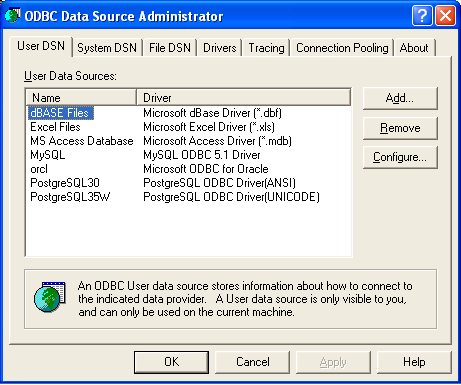
You can also use RODBC package for connecting to your PostgreSQL database but you need to configure your ODBC connections in

Windows Start Panel-

Settings-Control Panel-

Administrative Tools-Data Sources (ODBC)

You should probably see something like this screenshot.

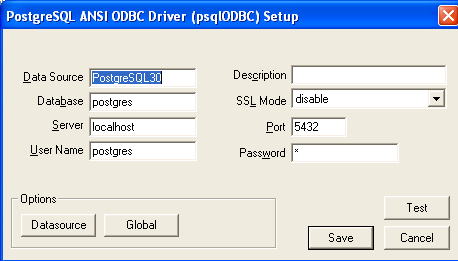
Coming back to R and noting the name of my PostgreSQL DSN from above screenshot-( If not there just click on add-scroll to appropriate database -here PostgreSQL and click on Finish- add in the default values for your database or your own created database values-see screenshot for help with other configuring- and remember to click Test below to check if username and password are working, port is correct etc.

so once the DSN is probably setup in the ODBC (frightening terminology is part of databases)- you can go to R to connect using RODBC package


#loading RODBC

library(RODBC)

#creating a Database connection
# for username,password,database name and DSN name

chan=odbcConnect("PostgreSQL35W","postgres;Password=X;Database=postgres")

#to list all table names

sqlTables(chan)

TABLE_QUALIFIER TABLE_OWNER TABLE_NAME TABLE_TYPE REMARKS
1       postgres      public        bod      TABLE      
 2        postgres      public  database1      TABLE      
 3        postgres      public         tt      TABLE

Now for MySQL databases it is exactly the same code except we download and install the ODBC driver from http://www.mysql.com/downloads/connector/odbc/

and then we run the same configuring DSN as we did for postgreSQL.

After that we use RODBC in pretty much the same way except changing for the default username and password for MySQL and changing the DSN name for the previous step.

channel <- odbcConnect("mysql","jasperdb;Password=XXX;Database=Test")
test2=sqlQuery(channel,"select * from jiuser")
test2
 id  username tenantId   fullname emailAddress  password externallyDefined enabled previousPasswordChangeTime1  1   jasperadmin        1 Jasper Administrator           NA 349AFAADD5C5A2BD477309618DC              NA    01                       
2  2       joe1ser        1             Joe User           NA                 4DD8128D07A               NA    01
odbcClose(channel)
While using RODBC for all databases is a welcome step, perhaps the change release notes for Window Users of R may need to be more substantiative than one given for R 2.12.2

Getting Inside R

Forums and Minerals, the new Internet tools
Image via Wikipedia

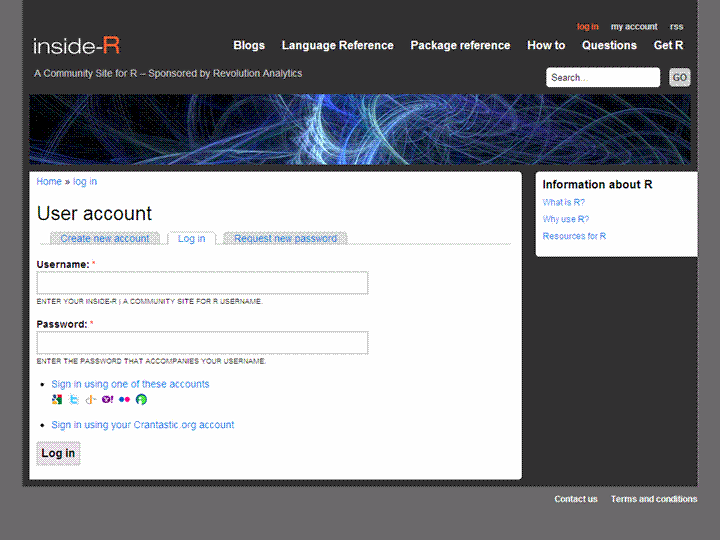
I loved the new upgraded design of Inside-R, Revo’s new(?) community.

And promptly shot up a blog application.

What makes Inside- R- slightly better than SDC, Analyticbridge,PlanetR and R _bloggers (with due respects)

  1. Open Id logins (I think thats a new and good step)
  2. Options for automated feed parsing for blogs
  3. More than just a blog aggregator- includes sections on other stuff- thus more like a community than a big feed
  4. Abbreviated feeds- just gives you two-three lines of summary per post  than the whole big schmakaround -thats a time saver for me —(D Smith is the only -lonely blogger atm there)
  5. The more the merrier- One more place to read and write R.


btw is the name insider (as in guy who knows inside stuff) or Inside- R (as in get inside the R box)- just kidding. With PlyR, ManipulatR, ApplyR and now Inside R- the pun gets MerrieR

If my blog app gets rejected- these views may change ,grr


LibreOffice Beta 2 (Office Fork off Oracle) launches!


Windows 7, the latest client version in the Mi...
Image via Wikipedia


Announcement from Code Ninjas at Document Foundation

10 years after the StarOffice code has been opened as OpenOffice.org, The Document Foundation is proud to announce the availability of LibreOffice Beta 2 for public testing. Please, download the suitable package(s) from

http://www.documentfoundation.org/download/


Ajay- Note that first beta was downloaded almost 100,000 times

install them, and start testing! Should you find bugs, please report them to the FreeDesktop Bugzilla:

https://bugs.freedesktop.org

If you want to get involved in this exciting project, you can contribute code:

http://www.documentfoundation.org/develop/

translate LibreOffice to your language:

http://www.freedesktop.org/wiki/Software/LibreOffice/i18n/translating_3.3

or just donate:

http://www.documentfoundation.org/contribution/
A list of known issues with Beta 2 is available in our wiki:

http://wiki.documentfoundation.org/Beta2

Beta Release Notes

This beta release is not intended for production use!

There are a number of known issues being worked on:

  • The Windows build is an International build – you can choose the user interface language that is suitable for you, but the help is always English. We are currently working on improving the delivery mechanism to be able to provide you with the localized help. We are also working on smaller problems like wrong description of several languages.
  • The Linux and MacOSX builds are English builds with the possibility to install language packs. Please browse the archives to get the langugage pack you need for your platform.
  • The LibreOffice branding and renaming is new and work in progress. You may still see old graphics, icons or websites. So please bear with us. This also applies to the BrOffice.org branding – applicable in Brazil.
  • Filters for the legacy StarOffice binary formats are missing.

I tested it- it seems okay enough. Once again Open Source tends to underplay expectations (when was the last time you saw that in enterprise software?)

Interview John F Moore CEO The Lab

Social Media Landscape

Here is an interview with John F Moore, social media adviser,technologist and founder and CEO of The Lab.

Ajay-  The internet seems to be crowded by social media experts with everyone who spends a lot of time on the internet claiming to be one? How  does a small business owner on a budget distinguish for the correct value proposition that social media can give them. 

John- You’re right.  It seems like everytime I turn around I bump into more social media “experts”.  The majority of these self-proclaimed experts are not adding a great deal of value.  When looking to spend money for help ask the person a few questions about their approach. Things you should be hearing include:

  • The expert should be seeking to fully understand your business, your goals, your available resources, etc..
  • The expert should be seeking to understand current management thinking about social media and related technologies.

If the expert is purely focused on tools they are the wrong person.  Your solution may require tools alone but they cannot know this without first understanding your business.

Ajay- Facebook has 600 million people, with people preferring to play games and connect to old acquaintances rather than use social media for tangible career or business benefit..

John- People are definitely spending time playing games, looking at photos, and catching up with old friends.  However, there are many businesses seeing real value from Facebook (primarily by tying it into their e-mail marketing and using coupons and other incentives).  For example, I recently shared a small case study (http://thejohnfmoore.com/2010/10/07/email-social-media-and-coupons-makes-the-cfo-smile/) where a small pet product company achieved a 22% bump in monthly revenue by combining Facebook and coupons together.  In fact,45% of this bump in revenue came from new clients.  Customer acquisition and increased revenue were accomplished by using Facebook for their business.
Ajay-  How does a new social media convert (individual) go on selecting communities to join (Facebook,Twitter,Linkedin,Ning, Ping,Orkut, Empire Avenue etc etc.
How does a small business owner take the same decision.

John- It always starts with taking the time to define your goals and then determine how much time and effort you are willing to invest.  For example:
  • LinkedIn. A must have for individuals as it is one of the key social networking communities for professional networking.  Individuals should join groups that are relevant to their career and invest an hour a week.  Businesses should ensure they have a business profile completed and up to date.
  • Facebook can be a challenge for anyone trying to walk the personal/professional line.  However, from a business standpoint you should be creating a Facebook page that you can use to compliment your other marketing channels.
  • Twitter.  It is a great network to learn of, to meet, and to interact with people from around the world.  I have met thousands of interesting people, many of which I have had the pleasure to meet with in real life.  Businesses need to invest in listening on twitter to determine if their customers (current or potential) or competitors are already there discussing them, their marketplace, or their offerings.
In all cases I would encourage businesses to setup social media accounts on LinkedIn, Facebook, Twitter, YouTube, and Flickr.  You want to ensure your brand is protected by owning these accounts and ensuring at least the base information is accurate.
Ajay- Name the top 5 points that you think make a social media community successful.  What are the top 5 points for a business to succeed in their social media strategy.

John-
  • Define your goals up front.  Understand why you are building a community and keep this goal in mind.
  • Provide education.  Ideally you want to become a thought leader in your space, the trusted resource that people can turn to even if they are not using your product or services today.
  • Be honest.  We all make mistakes.  When you do, be honest with your community and engage them in any fall-out that may be coming out of your mistake.
  • Listen to them.  Use platforms like BubbleIdeas to gather feedback on what your community is looking for from the relationship.
  • Measure.  Are you on track with your goals?  Do your goals need to change?
Ajay- What is the unique value proposition that “The Lab” offers

John- The Lab understands the strategic importance of leveraging social media, management and leadership best practices, and our understanding of local government and small and medium business to help people in these areas achieve their goals.  Too many consultants come to the table with a predefined solution that really misses the mark as it lacks understanding of the client’s goals.
Ajay-  What is “CityCamp in Boston” all about.

John- CityCamp is a FREE unconference focused on innovation for municipal governments and community organizations (http://www.citycampboston.org/what-is-citycamp-boston/).  It brings together politicians, local municipal employees, citizens, vendors, developers, and journalist to build a common understanding of local government challenges and then works to deliver measurable outcomes following the event.  The key is the focus on change management, driving change as opposed to just in the moment education.
Biography-

John F Moore is the Founder and CEO of The Lab (http://thelabinboston.com).  John has experience working with local governments and small and medium business owners to achieve their goals.  His experience with social media strategies, CRM, and a plethora of other solutions provides immense value to all of our clients.   He has built engineering organizations, learned sales and marketing, run customer service teams, and built and executed strategies for social media thought leadership and branding.  He is also a prolific blogger as you can see by checking out his blog at http://thejohnfmoore.com.