Bruno Aziza, Microsoft Global BI Lead joins PAW Keynote

By Richard Wheeler (Zephyris) 2007. Lambda rep...
Image via Wikipedia


An interesting development, Bruno Aziza, Director, Worldwide Strategy Lead, Business Intelligence, Microsoft has joined Predictive Analytics World as a keynote speaker.

http://www.predictiveanalyticsworld.com/dc/2010/agenda.php#day2-2

Keynote
Predictive Analytics and Business Performance

In this session, Bruno Aziza will discuss the challenges organizations face with Analytics and Performance. This participative session will provide first-hand accounts from Fortune 500 companies who are winning by building accountability, intelligence, and informed decision-making into their organizational DNA.

Speaker: Bruno Aziza, Director, Worldwide Strategy Lead, Business Intelligence, Microsoft

Some info about Mr Aziza,

http://www.predictiveanalyticsworld.com/dc/2010/speakers.php#aziza

Bruno Aziza, Director, Worldwide Strategy Lead, Business Intelligence,Microsoft

Bruno AzizaBruno Aziza is a recognized authority on Strategy Execution, Business Intelligence and Information Management. He is the co-author of best-selling book, “Drive Business Performance: Enabling a Culture of Intelligent Execution” and a Fellow at the Advanced Performance Institute, a world-leading and independent advisory group specialized in organizational performance. Drs. Kaplan & Norton, of Balanced Scorecard fame, praise Aziza for moving “the field of performance management forward in important new directions.”

Aziza’s work has been featured in publications across North America, Europe and Asia such as Business Finance magazine, Intelligent Enterprise, CRM magazine and others.

Aziza has held management positions at Apple Inc.Business Objects (SAP), AppStream(Symantec) and Decathlon SA. He currently works on Microsoft Business Intelligence go-to-market strategy and execution for partners, services, sales and marketing. Aziza lives in Seattle with his family and enjoys sports and travelling.

He regularly provides views on leadership and performance on the SuccessFactors thought leader Network , the CIO Network and Forbes Magazine. Aziza is the host ofBizIntelligence.TV – a leading weekly show on Business Intelligence and Analytics. An award-winning speaker, Aziza frequently keynotes international events and has shared the stage with executives and thought leaders such as Dr. Kaplan. Aziza’s biggest crowd to date is 5,000 people.

Follow or contact Bruno via:
•Twitter @ http://twitter.com/brunoaziza
•Facebook @ http://tinyurl.com/bruno-on-facebook
•Linkedin @ http://www.linkedin.com/in/brunoaziza
•YouTube @ http://tinyurl.com/bruno-on-tv
•Kindle blog @ http://tinyurl.com/culture-blog
•Forbes blog @ http://tinyurl.com/culture-blog

That makes it an interesting Pow Wow between the big players at the conference Oracle,SAP, IBM, SAS and now MS –all seem to be there.

Truly a Predictive Analytics World.


Going Deap : Algols in Python

Logo of PyPy
Image via Wikipedia

Here is an important new step in Python- the established statistical programming language (used to be really pushed by SPSS in pre-IBM days and the rPy package integrates R and Python).

Well the news  ( http://www.kdnuggets.com/2010/10/eap-evolutionary-algorithms-in-python.html ) is the release of Distributed Evolutionary Algorithms in Python. If your understanding of modeling means running regression and iterating it- you may need to read some more.  If you have felt frustrated at lack of parallelization in statistical software as well as your own hardware constraints- well go DEAP (and for corporate types the licensing is

http://www.gnu.org/licenses/lgpl.html ).

http://code.google.com/p/deap/

DEAP

DEAP is intended to be an easy to use distributed evolutionary algorithm library in the Python language. Its two main components are modular and can be used separately. The first module is a Distributed Task Manager (DTM), which is intended to run on cluster of computers. The second part is the Evolutionary Algorithms in Python (EAP) framework.

DTM

DTM is a distributed task manager that is able to spread workload over a buch of computers using a TCP or a MPI connection.

DTM include the following features:


EAP

Features

EAP includes the following features:

  • Genetic algorithm using any imaginable representation
    • List, Array, Set, Dictionary, Tree, …
  • Genetic programing using prefix trees
    • Loosely typed, Strongly typed
    • Automatically defined functions (new v0.6)
  • Evolution strategies (including CMA-ES)
  • Multi-objective optimisation (NSGA-II, SPEA-II)
  • Parallelization of the evaluations (and maybe more) (requires python2.6 and preferably python2.7) (new v0.6)
  • Genealogy of an evolution (that is compatible with NetworkX) (new v0.6)
  • Hall of Fame of the best individuals that lived in the population (new v0.5)
  • Milestones that take snapshot of a system regularly (new v0.5)


Documentation

See the eap user’s guide for EAP 0.6 documentation.

Requirement

The most basic features of EAP requires Python2.5 (we simply do not offer support for 2.4). In order to use multiprocessing you will need Python2.6 and to be able to combine the toolbox and the multiprocessing module Python2.7 is needed for its support to pickle partial functions.

Projects using EAP

If you want your project listed here, simply send us a link and a brief description and we’ll be glad to add it.

and from the wordpress.com blog (funny how people like code.google.com but not blogger.google.com anymore) at http://deapdev.wordpress.com/

EAP is part of the DEAP project, that also includes some facilities for the automatic distribution and parallelization of tasks over a cluster of computers. The D part of DEAP, called DTM, is under intense development and currently available as an alpha version. DTM currently provides two and a half ways to distribute workload on a cluster or LAN of workstations, based on MPI and TCP communication managers.

This public release (version 0.6) is more complete and simpler than ever. It includes Genetic Algorithms using any imaginable representation, Genetic Programming with strongly and loosely typed trees in addition to automatically defined functions, Evolution Strategies (including Covariance Matrix Adaptation), multiobjective optimization techniques (NSGA-II and SPEA2), easy parallelization of algorithms and much more like milestones, genealogy, etc.

We are impatient to hear your feedback and comments on that system at .

Best,

François-Michel De Rainville
Félix-Antoine Fortin
Marc-André Gardner
Christian Gagné
Marc Parizeau

Laboratoire de vision et systèmes numériques
Département de génie électrique et génie informatique
Université Laval
Quebec City (Quebec), Canada

and if you are new to Python -sigh here are some statistical things (read ad-van-cED analytics using Python) by a slideshare from Visual numerics (pre Rogue Wave acquisition)

Also see,

http://code.google.com/p/deap/wiki/SimpleExample


The SEO mess on joining blog aggregators


Mug shot of Paris Hilton.
Image via Wikipedia


If you are an analytics blogger who writes, and is aggregated on an analytical community- read on- Here’s how blog aggregation communities can help you lose 30% of all future traffic long term, while giving you a short term.

The problem is not created by Blogging Communities (like R-Bloggers, or PlanteR, or Smart Data Collective or AnalyticBridge or even BeyeBlogs )

It is created by the way Google Page Rank is structured- you see given exactly the same content on two different we pages- Google Page Rank will place the higher Page Rank results higher. This is counter intutive and quite simple to rectify- The Google Spider can just use the Time Stamp for choosing which article was published where first (Obviously on your blog, AND then later to the aggregator).

How bad is the mess? Well joining ANY blog aggregation will lead to an instant lift of upto 10-50 % of your current traffic as similar bloggers try and read about you. However you can lose the long term 30% proportion which is a benchmark of search engine created traffic for you.

So do you opt out of blog aggregation? No. It’s a SEO mess and it’s unfair to punish your blog aggregator, most of whom are running on ad-supported sponsors or their own funds on dry fumes to publish your content. Most of the fore mentioned communities are created by excellent people I interacted with heavily- and they are genuinely motivated to give readers an easy way to keep up with blogs. Especially Smart Data Collective, Analyticbridge and R-bloggers whose founders I have known personally.

You can do one thing- create manual summaries in the excerpt feature of your blog posts- it’s just below the WordPress page. And switch your RSS feed to summary rather than full. It avoids losing keyword rank to other websites, it prevents the Blog Aggregation from gaining too much influence in key word related searches, and it keeps your whole eco system happy, Best of All it helps readers of Blog Aggregators- since most of them use a summary on the front page anyways.

An additional thought on Google Page Rank- something I have sulked over but not spoken for a long long time.  It ignores the value of reader- If Bill Gates, Steve Jobs, and 500 ceos from Fortune 500 companies read my blog but do not link to it- it will count daily traffic as 500. Probably it will give more weightage to Paris Hilton fans.

A suggestion-humbly- you can use IP Address lookup of visitors to see if traffic is coming from corporate sources or retail sources -Clicky from GetClicky does this. Use it as feedback in Google Analytics as well as Google Trends.

And maybe PageRank needs to add quantity and quality of visitors as additional variables . Do a A/B test guys some Chi Square juice- its not quite Mad Men Adverting but its still good fun.


PageRank
Image via Wikipedia


and the world is one big community as per xkcd


Microsoft Online Games

No, this is not about the X Box kind of games. It is about Microsoft ‘s tactical shift in the online space from going it alone, and building stuff itself, –to partnering, and sometimes investing and exiting business.

In Blogs- It recently announced a migration of MS Live Spaces to WordPress.com – It gives Automattic 30 million more users- no small change consider there were 26 million existing WP users.

Microsoft Messenger, which is the oldest online app in the suite, now provides instant messaging services to about 350 million users, and from now on Windows Live Writer works specifically with the WordPress.com blog service by default. Hopefully Skype, and Google Voice will show MS the way to monitize that business app yet.

Google buying blogger-blogspot seems to have done little, but given Biz Stone room to create another content disruption-Twitter.

With the round of lawsuits by proxy, in Android -Motorola, or for acquisitions – MS is just doing what Marc Anderseen (who’s apparently a better VC than Paul Allen was), Sun and co did to it in the nineties.

Google seems to be regretting putting a spade in the Yahoo acquisition- that would have tied up a big chunk of Idle MS cash- leaving it little room for niche investments (like the 250 mill that helped Facebook ramp up in time).

The real surprise here could be Apple- it has shown little interest in cloud computing- and it seems to be testing the waters with Ping. But Apple sure smells competition- and Android is doing to Iphone what Windows did to the Mac in the early 1990’s.

Google lacks presence in online gaming (despite it’s own Zynga investment)- and needs to start monetizing properties like Android OS (say 10$ for every phone license ??), Google Maps (as an app for GPS) and Google Voice. Indeed it may be time for the big G to start thinking of spinning off atleast some products- earning better returns, while retaining control (dual stock splits) and killing those anti trust lawyer fees forever.

As the Ancient Chinese said, May you live in interesting times. Fun to watch the online games people play.


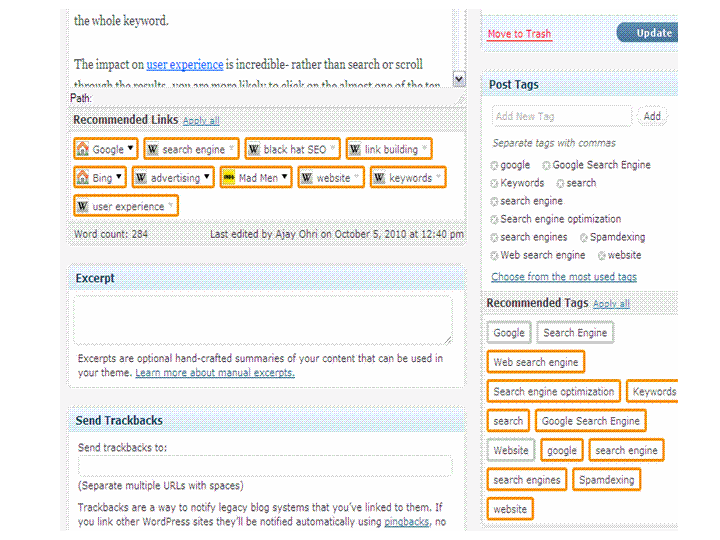
The auto-suggest link/tags for WP.com blogs

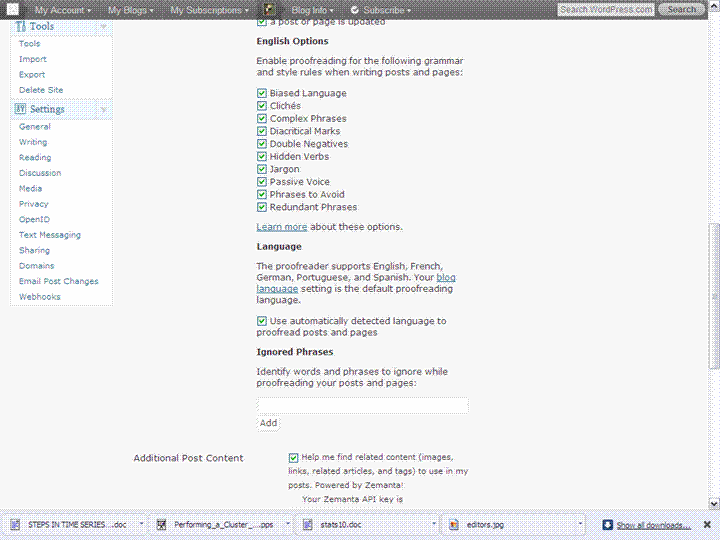
WordPress.com blogs have a great new option for generating tags, and links and thus improving their search engine optimization for posts.

Just go to Users-Personal Settings- and check the options shown. Thats it every time you write a post it suggests links and tags. Links are helpful for your readers (like Wikipedia links to understand dense technical jargon, or associated websites). Tags help to classify your contents so that all visitors to the web site including spiders ,search engines and your readers can search it better.

The bad thing is I need to go back to all 1025 posts on this site and auto generate tags for the archives ! Oh well. Great collaboration between zementa and Automattic for this new feature.

Interview Michael J. A. Berry Data Miners, Inc

Here is an interview with noted Data Mining practitioner Michael Berry, author of seminal books in data mining, noted trainer and consultantmjab picture

Ajay- Your famous book “Data Mining Techniques: For Marketing, Sales, and Customer Relationship Management” came out in 2004, and an update is being planned for 2011. What are the various new data mining techniques and their application that you intend to talk about in that book.

Michael- Each time we do a revision, it feels like writing a whole new book. The first edition came out in 1997 and it is hard to believe how much the world has changed since then. I’m currently spending most of my time in the on-line retailing world. The things I worry about today–improving recommendations for cross-sell and up-sell,and search engine optimization–wouldn’t have even made sense to me back then. And the data sizes that are routine today were beyond the capacity of the most powerful super computers of the nineties. But, if possible, Gordon and I have changed even more than the data mining landscape. What has changed us is experience. We learned an awful lot between the first and second editions, and I think we’ve learned even more between the second and third.

One consequence is that we now have to discipline ourselves to avoid making the book too heavy to lift. For the first edition, we could write everything we knew (and arguably, a bit more!); now we have to remind ourselves that our intended audience is still the same–intelligent laymen with a practical interest in getting more information out of data. Not statisticians. Not computer scientists. Not academic researchers. Although we welcome all readers, we are primarily writing for someone who works in a marketing department and has a title with the word “analyst” or “analytics” in it. We have relaxed our “no equations” rule slightly for cases when the equations really do make things easier to explain, but the core explanations are still in words and pictures.

The third edition completes a transition that was already happening in the second edition. We have fully embraced standard statistical modeling techniques as full-fledged components of the data miner’s toolkit. In the first edition, it seemed important to make a distinction between old, dull, statistics, and new, cool, data mining. By the second edition, we realized that didn’t really make sense, but remnants of that attitude persisted. The third edition rectifies this. There is a chapter on statistical modeling techniques that explains linear and logistic regression, naive Bayes models, and more. There is also a brand new chapter on text mining, a curious omission from previous editions.

There is also a lot more material on data preparation. Three whole chapters are devoted to various aspects of data preparation. The first focuses on creating customer signatures. The second is focused on using derived variables to bring information to the surface, and the third deals with data reduction techniques such as principal components. Since this is where we spend the greatest part of our time in our work, it seemed important to spend more time on these subjects in the book as well.

Some of the chapters have been beefed up a bit. The neural network chapter now includes radial basis functions in addition to multi-layer perceptrons. The clustering chapter has been split into two chapters to accommodate new material on soft clustering, self-organizing maps, and more. The survival analysis chapter is much improved and includes material on some of our recent application of survival analysis methods to forecasting. The genetic algorithms chapter now includes a discussion of swarm intelligence.

Ajay- Describe your early career and how you came into Data Mining as a profession. What do you think of various universities now offering MS in Analytics. How do you balance your own teaching experience with your consulting projects at The Data Miners.

Michael- I fell into data mining quite by accident. I guess I always had a latent interest in the topic. As a high school and college student, I was a fan of Martin Gardner‘s mathematical games in in Scientific American. One of my favorite things he wrote about was a game called New Eleusis in which one players, God, makes up a rule to govern how cards can be played (“an even card must be followed by a red card”, say) and the other players have to figure out the rule by watching what plays are allowed by God and which ones are rejected. Just for my own amusement, I wrote a computer program to play the game and presented it at the IJCAI conference in, I think, 1981.

That paper became a chapter in a book on computer game playing–so my first book was about finding patterns in data. Aside from that, my interest in finding patterns in data lay dormant for years. At Thinking Machines, I was in the compiler group. In particular, I was responsible for the run-time system of the first Fortran Compiler for the CM-2 and I represented Thinking Machines at the Fortran 8X (later Fortran-90) standards meetings.

What changed my direction was that Thinking Machines got an export license to sell our first machine overseas. The machine went to a research lab just outside of Paris. The connection machine was so hard to program, that if you bought one, you got an applications engineer to go along with it. None of the applications engineers wanted to go live in Paris for a few months, but I did.

Paris was a lot of fun, and so, I discovered, was actually working on applications. When I came back to the states, I stuck with that applied focus and my next assignment was to spend a couple of years at Epsilon, (then a subsidiary of American Express) working on a database marketing system that stored all the “records of charge” for American Express card members. The purpose of the system was to pick ads to go in the billing envelope. I also worked on some more general purpose data mining software for the CM-5.

When Thinking Machines folded, I had the opportunity to open a Cambridge office for a Virginia-based consulting company called MRJ that had been a major channel for placing Connection Machines in various government agencies. The new group at MRJ was focused on data mining applications in the commercial market. At least, that was the idea. It turned out that they were more interested in data warehousing projects, so after a while we parted company.

That led to the formation of Data Miners. My two partners in Data Miners, Gordon Linoff and Brij Masand, share the Thinking Machines background.

To tell the truth, I really don’t know much about the university programs in data mining that have started to crop up. I’ve visited the one at NC State, but not any of the others.

I myself teach a class in “Marketing Analytics” at the Carroll School of Management at Boston College. It is an elective part of the MBA program there. I also teach short classes for corporations on their sites and at various conferences.

Ajay- At the previous Predictive Analytics World, you took a session on Forecasting and Predicting Subsciber levels (http://www.predictiveanalyticsworld.com/dc/2009/agenda.php#day2-6) .

It seems inability to forecast is a problem many many companies face today. What do you think are the top 5 principles of business forecasting which companies need to follow.

Michael- I don’t think I can come up with five. Our approach to forecasting is essentially simulation. We try to model the underlying processes and then turn the crank to see what happens. If there is a principal behind that, I guess it is to approach a forecast from the bottom up rather than treating aggregate numbers as a time series.

Ajay- You often partner your talks with SAS Institute, and your blog at http://blog.data-miners.com/ sometimes contain SAS code as well. What particular features of the SAS software do you like. Do you use just the Enterprise Miner or other modules as well for Survival Analysis or Forecasting.

Michael- Our first data mining class used SGI’s Mineset for the hands-on examples. Later we developed versions using Clementine, Quadstone, and SAS Enterprise Miner. Then, market forces took hold. We don’t market our classes ourselves, we depend on others to market them and then share in the revenue.

SAS turned out to be much better at marketing our classes than the other companies, so over time we stopped updating the other versions. An odd thing about our relationship with SAS is that it is only with the education group. They let us use Enterprise Miner to develop course materials, but we are explicitly forbidden to use it in our consulting work. As a consequence, we don’t use it much outside of the classroom.

Ajay- Also any other software you use (apart from SQL and J)

Michael- We try to fit in with whatever environment our client has set up. That almost always is SQL-based (Teradata, Oracle, SQL Server, . . .). Often SAS Stat is also available and sometimes Enterprise Miner.

We run into SPSS, Statistica, Angoss, and other tools as well. We tend to work in big data environments so we’ve also had occasion to use Ab Initio and, more recently, Hadoop. I expect to be seeing more of that.

Biography-

Together with his colleague, Gordon Linoff, Michael Berry is author of some of the most widely read and respected books on data mining. These best sellers in the field have been translated into many languages. Michael is an active practitioner of data mining. His books reflect many years of practical, hands-on experience down in the data mines.

Data Mining Techniques cover

Data Mining Techniques for Marketing, Sales and Customer Relationship Management

by Michael J. A. Berry and Gordon S. Linoff
copyright 2004 by John Wiley & Sons
ISB

Mining the Web cover

Mining the Web

by Michael J.A. Berry and Gordon S. Linoff
copyright 2002 by John Wiley & Sons
ISBN 0-471-41609-6

Non-English editions available in Traditional Chinese and Simplified Chinese

This book looks at the new opportunities and challenges for data mining that have been created by the web. The book demonstrates how to apply data mining to specific types of online businesses, such as auction sites, B2B trading exchanges, click-and-mortar retailers, subscription sites, and online retailers of digital content.

Mastering Data Mining

by Michael J.A. Berry and Gordon S. Linoff
copyright 2000 by John Wiley & Sons
ISBN 0-471-33123-6

Non-English editions available in JapaneseItalianTraditional Chinese , and Simplified Chinese

A case study-based guide to applying data mining techniques for solving practical business problems. These “warts and all” case studies are drawn directly from consulting engagements performed by the authors.

A data mining educator as well as a consultant, Michael is in demand as a keynote speaker and seminar leader in the area of data mining generally and the application of data mining to customer relationship management in particular.

Prior to founding Data Miners in December, 1997, Michael spent 8 years at Thinking Machines Corporation. There he specialized in the application of massively parallel supercomputing techniques to business and marketing applications, including one of the largest database marketing systems of the time.

Blog Update

Some changes at Decisionstats-

1) We are back at Decisionstats.com and Decisionstats.wordpress.com will point to that as well. The SEO effects would be interesting and so would be the Instant Pagerank or LinkRank or whatever Coffee/Percolator they use in Cali to index the site.

2) AsterData is no longer a sponsor- but Predictive Analytics Conference is. Welcome PAWS! I have been a blog partner to PAWS ever since it began- and it’s a great marketing fit. Expect to see a lot of exclusive content and interviews from great speakers at PAWS.

3) The Feedblitz newsletter (now at 404 subscribers) is now a weekly subscription to send one big big email rather than lots of email through the week- this is because my blogging frequency is moving up as I collect material for a new book on business analytics that I would probably release in 2011 (if all goes well, touchwood). Linkedin group would be getting a weekly update announcement. If you are connected to Decisionstats on Analyticbridge _ I would soon try to find a way to update the whole post automatically using RSS and Ning.com . or not. Depends.

4) R continues to be a bigger focus. So will SPSS and maybe JMP. Newer softwares or older softwares that change more rapidly would get more coverage. Generally a particular software is covered if it has newer features, or an interesting techie conference, or it gets sued.

5) I will occasionally write a poem or post a video once a week randomly to prove geeks and nerds and analysts can have fun (much more fun actually dont we)

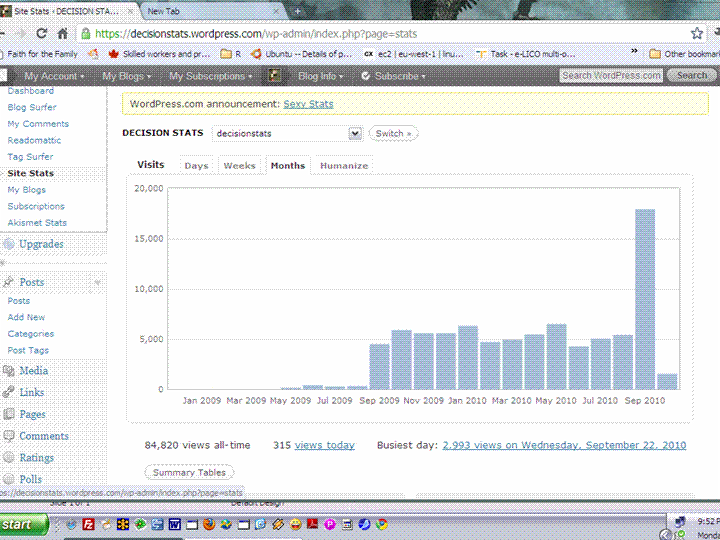
Thanks for reading this. Sept 2010 was the best ever for Decisionstats.com – we crossed 15,000 + visitors and thanks for that again! I promise to bore you less and less as we grow old together on the blog 😉