New Google Ad Planner

Dusan's User Interface challenge
Image by moggs oceanlane via Flickr

The new Google Ad Planner is really nice-seems better than old Adwords interface, though needs a UI redesign before it can complete with the clean cut slice and dice of Facebook Ad Planner.

It’s the interface, stupid that makes an Iphone sell more than the Symbian even with 90% functionality. Same reasons why Google Storage is okay but Google Prediction API gets slower liftoff than Amazon Console (now with FREE instances) – though the R interface to Prediction API sure helps.

Prediction API is a terrific tool dying for oxygen out there (and will end up like Wave- I hope not)

Sometimes you need artists as well as engineers to design query tools, G Men- and guess the Double Click anti trust rumours have quietened down enough because why the heck did double click interface integration take so loooong.

( and btw why cant Google just get into the multi billion dashboard business if they can manage ALL the data IN THE INTERNET ——they sure can do it for specific companies- – but wait-

they are probably waiting for AsterData to stop sucking thumbs ,chanting on MapReduce SQL,  MapReduce SQL nursery rhymes and start inventing NEW STUFF again (or atleast creating two product brands from nCluster (when you and I were in school together giggle)

Btw the time Google make up their mind to enter BI or wait for Aster to finish- IBM would have gulped and burped all there it is- and thats the way that market rolls.

Back to Ad s and Mad Men.

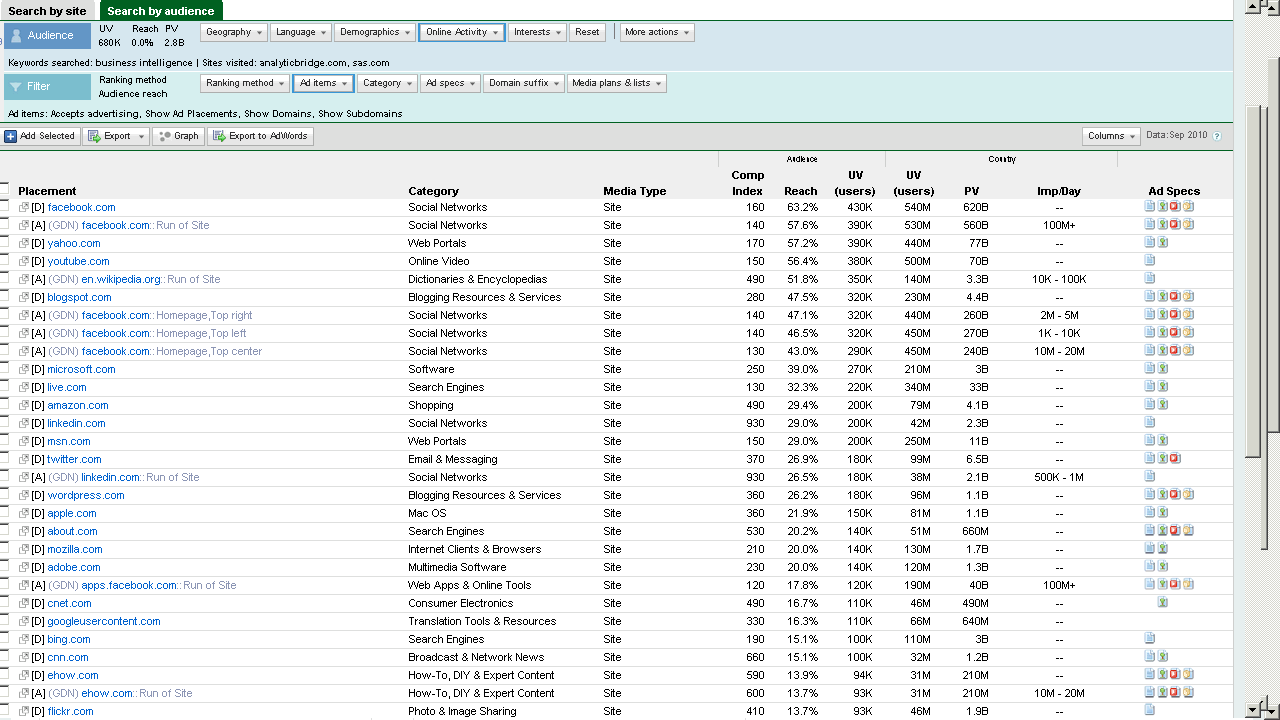
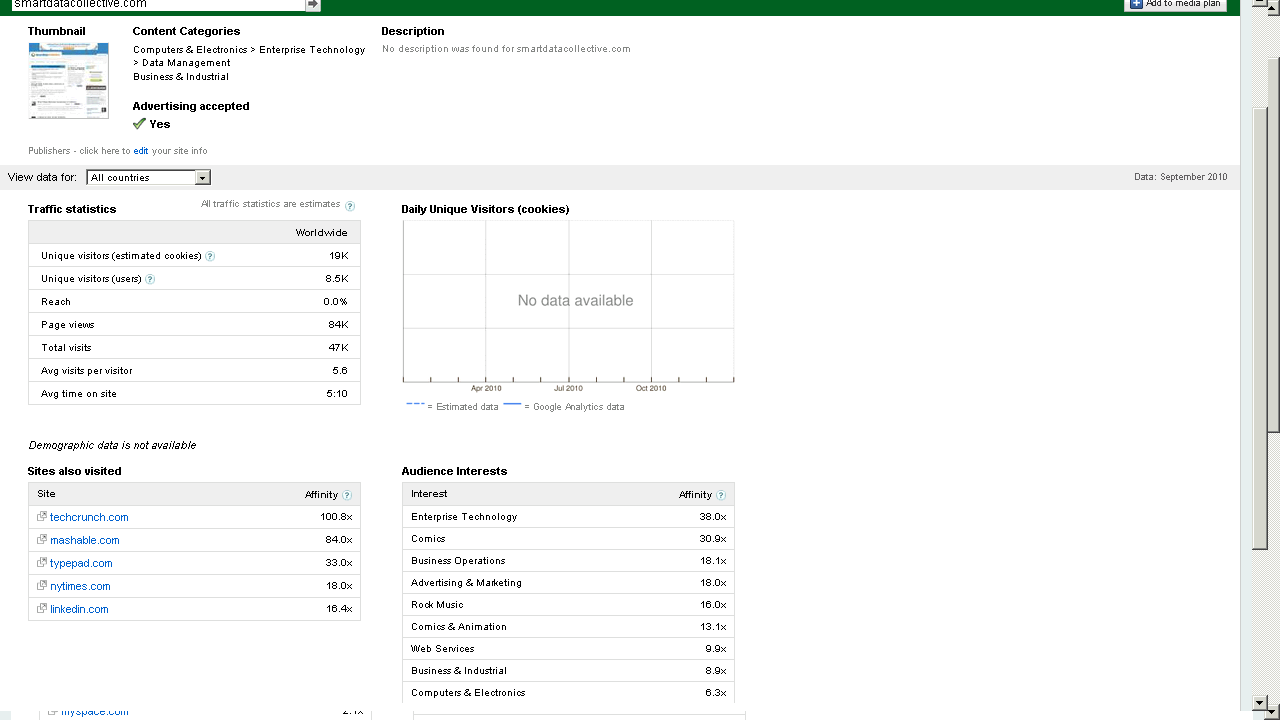
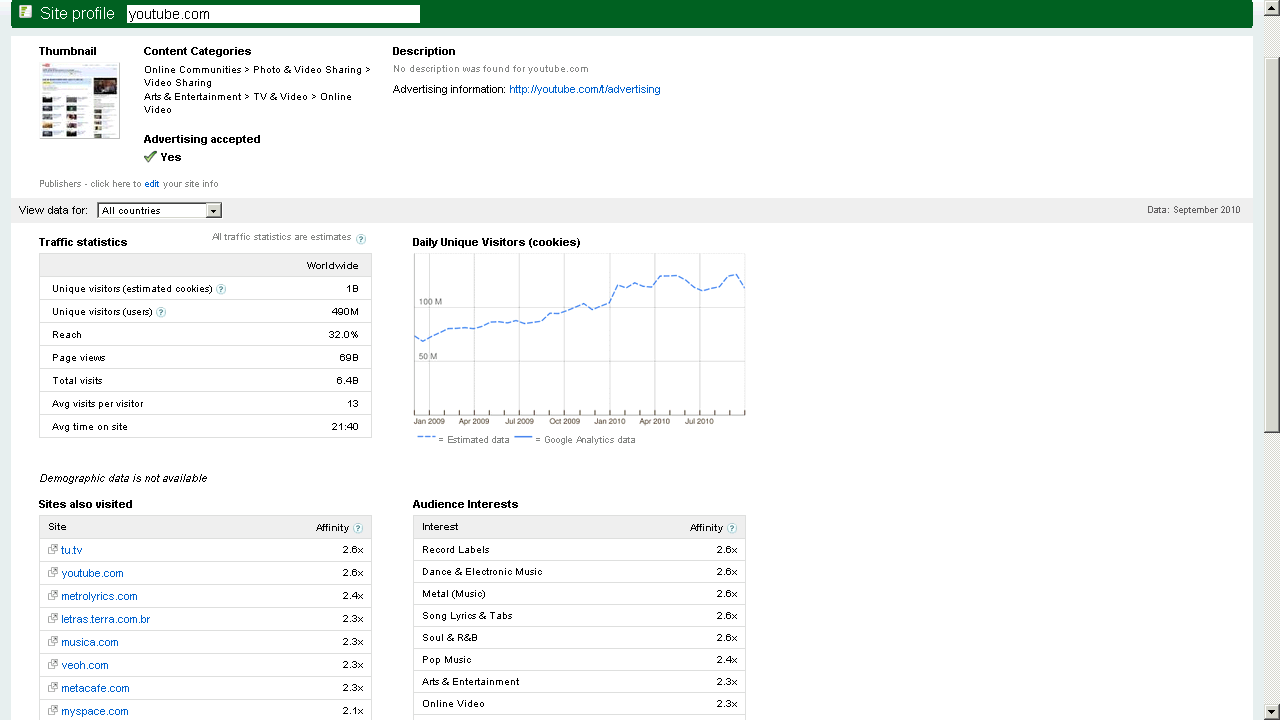
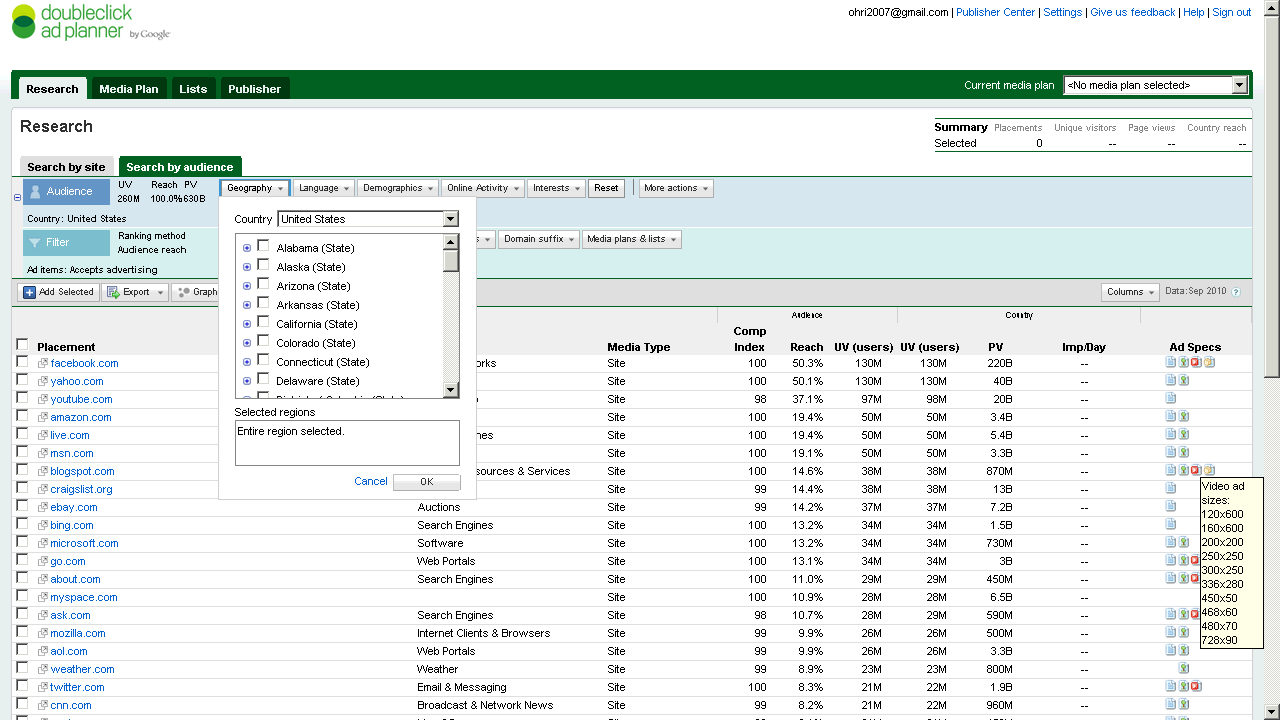
Here are some screenshots-of the new Google Ad Planner-

I found it useful to review traffic for third party websites (even better than Google Trends) and thats a definite plus over Facebooks closed dormitory world of ads.

Click on them for some more views or go straight to http://google.com/adplanner and Enjoy Baby!

Which websites attract your target customers?

View a site listing: 

Ad Planner top 1,000 sites

Refine your online advertising with DoubleClick Ad Planner, a free media planning tool that can help you:

Identify websites your target customers are likely to visit

  • Define audiences by demographics and interests.
  • Search for websites relevant to your target audience.
  • Access unique users, page views, and other data for millions of websites from over 40 countries.

Easily build media plans for yourself or your clients

  • Create lists of websites where you’d like to advertise.
  • Generate aggregated website statistics for your media plan.

and

Take charge of your DoubleClick Ad Planner site listing

View a site listing: 

Ad Planner top 1,000 sites

DoubleClick Ad Planner is a media planning tool where advertisers find sites for their media buys. As a site owner, you can access the DoubleClick Ad Planner Publisher Center and
Market your site
Write a site description to present your audience and unique value to advertisers.
Help advertisers search for you
Choose categories for your site and ad formats you support.
Improve the data that advertisers see
Share your Google Analytics data to reflect the most accurate traffic numbers for your site.


Interview James Dixon Pentaho

Here is an interview with James Dixon the founder of Pentaho, self confessed Chief Geek and CTO. Pentaho has been growing very rapidly and it makes open source Business Intelligence solutions- basically the biggest chunk of enterprise software market currently.

Ajay-  How would you describe Pentaho as a BI product for someone who is completely used to traditional BI vendors (read non open source). Do the Oracle lawsuits over Java bother you from a business perspective?

James-

Pentaho has a full suite of BI software:

* ETL: Pentaho Data Integration

* Reporting: Pentaho Reporting for desktop and web-based reporting

* OLAP: Mondrian ROLAP engine, and Analyzer or Jpivot for web-based OLAP client

* Dashboards: CDF and Dashboard Designer

* Predictive Analytics: Weka

* Server: Pentaho BI Server, handles web-access, security, scheduling, sharing, report bursting etc

We have all of the standard BI functionality.

The Oracle/Java issue does not bother me much. There are a lot of software companies dependent on Java. If Oracle abandons Java a lot resources will suddenly focus on OpenJDK. It would be good for OpenJDK and might be the best thing for Java in the long term.

Ajay-  What parts of Pentaho’s technology do you personally like the best as having an advantage over other similar proprietary packages.

Describe the latest Pentaho for Hadoop offering and Hadoop/HIVE ‘s advantage over say Map Reduce and SQL.

James- The coolest thing is that everything is pluggable:

* ETL: New data transformation steps can be added. New orchestration controls (job entries) can be added. New perspectives can be added to the design UI. New data sources and destinations can be added.

* Reporting: New content types and report objects can be added. New data sources can be added.

* BI Server: Every factory, engine, and layer can be extended or swapped out via configuration. BI components can be added. New visualizations can be added.

This means it is very easy for Pentaho, partners, customers, and community member to extend our software to do new things.

In addition every engine and component can be fully embedded into a desktop or web-based application. I made a youtube video about our philosophy: http://www.youtube.com/watch?v=uMyR-In5nKE

Our Hadoop offerings allow ETL developers to work in a familiar graphical design environment, instead of having to code MapReduce jobs in Java or Python.

90% of the Hadoop use cases we hear about are transformation/reporting/analysis of structured/semi-structured data, so an ETL tool is perfect for these situations.

Using Pentaho Data Integration reduces implementation and maintenance costs significantly. The fact that our ETL engine is Java and is embeddable means that we can deploy the engine to the Hadoop data nodes and transform the data within the nodes.

Ajay-  Do you think the combination of recession, outsourcing,cost cutting, and unemployment are a suitable environment for companies to cut technology costs by going out of their usual vendor lists and try open source for a change /test projects.

Jamie- Absolutely. Pentaho grew (downloads, installations, revenue) throughout the recession. We are on target to do 250% of what we did last year, while the established vendors are flat in terms of new license revenue.

Ajay-  How would you compare the user interface of reports using Pentaho versus other reporting software. Please feel free to be as specific.

James- We have all of the everyday, standard reporting features covered.

Over the years the old tools, like Crystal Reports, have become bloated and complicated.

We don’t aim to have 100% of their features, because we’d end us just as complicated.

The 80:20 rule applies here. 80% of the time people only use 20% of their features.

We aim for 80% feature parity, which should cover 95-99% of typical use cases.

Ajay-  Could you describe the Pentaho integration with R as well as your relationship with Weka. Jaspersoft already has a partnership with Revolution Analytics for RevoDeployR (R on a web server)-

Any  R plans for Pentaho as well?

James- The feature set of R and Weka overlap to a small extent – both of them include basic statistical functions. Weka is focused on predictive models and machine learning, whereas R is focused on a full suite of statistical models. The creator and main Weka developer is a Pentaho employee. We have integrated R into our ETL tool. (makes me happy 🙂 )

(probably not a good time to ask if SAS integration is done as well for a big chunk of legacy base SAS/ WPS users)

About-

As “Chief Geek” (CTO) at Pentaho, James Dixon is responsible for Pentaho’s architecture and technology roadmap. James has over 15 years of professional experience in software architecture, development and systems consulting. Prior to Pentaho, James held key technical roles at AppSource Corporation (acquired by Arbor Software which later merged into Hyperion Solutions) and Keyola (acquired by Lawson Software). Earlier in his career, James was a technology consultant working with large and small firms to deliver the benefits of innovative technology in real-world environments.

Google Raise What

Google recently did the following-

1 Raised salaries by 1000 $ across board, and gave a 10% increase at lower levels to reportedly 30% increase at higher levels.

The surprise 1000$ cash bonus , was a simple application of expectation management, people love a surprise 1000$ raise, but hate if told they would be getting a 90$ raise in their monthly salary from next quarter.

Ex Googlers or GoogleX as the groups is called have helped create a lot of not so evil value at Facebook, and at Twitter. Even the rest of the World made more money on Map Reduce than Google itself did

And Google refuses to do simple things like sell Android )s at 10 bucks a pop, or Google Maps at 0.99 cents a pop. Not even a paid content search by integrating syndicating sources like Factiva, Bloomberg etc

The book scanning project would be out soon , hey when, but they could better get some health record scanning contracts to help cut digital costs

And the A/B experiment to move to pay per conversion rather than pay per click will hurt spamboy advertisers in Facebook or Bing more than Google.

and will someone remove the 100$ limit in Adsense minimum revenue-the internet long tail doesnt end at the round number

But Google ‘s rumors of firing the guy who leaked the raise rumor is totally deception –

seems they are just plugging the leaks for hot new features to counter Gmail killers (where did we heard this phrase before) by

Mark “Still dont have a diploma from Harvard”

speaking of which if Facebook has 500 million unique customers logging and clicking ads (right)- how many unique customers search and click ads on Google. A histogram using a Monte Carlo would be nice- 🙂


Image using png package courtesy Romain Francois at http://romainfrancois.blog.free.fr/

Open Source Cartoon

Jim Goodnight, Chief Executive Officer, SAS, U...
Image via Wikipedia

Ok I promised a weekly cartoon on Friday but it’s Saturday.
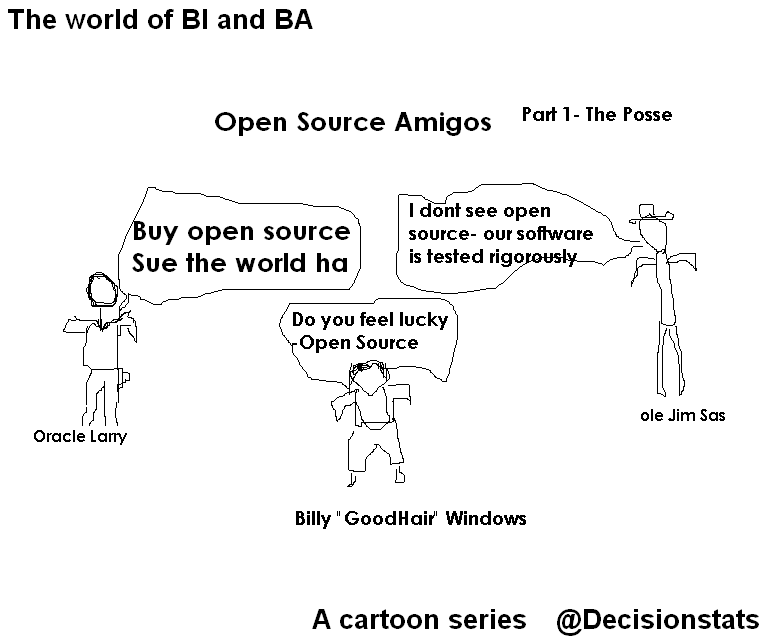
Last week we spoofed Larry Ellison , Jim Goodnight and Bill Gates– people who created billions of taxes for the economy but would be regarded as evil by some open source guys- though they may have created more jobs for more families than the whole Federal Reserve Bank did in 2008-10. Jobs are necessary for families. Period.

You can review it here https://decisionstats.com/wp-content/uploads/2010/11/os1.png

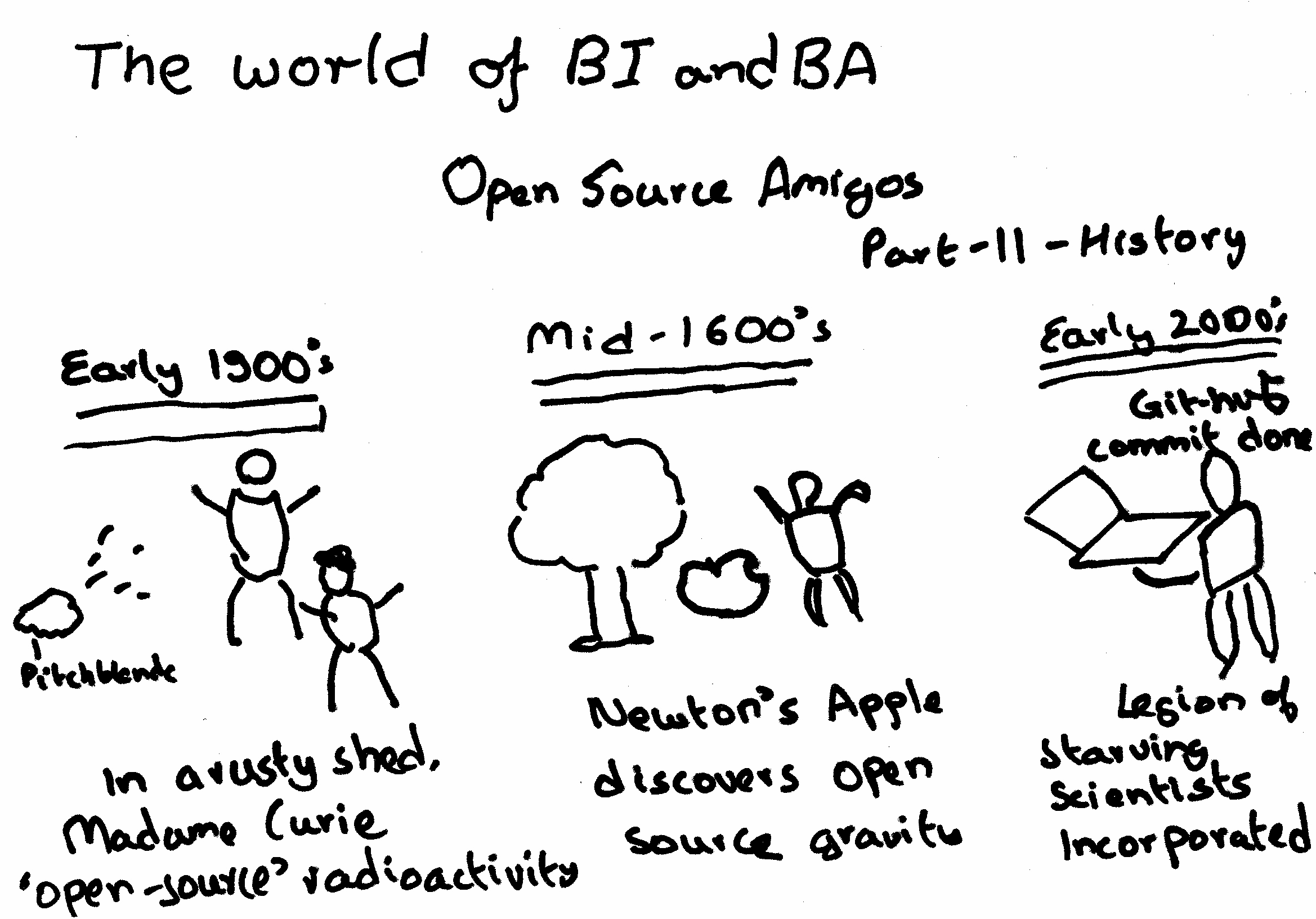
In Part 2- we see Open Source is actually older than Stallman (yes people are older than Stallman) – in fact open source has been around for far more time than even

Jim Goodnight’s current age- which can be revealed by using proc goodnight options=all.

Deduping Facebook

How many accounts in Facebook are one unique customer?

Does 500 million human beings as Facebook customers sound too many duplicates? (and how much more can you get if you get the Chinese market- FB is semi censored there)

Is Facebook response rate on ads statistically same as response rates on websites or response rates on emails or response rates on spam?

Why is my Facebook account (which apparently) I am free to download one big huge 130 mb file, not chunks of small files I can download.

Why cant Facebook use URL shorteners for the links of Photos (ever seen those tiny fonted big big urls below each photo)

How come Facebook use so much R (including making the jjplot package) but wont sponsor a summer of code contest (unlike Google)-100 million for schools and 2 blog posts for R? and how much money for putting e education content and games on Facebook.

Will Facebook ever create an-in  house game?  Did Google put money in Zynga (FB’s top game partner) because it likes

games 🙂 ? How dependent is FB on Zynga anyways?

So many questions———————————————————— so little time


SAS for Job Interviews

SAS Institute, Solutions
Image via Wikipedia

Yeah. I hope someone wrote a book like that.

Basically,

  1. Libname
  2. Proc Datasets
  3. Proc Import
  4. Proc Contents
  5. Proc Freq
  6. Proc Means
  7. Proc Univariate
  8. Proc Reg
  9. Proc Logistic
  10. Proc Export (to excel where you do the graphs)
  11. ODS
  12. Proc Tabulate

(note – it would be interesting to do a proc freq on all procs say used say on SAS On Demand)

Any thing else is not needed for a entry level job for a fresh grad student or job for a veteran re-trained worker.

Just like society needs science and commerce as twin pillars, analytics needs SAS (great Marketing) and R (great research) for expanding the pie of analytics which is woefully underutilized and stupidly overcapitalized by jazzy-copy-paste-data-from-query- software disguised as “intelligent software”.  R has no certification and no formal training for jobs (as yet) though this should change. SAS looks great (still) for getting jobs for grad students. R looks great (yup) for getting research jobs probably not corporate analytics jobs ?What do you think?