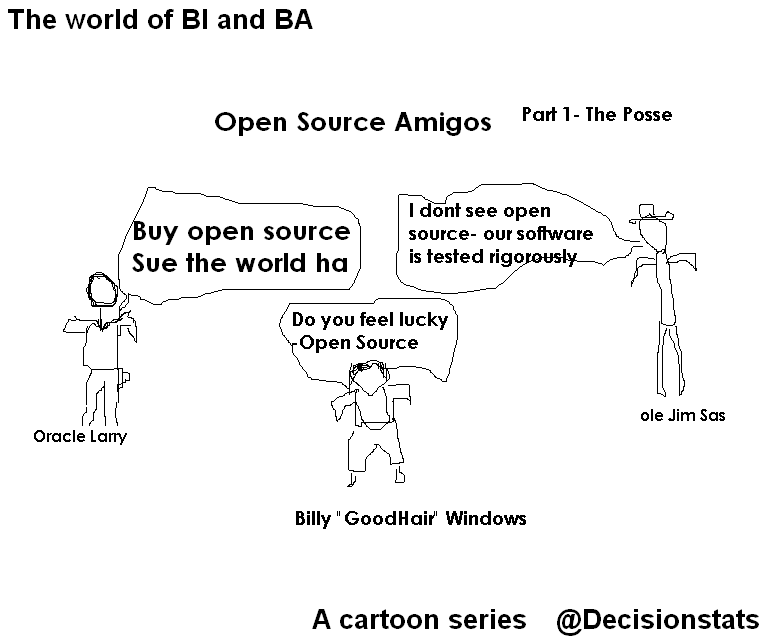
Ok I promised a weekly cartoon on Friday but it’s Saturday. Last week we spoofed Larry Ellison , Jim Goodnight and Bill Gates– people who created billions of taxes for the economy but would be regarded as evil by some open source guys- though they may have created more jobs for more families than the whole Federal Reserve Bank did in 2008-10. Jobs are necessary for families. Period.
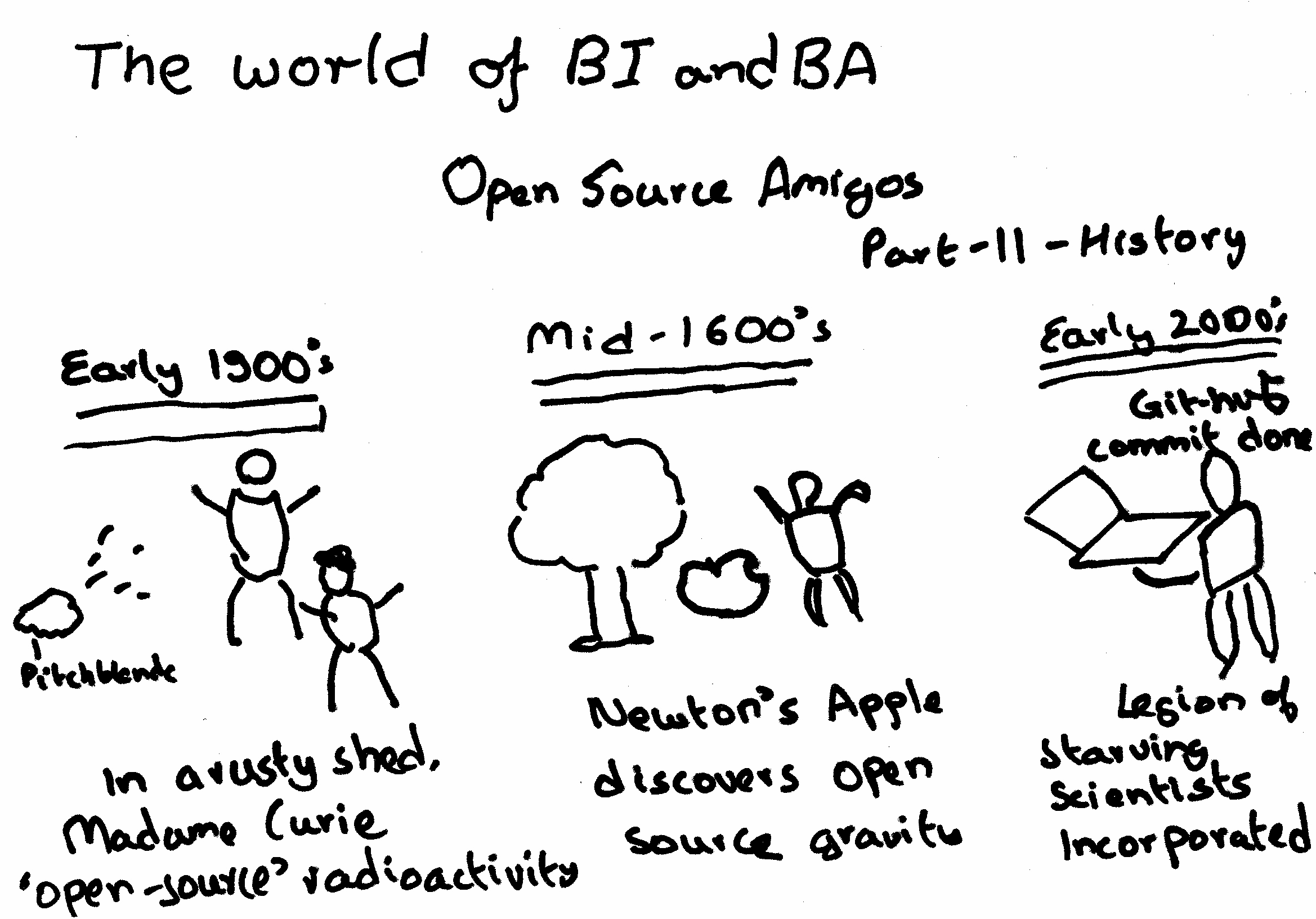
In Part 2- we see Open Source is actually older than Stallman (yes people are older than Stallman) – in fact open source has been around for far more time than even
Jim Goodnight’s current age- which can be revealed by using proc goodnight options=all.
The decision of quality open source makers to offer their software at bargain basement prices even to enterprise customers who are used to pay prices many times more-pricing is the reason open source software is taking a long time to command respect in enterprise software.
I hate to be the messenger who brings the bad news to my open source brethren-
but their worst nightmare is not the actions of their proprietary competitors like Oracle, SAP, SAS, Microsoft ( they hate each other even more than open source )
nor the collective marketing tactics which are textbook like (but referred as Fear Uncertainty Doubt by those outside that golden quartet)- it is their own communities and their own cheap pricing.
But James, why offer software to enterprise customers at one tenth the next competitor- one reason is open source companies more often than not compete more with their free community version software than with big proprietary packages.
Communities including academics are used to free- hey how about paying say 1$ for each download.
There are two million R users- if say even 50 % of them paid 1 $ as a lifetime license fee- you could sponsor enough new packages than twenty years of Google Summer of Code does right now.
Secondly, this pricing can easily be adjusted by shifting the licensing to say free for businesses less than 2 people (even for the enhanced corporate software version not just the plain vanilla community software thus further increasing the spread of the plain vanilla versions)- for businesses from 10 to 20 people offer a six month trial rather than one month trial.
– but adjust the pricing to much more realistic levels compared to competing software. Make enterprise software pay a real value.
That’s the only way to earn respect. as well as a few dollars more.
As for SAS, it is time it started ridiculing Python now that it has accepted R.
Pentaho and Jasper do give good great graphics in BI (Graphical display in BI is not a SAS forte though probably I dont know how much they cross sell JMP to BI customers- probably too much JMP is another division syndrome there)
Jim Goodnight – grand old man and Godfather of the Cosa Nostra of the BI/Database Analytics software industry said recently on open source in BI (btw R is generally termed in business analytics and NOT business intelligence software so these remarks were more apt to Pentaho and Jaspersoft )
Asked whether open source BI and data integration software from the likes of Jaspersoft, Pentaho and Talend is a growing threat, [Goodnight] said: “We haven’t noticed that a lot. Most of our companies need industrial strength software that has been tested, put through every possible scenario or failure to make sure everything works correctly.”
The first, labeled BI Platforms, is drawn fromGartner Market Share Analysis: Business Intelligence, Analytics and Performance Management Software, Worldwide, 2009, published May 2010 , and Gartner Dataquest Market Share: Business Intelligence, Analytics and Performance Management Software, Worldwide, 2009.
and
Advanced Analytics category.
and
so whats the performance of Talend, Pentaho and Jaspersoft
Achieved record revenue, more then doubling from 2008. The fourth quarter of 2009 was Talend’s tenth consecutive quarter of growth.
Grew customer base by 140% to over 1,000 customers, up from 420 at the end of 2008. Of these new customers, over 50% are Fortune 1000 companies.
Total downloads reached seven million, with over 300,000 users of the open source products.
Talend doubled its staff, increasing to 200 global employees. Continuing this trend, Talend has already hired 15 people in 2010 to support its rapid growth.
40% sequential growth most recent quarter. (I didn’t ask whether there was any reason to suspect seasonality.)
130% annual revenue growth run rate.
“Not quite” profitable.
Several hundred commercial subscribers, at an average of $25K annually per, including >100 in Europe.
9,000 paying customers of some kind.
100,000+ total deployments, “very conservatively,” counting OEMs as one deployment each and not double-counting for OEMs’ customers. (Nick said Business Objects quotes 45,000 deployments by the same standards.)
70% of revenue from the mid-market, defined as $100 million – $1 billion revenue. 30% from bigger enterprises. (Hmm. That begs a couple of questions, such as where OEM revenue comes in, and whether <$100 million enterprises were truly a negligible part of revenue.)
1) There is a complete lack of transparency in open source BI market shares as almost all these companies are privately held and do not disclose revenues.
2) What may be a pure play open source company may actually be a company funded by a big BI vendor (like Revolution Analytics is funded among others by Intel-Microsoft) and EnterpriseDB has IBM as an investor.MySQL and Sun of course are bought by Oracle
The degree of control by proprietary vendors on open source vendors is still not disclosed- whether they are holding a stake for strategic reasons or otherwise.
3) None of the Open Source Vendors are even close to a 1 Billion dollar revenue number.
Jim Goodnight is pointing out market reality when he says he has not seen much impact (in terms of market share). As for the rest of his remarks, well he’s got a job to do as CEO and thats talk up his company and trash the competition- which he as been doing for 3 decades and unlikely to change now unless there is severe market share impact. Unless you expect him to notice companies less than 5% of his size in revenue.
John Sall, founder SAS AND JMP , has released the latest blockbuster edition of flagship of JMP 9 (JMP Stands for John’s Macintosh Program).
To kill all birds with one software, it is integrated with R and SAS, and the brochure frankly lists all the qualities. Why am I excited for JMP 9 integration with R and with SAS- well it integrates bigger datasets manipulation (thanks to SAS) with R’s superb library of statistical packages and a great statistical GUI (JMP). This makes JMP the latest software apart from SAS/IML, Rapid Miner,Knime, Oracle Data Miner to showcase it’s R integration (without getting into the GPL compliance need for showing source code– it does not ship R- and advises you to just freely download R). I am sure Peter Dalgaard, and Frankie Harell are all overjoyed that R Base and Hmisc packages would be used by fellow statisticians and students for JMP- which after all is made in the neighborhood state of North Carolina.
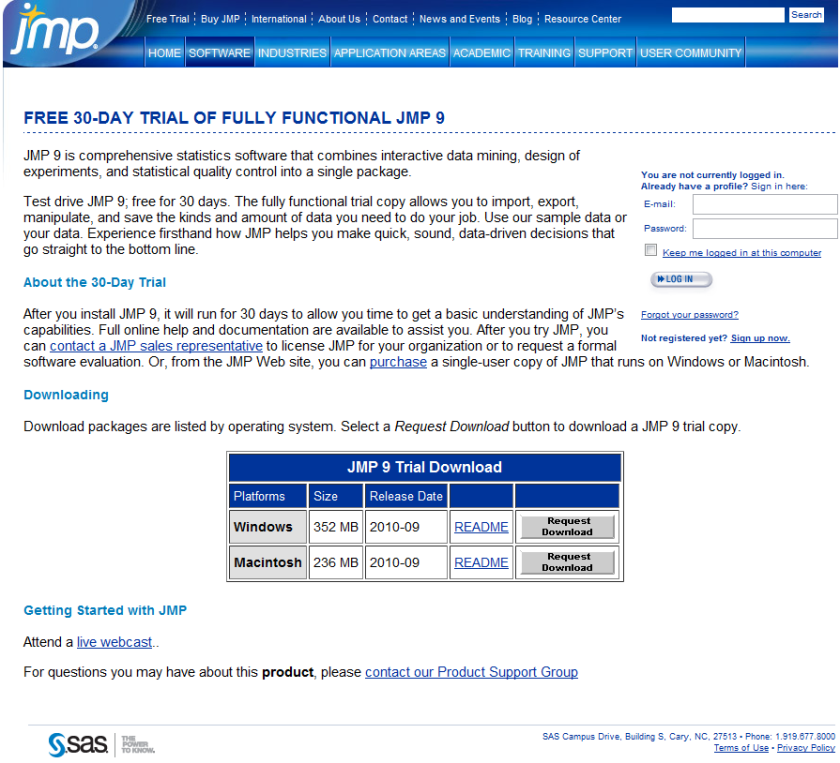
Best of all a JMP 30 day trial is free- so no money lost if you download JMP 9 (and no they dont ask for your credit card number, or do they- but they do have a huuuuuuge form to register before you download. Still JMP 9 the software itself is more thoughtfully designed than the email-prospect-leads-form and the extra functionality in the free 30 day trial is worth it.
R is a programming language and software environment for statistical computing and graphics. JMP now supports a set of JSL functions to access R. The JSL functions provide the following options:
• open and close a connection between JMP and R
• exchange data between JMP and R
•submit R code for execution
•display graphics produced by R
JMP and R each have their own sets of computational methods.
R has some methods that JMP does not have. Using JSL functions, you can connect to R and use these R computational methods from within JMP.
Textual output and error messages from R appear in the log window.R must be installed on the same computer as JMP.
though probably they are not creating a movie on Jim yet (imagine a movie titled “The Statistical Software” -not just the same dude feel as “The Social Network”)
China could be the biggest threat to India in next five years, positioning itself as the lowest-cost manpower supplier in the IT sector by 2015, according to Mr Vineet Nayar, CEO, HCL Technologies.
“I believe it (China) is the biggest threat in the next five years that we are going to face…So India will have to up its game,” he told reporters on sidelines of ‘Directions’, the company’s annual town hall.
Terming China, as both “threat and opportunity”, Mr Nayar said that India will have to find alternate “differentiators” than the ones it currently has. Despite issues of language and the purported inability to scale-up, China has sharpened its technological and innovation edge, he added.
“Look at the technology companies from China…how does that fit in with the assumption that they (China) do not understand English or technology. They are producing cutting edge technology at a price which is lower than everyone else,” he said.
Manpower
By 2015, Mr Nayar said, China will be the lowest cost manpower supplier in IT sector to the world
——————————————————————————————–
I wonder how he did his forecast. Did he do a time series analysis using a software, did he peer into his crystal ball, or did he spend a lot of time brainstorming with his strategic macro economic team on Chinese threat.
China has various advantages over India (and in fact the US)-
1) Big pool of reliable scientific manpower
2) State funded education in higher studies and STEM
3) Increasing exposure with the West-English speaking is no longer an issue. Almost 50 % of Grad Students in the US in STEM and certain sectors are Chinese and they not only retain fraternal ties with the motherland- they often remain un-assimilated with American Culture mainstream. or they have a separate interaction with fellow American Chinese and seperate with American Americans.
Chinese suffer from some disadvantages in software-
1) Communism Perception- Just because the Govt is communist and likes to confront US once a year (and India twice a month)- is no excuse for the hapless Chinese startup guy to lose out on software outsourcing contracts. unfortunately there have been reported cases where sneak codes have been inserted in code deliverables for American partners, just like American companies are forced to work with DoD (especially in software, embedded chips and telecom)
If you have 10000 lines of code delivered by your Chinese partner, how sure are you of going through each line of code for each sub routine or call procedure.
2) English- Chinese accent is like Chinese cooking. Unique- many Chinese are unable to master the different style of English even after years (derived from Latin and Indo European class of languages)
Sales jobs tend to go to American trained Chinese or to Westerners.
In Indian software companies, accent is a lesser problem.
———————————————————————————-
The biggest threat to Indian software in 5 years is actually Indian software itself- Can it evolve and mature to a product based model from a service only model.
Can Indian software partner with Chinese companies and maybe teach the Indian government why friendship is more profitable than envy and suspicion. If the US and China can trade enormously despite annual tensions, why cant Indian services do the same- if they lose this opportunity, US companies will likely bypass them and create the same GE/McKinsey style backoffices that started the Indian offshoring phenomenon.
3) Lastly- what did the poor American grad student do to deserve that even if devotes years to study STEM (and being called a Geek and Nerd) his job will get outsourced to India or China (if not now- in his 30s or worse in his 40s). Talk to any middle aged IT chap in the US who is middle class- and India and China would figure in why he still worries about his overpriced mortgage.
Unless the US wants only Twitter and Facebook as dominant technologies in the 21 st century.
Here is an interview with John F Moore, social media adviser,technologist and founder and CEO of The Lab.
Ajay- The internet seems to be crowded by social media experts with everyone who spends a lot of time on the internet claiming to be one? How does a small business owner on a budget distinguish for the correct value proposition that social media can give them.
John- You’re right. It seems like everytime I turn around I bump into more social media “experts”. The majority of these self-proclaimed experts are not adding a great deal of value. When looking to spend money for help ask the person a few questions about their approach. Things you should be hearing include:
The expert should be seeking to fully understand your business, your goals, your available resources, etc..
The expert should be seeking to understand current management thinking about social media and related technologies.
If the expert is purely focused on tools they are the wrong person. Your solution may require tools alone but they cannot know this without first understanding your business.
Ajay- Facebook has 600 million people, with people preferring to play games and connect to old acquaintances rather than use social media for tangible career or business benefit..
John- People are definitely spending time playing games, looking at photos, and catching up with old friends. However, there are many businesses seeing real value from Facebook (primarily by tying it into their e-mail marketing and using coupons and other incentives). For example, I recently shared a small case study (http://thejohnfmoore.com/2010/10/07/email-social-media-and-coupons-makes-the-cfo-smile/) where a small pet product company achieved a 22% bump in monthly revenue by combining Facebook and coupons together. In fact,45% of this bump in revenue came from new clients. Customer acquisition and increased revenue were accomplished by using Facebook for their business.
Ajay- How does a new social media convert (individual) go on selecting communities to join (Facebook,Twitter,Linkedin,Ning, Ping,Orkut, Empire Avenue etc etc.
How does a small business owner take the same decision.
John- It always starts with taking the time to define your goals and then determine how much time and effort you are willing to invest. For example:
LinkedIn. A must have for individuals as it is one of the key social networking communities for professional networking. Individuals should join groups that are relevant to their career and invest an hour a week. Businesses should ensure they have a business profile completed and up to date.
Facebook can be a challenge for anyone trying to walk the personal/professional line. However, from a business standpoint you should be creating a Facebook page that you can use to compliment your other marketing channels.
Twitter. It is a great network to learn of, to meet, and to interact with people from around the world. I have met thousands of interesting people, many of which I have had the pleasure to meet with in real life. Businesses need to invest in listening on twitter to determine if their customers (current or potential) or competitors are already there discussing them, their marketplace, or their offerings.
In all cases I would encourage businesses to setup social media accounts on LinkedIn, Facebook, Twitter, YouTube, and Flickr. You want to ensure your brand is protected by owning these accounts and ensuring at least the base information is accurate.
Ajay- Name the top 5 points that you think make a social media community successful. What are the top 5 points for a business to succeed in their social media strategy.
John-
Define your goals up front. Understand why you are building a community and keep this goal in mind.
Provide education. Ideally you want to become a thought leader in your space, the trusted resource that people can turn to even if they are not using your product or services today.
Be honest. We all make mistakes. When you do, be honest with your community and engage them in any fall-out that may be coming out of your mistake.
Listen to them. Use platforms like BubbleIdeas to gather feedback on what your community is looking for from the relationship.
Measure. Are you on track with your goals? Do your goals need to change?
Ajay- What is the unique value proposition that “The Lab” offers
John- The Lab understands the strategic importance of leveraging social media, management and leadership best practices, and our understanding of local government and small and medium business to help people in these areas achieve their goals. Too many consultants come to the table with a predefined solution that really misses the mark as it lacks understanding of the client’s goals.
Ajay- What is “CityCamp in Boston” all about.
John- CityCamp is a FREE unconference focused on innovation for municipal governments and community organizations (http://www.citycampboston.org/what-is-citycamp-boston/). It brings together politicians, local municipal employees, citizens, vendors, developers, and journalist to build a common understanding of local government challenges and then works to deliver measurable outcomes following the event. The key is the focus on change management, driving change as opposed to just in the moment education.
Biography-
John F Moore is the Founder and CEO of The Lab (http://thelabinboston.com). John has experience working with local governments and small and medium business owners to achieve their goals. His experience with social media strategies, CRM, and a plethora of other solutions provides immense value to all of our clients. He has built engineering organizations, learned sales and marketing, run customer service teams, and built and executed strategies for social media thought leadership and branding. He is also a prolific blogger as you can see by checking out his blog at http://thejohnfmoore.com.
Often I am asked by clients, friends and industry colleagues on the suitability or unsuitability of particular software for analytical needs. My answer is mostly-
It depends on-
1) Cost of Type 1 error in purchase decision versus Type 2 error in Purchase Decision. (forgive me if I mix up Type 1 with Type 2 error- I do have some weird childhood learning disabilities which crop up now and then)
Here I define Type 1 error as paying more for a software when there were equivalent functionalities available at lower price, or buying components you do need , like SPSS Trends (when only SPSS Base is required) or SAS ETS, when only SAS/Stat would do.
The first kind is of course due to the presence of free tools with GUI like R, R Commander and Deducer (Rattle does have a 500$ commercial version).
The emergence of software vendors like WPS (for SAS language aficionados) which offer similar functionality as Base SAS, as well as the increasing convergence of business analytics (read predictive analytics), business intelligence (read reporting) has led to somewhat brand clutter in which all softwares promise to do everything at all different prices- though they all have specific strengths and weakness. To add to this, there are comparatively fewer business analytics independent analysts than say independent business intelligence analysts.
2) Type 2 Error- In this case the opportunity cost of delayed projects, business models , or lower accuracy – consequences of buying a lower priced software which had lesser functionality than you required.
To compound the magnitude of error 2, you are probably in some kind of vendor lock-in, your software budget is over because of buying too much or inappropriate software and hardware, and still you could do with some added help in business analytics. The fear of making a business critical error is a substantial reason why open source software have to work harder at proving them competent. This is because writing great software is not enough, we need great marketing to sell it, and great customer support to sustain it.
As Business Decisions are decisions made in the constraints of time, information and money- I will try to create a software purchase matrix based on my knowledge of known softwares (and unknown strengths and weakness), pricing (versus budgets), and ranges of data handling. I will add in basically an optimum approach based on known constraints, and add in flexibility for unknown operational constraints.
I will restrain this matrix to analytics software, though you could certainly extend it to other classes of enterprise software including big data databases, infrastructure and computing.
Noted Assumptions- 1) I am vendor neutral and do not suffer from subjective bias or affection for particular software (based on conferences, books, relationships,consulting etc)
2) All software have bugs so all need customer support.
3) All software have particular advantages , strengths and weakness in terms of functionality.
4) Cost includes total cost of ownership and opportunity cost of business analytics enabled decision.
5) All software marketing people will praise their own software- sometimes over-selling and mis-selling product bundles.
Software compared are SPSS, KXEN, R,SAS, WPS, Revolution R, SQL Server, and various flavors and sub components within this. Optimized approach will include parallel programming, cloud computing, hardware costs, and dependent software costs.







 DECISION STATS