Predictive Analytics World March2011 SF

USGS Satellite photo of the San Francisco Bay ...
Image via Wikipedia

Message from PAWCON-


Predictive Analytics World, Mar 14-15 2011, San Francisco, CA

More info: pawcon.com/sanfrancisco

Agenda at-a-glance: pawcon.com/sanfrancisco/2011/agenda_overview.php

PAW’s San Francisco 2011 program is the richest and most diverse yet, including over 30 sessions across two tracks – an “All Audiences” and an “Expert/Practitioner” track — so you can witness how predictive analytics is applied at Bank of America, Bank of the West, Best Buy, CA State Automobile Association, Cerebellum Capital, Chessmetrics, Fidelity, Gaia Interactive, GE Capital, Google, HealthMedia, Hewlett Packard, ICICI Bank (India), MetLife, Monster.com, Orbitz, PayPal/eBay, Richmond, VA Police Dept, U. of Melbourne, Yahoo!, YMCA, and a major N. American telecom, plus insights from projects for Anheiser-Busch, the SSA, and Netflix.

PAW’s agenda covers hot topics and advanced methods such as uplift modeling (net lift), ensemble models, social data (6 sessions on this), search marketing, crowdsourcing, blackbox trading, fraud detection, risk management, survey analysis, and other innovative applications that benefit organizations in new and creative ways.

Predictive Analytics World is the only conference of its kind, delivering vendor-neutral sessions across verticals such as banking, financial services, e-commerce, education, government, healthcare, high technology, insurance, non-profits, publishing, social gaming, retail and telecommunications

And PAW covers the gamut of commercial applications of predictive analytics, including response modeling, customer retention with churn modeling, product recommendations, fraud detection, online marketing optimization, human resource decision-making, law enforcement, sales forecasting, and credit scoring.

WORKSHOPS. PAW also features pre- and post-conference workshops that complement the core conference program. Workshop agendas include advanced predictive modeling methods, hands-on training and enterprise decision management.

More info: pawcon.com/sanfrancisco

Agenda at-a-glance: pawcon.com/sanfrancisco/2011/agenda_overview.php

Be sure to register by Dec 7 for the Super Early Bird rate (save $400):
pawcon.com/sanfrancisco/register.php

If you’d like our informative event updates, sign up at:
pawcon.com/signup-us.php

Nice BI Tutorials

Tutorials screenshot.
Image via Wikipedia

Here is a set of very nice, screenshot enabled tutorials from SAP BI. They are a bit outdated (3 years old) but most of it is quite relevant- especially from a Tutorial Design Perspective –

Most people would rather see screenshot based step by step powerpoints, than cluttered or clever presentations , or even videos that force you to sit like a TV zombie. Unfortunately most tutorial presentations I see especially for BI are either slides with one or two points, that abruptly shift to “concepts” or videos that are atleast more than 10 minutes long. That works fine for scripting tutorials or hands on workshops, but cannot be reproduced for later instances of study.

The mode of tutorials especially for GUI software can vary, it may be Slideshare, Scribd, Google Presentation,Microsoft Powerpoint but a step by step screenshot by screenshot tutorial is much better for understanding than commando line jargon/ Youtub   Videos presentations, or Powerpoint with Points.

Have a look at these SAP BI 7 slideshares

and

Speaking of BI, the R Package called Brew is going to brew up something special especially combined with R Apache. However I wish R Apache, or R Web, or RServe had step by step install screenshot tutorials to increase their usage in Business Intelligence.

I tried searching for JMP GUI Tutorials too, but I believe putting all your content behind a registration wall is not so great. Do a Pareto Analysis of your training material, surely you can share a couple more tutorials without registration. It also will help new wanna-migrate users to get a test and feel for the installation complexities as well as final report GUI.


SAS for Job Interviews

SAS Institute, Solutions
Image via Wikipedia

Yeah. I hope someone wrote a book like that.

Basically,

  1. Libname
  2. Proc Datasets
  3. Proc Import
  4. Proc Contents
  5. Proc Freq
  6. Proc Means
  7. Proc Univariate
  8. Proc Reg
  9. Proc Logistic
  10. Proc Export (to excel where you do the graphs)
  11. ODS
  12. Proc Tabulate

(note – it would be interesting to do a proc freq on all procs say used say on SAS On Demand)

Any thing else is not needed for a entry level job for a fresh grad student or job for a veteran re-trained worker.

Just like society needs science and commerce as twin pillars, analytics needs SAS (great Marketing) and R (great research) for expanding the pie of analytics which is woefully underutilized and stupidly overcapitalized by jazzy-copy-paste-data-from-query- software disguised as “intelligent software”.  R has no certification and no formal training for jobs (as yet) though this should change. SAS looks great (still) for getting jobs for grad students. R looks great (yup) for getting research jobs probably not corporate analytics jobs ?What do you think?


Interesting R competition at Reddit

Image representing Reddit as depicted in Crunc...
Image via CrunchBase

Here is an interesting R competition going on at Reddit and it is to help Reddit make a recommendation engine 🙂

http://www.reddit.com/r/redditdev/comments/dtg4j/want_to_help_reddit_build_a_recommender_a_public/

by ketralnis

As promised, here is the big dump of voting information that you guys donated to research. Warning: this contains much geekery that may result in discomfort for the nerd-challenged.

I’m trying to use it to build a recommender, and I’ve got some preliminary source code. I’m looking for feedback on all of these steps, since I’m not experienced at machine learning.

Here’s what I’ve done

  • I dumped all of the raw data that we’ll need to generate the public dumps. The queries are the comments in the two .pig files and it took about 52 minutes to do the dump against production. The result of this raw dump looks like:
    $ wc -l *.dump
     13,830,070 reddit_data_link.dump
    136,650,300 reddit_linkvote.dump
         69,489 reddit_research_ids.dump
     13,831,374 reddit_thing_link.dump
    
  • I filtered the list of votes for the list of users that gave us permission to use their data. For the curious, that’s 67,059 users: 62,763 with “public votes” and 6,726 with “allow my data to be used for research”. I’d really like to see that second category significantly increased, and hopefully this project will be what does it. This filtering is done by srrecs_researchers.pig and took 83m55.335s on my laptop.
  • I converted data-dumps that were in our DB schema format to a more useable format using srrecs.pig(about 13min)
  • From that dump I mapped all of the account_ids, link_ids, and sr_ids to salted hashes (using obscure() insrrecs.py with a random seed, so even I don’t know it). This took about 13min on my laptop. The result of this, votes.dump is the file that is actually public. It is a tab-separated file consisting in:
    account_id,link_id,sr_id,dir
    

    There are 23,091,688 votes from 43,976 users over 3,436,063 links in 11,675 reddits. (Interestingly these ~44k users represent almost 17% of our total votes). The dump is 2.2gb uncompressed, 375mb in bz2.

What to do with it

The recommendations system that I’m trying right now turns those votes into a set of affinities. That is, “67% of user #223’s votes on /r/reddit.com are upvotes and 52% on programming). To make these affinities (55m45.107s on my laptop):

 cat votes.dump | ./srrecs.py "affinities_m()" | sort -S200m | ./srrecs.py "affinities_r()" > affinities.dump

Then I turn the affinities into a sparse matrix representing N-dimensional co-ordinates in the vector space of affinities (scaled to -1..1 instead of 0..1), in the format used by R’s skmeans package (less than a minute on my laptop). Imagine that this matrix looks like

          reddit.com pics       programming horseporn  bacon
          ---------- ---------- ----------- ---------  -----
ketralnis -0.5       (no votes) +0.45       (no votes) +1.0
jedberg   (no votes) -0.25      +0.95       +1.0       -1.0
raldi     +0.75      +0.75      +0.7        (no votes) +1.0
...

We build it like:

# they were already grouped by account_id, so we don't have to
# sort. changes to the previous step will probably require this
# step to have to sort the affinities first
cat affinities.dump | ./srrecs.py "write_matrix('affinities.cm', 'affinities.clabel', 'affinities.rlabel')"

I pass that through an R program srrecs.r (if you don’t have R installed, you’ll need to install that, and the packageskmeans like install.packages('skmeans')). This program plots the users in this vector space finding clusters using a sperical kmeans clustering algorithm (on my laptop, takes about 10 minutes with 15 clusters and 16 minutes with 50 clusters, during which R sits at about 220mb of RAM)

# looks for the files created by write_matrix in the current directory
R -f ./srrecs.r

The output of the program is a generated list of cluster-IDs, corresponding in order to the order of user-IDs inaffinities.clabel. The numbers themselves are meaningless, but people in the same cluster ID have been clustered together.

Here are the files

These are torrents of bzip2-compressed files. If you can’t use the torrents for some reason it’s pretty trivial to figure out from the URL how to get to the files directly on S3, but please try the torrents first since it saves us a few bucks. It’s S3 seeding the torrents anyway, so it’s unlikely that direct-downloading is going to go any faster or be any easier.

  • votes.dump.bz2 — A tab-separated list of:
    account_id, link_id, sr_id, direction
    
  • For your convenience, a tab-separated list of votes already reduced to percent-affinities affinities.dump.bz2, formatted:
    account_id, sr_id, affinity (scaled 0..1)
    
  • For your convenience, affinities-matrix.tar.bz2 contains the R CLUTO format matrix files affinities.cm,affinities.clabelaffinities.rlabel

And the code

  • srrecs.pigsrrecs_researchers.pig — what I used to generate and format the dumps (you probably won’t need this)
  • mr_tools.pysrrecs.py — what I used to salt/hash the user information and generate the R CLUTO-format matrix files (you probably won’t need this unless you want different information in the matrix)
  • srrecs.r — the R-code to generate the clusters

Here’s what you can experiment with

  • The code isn’t nearly useable yet. We need to turn the generated clusters into an actual set of recommendations per cluster, preferably ordered by predicted match. We probably need to do some additional post-processing per user, too. (If they gave us an affinity of 0% to /r/askreddit, we shouldn’t recommend it, even if we predicted that the rest of their cluster would like it.)
  • We need a test suite to gauge the accuracy of the results of different approaches. This could be done by dividing the data-set in and using 80% for training and 20% to see if the predictions made by that 80% match.
  • We need to get the whole process to less than two hours, because that’s how often I want to run the recommender. It’s okay to use two or three machines to accomplish that and a lot of the steps can be done in parallel. That said we might just have to accept running it less often. It needs to run end-to-end with no user-intervention, failing gracefully on error
  • It would be handy to be able to idenfity the cluster of just a single user on-the-fly after generating the clusters in bulk
  • The results need to be hooked into the reddit UI. If you’re willing to dive into the codebase, this one will be important as soon as the rest of the process is working and has a lot of room for creativity
  • We need to find the sweet spot for the number of clusters to use. Put another way, how many different types of redditors do you think there are? This could best be done using the aforementioned test-suite and a good-old-fashioned binary search.

Some notes:

  • I’m not attached to doing this in R (I don’t even know much R, it just has a handy prebaked skmeans implementation). In fact I’m not attached to my methods here at all, I just want a good end-result.
  • This is my weekend fun project, so it’s likely to move very slowly if we don’t pick up enough participation here
  • The final version will run against the whole dataset, not just the public one. So even though I can’t release the whole dataset for privacy reasons, I can run your code and a test-suite against it

——————————————————————————————-


I am thinking of using Rattle and using the arules package, and running it on the EC2 to get the horsepower.

How else do you think you can tackle a recommendation engine problem.


Ajay


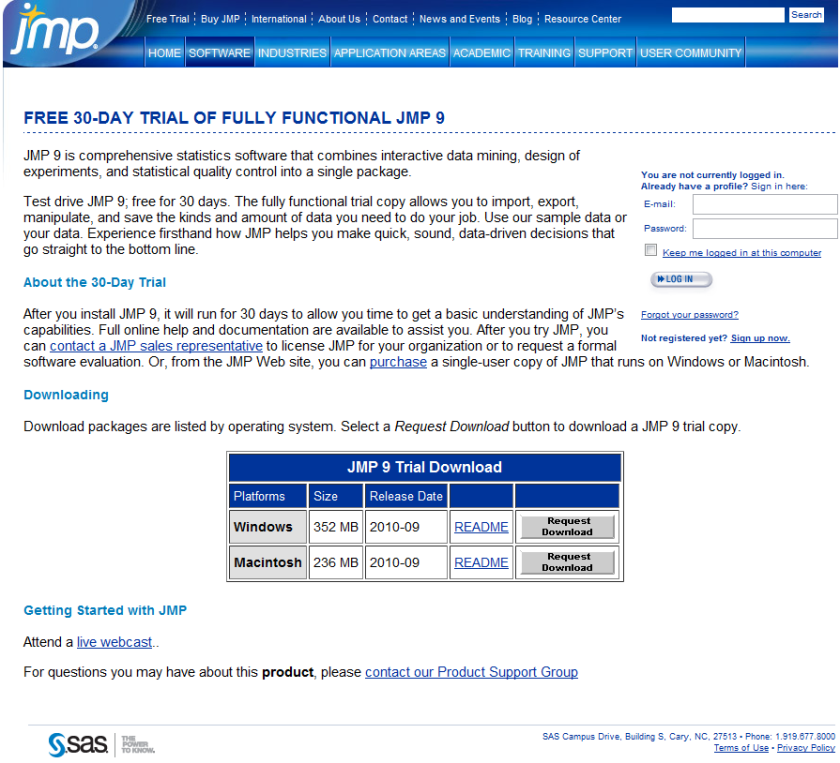
John Sall sets JMP 9 free to tango with R


Diagnostic graphs produced by plot.lm() functi...
Image via Wikipedia


John Sall, founder SAS AND JMP , has released the latest blockbuster edition of flagship of JMP 9 (JMP Stands for John’s Macintosh Program).

To kill all birds with one software, it is integrated with R and SAS, and the brochure frankly lists all the qualities. Why am I excited for JMP 9 integration with R and with SAS- well it integrates bigger datasets manipulation (thanks to SAS) with R’s superb library of statistical packages and a great statistical GUI (JMP). This makes JMP the latest software apart from SAS/IML, Rapid Miner,Knime, Oracle Data Miner to showcase it’s R integration (without getting into the GPL compliance need for showing source code– it does not ship R- and advises you to just freely download R). I am sure Peter Dalgaard, and Frankie Harell are all overjoyed that R Base and Hmisc packages would be used by fellow statisticians  and students for JMP- which after all is made in the neighborhood state of North Carolina.

Best of all a JMP 30 day trial is free- so no money lost if you download JMP 9 (and no they dont ask for your credit card number, or do they- but they do have a huuuuuuge form to register before you download. Still JMP 9 the software itself is more thoughtfully designed than the email-prospect-leads-form and the extra functionality in the free 30 day trial is worth it.

Also see “New Features  in JMP 9  http://www.jmp.com/software/jmp9/pdf/new_features.pdf

which has this regarding R.

Working with R

R is a programming language and software environment for statistical computing and graphics. JMP now  supports a set of JSL functions to access R. The JSL functions provide the following options:

• open and close a connection between JMP and R

• exchange data between JMP and R

•submit R code for execution

•display graphics produced by R

JMP and R each have their own sets of computational methods.

R has some methods that JMP does not have. Using JSL functions, you can connect to R and use these R computational methods from within JMP.

Textual output and error messages from R appear in the log window.R must be installed on the same computer as JMP.

JMP is not distributed with a copy of R. You can download R from the Comprehensive R Archive Network Web site:http://cran.r-project.org

Because JMP is supported as both a 32-bit and a 64-bit Windows application, you must install the corresponding 32-bit or 64-bit version of R.

For details, see the Scripting Guide book.

and the download trial page ( search optimized URL) –

http://www.sas.com/apps/demosdownloads/jmptrial9_PROD__sysdep.jsp?packageID=000717&jmpflag=Y

In related news (Richest man in North Carolina also ranks nationally(charlotte.news14.com) , Jim Goodnight is now just as rich as Mark Zuckenberg, creator of Facebook-

though probably they are not creating a movie on Jim yet (imagine a movie titled “The Statistical Software” -not just the same dude feel as “The Social Network”)

See John’s latest interview :

The People Behind the Software: John Sall

http://blogs.sas.com/jmp/index.php?/archives/352-The-People-Behind-the-Software-John-Sall.html

Interview John Sall Founder JMP/SAS Institute

https://decisionstats.com/2009/07/28/interview-john-sall-jmp/

SAS Early Days

https://decisionstats.com/2010/06/02/sas-early-days/

Which software do we buy? -It depends

Software (novel)
Image via Wikipedia

Often I am asked by clients, friends and industry colleagues on the suitability or unsuitability of particular software for analytical needs.  My answer is mostly-

It depends on-

1) Cost of Type 1 error in purchase decision versus Type 2 error in Purchase Decision. (forgive me if I mix up Type 1 with Type 2 error- I do have some weird childhood learning disabilities which crop up now and then)

Here I define Type 1 error as paying more for a software when there were equivalent functionalities available at lower price, or buying components you do need , like SPSS Trends (when only SPSS Base is required) or SAS ETS, when only SAS/Stat would do.

The first kind is of course due to the presence of free tools with GUI like R, R Commander and Deducer (Rattle does have a 500$ commercial version).

The emergence of software vendors like WPS (for SAS language aficionados) which offer similar functionality as Base SAS, as well as the increasing convergence of business analytics (read predictive analytics), business intelligence (read reporting) has led to somewhat brand clutter in which all softwares promise to do everything at all different prices- though they all have specific strengths and weakness. To add to this, there are comparatively fewer business analytics independent analysts than say independent business intelligence analysts.

2) Type 2 Error- In this case the opportunity cost of delayed projects, business models , or lower accuracy – consequences of buying a lower priced software which had lesser functionality than you required.

To compound the magnitude of error 2, you are probably in some kind of vendor lock-in, your software budget is over because of buying too much or inappropriate software and hardware, and still you could do with some added help in business analytics. The fear of making a business critical error is a substantial reason why open source software have to work harder at proving them competent. This is because writing great software is not enough, we need great marketing to sell it, and great customer support to sustain it.

As Business Decisions are decisions made in the constraints of time, information and money- I will try to create a software purchase matrix based on my knowledge of known softwares (and unknown strengths and weakness), pricing (versus budgets), and ranges of data handling. I will add in basically an optimum approach based on known constraints, and add in flexibility for unknown operational constraints.

I will restrain this matrix to analytics software, though you could certainly extend it to other classes of enterprise software including big data databases, infrastructure and computing.

Noted Assumptions- 1) I am vendor neutral and do not suffer from subjective bias or affection for particular software (based on conferences, books, relationships,consulting etc)

2) All software have bugs so all need customer support.

3) All software have particular advantages , strengths and weakness in terms of functionality.

4) Cost includes total cost of ownership and opportunity cost of business analytics enabled decision.

5) All software marketing people will praise their own software- sometimes over-selling and mis-selling product bundles.

Software compared are SPSS, KXEN, R,SAS, WPS, Revolution R, SQL Server,  and various flavors and sub components within this. Optimized approach will include parallel programming, cloud computing, hardware costs, and dependent software costs.

To be continued-


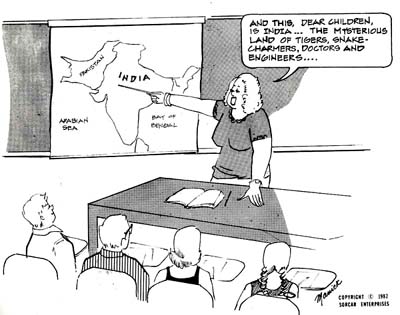
India to make own DoS -citing cyber security

After writing code for the whole world, Indian DoD (Department of Defense) has decided to start making it’s own Operating System citing cyber security. Presumably they know all about embedded code in chips, sneak kill code routines in dependent packages in operating system, and would not be using Linus Trovald’s original kernel (maybe the website was hacked to insert a small call k function 😉

as the ancient Chinese said- May you live in interesting times. Still cyber wars are better than real wars- and StuxNet virus is but a case study why countries can kill enemy plans without indulging in last century tactics.

Source-Manick Sorcar, The great Indian magician

http://www.manicksorcar.com/cartoon33.jpg

http://timesofindia.indiatimes.com/tech/news/software-services/Security-threat-DRDO-to-make-own-OS/articleshow/6719375.cms

BANGALORE: India would develop its own futuristic computer operating system to thwart attempts of cyber attacks and data theft and things of that nature, a top defence scientist said.

Dr V K Saraswat, Scientific Adviser to the Defence Minister, said the DRDO has just set up a software development  centre each here and in Delhi, with the mandate develop such a system. This “national effort” would be spearheaded by the  Defence Research and Development Organisation (DRDO) in partnership with software companies in and around Bangalore,  Hyderabad and Delhi as also academic institutions like Indian Institute of Science Bangalore and IIT Chennai, among others.

“There are many gaps in our software areas; particularly we don’t have our own operating system,” said  Saraswat, also Director General of DRDO and Secretary, Defence R & D. India currently uses operating systems developed by western countries.

Read more: Security threat: DRDO to make own OS – The Times of India http://timesofindia.indiatimes.com/tech/news/software-services/Security-threat-DRDO-to-make-own-OS/articleshow/6719375.cms#ixzz1227Y3oHg