The White Man's Burden-Poem

Rudyard Kipling, The White Man’s Burden

Take up the White Man’s burden–Send forth the best ye breed–

Go bind your sons to exile To serve your captives’ need;

To wait in heavy harness, On fluttered folk and wild–

Your new-caught, sullen peoples, Half-devil and half-child.

Take up the White Man’s burden–In patience to abide,

To veil the threat of terror And check the show of pride;

By open speech and simple, An hundred times made plain

To seek another’s profit, And work another’s gain.

Take up the White Man’s burden– The savage wars of peace–

Fill full the mouth of Famine And bid the sickness cease;

And when your goal is nearest The end for others sought,

Watch sloth and heathen Folly Bring all your hopes to nought.

Take up the White Man’s burden–No tawdry rule of kings,

But toil of serf and sweeper–The tale of common things.

The ports ye shall not enter,The roads ye shall not tread,

Go mark them with your living,And mark them with your dead.

Take up the White Man’s burden–And reap his old reward:

The blame of those ye better,The hate of those ye guard–

The cry of hosts ye humour (Ah, slowly!) toward the light:–

“Why brought he us from bondage, Our loved Egyptian night?”

Take up the White Man’s burden–Ye dare not stoop to less–

Nor call too loud on Freedom To cloke your weariness;

By all ye cry or whisper, By all ye leave or do,

The silent, sullen peoples Shall weigh your gods and you.

Take up the White Man’s burden– Have done with childish days–

The lightly proferred laurel, The easy, ungrudged praise.

Comes now, to search your manhood Through all the thankless years

Cold, edged with dear-bought wisdom, The judgment of your peers!

This famous poem, written by Britain‘s imperial poet, was a response to the American take over of the Phillipines after the Spanish-American War.(published in 1899)

source

http://www.fordham.edu/halsall/mod/kipling.html

UPDATE Twitter starts using Speedbit (powered by Yahoo-Bing?) for search

UPDATED Twitter is back to usual search results. It may have been a test of new (or newer twitter) which got live before it should be.

EARLIER POST

Unbelievable-!

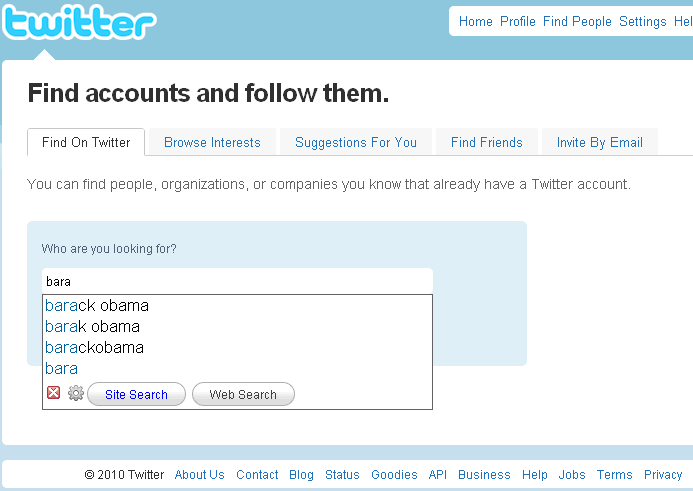
Go to twitter-I did

http://twitter.com/invitations/find_on_twitter

and search for keywords

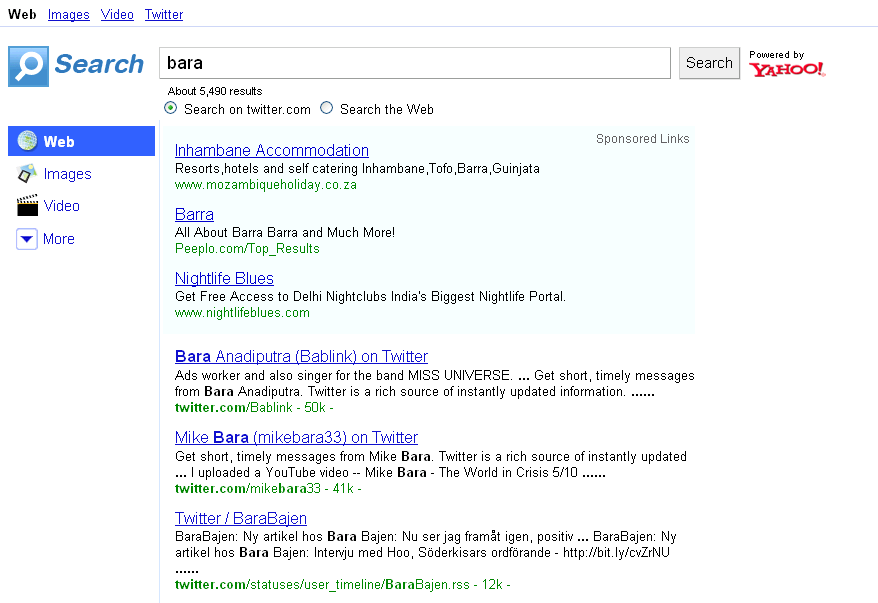
When you hit search you go to Speedbit, powered by Yahoo!

http://start.speedbit.com/search.aspx?site=suggest&cnl=7645705662&sitesearch=twitter.com&q=bara&bi=255309&si=7124&cc=IN&pop=0


Parallel Programming using R in Windows

Ashamed at my lack of parallel programming, I decided to learn some R Parallel Programming (after all parallel blogging is not really respect worthy in tech-geek-ninja circles).

So I did the usual Google- CRAN- search like a dog thing only to find some obstacles.

Obstacles-

Some Parallel Programming Packages like doMC are not available in Windows

http://cran.r-project.org/web/packages/doMC/index.html

Some Parallel Programming Packages like doSMP depend on Revolution’s Enterprise R (like –

http://blog.revolutionanalytics.com/2009/07/simple-scalable-parallel-computing-in-r.html

and http://www.r-statistics.com/2010/04/parallel-multicore-processing-with-r-on-windows/ (No the latest hack didnt work)

or are in testing like multicore (for Windows) so not available on CRAN

http://cran.r-project.org/web/packages/multicore/index.html

fortunately available on RForge

http://www.rforge.net/multicore/files/

Revolution did make DoSnow AND foreach available on CRAN

see http://blog.revolutionanalytics.com/2009/08/parallel-programming-with-foreach-and-snow.html

but the documentation in SNOW is overwhelming (hint- I use Windows , what does that tell you about my tech acumen)

http://sekhon.berkeley.edu/snow/html/makeCluster.html and

http://www.stat.uiowa.edu/~luke/R/cluster/cluster.html

what is a PVM or MPI? and SOCKS are for wearing or getting lost in washers till I encountered them in SNOW


Finally I did the following-and made the parallel programming work in Windows using R

require(doSNOW)
cl<-makeCluster(2) # I have two cores
registerDoSNOW(cl)
# create a function to run in each itteration of the loop

check <-function(n) {

+ for(i in 1:1000)

+ {

+ sme <- matrix(rnorm(100), 10,10)

+ solve(sme)

+ }

+ }
times <- 100     # times to run the loop
system.time(x <- foreach(j=1:times ) %dopar% check(j))
user  system elapsed
0.16    0.02   19.17
system.time(for(j in 1:times ) x <- check(j))
user  system elapsed</pre>
39.66    0.00   40.46

stopCluster(cl)

And it works!

Matlab-Mathematica-R and GPU Computing

Matlab announced they have a parallel computing toolbox- specially to enable GPU computing as well

http://www.mathworks.com/products/parallel-computing/

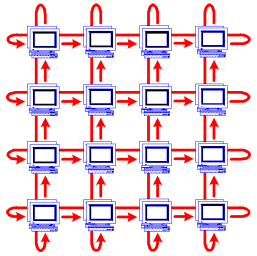
Parallel Computing Toolbox™ lets you solve computationally and data-intensive problems using multicore processors, GPUs, and computer clusters. High-level constructs—parallel for-loops, special array types, and parallelized numerical algorithms—let you parallelize MATLAB® applications without CUDA or MPI programming. You can use the toolbox with Simulink® to run multiple simulations of a model in parallel.

MATLAB GPU Support

The toolbox provides eight workers (MATLAB computational engines) to execute applications locally on a multicore desktop. Without changing the code, you can run the same application on a computer cluster or a grid computing service (using MATLAB Distributed Computing Server™). You can run parallel applications interactively or in batch.

Parallel Computing with MATLAB on Amazon Elastic Compute Cloud (EC2)

Also a video of using Mathematica and GPU

Also R has many packages for GPU computing

Parallel computing: GPUs

from http://cran.r-project.org/web/views/HighPerformanceComputing.html

  • The gputools package by Buckner provides several common data-mining algorithms which are implemented using a mixture of nVidia‘s CUDA langauge and cublas library. Given a computer with an nVidia GPU these functions may be substantially more efficient than native R routines. The rpud package provides an optimised distance metric for NVidia-based GPUs.
  • The cudaBayesreg package by da Silva implements the rhierLinearModel from the bayesm package using nVidia’s CUDA langauge and tools to provide high-performance statistical analysis of fMRI voxels.
  • The rgpu package (see below for link) aims to speed up bioinformatics analysis by using the GPU.
  • The magma package provides an interface to the hybrid GPU/CPU library Magma (see below for link).
  • The gcbd package implements a benchmarking framework for BLAS and GPUs (using gputools).

I tried to search for SAS and GPU and SPSS and GPU but got nothing. Maybe they would do well to atleast test these alternative hardwares-

Also see Matlab on GPU comparison for the product Jacket vs Parallel Computing Toolbox

http://www.accelereyes.com/products/compare

More PAWS

Dr Eric Siegel  (interviewed here at https://decisionstats.wordpress.com/2009/07/14/interview_eric-siege/ )

continues his series of excellent analytical conferences-

Oct 19-20 – WASHINGTON DC: PAW Conference & Workshops (pawcon.com/dc)

Oct 28-29 – SAN FRANCISCO: Workshop (businessprediction.com)

Nov 15-16 – LONDON: PAW Conference & Workshop (pawcon.com/london)

March 14-15, 2011 – SAN FRANCISCO: PAW Conference & Workshops

* Register by Sep 30 for PAW London Early-Bird – Save £200
http://pawcon.com/london/register.php

* For the Oct 28-29 workshop, see http://businessprediction.com

———————–

INFORMATION ABOUT THE PAW CONFERENCES:

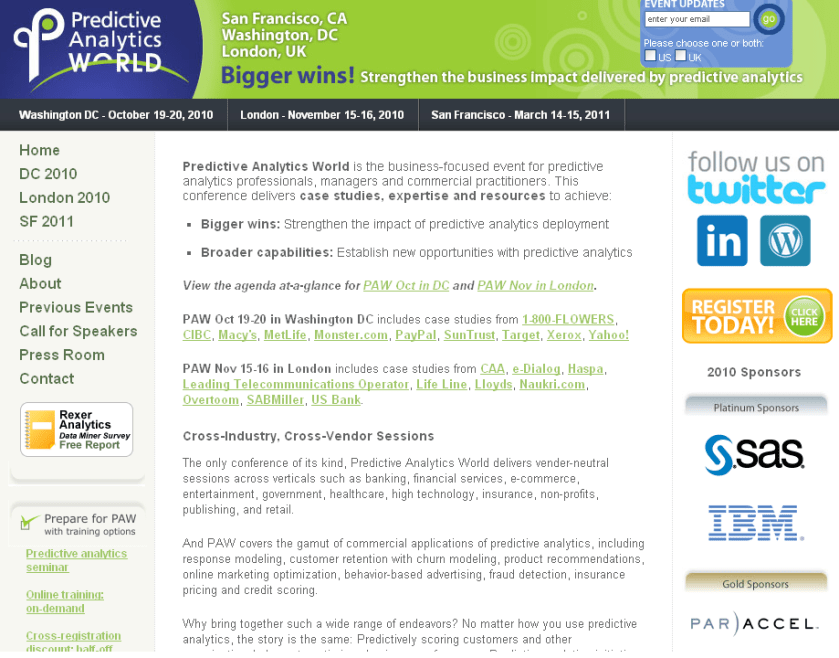
Predictive Analytics World ( http://pawcon.com ) is the business-focused event for predictive analytics professionals, managers and commercial practitioners, covering today’s commercial deployment of predictive analytics, across industries and across software vendors.

PAW delivers the best case studies, expertise, keynotes, sessions, workshops, exposition, expert panel, live demos, networking coffee breaks, reception, birds-of-a-feather lunches, brand-name enterprise leaders, and industry heavyweights in the business.

Case study presentations cover campaign targeting, churn modeling, next-best-offer, selecting marketing channels, global analytics deployment, email marketing, HR candidate search, and other innovative applications. The Conference agendas cover hot topics such as social data, text mining, search marketing, risk management, uplift (incremental lift) modeling, survey analysis, consumer privacy, sales force optimization and other innovative applications that benefit organizations in new and creative ways.

PAW delivers two rich conference programs in Oct./Nov. with very little content overlap featuring a wealth of speakers with front-line experience. See which one is best for you:

PAW’s DC 2010 (Oct 19-20) program includes over 25 sessions across two tracks – an “All Audiences” and an “Expert/Practitioner” track — so you can witness how predictive analytics is applied at 1-800-FLOWERS, CIBC, Corporate Executive Board, Forrester, LifeLine, Macy’s, MetLife, Miles Kimball, Monster, Paychex, PayPal (eBay), SunTrust, Target, UPMC Health Plan, Xerox, YMCA, and Yahoo!, plus special examples from the U.S. government agencies DoD, DHS, and SSA.

Sign up for event updates in the US http://pawcon.com/signup-us.php
View the agenda at-a-glance: http://pawcon.com/dc/2010/agenda_overview.php
For more: http://pawcon.com/dc
Register: http://pawcon.com/dc/register.php

PAW London 2010 (Nov 15-16) will feature over 20 speakers from 10 countries with case studies from leading enterprises in e-commerce, finance, healthcare, retail, and telecom such as Canadian Automobile Association, Chessmetrics, e-Dialog, Hamburger Sparkasse, Jeevansathi.com (India’s 2nd-largest matrimony portal), Life Line Screening, Lloyds TSB, Naukri.com (India’s number 1 job portal), Overtoom, SABMiller, Univ. of Melbourne, and US Bank, plus special examples from Anheuser-Busch, Disney, HP, HSBC, Pfizer, U.S. SSA, WestWind Foundation and others.

Sign up for event updates in the UK http://pawcon.com/signup-uk.php
View the agenda at-a-glance: http://pawcon.com/london/2010/agenda_overview.php
For more: http://pawcon.com/london
Register: http://pawcon.com/london/register.php

——————————-

PAW San Francisco Save-the-Date and Call-for-Speakers:

March 14-15, 2011
San Francisco Marriott Marquis
San Francisco, CA

PAW call-for-speakers information and submission form: (Due Oct 8)
http://www.predictiveanalyticsworld.com/submit.php

If you wish to receive periodic call-for-speakers notifications regarding Predictive Analytics World, email chair@predictiveanalyticsworld.com with the subject line “call-for-speakers notifications”.

Predictive Analytics World
http://www.predictiveanalyticsworld.com
Washington DC – London – San Francisco

Google moving on from MapReduce: rest of world still catching up

Apparently it is true as per the Register, but details in a paper next month- It is called Google Caffeine.

http://www.theregister.co.uk/2010/09/09/google_caffeine_explained/

Caffeine expands on BigTable to create a kind of database programming model that lets the company make changes to its web index without rebuilding the entire index from scratch. “[Caffeine] is a database-driven, Big Table–variety indexing system,” Lipkovitz tells The Reg, saying that Google will soon publish a paper discussing the system. The paper, he says, will be delivered next month at the USENIX Symposium on Operating Systems Design and Implementation (OSDI).

and interestingly

MapReduce, he says, isn’t suited to calculations that need to occur in near real-time.

MapReduce is a sequence of batch operations, and generally, Lipkovits explains, you can’t start your next phase of operations until you finish the first. It suffers from “stragglers,” he says. If you want to build a system that’s based on series of map-reduces, there’s a certain probability that something will go wrong, and this gets larger as you increase the number of operations. “You can’t do anything that takes a relatively short amount of time,” Lipkovitz says, “so we got rid of it.”

With Caffeine, Google can update its index by making direct changes to the web map already stored in BigTable. This includes a kind of framework that sits atop BigTable, and Lipkovitz compares it to old-school database programming and the use of “database triggers.”

but most importantly

In 2004, Google published research papers on GFS and MapReduce that became the basis for the open source Hadoop platform now used by Yahoo!, Facebook, and — yes — Microsoft. But as Google moves beyond GFS and MapReduce, Lipokovitz stresses that he is “not claiming that the rest of the world is behind us.”

But oh no!

“We’re in business of making searches useful,” he says. “We’re not in the business of selling infrastructure

But I say why not- Search is good and advertising is okay

There is more (not evil) money in infrastructure (of big data) as there is in advertising. But the advertising guys disagree