2011 Forecast-ying

Free twitter badge
Image via Wikipedia

I had recently asked some friends from my Twitter lists for their take on 2011, atleast 3 of them responded back with the answer, 1 said they were still on it, and 1 claimed a recent office event.

Anyways- I take note of the view of forecasting from

http://www.uiah.fi/projekti/metodi/190.htm

The most primitive method of forecasting is guessing. The result may be rated acceptable if the person making the guess is an expert in the matter.

Ajay- people will forecast in end 2010 and 2011. many of them will get forecasts wrong, some very wrong, but by Dec 2011 most of them would be writing forecasts on 2012. almost no one will get called on by irate users-readers- (hey you got 4 out of 7 wrong last years forecast!) just wont happen. people thrive on hope. so does marketing. in 2011- and before

and some forecasts from Tom Davenport’s The International Institute for Analytics (IIA) at

http://iianalytics.com/2010/12/2011-predictions-for-the-analytics-industry/

Regulatory and privacy constraints will continue to hamper growth of marketing analytics.

(I wonder how privacy and analytics can co exist in peace forever- one view is that model building can use anonymized data suppose your IP address was anonymized using a standard secret Coco-Cola formula- then whatever model does get built would not be of concern to you individually as your privacy is protected by the anonymization formula)

Anyway- back to the question I asked-

What are the top 5 events in your industry (events as in things that occured not conferences) and what are the top 3 trends in 2011.

I define my industry as being online technology writing- research (with a heavy skew on stat computing)

My top 5 events for 2010 were-

1) Consolidation- Big 5 software providers in BI and Analytics bought more, sued more, and consolidated more.  The valuations rose. and rose. leading to even more smaller players entering. Thus consolidation proved an oxy moron as total number of influential AND disruptive players grew.


2) Cloudy Computing- Computing shifted from the desktop but to the mobile and more to the tablet than to the cloud. Ipad front end with Amazon Ec2 backend- yup it happened.

3) Open Source grew louder- yes it got more clients. and more revenue. did it get more market share. depends on if you define market share by revenues or by users.

Both Open Source and Closed Source had a good year- the pie grew faster and bigger so no one minded as long their slices grew bigger.

4) We didnt see that coming –

Technology continued to surprise with events (thats what we love! the surprises)

Revolution Analytics broke through R’s Big Data Barrier, Tableau Software created a big Buzz,  Wikileaks and Chinese FireWalls gave technology an entire new dimension (though not universally popular one).

people fought wars on emails and servers and social media- unfortunately the ones fighting real wars in 2009 continued to fight them in 2010 too

5) Money-

SAP,SAS,IBM,Oracle,Google,Microsoft made more money than ever before. Only Facebook got a movie named on itself. Venture Capitalists pumped in money in promising startups- really as if in a hurry to park money before tax cuts expired in some countries.


2011 Top Three Forecasts

1) Surprises- Expect to get surprised atleast 10 % of the time in business events. As internet grows the communication cycle shortens, the hype cycle amplifies buzz-

more unstructured data  is created (esp for marketing analytics) leading to enhanced volatility

2) Growth- Yes we predict technology will grow faster than the automobile industry. Game changers may happen in the form of Chrome OS- really its Linux guys-and customer adaptability to new USER INTERFACES. Design will matter much more in technology on your phone, on your desktop and on your internet. Packaging sells.

False Top Trend 3) I will write a book on business analytics in 2011. yes it is true and I am working with A publisher. No it is not really going to be a top 3 event for anyone except me,publisher and lucky guys who read it.

3) Creating technology and technically enabling creativity will converge at an accelerated rate. use of widgets, guis, snippets, ide will ensure creative left brains can code easier. and right brains can design faster and better due to a global supply chain of techie and artsy professionals.


Collateral

10 9 09 Bearman Cartoon Obama Nobel Peace Prize
Image by Bearman2007 via Flickr

It has always surprised me- how my American friends who passionately support the First Amendment kind of always oppose the Second Amendment and vice versa. Being a non American- I would always take the Fifth.

An earlier Wikileak video of killing two Reuters Employees-and I am not sure who is right- American govt for restricting access to federal employees or Chinese govt for restricting access to Nobel peace  prize.

or all the Govts of the world for all the cables they write. and all the journalists for all the stories they tell.

Merry Christmas anyways.

from Wikiquotes of another Indian.

http://en.wikiquote.org/wiki/Mohandas_Karamchand_Gandhi

Facts we would always place before our readers, whether they are palatable or not, and it is by placing them constantly before the public in their nakedness that the misunderstanding between the two communities in South Africa can be removed.

In this instance of the fire-arms, the Asiatic has been most improperly bracketed with the native. The British Indian does not need any such restrictions as are imposed by the Bill on the natives regarding the carrying of fire-arms. The prominent race can remain so by preventing the native from arming himself. Is there a slightest vestige of justification for so preventing the British Indian?

  • Comments on a court case in The Indian Opinion (25 March 1905)
  • Had we adopted non-violence as the weapon of the strong, because we realised that it was more effective than any other weapon, in fact the mightiest force in the world, we would have made use of its full potency and not have discarded it as soon as the fight against the British was over or we were in a position to wield conventional weapons. But as I have already said, we adopted it out of our helplessness. If we had the atom bomb, we would have used it against the British.
    • Speech (16 June 1947) as the official date for Indian independence approached (15 August 1947) , as quoted in Mahatma Gandhi : The Last Phase (1958) by Pyarelal, p. 326. The last sentence of this statement has sometimes been quoted as if it was being made as an affirmation of extreme hostility to the British, rather than as part of an affirmation of the strength of non-violence, and the ultimate weakness of those who needlessly resort to violence if it is within their power.
  • One of the objects of a newspaper is to understand popular feeling and to give expression to it; another is to arouse among the people certain desirable sentiments; and the third is fearlessly to expose popular defects
  • The non-violent state will be an ordered anarchy. That State is the best governed which is governed the least.

[http://www.youtube.com/watch?v=5rXPrfnU3G0&feature=player_embedded]

RWui :Creating R Web Interfaces on the go

Here is a great R application created by http://sysbio.mrc-bsu.cam.ac.uk

R Wui for creating R Web Interfaces

its been there for some time now- but presumably R Apache is more well known.

From-

http://sysbio.mrc-bsu.cam.ac.uk/Rwui/tutorial/Rwui_Rnews_final.pdf

The web application Rwui is used to create web interfaces  for running R scripts. All the code is generated automatically so that a fully functional web interface for an R script can be downloaded and up and running in a matter of minutes.

Rwui is aimed at R script writers who have scripts that they want people unversed in R to use. The script writer uses Rwui to create a web application that will run their R script. Rwui allows the script writer to do this without them having to do any web application programming, because Rwui generates all the code for them.

The script writer designs the web application to run their R script by entering information on a sequence of web pages. The script writer then downloads the application they have created and installs it on their own server.

http://sysbio.mrc-bsu.cam.ac.uk/Rwui/tutorial/Technical_Report.pdf

Features of web applications created by Rwui

  1. Whole range of input items available if required – text boxes, checkboxes, file upload etc.
  2. Facility for uploading of an arbitrary number of files (for example, microarray replicates).
  3. Facility for grouping uploaded files (for example, into ‘Diseased’ and ‘Control’ microarray data files).
  4. Results files displayed on results page and available for download.
  5. Results files can be e-mailed to the user.
  6. Interactive results files using image maps.
  7. Repeat analyses with different parameters and data files – new results added to results list, as a link to the corresponding results page.
  8. Real time progress information (text or graphical) displayed when running the application.

Requirements

In order to use the completed web applications created by Rwui you will need:

  1. A Java webserver such as Tomcat version 5.5 or later.
  2. Java version 1.5
  3. R – a version compatible with your R script(s).

Using Rwui

Using Rwui to create a web application for an R script simply involves:

  1. Entering details about your Rscript on a sequence of web pages.
  2. Rwui is quite flexible so you can backtrack, edit and insert, as you design your application.
  3. Rwui then generates the web application, which is Java based and platform independent.
  4. The application can be downloaded either as a .zip or .tgz file.
  5. Unpacked, the download contains all the source code and a .war file.
  6. Once the .war file is copied to the Tomcat webapps directory, the application is ready to use.
  7. Application details are saved in an ‘application definition file’ for reuse and modification.
Interested-
go click and check out a new web app from http://sysbio.mrc-bsu.cam.ac.uk/Rwui/ in a matter of minutes
Also see

American Decline- Why outsourcing doesnt make sense

Bureau of Labor Statistics logo RGB colors.
Image via Wikipedia

Here is a celebrated graphic from an American journalist using U.S. Department of Labor’s Bureau of Labor Statistics. It is a good example of using time as a dimension for animation- and heat maps for geography enabled visualizations.

————————–According to the U.S. Department of Labor’s Bureau of Labor Statistics, there are nearly 31 million people currently unemployed — that’s including those involuntarily working part time and those who want a job, but have given up on trying to find one. In the face of the worst economic upheaval since the Great Depression, millions of Americans are hurting. “The Decline: The Geography of a Recession,” as created by labor writer LaToya Egwuekwe, serves as a vivid representation of just how much. Watch the deteriorating transformation of the U.S. economy from January 2007 — approximately one year before the start of the recession — to the most recent unemployment data available today. Original link: http://www.latoyaegwuekwe.com/geographyofarecession.html. For more information, email latoya.egwuekwe@yahoo.com

————————————————————————————-


31 million unemployed- Does a US corporation seriously think that it can build everything OUTSIDE America and SELL INSIDE America. or who think it is okay intellectual property continues to be stolen as long as labor is cheap.

Shame on you if you outsourced your neighbour’s jobs- or would rather hire in a geography where they steal your intellectual property.


This Christmastime – May the Ghost of  the Unemployed Family Christmases visit you in your sleep instead.

Brief Interview Timo Elliott

Here is a brief interview with Timo Elliott.Timo Elliott is a 19-year veteran of SAP Business Objects.

Ajay- What are the top 5 events in Business Integration and Data Visualization services you saw in 2010 and what are the top three trends you see in these in 2011.


Timo-

Top five events in 2010:

(1) Back to strong market growth. IT spending plummeted last year (BI continued to grow, but more slowly than previous years). This year, organizations reopened their wallets and funded new analytics initiatives — all the signs indicate that BI market growth will be double that of 2009.

(2) The launch of the iPad. Mobile BI has been around for years, but the iPad opened the floodgates of organizations taking a serious look at mobile analytics — and the easy-to-use, executive-friendly iPad dashboards have considerably raised the profile of analytics projects inside organizations.

(3) Data warehousing got exciting again. Decades of incremental improvements (column databases, massively parallel processing, appliances, in-memory processing…) all came together with robust commercial offers that challenged existing data storage and calculation methods. And new “NoSQL” approaches, designed for the new problems of massive amounts of less-structured web data, started moving into the mainstream.

(4) The end of Google Wave, the start of social BI.Google Wave was launched as a rethink of how we could bring together email, instant messaging, and social networks. While Google decided to close down the technology this year, it has left its mark, notably by influencing the future of “social BI”, with several major vendors bringing out commercial products this year.

(5) The start of the big BI merge. While several small independent BI vendors reported strong growth, the major trend of the year was consolidation and integration: the BI megavendors (SAP, Oracle, IBM, Microsoft) increased their market share (sometimes by acquiring smaller vendors, e.g. IBM/SPSS and SAP/Sybase) and integrated analytics with their existing products, blurring the line between BI and other technology areas.

Top three trends next year:

(1) Analytics, reinvented. New DW techniques make it possible to do sub-second, interactive analytics directly against row-level operational data. Now BI processes and interfaces need to be rethought and redesigned to make best use of this — notably by blurring the distinctions between the “design” and “consumption” phases of BI.

(2) Corporate and personal BI come together. The ability to mix corporate and personal data for quick, pragmatic analysis is a common business need. The typical solution to the problem — extracting and combining the data into a local data store (either Excel or a departmental data mart) — pleases users, but introduces duplication and extra costs and makes a mockery of information governance. 2011 will see the rise of systems that let individuals and departments load their data into personal spaces in the corporate environment, allowing pragmatic analytic flexibility without compromising security and governance.

(3) The next generation of business applications. Where are the business applications designed to support what people really do all day, such as implementing this year’s strategy, launching new products, or acquiring another company? 2011 will see the first prototypes of people-focused, flexible, information-centric, and collaborative applications, bringing together the best of business intelligence, “enterprise 2.0”, and existing operational applications.

And one that should happen, but probably won’t:

(4) Intelligence = Information + PEOPLE. Successful analytics isn’t about technology — it’s about people, process, and culture. The biggest trend in 2011 should be organizations spending the majority of their efforts on user adoption rather than technical implementation.                 About- http://timoelliott.com/blog/about

Timo Elliott is a 19-year veteran of SAP BusinessObjects, and has spent the last twenty years working with customers around the world on information strategy.

He works closely with SAP research and innovation centers around the world to evangelize new technology prototypes.

His popular Business Analytics and SAPWeb20 blogs track innovation in analytics and social media, including topics such as augmented corporate reality, collaborative decision-making, and social network analysis.

His PowerPoint Twitter Tools lets presenters see and react to tweets in real time, embedded directly within their slides.

A popular and engaging speaker, Elliott presents regularly to IT and business audiences at international conferences, on subjects such as why BI projects fail and what to do about it, and the intersection of BI and enterprise 2.0.

Prior to Business Objects, Elliott was a computer consultant in Hong Kong and led analytics projects for Shell in New Zealand. He holds a first-class honors degree in Economics with Statistics from Bristol University, England. He blogs on http://timoelliott.com/blog/ (one of the best designed blogs in BI) . You can see more about him personal web site here and photo/sketch blog here. You should follow Timo at http://twitter.com/timoelliott

Art Credit- Timo Elliott

Related Articles

Why social media is an one way street- cant close accounts

Update to https://decisionstats.com/2010/11/24/deleting-twitter-facebooklinkedin-accepting-life/

You cant DELETE a Facebook Account- it gets deactivated NOT DELETED.

You have to delete photo albums one by one, but if you have a folder like profile photos or wall photos or mobile uploads  (you cant delete these folders you have to delete those photos one by one)

So I had to delete 1100 friends, delete all Facebook Pages I created, and then download the account- (photos) which were now a more easy to download zip file of 92 mb. And I deleted all the 250+ Likes I had given to things I had flippantly liked- it was horrifying because if you accumulate all that info- it basically gives you a big lead in estimating my psychological profile- and thats not stuff I want to be used for selling.

Then I deactivated it- no like Lord Voldermort’s horcruxes you cant delete it all.

and Facebook shows you ads even if you clean your profile and your friends and can longer see any preference for any product.

Facebook treats data like prisoners – even if you are released they WILL maintain your record.

20 years later they would be able to blackmail all the people  of all countries in the WORLD- by that much info.

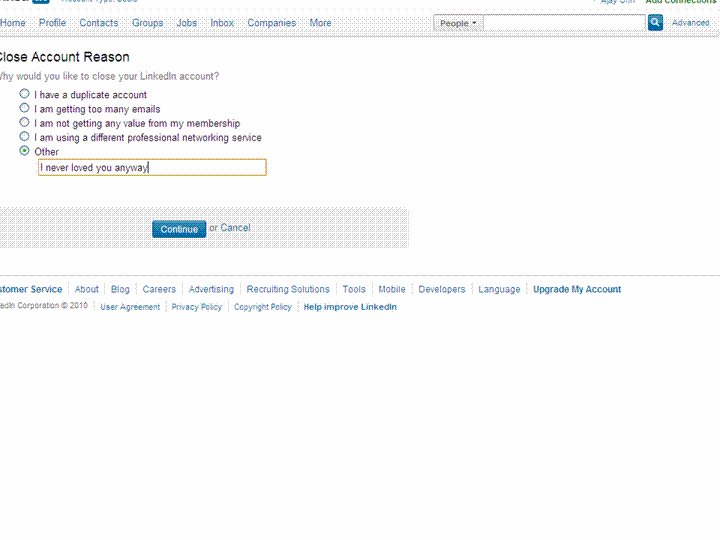
And Linkedin is still getting deleted- I got this email from them-

basically if you have an active group for whom you are the only owner you cant delete yourself- you have to delete the group or find another owner.

Sigh!

If it took me 2 days to download all my info, and wipe my social media for just 3 yrs of using it (albiet at an expert enough level to act as a social media consultant to some companies)- I am not sure what today’s generation of young people who jump to twitter and Facebook at early ages would face after say 5-10 years of data is collected on them. Lots of Ads I guess!