LibreOffice News and Google Musings

Tux, the Linux penguin
Image via Wikipedia

Official Bloggers on LibreOffice- http://planet.documentfoundation.org/

Note- for some strange reason I continue to be on top ranked LibreOffice blogs- maybe because I write more on the software itself than on Oracle politics or coffee spillovers.

LibreOffice Beta 2  is ready and I just installed it on Windows 7 – works nice- and I somehow think open Office and Google needs an  example to stop being so scary on cautioning—— hey,hey it’s a  beta – (do you see Oracle saying this release is a beta or Windows saying hey this Windows Vista is a beta for Windows 7- No right?)-

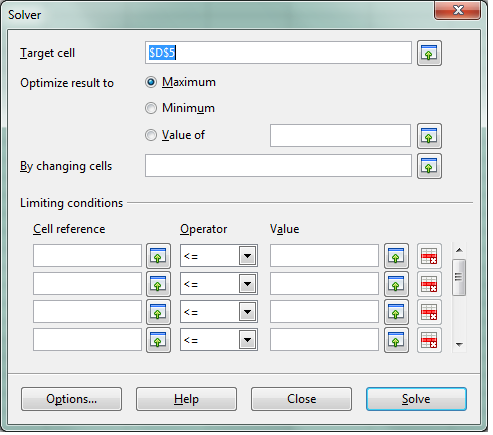
see screenshot of solver in  LibreOffice spreadsheet -works just fine.

We cant wait for Chromium OS and LibreOffice integration (or Google Docs-LibreOffice integration)  so Google starts thinking on those lines (of course

Google also needs to ramp up Google Storage and Google Predict API– but dude are you sure you wanna take on Amazon, Oracle and MS and Yahoo and Apple at the same time. Dear Herr Schmidt- Last German Guy who did that ,  ended up in a bunker in Berlin. (Ever since I had to pay 50 euros as Airline Transit fee -yes Indian passport holders have to do that in Germany- I am kind of non objective on that issue)

Google Management is busy nowadays thinking of trying to beat Facebook -hint -hint-

-buy out the biggest app makers of Facebook apps and create an api for Facebook info download and upload into Orkut –maybe invest like an angel in that startup called Diaspora http://www.joindiaspora.com/) see-

Back to the topic (and there are enough people blogging on Google should or shouldnt do)

-LibreOffice aesthetically rocks! It has a cool feel.

More news- The Wiki is up and awaits you at http://wiki.documentfoundation.org/Documentation

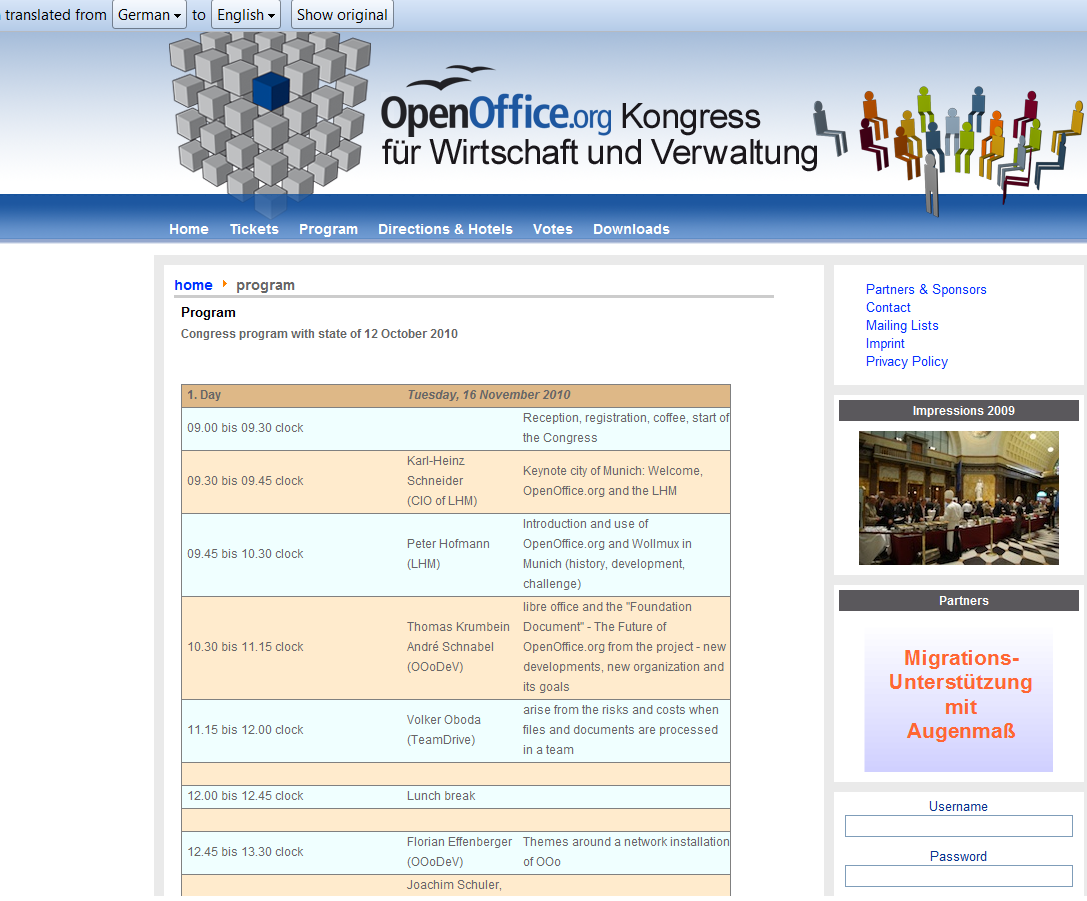
And there is a general pow-wow scheduled at http://www.oookwv.de/ for the Open Office Congress (Kongress)

As you can see I used the Chrome Extension for Google Translate for an instant translation from German into English (though it still needs some work,  Herr Translator)

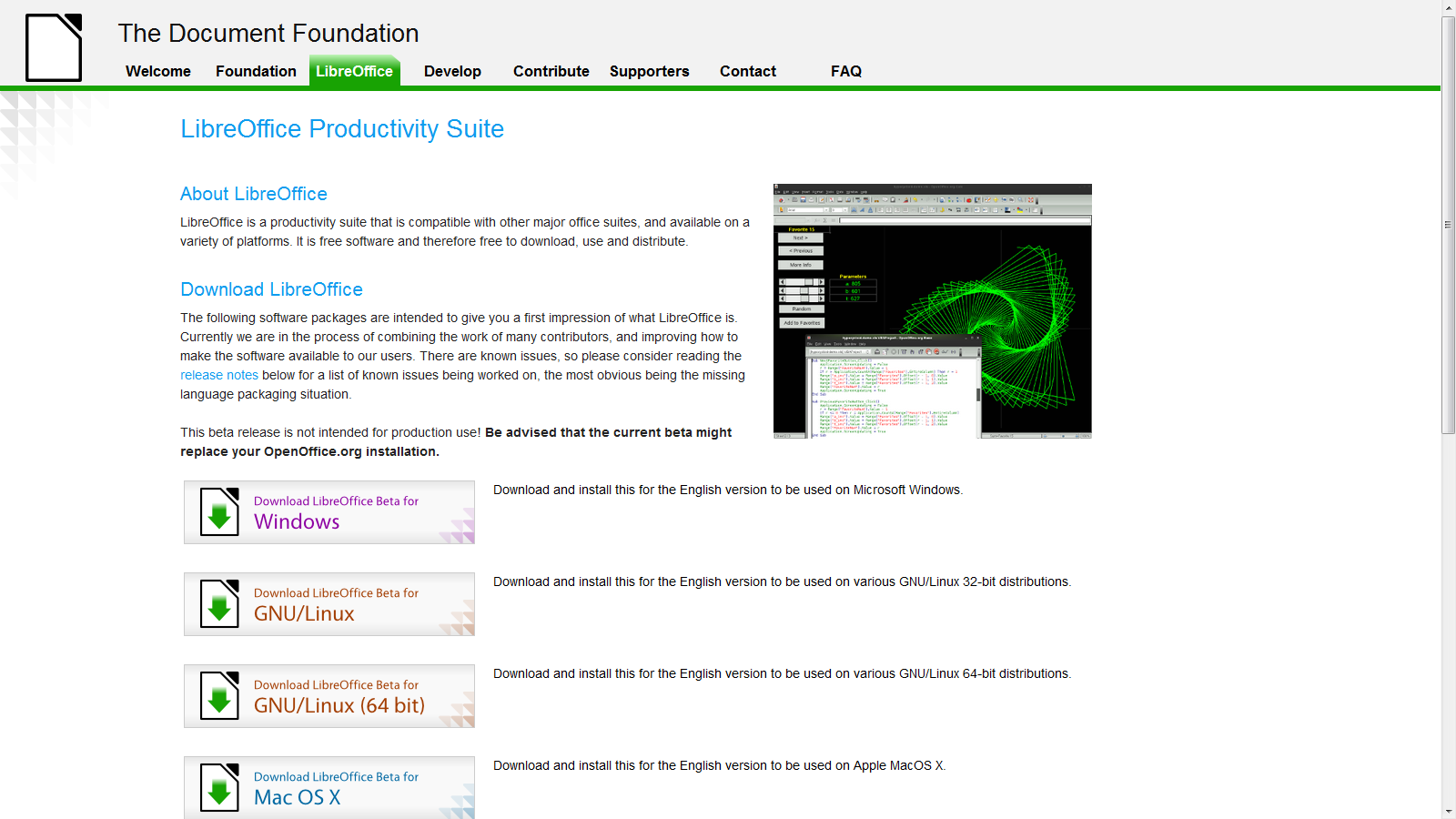
Back to actually working on LibreOffice- if Word and Powerpoint is all you do- save some money for Christmas and download it today from

Interview John F Moore CEO The Lab

Social Media Landscape

Here is an interview with John F Moore, social media adviser,technologist and founder and CEO of The Lab.

Ajay-  The internet seems to be crowded by social media experts with everyone who spends a lot of time on the internet claiming to be one? How  does a small business owner on a budget distinguish for the correct value proposition that social media can give them. 

John- You’re right.  It seems like everytime I turn around I bump into more social media “experts”.  The majority of these self-proclaimed experts are not adding a great deal of value.  When looking to spend money for help ask the person a few questions about their approach. Things you should be hearing include:

  • The expert should be seeking to fully understand your business, your goals, your available resources, etc..
  • The expert should be seeking to understand current management thinking about social media and related technologies.

If the expert is purely focused on tools they are the wrong person.  Your solution may require tools alone but they cannot know this without first understanding your business.

Ajay- Facebook has 600 million people, with people preferring to play games and connect to old acquaintances rather than use social media for tangible career or business benefit..

John- People are definitely spending time playing games, looking at photos, and catching up with old friends.  However, there are many businesses seeing real value from Facebook (primarily by tying it into their e-mail marketing and using coupons and other incentives).  For example, I recently shared a small case study (http://thejohnfmoore.com/2010/10/07/email-social-media-and-coupons-makes-the-cfo-smile/) where a small pet product company achieved a 22% bump in monthly revenue by combining Facebook and coupons together.  In fact,45% of this bump in revenue came from new clients.  Customer acquisition and increased revenue were accomplished by using Facebook for their business.
Ajay-  How does a new social media convert (individual) go on selecting communities to join (Facebook,Twitter,Linkedin,Ning, Ping,Orkut, Empire Avenue etc etc.
How does a small business owner take the same decision.

John- It always starts with taking the time to define your goals and then determine how much time and effort you are willing to invest.  For example:
  • LinkedIn. A must have for individuals as it is one of the key social networking communities for professional networking.  Individuals should join groups that are relevant to their career and invest an hour a week.  Businesses should ensure they have a business profile completed and up to date.
  • Facebook can be a challenge for anyone trying to walk the personal/professional line.  However, from a business standpoint you should be creating a Facebook page that you can use to compliment your other marketing channels.
  • Twitter.  It is a great network to learn of, to meet, and to interact with people from around the world.  I have met thousands of interesting people, many of which I have had the pleasure to meet with in real life.  Businesses need to invest in listening on twitter to determine if their customers (current or potential) or competitors are already there discussing them, their marketplace, or their offerings.
In all cases I would encourage businesses to setup social media accounts on LinkedIn, Facebook, Twitter, YouTube, and Flickr.  You want to ensure your brand is protected by owning these accounts and ensuring at least the base information is accurate.
Ajay- Name the top 5 points that you think make a social media community successful.  What are the top 5 points for a business to succeed in their social media strategy.

John-
  • Define your goals up front.  Understand why you are building a community and keep this goal in mind.
  • Provide education.  Ideally you want to become a thought leader in your space, the trusted resource that people can turn to even if they are not using your product or services today.
  • Be honest.  We all make mistakes.  When you do, be honest with your community and engage them in any fall-out that may be coming out of your mistake.
  • Listen to them.  Use platforms like BubbleIdeas to gather feedback on what your community is looking for from the relationship.
  • Measure.  Are you on track with your goals?  Do your goals need to change?
Ajay- What is the unique value proposition that “The Lab” offers

John- The Lab understands the strategic importance of leveraging social media, management and leadership best practices, and our understanding of local government and small and medium business to help people in these areas achieve their goals.  Too many consultants come to the table with a predefined solution that really misses the mark as it lacks understanding of the client’s goals.
Ajay-  What is “CityCamp in Boston” all about.

John- CityCamp is a FREE unconference focused on innovation for municipal governments and community organizations (http://www.citycampboston.org/what-is-citycamp-boston/).  It brings together politicians, local municipal employees, citizens, vendors, developers, and journalist to build a common understanding of local government challenges and then works to deliver measurable outcomes following the event.  The key is the focus on change management, driving change as opposed to just in the moment education.
Biography-

John F Moore is the Founder and CEO of The Lab (http://thelabinboston.com).  John has experience working with local governments and small and medium business owners to achieve their goals.  His experience with social media strategies, CRM, and a plethora of other solutions provides immense value to all of our clients.   He has built engineering organizations, learned sales and marketing, run customer service teams, and built and executed strategies for social media thought leadership and branding.  He is also a prolific blogger as you can see by checking out his blog at http://thejohnfmoore.com.

Bruno Aziza, Microsoft Global BI Lead joins PAW Keynote

By Richard Wheeler (Zephyris) 2007. Lambda rep...
Image via Wikipedia


An interesting development, Bruno Aziza, Director, Worldwide Strategy Lead, Business Intelligence, Microsoft has joined Predictive Analytics World as a keynote speaker.

http://www.predictiveanalyticsworld.com/dc/2010/agenda.php#day2-2

Keynote
Predictive Analytics and Business Performance

In this session, Bruno Aziza will discuss the challenges organizations face with Analytics and Performance. This participative session will provide first-hand accounts from Fortune 500 companies who are winning by building accountability, intelligence, and informed decision-making into their organizational DNA.

Speaker: Bruno Aziza, Director, Worldwide Strategy Lead, Business Intelligence, Microsoft

Some info about Mr Aziza,

http://www.predictiveanalyticsworld.com/dc/2010/speakers.php#aziza

Bruno Aziza, Director, Worldwide Strategy Lead, Business Intelligence,Microsoft

Bruno AzizaBruno Aziza is a recognized authority on Strategy Execution, Business Intelligence and Information Management. He is the co-author of best-selling book, “Drive Business Performance: Enabling a Culture of Intelligent Execution” and a Fellow at the Advanced Performance Institute, a world-leading and independent advisory group specialized in organizational performance. Drs. Kaplan & Norton, of Balanced Scorecard fame, praise Aziza for moving “the field of performance management forward in important new directions.”

Aziza’s work has been featured in publications across North America, Europe and Asia such as Business Finance magazine, Intelligent Enterprise, CRM magazine and others.

Aziza has held management positions at Apple Inc.Business Objects (SAP), AppStream(Symantec) and Decathlon SA. He currently works on Microsoft Business Intelligence go-to-market strategy and execution for partners, services, sales and marketing. Aziza lives in Seattle with his family and enjoys sports and travelling.

He regularly provides views on leadership and performance on the SuccessFactors thought leader Network , the CIO Network and Forbes Magazine. Aziza is the host ofBizIntelligence.TV – a leading weekly show on Business Intelligence and Analytics. An award-winning speaker, Aziza frequently keynotes international events and has shared the stage with executives and thought leaders such as Dr. Kaplan. Aziza’s biggest crowd to date is 5,000 people.

Follow or contact Bruno via:
•Twitter @ http://twitter.com/brunoaziza
•Facebook @ http://tinyurl.com/bruno-on-facebook
•Linkedin @ http://www.linkedin.com/in/brunoaziza
•YouTube @ http://tinyurl.com/bruno-on-tv
•Kindle blog @ http://tinyurl.com/culture-blog
•Forbes blog @ http://tinyurl.com/culture-blog

That makes it an interesting Pow Wow between the big players at the conference Oracle,SAP, IBM, SAS and now MS –all seem to be there.

Truly a Predictive Analytics World.


Which software do we buy? -It depends

Software (novel)
Image via Wikipedia

Often I am asked by clients, friends and industry colleagues on the suitability or unsuitability of particular software for analytical needs.  My answer is mostly-

It depends on-

1) Cost of Type 1 error in purchase decision versus Type 2 error in Purchase Decision. (forgive me if I mix up Type 1 with Type 2 error- I do have some weird childhood learning disabilities which crop up now and then)

Here I define Type 1 error as paying more for a software when there were equivalent functionalities available at lower price, or buying components you do need , like SPSS Trends (when only SPSS Base is required) or SAS ETS, when only SAS/Stat would do.

The first kind is of course due to the presence of free tools with GUI like R, R Commander and Deducer (Rattle does have a 500$ commercial version).

The emergence of software vendors like WPS (for SAS language aficionados) which offer similar functionality as Base SAS, as well as the increasing convergence of business analytics (read predictive analytics), business intelligence (read reporting) has led to somewhat brand clutter in which all softwares promise to do everything at all different prices- though they all have specific strengths and weakness. To add to this, there are comparatively fewer business analytics independent analysts than say independent business intelligence analysts.

2) Type 2 Error- In this case the opportunity cost of delayed projects, business models , or lower accuracy – consequences of buying a lower priced software which had lesser functionality than you required.

To compound the magnitude of error 2, you are probably in some kind of vendor lock-in, your software budget is over because of buying too much or inappropriate software and hardware, and still you could do with some added help in business analytics. The fear of making a business critical error is a substantial reason why open source software have to work harder at proving them competent. This is because writing great software is not enough, we need great marketing to sell it, and great customer support to sustain it.

As Business Decisions are decisions made in the constraints of time, information and money- I will try to create a software purchase matrix based on my knowledge of known softwares (and unknown strengths and weakness), pricing (versus budgets), and ranges of data handling. I will add in basically an optimum approach based on known constraints, and add in flexibility for unknown operational constraints.

I will restrain this matrix to analytics software, though you could certainly extend it to other classes of enterprise software including big data databases, infrastructure and computing.

Noted Assumptions- 1) I am vendor neutral and do not suffer from subjective bias or affection for particular software (based on conferences, books, relationships,consulting etc)

2) All software have bugs so all need customer support.

3) All software have particular advantages , strengths and weakness in terms of functionality.

4) Cost includes total cost of ownership and opportunity cost of business analytics enabled decision.

5) All software marketing people will praise their own software- sometimes over-selling and mis-selling product bundles.

Software compared are SPSS, KXEN, R,SAS, WPS, Revolution R, SQL Server,  and various flavors and sub components within this. Optimized approach will include parallel programming, cloud computing, hardware costs, and dependent software costs.

To be continued-


Revolution R for Linux

Screenshot of the Redhat Enterprise Linux Desktop
Image via Wikipedia

New software just released from the guys in California (@RevolutionR) so if you are a Linux user and have academic credentials you can download it for free  (@Cmastication doesnt), you can test it to see what the big fuss is all about (also see http://www.revolutionanalytics.com/why-revolution-r/benchmarks.php) –

Revolution Analytics has just released Revolution R Enterprise 4.0.1 for Red Hat Enterprise Linux, a significant step forward in enterprise data analytics. Revolution R Enterprise 4.0.1 is built on R 2.11.1, the latest release of the open-source environment for data analysis and graphics. Also available is the initial release of our deployment server solution, RevoDeployR 1.0, designed to help you deliver R analytics via the Web. And coming soon to Linux: RevoScaleR, a new package for fast and efficient multi-core processing of large data sets.

As a registered user of the Academic version of Revolution R Enterprise for Linux, you can take advantage of these improvements by downloading and installing Revolution R Enterprise 4.0.1 today. You can install Revolution R Enterprise 4.0.1 side-by-side with your existing Revolution R Enterprise installations; there is no need to uninstall previous versions.

Download Information

The following information is all you will need to download and install the Academic Edition.

Supported Platforms:

Revolution R Enterprise Academic edition and RevoDeployR are supported on Red Hat® Enterprise Linux® 5.4 or greater (64-bit processors).

Approximately 300MB free disk space is required for a full install of Revolution R Enterprise. We recommend at least 1GB of RAM to use Revolution R Enterprise.

For the full list of system requirements for RevoDeployR, refer to the RevoDeployR™ Installation Guide for Red Hat® Enterprise Linux®.

Download Links:

You will first need to download the Revolution R Enterprise installer.

Installation Instructions for Revolution R Enterprise Academic Edition

After downloading the installer, do the following to install the software:

  • Log in as root if you have not already.
  • Change directory to the directory containing the downloaded installer.
  • Unpack the installer using the following command:
    tar -xzf Revo-Ent-4.0.1-RHEL5-desktop.tar.gz
  • Change directory to the RevolutionR_4.0.1 directory created.
  • Run the installer by typing ./install.py and following the on-screen prompts.

Getting Started with the Revolution R Enterprise

After you have installed the software, launch Revolution R Enterprise by typing Revo64 at the shell prompt.

Documentation is available in the form of PDF documents installed as part of the Revolution R Enterprise distribution. Type Revo.home(“doc”) at the R prompt to locate the directory containing the manuals Getting Started with Revolution R (RevoMan.pdf) and the ParallelR User’s Guide(parRman.pdf).

Installation Instructions for RevoDeployR (and RServe)

After downloading the RevoDeployR distribution, use the following steps to install the software:

Note: These instructions are for an automatic install.  For more details or for manual install instructions, refer to RevoDeployR_Installation_Instructions_for_RedHat.pdf.

  1. Log into the operating system as root.
    su –
  2. Change directory to the directory containing the downloaded distribution for RevoDeployR and RServe.
  3. Unzip the contents of the RevoDeployR tar file. At prompt, type:
    tar -xzf deployrRedHat.tar.gz
  4. Change directories. At the prompt, type:
    cd installFiles
  5. Launch the automated installation script and follow the on-screen prompts. At the prompt, type:
    ./installRedHat.sh
    Note: Red Hat installs MySQL without a password.

Getting Started with RevoDeployR

After installing RevoDeployR, you will be directed to the RevoDeployR landing page. The landing page has links to documentation, the RevoDeployR management console, the API Explorer development tool, and sample code.

Support

For help installing this Academic Edition, please email support@revolutionanalytics.com

Also interestingly some benchmarks on Revolution R vs R.

http://www.revolutionanalytics.com/why-revolution-r/benchmarks.php

R-25 Benchmarks

The simple R-benchmark-25.R test script is a quick-running survey of general R performance. The Community-developed test consists of three sets of small benchmarks, referred to in the script as Matrix Calculation, Matrix Functions, and Program Control.

R-25 Matrix Calculation R-25 Matrix Functions R-Matrix Program Control
R-25 Benchmarks Base R 2.9.2 Revolution R (1-core) Revolution R (4-core) Speedup (4 core)
Matrix Calculation 34 sec 6.6 sec 4.4 sec 7.7x
Matrix Functions 20 sec 4.4 sec 2.1 sec 9.5x
Program Control 4.7 sec 4 sec 4.2 sec Not Appreciable

Speedup = Slower time / Faster Time – 1   Test descriptions available at http://r.research.att.com/benchmarks

Additional Benchmarks

Revolution Analytics has created its own tests to simulate common real-world computations.  Their descriptions are explained below.

Matrix Multiply Cholesky Factorization
Singular Value Decomposition Principal Component Analysis Linear Discriminant Analysis
Linear Algebra Computation Base R 2.9.2 Revolution R (1-core) Revolution R (4-core) Speedup (4 core)
Matrix Multiply 243 sec 22 sec 5.9 sec 41x
Cholesky Factorization 23 sec 3.8 sec 1.1 sec 21x
Singular Value Decomposition 62 sec 13 sec 4.9 sec 12.6x
Principal Components Analysis 237 sec 41 sec 15.6 sec 15.2x
Linear Discriminant Analysis 142 sec 49 sec 32.0 sec 4.4x

Speedup = Slower time / Faster Time – 1

Matrix Multiply

This routine creates a random uniform 10,000 x 5,000 matrix A, and then times the computation of the matrix product transpose(A) * A.

set.seed (1)
m <- 10000
n <-  5000
A <- matrix (runif (m*n),m,n)
system.time (B <- crossprod(A))

The system will respond with a message in this format:

User   system elapsed
37.22    0.40   9.68

The “elapsed” times indicate total wall-clock time to run the timed code.

The table above reflects the elapsed time for this and the other benchmark tests. The test system was an INTEL® Xeon® 8-core CPU (model X55600) at 2.5 GHz with 18 GB system RAM running Windows Server 2008 operating system. For the Revolution R benchmarks, the computations were limited to 1 core and 4 cores by calling setMKLthreads(1) and setMKLthreads(4) respectively. Note that Revolution R performs very well even in single-threaded tests: this is a result of the optimized algorithms in the Intel MKL library linked to Revolution R. The slight greater than linear speedup may be due to the greater total cache available to all CPU cores, or simply better OS CPU scheduling–no attempt was made to pin execution threads to physical cores. Consult Revolution R’s documentation to learn how to run benchmarks that use less cores than your hardware offers.

Cholesky Factorization

The Cholesky matrix factorization may be used to compute the solution of linear systems of equations with a symmetric positive definite coefficient matrix, to compute correlated sets of pseudo-random numbers, and other tasks. We re-use the matrix B computed in the example above:

system.time (C <- chol(B))

Singular Value Decomposition with Applications

The Singular Value Decomposition (SVD) is a numerically-stable and very useful matrix decompisition. The SVD is often used to compute Principal Components and Linear Discriminant Analysis.

# Singular Value Deomposition
m <- 10000
n <- 2000
A <- matrix (runif (m*n),m,n)
system.time (S <- svd (A,nu=0,nv=0))

# Principal Components Analysis
m <- 10000
n <- 2000
A <- matrix (runif (m*n),m,n)
system.time (P <- prcomp(A))

# Linear Discriminant Analysis
require (‘MASS’)
g <- 5
k <- round (m/2)
A <- data.frame (A, fac=sample (LETTERS[1:g],m,replace=TRUE))
train <- sample(1:m, k)
system.time (L <- lda(fac ~., data=A, prior=rep(1,g)/g, subset=train))

Cloudera and Aster Data partner up

Basically making it easier for data to move between the two systems Hadoop (Cloudera) and Aster’s Analytics (MapReduce/SQL)-

From the press release-http://goo.gl/vgsr

today announced an agreement that unites Cloudera Distribution for Hadoop (CDH) with Aster Data nCluster. The integration enables customers to leverage MPP platforms for large-scale data processing, management and analytics across structured and unstructured formats to analyze massive amounts of data for deeper business insight.

Cloudera is building a massively parallel, two-way connector for high-speed movement of data between CDH and Aster Data nCluster. The connector will be supported as part of Cloudera Enterprise.

Interview Michael J. A. Berry Data Miners, Inc

Here is an interview with noted Data Mining practitioner Michael Berry, author of seminal books in data mining, noted trainer and consultantmjab picture

Ajay- Your famous book “Data Mining Techniques: For Marketing, Sales, and Customer Relationship Management” came out in 2004, and an update is being planned for 2011. What are the various new data mining techniques and their application that you intend to talk about in that book.

Michael- Each time we do a revision, it feels like writing a whole new book. The first edition came out in 1997 and it is hard to believe how much the world has changed since then. I’m currently spending most of my time in the on-line retailing world. The things I worry about today–improving recommendations for cross-sell and up-sell,and search engine optimization–wouldn’t have even made sense to me back then. And the data sizes that are routine today were beyond the capacity of the most powerful super computers of the nineties. But, if possible, Gordon and I have changed even more than the data mining landscape. What has changed us is experience. We learned an awful lot between the first and second editions, and I think we’ve learned even more between the second and third.

One consequence is that we now have to discipline ourselves to avoid making the book too heavy to lift. For the first edition, we could write everything we knew (and arguably, a bit more!); now we have to remind ourselves that our intended audience is still the same–intelligent laymen with a practical interest in getting more information out of data. Not statisticians. Not computer scientists. Not academic researchers. Although we welcome all readers, we are primarily writing for someone who works in a marketing department and has a title with the word “analyst” or “analytics” in it. We have relaxed our “no equations” rule slightly for cases when the equations really do make things easier to explain, but the core explanations are still in words and pictures.

The third edition completes a transition that was already happening in the second edition. We have fully embraced standard statistical modeling techniques as full-fledged components of the data miner’s toolkit. In the first edition, it seemed important to make a distinction between old, dull, statistics, and new, cool, data mining. By the second edition, we realized that didn’t really make sense, but remnants of that attitude persisted. The third edition rectifies this. There is a chapter on statistical modeling techniques that explains linear and logistic regression, naive Bayes models, and more. There is also a brand new chapter on text mining, a curious omission from previous editions.

There is also a lot more material on data preparation. Three whole chapters are devoted to various aspects of data preparation. The first focuses on creating customer signatures. The second is focused on using derived variables to bring information to the surface, and the third deals with data reduction techniques such as principal components. Since this is where we spend the greatest part of our time in our work, it seemed important to spend more time on these subjects in the book as well.

Some of the chapters have been beefed up a bit. The neural network chapter now includes radial basis functions in addition to multi-layer perceptrons. The clustering chapter has been split into two chapters to accommodate new material on soft clustering, self-organizing maps, and more. The survival analysis chapter is much improved and includes material on some of our recent application of survival analysis methods to forecasting. The genetic algorithms chapter now includes a discussion of swarm intelligence.

Ajay- Describe your early career and how you came into Data Mining as a profession. What do you think of various universities now offering MS in Analytics. How do you balance your own teaching experience with your consulting projects at The Data Miners.

Michael- I fell into data mining quite by accident. I guess I always had a latent interest in the topic. As a high school and college student, I was a fan of Martin Gardner‘s mathematical games in in Scientific American. One of my favorite things he wrote about was a game called New Eleusis in which one players, God, makes up a rule to govern how cards can be played (“an even card must be followed by a red card”, say) and the other players have to figure out the rule by watching what plays are allowed by God and which ones are rejected. Just for my own amusement, I wrote a computer program to play the game and presented it at the IJCAI conference in, I think, 1981.

That paper became a chapter in a book on computer game playing–so my first book was about finding patterns in data. Aside from that, my interest in finding patterns in data lay dormant for years. At Thinking Machines, I was in the compiler group. In particular, I was responsible for the run-time system of the first Fortran Compiler for the CM-2 and I represented Thinking Machines at the Fortran 8X (later Fortran-90) standards meetings.

What changed my direction was that Thinking Machines got an export license to sell our first machine overseas. The machine went to a research lab just outside of Paris. The connection machine was so hard to program, that if you bought one, you got an applications engineer to go along with it. None of the applications engineers wanted to go live in Paris for a few months, but I did.

Paris was a lot of fun, and so, I discovered, was actually working on applications. When I came back to the states, I stuck with that applied focus and my next assignment was to spend a couple of years at Epsilon, (then a subsidiary of American Express) working on a database marketing system that stored all the “records of charge” for American Express card members. The purpose of the system was to pick ads to go in the billing envelope. I also worked on some more general purpose data mining software for the CM-5.

When Thinking Machines folded, I had the opportunity to open a Cambridge office for a Virginia-based consulting company called MRJ that had been a major channel for placing Connection Machines in various government agencies. The new group at MRJ was focused on data mining applications in the commercial market. At least, that was the idea. It turned out that they were more interested in data warehousing projects, so after a while we parted company.

That led to the formation of Data Miners. My two partners in Data Miners, Gordon Linoff and Brij Masand, share the Thinking Machines background.

To tell the truth, I really don’t know much about the university programs in data mining that have started to crop up. I’ve visited the one at NC State, but not any of the others.

I myself teach a class in “Marketing Analytics” at the Carroll School of Management at Boston College. It is an elective part of the MBA program there. I also teach short classes for corporations on their sites and at various conferences.

Ajay- At the previous Predictive Analytics World, you took a session on Forecasting and Predicting Subsciber levels (http://www.predictiveanalyticsworld.com/dc/2009/agenda.php#day2-6) .

It seems inability to forecast is a problem many many companies face today. What do you think are the top 5 principles of business forecasting which companies need to follow.

Michael- I don’t think I can come up with five. Our approach to forecasting is essentially simulation. We try to model the underlying processes and then turn the crank to see what happens. If there is a principal behind that, I guess it is to approach a forecast from the bottom up rather than treating aggregate numbers as a time series.

Ajay- You often partner your talks with SAS Institute, and your blog at http://blog.data-miners.com/ sometimes contain SAS code as well. What particular features of the SAS software do you like. Do you use just the Enterprise Miner or other modules as well for Survival Analysis or Forecasting.

Michael- Our first data mining class used SGI’s Mineset for the hands-on examples. Later we developed versions using Clementine, Quadstone, and SAS Enterprise Miner. Then, market forces took hold. We don’t market our classes ourselves, we depend on others to market them and then share in the revenue.

SAS turned out to be much better at marketing our classes than the other companies, so over time we stopped updating the other versions. An odd thing about our relationship with SAS is that it is only with the education group. They let us use Enterprise Miner to develop course materials, but we are explicitly forbidden to use it in our consulting work. As a consequence, we don’t use it much outside of the classroom.

Ajay- Also any other software you use (apart from SQL and J)

Michael- We try to fit in with whatever environment our client has set up. That almost always is SQL-based (Teradata, Oracle, SQL Server, . . .). Often SAS Stat is also available and sometimes Enterprise Miner.

We run into SPSS, Statistica, Angoss, and other tools as well. We tend to work in big data environments so we’ve also had occasion to use Ab Initio and, more recently, Hadoop. I expect to be seeing more of that.

Biography-

Together with his colleague, Gordon Linoff, Michael Berry is author of some of the most widely read and respected books on data mining. These best sellers in the field have been translated into many languages. Michael is an active practitioner of data mining. His books reflect many years of practical, hands-on experience down in the data mines.

Data Mining Techniques cover

Data Mining Techniques for Marketing, Sales and Customer Relationship Management

by Michael J. A. Berry and Gordon S. Linoff
copyright 2004 by John Wiley & Sons
ISB

Mining the Web cover

Mining the Web

by Michael J.A. Berry and Gordon S. Linoff
copyright 2002 by John Wiley & Sons
ISBN 0-471-41609-6

Non-English editions available in Traditional Chinese and Simplified Chinese

This book looks at the new opportunities and challenges for data mining that have been created by the web. The book demonstrates how to apply data mining to specific types of online businesses, such as auction sites, B2B trading exchanges, click-and-mortar retailers, subscription sites, and online retailers of digital content.

Mastering Data Mining

by Michael J.A. Berry and Gordon S. Linoff
copyright 2000 by John Wiley & Sons
ISBN 0-471-33123-6

Non-English editions available in JapaneseItalianTraditional Chinese , and Simplified Chinese

A case study-based guide to applying data mining techniques for solving practical business problems. These “warts and all” case studies are drawn directly from consulting engagements performed by the authors.

A data mining educator as well as a consultant, Michael is in demand as a keynote speaker and seminar leader in the area of data mining generally and the application of data mining to customer relationship management in particular.

Prior to founding Data Miners in December, 1997, Michael spent 8 years at Thinking Machines Corporation. There he specialized in the application of massively parallel supercomputing techniques to business and marketing applications, including one of the largest database marketing systems of the time.