AsterData still alive;/launches SQL-MapReduce Developer Portal

so apparantly ole client AsterData continues to thrive under gentle touch of Terrific Data

———————————————————————————————————————————————————

Aster Data today launched the SQL-MapReduce Developer Portal, a new online community for data scientists and analytic developers. For your convenience, I copied the release below and it can also be found here. Please let me know if you have any questions or if there is anything else I can help you with.

Sara Korolevich

Point Communications Group for Aster Data

sarak@pointcgroup.com

Office: 602.279.1137

Mobile: 623.326.0881

Teradata Accelerates Big Data Analytics with First Collaborative Community for SQL-MapReduce®

New online community for data scientists and analytic developers enables development and sharing of powerful MapReduce analytics


San Carlos, California – Teradata Corporation (NYSE:TDC) today announced the launch of the Aster Data SQL-MapReduce® Developer Portal. This portal is the first collaborative online developer community for SQL-MapReduce analytics, an emerging framework for processing non-relational data and ultra-fast analytics.

“Aster Data continues to deliver on its unique vision for powerful analytics with a rich set of tools to make development of those analytics quick and easy,” said Tasso Argyros, vice president of Aster Data Marketing and Product Management, Teradata Corporation. “This new developer portal builds on Aster Data’s continuing SQL-MapReduce innovation, leveraging the flexibility and power of SQL-MapReduce for analytics that were previously impossible or impractical.”

The developer portal showcases the power and flexibility of Aster Data’s SQL-MapReduce – which uniquely combines standard SQL with the popular MapReduce distributed computing technology for processing big data – by providing a collaborative community for sharing SQL-MapReduce expert insights in addition to sharing SQL-MapReduce analytic functions and sample code. Data scientists, quantitative analysts, and developers can now leverage the experience, knowledge, and best practices of a community of experts to easily harness the power of SQL-MapReduce for big data analytics.

A recent report from IDC Research, “Taking Care of Your Quants: Focusing Data Warehousing Resources on Quantitative Analysts Matters,” has shown that by enabling data scientists with the tools to harness emerging types and sources of data, companies create significant competitive advantage and become leaders in their respective industry.

“The biggest positive differences among leaders and the rest come from the introduction of new types of data,” says Dan Vesset, program vice president, Business Analytics Solutions, IDC Research. “This may include either new transactional data sources or new external data feeds of transactional or multi-structured interactional data — the latter may include click stream or other data that is a by-product of social networking.”

Vesset goes on to say, “Aster Data provides a comprehensive platform for analytics and their SQL-MapReduce Developer Portal provides a community for sharing best practices and functions which can have an even greater impact to an organization’s business.”

With this announcement Aster Data extends its industry leadership in delivering the most comprehensive analytic platform for big data analytics — not only capable of processing massive volumes of multi-structured data, but also providing an extensive set of tools and capabilities that make it simple to leverage the power of MapReduce analytics. The Aster Data

SQL-MapReduce Developer Portal brings the power of SQL-MapReduce accessible to data scientists, quantitative analysis, and analytic developers by making it easy to share and collaborate with experts in developing SQL-MapReduce analytics. This portal builds on Aster Data’s history of SQL-MapReduce innovations, including:

  • The first deep integration of SQL with MapReduce
  • The first MapReduce support for .NET
  • The first integrated development environment, Aster Data
    Developer Express
  • A comprehensive suite of analytic functions, Aster Data
    Analytic Foundation

Aster Data’s patent-pending SQL-MapReduce enables analytic applications and functions that can deliver faster, deeper insights on terabytes to petabytes of data. These applications are implemented using MapReduce but delivered through standard SQL and business intelligence (BI) tools.

SQL-MapReduce makes it possible for data scientists and developers to empower business analysts with the ability to make informed decisions, incorporating vast amounts of data, regardless of query complexity or data type. Aster Data customers are using SQL-MapReduce for rich analytics including analytic applications for social network analysis, digital marketing optimization, and on-the-fly fraud detection and prevention.

“Collaboration is at the core of our success as one of the leading providers, and pioneers of social software,” said Navdeep Alam, director of Data Architecture at Mzinga. “We are pleased to be one of the early members of The Aster Data SQL-MapReduce Developer Portal, which will allow us the ability to share and leverage insights with others in using big data analytics to attain a deeper understanding of customers’ behavior and create competitive advantage for our business.”

SQL-MapReduce is one of the core capabilities within Aster Data’s flagship product. Aster DatanCluster™ 4.6, the industry’s first massively parallel processing (MPP) analytic platform has an integrated analytics engine that stores and processes both relational and non-relational data at scale. With Aster Data’s unique analytics framework that supports both SQL and
SQL-MapReduce™, customers benefit from rich, new analytics on large data volumes with complex data types. Aster Data analytic functions are embedded within the analytic platform and processed locally with data, which allows for faster data exploration. The SQL-MapReduce framework provides scalable fault-tolerance for new analytics, providing users with superior reliability, regardless of number of users, query size, or data types.


About Aster Data
Aster Data is a market leader in big data analytics, enabling the powerful combination of cost-effective storage and ultra-fast analysis of new sources and types of data. The Aster Data nCluster analytic platform is a massively parallel software solution that embeds MapReduce analytic processing with data stores for deeper insights on new data sources and types to deliver new analytic capabilities with breakthrough performance and scalability. Aster Data’s solution utilizes Aster Data’s patent-pending SQL-MapReduce to parallelize processing of data and applications and deliver rich analytic insights at scale. Companies including Barnes & Noble, Intuit, LinkedIn, Akamai, and MySpace use Aster Data to deliver applications such as digital marketing optimization, social network and relationship analysis, and fraud detection and prevention.


About Teradata
Teradata is the world’s leader in data warehousing and integrated marketing management through itsdatabase softwaredata warehouse appliances, and enterprise analytics. For more information, visitteradata.com.

# # #

Teradata is a trademark or registered trademark of Teradata Corporation in the United States and other countries.

Lovely forecasting blog

Eight different random walks.
Image via Wikipedia

I really loved this simple, smart and yet elegant explanation of forecasting. even a high school quarterback could understand it, and maybe get a internship job building and running and re running code for Mars shot.

Despite my plea that you remain svelte in real life, I implore you to be naïve in business forecasting – and use a naïve forecasting model early and often. A naïve forecasting model is the most important model you will ever use in business forecasting.

and now the killer line

Purists may argue that the only true naïve forecast is the “no-change” forecast, meaning either a random walk (forecast = last known actual) or a seasonal random walk (e.g. forecast = actual from corresponding period last year). These are referred to as NF1 and NF2 in the Makridakis text (where NF = Naïve Forecast). In our 2006 SAS webseries Finding Flaws in Forecasting, an attendee asked “What about using a simple time series forecast with no intervention as the naïve forecast?” Is that allowed?

i did write a blog article on forecasting some time back, but back then I was a little blogger, with the website name being http://iwannacrib.com

great work in helping make forecasting easier to understand for people who have flower shops and dont have a bee, to help them with the forecasts, nor an geeky email list, not 4000$.

make it easier for the little guy to forecast his sales, so he cuts down on his supply chain inventory, lowering his carbon footprint.

Blog.sas.com take a bow, on labour day, helping workers with easy to understand models.

http://blogs.sas.com/forecasting/index.php?/archives/68-Which-Naive-Model-to-Use.html

New book on BigData Analytics and Data mining using #Rstats with a GUI

Joseph Marie Jacquard
Image via Wikipedia

I am hoping to put this on my pre-ordered or Amazon Wish list. The book the common people who wanted to do data mining with , but were unable to ask aloud they didnt know much.  It is written by the seminal Australian authority on data mining Dr Graham Williams whom I interviewed here at https://decisionstats.com/2009/01/13/interview-dr-graham-williams/

Data Mining for the masses using an ergonomically designed Graphical User Interface.

Thank you Springer. Thank you Dr Graham Williams

http://www.springer.com/statistics/physical+%26+information+science/book/978-1-4419-9889-7

Data Mining with Rattle and R

Data Mining with Rattle and R

The Art of Excavating Data for Knowledge Discovery

Series: Use R

Williams, Graham

1st Edition., 2011, XX, 409 p. 150 illus. in color.

  • Softcover, ISBN 978-1-4419-9889-7

    Due: August 29, 2011

    54,95 €
  • Encourages the concept of programming with data – more than just pushing data through tools, but learning to live and breathe the data
  • Accessible to many readers and not necessarily just those with strong backgrounds in computer science or statistics
  • Details some of the more popular algorithms for data mining, as well as covering model evaluation and model deployment

Data mining is the art and science of intelligent data analysis. By building knowledge from information, data mining adds considerable value to the ever increasing stores of electronic data that abound today. In performing data mining many decisions need to be made regarding the choice of methodology, the choice of data, the choice of tools, and the choice of algorithms.

Throughout this book the reader is introduced to the basic concepts and some of the more popular algorithms of data mining. With a focus on the hands-on end-to-end process for data mining, Williams guides the reader through various capabilities of the easy to use, free, and open source Rattle Data Mining Software built on the sophisticated R Statistical Software. The focus on doing data mining rather than just reading about data mining is refreshing.

The book covers data understanding, data preparation, data refinement, model building, model evaluation,  and practical deployment. The reader will learn to rapidly deliver a data mining project using software easily installed for free from the Internet. Coupling Rattle with R delivers a very sophisticated data mining environment with all the power, and more, of the many commercial offerings.

Content Level » Research

Keywords » Data mining

Related subjects » Physical & Information Science

Related- https://decisionstats.com/2009/01/13/interview-dr-graham-williams/

Try JMP for free in steps 1-2-3

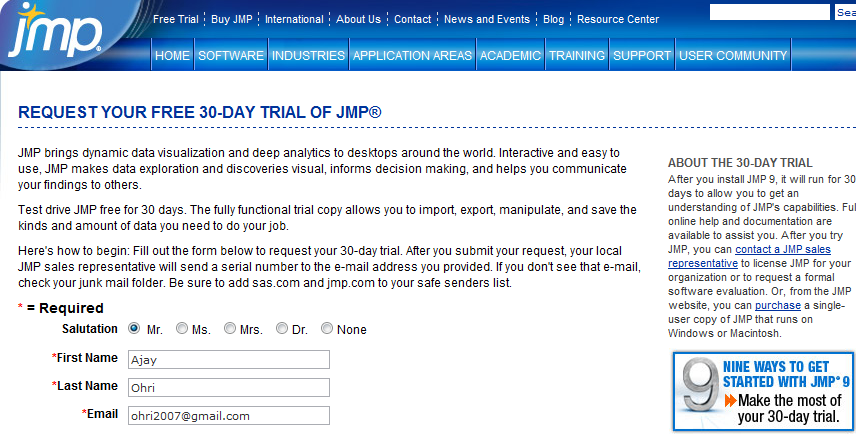
Test a 30 day free trial of JMP, the beautiful software with the ugliest website.

In case you have never used JMP, but know the difference between a mean and a mode- take a look.

Step 1 Fill long and badly designed outdated form (note the blue lightening graphics design and font)


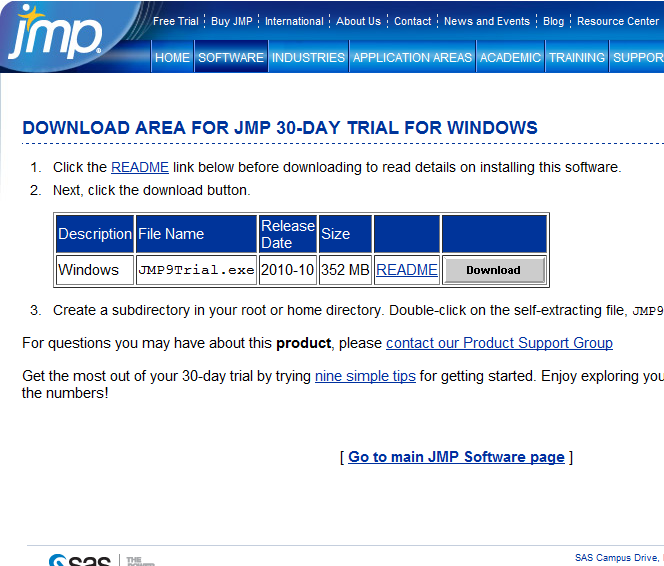
Step 2 See uselessly long message, as the website does require registration but it has not done  any oAuth/SM easy registration even though they help sell software in the same campus on social media

Step 3 Wait for 352 mb TO DOWNLOAD without a bit torrent or mirror servers, or even a link for scheduling Download Accelerator-

Note internet connections can be lousy (globally not just in India) to categorize 352 mb of downloads as painful.


And after all the violence and double talk
There’s just a song in all the trouble and the strife

JMP is still the best easiest to use powerful Big Data software with extensions into R and SAS.

Using Color Palettes in R

If you like me, are unable to decide whether blue or brown is a better color for graph- color palettes in R are a big help for aesthetically acceptable alternatives.

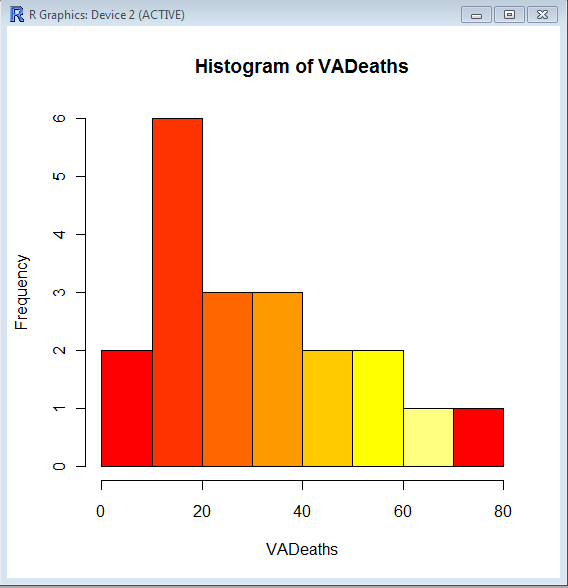
Using the same graphs, I choose the 5 main kinds of color palettes, using them is as easy as specifying the col= parameter in graphical display in Base Graphs. And I modified the n parameter for number of colors to be used- you can specify more or less depending how much you want the gradient or difference in colors to be.

> hist(VADeaths,col=heat.colors(7))

> hist(VADeaths,col=terrain.colors(7))

Continue reading “Using Color Palettes in R”

Top ten business analytics graphs Bar Charts (3/10)

Bar Charts and Histograms-Bar Charts are one of the most widely used types of Business Charts. Even the ever popular histograms are  special cases of bar charts (but showing frequencies). Histograms are the not the same as bar charts, they are simply bar charts of frequencies.

Basically a bar chart shows rectangular bars with length proportional to the quantities being described. It helps to see relative quantities between various category types.

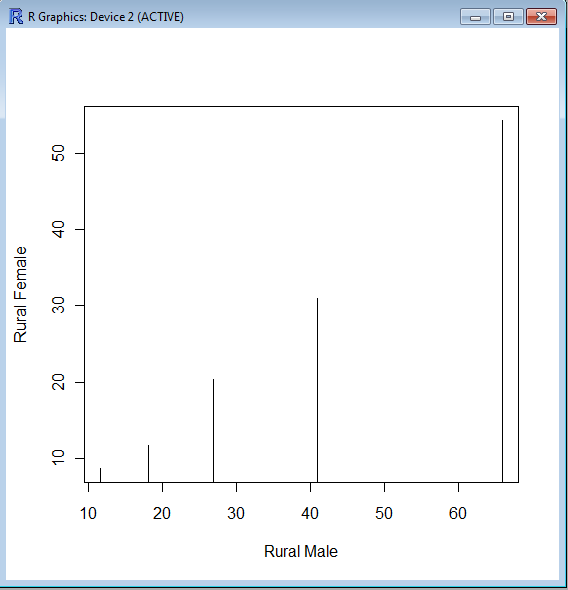
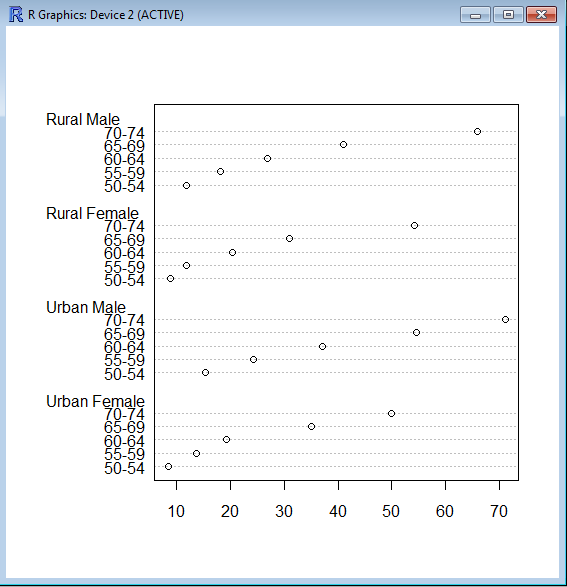
The barplot() command is used for making Bar Plots, while hist() is used for histograms. You can also use the plot() command with type=h to create histograms-The official R manual also suggests that Dot plots using dotchart () are a reasonable substitute for bar plots.
A very simple easy to understand tutorial for basic bar plots is at http://msenux.redwoods.edu/math/R/barplot.php

The difference between the three main functions that can be used for these charts are shown below-

> VADeaths
Rural Male Rural Female Urban Male Urban Female
50-54       11.7          8.7       15.4          8.4
55-59       18.1         11.7       24.3         13.6
60-64       26.9         20.3       37.0         19.3
65-69       41.0         30.9       54.6         35.1
70-74       66.0         54.3       71.1         50.0

> plot(VADeaths,type=”h”)


> dotchart(VADeaths)

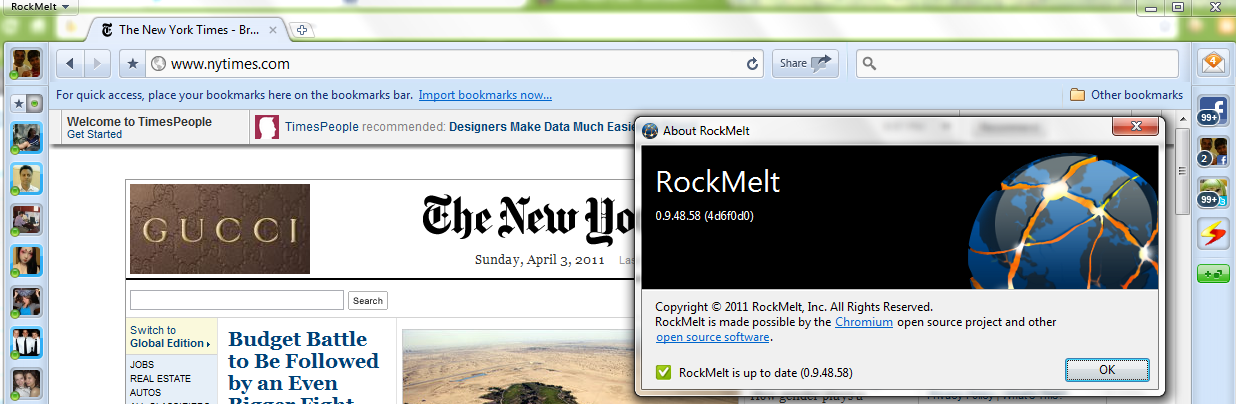
Rockmelt: A chromium based browser with a social layer

I kind of liked the latest browser on the block: Rockmelt.

It is based on Chromium open source project, that is primarily lead by Google. In case Facebook wants to buy a browser it can use Rockmelt–provided the mutual powers and angels agree.

I really liked the idea of a social layer- though I am not sure how the analytics embedded within a browser/report should be used.

Basically it re-designs the interface to put your social networks to the margin, thus quite a boon in you have active social media presence on multiple sites or a power reader/surfer. Timely alerts ping you to status/new messages without cluttering your screen and internet experience. Worth atleast a try or first look for the innovator kind of internet customer.

I still prefer the speed of Chrome– because Rockwell interface is still not easy to transition to – it almost adds in 3 dimensions in terms of where your eyeball should be while surfing (to left/right/margin).


and thats despite the funny fine print in Chrome’s user agreement of “continuing innovation”

type about:terms in your chrome bar to see-

4.3 As part of this continuing innovation, you acknowledge and agree that Google may stop (permanently or temporarily) providing the Services (or any features within the Services) to you or to users generally at Google’s sole discretion, without prior notice to you. You may stop using the Services at any time. You do not need to specifically inform Google when you stop using the Services.