Mash Hash Smash
To all the Larries of the world
the Joes, the Jims, the Steves
A shout out, much respect, you have unfurled.
Mash
First create a mash, an aggregated stash
Cross Domain platforms , the blurring of silo edges,
Intra department rivalries have no place in Klaatus world
Create a mash-up , shut up and draw
Do not swallow your own FUD in AAker’s brand indentity trap
Cognitive Bias leads to agency conflict
Ignore the little guys who bond in dorms at your peril,
Statistically the young still have more time than the boomers
to adapt , to change, to nurture the trees that stood for 300 million years
Hash
Congratulations, you got some money
Enjoy the lunch, the San Fransisco strip pubs, attention
Working furiously as the launch date approaches
Dont leave your prototype when you schmooze
remember your hommies and bro
Nice people last nice products have faltered
Everyone hates pompous software marketing
Create a hash tag in your blog
make title tag both tweet optimized and web search crawl able
If you are good to the search engine
It being fair will reward you well
On the internet phonies don’t last except in bubbles
Smash
When the economy is down is a good time to hire top talent at negotiable rates
When the economy is up is a good time to move from naive sales forecast models
The ego of the CEO is less valuable than the death of an elephant
Elephants dont dance but peacocks do
Use Fear Doubt Uncertainty selectively
Karma revolves FUD PIE on your face
be generous to schools you didnt study in
The poor have a right to college in India and China
Your medicine costs 1/10 th in Asia
Outsource but dont betray your nation
Outsource everything except your pride
Enjoy the show, welcome to the ride
The impact of currency fluctuations on outsourcing businesses globally.
If you have a current offshore team in a different country/currency zone then you may find that the significant cost savings from outsourcing have vanished due to currency fluctuations that occur for reasons like earthquakes, war or oil- something which is outside the core competency of your business corporation. As off shoring companies incur cost in local currencies but gain revenue in American Dollars and Euro (mostly), they pass on these fluctuating costs to their customers but rarely pass along discounts on existing contracts. Sometimes the offshoring contract actually gains from currency fluctuations.The Indian rupee has fluctuated from 43.62 Rupees per USD (04-01-2005) to 48.58 (12-31-2008) to the current value of 44.65.This makes for a volatility component of almost 10 percentage points to the revenue and profit margins of an off shoring vendor. Inflation in India has been growing at 8.5 % and the annual increase in salaries has been around 10-15 % for the past few years. Offshoring vendors have been known to cut back on quality in recruitment when costs have risen historically, and the current attrition rate in Indian ITES is almost 17%.
This raises important questions for companies going for global bids for the offshoring contracts. Should macroeconomic indicators like currency fluctuations, wage-inflation be part of the request for proposal process (RFP). Would vendors be comfortable in disclosing the ratio of salary costs to billing revenue. Should dips in service quality be penalized by customer. Most importantly, while going in for a multi year contract, the projection of fore-casted savings may vary greatly due to extraneous factors.
Having a child lowers a woman’s lifetime earnings, but how much depends upon her skill level. In The Mommy Track Divides: The Impact of Childbearing on Wages of Women of Differing Skill Levels (NBER Working Paper No. 16582), co-authors Elizabeth Ty Wilde, Lily Batchelder, and David Ellwood estimate that having a child costs the average high skilled woman $230,000 in lost lifetime wages relative to similar women who never gave birth. By comparison, low skilled women experience a lifetime wage loss of only $49,000.
Using the 1979 National Longitudinal Survey of Youth (NLSY), Wilde et. al. divided women into high, medium, and low skill categories based on their Armed Forces Qualification Test (AFQT) scores. The authors use these skill categories, combined with earnings, labor force participation, and family formation data, to chart the labor market progress of women before and after childbirth, from ages 14-to-21 in 1979 through 41-to-49 in 2006, this study’s final sample year.
High scoring and low scoring women differed in a number of ways. While 70-75 percent of higher scoring women work full-time all year prior to their first birth, only 55-60 percent of low scoring women do. As they age, the high scoring women enjoy steeper wage growth than low scoring women; low scoring women’s wages do not change much if they reenter the labor market after they have their first child. Five years after the first birth, about 35 percent of each group is working full-time. However, the high scoring women who are not working full-time are more likely to be working part-time than the low scoring women, who are more likely to leave the workforce entirely.
and
Men’s earning profiles are relatively unaffected by having children although men who never have children earn less on average than those who do. High scoring women who have children late also tend to earn more than high scoring childless women. Their earnings advantage occurs before they have children and narrows substantially after they become mothers.
the latest freest office productivity software in the world.
The Document Foundation maintains its release schedule thanks to a growing and vibrant community of developers
The Internet, March 22, 2011 – The Document Foundation announces LibreOffice 3.3.2, the second micro release of the free office suite for personal productivity, which further improves the stability of the software and sets the platform for the next release 3.4, due in mid May. The community of developers has been able to maintain the tight schedule thanks to the increase in the number of contributors, and to the fact that those that have started with easy hacks in September 2010 are now working at substantial features. In addition, they have almost completed the code cleaning process, getting rid of German comments and obsolete functionalities.
“I have started hacking LibreOffice code on September 28, 2010, just a few hours after the announcement of the project, and I found a very welcoming community, where senior developers went out of their way to help newbies like me to become productive. After a few hours I submitted a small patch removing 5 or 6 lines of dead code… enough to get my feet wet and learn the workflow”, says Norbert, a French developer living in the United States. “In a short time, I ended up removing the VOS library – deprecated for a decade – from LibreOffice, and finding and fixing various threading issues in the process”.
LibreOffice 3.3.2 is being released just one day after the closing of the first funding round launched by The Document Foundation to collect donations towards the 50,000-euro capital needed to establish a Stiftung in Germany. In five weeks, the community has donated twice as much, i.e. around 100,000 euros. All additional funds will be used for operating expenses such as infrastructure costs and registration of domain names and trademarks, as well as for community development expenses such as travel funding for TDF representatives speaking at conferences, booth fees for trade shows, and initial financing of merchandising items, DVDs and printed material.
Italo Vignoli, a founder and a steering committee member of The Document Foundation, will be keynoting at Flourish 2011 in Chicago on Sunday, April 3, at 10:30AM, about getting independent from OpenOffice and Oracle, starting The Document Foundation, raising the capital and the first community budget, organizing developers and other work, and outlining a roadmap for future releases and features.
The Document Foundation has the mission of facilitating the evolution of the LibreOffice Community into a new, open, independent, and meritocratic organization within the next few months. An independent foundation is a better reflection of the values of our contributors, users and supporters, and will enable a more effective, efficient and transparent community. TDF will protect past investments by building on the achievements of the first decade, will encourage wide participation within the community, and will co-ordinate activity across the community.
Dap is a small statistics and graphics package based on C. Version 3.0 and later of Dap can read SBS programs (based on the utterly famous, industry standard statistics system with similar initials – you know the one I mean)! The user wishing to perform basic statistical analyses is now freed from learning and using C syntax for straightforward tasks, while retaining access to the C-style graphics and statistics features provided by the original implementation. Dap provides core methods of data management, analysis, and graphics that are commonly used in statistical consulting practice (univariate statistics, correlations and regression, ANOVA, categorical data analysis, logistic regression, and nonparametric analyses).
Anyone familiar with the basic syntax of C programs can learn to use the C-style features of Dap quickly and easily from the manual and the examples contained in it; advanced features of C are not necessary, although they are available. (The manual contains a brief introduction to the C syntax needed for Dap.) Because Dap processes files one line at a time, rather than reading entire files into memory, it can be, and has been, used on data sets that have very many lines and/or very many variables.
I wrote Dap to use in my statistical consulting practice because the aforementioned utterly famous, industry standard statistics system is (or at least was) not available on GNU/Linux and costs a bundle every year under a lease arrangement. And now you can run programs written for that system directly on Dap! I was generally happy with that system, except for the graphics, which are all but impossible to use, but there were a number of clumsy constructs left over from its ancient origins.
sounds too good to be true- GNU /DAP joins WPS workbench and Dulles Open’s Carolina as the third SAS language compiler (besides the now defunct BASS software) see http://en.wikipedia.org/wiki/SAS_language#Controversy
Dap was written to be a free replacement for SAS, but users are assumed to have a basic familiarity with the C programming language in order to permit greater flexibility. Unlike R it has been designed to be used on large data sets.
It has been designed so as to cope with very large data sets; even when the size of the data exceeds the size of the computer’s memory
Analyzing data can have many challenges associated with it. In the case of business analytics data, these challenges or constraints can have a marked effect on the quality and timeliness of the analysis as well as the expected versus actual payoff from the analytical results.
Challenges of Analytical Data Processing-
1) Data Formats- Reading in complete data, without losing any part (or meta data), or adding in superfluous details (that increase the scope). Technical constraints of data formats are relatively easy to navigate thanks to ODBC and well documented and easily search-able syntax and language.
The costs of additional data augmentation (should we pay for additional credit bureau data to be appended) , time of storing and processing the data (every column needed for analysis can add in as many rows as whole dataset, which can be a time enhancing problem if you are considering an extra 100 variables with a few million rows), but above all that of business relevance and quality guidelines will ensure basic data input and massaging are considerable parts of whole analytical project timeline.
2) Data Quality-Perfect data exists in a perfect world. The price of perfect information is one business will mostly never budget or wait for. To deliver inferences and results based on summaries of data which has missing, invalid, outlier data embedded within it makes the role of an analyst just as important as which ever tool is chosen to remove outliers, replace missing values, or treat invalid data.
3) Project Scope-
How much data? How much Analytical detail versus High Level Summary? Timelines for delivery as well as refresh of data analysis? Checks (statistical as well as business)?
How easy is it to load and implement the new analysis in existing Information Technology Infrastructure? These are some of the outer parameters that can limit both your analytical project scope, your analytical tool choice, and your processing methodology.
4) Output Results vis a vis stakeholder expectation management-
Stakeholders like to see results, not constraints, hypothesis ,assumptions , p-value, or chi -square value. Output results need to be streamlined to a decision management process to justify the investment of human time and effort in an analytical project, choice,training and navigating analytical tool complexities and constraints are subset of it. Optimum use of graphical display is a part of aligning results to a more palatable form to stakeholders, provided graphics are done nicely.
Eg Marketing wants to get more sales so they need a clear campaign, to target certain customers via specific channels with specified collateral. In order to base their business judgement, business analytics needs to validate , cross validate and sometimes invalidate this business decision making with clear transparent methods and processes.
Given a dataset- the basic analytical steps that an analyst will do with R are as follows. This is meant as a note for analysts at a beginner level with R.
Package -specific syntax
update.packages() #This updates all packages
install.packages(package1) #This installs a package locally, a one time event
library(package1) #This loads a specified package in the current R session, which needs to be done every R session
CRAN________LOCAL HARD DISK_________R SESSION is the top to bottom hierarchy of package storage and invocation.
ls() #This lists all objects or datasets currently active in the R session
> names(assetsCorr) #This gives the names of variables within a dataframe
[1] “AssetClass” “LargeStocksUS” “SmallStocksUS”
[4] “CorporateBondsUS” “TreasuryBondsUS” “RealEstateUS”
[7] “StocksCanada” “StocksUK” “StocksGermany”
[10] “StocksSwitzerland” “StocksEmergingMarkets”
> dim(assetsCorr) #gives dimensions observations and variable number
[1] 12 11
str(Dataset) – This gives the structure of the dataset (note structure gives both the names of variables within dataset as well as dimensions of the dataset)
head(dataset,n1) gives the first n1 rows of dataset while
tail(dataset,n2) gives the last n2 rows of a dataset where n1,n2 are numbers and dataset is the name of the object (here a data frame that is being considered)
summary(dataset) gives you a brief summary of all variables while
library(Hmisc)
describe(dataset) gives a detailed description on the variables
simple graphics can be given by
hist(Dataset1)
and
plot(Dataset1)
As you can see in above cases, there are multiple ways to get even basic analysis about data in R- however most of the syntax commands are intutively understood (like hist for histogram, t.test for t test, plot for plot).
For detailed analysis throughout the scope of analysis, for a business analytics user it is recommended to using multiple GUI, and multiple packages. Even for highly specific and specialized analytical tasks it is recommended to check for a GUI that incorporates the required package.
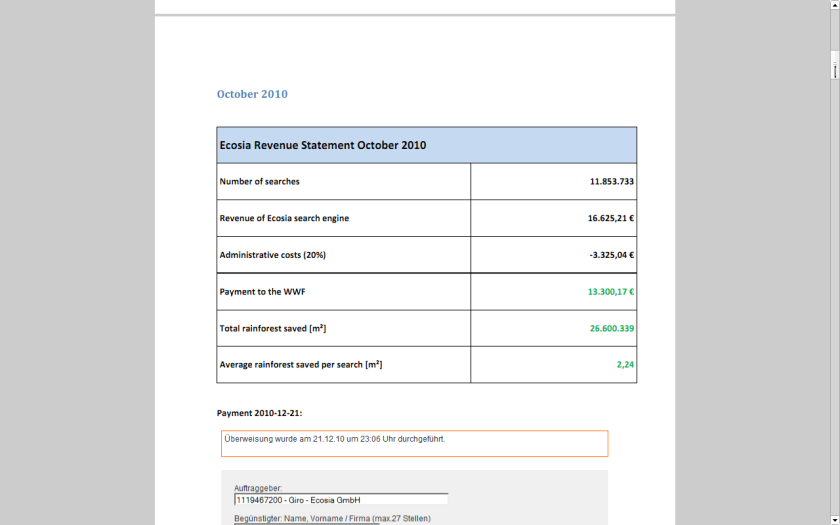
I recently found an interesting example of a website that both makes a lot of money and yet is much more efficient than any free or non profit. It is called ECOSIA
If you see a website that wants to balance administrative costs plus have a transparent way to make the world better- this is a great example.
World’s largest tropical forest reserve (38,867 square kilometers, or about the size of Switzerland)
Home to about 14% of all amphibian species and roughly 54% of all bird species in the Amazon – not to mention large populations of at least eight threatened species, including the jaguar
Includes part of the Guiana Shield containing 25% of world’s remaining tropical rainforests – 80 to 90% of which are still pristine
Holds the last major unpolluted water reserves in the Neotropics, containing approximately 20% of all of the Earth’s water
One of the last tropical regions on Earth vastly unaltered by humans
Significant contributor to climatic regulation via heat absorption and carbon storage
Click per milli (or CPM) gives you a very low low conversion compared to contacting ad sponsor directly.
But its a great data experiment-
as you can monitor which companies are likely to be advertised on your site (assume google knows more about their algols than you will)
which formats -banner or text or flash have what kind of conversion rates
what are the expected pay off rates from various keywords or companies (like business intelligence software, predictive analytics software and statistical computing software are similar but have different expected returns (if you remember your eco class)
NOW- Based on above data, you know whats your minimum baseline to expect from a private advertiser than a public, crowd sourced search engine one (like Google or Bing)
Lets say if you have 100000 views monthly. and assume one out of 1000 page views will lead to a click. Say the advertiser will pay you 1 $ for every 1 click (=1000 impressions)
Then your expected revenue is $100.But if your clicks are priced at 2.5$ for every click , and your click through rate is now 3 out of 1000 impressions- (both very moderate increases that can done by basic placement optimization of ad type, graphics etc)-your new revenue is 750$.
Be a good Samaritan- you decide to share some of this with your audience -like 4 Amazon books per month ( or I free Amazon book per week)- That gives you a cost of 200$, and leaves you with some 550$.
Wait! it doesnt end there- Adam Smith‘s invisible hand moves on .
You say hmm let me put 100 $ for an annual paper writing contest of $1000, donate $200 to one laptop per child ( or to Amazon rain forests or to Haiti etc etc etc), pay $100 to your upgraded server hosting, and put 350$ in online advertising. say $200 for search engines and $150 for Facebook.
Woah!
Month 1 would should see more people visiting you for the first time. If you have a good return rate (returning visitors as a %, and low bounce rate (visits less than 5 secs)- your traffic should see atleast a 20% jump in new arrivals and 5-10 % in long term arrivals. Ignoring bounces- within three months you will have one of the following
1) An interesting case study on statistics on online and social media advertising, tangible motivations for increasing community response , and some good data for study
2) hopefully better cost management of your server expenses
3)very hopefully a positive cash flow
you could even set a percentage and share the monthly (or annually is better actions) to your readers and advertisers.
go ahead- change the world!
the key paradigms here are sharing your traffic and revenue openly to everyone
donating to a suitable cause
helping increase awareness of the suitable cause
basing fixed percentages rather than absolute numbers to ensure your site and cause are sustained for years.



 DECISION STATS