For Microsoft Windows installations, to upgrade your Rattle installation you may need to remove any old installs of the Gtk+ libraries using the Uninstall application from the Microsoft Windows Control Panel). Then install the new Gtk2 library:
The output from rattle.info() will include an “install.packages” command that will identify Rattle related packages that have updates available. You can cut-and-paste that command to the R prompt to have those packages updated in your installation.
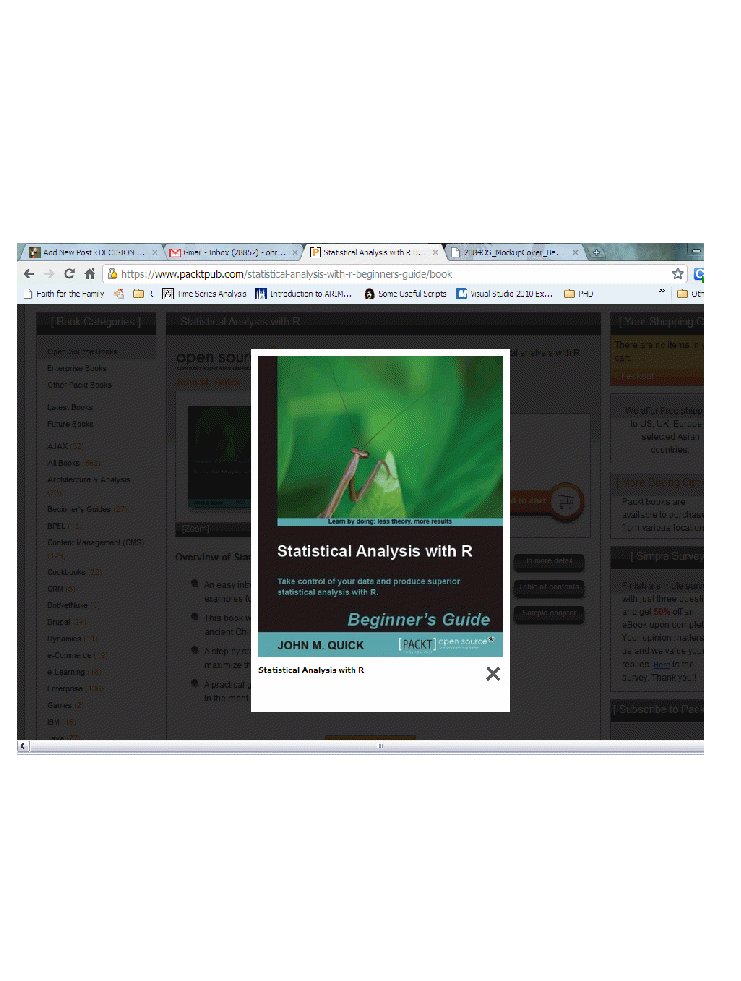
I was asked to be a techie reviewe for John M Quick’s new R book “Statistical Analysis with R” from Packt Publishing some months ago-(very much to my surprise I confess)-
I agreed- and technical reviewer work does take time- its like being a mid wife and there is whole team trying to get the book to birth.
Statistical Analysis with R- is a Beginner’s Guide so has nice screenshots, simple case studies, and quizzes to check recall of student/ reader. I remember struggling with the official “beginner’s guide to R” so this one is different in that it presents a story of a Chinese Army and how to use R to plan resources to fight the battle. It’s recommended especially for undergraduate courses- R need not be an elitist language- and given my experience with Asian programming acumen – I am sure it is a matter of time before high schools in India teach basic R in final years ( I learnt quite a shit load of quantum physics as compulsory topics in Indian high schools- but I guess we didnt have Jersey Shore things to do)
Congrats to author Mr John M Quick- he is doing his educational Phd from ASU- and I am sure both he and his approach to making education simple informative and fun will go places.
Only bad thing- The Name Statistical Analysis with R has atleast three other books , but I guess Google will catch up to it.
More than just a blog aggregator- includes sections on other stuff- thus more like a community than a big feed
Abbreviated feeds- just gives you two-three lines of summary per post than the whole big schmakaround -thats a time saver for me —(D Smith is the only -lonely blogger atm there)
The more the merrier- One more place to read and write R.
btw is the name insider (as in guy who knows inside stuff) or Inside- R (as in get inside the R box)- just kidding. With PlyR, ManipulatR, ApplyR and now Inside R- the pun gets MerrieR
If my blog app gets rejected- these views may change ,grr
A new report from Linux Foundation found significant growth trends for enterprise usage of Linux- which should be welcome to software companies that have enabled Linux versions of software, service providers that provide Linux based consulting (note -lesser competition, lower overheads) and to application creators.
Key Findings from the Report
• 79.4 percent of companies are adding more Linux relative to other operating systems in the next five years.
• More people are reporting that their Linux deployments are migrations from Windows than any other platform, including Unix migrations. 66 percent of users surveyed say that their Linux deployments are brand new (“Greenfield”) deployments.
• Among the early adopters who are operating in cloud environments, 70.3 percent use Linux as their primary platform, while only 18.3 percent use Windows.
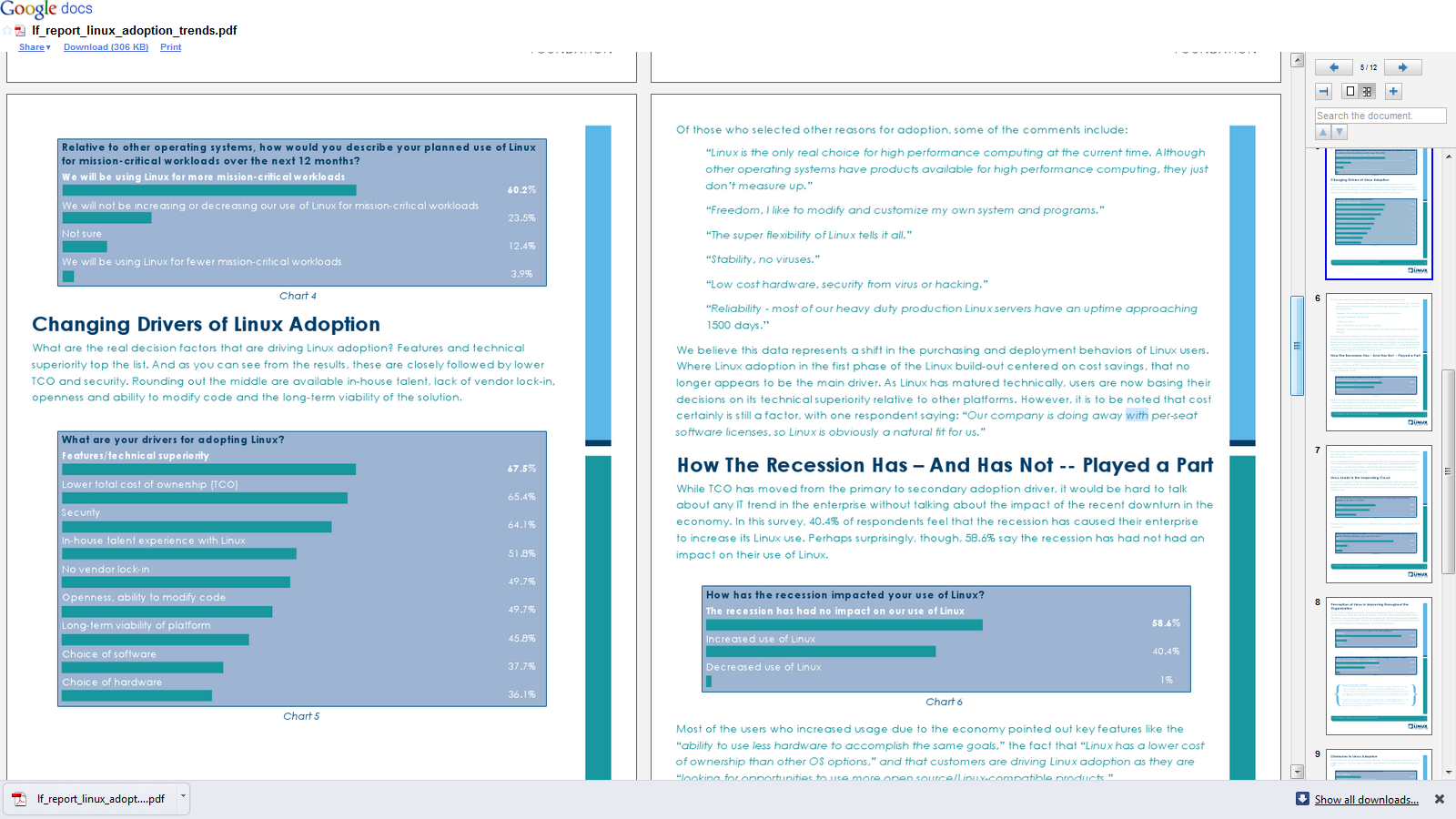
• 60.2 percent of respondents say they will use Linux for more mission-critical workloads over the next 12 months.
• 86.5 percent of respondents report that Linux is improving and 58.4 percent say their CIOs see Linux as more strategic to the organization as compared to three years ago.
• Drivers for Linux adoption extend beyond cost: technical superiority is the primary driver, followed by cost and then security.
• The growth in Linux, as demonstrated by this report, is leading companies to increasingly seek Linux IT professionals, with 38.3 percent of respondents citing a lack of Linux talent as one of their main concerns related to the platform.
• Users participate in Linux development in three primary ways: testing and submitting bugs (37.5 percent), working with vendors (30.7 percent) and participating in The Linux Foundation activities (26.0 percent).
and from the report itself-
It is an interesting report (and for some reason in a blue font-making it more like a blue paper than a white paper)
His argument of love is not very original though it was first made by these four guys
I am going to argue that “some” R developers should be paid, while the main focus should be volunteers code. These R developers should be paid as per usage of their packages.
Let me expand.
Imagine the following conversation between Ross Ihaka, Norman Nie and Peter Dalgaard.
Norman- Hey Guys, Can you give me some code- I got this new startup.
Ross Ihaka and Peter Dalgaard- Sure dude. Here is 100,000 lines of code, 2000 packages and 2 decades of effort.
Norman- Thanks guys.
Ross Ihaka- Hey, What you gonna do with this code.
Norman- I will better it. Sell it. Finally beat Jim Goodnight and his **** Proc GLM and **** Proc Reg.
Ross- Okay, but what will you give us? Will you give us some code back of what you improve?
Norman – Uh, let me explain this open core …
Peter D- Well how about some royalty?
Norman- Sure, we will throw parties at all conferences, snacks you know at user groups.
Ross – Hmm. That does not sound fair. (walks away in a huff muttering)-He takes our code, sells it and wont share the code
Peter D- Doesnt sound fair. I am back to reading Hamlet, the great Dane, and writing the next edition of my book. I am glad I wrote a book- Ross didnt even write that.
Norman-Uh Oh. (picks his phone)- Hey David Smith, We need to write some blog articles pronto – these open source guys ,man…
———–I think that sums what has been going on in the dynamics of R recently. If Ross Ihaka and R Gentleman had adopted an open core strategy- meaning you can create packages to R but not share the original where would we all be?
At this point if he is reading this, David Smith , long suffering veteran of open source flameouts is rolling his eyes while Tal G is wondering if he will publish this on R Bloggers and if so when or something.
Lets bring in another R veteran- Hadley Wickham who wrote a book on R and also created ggplot. Thats the best quality, most often used graphics package.
In terms of economic utilty to end user- the ggplot package may be as useful if not more as the foreach package developed by Revolution Computing/Analytics.
However lets come to open core licensing ( read it here http://alampitt.typepad.com/lampitt_or_leave_it/2008/08/open-core-licen.html ) which is where the debate is- Revolution takes code- enhances it (in my opinion) substantially with new formats XDF for better efficieny, web services API, and soon coming next year a GUI (thanks in advance , Dr Nie and guys)
and sells this advanced R code to businesses happy to pay ( they are currently paying much more to DR Goodnight and HIS guys)
Why would any sane customer buy it from Revolution- if he could download exactly the same thing from http://r-project.org
Hence the business need for Revolution Analytics to have an enhanced R- as they are using a product based software model not software as a service model.
If Revolution gives away source code of these new enhanced codes to R core team- how will R core team protect the above mentioned intelectual property- given they have 2 decades experience of giving away free code , and back and forth on just code.
Now Revolution also has a marketing budget- and thats how they sponsor some R Core events, conferences, after conference snacks.
How would people decide if they are being too generous or too stingy in their contribution (compared to the formidable generosity of SAS Institute to its employees, stakeholders and even third party analysts).
Would it not be better- IF Revolution can shift that aspect of relationship to its Research and Development budget than it’s marketing budget- come with some sort of incentive for “SOME” developers – even researchers need grants and assistantships, scholarships, make a transparent royalty formula say 17.5 % of the NEW R sales goes to R PACKAGE Developers pool, which in turn examines usage rate of packages and need/merit before allocation- that would require Revolution to evolve from a startup to a more sophisticated corporate and R Core can use this the same way as John M Chambers software award/scholarship
Dont pay all developers- it would be an insult to many of them – say Prof Harrell creator of HMisc to accept – but can Revolution expand its dev base (and prospect for future employees) by even sponsoring some R Scholarships.
And I am sure that if Revolution opens up some more code to the community- they would the rest of the world and it’s help useful. If it cant trust people like R Gentleman with some source code – well he is a board member.
——————————————————————————————–
Now to sum up some technical discussions on NeW R
1) An accepted way of benchmarking efficiencies.
2) Code review and incorporation of efficiencies.
3) Multi threading- Multi core usage are trends to be incorporated.
4) GUIs like R Commander E Plugins for other packages, and Rattle for Data Mining to have focussed (or Deducer). This may involve hiring User Interface Designers (like from Apple 😉 who will work for love AND money ( Even the Beatles charge royalty for that song)
5) More support to cloud computing initiatives like Biocep and Elastic R – or Amazon AMI for using cloud computers- note efficiency arguements dont matter if you just use a Chrome Browser and pay 2 cents a hour for an Amazon Instance. Probably R core needs more direct involvement of Google (Cloud OS makers) and Amazon as well as even Salesforce.com (for creating Force.com Apps). Note even more corporates here need to be involved as cloud computing doesnot have any free and open source infrastructure (YET)
“If something goes wrong with Microsoft, I can phone Microsoft up and have it fixed. With Open Source, I have to rely on the community.”
And the community, as much as we may love it, is unpredictable. It might care about your problem and want to fix it, then again, it may not. Anyone who has ever witnessed something online go “viral”, good or bad, will know what I’m talking about.








 DECISION STATS