
GNU PSPP- The Open Source SPSS

If you are SPSS user (for statistics/ not data mining) you can also try 0ut GNU PSPP- which is the open source equivalent and quite eerily impressive in performance. It is available at http://www.gnu.org/software/pspp/ or http://pspp.awardspace.com/ and you can also read more at http://en.wikipedia.org/wiki/PSPP
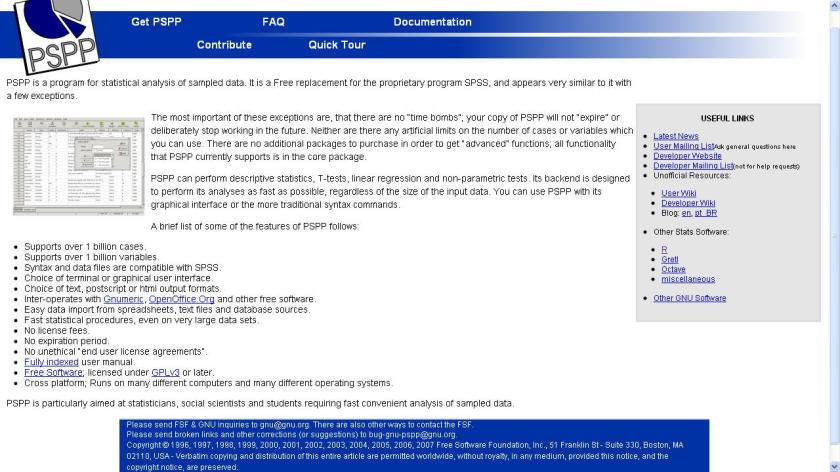
PSPP is a program for statistical analysis of sampled data. It is a Free replacement for the proprietary program SPSS, and appears very similar to it with a few exceptions.

[ Image of Variable Sheet ]The most important of these exceptions are, that there are no “time bombs”; your copy of PSPP will not “expire” or deliberately stop working in the future. Neither are there any artificial limits on the number of cases or variables which you can use. There are no additional packages to purchase in order to get “advanced” functions; all functionality that PSPP currently supports is in the core package.

PSPP can perform descriptive statistics, T-tests, linear regression and non-parametric tests. Its backend is designed to perform its analyses as fast as possible, regardless of the size of the input data. You can use PSPP with its graphical interface or the more traditional syntax commands.

A brief list of some of the features of PSPP follows:

  • Supports over 1 billion cases.
  • Supports over 1 billion variables.
  • Syntax and data files are compatible with SPSS.
  • Choice of terminal or graphical user interface.
  • Choice of text, postscript or html output formats.
  • Inter-operates with GnumericOpenOffice.Org and other free software.
  • Easy data import from spreadsheets, text files and database sources.
  • Fast statistical procedures, even on very large data sets.
  • No license fees.
  • No expiration period.
  • No unethical “end user license agreements”.
  • Fully indexed user manual.
  • Free Software; licensed under GPLv3 or later.
  • Cross platform; Runs on many different computers and many different operating systems.

PSPP is particularly aimed at statisticians, social scientists and students requiring fast convenient analysis of sampled data.

and

Features

This software provides a basic set of capabilities: frequencies, cross-tabs comparison of means (T-tests and one-way ANOVA); linear regression, reliability (Cronbach’s Alpha, not failure or Weibull), and re-ordering data, non-parametric tests, factor analysis and more.

At the user’s choice, statistical output and graphics are done in asciipdfpostscript or html formats. A limited range of statistical graphs can be produced, such as histogramspie-charts and np-charts.

PSPP can import GnumericOpenDocument and Excel spreadsheetsPostgres databasescomma-separated values– and ASCII-files. It can export files in the SPSS ‘portable’ and ‘system’ file formats and to ASCII files. Some of the libraries used by PSPP can be accessed programmatically; PSPP-Perl provides an interface to the libraries used by PSPP.

Origins

The PSPP project (originally called “Fiasco”) is a free, open-source alternative to the proprietary statistics package SPSS. SPSS is closed-source and includes a restrictive licence anddigital rights management. The author of PSPP considered this ethically unacceptable, and decided to write a program which might with time become functionally identical to SPSS, except that there would be no licence expiry, and everyone would be permitted to copy, modify and share the program.

Release history

  • 0.7.5 June 2010 http://pspp.awardspace.com/
  • 0.6.2 October 2009
  • 0.6.1 October 2008
  • 0.6.0 June 2008
  • 0.4.0.1 August 2007
  • 0.4.0 August 2005
  • 0.3.0 April 2004
  • 0.2.4 January 2000
  • 0.1.0 August 1998

Third Party Reviews

In the book “SPSS For Dummies“, the author discusses PSPP under the heading of “Ten Useful Things You Can Find on the Internet” [1]. In 2006, the South African Statistical Association presented a conference which included an analysis of how PSPP can be used as a free replacement to SPSS [2].

Citation-

Please send FSF & GNU inquiries to gnu@gnu.org. There are also other ways to contact the FSF. Please send broken links and other corrections (or suggestions) to bug-gnu-pspp@gnu.org.

Copyright © 1996, 1997, 1998, 1999, 2000, 2001, 2002, 2003, 2004, 2005, 2006, 2007 Free Software Foundation, Inc., 51 Franklin St – Suite 330, Boston, MA 02110, USA – Verbatim copying and distribution of this entire article are permitted worldwide, without royalty, in any medium, provided this notice, and the copyright notice, are preserved.
Big Data and R: New Product Release by Revolution Analytics

Press Release by the Guys in Revolution Analytics- this time claiming to enable terabyte level analytics with R. Interesting stuff but techie details are awaited.

Revolution Analytics Brings

Big Data Analysis to R

The world’s most powerful statistics language can now tackle terabyte-class data sets using

Revolution R Enterpriseat a fraction of the cost of legacy analytics products


JSM 2010 – VANCOUVER (August 3, 2010) — Revolution Analytics today introduced ‘Big Data’ analysis to its Revolution R Enterprise software, taking the popular R statistics language to unprecedented new levels of capacity and performance for analyzing very large data sets. For the first time, R users will be able to process, visualize and model terabyte-class data sets in a fraction of the time of legacy products—without employing expensive or specialized hardware.

The new version of Revolution R Enterprise introduces an add-on package called RevoScaleR that provides a new framework for fast and efficient multi-core processing of large data sets. It includes:

  • The XDF file format, a new binary ‘Big Data’ file format with an interface to the R language that provides high-speed access to arbitrary rows, blocks and columns of data.
  • A collection of widely-used statistical algorithms optimized for Big Data, including high-performance implementations of Summary Statistics, Linear Regression, Binomial Logistic Regressionand Crosstabs—with more to be added in the near future.
  • Data Reading & Transformation tools that allow users to interactively explore and prepare large data sets for analysis.
  • Extensibility, expert R users can develop and extend their own statistical algorithms to take advantage of Revolution R Enterprise’s new speed and scalability capabilities.

“The R language’s inherent power and extensibility has driven its explosive adoption as the modern system for predictive analytics,” said Norman H. Nie, president and CEO of Revolution Analytics. “We believe that this new Big Data scalability will help R transition from an amazing research and prototyping tool to a production-ready platform for enterprise applications such as quantitative finance and risk management, social media, bioinformatics and telecommunications data analysis.”

Sage Bionetworks is the nonprofit force behind the open-source collaborative effort, Sage Commons, a place where data and disease models can be shared by scientists to better understand disease biology. David Henderson, Director of Scientific Computing at Sage, commented: “At Sage Bionetworks, we need to analyze genomic databases hundreds of gigabytes in size with R. We’re looking forward to using the high-speed data-analysis features of RevoScaleR to dramatically reduce the times it takes us to process these data sets.”

Take Hadoop and Other Big Data Sources to the Next Level

Revolution R Enterprise fits well within the modern ‘Big Data’ architecture by leveraging popular sources such as Hadoop, NoSQL or key value databases, relational databases and data warehouses. These products can be used to store, regularize and do basic manipulation on very large datasets—while Revolution R Enterprise now provides advanced analytics at unparalleled speed and scale: producing speed on speed.

“Together, Hadoop and R can store and analyze massive, complex data,” said Saptarshi Guha, developer of the popular RHIPE R package that integrates the Hadoop framework with R in an automatically distributed computing environment. “Employing the new capabilities of Revolution R Enterprise, we will be able to go even further and compute Big Data regressions and more.”

Platforms and Availability

The new RevoScaleR package will be delivered as part of Revolution R Enterprise 4.0, which will be available for 32-and 64-bit Microsoft Windows in the next 30 days. Support for Red Hat Enterprise Linux (RHEL 5) is planned for later this year.

On its website (http://www.revolutionanalytics.com/bigdata), Revolution Analytics has published performance and scalability benchmarks for Revolution R Enterprise analyzing a 13.2 gigabyte data set of commercial airline information containing more than 123 million rows, and 29 columns.

Additionally, the company will showcase its new Big Data solution in a free webinar on August 25 at 9:00 a.m. Pacific.

Additional Resources

•      Big Data Benchmark whitepaper

•      The Revolution Analytics Roadmap whitepaper

•      Revolutions Blog

•      Download free academic copy of Revolution R Enterprise

•      Visit Inside-R.org for the most comprehensive set of information on R

•      Spread the word: Add a “Download R!” badge on your website

•      Follow @RevolutionR on Twitter

About Revolution Analytics

Revolution Analytics (http://www.revolutionanalytics.com) is the leading commercial provider of software and support for the popular open source R statistics language. Its Revolution R products help make predictive analytics accessible to every type of user and budget. The company is headquartered in Palo Alto, Calif. and backed by North Bridge Venture Partners and Intel Capital.

Media Contact

Chantal Yang
Page One PR, for Revolution Analytics
Tel: +1 415-875-7494

Email:  revolution@pageonepr.com

My latest creation

I have just teamed up to create my latest venture called Kush Cognitives (Kush is my son). The firm is gonna make websites, build statistical analysis and offer social media offerings. It’s my latest venture and it merges all my previous ones and skills. After almost 3 years of working on and off with multiple people, this one is with a friend in the US.

Over the years (since 2007) I have made http://virtua-analytics.com (defunct), Swarajya Analytics Private Limited (www.swanplc.com – now sold) and now Kush Cognitives. I have gone through the models of proprietorship and corporation and now partnership.

Kush Cognitives is hosted at Decisionstats.com (as our flagship website) and we have shifted the blog to Decisionstats.Wordpress.com

We are aiming at the startups and small and medium segments first, but we retain capabilities for bigger clients as well. Lesser Bullshit and More Bang for your Buck.

So wish us luck- and if you need any social media advice, statistical analysis to be done, or technical matters of creating websites-This also includes training customization in R , SAS  , and statistical software but from a more practical point of view from a user angle. We are able to cater to both US and Indian clients.

give us a buzz at http://decisionstats.com

regards

Ajay Ohri

Image Courtesy-michelangelo

SAS Sentiment Analysis wins Award

From Business Wire, the new Sentiment Analysis product by SAS Institute (created by acquisition Teragram ) wins an award. As per wikipedia

http://en.wikipedia.org/wiki/Sentiment_analysis

Sentiment analysis or opinion mining refers to a broad (definitionally challenged) area of natural language processingcomputational linguistics and text mining. Generally speaking, it aims to determine the attitude of a speaker or a writer with respect to some topic. The attitude may be their judgment or evaluation (see appraisal theory), their affective state (that is to say, the emotional state of the author when writing) or the intended emotional communication (that is to say, the emotional effect the author wishes to have on the reader).

It was developed by Teragram. Here is another Sentiment Analysis tool from Stanford Grad school at http://twittersentiment.appspot.com/search?query=sas

See-

Sentiment analysis for sas

Image Citation-

http://threeminds.organic.com/2009/09/five_reasons_sentiment_analysi.html

Read an article on sentiment analysis here at http://www.nytimes.com/2009/08/24/technology/internet/24emotion.html

And the complete press release at http://goo.gl/iVzf`

SAS Sentiment Analysis delivers insights on customer, competitor and organizational opinions to a degree never before possible via manual review of electronic text. As a result, SAS, the leader in business analytics software and services, has earned the prestigious Communications Solutions Product of the Year Award fromTechnology Marketing Corporation (TMC).

“SAS has automated the time-consuming process of reading individual documents and manually extracting relevant information”

“SAS Sentiment Analysis has shown benefits for its customers and it provides ROI for the companies that use it,” said Rich Tehrani, CEO, TMC. “Congratulations to the entire team at SAS, a company distinguished by its dedication to software quality and superiority to address marketplace needs.”

Derive positive and negative opinions, evaluations and emotions

SAS Sentiment Analysis’ high-performance crawler locates and extracts sentiment from digital content sources, including mainstream websites, social media outlets, internal servers and incoming news feeds. SAS’ unique hybrid approach combines powerful statistical techniques with linguistics rules to improve accuracy to the detailed feature level. It summarizes the sentiment expressed in all available text collections – identifying trends and creating graphical reports that describe the expressed feelings of consumers, partners, employees and competitors in real time. Output from SAS Sentiment Analysis can be stored in document repositories, surfaced in corporate portals and used as input to additional SAS Text Analytics software or search engines to help decision makers evaluate trends, predict future outcomes, minimize risks and capitalize on opportunities.

“SAS has automated the time-consuming process of reading individual documents and manually extracting relevant information,” said Fiona McNeill, Global Analytics Product Marketing Manager at SAS. “Our integrated analytics framework helps organizations maximize the value of information to improve their effectiveness.”

SAS Sentiment Analysis is included in the SAS Text Analytics suite, which helps organizations discover insights from electronic text materials, associate them for delivery to the right person or place, and provide intelligence to select the best course of action. Whether answering complex search-and-retrieval questions, ensuring appropriate content is presented to internal or external constituencies, or predicting which activity or channel will produce the best effect on existing sentiments, SAS Text Analytics provides exceptional real-time processing speeds for large volumes of text.

SAS Text Analytics solutions are part of the SAS Business Analytics Framework, backed by the industry’s most comprehensive range of consulting, training and support services, ensuring customers maximum return from their IT investments.

Recognizing vision

The Communications Solutions Product of the Year Award recognizes vision, leadership and thoroughness. The most innovative products and services brought to the market from March 2008 through March 2009 were chosen as winners of this Product of the Year Award and are published on the INTERNET TELEPHONY and Customer Interaction Solutions websites.

Towards better analytical software

Here are some thoughts on using existing statistical software for better analytics and/or business intelligence (reporting)-

1) User Interface Design Matters- Most stats software have a legacy approach to user interface design. While the Graphical User Interfaces need to more business friendly and user friendly- example you can call a button T Test or You can call it Compare > Means of Samples (with a highlight called T Test). You can call a button Chi Square Test or Call it Compare> Counts Data. Also excessive reliance on drop down ignores the next generation advances in OS- namely touchscreen instead of mouse click and point.

Given the fact that base statistical procedures are the same across softwares, a more thoughtfully designed user interface (or revamped interface) can give softwares an edge over legacy designs.

2) Branding of Software Matters- One notable whine against SAS Institite products is a premier price. But really that software is actually inexpensive if you see other reporting software. What separates a Cognos from a Crystal Reports to a SAS BI is often branding (and user interface design). This plays a role in branding events – social media is often the least expensive branding and marketing channel. Same for WPS and Revolution Analytics.

3) Alliances matter- The alliances of parent companies are reflected in the sales of bundled software. For a complete solution , you need a database plus reporting plus analytical software. If you are not making all three of the above, you need to partner and cross sell. Technically this means that software (either DB, or Reporting or Analytics) needs to talk to as many different kinds of other softwares and formats. This is why ODBC in R is important, and alliances for small companies like Revolution Analytics, WPS and Netezza are just as important as bigger companies like IBM SPSS, SAS Institute or SAP. Also tie-ins with Hadoop (like R and Netezza appliance)  or  Teradata and SAS help create better usage.

4) Cloud Computing Interfaces could be the edge- Maybe cloud computing is all hot air. Prudent business planing demands that any software maker in analytics or business intelligence have an extremely easy to load interface ( whether it is a dedicated on demand website) or an Amazon EC2 image. Easier interfaces win and with the cloud still in early stages can help create an early lead. For R software makers this is critical since R is bad in PC usage for larger sets of data in comparison to counterparts. On the cloud that disadvantage vanishes. An easy to understand cloud interface framework is here ( its 2 years old but still should be okay) http://knol.google.com/k/data-mining-through-cloud-computing#

5) Platforms matter- Softwares should either natively embrace all possible platforms or bundle in middle ware themselves.

Here is a case study SAS stopped supporting Apple OS after Base SAS 7. Today Apple OS is strong  ( 3.47 million Macs during the most recent quarter ) and the only way to use SAS on a Mac is to do either

http://goo.gl/QAs2

or do a install of Ubuntu on the Mac ( https://help.ubuntu.com/community/MacBook ) and do this

http://ubuntuforums.org/showthread.php?t=1494027

Why does this matter? Well SAS is free to academics and students  from this year, but Mac is a preferred computer there. Well WPS can be run straight away on the Mac (though they are curiously not been able to provide academics or discounted student copies 😉 ) as per

http://goo.gl/aVKu

Does this give a disadvantage based on platform. Yes. However JMP continues to be supported on Mac. This is also noteworthy given the upcoming Chromium OS by Google, Windows Azure platform for cloud computing.

Special Issue of JSS on R GUIs

An announcement by the Journal of Statistical Software- call for papers on R GUIs. Initial deadline is December 2010 with final versions published along 2011.

Announce

Special issue of the Journal of Statistical Software on

Graphical User Interfaces for R

Editors: Pedro Valero-Mora and Ruben Ledesma

Since it original paper from Gentleman and Ihaka was published, R has managed to gain an ever-increasing percentage of academic and professional statisticians but the spread of its use among novice and occasional users of statistics have not progressed at the same pace. Among the reasons for this relative lack of impact, the lack of a GUI or point and click interface is one of the causes most widely mentioned. But, however, in the last few years, this situation has been quietly changing and a number of projects have equipped R with a number of different GUIs, ranging from the very simple to the more advanced, and providing the casual user with what could be still a new source of trouble: choosing what is the GUI for him. We may have moved from the “too few” situation to the “too many” situation
This special issue of the JSS intends as one of its main goals to offer a general overview of the different GUIs currently available for R. Thus, we think that somebody trying to find its way among different alternatives may find useful it as starting point. However, we do not want to stop in a mere listing but we want to offer a bit of a more general discussion about what could be good GUIs  for R (and how to build them). Therefore, we want to see papers submitted that discuss the whole concept of GUI in R, what elements it should include (or not), how this could be achieved, and, why not, if it is actually needed at all. Finally, despite the high success of R, this does not mean other systems may not treasure important features that we would like to see in R. Indeed, descriptions of these nice features that we do not have in R but are in other systems could be another way of driving the future progress of GUIs for R.

In summary, we envision papers for this special issue on GUIs for R in the following categories:

– General discussions on GUIs for statistics, and for R.

– Implementing GUI toolboxes for R so others can program GUIs with them.

– R GUIs examples (with two subcategories, in the desktop or in the cloud).

– Is there life beyond R? What features have other systems that R does not have and why R needs them.

Papers can be sent directly to Pedro Valero-Mora (valerop@uv.es) or Ruben Ledesma (rdledesma@gmail.com) and they will follow the usual JSS reviewing procedure. Initial deadline is December 2010 with final versions published along 2011.

====================================================
Jan de Leeuw; Distinguished Professor and Chair, UCLA Department of Statistics;
Director: UCLA Center for Environmental Statistics (CES);
Editor: Journal of Multivariate Analysis, Journal of Statistical Software;

Protected: Analyzing SAS Institute-WPS Lawsuit

This content is password-protected. To view it, please enter the password below.