Cisco SocialMiner

A highly simplified version of the RSS feed ic...
Image via Wikipedia

A new product from Cisco to mine social media for analytics on sentiment-

http://www.cisco.com/en/US/products/ps11349/index.html

Cisco SocialMiner is a social media customer care solution that can help you proactively respond to customers and prospects communicating through public social media networks like Twitter, Facebook, or other public forums or blogging sites. By providing social media monitoring, queuing, and workflow to organize customer posts on social media networks and deliver them to your social media customer care team, your company can respond to customers in real time using the same social network they are using.

Cisco SocialMiner provides:

  • The ability to configure multiple campaigns to search for customer postings on the public social web about your company’s products, services, or area of expertise
  • Filtering of social contacts based on preconfigured campaign filters to focus campaign searches
  • Routing of social contacts to skilled customer care representatives in the contact center or to experts in the enterprise–multiple people can work together to handle responses to customer postings through shared work queues
  • Detailed metrics for social media customer care activities, campaign reports, and team reports

With Cisco SocialMiner, your company can listen and respond to customer conversations originating in the social web. Being proactive can help your company enhance its service, improve customer loyalty, garner new customers, and protect your brand.

Table 1. Features and Benefits of Cisco SocialMiner 8.5

Feature Benefits
Product Baseline Features
Social media feeds

• Feeds are configurable sources to capture public social contacts that contain specific words, terms, or phrases.

• Feeds enable you to search for information on the public social web about your company’s products, services, or area of expertise.

• Cisco SocialMiner supports the following types of feeds:

• Facebook

• Twitter
Campaign management

• Groups feeds into campaigns to organize all posting activity related to a product category or business objective

• Produces metrics on campaign activity

• Provides the ability to configure multiple campaigns to search for customer postings on specific products or services

• Groups social contacts for handling by the social media customer care team

• Enables filtering of social contacts based on preconfigured campaign filters to focus campaign searches
Route and queue social contacts

• Enables routing of social contacts to skilled customer care representatives in the contact center

• Draws on expertise in the enterprise by allowing multiple people in the enterprise to work together to handle responses to customer postings through shared work queues

• Enables automated distribution of work to improve efficiency and effectiveness of social media engagement
Tagging

• Allows work to be routed to the appropriate team by grouping each post or social contact into different categories; for example, a post can be marked with the “customer_support” tag; this post will then appear on a customer support agent’s queue for processing
Social media customer care metrics

• Provides detailed metrics on social media customer care activities, campaign reports, and team reports

• Measures work and results

• Manages to service-level goals

• Supports brand management

• Optimizes staffing

• Includes dashboarding of social media posting activity when Cisco Unified Intelligence Center is used
Reporting for social contacts

• Provides a reporting database that can be accessed using any reporting tool, including Cisco Unified Intelligence Center

• Enables customer care management to accurately report on and track social media interactions by the contact center
OpenSocial-compliant gadgets

Representational State Transfer (REST) application programming interfaces (APIs)

• Provides flexible user interface options

• Enables extensive opportunities for customization
Optional integration with full suite of Cisco Collaboration tools

• Allows you to take advantage of the full suite of Cisco Collaboration tools, including Cisco Quad, Cisco Show and Share, and Cisco Pulse technology, to help your social media customer care team quickly find answers to help customers efficiently and effectively

• Easy to maintain with existing IT personnel
Operating Environment
Cisco Unified Computing System(UCS) C-Series or B-Series Servers

• Requires a Cisco UCS C-Series or B-Series Server.

• Server consolidation means lower cost per server with Cisco UCS Servers.
Architecture
Scalability

• One server supports up to 30 simultaneous social media customer care users and 10,000 social contacts per hour.
Management
Cisco Unified Real-Time Monitoring Tool (RTMT)

• Operational management is enhanced through integration with the Cisco Unified RTMT, providing consistent application monitoring across Cisco Unified Communications Solutions.
Simple Network Management Protocol (SNMP)

• SNMP with an associated MIB is supported through the Cisco Voice Operating System (VOS).
Reporting
Cisco Unified Intelligence Center

• Create customizable reports of social media customer care events using Cisco Unified Intelligence Center (purchased separately).


Enterprise Linux rises rapidly:New Report

Tux, as originally drawn by Larry Ewing
Image via Wikipedia

A new report from Linux Foundation found significant growth trends for enterprise usage of Linux- which should be welcome to software companies that have enabled Linux versions of software, service providers that provide Linux based consulting (note -lesser competition, lower overheads) and to application creators.

From –

http://www.linuxfoundation.org/news-media/announcements/2010/10/new-linux-foundation-user-survey-shows-enterprise-linux-achieve-sig

Key Findings from the Report
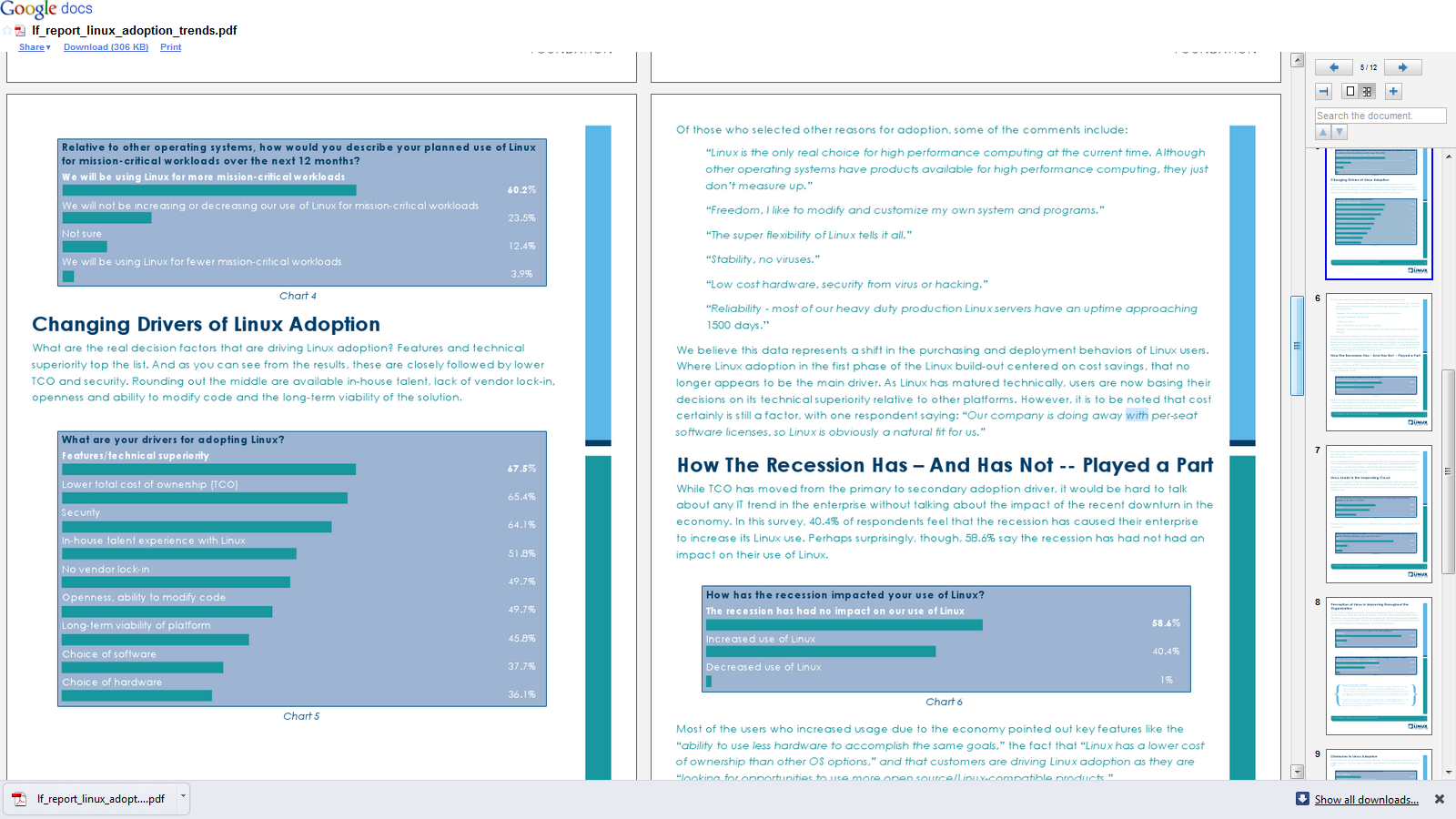
• 79.4 percent of companies are adding more Linux relative to other operating systems in the next five years.

• More people are reporting that their Linux deployments are migrations from Windows than any other platform, including Unix migrations. 66 percent of users surveyed say that their Linux deployments are brand new (“Greenfield”) deployments.

• Among the early adopters who are operating in cloud environments, 70.3 percent use Linux as their primary platform, while only 18.3 percent use Windows.

• 60.2 percent of respondents say they will use Linux for more mission-critical workloads over the next 12 months.

• 86.5 percent of respondents report that Linux is improving and 58.4 percent say their CIOs see Linux as more strategic to the organization as compared to three years ago.

• Drivers for Linux adoption extend beyond cost: technical superiority is the primary driver, followed by cost and then security.

• The growth in Linux, as demonstrated by this report, is leading companies to increasingly seek Linux IT professionals, with 38.3 percent of respondents citing a lack of Linux talent as one of their main concerns related to the platform.

• Users participate in Linux development in three primary ways: testing and submitting bugs (37.5 percent), working with vendors (30.7 percent) and participating in The Linux Foundation activities (26.0 percent).

and from the report itself-

download here-

http://www.linuxfoundation.org/lp/page/download-the-free-linux-adoption-trends-report

BI Software

Here is the brand new release from Jaspersoft at a groovy price of 9000$. Somebody stop these guys!

It’s a great company to watch for buyouts as well- given their expertise in REPORTING and clientele- especially for anyone looking to im prove thier standing in both open source world and reporting software branding.

From AOL owned Arrogantion’s site http://www.crunchbase.com/company/jaspersoft


Total $24.5M
Series D, 8/07 1
Scale Venture Partners
SAP Ventures
Doll Capital Management
Partech International
Morgenthaler Ventures
$12M
Unattributed, 12/08 2
Adams Street Partners
Red Hat
Morgenthaler Ventures
Doll Capital Management
Partech International


The news-

Announcing JasperReports Server Professional

More Resources

Webinar: Introducing JasperReports Server Professional

Thursday October 14

In this live webinar, learn how a new solution from Jaspersoft combines the world’s favorite reporting server with powerful, mature report server functionality—for about 80% less.

  • Date: Thu, Oct 14
  • Time: 10:00 AM PDT
  • Duration: 60 minutes

The World’s Most Powerful and Affordable Reporting Server

Limited Time Introductory Offer: Starting from $9,000 (restrictions apply)

JasperReports Server is the recommended product for organizations requiring an affordable reporting solution for interactive, operational, and production-based reporting. Deployed as a standalone reporting server or integrated inside another application, JasperReports Server is a flexible, powerful, interactive reporting environment for small or large enterprises.

Powered by the world’s most popular reporting tools in JasperReports and iReport, developers and users can take advantage of more interactivity, security, and scheduling of their reports.

Key Benefits:

  • Affordable: Unlimited reports for unlimited users starting at $9,000
  • Powerful: Report scheduling and distribution to 1,000s of users on a single server
  • Flexible: Web service architecture simplifies application integration
  • Secure: Centralized repository authenticates report access
  • Interactive: Easy to interact, self-serve parameterized-based reports
  • Visual appeal: Flash-based charts and maps engage users and enhance applications
  • Open: Access to any data source including relational, XML, Hibernate, EJB, POJO, and custom


Speaking of videos -here is a great video on BI from good ol Tennessee-a great 27 min tutorial on BI for newbies


Interview Dean Abbott Abbott Analytics

Here is an interview with noted Analytics Consultant and trainer Dean Abbott. Dean is scheduled to take a workshop on Predictive Analytics at PAW (Predictive Analytics World Conference)  Oct 18 , 2010 in Washington D.C

Ajay-  Describe your upcoming hands on workshop at Predictive Analytics World and how it can help people learn more predictive modeling.

Refer- http://www.predictiveanalyticsworld.com/dc/2010/handson_predictive_analytics.php

Dean- The hands-on workshop is geared toward individuals who know something about predictive analytics but would like to experience the process. It will help people in two regards. First, by going through the data assessment, preparation, modeling and model assessment stages in one day, the attendees will see how predictive analytics works in reality, including some of the pain associated with false starts and mistakes. At the same time, they will experience success with building reasonable models to solve a problem in a single day. I have found that for many, having to actually build the predictive analytics solution if an eye-opener. Seeing demonstrations show the capabilities of a tool, but greater value for an end-user is the development of intuition of what to do at each each stage of the process that makes the theory of predictive analytics real.

Second, they will gain experience using a top-tier predictive analytics software tool, Enterprise Miner (EM). This is especially helpful for those who are considering purchasing EM, but also for those who have used open source tools and have never experienced the additional power and efficiencies that come with a tool that is well thought out from a business solutions standpoint (as opposed to an algorithm workbench).

Ajay-  You are an instructor with software ranging from SPSS, S Plus, SAS Enterprise Miner, Statistica and CART. What features of each software do you like best and are more suited for application in data cases.

Dean- I’ll add Tibco Spotfire Miner, Polyanalyst and Unica’s Predictive Insight to the list of tools I’ve taught “hands-on” courses around, and there are at least a half dozen more I demonstrate in lecture courses (JMP, Matlab, Wizwhy, R, Ggobi, RapidMiner, Orange, Weka, RandomForests and TreeNet to name a few). The development of software is a fascinating undertaking, and each tools has its own strengths and weaknesses.

I personally gravitate toward tools with data flow / icon interface because I think more that way, and I’ve tired of learning more programming languages.

Since the predictive analytics algorithms are roughly the same (backdrop is backdrop no matter which tool you use), the key differentiators are

(1) how data can be loaded in and how tightly integrated can the tool be with the database,

(2) how well big data can be handled,

(3) how extensive are the data manipulation options,

(4) how flexible are the model reporting options, and

(5) how can you get the models and/or predictions out.

There are vast differences in the tools on these matters, so when I recommend tools for customers, I usually interview them quite extensively to understand better how they use data and how the models will be integrated into their business practice.

A final consideration is related to the efficiency of using the tool: how much automation can one introduce so that user-interaction is minimized once the analytics process has been defined. While I don’t like new programming languages, scripting and programming often helps here, though some tools have a way to run the visual programming data diagram itself without converting it to code.

Ajay- What are your views on the increasing trend of consolidation and mergers and acquisitions in the predictive analytics space. Does this increase the need for vendor neutral analysts and consultants as well as conferences.

Dean- When companies buy a predictive analytics software package, it’s a mixed bag. SPSS purchasing of Clementine was ultimately good for the predictive analytics, though it took several years for SPSS to figure out what they wanted to do with it. Darwin ultimately disappeared after being purchased by Oracle, but the newer Oracle data mining tool, ODM, integrates better with the database than Darwin did or even would have been able to.

The biggest trend and pressure for the commercial vendors is the improvements in the Open Source and GNU tools. These are becoming more viable for enterprise-level customers with big data, though from what I’ve seen, they haven’t caught up with the big commercial players yet. There is great value in bringing both commercial and open source tools to the attention of end-users in the context of solutions (rather than sales) in a conference setting, which is I think an advantage that Predictive Analytics World has.

As a vendor-neutral consultant, flux is always a good thing because I have to be proficient in a variety of tools, and it is the breadth that brings value for customers entering into the predictive analytics space. But it is very difficult to keep up with the rapidly-changing market and that is something I am weighing myself: how many tools should I keep in my active toolbox.

Ajay-  Describe your career and how you came into the Predictive Analytics space. What are your views on various MS Analytics offered by Universities.

Dean- After getting a masters degree in Applied Mathematics, my first job was at a small aerospace engineering company in Charlottesville, VA called Barron Associates, Inc. (BAI); it is still in existence and doing quite well! I was working on optimal guidance algorithms for some developmental missile systems, and statistical learning was a key part of the process, so I but my teeth on pattern recognition techniques there, and frankly, that was the most interesting part of the job. In fact, most of us agreed that this was the most interesting part: John Elder (Elder Research) was the first employee at BAI, and was there at that time. Gerry Montgomery and Paul Hess were there as well and left to form a data mining company called AbTech and are still in analytics space.

After working at BAI, I had short stints at Martin Marietta Corp. and PAR Government Systems were I worked on analytics solutions in DoD, primarily radar and sonar applications. It was while at Elder Research in the 90s that began working in the commercial space more in financial and risk modeling, and then in 1999 I began working as an independent consultant.

One thing I love about this field is that the same techniques can be applied broadly, and therefore I can work on CRM, web analytics, tax and financial risk, credit scoring, survey analysis, and many more application, and cross-fertilize ideas from one domain into other domains.

Regarding MS degrees, let me first write that I am very encouraged that data mining and predictive analytics are being taught in specific class and programs rather than as just an add-on to an advanced statistics or business class. That stated, I have mixed feelings about analytics offerings at Universities.

I find that most provide a good theoretical foundation in the algorithms, but are weak in describing the entire process in a business context. For those building predictive models, the model-building stage nearly always takes much less time than getting the data ready for modeling and reporting results. These are cross-discipline tasks, requiring some understanding of the database world and the business world for us to define the target variable(s) properly and clean up the data so that the predictive analytics algorithms to work well.

The programs that have a practicum of some kind are the most useful, in my opinion. There are some certificate programs out there that have more of a business-oriented framework, and the NC State program builds an internship into the degree itself. These are positive steps in the field that I’m sure will continue as predictive analytics graduates become more in demand.

Biography-

DEAN ABBOTT is President of Abbott Analytics in San Diego, California. Mr. Abbott has over 21 years of experience applying advanced data mining, data preparation, and data visualization methods in real-world data intensive problems, including fraud detection, response modeling, survey analysis, planned giving, predictive toxicology, signal process, and missile guidance. In addition, he has developed and evaluated algorithms for use in commercial data mining and pattern recognition products, including polynomial networks, neural networks, radial basis functions, and clustering algorithms, and has consulted with data mining software companies to provide critiques and assessments of their current features and future enhancements.

Mr. Abbott is a seasoned instructor, having taught a wide range of data mining tutorials and seminars for a decade to audiences of up to 400, including DAMA, KDD, AAAI, and IEEE conferences. He is the instructor of well-regarded data mining courses, explaining concepts in language readily understood by a wide range of audiences, including analytics novices, data analysts, statisticians, and business professionals. Mr. Abbott also has taught both applied and hands-on data mining courses for major software vendors, including Clementine (SPSS, an IBM Company), Affinium Model (Unica Corporation), Statistica (StatSoft, Inc.), S-Plus and Insightful Miner (Insightful Corporation), Enterprise Miner (SAS), Tibco Spitfire Miner (Tibco), and CART (Salford Systems).

KXEN Update

Update from a very good data mining software company, KXEN –

  1. Longtime Chairman and founder Roger Haddad is retiring but would be a Board Member. See his interview with Decisionstats here https://decisionstats.wordpress.com/2009/01/05/interview-roger-haddad-founder-of-kxen-automated-modeling-software/ (note images were hidden due to migration from .com to .wordpress.com )
  2. New Members of Leadership are as-
John Ball, CEOJohn Ball
Chief Executive Officer

John Ball brings 20 years of experience in enterprise software, deep expertise in business intelligence and CRM applications, and a proven track record of success driving rapid growth at highly innovative companies.

Prior to joining KXEN, Mr. Ball served in several executive roles at salesforce.com, the leading provider of SaaS applications. Most recently, John served as VP & General Manager, Analytics and Reporting Products, where he spearheaded salesforce.com’s foray into CRM analytics and business intelligence. John also served as VP & General Manager, Service and Support Applications at salesforce.com, where he successfully grew the business to become the second largest and fastest growing product line at salesforce.com. Before salesforce.com, Ball was founder and CEO of Netonomy, the leading provider of customer self-service solutions for the telecommunications industry. Ball also held a number of executive roles at Business Objects, including General Manager, Web Products, where delivered to market the first 3 versions of WebIntelligence. Ball has a master’s degree in electrical engineering from Georgia Tech and a master’s degree in electric

I hope John atleast helps build a KXEN Force.com application- there are only 2 data mining apps there on App Exchange. Also on the wish list  more social media presence, a Web SaaS/Amazon API for KXEN, greater presence in American/Asian conferences, and a solution for SME’s (which cannot afford the premium pricing of the flagship solution. An alliance with bigger BI vendors like Oracle, SAP or IBM  for selling the great social network analysis.

Bill Russell as Non Executive Chairman-

Bill Russell as Non-executive Chairman of the Board, effective July 16 2010. Russell has 30 years of operational experience in enterprise software, with a special focus on business intelligence, analytics, and databases.Russell held a number of senior-level positions in his more than 20 years at Hewlett-Packard, including Vice President and General Manager of the multi-billion dollar Enterprise Systems Group. He has served as Non-executive Chairman of the Board for Sylantro Systems Corporation, webMethods Inc., and Network Physics, Inc. and has served as a board director for Cognos Inc. In addition to KXEN, Russell currently serves on the boards of Saba, PROS Holdings Inc., Global 360, ParAccel Inc., and B.T. Mancini Company.

Xavier Haffreingue as senior vice president, worldwide professional services and solutions.
He has almost 20 years of international enterprise software experience gained in the CRM, BI, Web and database sectors. Haffreingue joins KXEN from software provider Axway where he was VP global support operations. Prior to Axway, he held various leadership roles in the software industry, including VP self service solutions at Comverse Technologies and VP professional services and support at Netonomy, where he successfully delivered multi-million dollar projects across Europe, Asia-Pacific and Africa. Before that he was with Business Objects and Sybase, where he ran support and services in southern Europe managing over 2,500 customers in more than 20 countries.

David Guercio  as senior vice president, Americas field operations. Guercio brings to the role more than 25 years experience of building and managing high-achieving sales teams in the data mining, business intelligence and CRM markets. Guercio comes to KXEN from product lifecycle management vendor Centric Software, where he was EVP sales and client services. Prior to Centric, he was SVP worldwide sales and client services at Inxight Software, where he was also Chairman and CEO of the company’s Federal Systems Group, a subsidiary of Inxight that saw success in the US Federal Government intelligence market. The success in sales growth and penetration into the federal government led to the acquisition of Inxight by Business Objects in 2007, where Guercio then led the Inxight sales organization until Business Objects was acquired by SAP. Guercio was also a key member of the management team and a co-founder at Neovista, an early pioneer in data mining and predictive analytics. Additionally, he held the positions of director of sales and VP of professional services at Metaphor Computer Systems, one of the first data extraction solutions companies, which was acquired by IBM. During his career, Guercio also held executive positions at Resonate and SiGen.

3) Venture Capital funding to fund expansion-

It has closed $8 million in series D funding to further accelerate its growth and international expansion. The round was led by NextStage and included participation from existing investors XAnge Capital, Sofinnova Ventures, Saints Capital and Motorola Ventures.

This was done after John Ball had joined as CEO.

4) Continued kudos from analysts and customers for it’s technical excellence.

KXEN was named a leader in predictive analytics and data mining by Forrester Research (1) and was rated highest for commercial deployments of social network analytics by Frost & Sullivan (2)

Also it became an alliance partner of Accenture- which is also a prominent SAS partner as well.

In Database Optimization-

In KXEN V5.1, a new data manipulation module (ADM) is provided in conjunction with scoring to optimize database workloads and provide full in-database model deployment. Some leading data mining vendors are only now beginning to offer this kind of functionality, and then with only one or two selected databases, giving KXEN a more than five-year head start. Some other vendors are only offering generic SQL generation, not optimized for each database, and do not provide the wealth of possible outputs for their scoring equations: For example, real operational applications require not only to generate scores, but decision probabilities, error bars, individual input contributions – used to derive reasons of decision and more, which are available in KXEN in-database scoring modules.

Since 2005, KXEN has leveraged databases as the data manipulation engine for analytical dataset generation. In 2008, the ADM (Analytical Data Management) module delivered a major enhancement by providing a very easy to use data manipulation environment with unmatched productivity and efficiency. ADM works as a generator of optimized database-specific SQL code and comes with an integrated layer for the management of meta-data for analytics.

KXEN Modeling Factory- (similar to SAS’s recent product Rapid Predictive Modeler http://www.sas.com/resources/product-brief/rapid-predictive-modeler-brief.pdf and http://jtonedm.com/2010/09/02/first-look-rapid-predictive-modeler/)

KXEN Modeling Factory (KMF) has been designed to automate the development and maintenance of predictive analytics-intensive systems, especially systems that include large numbers of models, vast amounts of data or require frequent model refreshes. Information about each project and model is monitored and disseminated to ensure complete management and oversight and to facilitate continual improvement in business performance.

Main Functions

Schedule: creation of the Analytic Data Set (ADS), setup of how and when to score, setup of when and how to perform model retraining and refreshes …

Report
: Monitormodel execution over time, Track changes in model quality over time, see how useful one variable is by considering its multiple instance in models …

Notification
: Rather than having to wade through pages of event logs, KMF Department allows users to manage by exception through notifications.

Other products from KXEN have been covered here before https://decisionstats.wordpress.com/tag/kxen/ , including Structural Risk Minimization- https://decisionstats.wordpress.com/2009/04/27/kxen-automated-regression-modeling/

Thats all for the KXEN update- all the best to the new management team and a splendid job done by Roger Haddad in creating what is France and Europe’s best known data mining company.

Note- Source – http://www.kxen.com


Open Source Business Intelligence: Pentaho and Jaspersoft

Here are two products that are used widely for Business Intelligence_ They are open source and both have free preview.

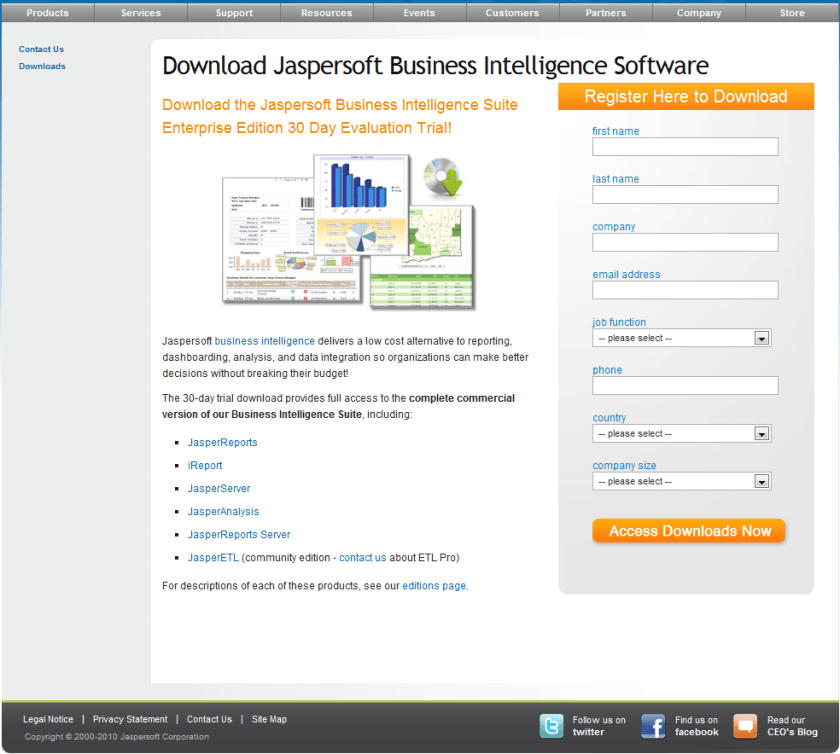
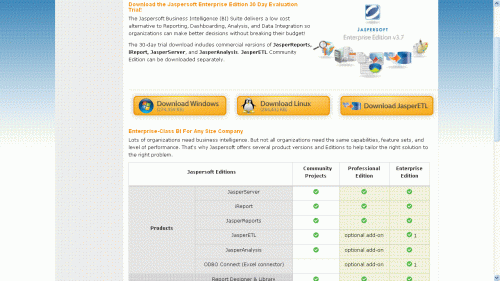
Jaspersoft-For the Enterprise version click on the screenshot while for the free community version you can go to

http://jasperforge.org/projects/jasperserver

Interestingly (and not surprisingly) Revolution Analytics is teaming up with Jaspersoft to use R for reporting along with the Jaspersoft BI stack.

ADVANCED ANALYTICS ON DEMAND IN APPLICATIONS, IN DASHBOARDS, AND ON THE WEB

FREE WEBINAR WEDNESDAY, SEPTEMBER 22ND @9AM PACIFIC

DEPLOYING R: ADVANCED ANALYTICS ON DEMAND IN APPLICATIONS, IN DASHBOARDS, AND ON THE WEB

A JOINT WEBINAR FROM REVOLUTION ANALYTICS AND JASPERSOFT

Date: Wednesday, September 22, 2010
Time: 9:00am PDT (12:00pm EDT; 4:00pm GMT)
Presenters: David Smith, Vice President of Marketing, Revolution Analytics
Andrew Lampitt, Senior Director of Technology Alliances, Jaspersoft
Matthew Dahlman, Business Development Engineer, Jaspersoft
Registration: Click here to register now!

R is a popular and powerful system for creating custom data analysis, statistical models, and data visualizations. But how can you make the results of these R-based computations easily accessible to others? A PhD statistician could use R directly to run the forecasting model on the latest sales data, and email a report on request, but then the process is just going to have to be repeated again next month, even if the model hasn’t changed. Wouldn’t it be better to empower the Sales manager to run the model on demand from within the BI application she already uses—daily, even!—and free up the statistician to build newer, better models for others?

In this webinar, David Smith (VP of Marketing, Revolution Analytics) will introduce the new “RevoDeployR” Web Services framework for Revolution R Enterprise, which is designed to make it easy to integrate dynamic R-based computations into applications for business users. RevoDeployR empowers data analysts working in R to publish R scripts to a server-based installation of Revolution R Enterprise. Application developers can then use the RevoDeployR Web Services API to securely and scalably integrate the results of these scripts into any application, without needing to learn the R language. With RevoDeployR, authorized users of hosted or cloud-based interactive Web applications, desktop applications such as Microsoft Excel, and BI applications like Jaspersoft can all benefit from on-demand analytics and visualizations developed by expert R users.

To demonstrate the power of deploying R-based computations to business users, Andrew Lampitt will introduce Jaspersoft commercial open source business intelligence, the world’s most widely used BI software. In a live demonstration, Matt Dahlman will show how to supercharge the BI process by combining Jaspersoft and Revolution R Enterprise, giving business users on-demand access to advanced forecasts and visualizations developed by expert analysts.

Click here to register for the webinar.

Speaker Biographies:

David Smith is the Vice President of Marketing at Revolution Analytics, the leading commercial provider of software and support for the open source “R” statistical computing language. David is the co-author (with Bill Venables) of the official R manual An Introduction to R. He is also the editor of Revolutions (http://blog.revolutionanalytics.com), the leading blog focused on “R” language, and one of the originating developers of ESS: Emacs Speaks Statistics. You can follow David on Twitter as @revodavid.

Andrew Lampitt is Senior Director of Technology Alliances at Jaspersoft. Andrew is responsible for strategic initiatives and partnerships including cloud business intelligence, advanced analytics, and analytic databases. Prior to Jaspersoft, Andrew held other business positions with Sunopsis (Oracle), Business Objects (SAP), and Sybase (SAP). Andrew earned a BS in engineering from the University of Illinois at Urbana Champaign.

Matthew Dahlman is Jaspersoft’s Business Development Engineer, responsible for technical aspects of technology alliances and regional business development. Matt has held a wide range of technical positions including quality assurance, pre-sales, and technical evangelism with enterprise software companies including Sybase, Netonomy (Comverse), and Sunopsis (Oracle). Matt earned a BA in mathematics from Carleton College in Northfield, Minnesota.


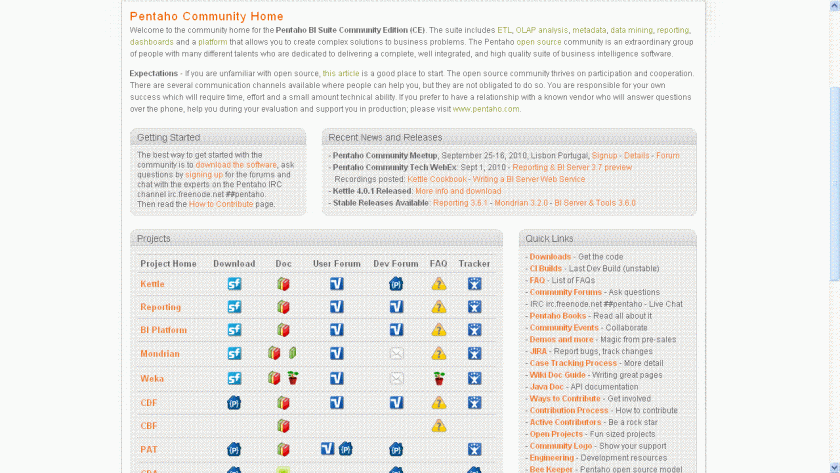
The second widely used BI stack in open source is Pentaho.

You can download it here to evaluate it or click on screenshot to read more at

http://community.pentaho.com/

http://sourceforge.net/projects/pentaho/files/Business%20Intelligence%20Server/

MapReduce Analytics Apps- AsterData's Developer Express Plugin

AsterData continues to wow with it’s efforts on bridging MapReduce and Analytics, with it’s new Developer Express plug-in for Eclipse. As any Eclipse user knows, that greatly improves ability to write code or develop ( similar to creating Android apps if you have tried to). I did my winter internship at AsterData last December last year in San Carlos, and its an amazing place with giga-level bright people.

Here are some details ( Note I plan to play a bit more on the plugin on my currently downUbuntu on this and let you know)

http://marketplace.eclipse.org/content/aster-data-developer-express-plug-eclipse

Aster Data Developer Express provides an integrated set of tools for development of SQL and MapReduce analytics for Aster Data nCluster, a massively parallel database with an integrated analytics engine.

The Aster Data Developer Express plug-in for Eclipse enables developers to easily create new analytic application projects with the help of an intuitive set of wizards, immediately test their applications on their desktop, and push down their applications into the nCluster database with a single click.

Using Developer Express, analysts can significantly reduce the complexity and time needed to create advanced analytic applications so that they can more rapidly deliver deeper and richer analytic insights from their data.

and from the Press Release

Now, any developer or analyst that is familiar with the Java programming language can complete a rich analytic application in under an hour using the simple yet powerful Aster Data Developer Express environment in Eclipse. Aster Data Developer Express delivers both rapid development and local testing of advanced analytic applications for any project, regardless of size.

The free, downloadable Aster Data Developer Express IDE now brings the power of SQL-MapReduce to any organization that is looking to build richer analytic applications that can leverage massive data volumes. Much of the MapReduce coding, including programming concepts like parallelization and distributed data analysis, is addressed by the IDE without the developer or analyst needing to have expertise in these areas. This simplification makes it much easier for developers to be successful quickly and eliminates the need for them to have any deep knowledge of the MapReduce parallel processing framework. Google first published MapReduce in 2004 for parallel processing of big data sets. Aster Data has coupled SQL with MapReduce and brought SQL-MapReduce to market, making it significantly easier for any organization to leverage the power of MapReduce. The Aster Developer Express IDE simplifies application development even further with an intuitive point-and-click development environment that speeds development of rich analytic applications. Applications can be validated locally on the desktop or ultimately within Aster Data nCluster, a massive parallel processing (MPP) database with a fully integrated analytics engine that is powered by MapReduce—known as a data-analytics server.

Rich analytic applications that can be easily built with Aster Data’s downloadable IDE include:

Iterative Analytics: Uncovering critical business patterns in your data requires hypothesis-driven, iterative analysis.  This class of applications is defined by the exploratory navigation of massive volumes of data in a top-down, deductive manner.  Aster Data’s IDE makes this easy to develop and to validate the algorithms and functions required to deliver these advanced analytic applications.

Prediction and Optimization: For this class of applications, the process is inductive. Rather than starting with a hypothesis, developers and analysts can easily build analytic applications that discover the trends, patterns, and outliers in data sets.  Examples include propensity to churn in telecommunications, proactive product and service recommendations in retail, and pricing and retention strategies in financial services.

Ad Hoc Analysis: Examples of ad hoc analysis that can be performed includes social network analysis, advanced click stream analysis, graph analysis, cluster analysis, and a wide variety of mathematical, trigonometry, and statistical functions.

“Aster Data’s IDE and SQL-MapReduce significantly eases development of advanced analytic applications on big data. We have now built over 350 analytic functions in SQL-MapReduce on Aster Data nCluster that are available for customers to purchase,” said Partha Sen, CEO and Founder of Fuzzy Logix. “Aster Data’s implementation of MapReduce with SQL-MapReduce goes beyond the capabilities of general analytic development APIs and provides us with the excellent control and flexibility needed to implement even the most complex analytic algorithms.”

Richer analytics on big data volumes is the new competitive frontier. Organizations have always generated reports to guide their decision-making. Although reports are important, they are historical sets of information generally arranged around predefined metrics and generated on a periodic basis.

Advanced analytics begins where reporting leaves off. Reporting often answers historical questions such as “what happened?” However, analytics addresses “why it happened” and, increasingly, “what will happen next?” To that end, solutions like Aster Data Developer Express ease the development of powerful ad hoc, predictive analytics and enables analysts to quickly and deeply explore terabytes to petabytes of data.
“We are in the midst of a new age in analytics. Organizations today can harness the power of big data regardless of scale or complexity”, said Don Watters, Chief Data Architect for MySpace. “Solutions like the Aster Data Developer Express visual development environment make it even easier by enabling us to automate aspects of development that currently take days, allowing us to build rich analytic applications significantly faster. Making Developer Express openly available for download opens the power of MapReduce to a broader audience, making big data analytics much faster and easier than ever before.”

“Our delivery of SQL coupled with MapReduce has clearly made it easier for customers to build highly advanced analytic applications that leverage the power of MapReduce. The visual IDE, Aster Data Developer Express, introduced earlier this year, made application development even easier and the great response we have had to it has driven us to make this open and freely available to any organization looking to build rich analytic applications,” said Tasso Argyros, Founder and CTO, Aster Data. “We are excited about today’s announcement as it allows companies of all sizes who need richer analytics to easily build powerful analytic applications and experience the power of MapReduce without having to learn any new skills.”

You can have a look here at http://www.asterdata.com/download_developer_express/