Heritage Health Prize- Data Mining Contest for 3mill USD

An animation of the quicksort algorithm sortin...
Image via Wikipedia

If Netflix was about 1 mill USD to better online video choices, here is a chance to earn serious money, write great code, and save lives!

From http://www.heritagehealthprize.com/

Heritage Health Prize
Launching April 4

Laptop

More than 71 Million individuals in the United States are admitted to
hospitals each year, according to the latest survey from the American
Hospital Association. Studies have concluded that in 2006 well over
$30 billion was spent on unnecessary hospital admissions. Each of
these unnecessary admissions took away one hospital bed from someone
else who needed it more.

Prize Goal & Participation

The goal of the prize is to develop a predictive algorithm that can identify patients who will be admitted to the hospital within the next year, using historical claims data.

Official registration will open in 2011, after the launch of the prize. At that time, pre-registered teams will be notified to officially register for the competition. Teams must consent to be bound by final competition rules.

Registered teams will develop and test their algorithms. The winning algorithm will be able to predict patients at risk for an unplanned hospital admission with a high rate of accuracy. The first team to reach the accuracy threshold will have their algorithms confirmed by a judging panel. If confirmed, a winner will be declared.

The competition is expected to run for approximately two years. Registration will be open throughout the competition.

Data Sets

Registered teams will be granted access to two separate datasets of de-identified patient claims data for developing and testing algorithms: a training dataset and a quiz/test dataset. The datasets will be comprised of de-identified patient data. The datasets will include:

  • Outpatient encounter data
  • Hospitalization encounter data
  • Medication dispensing claims data, including medications
  • Outpatient laboratory data, including test outcome values

The data for each de-identified patient will be organized into two sections: “Historical Data” and “Admission Data.” Historical Data will represent three years of past claims data. This section of the dataset will be used to predict if that patient is going to be admitted during the Admission Data period. Admission Data represents previous claims data and will contain whether or not a hospital admission occurred for that patient; it will be a binary flag.

DataThe training dataset includes several thousand anonymized patients and will be made available, securely and in full, to any registered team for the purpose of developing effective screening algorithms.

The quiz/test dataset is a smaller set of anonymized patients. Teams will only receive the Historical Data section of these datasets and the two datasets will be mixed together so that teams will not be aware of which de-identified patients are in which set. Teams will make predictions based on these data sets and submit their predictions to HPN through the official Heritage Health Prize web site. HPN will use the Quiz Dataset for the initial assessment of the Team’s algorithms. HPN will evaluate and report back scores to the teams through the prize website’s leader board.

Scores from the final Test Dataset will not be made available to teams until the accuracy thresholds are passed. The test dataset will be used in the final judging and results will be kept hidden. These scores are used to preserve the integrity of scoring and to help validate the predictive algorithms.

Teams can begin developing and testing their algorithms as soon as they are registered and ready. Teams will log onto the official Heritage Health Prize website and submit their predictions online. Comparisons will be run automatically and team accuracy scores will be posted on the leader board. This score will be only on a portion of the predictions submitted (the Quiz Dataset), the additional results will be kept back (the Test Dataset).

Form

Once a team successfully scores above the accuracy thresholds on the online testing (quiz dataset), final judging will occur. There will be three parts to this judging. First, the judges will confirm that the potential winning team’s algorithm accurately predicts patient admissions in the Test Dataset (again, above the thresholds for accuracy).

Next, the judging panel will confirm that the algorithm does not identify patients and use external data sources to derive its predictions. Lastly, the panel will confirm that the team’s algorithm is authentic and derives its predictive power from the datasets, not from hand-coding results to improve scores. If the algorithm meets these three criteria, it will be declared the winner.

Failure to meet any one of these three parts will disqualify the team and the contest will continue. The judges reserve the right to award second and third place prizes if deemed applicable.


Input Data in R using the top 3 R GUI

PC-DOS was an early OS for personal computers ...
Image via Wikipedia

One area where clearly GUI methods are preferable to command line methods in R, is data input. There is no need of learning read.csv or read.table when these options are only two clicks away in any R GUI. For academics/students there is a definite need to easily access

datasets from attached packages just as it is a need for business analysts to access databases with a few clicks than learn or read pages of pdf on RODBC. However some GUI (like Rattle) need data only in data frames, rather than list or arrays-this limits R’s flexibility. These are my views but you can see and compare views of data input in R Commander, Rattle and Deducer.


Interview Anne Milley JMP

Here is an interview with Anne Milley, a notable thought leader in the world of analytics. Anne is now Senior Director, Analytical Strategy in Product Marketing for JMP , the leading data visualization software from the SAS Institute.

Ajay-What do you think are the top 5 unique selling points of JMP compared to other statistical software in its category?

Anne-

JMP combines incredible analytic depth and breadth with interactive data visualization, creating a unique environment optimized for discovery and data-driven innovation.

With an extensible framework using JSL (JMP Scripting Language), and integration with SAS, R, and Excel, JMP becomes your analytic hub.

JMP is accessible to all kinds of users. A novice analyst can dig into an interactive report delivered by a custom JMP application. An engineer looking at his own data can use built-in JMP capabilities to discover patterns, and a developer can write code to extend JMP for herself or others.

State-of-the-art DOE capabilities make it easy for anyone to design and analyze efficient experiments to determine which adjustments will yield the greatest gains in quality or process improvement – before costly changes are made.

Not to mention, JMP products are exceptionally well designed and easy to use. See for yourself and check out the free trial at www.jmp.com.

Download a free 30-day trial of JMP.

Ajay- What are the challenges and opportunities of expanding JMP’s market share? Do you see JMP expanding its conferences globally to engage global audiences?

Anne-

We realized solid global growth in 2010. The release of JMP Pro and JMP Clinical last year along with continuing enhancements to the rest of the JMP family of products (JMP and JMP Genomics) should position us well for another good year.

With the growing interest in analytics as a means to sustained value creation, we have the opportunity to help people along their analytic journey – to get started, take the next step, or adopt new paradigms speeding their time to value. The challenge is doing that as fast as we would like.

We are hiring internationally to offer even more events, training and academic programs globally.

Ajay- What are the current and proposed educational and global academic initiatives of JMP? How can we see more JMP in universities across the world (say India- China etc)?

Anne-

We view colleges and universities both as critical incubators of future JMP users and as places where attitudes about data analysis and statistics are formed. We believe that a positive experience in learning statistics makes a person more likely to eventually want and need a product like JMP.

For most students – and particularly for those in applied disciplines of business, engineering and the sciences – the ability to make a statistics course relevant to their primary area of study fosters a positive experience. Fortunately, there is a trend in statistical education toward a more applied, data-driven approach, and JMP provides a very natural environment for both students and researchers.

Its user-friendly navigation, emphasis on data visualization and easy access to the analytics behind the graphics make JMP a compelling alternative to some of our more traditional competitors.

We’ve seen strong growth in the education markets in the last few years, and JMP is now used in nearly half of the top 200 universities in the US.

Internationally, we are at an earlier stage of market development, but we are currently working with both JMP and SAS country offices and their local academic programs to promote JMP. For example, we are working with members of the JMP China office and faculty at several universities in China to support the use of JMP in the development of a master’s curriculum in Applied Statistics there, touched on in this AMSTAT News article.

Ajay- What future trends do you see for 2011 in this market (say top 5)?

Anne-

Growing complexity of data (text, image, audio…) drives the need for more and better visualization and analysis capabilities to make sense of it all.

More “chief analytics officers” are making better use of analytic talent – people are the most important ingredient for success!

JMP has been on the vanguard of 64-bit development, and users are now catching up with us as 64-bit machines become more common.

Users should demand easy-to-use, exploratory and predictive modeling tools as well as robust tools to experiment and learn to help them make the best decisions on an ongoing basis.

All these factors and more fuel the need for the integration of flexible, extensible tools with popular analytic platforms.

Ajay-You enjoy organic gardening as a hobby. How do you think hobbies and unwind time help people be better professionals?

Anne-

I am lucky to work with so many people who view their work as a hobby. They have other interests too, though, some of which are work-related (statistics is relevant everywhere!). Organic gardening helps me put things in perspective and be present in the moment. More than work defines who you are. You can be passionate about your work as well as passionate about other things. I think it’s important to spend some leisure time in ways that bring you joy and contribute to your overall wellbeing and outlook.

Btw, nice interviews over the past several months—I hadn’t kept up, but will check it out more often!

Biography–  Source- http://www.sas.com/knowledge-exchange/business-analytics/biographies.html

  • Anne Milley

    Anne Milley

    Anne Milley is Senior Director of Analytics Strategy at JMP Product Marketing at SAS. Her ties to SAS began with bank failure prediction at Federal Home Loan Bank Dallas and continued at 7-Eleven Inc. She has authored papers and served on committees for F2006, KDD, SIAM, A2010 and several years of SAS’ annual data mining conference. Milley is a contributing faculty member for the International Institute of Analytics. anne.milley@jmp.com

Open Source Compiler for SAS language/ GNU -DAP

A Bold GNU Head
Image via Wikipedia

I am still testing this out.

But if you know bit more about make and .compile in Ubuntu check out

http://www.gnu.org/software/dap/

I loved the humorous introduction

Dap is a small statistics and graphics package based on C. Version 3.0 and later of Dap can read SBS programs (based on the utterly famous, industry standard statistics system with similar initials – you know the one I mean)! The user wishing to perform basic statistical analyses is now freed from learning and using C syntax for straightforward tasks, while retaining access to the C-style graphics and statistics features provided by the original implementation. Dap provides core methods of data management, analysis, and graphics that are commonly used in statistical consulting practice (univariate statistics, correlations and regression, ANOVA, categorical data analysis, logistic regression, and nonparametric analyses).

Anyone familiar with the basic syntax of C programs can learn to use the C-style features of Dap quickly and easily from the manual and the examples contained in it; advanced features of C are not necessary, although they are available. (The manual contains a brief introduction to the C syntax needed for Dap.) Because Dap processes files one line at a time, rather than reading entire files into memory, it can be, and has been, used on data sets that have very many lines and/or very many variables.

I wrote Dap to use in my statistical consulting practice because the aforementioned utterly famous, industry standard statistics system is (or at least was) not available on GNU/Linux and costs a bundle every year under a lease arrangement. And now you can run programs written for that system directly on Dap! I was generally happy with that system, except for the graphics, which are all but impossible to use,  but there were a number of clumsy constructs left over from its ancient origins.

http://www.gnu.org/software/dap/#Sample output

  • Unbalanced ANOVA
  • Crossed, nested ANOVA
  • Random model, unbalanced
  • Mixed model, balanced
  • Mixed model, unbalanced
  • Split plot
  • Latin square
  • Missing treatment combinations
  • Linear regression
  • Linear regression, model building
  • Ordinal cross-classification
  • Stratified 2×2 tables
  • Loglinear models
  • Logit  model for linear-by-linear association
  • Logistic regression
  • Copyright © 2001, 2002, 2003, 2004 Free Software Foundation, Inc., 51 Franklin Street, Fifth Floor, Boston, MA 02110-1301, USA

    sounds too good to be true- GNU /DAP joins WPS workbench and Dulles Open’s Carolina as the third SAS language compiler (besides the now defunct BASS software) see http://en.wikipedia.org/wiki/SAS_language#Controversy


    Also see http://en.wikipedia.org/wiki/DAP_(software)

    Dap was written to be a free replacement for SAS, but users are assumed to have a basic familiarity with the C programming language in order to permit greater flexibility. Unlike R it has been designed to be used on large data sets.

    It has been designed so as to cope with very large data sets; even when the size of the data exceeds the size of the computer’s memory

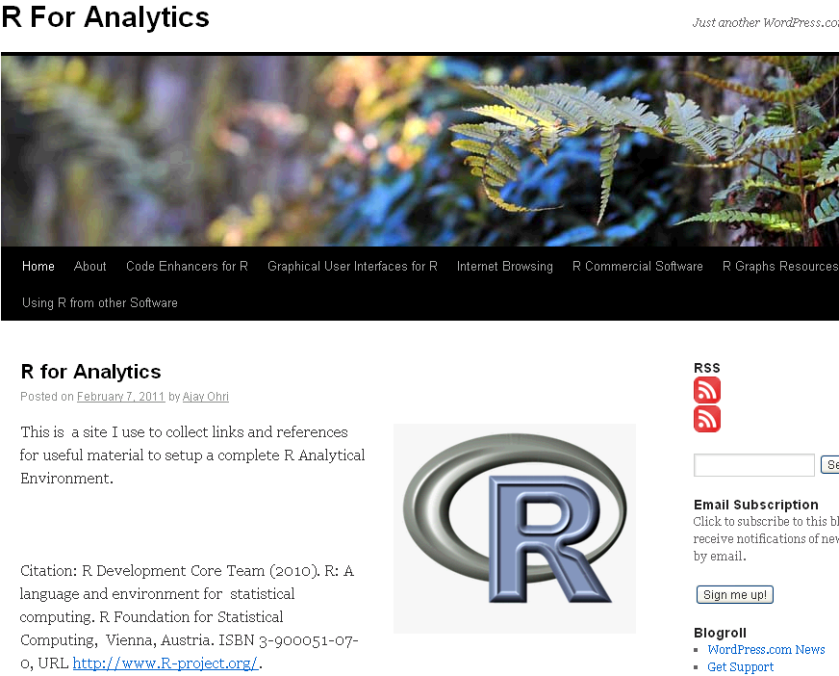
    R for Analytics is now live

    Okay, through the weekend I created a website for a few of my favourite things.

    It’s on at https://rforanalytics.wordpress.com/

    Graphical User Interfaces for R


    Jerry Rubin said: “Don’t trust anyone over thirty

    I dont trust anyone not using atleast one R GUI. Here’s a list of the top 10.


    Code Enhancers for R

    Here is a list of top 5 code enhancers,editors in R

    R Commercial Software

    A list of companies and software making (and) selling R software (and) services. Hint- it is almost 5 (unless I missed someone)

    R Graphs Resources

    R’s famous graphing capabilities and equally famous learning curve can be made a bit more humane- using some of these resources.

    Internet Browsing

    Because that’s what I do (all I do as per my cat) , and I am pretty good at it.

    Using R from other Software

    R can be used successfully from a lot of analytical software including some surprising ones praising the great 3000 packages library.

    (to be continued- as I find more stuff I will keep it there, some ideas- database access from R, prominent R consultants, prominent R packages, famous R interviewees 😉 )

    ps- The quote from Jerry Rubin seems funny for a while. I turn 34 this year.

    Using R from within Python

    Python logo
    Image via Wikipedia

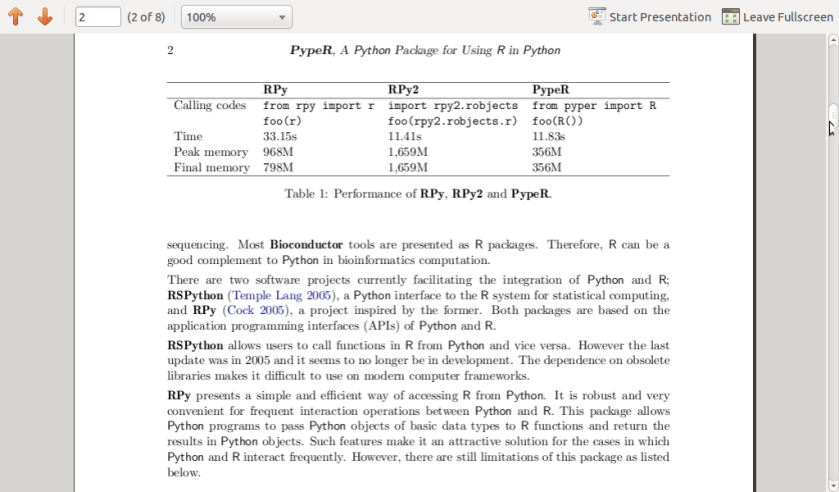
    I came across this excellent JSS paper at www.jstatsoft.org/v35/c02/paper

    on a Python package called PypeR which allows you to use R from within Python using the pipe functionality.

    It is an interesting package and given Python’s increasing buzz , one worthy to be checked out by people using or thinking Python in their packages.


    Citation:
    	@article{Xia:McClelland:Wang:2010:JSSOBK:v35c02,
    	  author =	"Xiao-Qin Xia and Michael McClelland and Yipeng Wang",
    	  title =	"PypeR, A Python Package for Using R in Python",
    	  journal =	"Journal of Statistical Software, Code Snippets",
    	  volume =	"35",
    	  number =	"2",
    	  pages =	"1--8",
    	  day =  	"30",
    	  month =	"7",
    	  year = 	"2010",
    	  CODEN =	"JSSOBK",
    	  ISSN = 	"1548-7660",
    	  bibdate =	"2010-03-23",
    	  URL =  	"http://www.jstatsoft.org/v35/c02",
    	  accepted =	"2010-03-23",
    	  acknowledgement = "",
    	  keywords =	"",
    	  submitted =	"2009-10-23",
    	}


    Interview Luis Torgo Author Data Mining with R

    Example of k-nearest neighbour classification
    Image via Wikipedia

    Here is an interview with Prof Luis Torgo, author of the recent best seller “Data Mining with R-learning with case studies”.

    Ajay- Describe your career in science. How do you think can more young people be made interested in science.

    Luis- My interest in science only started after I’ve finished my degree. I’ve entered a research lab at the University of Porto and started working on Machine Learning, around 1990. Since then I’ve been involved generally in data analysis topics both from a research perspective as well as from a more applied point of view through interactions with industry partners on several projects. I’ve spent most of my career at the Faculty of Economics of the University of Porto, but since 2008 I’m at the department of Computer Science of the Faculty of Sciences of the same university. At the same time I’ve been a researcher at LIAAD / Inesc Porto LA (www.liaad.up.pt).

    I like a lot what I do and like science and the “scientific way of thinking”, but I cannot say that I’ve always thought of this area as my “place”. Most of all I like solving challenging problems through data analysis. If that translates into some scientific outcome than I’m more satisfied but that is not my main goal, though I’m kind of “forced” to think about that because of the constraints of an academic career.

    That does not mean I’m not passionate about science, I just think there are many more ways of “doing science” than what is reflected in the usual “scientific indicators” that most institutions seem to be more and more obsessed about.

    Regards interesting young people in science that is a hard question that I’m not sure I’m qualified to answer. I do tend to think that young people are more sensible to concrete examples of problems they think are interesting and that science helps in solving, as a way of finding a motivation for facing the hard work they will encounter in a scientific career. I do believe in case studies as a nice way to learn and motivate, and thus my book 😉

    Ajay- Describe your new book “Data Mining with R, learning with case studies” Why did you choose a case study based approach? who is the target audience? What is your favorite case study from the book

    Luis- This book is about learning how to use R for data mining. The book follows a “learn by doing it” approach to data mining instead of the more common theoretical description of the available techniques in this discipline. This is accomplished by presenting a series of illustrative case studies for which all necessary steps, code and data are provided to the reader. Moreover, the book has an associated web page (www.liaad.up.pt/~ltorgo/DataMiningWithR) where all code inside the book is given so that easy copy-paste is possible for the more lazy readers.

    The language used in the book is very informal without many theoretical details on the used data mining techniques. For obtaining these theoretical insights there are already many good data mining books some of which are referred in “further readings” sections given throughout the book. The decision of following this writing style had to do with the intended target audience of the book.

    In effect, the objective was to write a monograph that could be used as a supplemental book for practical classes on data mining that exist in several courses, but at the same time that could be attractive to professionals working on data mining in non-academic environments, and thus the choice of this more practically oriented approach.

    Regards my favorite case study that is a hard question for an author… still I would probably choose the “Predicting Stock Market Returns” case study (Chapter 3). Not only because I like this challenging problem, but mainly because the case study addresses all aspects of knowledge discovery in a real world scenario and not only the construction of predictive models. It tackles data collection, data pre-processing, model construction, transforming predictions into actions using different trading policies, using business-related performance metrics, implementing a trading simulator for “real-world” evaluation, and laying out grounds for constructing an online trading system.

    Obviously, for all these steps there are far too many options to be possible to describe/evaluate all of them in a chapter, still I do believe that for the reader it is important to see the overall picture, and read about the relevant questions on this problem and some possible paths that can be followed at these different steps.

    In other words: do not expect to become rich with the solution I describe in the chapter !

    Ajay- Apart from R, what other data mining software do you use or have used in the past. How would you compare their advantages and disadvantages with R

    Luis- I’ve played around with Clementine, Weka, RapidMiner and Knime, but really only playing with teaching goals, and no serious use/evaluation in the context of data mining projects. For the latter I mainly use R or software developed by myself (either in R or other languages). In this context, I do not think it is fair to compare R with these or other tools as I lack serious experience with them. I can however, tell you about what I see as the main pros and cons of R. The main reason for using R is really not only the power of the tool that does not stop surprising me in terms of what already exists and keeps appearing as contributions of an ever growing community, but mainly the ability of rapidly transforming ideas into prototypes. Regards some of its drawbacks I would probably mention the lack of efficiency when compared to other alternatives and the problem of data set sizes being limited by main memory.

    I know that there are several efforts around for solving this latter issue not only from the community (e.g. http://cran.at.r-project.org/web/views/HighPerformanceComputing.html), but also from the industry (e.g. Revolution Analytics), but I would prefer that at this stage this would be a standard feature of the language so the the “normal” user need not worry about it. But then this is a community effort and if I’m not happy with the current status instead of complaining I should do something about it!

    Ajay- Describe your writing habit- How do you set about writing the book- did you write a fixed amount daily or do you write in bursts etc

    Luis- Unfortunately, I write in bursts whenever I find some time for it. This is much more tiring and time consuming as I need to read back material far too often, but I cannot afford dedicating too much consecutive time to a single task. Actually, I frequently tease my PhD students when they “complain” about the lack of time for doing what they have to, that they should learn to appreciate the luxury of having a single task to complete because it will probably be the last time in their professional life!

    Ajay- What do you do to relax or unwind when not working?

    Luis- For me, the best way to relax from work is by playing sports. When I’m involved in some game I reset my mind and forget about all other things and this is very relaxing for me. A part from sports I enjoy a lot spending time with my family and friends. A good and long dinner with friends over a good bottle of wine can do miracles when I’m too stressed with work! Finally,I do love traveling around with my family.

    Luis Torgo

    Short Bio: Luis Torgo has a degree in Systems and Informatics Engineering and a PhD in Computer Science. He is an Associate Professor of the Department of Computer Science of the Faculty of Sciences of the University of Porto. He is also a researcher of the Laboratory of Artificial Intelligence and Data Analysis (LIAAD) belonging to INESC Porto LA. Luis Torgo has been an active researcher in Machine Learning and Data Mining for more than 20 years. He has lead several academic and industrial Data Mining research projects. Luis Torgo accompanies the R project almost since its beginning, using it on his research activities. He teaches R at different levels and has given several courses in different countries.

    For reading “Data Mining with R” – you can visit this site, also to avail of a 20% discount the publishers have generously given (message below)-

    For more information and to place an order, visit us at http://www.crcpress.com.  Order online and apply 20% Off discount code 907HM at checkout.  CRC is pleased to offer free standard shipping on all online orders!

    link to the book page  http://www.crcpress.com/product/isbn/9781439810187

    Price: $79.95
    Cat. #: K10510
    ISBN: 9781439810187
    ISBN 10: 1439810184
    Publication Date: November 09, 2010
    Number of Pages: 305
    Availability: In Stock
    Binding(s): Hardback