Name an industry in which top level executives are mostly white males, new recruits are mostly male (white or Indian/Chinese), women are primarily shunted into publicity relationships, social media or marketing.
Statistical Computing And Business Intelligence are the white man’s last stand to preserve an exclusive club of hail fellow well met and lets catch up after drinks culture. Newer startups are the exception in the business intelligence world , but a whiter face helps (so do an Indian or Chinese male) to attract a mostly male white venture capital industry.
I have earlier talked about technology being totally dominated by Asian males at grad student level and ASA membership almost not representing minorities like blacks and yes women- but this is about corporate culture in the traditional BI world.
If you are connected to the BI or Stat Computing world, who would you rather hire AND who have you actually hired- with identical resumes
White Male or White Female or Brown Indian Male/Female or Yellow Male/Female or Black Male or Black Female
How many Black Grad Assistants do you see in tech corridors- (Nah- it is easier to get a hard working Chinese /Indian- who smiles and does a great job at $12/hour)
How many non- Asian non white Authors do you see in technology and does that compare to pie chart below
Note_ 2010 Census numbers arent available for STEM, and I was unable to find ethnic background for various technology companies, because though these numbers are collected for legal purposes, they are not publicly shared.
Any technology company which has more than 40% women , or more than 10% blacks would be fairly representative to the US population. Anecdotal evidence suggests European employment for minorities is worse (especially for Asians) but better for women.
Any data sources to support/ refute these hypothesis are welcome for purposes of scientific inquiry.
Tableau was named by Software Magazine as the fastest growing software company in the $10 million to $30 million range in the world, and the second fastest growing software company worldwide overall. The ranking stems from the publication’s 28th annual Software 500 ranking of the world’s largest software service providers.
“We’re growing fast because the market is starving for easy-to-use products that deliver rapid-fire business intelligence to everyone. Our customers want ways to unlock their databases and produce engaging reports and dashboards,” said Christian Chabot CEO and co-founder of Tableau.
Put together an Academy-Award winning professor from the nation’s most prestigious university, a savvy business leader with a passion for data, and a brilliant computer scientist. Add in one of the most challenging problems in software – making databases and spreadsheets understandable to ordinary people. You have just recreated the fundamental ingredients for Tableau.
The catalyst? A Department of Defense (DOD) project aimed at increasing people’s ability to analyze information and brought to famed Stanford professor, Pat Hanrahan. A founding member of Pixar and later its chief architect for RenderMan, Pat invented the technology that changed the world of animated film. If you know Buzz and Woody of “Toy Story”, you have Pat to thank.
Under Pat’s leadership, a team of Stanford Ph.D.s got together just down the hall from the Google folks. Pat and Chris Stolte, the brilliant computer scientist, realized that data visualization could produce large gains in people’s ability to understand information. Rather than analyzing data in text form and then creating visualizations of those findings, Pat and Chris invented a technology called VizQL™ by which visualization is part of the journey and not just the destination. Fast analytics and visualization for everyone was born.
While satisfying the DOD project, Pat and Chris met Christian Chabot, a former data analyst who turned into Jello when he saw what had been invented. The three formed a company and spun out of Stanford like so many before them (Yahoo, Google, VMWare, SUN). With Christian on board as CEO, Tableau rapidly hit one success after another: its first customer (now Tableau’s VP, Operations, Tom Walker), an OEM deal with Hyperion (now Oracle), funding from New Enterprise Associates, a PC Magazine award for “Product of the Year” just one year after launch, and now over 50,000 people in 50+ countries benefiting from the breakthrough.
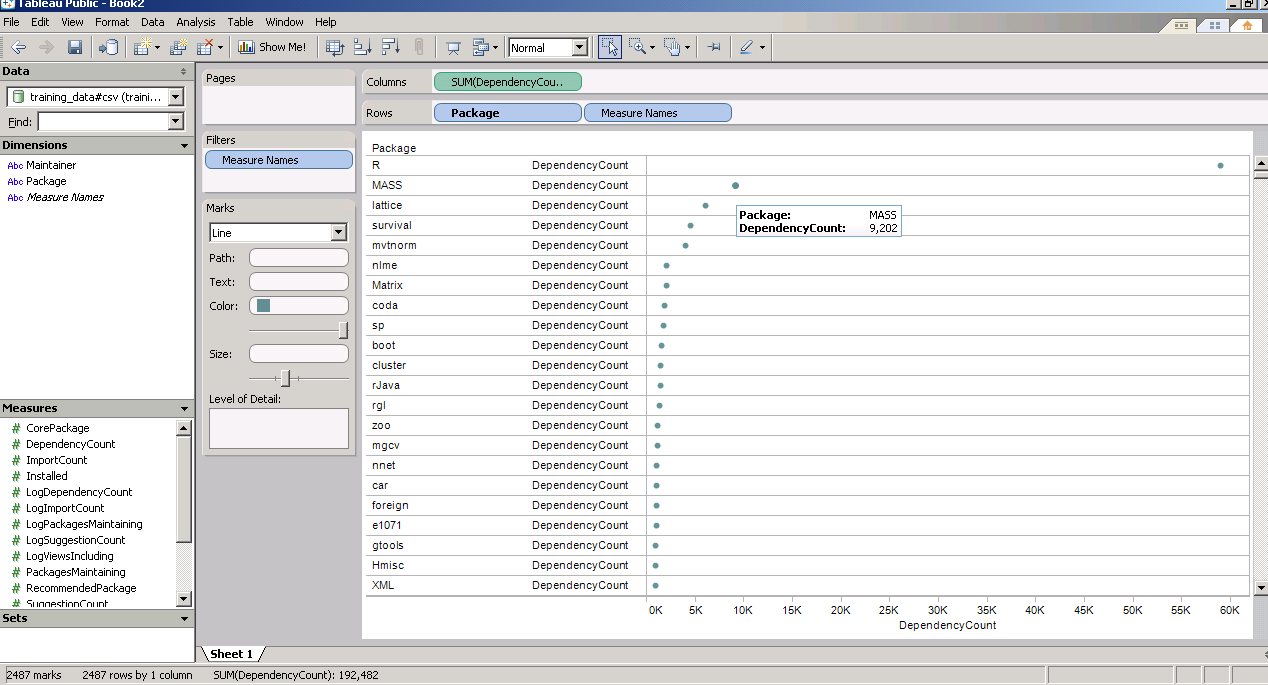
and now a demo I ran on the Kaggle contest data (it is a csv dataset with 95000 rows)
I found Tableau works extremely good at pivoting data and visualizing it -almost like Excel on Steroids. Download the free version here ( I dont know about an academic program (see links below) but software is not expensive at all)
The Professional Edition is a visual analysis and reporting solution for data stored in MS SQL Server, MS Analysis Services, Oracle, IBM DB2, Netezza, Hyperion Essbase, Teradata, Vertica, MySQL, PostgreSQL, Firebird, Excel, MS Access or Text Files. Available via download.
Tableau Server enables users of Tableau Desktop Professional to publish workbooks and visualizations to a server where users with web browsers can access and interact with the results. Available via download.
* Price is per Named User and includes one year of maintenance (upgrades and support). Products are made available as a download immediately after purchase. You may revisit the download site at any time during your current maintenance period to access the latest releases.
The Internet has brought the general concept of time-sharing back into popularity. Expensive corporate server farms costing millions can host thousands of customers all sharing the same common resources. As with the early serial terminals, websites operate primarily in bursts of activity followed by periods of idle time. This bursting nature permits the service to be used by many website customers at once, and none of them notice any delays in communications until the servers start to get very busy.
Jim Goodnight – grand old man and Godfather of the Cosa Nostra of the BI/Database Analytics software industry said recently on open source in BI (btw R is generally termed in business analytics and NOT business intelligence software so these remarks were more apt to Pentaho and Jaspersoft )
Asked whether open source BI and data integration software from the likes of Jaspersoft, Pentaho and Talend is a growing threat, [Goodnight] said: “We haven’t noticed that a lot. Most of our companies need industrial strength software that has been tested, put through every possible scenario or failure to make sure everything works correctly.”
The first, labeled BI Platforms, is drawn fromGartner Market Share Analysis: Business Intelligence, Analytics and Performance Management Software, Worldwide, 2009, published May 2010 , and Gartner Dataquest Market Share: Business Intelligence, Analytics and Performance Management Software, Worldwide, 2009.
and
Advanced Analytics category.
and
so whats the performance of Talend, Pentaho and Jaspersoft
Achieved record revenue, more then doubling from 2008. The fourth quarter of 2009 was Talend’s tenth consecutive quarter of growth.
Grew customer base by 140% to over 1,000 customers, up from 420 at the end of 2008. Of these new customers, over 50% are Fortune 1000 companies.
Total downloads reached seven million, with over 300,000 users of the open source products.
Talend doubled its staff, increasing to 200 global employees. Continuing this trend, Talend has already hired 15 people in 2010 to support its rapid growth.
40% sequential growth most recent quarter. (I didn’t ask whether there was any reason to suspect seasonality.)
130% annual revenue growth run rate.
“Not quite” profitable.
Several hundred commercial subscribers, at an average of $25K annually per, including >100 in Europe.
9,000 paying customers of some kind.
100,000+ total deployments, “very conservatively,” counting OEMs as one deployment each and not double-counting for OEMs’ customers. (Nick said Business Objects quotes 45,000 deployments by the same standards.)
70% of revenue from the mid-market, defined as $100 million – $1 billion revenue. 30% from bigger enterprises. (Hmm. That begs a couple of questions, such as where OEM revenue comes in, and whether <$100 million enterprises were truly a negligible part of revenue.)
1) There is a complete lack of transparency in open source BI market shares as almost all these companies are privately held and do not disclose revenues.
2) What may be a pure play open source company may actually be a company funded by a big BI vendor (like Revolution Analytics is funded among others by Intel-Microsoft) and EnterpriseDB has IBM as an investor.MySQL and Sun of course are bought by Oracle
The degree of control by proprietary vendors on open source vendors is still not disclosed- whether they are holding a stake for strategic reasons or otherwise.
3) None of the Open Source Vendors are even close to a 1 Billion dollar revenue number.
Jim Goodnight is pointing out market reality when he says he has not seen much impact (in terms of market share). As for the rest of his remarks, well he’s got a job to do as CEO and thats talk up his company and trash the competition- which he as been doing for 3 decades and unlikely to change now unless there is severe market share impact. Unless you expect him to notice companies less than 5% of his size in revenue.
Often I am asked by clients, friends and industry colleagues on the suitability or unsuitability of particular software for analytical needs. My answer is mostly-
It depends on-
1) Cost of Type 1 error in purchase decision versus Type 2 error in Purchase Decision. (forgive me if I mix up Type 1 with Type 2 error- I do have some weird childhood learning disabilities which crop up now and then)
Here I define Type 1 error as paying more for a software when there were equivalent functionalities available at lower price, or buying components you do need , like SPSS Trends (when only SPSS Base is required) or SAS ETS, when only SAS/Stat would do.
The first kind is of course due to the presence of free tools with GUI like R, R Commander and Deducer (Rattle does have a 500$ commercial version).
The emergence of software vendors like WPS (for SAS language aficionados) which offer similar functionality as Base SAS, as well as the increasing convergence of business analytics (read predictive analytics), business intelligence (read reporting) has led to somewhat brand clutter in which all softwares promise to do everything at all different prices- though they all have specific strengths and weakness. To add to this, there are comparatively fewer business analytics independent analysts than say independent business intelligence analysts.
2) Type 2 Error- In this case the opportunity cost of delayed projects, business models , or lower accuracy – consequences of buying a lower priced software which had lesser functionality than you required.
To compound the magnitude of error 2, you are probably in some kind of vendor lock-in, your software budget is over because of buying too much or inappropriate software and hardware, and still you could do with some added help in business analytics. The fear of making a business critical error is a substantial reason why open source software have to work harder at proving them competent. This is because writing great software is not enough, we need great marketing to sell it, and great customer support to sustain it.
As Business Decisions are decisions made in the constraints of time, information and money- I will try to create a software purchase matrix based on my knowledge of known softwares (and unknown strengths and weakness), pricing (versus budgets), and ranges of data handling. I will add in basically an optimum approach based on known constraints, and add in flexibility for unknown operational constraints.
I will restrain this matrix to analytics software, though you could certainly extend it to other classes of enterprise software including big data databases, infrastructure and computing.
Noted Assumptions- 1) I am vendor neutral and do not suffer from subjective bias or affection for particular software (based on conferences, books, relationships,consulting etc)
2) All software have bugs so all need customer support.
3) All software have particular advantages , strengths and weakness in terms of functionality.
4) Cost includes total cost of ownership and opportunity cost of business analytics enabled decision.
5) All software marketing people will praise their own software- sometimes over-selling and mis-selling product bundles.
Software compared are SPSS, KXEN, R,SAS, WPS, Revolution R, SQL Server, and various flavors and sub components within this. Optimized approach will include parallel programming, cloud computing, hardware costs, and dependent software costs.
A: Not at all. The Document Foundation will continue to be focused on developing, supporting, and promoting the same software, and it’s very much business as usual. We are simply moving to a new and more appropriate organisational model for the next decade – a logical development from Sun’s inspirational launch a decade ago.
Q: Why are you calling yourselves “The Document Foundation”?
A: For ten years we have used the same name – “OpenOffice.org” – for both the Community and the software. We’ve decided it removes ambiguity to have a different name for the two, so the Community is now “The Document Foundation”, and the software “LibreOffice”. Note: there are other examples of this usage in the free software community – e.g. the Mozilla Foundation with the Firefox browser.
Q: Does this mean you intend to develop other pieces of software?
A: We would like to have that possibility open to us in the future…
Q: And why are you calling the software “LibreOffice” instead of “OpenOffice.org”?
A: The OpenOffice.org trademark is owned by Oracle Corporation. Our hope is that Oracle will donate this to the Foundation, along with the other assets it holds in trust for the Community, in due course, once legal etc issues are resolved. However, we need to continue work in the meantime – hence “LibreOffice” (“free office”).
Q: Why are you building a new web infrastructure?
A: Since Oracle’s takeover of Sun Microsystems, the Community has been under “notice to quit” from our previous Collabnet infrastructure. With today’s announcement of a Foundation, we now have an entity which can own our emerging new infrastructure.
Q: What does this announcement mean to other derivatives of OpenOffice.org?
A: We want The Document Foundation to be open to code contributions from as many people as possible. We are delighted to announce that the enhancements produced by the Go-OOo team will be merged into LibreOffice, effective immediately. We hope that others will follow suit.
Q: What difference will this make to the commercial products produced by Oracle Corporation, IBM, Novell, Red Flag, etc?
A: The Document Foundation cannot answer for other bodies. However, there is nothing in the licence arrangements to stop companies continuing to release commercial derivatives of LibreOffice. The new Foundation will also mean companies can contribute funds or resources without worries that they may be helping a commercial competitor.
Q: What difference will The Document Foundation make to developers?
A: The Document Foundation sets out deliberately to be as developer friendly as possible. We do not demand that contributors share their copyright with us. People will gain status in our community based on peer evaluation of their contributions – not by who their employer is.
Q: What difference will The Document Foundation make to users of LibreOffice?
A: LibreOffice is The Document Foundation’s reason for existence. We do not have and will not have a commercial product which receives preferential treatment. We only have one focus – delivering the best free office suite for our users – LibreOffice.
—————————————————————————————————-
Non Microsoft and Non Oracle vendors are indeed going to find it useful the possiblities of bundling a free Libre Office that reduces the total cost of ownership for analytics software. Right now, some of the best free advertising for Microsoft OS and Office is done by enterprise software vendors who create Windows Only Products and enable MS Office integration better than Open Office integration. This is done citing user demand- but it is a chicken egg dilemma- as functionality leads to enhanced demand. Microsoft on the other hand is aware of this dependence and has made SQL Server and SQL Analytics (besides investing in analytics startups like Revolution Analytics) along with it’s own infrastructure -Azure Cloud Platform/EC2 instances.
“As a high tech company, SAS depends on a strong educational system for its long-term success,” said SAS CEO Jim Goodnight. “Beyond that, STEM education – developing skills for a knowledge economy – is critical to American competitiveness. Without emphasis on STEM, we sacrifice innovation and export our knowledge jobs to other countries.”
Goodnight and SAS have been active in education for years. The SAS co-founder and his wife, Ann Goodnight, launched college prep school Cary Academy in 1996, and the SAS inSchool program has developed educational software for schools since the mid-1990s. In 2008, Jim Goodnight made SAS Curriculum Pathways available free to all U.S. educators. The web-based service provides content in English, mathematics, social studies, science and Spanish.
SAS is the only Triangle-based company among the Change the Equation corporate partners, but the group includes several other companies with a significant Raleigh-Durham presence: chief among them IBM (NYSE: IBM), GlaxoSmithKline (NYSE: GSK), and Cisco Systems (Nasdaq: CSCO).





 DECISION STATS