
28.635308
77.224960

Please use the following code to get a 15% discount on the 2 Day Conference Pass: AJAY11.

Predictive Analytics World announces new full-day workshops coming to San Francisco March 13-19, amounting to seven consecutive days of content.
These workshops deliver top-notch analytical and business expertise across the hottest topics.
Register now for one or more workshops, offered just before and after the full two-day Predictive Analytics World conference program (March 14-15). Early Bird registration ends on January 31st – take advantage of reduced pricing before then.
 |
Driving Enterprise Decisions with Business Analytics – March 13, 2011 |
| James Taylor, CEO, Decision Management Solutions | |
 |
NEW – R for Predictive Modeling: A Hands-On Introduction – March 13, 2011 |
| Max Kuhn, Director, Nonclinical Statistics, Pfizer | |
 |
The Best and Worst of Predictive Analytics: Predictive Modeling Methods and Common Data Mining Mistakes – March 16, 2011 |
| John Elder, Ph.D., CEO and Founder, Elder Research, Inc. | |
 |
Hands-On Predictive Analytics – March 17, 2011 |
| Dean Abbott, President, Abbott Analytics | |
 |
NEW – Net Lift Models: Optimizing the Impact of Your Marketing – March 18-19, 2011 |
| Kim Larsen, VP of Analytical Insights, Market Share Partners |
Download the Conference Preview or view the Predictive Analytics World Agenda online
Make savings now with the early bird rate. Receive $200 off your registration rate for Predictive Analytics World – San Francisco (March 14-15), plus $100 off each workshop for which you register.
Register now before Early Bird Price expires on January 31st!
Additional savings of $200 on the two-day conference pass when you register a colleague at the same time.


CDC.gov has a great tool for showing United States statistics on death and injury, drillable by various details.
The tool is hosted at http://wisqars.cdc.gov:8080/cdcMapFramework/
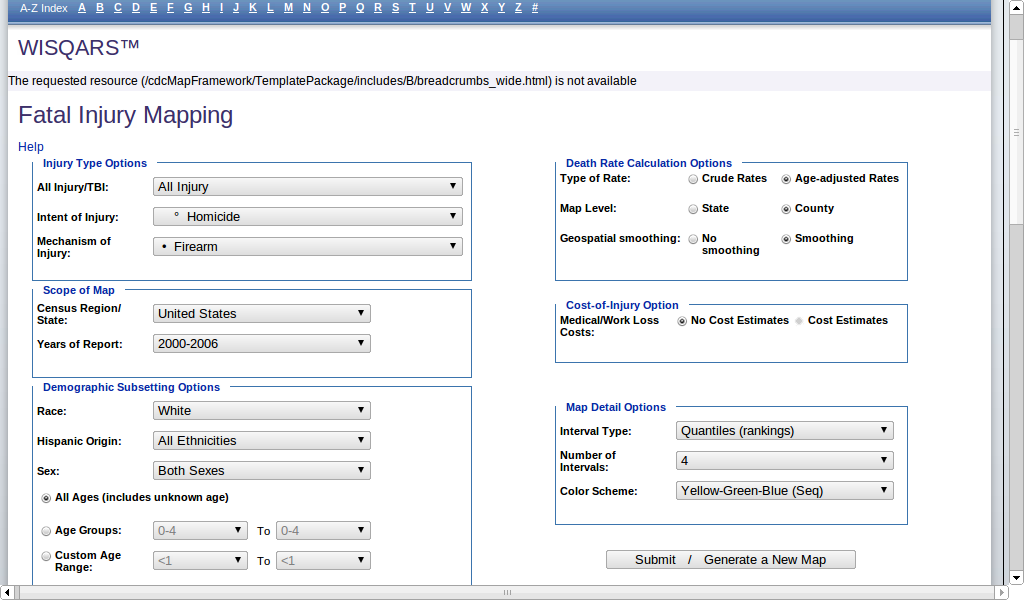
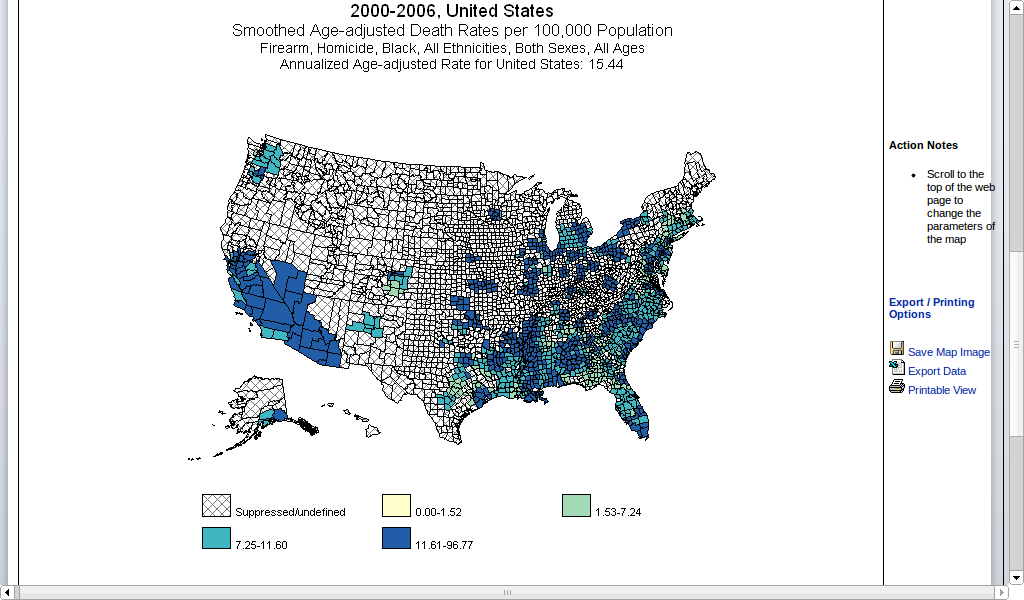
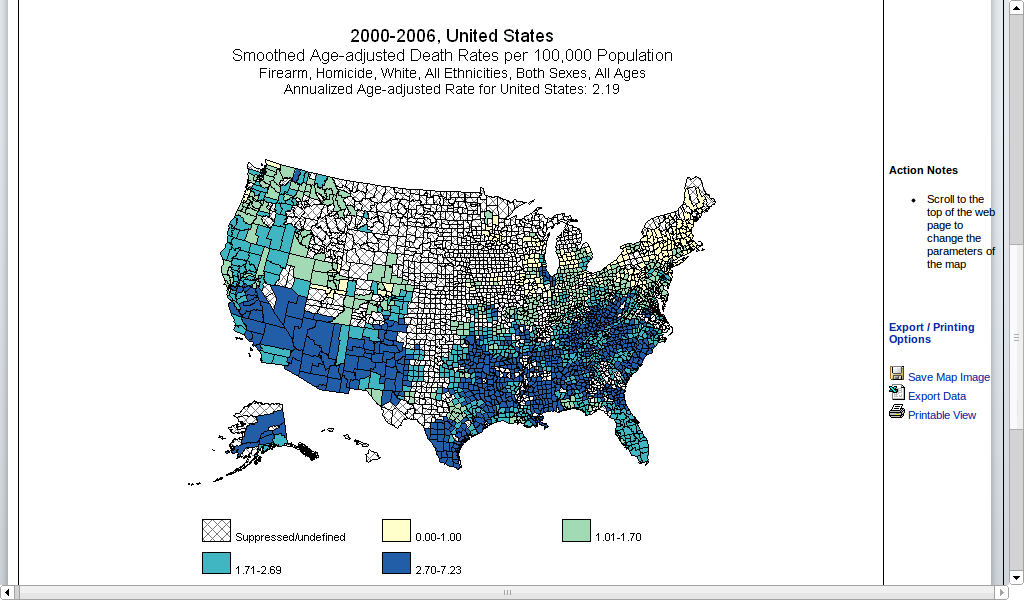
As a test I decided to map out injuries due to fire arms , and compare firearm deaths of white people versus the whole population.(see firearm deaths file)
See white people are more likely than black people to own guns (also read http://www.ncbi.nlm.nih.gov/pubmed/9572612 ), but it seems statistically they are less likely to be injured by firearms- so it could affect support for gun control laws on a racial ground- that was my null hypothesis. No politics, just plain statistics. I dont know- why dont you look at the data and decide-



What are the top three trends you see in 2011?

Brief Bio-
Carole-Ann is a renowned guru in the Decision Management space. She created the vision for Decision Management that is widely adopted now in the industry. Her claim to fame is the strategy and direction of Blaze Advisor, the then-leading BRMS product, while she also managed all the Decision Management tools at FICO (business rules, predictive analytics and optimization). She has a vision for Decision Management both as a technology and a discipline that can revolutionize the way corporations do business, and will never get tired of painting that vision for her audience. She speaks often at Industry conferences and has conducted university classes in France and Washington DC.
Leveraging her Masters degree in Applied Mathematics / Computer Science from a “Grande Ecole” in France, she started her career building advanced systems using all kinds of technologies — expert systems, rules, optimization, dashboarding and cubes, web search, and beta version of database replication – as well as conducting strategic consulting gigs around change management.
She now tweets as @CMatignon, blogs at blog.sparklinglogic.com and interacts at community.sparklinglogic.com.
She started her career building advanced systems using all kinds of technologies — expert systems, rules, optimization, dashboarding and cubes, web search, and beta version of database replication. At Cleversys (acquired by Kurt Salmon & Associates), she also conducted strategic consulting gigs mostly around change management.
While playing with advanced software components, she found a passion for technology and joined ILOG (acquired by IBM). She developed a growing interest in Optimization as well as Business Rules. At ILOG, she coined the term BRMS while brainstorming with her Sales counterpart. She led the Presales organization for Telecom in the Americas up until 2000 when she joined Blaze Software (acquired by Brokat Technologies, HNC Software and finally FICO).
Her 360-degree experience allowed her to gain appreciation for all aspects of a software company, giving her a unique perspective on the business. Her technical background kept her very much in touch with technology as she advanced.
She also became addicted to Twitter in the process. She is active on all kinds of social media, always looking for new digital experience!
Outside of work, Carole-Ann loves spending time with her two boys. They grow fruits in their Northern California home and cook all together in the French tradition.


A fascinating article in New York Times details the fascinating details of the Stuxnet virus, apparently the most successful cyber weapon in recent times.
Given that Industrial Controllers are a part of a everything from factories to missile launch configurations, I believe this is a fascinating area of study for the world’s research scientists including creating variants and defenses for this.
https://www.nytimes.com/2011/01/16/world/middleeast/16stuxnet.html
Also a 2008 presentation by Siemens that the NYT was kind enough to link to- (whither Wikileaks ??)

1) removing duplicates from a dataset based on certain key values/variables
2) merging two datasets based on a common key/variable/s
3) creating a subset based on a conditional value of a variable
4) creating a subset based on a conditional value of a time-date variable
5) changing format from one date time variable to another
6) doing a means grouped or classified at a level of aggregation
7) creating a new variable based on if then condition
8) creating a macro to run same program with different parameters
9) creating a logistic regression model, scoring dataset,
10) transforming variables
11) checking roc curves of model
12) splitting a dataset for a random sample (repeatable with random seed)
13) creating a cross tab of all variables in a dataset with one response variable
14) creating bins or ranks from a certain variable value
15) graphically examine cross tabs
16) histograms
17) plot(density())
18)creating a pie chart
19) creating a line graph, creating a bar graph
20) creating a bubbles chart
21) running a goal seek kind of simulation/optimization
22) creating a tabular report for multiple metrics grouped for one time/variable
23) creating a basic time series forecast
and some case studies I could think of-
As the Director, Risk you have to examine the overdue mortgages book that your predecessor left you. You need to optimize collections and minimize fraud and write-offs, and your efforts would be measured in maximizing profits from your department.
As a social media consultant you have been asked to maximize social media analytics and social media exposure to your client. You need to create a mechanism to report particular brand keywords, as well as automated triggers between unusual web activity, and statistical analysis of the website analytics metrics. Above all it needs to be set up in an automated reporting dashboard .
As a consultant to a telecommunication company you are asked to monitor churn and review the existing churn models. Also you need to maximize advertising spend on various channels. The problem is there are a large number of promotions always going on, some of the data is either incorrectly coded or there are interaction effects between the various promotions.
As a modeller you need to do the following-
1) Check ROC and H-L curves for existing model
2) Divide dataset in random splits of 40:60
3) Create multiple aggregated variables from the basic variables

http://www.libreoffice.org/features/
WRITER is the word processor inside LibreOffice. Use it for everything, from dashing off a quick letter to producing an entire book with tables of contents, embedded illustrations, bibliographies and diagrams. The while-you-type auto-completion, auto-formatting and automatic spelling checking make difficult tasks easy (but are easy to disable if you prefer). Writer is powerful enough to tackle desktop publishing tasks such as creating multi-column newsletters and brochures. The only limit is your imagination.
CALC tames your numbers and helps with difficult decisions when you’re weighing the alternatives. Analyze your data with Calc and then use it to present your final output. Charts and analysis tools help bring transparency to your conclusions. A fully-integrated help system makes easier work of entering complex formulas. Add data from external databases such as SQL or Oracle, then sort and filter them to produce statistical analyses. Use the graphing functions to display large number of 2D and 3D graphics from 13 categories, including line, area, bar, pie, X-Y, and net – with the dozens of variations available, you’re sure to find one that suits your project.
IMPRESS is the fastest and easiest way to create effective multimedia presentations. Stunning animation and sensational special effects help you convince your audience. Create presentations that look even more professional than the standard presentations you commonly see at work. Get your collegues’ and bosses’ attention by creating something a little bit different.
DRAW lets you build diagrams and sketches from scratch. A picture is worth a thousand words, so why not try something simple with box and line diagrams? Or else go further and easily build dynamic 3D illustrations and special effects. It’s as simple or as powerful as you want it to be.
BASE is the database front-end of the LibreOffice suite. With Base, you can seamlessly integrate into your existing database structures. Based on imported and linked tables and queries from MySQL, PostgreSQL or Microsoft Access and many other data sources, you can build powerful databases containing forms, reports, views and queries. Full integration is possible with the in-built HSQL database.
MATH is a simple equation editor that lets you lay-out and display your mathematical, chemical, electrical or scientific equations quickly in standard written notation. Even the most-complex calculations can be understandable when displayed correctly. E=mc2
Open Documentation just announced release candidate 3 of Libre office.
New Features-
http://www.libreoffice.org/download/new-features/

 Follow me on Twitter
 DECISION STATS