Why the West needs China to start moving towards cyber conflict

Hypothesis-

Western countries are running out of people to fight their wars. This is even more acute given the traditional and current demographic trends in both armed forces and general populations.

A shift to cyber conflict can help the West maintain parity over Eastern methods of assymetrical warfare (by human attrition /cyber conflict).

Declining resources will lead to converging conflicts of interest and dynamics in balance of power in the 21 st century.

Assumed Facts

The launch of Sputnik by USSR led to the moon shot rush by the US.1960s

The proposed announcement of StarWars by USA led to unsustainable defence expenditure by USSR.1980s

The threat of cyber conflict and espionage by China (and Russian cyber actions in war with Georgia) has led to increasing budgets for cyber conflict research and defense in USA. -2010s

Assumptions

If we do not learn from history, we are condemned to repeat it.

Declining Populations in the West and Rising Populations in the East in the 21 st century. The difference in military age personnel would be even more severe, due to more rapid aging in the west.

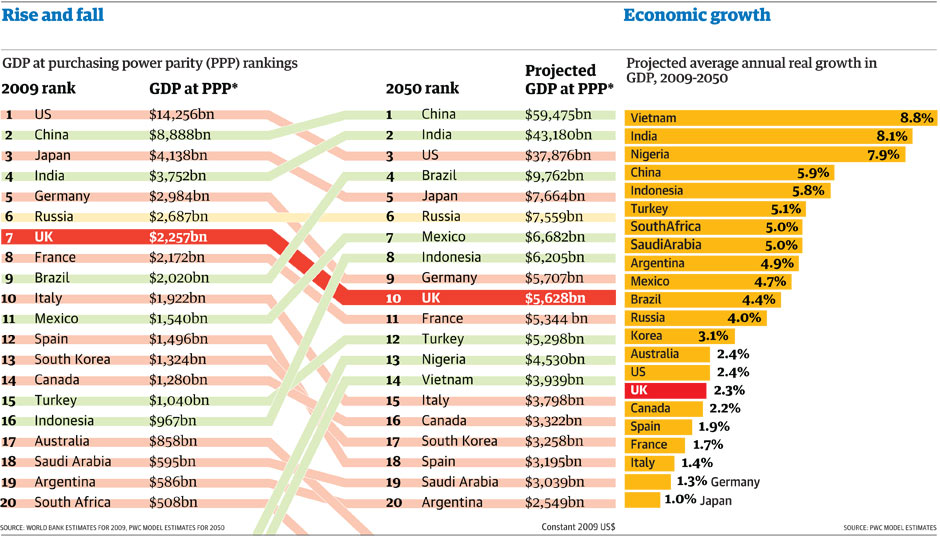
Economic output will be proportional to number of people employed as economies reach similar stages of maturity (Factor-Manufacturing-Services-Innovation)

Data-

http://esa.un.org/unpd/wpp/unpp/panel_population.htm

http://www.census.gov/population/international/

GDP projections to 2050 graphicView larger picture

GDP projections to 2050:
Summary-
Western defence forces would not be able to afford a human attrition intensive war by 2030 given current demographic trends  (both growth and aging). Existing balance of power could be maintained if resources are either shared or warfare is moved to cyber space. Technological advances can help augment resources reducing case for conflict scenarios.
Will the Internet be used by US against China in the 21 st century as Opium was used by GB in the 19th? Time will tell 🙂

Interview Michal Kosinski , Concerto Web Based App using #Rstats

Here is an interview with Michal Kosinski , leader of the team that has created Concerto – a web based application using R. What is Concerto? As per http://www.psychometrics.cam.ac.uk/page/300/concerto-testing-platform.htm

Concerto is a web based, adaptive testing platform for creating and running rich, dynamic tests. It combines the flexibility of HTML presentation with the computing power of the R language, and the safety and performance of the MySQL database. It’s totally free for commercial and academic use, and it’s open source

Ajay-  Describe your career in science from high school to this point. What are the various stats platforms you have trained on- and what do you think about their comparative advantages and disadvantages?  

Michal- I started with maths, but quickly realized that I prefer social sciences – thus after one year, I switched to a psychology major and obtained my MSc in Social Psychology with a specialization in Consumer Behaviour. At that time I was mostly using SPSS – as it was the only statistical package that was taught to students in my department. Also, it was not too bad for small samples and the rather basic analyses I was performing at that time.


My more recent research performed during my Mphil course in Psychometrics at Cambridge University followed by my current PhD project in social networks and research work at Microsoft Research, requires significantly more powerful tools. Initially, I tried to squeeze as much as possible from SPSS/PASW by mastering the syntax language. SPSS was all I knew, though I reached its limits pretty quickly and was forced to switch to R. It was a pretty dreary experience at the start, switching from an unwieldy but familiar environment into an unwelcoming command line interface, but I’ve quickly realized how empowering and convenient this tool was.


I believe that a course in R should be obligatory for all students that are likely to come close to any data analysis in their careers. It is really empowering – once you got the basics you have the potential to use virtually any method there is, and automate most tasks related to analysing and processing data. It is also free and open-source – so you can use it wherever you work. Finally, it enables you to quickly and seamlessly migrate to other powerful environments such as Matlab, C, or Python.

Ajay- What was the motivation behind building Concerto?

Michal- We deal with a lot of online projects at the Psychometrics Centre – one of them attracted more than 7 million unique participants. We needed a powerful tool that would allow researchers and practitioners to conveniently build and deliver online tests.

Also, our relationships with the website designers and software engineers that worked on developing our tests were rather difficult. We had trouble successfully explaining our needs, each little change was implemented with a delay and at significant cost. Not to mention the difficulties with embedding some more advanced methods (such as adaptive testing) in our tests.

So we created a tool allowing us, psychometricians, to easily develop psychometric tests from scratch an publish them online. And all this without having to hire software developers.

Ajay -Why did you choose R as the background for Concerto? What other languages and platforms did you consider. Apart from Concerto, how else do you utilize R in your center, department and University?

Michal- R was a natural choice as it is open-source, free, and nicely integrates with a server environment. Also, we believe that it is becoming a universal statistical and data processing language in science. We put increasing emphasis on teaching R to our students and we hope that it will replace SPSS/PASW as a default statistical tool for social scientists.

Ajay -What all can Concerto do besides a computer adaptive test?

Michal- We did not plan it initially, but Concerto turned out to be extremely flexible. In a nutshell, it is a web interface to R engine with a built-in MySQL database and easy-to-use developer panel. It can be installed on both Windows and Unix systems and used over the network or locally.

Effectively, it can be used to build any kind of web application that requires a powerful and quickly deployable statistical engine. For instance, I envision an easy to use website (that could look a bit like SPSS) allowing students to analyse their data using a web browser alone (learning the underlying R code simultaneously). Also, the authors of R libraries (or anyone else) could use Concerto to build user-friendly web interfaces to their methods.

Finally, Concerto can be conveniently used to build simple non-adaptive tests and questionnaires. It might seem to be slightly less intuitive at first than popular questionnaire services (such us my favourite Survey Monkey), but has virtually unlimited flexibility when it comes to item format, test flow, feedback options, etc. Also, it’s free.

Ajay- How do you see the cloud computing paradigm growing? Do you think browser based computation is here to stay?

Michal – I believe that cloud infrastructure is the future. Dynamically sharing computational and network resources between online service providers has a great competitive advantage over traditional strategies to deal with network infrastructure. I am sure the security concerns will be resolved soon, finishing the transformation of the network infrastructure as we know it. On the other hand, however, I do not see a reason why client-side (or browser) processing of the information should cease to exist – I rather think that the border between the cloud and personal or local computer will continually dissolve.

About

Michal Kosinski is Director of Operations for The Psychometrics Centre and Leader of the e-Psychometrics Unit. He is also a research advisor to the Online Services and Advertising group at the Microsoft Research Cambridge, and a visiting lecturer at the Department of Mathematics in the University of Namur, Belgium. You can read more about him at http://www.michalkosinski.com/

You can read more about Concerto at http://code.google.com/p/concerto-platform/ and http://www.psychometrics.cam.ac.uk/page/300/concerto-testing-platform.htm

Stanford Courses Delayed Again

Message from the guys at Palo Alto— Why dont they just make videos using Sal Academy’s help?

We’re sorry to have to tell you that our Machine Learning course will be delayed further. There have naturally been legal and administrative issues to be sorted out in offering Stanford classes freely to the outside world, and it’s just been taking time. We have, however, been able to take advantage of the extra time to debug and improve our course content!

We now expect that the course will start either late in February or early in March. We will let you know as soon as we hear a definite date. We apologize for the lack of communication in recent weeks; we kept hoping we would have a concrete launch date to give you, but that date has kept slipping.

Thanks so much for your patience! We are really sorry for repeatedly making you wait, and for any interference this causes in your schedules. We’re as excited and anxious as you are to get started, and we both look forward to your joining us soon in Machine Learning!

Andrew Ng and the ML Course Staff

Oracle launches its version of R #rstats

From-

http://www.oracle.com/us/corporate/press/1515738

Integrates R Statistical Programming Language into Oracle Database 11g

News Facts

Oracle today announced the availability of Oracle Advanced Analytics, a new option for Oracle Database 11g that bundles Oracle R Enterprise together with Oracle Data Mining.
Oracle R Enterprise delivers enterprise class performance for users of the R statistical programming language, increasing the scale of data that can be analyzed by orders of magnitude using Oracle Database 11g.
R has attracted over two million users since its introduction in 1995, and Oracle R Enterprise dramatically advances capability for R users. Their existing R development skills, tools, and scripts can now also run transparently, and scale against data stored in Oracle Database 11g.
Customer testing of Oracle R Enterprise for Big Data analytics on Oracle Exadata has shown up to 100x increase in performance in comparison to their current environment.
Oracle Data Mining, now part of Oracle Advanced Analytics, helps enable customers to easily build and deploy predictive analytic applications that help deliver new insights into business performance.
Oracle Advanced Analytics, in conjunction with Oracle Big Data ApplianceOracle Exadata Database Machine and Oracle Exalytics In-Memory Machine, delivers the industry’s most integrated and comprehensive platform for Big Data analytics.

Comprehensive In-Database Platform for Advanced Analytics

Oracle Advanced Analytics brings analytic algorithms to data stored in Oracle Database 11g and Oracle Exadata as opposed to the traditional approach of extracting data to laptops or specialized servers.
With Oracle Advanced Analytics, customers have a comprehensive platform for real-time analytic applications that deliver insight into key business subjects such as churn prediction, product recommendations, and fraud alerting.
By providing direct and controlled access to data stored in Oracle Database 11g, customers can accelerate data analyst productivity while maintaining data security throughout the enterprise.
Powered by decades of Oracle Database innovation, Oracle R Enterprise helps enable analysts to run a variety of sophisticated numerical techniques on billion row data sets in a matter of seconds making iterative, speed of thought, and high-quality numerical analysis on Big Data practical.
Oracle R Enterprise drastically reduces the time to deploy models by eliminating the need to translate the models to other languages before they can be deployed in production.
Oracle R Enterprise integrates the extensive set of Oracle Database data mining algorithms, analytics, and access to Oracle OLAP cubes into the R language for transparent use by R users.
Oracle Data Mining provides an extensive set of in-database data mining algorithms that solve a wide range of business problems. These predictive models can be deployed in Oracle Database 11g and use Oracle Exadata Smart Scan to rapidly score huge volumes of data.
The tight integration between R, Oracle Database 11g, and Hadoop enables R users to write one R script that can run in three different environments: a laptop running open source R, Hadoop running with Oracle Big Data Connectors, and Oracle Database 11g.
Oracle provides single vendor support for the entire Big Data platform spanning the hardware stack, operating system, open source R, Oracle R Enterprise and Oracle Database 11g.
To enable easy enterprise-wide Big Data analysis, results from Oracle Advanced Analytics can be viewed from Oracle Business Intelligence Foundation Suite and Oracle Exalytics In-Memory Machine.

Supporting Quotes

“Oracle is committed to meeting the challenges of Big Data analytics. By building upon the analytical depth of Oracle SQL, Oracle Data Mining and the R environment, Oracle is delivering a scalable and secure Big Data platform to help our customers solve the toughest analytics problems,” said Andrew Mendelsohn, senior vice president, Oracle Server Technologies.
“We work with leading edge customers who rely on us to deliver better BI from their Oracle Databases. The new Oracle R Enterprise functionality allows us to perform deep analytics on Big Data stored in Oracle Databases. By leveraging R and its library of open source contributed CRAN packages combined with the power and scalability of Oracle Database 11g, we can now do that,” said Mark Rittman, co-founder, Rittman Mead.
Oracle Advanced Analytics — an option to Oracle Database 11g Enterprise Edition – extends the database into a comprehensive advanced analytics platform through two major components: Oracle R Enterprise and Oracle Data Mining. With Oracle Advanced Analytics, customers have a comprehensive platform for real-time analytic applications that deliver insight into key business subjects such as churn prediction, product recommendations, and fraud alerting.

Oracle R Enterprise tightly integrates the open source R programming language with the database to further extend the database with Rs library of statistical functionality, and pushes down computations to the database. Oracle R Enterprise dramatically advances the capability for R users, and allows them to use their existing R development skills and tools, and scripts can now also run transparently and scale against data stored in Oracle Database 11g.

Oracle Data Mining provides powerful data mining algorithms that run as native SQL functions for in-database model building and model deployment. It can be accessed through the SQL Developer extension Oracle Data Miner to build, evaluate, share and deploy predictive analytics methodologies. At the same time the high-performance Oracle-specific data mining algorithms are accessible from R.

BENEFITS

  • Scalability—Allows customers to easily scale analytics as data volume increases by bringing the algorithms to where the data resides – in the database
  • Performance—With analytical operations performed in the database, R users can take advantage of the extreme performance of Oracle Exadata
  • Security—Provides data analysts with direct but controlled access to data in Oracle Database 11g, accelerating data analyst productivity while maintaining data security
  • Save Time and Money—Lowers overall TCO for data analysis by eliminating data movement and shortening the time it takes to transform “raw data” into “actionable information”
Oracle R Hadoop Connector Gives R users high performance native access to Hadoop Distributed File System (HDFS) and MapReduce programming framework.
This is a  R package
From the datasheet at

Understanding Indian Govt attitude to Iran and Iraq wars

This is a collection of links for a geo-strategic analysis, and the economics of wars and allies. The author neither condones nor condemns current global dynamics in the balance of power.

nations don’t have friends or enemies…nations only have interests

In 2003

The war in Iraq had a unique Indian angle right at the beginning. Some members of the US administration felt they needed more troops in Iraq, and they started negotiating with India. Those negotiations broke down because the Indians wanted to fight under the UN flag and on MONEY!!

India wanted-

  • More money per soldier deployed,
  • more share in post War Oil Contracts,
  • better diplomatic subtlety
Govt changed in India due to elections in2003 (Muslim voters are critical in any govt forming majority party), and the Iraq war ran its tragic course without any Indian explicit support.
In 26 Nov 2008, Islamic Terrorists killed US, Indian and Israeli citizens in terror strikes in Mumbai Sieze- thus proving that appeasing terrorist nations is just riding a tiger.

http://articles.timesofindia.indiatimes.com/2003-06-13/india/27203305_1_stabilisation-force-indian-troops-pentagon-delegation

NEW DELHI: There will be a lot a Iraq on the menu over the weekend before the Pentagon team arrives here on Monday to talk India into sending troops to the war-torn nation.

http://articles.timesofindia.indiatimes.com/2003-07-28/india/27176989_1_troops-issue-stabilisation-force-defence-policy-group

Jul 28, 2003, 01.28pm IST

NEW DELHI: Chairman of the US Joint Chiefs of Staff Gen Richard B Myers, who is arriving here on Monday evening on a two-day visit, will request India to reconsider its decision on sending troops to Iraq.

and

Jul 29, 2003, 07.00pm IST

NEW DELHI: Though Gen Myers flatly denied his visit had anything to do with persuading India to send troops to Iraq, it is evident that the US desperately wants Delhi to contribute a division-level force of over 15,000 combat soldiers.

http://articles.timesofindia.indiatimes.com/2003-09-10/india/27176101_1_stabilisation-force-force-under-american-control-regional-dialogue

Sep 10, 2003, 05.34pm IST

NEW DELHI: Even as the US-drafted resolution on Iraq is being heatedly debated in many countries, American Assistant Secretary of State for South Asia Christina Rocca held a series of meetings with External Affairs Ministry officials on Wednesday.

Though it was officially called “a regional dialogue”, the US request to contribute a division-level force of over 15,000 combat soldiers to the “stabilisation force” in Iraq is learnt to have figured in the discussions.

The penny wise -pound foolish attitude of then Def Secretary Rumsfield led to break down in negotiations.

“Those who fail to learn from history are doomed to repeat it.” Sir Winston Churchill

In 2012

Indian govt again faces elections and we have 150 million Muslim voters just like other countries have influential lobbies.

and while Israelis are being targeted again in attacks in India-

India is still seeking money-

India has struck a defiant tone over new financial sanctions imposed by the United States and European Union to punish Iran for its nuclear programme, coming up with elaborate trade and barter arrangements to pay for oil supplies.

However, the president of the All India Rice Exporters’ Association, said Monday’s attack on the wife of an Israeli diplomat in the Indian capital will damage trade with Iran and may complicate efforts to resolve an impasse over Iranian defaults on payments for rice imports worth around $150 million.

http://timesofindia.indiatimes.com/india/Unfazed-by-US-sanctions-India-to-step-up-ties-with-Iran/articleshow/11887691.cms

India buys $ 5  billion worth of oil from Iran. Annually. Clearly it is a critical financial trading partner to Iran.

It has now gotten extra sops from Iran to continue trading-and is now waiting for a sweeter monetary offer from US and/or Israel to even consider thinking about going through the pain of unchanging the inertia of ties with Iran.

There are some aspects of political corruption as well, as Indian political establishment  is notoriously prone to corruption by lobbyists (apparently there   is a global war on lobbyists that needs to happen)

http://timesofindia.indiatimes.com/india/Unfazed-by-US-sanctions-India-to-step-up-ties-with-Iran/articleshow/11887691.cms

 Feb 14, 2012, 05.54PM ISTUnfazed by US sanctions, India to step up ties with Iran
India is set to ramp up its energy and business ties with Iran. (AFP Photo)
NEW DELHI: Unfazed by US sanctions and Israel linking Tehran to the attack on an Israeli embassy car here, India is set to ramp up its energy and business ties with Iran, with a commerce ministry team heading to Tehran to explore fresh business opportunities. 

The team is expected to go to Tehran later this month to discuss steps to expand India’s trade with Iran, part of a larger strategy to pay for Iranian oil, said highly-placed sources. 

Despite the US and European Union sanctions on Iran, India recently sealed a payment mechanism under which Indian companies will pay for 45 percent of their crude oil imports from Iran in rupees. 

So diplomats with argue over money in Israel, Indian and US while terrorists will kill.

Against Stupidity- The Gods Themselves -Contend in Vain

Cyber Cold War

I try to write on cyber conflict without getting into the politics of why someone is hacking someone else. I always get beaten by someone in the comments thread when I write on politics.

But recent events have forced me to update my usual “how-to” cyber conflict to “why” cyber conflict. This is because of a terrorist attack in my hometown Delhi.

(updated-

http://www.nytimes.com/2012/02/14/world/middleeast/israeli-embassy-officials-attacked-in-india-and-georgia.html?_r=1&hp

Iran allegedly tried  (as per Israel) to assassinate the wife of Israeli Defence Attache in Delhi using a magnetic bomb, India as she went to school to pick up her kids, somebody else put a grenade in Israeli embassy car in Georgia which was found in time. 

Based on reports , initial work suggests the bomb was much more sophisticated than local terrorists, but the terrorists seemed to have some local recce work done.

India has 0 history of antisemitism but this is the second time Israelis have been targeted since 26/11 Mumbai attacks. India buys 12 % of oil annually from Iran (and refuses to join the oil embargo called by US and Europe)

Cyber Conflict is less painful than conflict, which is inevitable as long as mankind exists. Also the Western hemisphere needs a moon shot (cyber conflict could be the Sputnik like moment) and with declining and aging populations but better technology, Western Hemisphere govts need cyber conflict as they are running out of humans to fight their wars. Eastern govt. are even more obnoxious in using children for conflict propaganda, and corruption.

Last week CIA.gov website went down

This week Iranian govt is allegedly blocking https traffic on eve of Annual Revolution Day (what a coincidence!)


Some resources to help Internet users in Iran (or maybe this could be a dummy test for the big one – hacking the great firewall of China)

News from Hacker News-

http://news.ycombinator.com/item?id=3575029


I’m writing this to report the serious troubles we have regarding accessing Internet in Iran at the moment. Since Thursday Iranian government has shutted down the https protocol which has caused almost all google services (gmail, and google.com itself) to become inaccessible. Almost all websites that reply on Google APIs (like wolfram alpha) won’t work. Accessing to any website that replies on https (just imaging how many websites use this protocol, from Arch Wiki to bank websites). Also accessing many proxies is also impossible. There are almost no official reports on this and with many websites and my email accounts restricted I can just confirm this based on my own and friends experience. I have just found one report here:

Iran Shut Down Gmail , Google , Yahoo and sites using “Https” Protocol

The reason for this horrible shutdown is that the Iranian regime celebrates 1979 Islamic revolution tomorrow.

I just wanted to let you guys know about this. If you have any solution regarding bypassing this restriction please help!


The boys at Tor think they can help-

but its not so elegant, as I prefer creating a  batch file rather than explain coding to newbies. 

this is still getting to better and easier interfaces

https://www.torproject.org/projects/obfsproxy-instructions.html.en

Obfsproxy Instructions

client torrc

Step 1: Install dependencies, obfsproxy, and Tor


You will need a C compiler (gcc), the autoconf and autotools build system, the git revision control system, pkg-config andlibtoollibevent-2 and its headers, and the development headers of OpenSSL.

On Debian testing or Ubuntu oneiric, you could do:
# apt-get install autoconf autotools-dev gcc git pkg-config libtool libevent-2.0-5 libevent-dev libevent-openssl-2.0-5 libssl-dev

If you’re on a more stable Linux, you can either try our experimental backport libevent2 debs or build libevent2 from source.

Clone obfsproxy from its git repository:
$ git clone https://git.torproject.org/obfsproxy.git
The above command should create and populate a directory named ‘obfsproxy’ in your current directory.

Compile obfsproxy:
$ cd obfsproxy
$ ./autogen.sh && ./configure && make

Optionally, as root install obfsproxy in your system:
# make install

If you prefer not to install obfsproxy as root, you can instead just modify the Transport lines in your torrc file (explained below) to point to your obfsproxy binary.

You will need Tor 0.2.3.11-alpha or later.


Step 2a: If you’re the client…


First, you need to learn the address of a bridge that supports obfsproxy. If you don’t know any, try asking a friend to set one up for you. Then the appropriate lines to your tor configuration file:

UseBridges 1
Bridge obfs2 128.31.0.34:1051
ClientTransportPlugin obfs2 exec /usr/local/bin/obfsproxy --managed

Don’t forget to replace 128.31.0.34:1051 with the IP address and port that the bridge’s obfsproxy is listening on.
 Congratulations! Your traffic should now be obfuscated by obfsproxy. You are done! You can now start using Tor.

For old fashioned tunnel creation under Seas of English Channel-

http://dag.wieers.com/howto/ssh-http-tunneling/

Tunneling SSH over HTTP(S)
This document explains how to set up an Apache server and SSH client to allow tunneling SSH over HTTP(S). This can be useful on restricted networks that either firewall everything except HTTP traffic (tcp/80,tcp/443) or require users to use a local (HTTP) proxy.
A lot of people asked why doing it like this if you can just make sshd listen on port 443. Well, that might work if your environment is not hardened like I have seen at several companies, but this setup has a few advantages.

  • You can proxy to anywhere (see the Proxy directive in Apache) based on names
  • You can proxy to any port you like (see the AllowCONNECT directive in Apache)
  • It works even when there is a layer-7 protocol firewall
  • If you enable proxytunnel ssl support, it is indistinguishable from real SSL traffic
  • You can come up with nice hostnames like ‘downloads.yourdomain.com’ and ‘pictures.yourdomain.com’ and for normal users these will look like normal websites when visited.
  • There are many possibilities for doing authentication further along the path
  • You can do proxy-bouncing to the n-th degree to mask where you’re coming from or going to (however this requires more changes to proxytunnel, currently I only added support for one remote proxy)
  • You do not have to dedicate an IP-address for sshd, you can still run an HTTPS site

Related-

http://opensourceandhackystuff.blogspot.in/2012/02/captive-portal-security-part-1.html

and some crypto for young people

http://users.telenet.be/d.rijmenants/en/onetimepad.htm


Me- What am I doing about it? I am just writing poems on hacking at http://poemsforkush.com

Interview Kelci Miclaus, SAS Institute Using #rstats with JMP

Here is an interview with Kelci Miclaus, a researcher working with the JMP division of the SAS Institute, in which she demonstrates examples of how the R programming language is a great hit with JMP customers who like to be flexible.


Ajay- How has JMP been using integration with R? What has been the feedback from customers so far? Is there a single case study you can point out where the combination of JMP and R was better than any one of them alone?

Kelci- Feedback from customers has been very positive. Some customers are using JMP to foster collaboration between SAS and R modelers within their organizations. Many are using JMP’s interactive visualization to complement their use of R. Many SAS and JMP users are using JMP’s integration with R to experiment with more bleeding-edge methods not yet available in commercial software. It can be used simply to smooth the transition with regard to sending data between the two tools, or used to build complete custom applications that take advantage of both JMP and R.

One customer has been using JMP and R together for Bayesian analysis. He uses R to create MCMC chains and has found that JMP is a great tool for preparing the data for analysis, as well as displaying the results of the MCMC simulation. For example, the Control Chart platform and the Bubble Plot platform in JMP can be used to quickly verify convergence of the algorithm. The use of both tools together can increase productivity since the results of an analysis can be achieved faster than through scripting and static graphics alone.

I, along with a few other JMP developers, have written applications that use JMP scripting to call out to R packages and perform analyses like multidimensional scaling, bootstrapping, support vector machines, and modern variable selection methods. These really show the benefit of interactive visual analysis of coupled with modern statistical algorithms. We’ve packaged these scripts as JMP add-ins and made them freely available on our JMP User Community file exchange. Customers can download them and now employ these methods as they would a regular JMP platform. We hope that our customers familiar with scripting will also begin to contribute their own add-ins so a wider audience can take advantage of these new tools.

(see http://www.decisionstats.com/jmp-and-r-rstats/)

Ajay- Are there plans to extend JMP integration with other languages like Python?

Kelci- We do have plans to integrate with other languages and are considering integrating with more based on customer requests. Python has certainly come up and we are looking into possibilities there.

 Ajay- How is R a complimentary fit to JMP’s technical capabilities?

Kelci- R has an incredible breadth of capabilities. JMP has extensive interactive, dynamic visualization intrinsic to its largely visual analysis paradigm, in addition to a strong core of statistical platforms. Since our brains are designed to visually process pictures and animated graphs more efficiently than numbers and text, this environment is all about supporting faster discovery. Of course, JMP also has a scripting language (JSL) allowing you to incorporate SAS code, R code, build analytical applications for others to leverage SAS, R and other applications for users who don’t code or who don’t want to code.

JSL is a powerful scripting language on its own. It can be used for dialog creation, automation of JMP statistical platforms, and custom graphic scripting. In other ways, JSL is very similar to the R language. It can also be used for data and matrix manipulation and to create new analysis functions. With the scripting capabilities of JMP, you can create custom applications that provide both a user interface and an interactive visual back-end to R functionality. Alternatively, you could create a dashboard using statistical and/or graphical platforms in JMP to explore the data and with the click of a button, send a portion of the data to R for further analysis.

Another JMP feature that complements R is the add-in architecture, which is similar to how R packages work. If you’ve written a cool script or analysis workflow, you can package it into a JMP add-in file and send it to your colleagues so they can easily use it.

Ajay- What is the official view on R from your organization? Do you think it is a threat, or a complimentary product or another statistical platform that coexists with your offerings?

Kelci- Most definitely, we view R as complimentary. R contributors are providing a tremendous service to practitioners, allowing them to try a wide variety of methods in the pursuit of more insight and better results. The R community as a whole is providing a valued role to the greater analytical community by focusing attention on newer methods that hold the most promise in so many application areas. Data analysts should be encouraged to use the tools available to them in order to drive discovery and JMP can help with that by providing an analytic hub that supports both SAS and R integration.

Ajay-  While you do use R, are there any plans to give back something to the R community in terms of your involvement and participation (say at useR events) or sponsoring contests.

 Kelci- We are certainly open to participating in useR groups. At Predictive Analytics World in NY last October, they didn’t have a local useR group, but they did have a Predictive Analytics Meet-up group comprised of many R users. We were happy to sponsor this. Some of us within the JMP division have joined local R user groups, myself included.  Given that some local R user groups have entertained topics like Excel and R, Python and R, databases and R, we would be happy to participate more fully here. I also hope to attend the useR! annual meeting later this year to gain more insight on how we can continue to provide tools to help both the JMP and R communities with their work.

We are also exploring options to sponsor contests and would invite participants to use their favorite tools, languages, etc. in pursuit of the best model. Statistics is about learning from data and this is how we make the world a better place.

About- Kelci Miclaus

Kelci is a research statistician developer for JMP Life Sciences at SAS Institute. She has a PhD in Statistics from North Carolina State University and has been using SAS products and R for several years. In addition to research interests in statistical genetics, clinical trials analysis, and multivariate analysis/visualization methods, Kelci works extensively with JMP, SAS, and R integration.

.