Doing Time Series using a R GUI

The Xerox Star Workstation introduced the firs...
Image via Wikipedia

Until recently I had been thinking that RKWard was the only R GUI supporting Time Series Models-

however Bob Muenchen of http://www.r4stats.com/ was helpful to point out that the Epack Plugin provides time series functionality to R Commander.

Note the GUI helps explore various time series functionality.

Using Bulkfit you can fit various ARMA models to dataset and choose based on minimum AIC


> bulkfit(AirPassengers$x)
$res
ar d ma      AIC
[1,]  0 0  0 1790.368
[2,]  0 0  1 1618.863
[3,]  0 0  2 1522.122
[4,]  0 1  0 1413.909
[5,]  0 1  1 1397.258
[6,]  0 1  2 1397.093
[7,]  0 2  0 1450.596
[8,]  0 2  1 1411.368
[9,]  0 2  2 1394.373
[10,]  1 0  0 1428.179
[11,]  1 0  1 1409.748
[12,]  1 0  2 1411.050
[13,]  1 1  0 1401.853
[14,]  1 1  1 1394.683
[15,]  1 1  2 1385.497
[16,]  1 2  0 1447.028
[17,]  1 2  1 1398.929
[18,]  1 2  2 1391.910
[19,]  2 0  0 1413.639
[20,]  2 0  1 1408.249
[21,]  2 0  2 1408.343
[22,]  2 1  0 1396.588
[23,]  2 1  1 1378.338
[24,]  2 1  2 1387.409
[25,]  2 2  0 1440.078
[26,]  2 2  1 1393.882
[27,]  2 2  2 1392.659
$min
ar        d       ma      AIC
2.000    1.000    1.000 1378.338
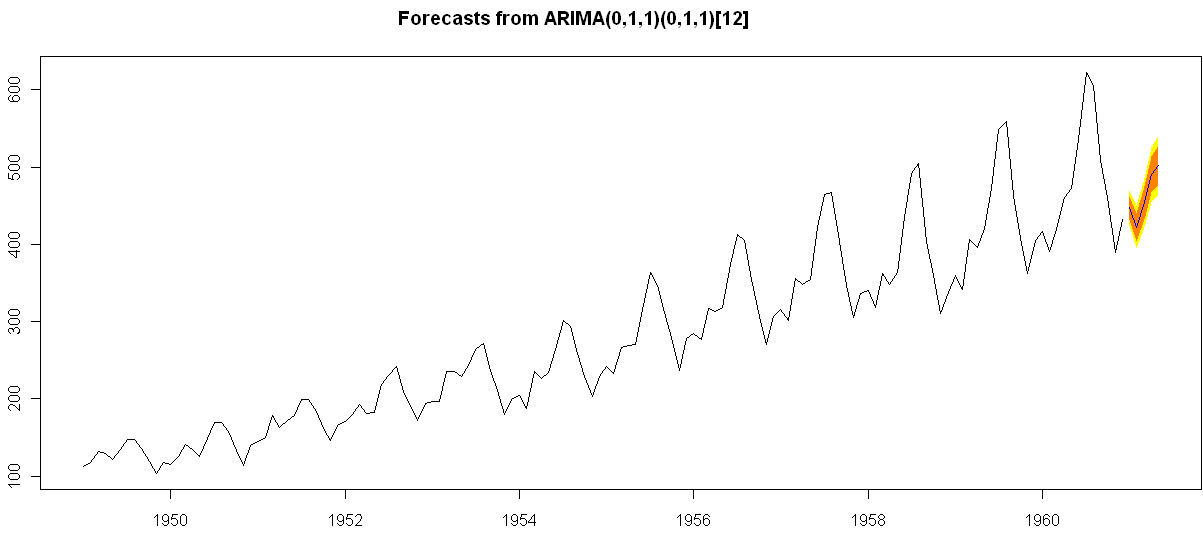
> ArimaModel.5 <- Arima(AirPassengers$x,order=c(0,1,1),
+ include.mean=1,
+   seasonal=list(order=c(0,1,1),period=12))
> ArimaModel.5
Series: AirPassengers$x
ARIMA(0,1,1)(0,1,1)[12]
Call: Arima(x = AirPassengers$x, order = c(0, 1, 1), seasonal = list(order = c(0,      1, 1), period = 12), include.mean = 1)
Coefficients:
ma1     sma1
-0.3087  -0.1074
s.e.   0.0890   0.0828
sigma^2 estimated as 135.4:  log likelihood = -507.5
AIC = 1021   AICc = 1021.19   BIC = 1029.63
> summary(ArimaModel.5, cor=FALSE)
Series: AirPassengers$x
ARIMA(0,1,1)(0,1,1)[12]
Call: Arima(x = AirPassengers$x, order = c(0, 1, 1), seasonal = list(order = c(0,      1, 1), period = 12), include.mean = 1)
Coefficients:
ma1     sma1
-0.3087  -0.1074
s.e.   0.0890   0.0828
sigma^2 estimated as 135.4:  log likelihood = -507.5
AIC = 1021   AICc = 1021.19   BIC = 1029.63
In-sample error measures:
ME        RMSE         MAE         MPE        MAPE        MASE
0.32355285 11.09952005  8.16242469  0.04409006  2.89713514  0.31563730
Dataset79 <- predar3(ArimaModel.5,fore1=5)


And I also found an interesting Ref Sheet for Time Series functions in R-

http://cran.r-project.org/doc/contrib/Ricci-refcard-ts.pdf

and a slightly more exhaustive time series ref card

http://www.statistische-woche-nuernberg-2010.org/lehre/bachelor/datenanalyse/Refcard3.pdf

Also of interest a matter of opinion on issues in Time Series Analysis in R at

http://www.stat.pitt.edu/stoffer/tsa2/Rissues.htm

Of course , if I was the sales manager for SAS ETS I would be worried given the increasing capabilities in Time Series in R. But then again some deficiencies in R GUI for Time Series-

1) Layout is not very elegant

2) Not enough documented help (atleast for the Epack GUI- and no integrated help ACROSS packages-)

3) Graphical capabilties need more help documentation to interpret the output (especially in ACF and PACF plots)

More resources on Time Series using R.

http://people.bath.ac.uk/masgs/time%20series/TimeSeriesR2004.pdf

and http://www.statoek.wiso.uni-goettingen.de/veranstaltungen/zeitreihen/sommer03/ts_r_intro.pdf

and books

http://www.springer.com/economics/econometrics/book/978-0-387-77316-2

http://www.springer.com/statistics/statistical+theory+and+methods/book/978-0-387-75960-9

http://www.springer.com/statistics/statistical+theory+and+methods/book/978-0-387-75958-6

http://www.springer.com/statistics/statistical+theory+and+methods/book/978-0-387-75966-1

Using R for Time Series in SAS


Time series: random data plus trend, with best...
Image via Wikipedia


Here is a great paper on using Time Series in R, and it specifically allows you to use just R output in Base SAS.

SAS Code

/* three methods: */

/* 1. Call R directly – Some errors are not reported to log */

x “’C:\Program Files\R\R-2.12.0\bin\r.exe’–no-save –no-restore <“”&rsourcepath\tsdiag.r””>””&rsourcepath\tsdiag.out”””;

/* include the R log in the SAS log */7data _null_;

infile “&rsourcepath\tsdiag.out”;

file log;

input;

put ’R LOG: ’ _infile_;

run;

/* include the image in the sas output.Specify a file if you are not using autogenerated html output */

ods html;

data _null_;

file print;

put “<IMG SRC=’” “&rsourcepath\plot.png” “’ border=’0’>”;

put “<IMG SRC=’” “&rsourcepath\acf.png” “’ border=’0’>”;

put “<IMG SRC=’” “&rsourcepath\pacf.png” “’ border=’0’>”;

put “<IMG SRC=’” “&rsourcepath\spect.png” “’ border=’0’>”;

put “<IMG SRC=’” “&rsourcepath\fcst.png” “’ border=’0’>”;

run;

ods html close;

The R code to create a time series plot is quite elegant though-


library(tseries)

air <- AirPassengers #Datasetname

ts.plot(air)

acf(air)

pacf(air)

plot(decompose(air))

air.fit <- arima(air,order=c(0,1,1), seasonal=list(order=c(0,1,1), period=12) #The ARIMA Model Based on PACF and ACF Graphs

tsdiag(air.fit)

library(forecast)

air.forecast <- forecast(air.fit)

plot.forecast(air.forecast)

You can download the fascinating paper from the Analytics NCSU Website http://analytics.ncsu.edu/sesug/2008/ST-146.pdf

About the Author-

Sam Croker has a MS in Statistics from the University of South Carolina and has over ten years of experience in analytics.   His research interests are in time series analysis and forecasting with focus on stream-flow analysis.  He is currently using SAS, R and other analytical tools for fraud and abuse detection in Medicare and Medicaid data. He also has experience in analyzing, modeling and forecasting in the finance, marketing, hospitality, retail and pharmaceutical industries.

Interview John F Moore CEO The Lab

Social Media Landscape

Here is an interview with John F Moore, social media adviser,technologist and founder and CEO of The Lab.

Ajay-  The internet seems to be crowded by social media experts with everyone who spends a lot of time on the internet claiming to be one? How  does a small business owner on a budget distinguish for the correct value proposition that social media can give them. 

John- You’re right.  It seems like everytime I turn around I bump into more social media “experts”.  The majority of these self-proclaimed experts are not adding a great deal of value.  When looking to spend money for help ask the person a few questions about their approach. Things you should be hearing include:

  • The expert should be seeking to fully understand your business, your goals, your available resources, etc..
  • The expert should be seeking to understand current management thinking about social media and related technologies.

If the expert is purely focused on tools they are the wrong person.  Your solution may require tools alone but they cannot know this without first understanding your business.

Ajay- Facebook has 600 million people, with people preferring to play games and connect to old acquaintances rather than use social media for tangible career or business benefit..

John- People are definitely spending time playing games, looking at photos, and catching up with old friends.  However, there are many businesses seeing real value from Facebook (primarily by tying it into their e-mail marketing and using coupons and other incentives).  For example, I recently shared a small case study (http://thejohnfmoore.com/2010/10/07/email-social-media-and-coupons-makes-the-cfo-smile/) where a small pet product company achieved a 22% bump in monthly revenue by combining Facebook and coupons together.  In fact,45% of this bump in revenue came from new clients.  Customer acquisition and increased revenue were accomplished by using Facebook for their business.
Ajay-  How does a new social media convert (individual) go on selecting communities to join (Facebook,Twitter,Linkedin,Ning, Ping,Orkut, Empire Avenue etc etc.
How does a small business owner take the same decision.

John- It always starts with taking the time to define your goals and then determine how much time and effort you are willing to invest.  For example:
  • LinkedIn. A must have for individuals as it is one of the key social networking communities for professional networking.  Individuals should join groups that are relevant to their career and invest an hour a week.  Businesses should ensure they have a business profile completed and up to date.
  • Facebook can be a challenge for anyone trying to walk the personal/professional line.  However, from a business standpoint you should be creating a Facebook page that you can use to compliment your other marketing channels.
  • Twitter.  It is a great network to learn of, to meet, and to interact with people from around the world.  I have met thousands of interesting people, many of which I have had the pleasure to meet with in real life.  Businesses need to invest in listening on twitter to determine if their customers (current or potential) or competitors are already there discussing them, their marketplace, or their offerings.
In all cases I would encourage businesses to setup social media accounts on LinkedIn, Facebook, Twitter, YouTube, and Flickr.  You want to ensure your brand is protected by owning these accounts and ensuring at least the base information is accurate.
Ajay- Name the top 5 points that you think make a social media community successful.  What are the top 5 points for a business to succeed in their social media strategy.

John-
  • Define your goals up front.  Understand why you are building a community and keep this goal in mind.
  • Provide education.  Ideally you want to become a thought leader in your space, the trusted resource that people can turn to even if they are not using your product or services today.
  • Be honest.  We all make mistakes.  When you do, be honest with your community and engage them in any fall-out that may be coming out of your mistake.
  • Listen to them.  Use platforms like BubbleIdeas to gather feedback on what your community is looking for from the relationship.
  • Measure.  Are you on track with your goals?  Do your goals need to change?
Ajay- What is the unique value proposition that “The Lab” offers

John- The Lab understands the strategic importance of leveraging social media, management and leadership best practices, and our understanding of local government and small and medium business to help people in these areas achieve their goals.  Too many consultants come to the table with a predefined solution that really misses the mark as it lacks understanding of the client’s goals.
Ajay-  What is “CityCamp in Boston” all about.

John- CityCamp is a FREE unconference focused on innovation for municipal governments and community organizations (http://www.citycampboston.org/what-is-citycamp-boston/).  It brings together politicians, local municipal employees, citizens, vendors, developers, and journalist to build a common understanding of local government challenges and then works to deliver measurable outcomes following the event.  The key is the focus on change management, driving change as opposed to just in the moment education.
Biography-

John F Moore is the Founder and CEO of The Lab (http://thelabinboston.com).  John has experience working with local governments and small and medium business owners to achieve their goals.  His experience with social media strategies, CRM, and a plethora of other solutions provides immense value to all of our clients.   He has built engineering organizations, learned sales and marketing, run customer service teams, and built and executed strategies for social media thought leadership and branding.  He is also a prolific blogger as you can see by checking out his blog at http://thejohnfmoore.com.

Bruno Aziza, Microsoft Global BI Lead joins PAW Keynote

By Richard Wheeler (Zephyris) 2007. Lambda rep...
Image via Wikipedia


An interesting development, Bruno Aziza, Director, Worldwide Strategy Lead, Business Intelligence, Microsoft has joined Predictive Analytics World as a keynote speaker.

http://www.predictiveanalyticsworld.com/dc/2010/agenda.php#day2-2

Keynote
Predictive Analytics and Business Performance

In this session, Bruno Aziza will discuss the challenges organizations face with Analytics and Performance. This participative session will provide first-hand accounts from Fortune 500 companies who are winning by building accountability, intelligence, and informed decision-making into their organizational DNA.

Speaker: Bruno Aziza, Director, Worldwide Strategy Lead, Business Intelligence, Microsoft

Some info about Mr Aziza,

http://www.predictiveanalyticsworld.com/dc/2010/speakers.php#aziza

Bruno Aziza, Director, Worldwide Strategy Lead, Business Intelligence,Microsoft

Bruno AzizaBruno Aziza is a recognized authority on Strategy Execution, Business Intelligence and Information Management. He is the co-author of best-selling book, “Drive Business Performance: Enabling a Culture of Intelligent Execution” and a Fellow at the Advanced Performance Institute, a world-leading and independent advisory group specialized in organizational performance. Drs. Kaplan & Norton, of Balanced Scorecard fame, praise Aziza for moving “the field of performance management forward in important new directions.”

Aziza’s work has been featured in publications across North America, Europe and Asia such as Business Finance magazine, Intelligent Enterprise, CRM magazine and others.

Aziza has held management positions at Apple Inc.Business Objects (SAP), AppStream(Symantec) and Decathlon SA. He currently works on Microsoft Business Intelligence go-to-market strategy and execution for partners, services, sales and marketing. Aziza lives in Seattle with his family and enjoys sports and travelling.

He regularly provides views on leadership and performance on the SuccessFactors thought leader Network , the CIO Network and Forbes Magazine. Aziza is the host ofBizIntelligence.TV – a leading weekly show on Business Intelligence and Analytics. An award-winning speaker, Aziza frequently keynotes international events and has shared the stage with executives and thought leaders such as Dr. Kaplan. Aziza’s biggest crowd to date is 5,000 people.

Follow or contact Bruno via:
•Twitter @ http://twitter.com/brunoaziza
•Facebook @ http://tinyurl.com/bruno-on-facebook
•Linkedin @ http://www.linkedin.com/in/brunoaziza
•YouTube @ http://tinyurl.com/bruno-on-tv
•Kindle blog @ http://tinyurl.com/culture-blog
•Forbes blog @ http://tinyurl.com/culture-blog

That makes it an interesting Pow Wow between the big players at the conference Oracle,SAP, IBM, SAS and now MS –all seem to be there.

Truly a Predictive Analytics World.


Interview Michael J. A. Berry Data Miners, Inc

Here is an interview with noted Data Mining practitioner Michael Berry, author of seminal books in data mining, noted trainer and consultantmjab picture

Ajay- Your famous book “Data Mining Techniques: For Marketing, Sales, and Customer Relationship Management” came out in 2004, and an update is being planned for 2011. What are the various new data mining techniques and their application that you intend to talk about in that book.

Michael- Each time we do a revision, it feels like writing a whole new book. The first edition came out in 1997 and it is hard to believe how much the world has changed since then. I’m currently spending most of my time in the on-line retailing world. The things I worry about today–improving recommendations for cross-sell and up-sell,and search engine optimization–wouldn’t have even made sense to me back then. And the data sizes that are routine today were beyond the capacity of the most powerful super computers of the nineties. But, if possible, Gordon and I have changed even more than the data mining landscape. What has changed us is experience. We learned an awful lot between the first and second editions, and I think we’ve learned even more between the second and third.

One consequence is that we now have to discipline ourselves to avoid making the book too heavy to lift. For the first edition, we could write everything we knew (and arguably, a bit more!); now we have to remind ourselves that our intended audience is still the same–intelligent laymen with a practical interest in getting more information out of data. Not statisticians. Not computer scientists. Not academic researchers. Although we welcome all readers, we are primarily writing for someone who works in a marketing department and has a title with the word “analyst” or “analytics” in it. We have relaxed our “no equations” rule slightly for cases when the equations really do make things easier to explain, but the core explanations are still in words and pictures.

The third edition completes a transition that was already happening in the second edition. We have fully embraced standard statistical modeling techniques as full-fledged components of the data miner’s toolkit. In the first edition, it seemed important to make a distinction between old, dull, statistics, and new, cool, data mining. By the second edition, we realized that didn’t really make sense, but remnants of that attitude persisted. The third edition rectifies this. There is a chapter on statistical modeling techniques that explains linear and logistic regression, naive Bayes models, and more. There is also a brand new chapter on text mining, a curious omission from previous editions.

There is also a lot more material on data preparation. Three whole chapters are devoted to various aspects of data preparation. The first focuses on creating customer signatures. The second is focused on using derived variables to bring information to the surface, and the third deals with data reduction techniques such as principal components. Since this is where we spend the greatest part of our time in our work, it seemed important to spend more time on these subjects in the book as well.

Some of the chapters have been beefed up a bit. The neural network chapter now includes radial basis functions in addition to multi-layer perceptrons. The clustering chapter has been split into two chapters to accommodate new material on soft clustering, self-organizing maps, and more. The survival analysis chapter is much improved and includes material on some of our recent application of survival analysis methods to forecasting. The genetic algorithms chapter now includes a discussion of swarm intelligence.

Ajay- Describe your early career and how you came into Data Mining as a profession. What do you think of various universities now offering MS in Analytics. How do you balance your own teaching experience with your consulting projects at The Data Miners.

Michael- I fell into data mining quite by accident. I guess I always had a latent interest in the topic. As a high school and college student, I was a fan of Martin Gardner‘s mathematical games in in Scientific American. One of my favorite things he wrote about was a game called New Eleusis in which one players, God, makes up a rule to govern how cards can be played (“an even card must be followed by a red card”, say) and the other players have to figure out the rule by watching what plays are allowed by God and which ones are rejected. Just for my own amusement, I wrote a computer program to play the game and presented it at the IJCAI conference in, I think, 1981.

That paper became a chapter in a book on computer game playing–so my first book was about finding patterns in data. Aside from that, my interest in finding patterns in data lay dormant for years. At Thinking Machines, I was in the compiler group. In particular, I was responsible for the run-time system of the first Fortran Compiler for the CM-2 and I represented Thinking Machines at the Fortran 8X (later Fortran-90) standards meetings.

What changed my direction was that Thinking Machines got an export license to sell our first machine overseas. The machine went to a research lab just outside of Paris. The connection machine was so hard to program, that if you bought one, you got an applications engineer to go along with it. None of the applications engineers wanted to go live in Paris for a few months, but I did.

Paris was a lot of fun, and so, I discovered, was actually working on applications. When I came back to the states, I stuck with that applied focus and my next assignment was to spend a couple of years at Epsilon, (then a subsidiary of American Express) working on a database marketing system that stored all the “records of charge” for American Express card members. The purpose of the system was to pick ads to go in the billing envelope. I also worked on some more general purpose data mining software for the CM-5.

When Thinking Machines folded, I had the opportunity to open a Cambridge office for a Virginia-based consulting company called MRJ that had been a major channel for placing Connection Machines in various government agencies. The new group at MRJ was focused on data mining applications in the commercial market. At least, that was the idea. It turned out that they were more interested in data warehousing projects, so after a while we parted company.

That led to the formation of Data Miners. My two partners in Data Miners, Gordon Linoff and Brij Masand, share the Thinking Machines background.

To tell the truth, I really don’t know much about the university programs in data mining that have started to crop up. I’ve visited the one at NC State, but not any of the others.

I myself teach a class in “Marketing Analytics” at the Carroll School of Management at Boston College. It is an elective part of the MBA program there. I also teach short classes for corporations on their sites and at various conferences.

Ajay- At the previous Predictive Analytics World, you took a session on Forecasting and Predicting Subsciber levels (http://www.predictiveanalyticsworld.com/dc/2009/agenda.php#day2-6) .

It seems inability to forecast is a problem many many companies face today. What do you think are the top 5 principles of business forecasting which companies need to follow.

Michael- I don’t think I can come up with five. Our approach to forecasting is essentially simulation. We try to model the underlying processes and then turn the crank to see what happens. If there is a principal behind that, I guess it is to approach a forecast from the bottom up rather than treating aggregate numbers as a time series.

Ajay- You often partner your talks with SAS Institute, and your blog at http://blog.data-miners.com/ sometimes contain SAS code as well. What particular features of the SAS software do you like. Do you use just the Enterprise Miner or other modules as well for Survival Analysis or Forecasting.

Michael- Our first data mining class used SGI’s Mineset for the hands-on examples. Later we developed versions using Clementine, Quadstone, and SAS Enterprise Miner. Then, market forces took hold. We don’t market our classes ourselves, we depend on others to market them and then share in the revenue.

SAS turned out to be much better at marketing our classes than the other companies, so over time we stopped updating the other versions. An odd thing about our relationship with SAS is that it is only with the education group. They let us use Enterprise Miner to develop course materials, but we are explicitly forbidden to use it in our consulting work. As a consequence, we don’t use it much outside of the classroom.

Ajay- Also any other software you use (apart from SQL and J)

Michael- We try to fit in with whatever environment our client has set up. That almost always is SQL-based (Teradata, Oracle, SQL Server, . . .). Often SAS Stat is also available and sometimes Enterprise Miner.

We run into SPSS, Statistica, Angoss, and other tools as well. We tend to work in big data environments so we’ve also had occasion to use Ab Initio and, more recently, Hadoop. I expect to be seeing more of that.

Biography-

Together with his colleague, Gordon Linoff, Michael Berry is author of some of the most widely read and respected books on data mining. These best sellers in the field have been translated into many languages. Michael is an active practitioner of data mining. His books reflect many years of practical, hands-on experience down in the data mines.

Data Mining Techniques cover

Data Mining Techniques for Marketing, Sales and Customer Relationship Management

by Michael J. A. Berry and Gordon S. Linoff
copyright 2004 by John Wiley & Sons
ISB

Mining the Web cover

Mining the Web

by Michael J.A. Berry and Gordon S. Linoff
copyright 2002 by John Wiley & Sons
ISBN 0-471-41609-6

Non-English editions available in Traditional Chinese and Simplified Chinese

This book looks at the new opportunities and challenges for data mining that have been created by the web. The book demonstrates how to apply data mining to specific types of online businesses, such as auction sites, B2B trading exchanges, click-and-mortar retailers, subscription sites, and online retailers of digital content.

Mastering Data Mining

by Michael J.A. Berry and Gordon S. Linoff
copyright 2000 by John Wiley & Sons
ISBN 0-471-33123-6

Non-English editions available in JapaneseItalianTraditional Chinese , and Simplified Chinese

A case study-based guide to applying data mining techniques for solving practical business problems. These “warts and all” case studies are drawn directly from consulting engagements performed by the authors.

A data mining educator as well as a consultant, Michael is in demand as a keynote speaker and seminar leader in the area of data mining generally and the application of data mining to customer relationship management in particular.

Prior to founding Data Miners in December, 1997, Michael spent 8 years at Thinking Machines Corporation. There he specialized in the application of massively parallel supercomputing techniques to business and marketing applications, including one of the largest database marketing systems of the time.

E-Webinar by PAW

Here is a webinar by Predictive Analytics World conference, sponsored by Netezza.

Introducing the first PAW Hosted eWebinar

The New Age of Analytical Marketing
– October 13 2010 at 2pm (EST)

The volume and variety of online customer data is growing exponentially as consumers continue to shift shopping, communication, social interaction, media consumption and more onto the web. This new customer information, coupled with new marketing channels such as social media and mobile, present marketers with a tremendous opportunity to create richer, more personalized experiences for customers while also increased sales and ROI.

  • Translate new online customer data and marketing channels into improved business results.
  • Make better use of customer analytics.
  • Explore the opportunities and challenges associated with today’s customer analytics best practices.
Moderator Special Guest Speakers:

Eric Siegel, Ph.D.
Founder
Predictive Analytics World

Vineet Singh
Director Innovation, Analytics and Engineering
Intuit

Krishnan Parasuraman
CTI/ Chief Architect
Netezza

http://risingmedia.omnovia.com/registration/96651285353324

AsterData gets $30 mill in funding

From the press release, the maker of Map Reduce based BI software gets 30 mill $ as Series C funding. Given the valuation recently by IBM to Netezza, AsterData seems set to cross the Billion Dollar valuation within the next 18-24 months IMO

Aster Data Closes $30 Million Series C Financing

Explosive Growth and Market Leadership Attracts New and Existing Investors

San Carlos, CA – September 22, 2010 – Aster Data, a market leader in big data management and advanced analytics, today announced that it has closed a $30 million Series C round of financing led by both new and existing investors. The company will use the new funding to accelerate growth, scale operations, and expand its global market share in the $20 billion database market – a market that is experiencing rapid growth as a result of both the explosion in data volumes across organizations and the urgent need to deliver a new class of analytics and data-driven applications. The Series C round of funding includes previous investors Sequoia Capital, JAFCO Ventures, Institutional Venture Partners, Cambrian Ventures, as well as an additional new strategic investor.  Also investing in this round is early investor David Cheriton, who previously backed high-growth companies including Google and VMware, and co-founded several successful technology companies.

Today’s Series C funding announcement underscores a year of strong innovation, execution, and overall momentum for the analytic database company. Key milestones include:

Strong sales growth: Since 2008, Aster Data has doubled revenue year-over-year and secured key customers that leverage Aster Data’s platform to address the big data management problem including MySpace, comScore, Barnes & Noble, and Akamai. Like so many organizations today,
Aster Data’s customers are experiencing explosive data growth across their organizations and recognize the need for rich, advanced analytics that give them deeper insights from their data.

Key executive hires: Quentin Gallivan, former CEO of both PivotLink and Postini and EVP of worldwide sales at Verisign, recently joined the company as Chief Executive Officer. In addition, earlier this year, John Calonico, previously at Interwoven, BEA, and Autodesk, joined as Chief Financial Officer; and Nitin Donde, formerly an executive at EMC and 3PAR, joined as Executive Vice President Engineering.  The strength and experience of Aster Data’s management team helps further establish a strong operational foundation for growth in 2010 and beyond.

Industry recognition: Aster Data was positioned in the “Visionaries” Quadrant of Gartner, Inc.’s

Data Warehouse Database Management Systems Magic Quadrant, published 2010 *; was recently named 2011 Tech Pioneer by the World Economic Forum; was named “Company to Watch” in the Information Management category of TechWeb’s Intelligent Enterprise 2010 Editors’ Choice Awards; and was awarded the 2010 San Francisco Business Times Technology and Innovation Award in the Best Product and Services Category.

Product Innovation: Aster Data continues to deliver ground-breaking capabilities to address the big data management and advanced analytics market need. Its recent announcement of
Aster Data nCluster 4.6 includes a column data store, making it the first hybrid row and column MPP DBMS with a unified SQL and MapReduce analytic framework for advanced analytics on large data sets. This year, Aster Data also delivered the most extensive library of pre-packaged MapReduce analytics totaling over 1000 functions, to ease and accelerate delivery of highly advanced analytic applications.

Aster Data’s analytic database, also called a ‘Data-Analytics Server’ is specifically designed to enable organizations to cost effectively store and analyze massive volumes of data. Aster Data leverages the power of commodity, general-purpose hardware, to reduce the cost to scale to support large data volumes and uniquely allows analysis of all data ‘in-database’ enabling richer and faster processing of large data sets. Aster Data’s in-database analytics engine uses the power of MapReduce, a parallel processing framework created by Google.

”The funding we received in our Series C round is a strong endorsement of Aster Data’s market leadership position and the high growth potential of the big data market,” said Quentin Gallivan, Chief Executive Officer, Aster Data. “The Aster Data team has executed exceptionally well to-date and I am excited to have the resources to accelerate the growth of the company as we expand our operations and execute aggressively across all fronts.”