John M. Chambers Statistical Software Award – 2011

Write code, win cash, and the glory. Deep bow to Father John M Chambers, inventor of S ,for endowing this award for statistical software creation by grads and undergrads.

An effort to be matched by companies like SAS, SPSS which after all came from grad school work. Now back to the competition, I gotta get my homies from U Tenn in a team ( I was a grad student last year though taking this year off due to medico- financial reasons)

John M. Chambers Statistical Software Award – 2011
Statistical Computing Section
American Statistical Association

The Statistical Computing Section of the American Statistical
Association announces the competition for the John M.  Chambers
Statistical Software Award. In 1998 the Association for Computing
Machinery presented its Software System Award to John Chambers for the
design and development of S. Dr. Chambers generously donated his award
to the Statistical Computing Section to endow an annual prize for
statistical software written by an undergraduate or graduate student.
The prize carries with it a cash award of $1000, plus a substantial
allowance for travel to the annual Joint Statistical Meetings where
the award will be presented.

Teams of up to 3 people can participate in the competition, with the
cash award being split among team members. The travel allowance will
be given to just one individual in the team, who will be presented the
award at JSM.  To be eligible, the team must have designed and
implemented a piece of statistical software.
The individual within
the team indicated to receive the travel allowance must have begun the
development while a student, and must either currently be a student,
or have completed all requirements for her/his last degree after
January 1, 2009.  To apply for the award, teams must provide the
following materials:

Current CV’s of all team members.

A letter from a faculty mentor at the academic institution of the
individual indicated to receive the travel award.  The letter
should confirm that the individual had substantial participation in
the development of the software, certify her/his student status
when the software began to be developed (and either the current
student status or the date of degree completion), and briefly
discuss the importance of the software to statistical practice.

A brief, one to two page description of the software, summarizing
what it does, how it does it, and why it is an important
contribution.  If the team member competing for the travel
allowance has continued developing the software after finishing
her/his studies, the description should indicate what was developed
when the individual was a student and what has been added since.

An installable software package with its source code for use by the
award committee. It should be accompanied by enough information to allow
the judges to effectively use and evaluate the software (including
its design considerations.)  This information can be provided in a
variety of ways, including but not limited to a user manual (paper
or electronic), a paper, a URL, and online help to the system.

All materials must be in English.  We prefer that electronic text be
submitted in Postscript or PDF.  The entries will be judged on a
variety of dimensions, including the importance and relevance for
statistical practice of the tasks performed by the software, ease of
use, clarity of description, elegance and availability for use by the
statistical community. Preference will be given to those entries that
are grounded in software design rather than calculation.  The decision
of the award committee is final.

All application materials must be received by 5:00pm EST, Monday,
February 21, 2011 at the address below.  The winner will be announced
in May and the award will be given at the 2011 Joint Statistical
Meetings.

Information on the competition can also be accessed on the website of
the Statistical Computing Section (www.statcomputing.org or see the
ASA website, www.amstat.org for a pointer), including the names and
contributions of previous winners.  Inquiries and application
materials should be emailed or mailed to:

Chambers Software Award
c/o Fei Chen
Avaya Labs
233 Mt Airy Rd.
Basking Ridge, NJ 07920
feic@avaya.com

Data Mining 2010:SAS Conference in Vegas

An interesting conference which I attended last year, this year one of the main guests is an ex professor of mine at UTenn. I am India bound this year though for family reasons.

http://www.sas.com/events/dmconf/over.html

Latest News

Early Bird Special
Register for M2010 before Sept. 17 and save $200 on conference fees!

Additional Data Mining Resources
Find additional data mining resouces including links to whitepapers, webinars, audio seminars, videos, blogs and online communities.

Location
Caesars Palace
Las Vegas, NV

Conference: October 25-26
Pre-conference workshops: October 24
Post-conference training: October 27-29

The M2010 Data Mining Conference is an international educational conference and exhibition for data mining practitioners including analysts, statisticians, programmers, consultants and anyone involved with data management within their organization, Hosted by SAS, M2010 is now in its 13th year and has become the world’s largest data mining conference, attracting over 600 people from various industries including Financial Services, Retail, Insurance, Technology, Education, Healthcare, Pharmaceutical, Government and more.

This conference is the top-choice for serious education and career networking. Conference highlights include

  • 6 keynotes
  • 36 sessions
  • 6 session tracks
  • exhibit hall
  • poster session
  • SAS software training
  • educational workshops
  • special events
  • networking opportunities
  • predictive modeling certification testing event.

Session Topics

  • Business applications
  • Data augmentation
  • Perspectives from the financial services industry
  • Fraud detection
  • Perspectives from the healthcare industry
  • New and emerging technologies
  • Perspectives from the retail industry
  • Data mining in marketing
  • Retention and Life Cycle Analysis
  • Text mining
  • And more! (View session abstracts.)

IPSUR – A Free R Textbook

Here is a free R textbook called IPSUR-

http://ipsur.r-forge.r-project.org/book/index.php

IPSUR stands for Introduction to Probability and Statistics Using R, ISBN: 978-0-557-24979-4, which is a textbook written for an undergraduate course in probability and statistics. The approximate prerequisites are two or three semesters of calculus and some linear algebra in a few places. Attendees of the class include mathematics, engineering, and computer science majors.

IPSUR is FREE, in the GNU sense of the word. Hard copies are available for purchase here from Lulu and will be available (coming soon) from the other standard online retailers worldwide. The price of the book is exactly the manufacturing cost plus the retailers’ markup. You may be able to get it even cheaper by downloading an electronic copy and printing it yourself, but if you elect this route then be sure to get the publisher-quality PDF from theDownloads page. And double check the price. It was cheaper for my students to buy a perfect-bound paperback from Lulu and have it shipped to their door than it was to upload the PDF to Fed-Ex Kinkos and Xerox a coil-bound copy (and on top of that go pick it up at the store).

If you are going to buy from anywhere other than Lulu then be sure to check the time-stamp on the copyright page. There is a 6 to 8 week delay from Lulu to Amazon and you may not be getting the absolute latest version available.

Refer to the Installation page for instructions to install an electronic copy of IPSUR on your personal computer. See the Feedback page for guidance about questions or comments you may have about IPSUR.

Also see http://ipsur.r-forge.r-project.org/rcmdrplugin/index.php for the R Cmdr Plugin

This plugin for the R Commander accompanies the text Introduction to Probability and Statistics Using R by G. Jay Kerns. The plugin contributes functions unique to the book as well as specific configuration and functionality to R Commander, the pioneering work by John Fox of McMaster University.

RcmdrPlugin.IPSUR’s primary goal is to provide a user-friendly graphical user interface (GUI) to the open-source and freely available R statistical computing environment. RcmdrPlugin.IPSUR is equipped to handle many of the statistical analyses and graphical displays usually encountered by upper division undergraduate mathematics, statistics, and engineering majors. Available features are comparable to many expensive commercial packages such as Minitab, SPSS, and JMP-IN.

Since the audience of RcmdrPlugin.IPSUR is slightly different than Rcmdr’s, certain functionality has been added and selected error-checks have been disabled to permit the student to explore alternative regions of the statistical landscape. The resulting benefit of increased flexibility is balanced by somewhat increased vulnerability to syntax errors and misuse; the instructor should keep this and the academic audience in mind when usingRcmdrPlugin.IPSUR in the classroom

Protected: Analyzing SAS Institute-WPS Lawsuit

This content is password-protected. To view it, please enter the password below.

Open Source and Software Strategy

Curt Monash at Monash Research pointed out some ongoing open source GPL issues for WordPress and the Thesis issue (Also see http://ma.tt/2009/04/oracle-and-open-source/ and  http://www.mattcutts.com/blog/switching-things-around/).

As a user of both going upwards of 2 years- I believe open source and GPL license enforcement are general parts of software strategy of most software companies nowadays. Some thoughts on  open source and software strategy-Thesis remains a very very popular theme and has earned upwards of 100,000 $ for its creator (estimate based on 20k plus installs and 60$ avg price)

  • Little guys like to give away code to get some satisfaction/ recognition, big guys give away free code only when its necessary or when they are not making money in that product segment anyway.
  • As Ethan Hunt said, ” Every Hero needs a Villian”. Every software (market share) war between players needs One Big Company Holding more market share and Open Source Strategy between other player who is not able to create in house code, so effectively out sources by creating open source project. But same open source propent rarely gives away the secret to its own money making project.
    • Examples- Google creates open source Android, but wont reveal its secret algorithm for search which drives its main profits,
    • Google again puts a paper for MapReduce but it’s Yahoo that champions Hadoop,
    • Apple creates open source projects (http://www.apple.com/opensource/) but wont give away its Operating Source codes (why?) which help people buys its more expensive hardware,
    • IBM who helped kickstart the whole proprietary code thing (remember MS DOS) is the new champion of open source (http://www.ibm.com/developerworks/opensource/) and
    • Microsoft continues to spark open source debate but read http://blogs.technet.com/b/microsoft_blog/archive/2010/07/02/a-perspective-on-openness.aspx and  also http://www.microsoft.com/opensource/
    • SAS gives away a lot of open source code (Read Jim Davis , CMO SAS here , but will stick to Base SAS code (even though it seems to be making more money by verticals focus and data mining).
    • SPSS was the first big analytics company that helps supports R (open source stats software) but will cling to its own code on its softwares.
    • WordPress.org gives away its software (and I like Akismet just as well as blogging) for open source, but hey as anyone who is on WordPress.com knows how locked in you can get by its (pricy) platform.
    • Vendor Lock-in (wink wink price escalation) is the elephant in the room for Big Software Proprietary Companies.
    • SLA Quality, Maintenance and IP safety is the uh-oh for going in for open source software mostly.
  • Lack of IP protection for revenue models for open source code is the big bottleneck  for a lot of companies- as very few software users know what to do with source code if you give it to them anyways.
    • If companies were confident that they would still be earning same revenue and there would be less leakage or theft, they would gladly give away the source code.
    • Derivative softwares or extensions help popularize the original softwares.
      • Half Way Steps like Facebook Applications  the original big company to create a platform for third party creators),
      • IPhone Apps and Android Applications show success of creating APIs to help protect IP and software control while still giving some freedom to developers or alternate
      • User Interfaces to R in both SAS/IML and JMP is a similar example
  • Basically open source is mostly done by under dog while top dog mostly rakes in money ( and envy)
  • There is yet to a big commercial success in open source software, though they are very good open source softwares. Just as Google’s success helped establish advertising as an alternate ( and now dominant) revenue source for online companies , Open Source needs a big example of a company that made billions while giving source code away and still retaining control and direction of software strategy.
  • Open source people love to hate proprietary packages, yet there are more shades of grey (than black and white) and hypocrisy (read lies) within  the open source software movement than the regulated world of big software. People will be still people. Software is just a piece of code.  😉

(Art citation-http://gapingvoid.com/about/ and http://gapingvoidgallery.com/

The R Online WikiBook

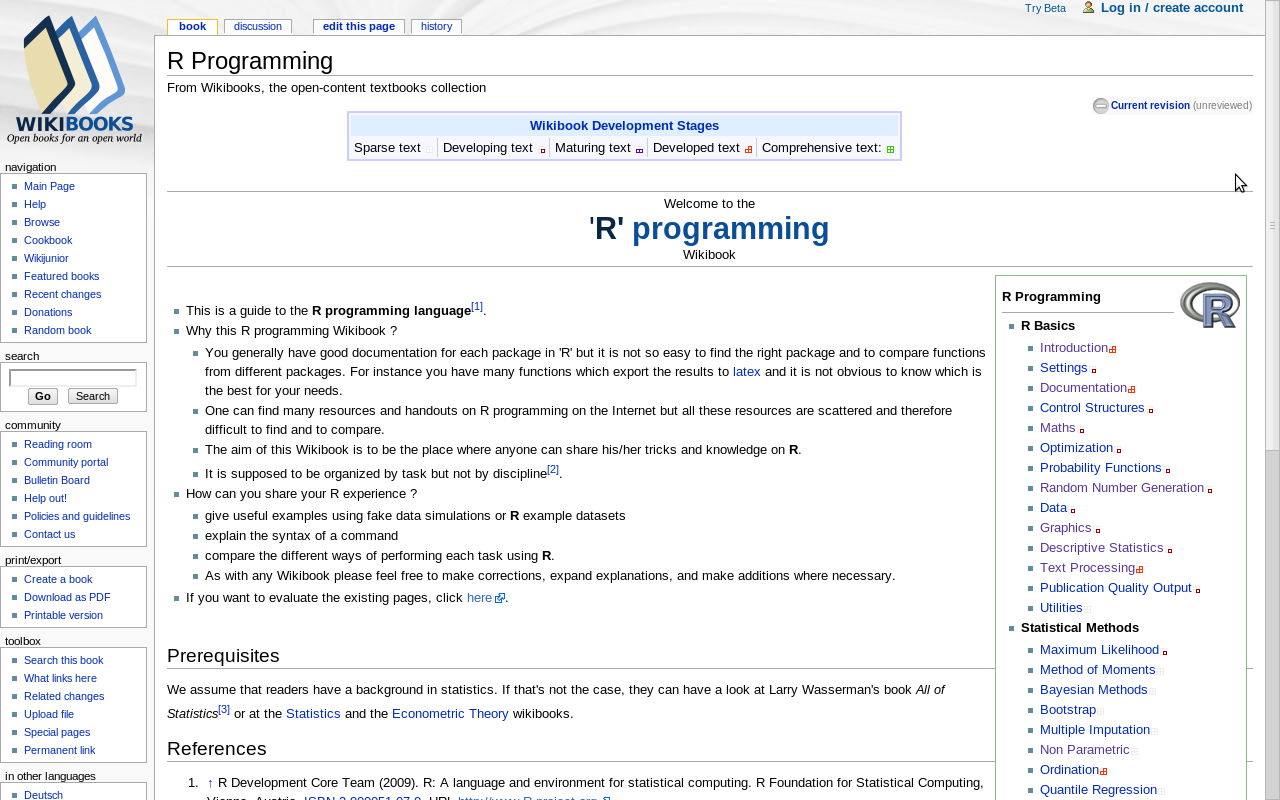
I came across the R Programming Wikibook at http://en.wikibooks.org/wiki/R_Programming

It is quite surprisingly good- easy to read for a beginner- handy and concise reference for intermediate users. Some chapters like clustering could do with some more support from the community -see http://en.wikibooks.org/wiki/R_Programming/Clustering

[edit]References

But I really liked the pages on Graphics, Modeling and Maths (including Matrix)

See

http://en.wikibooks.org/wiki/R_Programming/Graphics

and http://en.wikibooks.org/wiki/R_Programming/Linear_Models

I really believe that a consolidated one book online documentation can be achieved for R, only if we follow a moderated-wiki like structure. This can be of a great use- since online help documents for R are currently not concise or present a seemingly professional look (due to multiple formats and styles to the documentation) and they rarely do multiple package comparison. All this has made R books the top selling books on statistics on Amazon but a project like R deserves atleast one comprehensive online and concise book which can be used readily without going through all the scattered multiple documentation- a bit like a R Online Doc.This could help in stage next of the project in getting more users to be comfortable with it.

Any volunteers 🙂 ?

Ning and Wordframe

If you have ever been invited to a Ning.com community , or been part of an e-group ,or been member of a LinkedIn Group of Facebook Group – you would know what online communities are all about. Here is a relatively new entrant than Ning.com (http://en.wikipedia.org/wiki/Ning) and it is called Wordframe

The plus points of Wordframe –

(Screenshot –Wordframe.com)

  • It has much better ,updated skins than Ning http://wordframe.com/product/community/skins/
  • It is much better ,well suited for creating content
  • It can use existing RSS feeds , and almost create a seamless focused community out in 5 minutes flat.
  • It can potentially be used within organizations in intranet installations as well for in house content management and corporate blogging.
  • It is soon going to be open source and give APIs away for third party development as well.

Ning.com is having many more users, and is quite good in flexibility in terms of Questions and Answers, Forums, Groups, Friend  Creation . It’s design is okay- some of the skins could do with a Web 2.0 makeover. Above all it is free.


They are actually aimed at different segments ( I hope !!) so while Ning encourages focused social networking , Wordframe is more on focused blog /content heavy networking. One of the best Ning sites I have seen is www.analyticbrdige.com and one of the best Wordframe sites I have seen is www.smartdatacollective.com ( for Data related people ) and www.socialmediatoday.com ( for Online Media related people).

image (Screenshot- Ning.com)

So do you have a blog – join one or both these communities , share your RSS feed and watch you visibility and viewership go up.

You are an occasional blogger and would rather read instead- join one or both these communities (that gives you commenting freedom), read other feeds and watch you understanding and knowledge go up.


Disclaimer- I have been Blogger of the Week on Social Media Today, and Member of the Month on Analytic Bridge (see the right sidebar on www.decisionstats.com ). In addition I have acted as a consultant and vendor for both of them in various parts of time and am acquainted to both the founders.

Ajay -Do I think there is value in joining them – Yes ! It has given me more knowledge and perspective than I could ever hope to get working on my own sitting in suburban Delhi, India.

As a Hindi saying ( apt on online networking would go)- 1 and 1 make 11. That in summary is the power of offline and online networking and Ning and Wordframe help you do that.