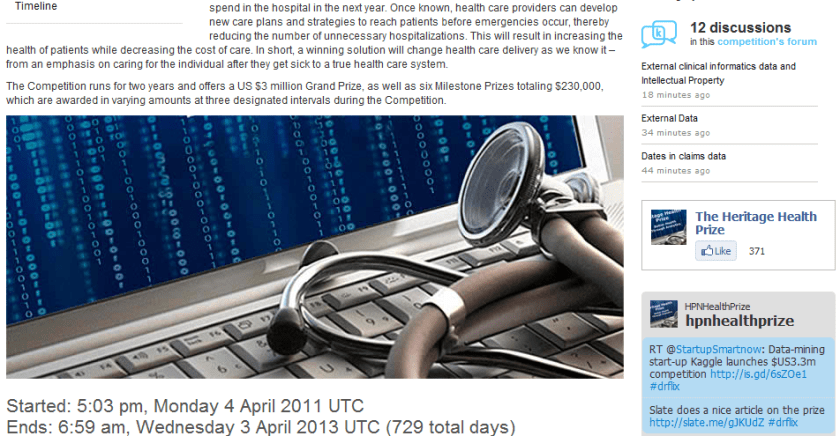
Heritage prize= 3mill now open

I am still angry with THE netflix for 1 mill I lost out. No sweat! this time the money is 3 times as much, it is legit, and yes baby you can change the world, make it a better place and get rich.! see details below-http://www.heritagehealthprize.com/c/hhp/Data

HERITAGE HEALTH PRIZE DATA FILES

You must accept this competition’s rules before you’ll be able to download data files.

IMPORTANT NOTE: The information provided below is intended only to provide general guidance to participants in the Heritage Health Prize Competition and is subject to the Competition Official Rules. Any capitalized term not defined below is defined in the Competition Official Rules. Please consult the Competition Official Rules for complete details.

Heritage Provider Network is providing Competition Entrants with deidentified member data collected during a forty-eight month period that is allocated among three data sets (the “Data Sets”). Competition Entrants will use the Data Sets to develop and test their algorithms for accurately predicting the number of days that the members will spend in a hospital (inpatient or emergency room visit) during the 12-month period following the Data Set cut-off date.

HHP_release2.zip contains the latest files, so you can ignore HHP_release1.zip. SampleEntry.CSV shows you how an entry should look.

Data Sets will be released to Entrants after registration on the Website according to the following schedule:

April 4, 2011 Claims Table – Y1 and DaysInHospital Table – Y2

May 4, 2011

All other Data Sets except Labs Table and Rx Table

From https://www.kaggle.com/
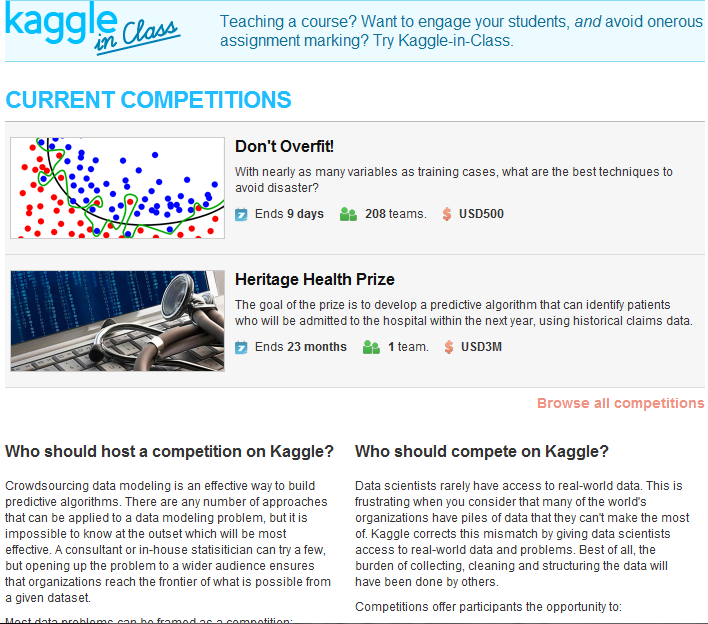
The $3 million Heritage Health Prize opens to entries

It’s been one month since the launch of the Heritage Health Prize. The prize has attracted some great publicity, receiving coverage from the Wall Street JournalThe EconomistSlate andForbes.

By now, people have had a good chance to poke around the first portion of the data. Now the fun starts! HPN have released two more years’-worth of data, set the accuracy threshold and are opening up the competition to entries. The data are available from the Heritage Health Prize page. Good luck to all participants!

The Deloitte/FIDE Chess Ratings Competition results

The Deloitte/FIDE Chess Ratings Competition attracted one of the strongest fields ever seen in a Kaggle Competition. The competition attracted 189 teams, ranging from chess ratings  experts to Netflix Prize winners. As Jeff Sonas wrote on the Kaggle blog last week, the  competition has far exceeded his expectations. A big congratulations the provisional winner, Tim Salimans, an econometrician at Erasmus University in Rotterdam. We look forward to reading about the approaches used by top performers on the Kaggle blog. We also look forward to the results of the FIDE prize, which could see the introduction of a new chess ratings system.

ICDAR 2011 Competition Results

The ICDAR 2011 competition also finished recently. The competiiton required participants to develop an algorithm that correctly matched handwriting samples. The winners were Lewis Griffin and Andrew Newell from the University College London who achieved Kaggle’s first ever perfect score by managing to match every sample correctly! Andrew and Lewis have posted a description of their winning method on the Kaggle blog.

Revolution R Enterprise

Since R is the most popular language used by Kaggle members, the Revolution Analytics team is making Revolution R Enterprise (the pre-eminent commercial version of R) available free of charge to Kaggle members. Revolution R Enterprise has several advantages over standard R, including the ability to seemlessly handle larger datasets. To get your free copy, visit http://info.revolutionanalytics.com/Kaggle.html.
Kaggle-in-Class

As many of you know, Kaggle offers a free platform, Kaggle-in-Class, for instructors who want to host competitions for their students. For those interested in hearing more about the use of Kaggle-in-Class as a teaching tool, Susan Holmes and Nelson Ray from Stanford University share their experience in a webinar organized by the Consortium for the Advancement of Undergraduate Statistics Education.

New book on BigData Analytics and Data mining using #Rstats with a GUI

Joseph Marie Jacquard
Image via Wikipedia

I am hoping to put this on my pre-ordered or Amazon Wish list. The book the common people who wanted to do data mining with , but were unable to ask aloud they didnt know much.  It is written by the seminal Australian authority on data mining Dr Graham Williams whom I interviewed here at https://decisionstats.com/2009/01/13/interview-dr-graham-williams/

Data Mining for the masses using an ergonomically designed Graphical User Interface.

Thank you Springer. Thank you Dr Graham Williams

http://www.springer.com/statistics/physical+%26+information+science/book/978-1-4419-9889-7

Data Mining with Rattle and R

Data Mining with Rattle and R

The Art of Excavating Data for Knowledge Discovery

Series: Use R

Williams, Graham

1st Edition., 2011, XX, 409 p. 150 illus. in color.

  • Softcover, ISBN 978-1-4419-9889-7

    Due: August 29, 2011

    54,95 €
  • Encourages the concept of programming with data – more than just pushing data through tools, but learning to live and breathe the data
  • Accessible to many readers and not necessarily just those with strong backgrounds in computer science or statistics
  • Details some of the more popular algorithms for data mining, as well as covering model evaluation and model deployment

Data mining is the art and science of intelligent data analysis. By building knowledge from information, data mining adds considerable value to the ever increasing stores of electronic data that abound today. In performing data mining many decisions need to be made regarding the choice of methodology, the choice of data, the choice of tools, and the choice of algorithms.

Throughout this book the reader is introduced to the basic concepts and some of the more popular algorithms of data mining. With a focus on the hands-on end-to-end process for data mining, Williams guides the reader through various capabilities of the easy to use, free, and open source Rattle Data Mining Software built on the sophisticated R Statistical Software. The focus on doing data mining rather than just reading about data mining is refreshing.

The book covers data understanding, data preparation, data refinement, model building, model evaluation,  and practical deployment. The reader will learn to rapidly deliver a data mining project using software easily installed for free from the Internet. Coupling Rattle with R delivers a very sophisticated data mining environment with all the power, and more, of the many commercial offerings.

Content Level » Research

Keywords » Data mining

Related subjects » Physical & Information Science

Related- https://decisionstats.com/2009/01/13/interview-dr-graham-williams/

High Performance Analytics

Marry Big Data Analytics to High Performance Computing, and you get the buzzword of this season- High Performance Analytics.

It basically consists of Parallelized code to run in parallel on custom hardware, in -database analytics for speed, and cloud computing /high performance computing environments. On an operational level, it consists of software (as in analytics) partnering with software (as in databases, Map reduce, Hadoop) plus some hardware (HP or IBM mostly). It is considered a high margin , highly profitable, business with small number of deals compared to say desktop licenses.

As per HPC Wire- which is a great tool/newsletter to keep updated on HPC , SAS Institute has been busy on this front partnering with EMC Greenplum and TeraData (who also acquired  SAS Partner AsterData to gain a much needed foot in the MR/SQL space) Continue reading “High Performance Analytics”

Augustus- a PMML model producer and consumer. Scoring engine.

A Bold GNU Head
Image via Wikipedia

I just checked out this new software for making PMML models. It is called Augustus and is created by the Open Data Group (http://opendatagroup.com/) , which is headed by Robert Grossman, who was the first proponent of using R on Amazon Ec2.

Probably someone like Zementis ( http://adapasupport.zementis.com/ ) can use this to further test , enhance or benchmark on the Ec2. They did have a joint webinar with Revolution Analytics recently.

https://code.google.com/p/augustus/

Recent News

  • Augustus v 0.4.3.1 has been released
  • Added a guide (pdf) for including Augustus in the Windows System Properties.
  • Updated the install documentation.
  • Augustus 2010.II (Summer) release is available. This is v 0.4.2.0. More information is here.
  • Added performance discussion concerning the optional cyclic garbage collection.

See Recent News for more details and all recent news.

Augustus

Augustus is a PMML 4-compliant scoring engine that works with segmented models. Augustus is designed for use with statistical and data mining models. The new release provides Baseline, Tree and Naive-Bayes producers and consumers.

There is also a version for use with PMML 3 models. It is able to produce and consume models with 10,000s of segments and conforms to a PMML draft RFC for segmented models and ensembles of models. It supports Baseline, Regression, Tree and Naive-Bayes.

Augustus is written in Python and is freely available under the GNU General Public License, version 2.

See the page Which version is right for me for more details regarding the different versions.

PMML

Predictive Model Markup Language (PMML) is an XML mark up language to describe statistical and data mining models. PMML describes the inputs to data mining models, the transformations used to prepare data for data mining, and the parameters which define the models themselves. It is used for a wide variety of applications, including applications in finance, e-business, direct marketing, manufacturing, and defense. PMML is often used so that systems which create statistical and data mining models (“PMML Producers”) can easily inter-operate with systems which deploy PMML models for scoring or other operational purposes (“PMML Consumers”).

Change Detection using Augustus

For information regarding using Augustus with Change Detection and Health and Status Monitoring, please see change-detection.

Open Data

Open Data Group provides management consulting services, outsourced analytical services, analytic staffing, and expert witnesses broadly related to data and analytics. It has experience with customer data, supplier data, financial and trading data, and data from internal business processes.

It has staff in Chicago and San Francisco and clients throughout the U.S. Open Data Group began operations in 2002.


Overview

The above example contains plots generated in R of scoring results from Augustus. Each point on the graph represents a use of the scoring engine and a chart is an aggregation of multiple Augustus runs. A Baseline (Change Detection) model was used to score data with multiple segments.

Typical Use

Augustus is typically used to construct models and score data with models. Augustus includes a dedicated application for creating, or producing, predictive models rendered as PMML-compliant files. Scoring is accomplished by consuming PMML-compliant files describing an appropriate model. Augustus provides a dedicated application for scoring data with four classes of models, Baseline (Change Detection) ModelsTree ModelsRegression Models and Naive Bayes Models. The typical model development and use cycle with Augustus is as follows:

  1. Identify suitable data with which to construct a new model.
  2. Provide a model schema which proscribes the requirements for the model.
  3. Run the Augustus producer to obtain a new model.
  4. Run the Augustus consumer on new data to effect scoring.

Separate consumer and producer applications are supplied for Baseline (Change Detection) models, Tree models, Regression models and for Naive Bayes models. The producer and consumer applications require configuration with XML-formatted files. The specification of the configuration files and model schema are detailed below. The consumers provide for some configurability of the output but users will often provide additional post-processing to render the output according to their needs. A variety of mechanisms exist for transmitting data but user’s may need to provide their own preprocessing to accommodate their particular data source.

In addition to the producer and consumer applications, Augustus is conceptually structured and provided with libraries which are relevant to the development and use of Predictive Models. Broadly speaking, these consist of components that address the use of PMML and components that are specific to Augustus.

Post Processing

Augustus can accommodate a post-processing step. While not necessary, it is often useful to

  • Re-normalize the scoring results or performing an additional transformation.
  • Supplements the results with global meta-data such as timestamps.
  • Formatting of the results.
  • Select certain interesting values from the results.
  • Restructure the data for use with other applications.

PMML Plugin for Greenplum now available

Predictive Model Markup Language
Image via Wikipedia

From a press release from Zementis.


, the Universal PMML Plug-in for in-database scoring. Available now for the EMC Greenplum Database, a high-performance massively parallel processing (MPP) database, the plug-in leverages the Predictive Model Markup Language (PMML) to execute predictive models directly within EMC Greenplum, for highly optimized in-database scoring.

Universal PMML Plug-in

Developed by the Data Mining Group (DMG), PMML is supported by all major data mining vendors, e.g., IBM SPSS, SAS, Teradata, FICO, STASTICA, Microstrategy, TIBCO and Revolution Analytics as well as open source tools like R, KNIME and RapidMiner. With PMML, models built in any of these data mining tools can now instantly be deployed in the EMC Greenplum database. The net result is the ability to leverage the power of standards-based predictive analytics on a massive scale, right where the data resides.

“By partnering with Zementis, a true PMML innovator, we are able to offer a vendor-agnostic solution for moving enterprise-level predictive analytics into the database execution environment,” said Dr. Steven Hillion, Vice President of Analytics at EMC Greenplum. “With Zementis and PMML, the de-facto standard for representing data mining models, we are eliminating the need to recode predictive analytic models in order to deploy them within our database. In turn, this enables an analyst to reduce the time to insight required in most businesses today.”

Want to learn more?
 

To learn more about how the EMC Greenplum Database and the Universal PMML Plug-in work together, feel free to:

  1. Visit the PMML Plug-in product page
  2. Download the white paper

The Universal PMML Plug-in for the EMC Greenplum Database is available now. Contact us today for more information.

Michael Zeller, CEO, Zementis


KDNuggets Survey on R

CRISP-DM
Image via Wikipedia

From http://www.kdnuggets.com/2011/03/new-poll-r-in-analytics-data-mining-work.html?k11n07

A new poll/survey on actual usage of R in Data Mining

R has been steadily growing in popularity among data miners and analytic professionals.

In KDnuggets 2010 Data Mining / Analytic Tools Poll, R was used by 30% of respondents.
In 2010 Rexer Analytics Data Miner SurveyR was the most popular tool, used by 43% of the data miners.

Another aspect of tool usefulness is how much does it help with the entire data mining process from data preparation and cleaning, modeling, evaluation, visualization and presentation (excluding deployment).

New KDnuggets Poll is asking:
What part of your analytics / data mining work in the past 12 months was done in R?

http://www.kdnuggets.com/2011/03/new-poll-r-in-analytics-data-mining-work.html?k11n07