Sector/ Sphere – Faster than Hadoop/Mapreduce at Terasort

Here is a preview of a relatively young software Sector and Sphere- which are claimed to be better than Hadoop /MapReduce at TeraSort Benchmark among others.

http://sector.sourceforge.net/tech.html

System Overview

The Sector/Sphere stack consists of the Sector distributed file system and the Sphere parallel data processing framework. The objective is to support highly effective and efficient large data storage and processing over commodity computer clusters.

Sector/Sphere Architecture

Sector consists of 4 parts, as shown in the above diagram. The Security server maintains the system security configurations such as user accounts, data IO permissions, and IP access control lists. The master servers maintain file system metadata, schedule jobs, and respond users’ requests. Sector supports multiple active masters that can join and leave at run time and they all actively respond users’ requests. The slave nodes are racks of computers that store and process data. The slaves nodes can be located within a single data center to across multiple data centers with high speed network connections. Finally, the client includes tools and programming APIs to access and process Sector data.

Sphere: Parallel Data Processing Framework

Sphere allows developers to write parallel data processing applications with a very simple set of API. It applies user-defined functions (UDF) on all input data segments in parallel. In a Sphere application, both inputs and outputs are Sector files. Multiple Sphere processing can be combined to support more complicated applications, with inputs/outputs exchanged/shared via the Sector file system.

Data segments are processed at their storage locations whenever possible (data locality). Failed data segments may be restarted on other nodes to achieve fault tolerance.

The Sphere framework can be compared to MapReduce as they both enforce data locality and provide simplified programming interfaces. In fact, Sphere can simulate any MapReduce operations, but Sphere is more efficient and flexible. Sphere can provide better data locality for applications that process files or multiple files as minimum input units and for applications that involve with iterative/combinative processing, which requires coordination of multiple UDFs to obtain the final result.

A Sphere application includes two parts: the client program that organizes inputs (including certain parameters), outputs, and UDFs; and the UDFs that process data segments. Data segmentation, load balancing, and fault tolerance are transparent to developers.

Space: Column-based Distbuted Data Table

Space stores data tables in Sector and uses Sphere for parallel query processing. Space is similar to BigTable. Table is stored by columns and is segmented on to multiple slave nodes. Tables are independent and no relationship between tables are supported. A reduced set of SQL operations is supported, including but not limited to table creation and modification, key-value update and lookup, and select operations based on UDF.

Supported by the Sector data placement mechanism and the Sphere parallel processing framework, Space can support efficient key-value lookup and certain SQL queries on very large data tables.

Space is currently still in development.

and just when you thought Hadoop was the only way to be on the cloud.

http://sector.sourceforge.net/benchmark.html

The Terasort Benchmark

The table below lists the performance (total processing time in seconds) of the Terasort benchmark of both Sphere and Hadoop. (Terasort benchmark: suppose there are N nodes in the system, the benchmark generates a 10GB file on each node and sorts the total N*10GB data. Data generation time is excluded.) Note that it is normal to see a longer processing time for more nodes because the total amount of data also increases proportionally.

The performance value listed in this page was achieved using the Open Cloud Testbed. Currently the testbed consists of 4 racks. Each rack has 32 nodes, including 1 NFS server, 1 head node, and 30 compute/slave nodes. The head node is a Dell 1950, dual dual-core Xeon 3.0GHz, 16GB RAM. The compute nodes are Dell 1435s, single dual core AMD Opteron 2.0GHz, 4GB RAM, and 1TB single disk. The 4 racks are located in JHU (Baltimore), StarLight (Chicago), UIC (Chicago), and Calit2(San Diego). The inter-rack bandwidth is 10GE, supported by CiscoWave deployed over National Lambda Rail.

Sphere
Hadoop (3 replicas)
Hadoop (1 replica)
UIC
1265 2889 2252
UIC + StarLight
1361 2896 2617
UIC + StarLight + Calit2
1430 4341 3069
UIC + StarLight + Calit2 + JHU
1526 6675 3702

The benchmark uses the testfs/testdc examples of Sphere and randomwriter/sort examples of Hadoop. Hadoop parameters were tuned to reach good results.

Updated on Sep. 22, 2009: We have benchmarked the most recent versions of Sector/Sphere (1.24a) and Hadoop (0.20.1) on a new set of servers. Each server node costs $2,200 and consits of a single Intel Xeon E5410 2.4GHz CPU, 16GB RAM, 4*1TB RAID0 disk, and 1Gb/s NIC. The 120 nodes are hosted on 4 racks within the same data center and the inter-rack bandwidth is 20Gb/s.

The table below lists the performance of sorting 1TB data using Sector/Sphere version 1.24a and Hadoop 0.20.1. Related Hadoop parameters have been tuned for better performance (e.g., big block size), while Sector/Sphere does not require tuning. In addition, to achieve the highest performance, replication is disabled in both systems (note that replication does not afftect the performance of Sphere but will significantly decrease the performance of Hadoop).

Number of Racks
Sphere
Hadoop
1
28m 25s 85m 49s
2
15m 20s 37m 0s
3
10m 19s 25m 14s
4
7m 56s 17m 45s

Matlab-Mathematica-R and GPU Computing

Matlab announced they have a parallel computing toolbox- specially to enable GPU computing as well

http://www.mathworks.com/products/parallel-computing/

Parallel Computing Toolbox™ lets you solve computationally and data-intensive problems using multicore processors, GPUs, and computer clusters. High-level constructs—parallel for-loops, special array types, and parallelized numerical algorithms—let you parallelize MATLAB® applications without CUDA or MPI programming. You can use the toolbox with Simulink® to run multiple simulations of a model in parallel.

MATLAB GPU Support

The toolbox provides eight workers (MATLAB computational engines) to execute applications locally on a multicore desktop. Without changing the code, you can run the same application on a computer cluster or a grid computing service (using MATLAB Distributed Computing Server™). You can run parallel applications interactively or in batch.

Parallel Computing with MATLAB on Amazon Elastic Compute Cloud (EC2)

Also a video of using Mathematica and GPU

Also R has many packages for GPU computing

Parallel computing: GPUs

from http://cran.r-project.org/web/views/HighPerformanceComputing.html

  • The gputools package by Buckner provides several common data-mining algorithms which are implemented using a mixture of nVidia‘s CUDA langauge and cublas library. Given a computer with an nVidia GPU these functions may be substantially more efficient than native R routines. The rpud package provides an optimised distance metric for NVidia-based GPUs.
  • The cudaBayesreg package by da Silva implements the rhierLinearModel from the bayesm package using nVidia’s CUDA langauge and tools to provide high-performance statistical analysis of fMRI voxels.
  • The rgpu package (see below for link) aims to speed up bioinformatics analysis by using the GPU.
  • The magma package provides an interface to the hybrid GPU/CPU library Magma (see below for link).
  • The gcbd package implements a benchmarking framework for BLAS and GPUs (using gputools).

I tried to search for SAS and GPU and SPSS and GPU but got nothing. Maybe they would do well to atleast test these alternative hardwares-

Also see Matlab on GPU comparison for the product Jacket vs Parallel Computing Toolbox

http://www.accelereyes.com/products/compare

My friend -The Computer

my friend the computer

i spend more time with you
than with anything or anyone else
i could leave you behind
but you climb my lap and now have turned mobile

my fingers hurt and my eyes are red
inputting my stuff on you i go on  and on instead
this is crazy not just done
no sooner do I finish writing that
I find I have just begun

for what separates the pretenders from the rest
is the actions not their words that make them the best
so my friend my computer and me
together we create
so much work to be done while the haters hate

news to be read, blogs to be done
code to be executed, and sometimes to be undone
email lists, and online games as well,
dreaming online heaven in offline hell
Words can be sublime so much can be told
My friend my computer and me- together we grow old.

SAS/Blades/Servers/ GPU Benchmarks

Just checked out cool new series from NVidia servers.

Now though SAS Inc/ Jim Goodnight thinks HP Blade Servers are the cool thing- the GPU takes hardware high performance computing to another level. It would be interesting to see GPU based cloud computers as well – say for the on Demand SAS (free for academics and students) but which has had some complaints of being slow.

See this for SAS and Blade Servers-

http://www.sas.com/success/ncsu_analytics.html

To give users hands-on experience, the program is underpinned by a virtual computing lab (VCL), a remote access service that allows users to reserve a computer configured with a desired set of applications and operating system and then access that computer over the Internet. The lab is powered by an IBM BladeCenter infrastructure, which includes more than 500 blade servers, distributed between two locations. The assignment of the blade servers can be changed to meet shifts in the balance of demand among the various groups of users. Laura Ladrie, MSA Classroom Coordinator and Technical Support Specialist, says, “The virtual computing lab chose IBM hardware because of its quality, reliability and performance. IBM hardware is also energy efficient and lends itself well to high performance/low overhead computing.

Thats interesting since IBM now competes (as owner of SPSS) and also cooperates with SAS Institute

And

http://www.theaustralian.com.au/australian-it/the-world-according-to-jim-goodnight-blade-switch-slashes-job-times/story-e6frgakx-1225888236107

You’re effectively turbo-charging through deployment of many processors within the blade servers?

Yes. We’ve got machines with 192 blades on them. One of them has 202 or 203 blades. We’re using Hewlett-Packard blades with 12 CP cores on each, so it’s a total 2300 CPU cores doing the computation.

Our idea was to give every one of those cores a little piece of work to do, and we came up with a solution. It involved a very small change to the algorithm we were using, and it’s just incredible how fast we can do things now.

I don’t think of it as a grid, I think of it as essentially one computer. Most people will take a blade and make a grid out of it, where everything’s a separate computer running separate jobs.

We just look at it as one big machine that has memory and processors all over the place, so it’s a totally different concept.

GPU servers can be faster than CPU servers, though , Professor G.


Source-

http://www.nvidia.com/object/preconfigured_clusters.html

TESLA GPU COMPUTING SOLUTIONS FOR DATA CENTERS
Supercharge your cluster with the Tesla family of GPU computing solutions. Deploy 1U systems from NVIDIA or hybrid CPU-GPU servers from OEMs that integrate NVIDIA® Tesla™ GPU computing processors.

When compared to the latest quad-core CPU, Tesla 20-series GPU computing processors deliver equivalent performance at 1/20th the power consumption and 1/10th the cost. Each Tesla GPU features hundreds of parallel CUDA cores and is based on the revolutionary NVIDIA® CUDA™ parallel computing architecture with a rich set of developer tools (compilers, profilers, debuggers) for popular programming languages APIs like C, C++, Fortran, and driver APIs like OpenCL and DirectCompute.

NVIDIA’s partners provide turnkey easy-to-deploy Preconfigured Tesla GPU clusters that are customizable to your needs. For 3D cloud computing applications, our partners offer the Tesla RS clusters that are optimized for running RealityServer with iray.

Available Tesla Products for Data Centers:
– Tesla S2050
– Tesla M2050/M2070
– Tesla S1070
– Tesla M1060

Also I liked the hybrid GPU and CPU

And from a paper on comparing GPU and CPU using Benchmark tests on BLAS from a Debian- Dirk E’s excellent blog

http://dirk.eddelbuettel.com/blog/

Usage of accelerated BLAS libraries seems to shrouded in some mystery, judging from somewhat regularly recurring requests for help on lists such as r-sig-hpc(gmane version), the R list dedicated to High-Performance Computing. Yet it doesn’t have to be; installation can be really simple (on appropriate systems).

Another issue that I felt needed addressing was a comparison between the different alternatives available, quite possibly including GPU computing. So a few weeks ago I sat down and wrote a small package to run, collect, analyse and visualize some benchmarks. That package, called gcbd (more about the name below) is now onCRAN as of this morning. The package both facilitates the data collection for the paper it also contains (in the vignette form common among R packages) and provides code to analyse the data—which is also included as a SQLite database. All this is done in the Debian and Ubuntu context by transparently installing and removing suitable packages providing BLAS implementations: that we can fully automate data collection over several competing implementations via a single script (which is also included). Contributions of benchmark results is encouraged—that is the idea of the package.

And from his paper on the same-

Analysts are often eager to reap the maximum performance from their computing platforms.

A popular suggestion in recent years has been to consider optimised basic linear algebra subprograms (BLAS). Optimised BLAS libraries have been included with some (commercial) analysis platforms for a decade (Moler 2000), and have also been available for (at least some) Linux distributions for an equally long time (Maguire 1999). Setting BLAS up can be daunting: the R language and environment devotes a detailed discussion to the topic in its Installation and Administration manual (R Development Core Team 2010b, appendix A.3.1). Among the available BLAS implementations, several popular choices have emerged. Atlas (an acronym for Automatically Tuned Linear Algebra System) is popular as it has shown very good performance due to its automated and CPU-speci c tuning (Whaley and Dongarra 1999; Whaley and Petitet 2005). It is also licensed in such a way that it permits redistribution leading to fairly wide availability of Atlas.1 We deploy Atlas in both a single-threaded and a multi-threaded con guration. Another popular BLAS implementation is Goto BLAS which is named after its main developer, Kazushige Goto (Goto and Van De Geijn 2008). While `free to use’, its license does not permit redistribution putting the onus of con guration, compilation and installation on the end-user. Lastly, the Intel Math Kernel Library (MKL), a commercial product, also includes an optimised BLAS library. A recent addition to the tool chain of high-performance computing are graphical processing units (GPUs). Originally designed for optimised single-precision arithmetic to accelerate computing as performed by graphics cards, these devices are increasingly used in numerical analysis. Earlier criticism of insucient floating-point precision or severe performance penalties for double-precision calculation are being addressed by the newest models. Dependence on particular vendors remains a concern with NVidia’s CUDA toolkit (NVidia 2010) currently still the preferred development choice whereas the newer OpenCL standard (Khronos Group 2008) may become a more generic alternative that is independent of hardware vendors. Brodtkorb et al. (2010) provide an excellent recent survey. But what has been lacking is a comparison of the e ective performance of these alternatives. This paper works towards answering this question. By analysing performance across ve di erent BLAS implementations|as well as a GPU-based solution|we are able to provide a reasonably broad comparison.

Performance is measured as an end-user would experience it: we record computing times from launching commands in the interactive R environment (R Development Core Team 2010a) to their completion.

And

Basic Linear Algebra Subprograms (BLAS) provide an Application Programming Interface
(API) for linear algebra. For a given task such as, say, a multiplication of two conformant
matrices, an interface is described via a function declaration, in this case sgemm for single
precision and dgemm for double precision. The actual implementation becomes interchangeable
thanks to the API de nition and can be supplied by di erent approaches or algorithms. This
is one of the fundamental code design features we are using here to benchmark the di erence
in performance from di erent implementations.
A second key aspect is the di erence between static and shared linking. In static linking,
object code is taken from the underlying library and copied into the resulting executable.
This has several key implications. First, the executable becomes larger due to the copy of
the binary code. Second, it makes it marginally faster as the library code is present and
no additional look-up and subsequent redirection has to be performed. The actual amount
of this performance penalty is the subject of near-endless debate. We should also note that
this usually amounts to only a small load-time penalty combined with a function pointer
redirection|the actual computation e ort is unchanged as the actual object code is identi-
cal. Third, it makes the program more robust as fewer external dependencies are required.
However, this last point also has a downside: no changes in the underlying library will be
reected in the binary unless a new build is executed. Shared library builds, on the other
hand, result in smaller binaries that may run marginally slower|but which can make use of
di erent libraries without a rebuild.

Basic Linear Algebra Subprograms (BLAS) provide an Application Programming Interface(API) for linear algebra. For a given task such as, say, a multiplication of two conformantmatrices, an interface is described via a function declaration, in this case sgemm for singleprecision and dgemm for double precision. The actual implementation becomes interchangeablethanks to the API de nition and can be supplied by di erent approaches or algorithms. Thisis one of the fundamental code design features we are using here to benchmark the di erencein performance from di erent implementations.A second key aspect is the di erence between static and shared linking. In static linking,object code is taken from the underlying library and copied into the resulting executable.This has several key implications. First, the executable becomes larger due to the copy ofthe binary code. Second, it makes it marginally faster as the library code is present andno additional look-up and subsequent redirection has to be performed. The actual amountof this performance penalty is the subject of near-endless debate. We should also note thatthis usually amounts to only a small load-time penalty combined with a function pointerredirection|the actual computation e ort is unchanged as the actual object code is identi-cal. Third, it makes the program more robust as fewer external dependencies are required.However, this last point also has a downside: no changes in the underlying library will bereected in the binary unless a new build is executed. Shared library builds, on the otherhand, result in smaller binaries that may run marginally slower|but which can make use ofdi erent libraries without a rebuild.

And summing up,

reference BLAS to be dominated in all cases. Single-threaded Atlas BLAS improves on the reference BLAS but loses to multi-threaded BLAS. For multi-threaded BLAS we nd the Goto BLAS dominate the Intel MKL, with a single exception of the QR decomposition on the xeon-based system which may reveal an error. The development version of Atlas, when compiled in multi-threaded mode is competitive with both Goto BLAS and the MKL. GPU computing is found to be compelling only for very large matrix sizes. Our benchmarking framework in the gcbd package can be employed by others through the R packaging system which could lead to a wider set of benchmark results. These results could be helpful for next-generation systems which may need to make heuristic choices about when to compute on the CPU and when to compute on the GPU.

Source – DirkE’paper and blog http://dirk.eddelbuettel.com/papers/gcbd.pdf

Quite appropriately-,

Hardware solutions or atleast need to be a part of Revolution Analytic’s thinking as well. SPSS does not have any choice anymore though 😉

It would be interesting to see how the new SAS Cloud Computing/ Server Farm/ Time Sharing facility is benchmarking CPU and GPU for SAS analytics performance – if being done already it would be nice to see a SUGI paper on the same at http://sascommunity.org.

Multi threading needs to be taken care automatically by statistical software to optimize current local computing (including for New R)

Acceptable benchmarks for testing hardware as well as software need to be reinforced and published across vendors, academics  and companies.

What do you think?


KXEN Update

Update from a very good data mining software company, KXEN –

  1. Longtime Chairman and founder Roger Haddad is retiring but would be a Board Member. See his interview with Decisionstats here https://decisionstats.wordpress.com/2009/01/05/interview-roger-haddad-founder-of-kxen-automated-modeling-software/ (note images were hidden due to migration from .com to .wordpress.com )
  2. New Members of Leadership are as-
John Ball, CEOJohn Ball
Chief Executive Officer

John Ball brings 20 years of experience in enterprise software, deep expertise in business intelligence and CRM applications, and a proven track record of success driving rapid growth at highly innovative companies.

Prior to joining KXEN, Mr. Ball served in several executive roles at salesforce.com, the leading provider of SaaS applications. Most recently, John served as VP & General Manager, Analytics and Reporting Products, where he spearheaded salesforce.com’s foray into CRM analytics and business intelligence. John also served as VP & General Manager, Service and Support Applications at salesforce.com, where he successfully grew the business to become the second largest and fastest growing product line at salesforce.com. Before salesforce.com, Ball was founder and CEO of Netonomy, the leading provider of customer self-service solutions for the telecommunications industry. Ball also held a number of executive roles at Business Objects, including General Manager, Web Products, where delivered to market the first 3 versions of WebIntelligence. Ball has a master’s degree in electrical engineering from Georgia Tech and a master’s degree in electric

I hope John atleast helps build a KXEN Force.com application- there are only 2 data mining apps there on App Exchange. Also on the wish list  more social media presence, a Web SaaS/Amazon API for KXEN, greater presence in American/Asian conferences, and a solution for SME’s (which cannot afford the premium pricing of the flagship solution. An alliance with bigger BI vendors like Oracle, SAP or IBM  for selling the great social network analysis.

Bill Russell as Non Executive Chairman-

Bill Russell as Non-executive Chairman of the Board, effective July 16 2010. Russell has 30 years of operational experience in enterprise software, with a special focus on business intelligence, analytics, and databases.Russell held a number of senior-level positions in his more than 20 years at Hewlett-Packard, including Vice President and General Manager of the multi-billion dollar Enterprise Systems Group. He has served as Non-executive Chairman of the Board for Sylantro Systems Corporation, webMethods Inc., and Network Physics, Inc. and has served as a board director for Cognos Inc. In addition to KXEN, Russell currently serves on the boards of Saba, PROS Holdings Inc., Global 360, ParAccel Inc., and B.T. Mancini Company.

Xavier Haffreingue as senior vice president, worldwide professional services and solutions.
He has almost 20 years of international enterprise software experience gained in the CRM, BI, Web and database sectors. Haffreingue joins KXEN from software provider Axway where he was VP global support operations. Prior to Axway, he held various leadership roles in the software industry, including VP self service solutions at Comverse Technologies and VP professional services and support at Netonomy, where he successfully delivered multi-million dollar projects across Europe, Asia-Pacific and Africa. Before that he was with Business Objects and Sybase, where he ran support and services in southern Europe managing over 2,500 customers in more than 20 countries.

David Guercio  as senior vice president, Americas field operations. Guercio brings to the role more than 25 years experience of building and managing high-achieving sales teams in the data mining, business intelligence and CRM markets. Guercio comes to KXEN from product lifecycle management vendor Centric Software, where he was EVP sales and client services. Prior to Centric, he was SVP worldwide sales and client services at Inxight Software, where he was also Chairman and CEO of the company’s Federal Systems Group, a subsidiary of Inxight that saw success in the US Federal Government intelligence market. The success in sales growth and penetration into the federal government led to the acquisition of Inxight by Business Objects in 2007, where Guercio then led the Inxight sales organization until Business Objects was acquired by SAP. Guercio was also a key member of the management team and a co-founder at Neovista, an early pioneer in data mining and predictive analytics. Additionally, he held the positions of director of sales and VP of professional services at Metaphor Computer Systems, one of the first data extraction solutions companies, which was acquired by IBM. During his career, Guercio also held executive positions at Resonate and SiGen.

3) Venture Capital funding to fund expansion-

It has closed $8 million in series D funding to further accelerate its growth and international expansion. The round was led by NextStage and included participation from existing investors XAnge Capital, Sofinnova Ventures, Saints Capital and Motorola Ventures.

This was done after John Ball had joined as CEO.

4) Continued kudos from analysts and customers for it’s technical excellence.

KXEN was named a leader in predictive analytics and data mining by Forrester Research (1) and was rated highest for commercial deployments of social network analytics by Frost & Sullivan (2)

Also it became an alliance partner of Accenture- which is also a prominent SAS partner as well.

In Database Optimization-

In KXEN V5.1, a new data manipulation module (ADM) is provided in conjunction with scoring to optimize database workloads and provide full in-database model deployment. Some leading data mining vendors are only now beginning to offer this kind of functionality, and then with only one or two selected databases, giving KXEN a more than five-year head start. Some other vendors are only offering generic SQL generation, not optimized for each database, and do not provide the wealth of possible outputs for their scoring equations: For example, real operational applications require not only to generate scores, but decision probabilities, error bars, individual input contributions – used to derive reasons of decision and more, which are available in KXEN in-database scoring modules.

Since 2005, KXEN has leveraged databases as the data manipulation engine for analytical dataset generation. In 2008, the ADM (Analytical Data Management) module delivered a major enhancement by providing a very easy to use data manipulation environment with unmatched productivity and efficiency. ADM works as a generator of optimized database-specific SQL code and comes with an integrated layer for the management of meta-data for analytics.

KXEN Modeling Factory- (similar to SAS’s recent product Rapid Predictive Modeler http://www.sas.com/resources/product-brief/rapid-predictive-modeler-brief.pdf and http://jtonedm.com/2010/09/02/first-look-rapid-predictive-modeler/)

KXEN Modeling Factory (KMF) has been designed to automate the development and maintenance of predictive analytics-intensive systems, especially systems that include large numbers of models, vast amounts of data or require frequent model refreshes. Information about each project and model is monitored and disseminated to ensure complete management and oversight and to facilitate continual improvement in business performance.

Main Functions

Schedule: creation of the Analytic Data Set (ADS), setup of how and when to score, setup of when and how to perform model retraining and refreshes …

Report
: Monitormodel execution over time, Track changes in model quality over time, see how useful one variable is by considering its multiple instance in models …

Notification
: Rather than having to wade through pages of event logs, KMF Department allows users to manage by exception through notifications.

Other products from KXEN have been covered here before https://decisionstats.wordpress.com/tag/kxen/ , including Structural Risk Minimization- https://decisionstats.wordpress.com/2009/04/27/kxen-automated-regression-modeling/

Thats all for the KXEN update- all the best to the new management team and a splendid job done by Roger Haddad in creating what is France and Europe’s best known data mining company.

Note- Source – http://www.kxen.com


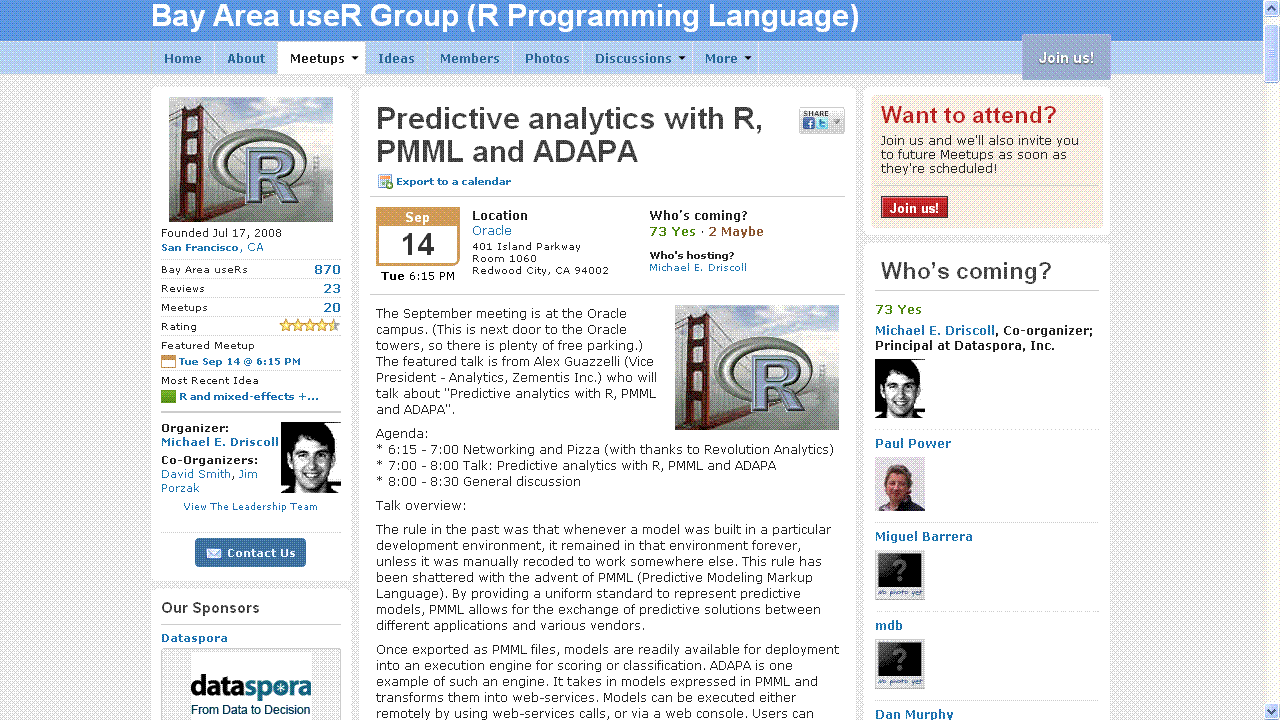
Event: Predictive analytics with R, PMML and ADAPA

From http://www.meetup.com/R-Users/calendar/14405407/

The September meeting is at the Oracle campus. (This is next door to the Oracle towers, so there is plenty of free parking.) The featured talk is from Alex Guazzelli (Vice President – Analytics, Zementis Inc.) who will talk about “Predictive analytics with R, PMML and ADAPA”.

Agenda:
* 6:15 – 7:00 Networking and Pizza (with thanks to Revolution Analytics)
* 7:00 – 8:00 Talk: Predictive analytics with R, PMML and ADAPA
* 8:00 – 8:30 General discussion

Talk overview:

The rule in the past was that whenever a model was built in a particular development environment, it remained in that environment forever, unless it was manually recoded to work somewhere else. This rule has been shattered with the advent of PMML (Predictive Modeling Markup Language). By providing a uniform standard to represent predictive models, PMML allows for the exchange of predictive solutions between different applications and various vendors.

Once exported as PMML files, models are readily available for deployment into an execution engine for scoring or classification. ADAPA is one example of such an engine. It takes in models expressed in PMML and transforms them into web-services. Models can be executed either remotely by using web-services calls, or via a web console. Users can also use an Excel add-in to score data from inside Excel using models built in R.

R models have been exported into PMML and uploaded in ADAPA for many different purposes. Use cases where clients have used the flexibility of R to develop and the PMML standard combined with ADAPA to deploy range from financial applications (e.g., risk, compliance, fraud) to energy applications for the smart grid. The ability to easily transition solutions developed in R to the operational IT production environment helps eliminate the traditional limitations of R, e.g. performance for high volume or real-time transactional systems and memory constraints associated with large data sets.

Speaker Bio:

Dr. Alex Guazzelli has co-authored the first book on PMML, the Predictive Model Markup Language which is the de facto standard used to represent predictive models. The book, entitled PMML in Action: Unleashing the Power of Open Standards for Data Mining and Predictive Analytics, is available on Amazon.com. As the Vice President of Analytics at Zementis, Inc., Dr. Guazzelli is responsible for developing core technology and analytical solutions under ADAPA, a PMML-based predictive decisioning platform that combines predictive analytics and business rules. ADAPA is the first system of its kind to be offered as a service on the cloud.
Prior to joining Zementis, Dr. Guazzelli was involved in not only building but also deploying predictive solutions for large financial and telecommunication institutions around the globe. In academia, Dr. Guazzelli worked with data mining, neural networks, expert systems and brain theory. His work in brain theory and computational neuroscience has appeared in many peer reviewed publications. At Zementis, Dr. Guazzelli and his team have been involved in a myriad of modeling projects for financial, health-care, gaming, chemical, and manufacturing industries.

Dr. Guazzelli holds a Ph.D. in Computer Science from the University of Southern California and a M.S and B.S. in Computer Science from the Federal University of Rio Grande do Sul, Brazil.